

The Southern Nevada Water Authority will pay you to replace a lawn with desert landscaping, and the check is real money. What fewer homeowners read is the second half of the deal. Before the payment arrives, you sign a conservation easement that is recorded against your parcel and binds every owner who comes after you.
This guide covers both halves for a single-family home in the Las Vegas Valley: what the rebate pays by water provider, what the yard must look like at inspection, how the deadlines work, what the easement says, and what it means when the house is sold. HOA boards converting common areas work under different rates and a state deadline, which are covered in our guide to the nonfunctional turf ban and the HOA deadline.
SNWA's Water Smart Landscapes rebate pays single-family owners $5 per square foot for the first 10,000 square feet of grass replaced with desert landscaping, then $2.50 (terms read October 23, 2026). Las Vegas Valley Water District customers get $2 more per foot; Henderson adds up to $575. A 1,000-square-foot lawn pays $5,000 to $7,000. Get approval before removing any grass, and expect to sign a recorded easement that permanently bars irrigated grass, spray irrigation and pools there.
- SNWA pays $5 per square foot up to 10,000 square feet; LVVWD customers collect $7 combined.
- Removing grass before SNWA's pre-conversion site visit makes the whole project ineligible, so apply first and wait.
- Converted areas need 50 percent plant cover at maturity, drip-only irrigation and permeable mulch at final inspection.
- The recorded easement runs with the land and bars grass, spray irrigation and pools in converted areas.
- Buyers should check disclosure item 14, the title commitment and the easement map before planning a pool.
Published October 23, 2026. Rebate rates, program conditions, water rates and watering rules were read on the Southern Nevada Water Authority, Las Vegas Valley Water District, City of Henderson and City of North Las Vegas websites on October 23, 2026. The worked examples and bill math are calculated from those published figures. The listing count is our own read of the GLVAR feed the same afternoon. No contractor priced a project for this article, and nothing here is legal or tax advice.
How Much Does the SNWA Grass Removal Rebate Pay a Single-Family Homeowner?
According to the SNWA's residential program conditions, new single-family applicants since September 18, 2025 are paid $5.00 per square foot for the first 10,000 square feet of functional turf converted, and $2.50 per square foot after that, "on a per-property, per-fiscal year (July 1 – June 30) basis." The conditions describe these as "Functional Turf conversions, as defined by the Authority," and Henderson's rebate page describes single-family yards the same way, as functional turf not subject to Assembly Bill 356. The "nonfunctional" label in Nevada's turf law applies to streetscapes, medians and other property that is not a single-family home.
Two local supplements sit on top of the SNWA rate. The same conditions say Las Vegas Valley Water District customers who submit a single-family application on or after January 1, 2025 are eligible for an additional $2 per square foot. According to the Las Vegas Valley Water District's rebates page, that brings its customers to $7 per square foot up to 10,000 square feet and $4.50 after, the extra money is funded by the district's excessive use charge on its highest residential users, and customers who applied before September 18, 2025 and still have grass must reapply to get the $7 rate.
According to the City of Henderson's rebate programs page, the city adds a flat supplement of up to $575 for single-family parcels inside city limits that convert at least 400 square feet, plus $50 for each new qualifying tree. You apply to SNWA first, the conversion must be done in a single phase within 12 months, and the city allows one conversion per calendar year. The city's tree section still mentions an older $3 rate; SNWA's own conditions control the per-foot amount.
Every new participant is also automatically eligible for SNWA's Tree Enhancement Program, which pays $100 for each new qualifying tree up to 100 percent canopy coverage of the converted area. The SNWA rebate page names only the LVVWD and Henderson as offering extra incentives, and the City of North Las Vegas conservation page points customers to the SNWA program without a city supplement.
| Who you buy water from | First 10,000 sq ft | Beyond 10,000 sq ft | Extra incentive | New qualifying tree |
|---|---|---|---|---|
| Any SNWA member agency (base rate) | $5.00 per sq ft | $2.50 per sq ft | None | $100 |
| Las Vegas Valley Water District | $7.00 per sq ft | $4.50 per sq ft | Included in the $7.00 | $100 |
| City of Henderson | $5.00 per sq ft | $2.50 per sq ft | Flat $575, 400 sq ft minimum | $150 ($100 SNWA plus $50 city) |
| City of North Las Vegas | $5.00 per sq ft | $2.50 per sq ft | None listed | $100 |
| For contrast: business, HOA, multifamily | $5.00 per sq ft | $1.50 per sq ft | Not applicable | $100 |
What Do 500, 1,000 and 2,500 Square-Foot Conversions Actually Pay?
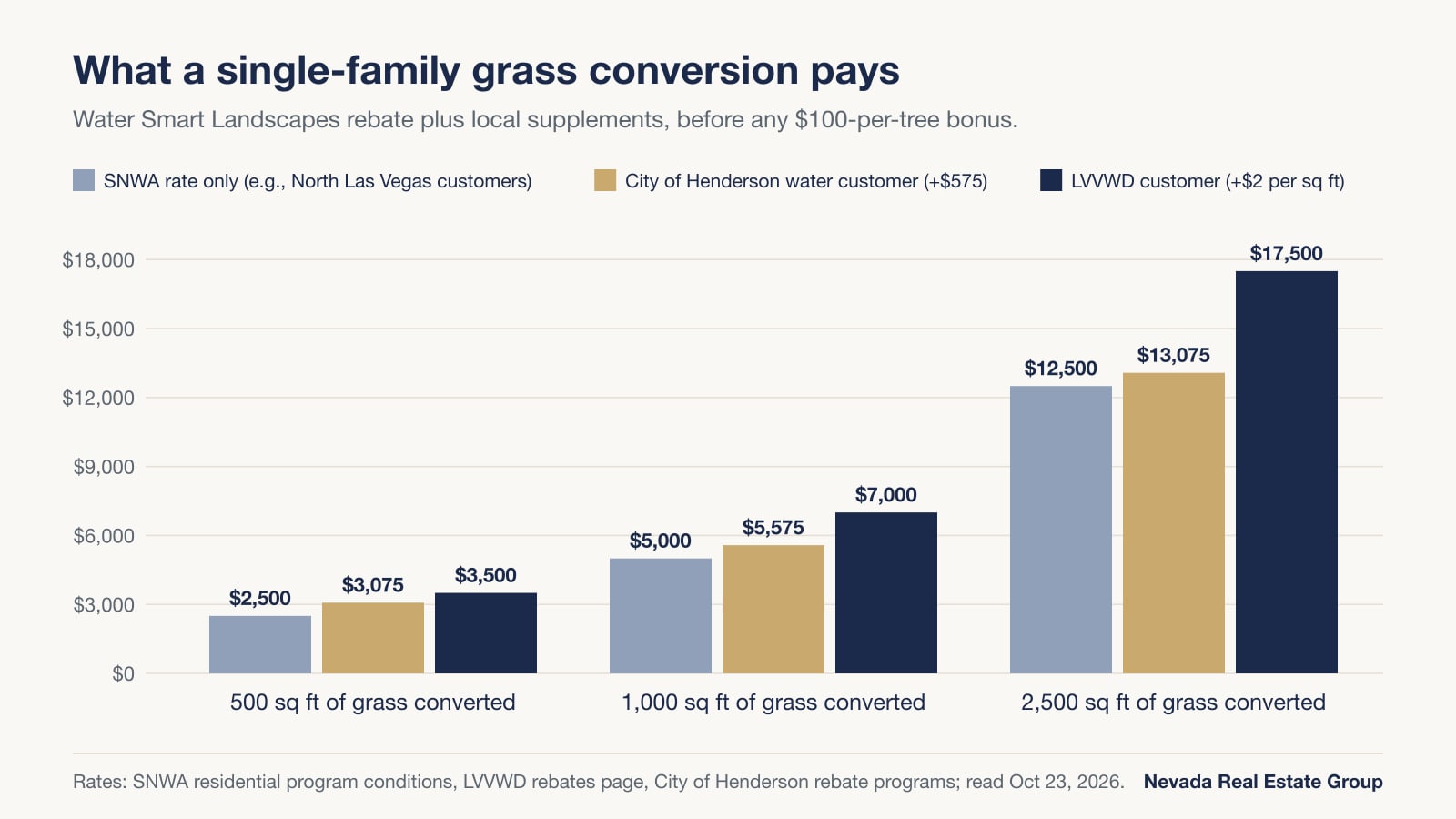
The rates are simple enough that the math is the easiest part of the decision. The table below applies them to five yard sizes, from the 400-square-foot program minimum to a 12,000-square-foot lawn on an estate lot, where the lower rate starts to apply. These are rebate amounts only. They leave out tree bonuses and say nothing about what a contractor will charge, which is covered further down.
| Grass converted | SNWA rate only (e.g., North Las Vegas) | City of Henderson customer | LVVWD customer |
|---|---|---|---|
| 400 sq ft (program minimum) | $2,000 | $2,575 | $2,800 |
| 500 sq ft | $2,500 | $3,075 | $3,500 |
| 1,000 sq ft | $5,000 | $5,575 | $7,000 |
| 2,500 sq ft | $12,500 | $13,075 | $17,500 |
| 12,000 sq ft | $55,000 | $55,575 | $79,000 |
The 12,000-square-foot row shows how the tier works. The first 10,000 square feet earn $50,000 at the base rate, and the last 2,000 earn $2.50 each, or $5,000, for $55,000. An LVVWD customer gets $70,000 plus 2,000 square feet at $4.50, or $79,000. The Henderson supplement is a flat amount, so it matters most on small yards: on 500 square feet it adds 23 percent to the check; on 2,500 square feet it adds less than 5 percent.
Trees change the numbers more than most people expect. A converted area needs living plants covering at least 50 percent of it at maturity, so a 1,000-square-foot conversion needs 500 square feet of mature canopy. Under the Tree Enhancement Program conditions, each qualifying tree must have a mature canopy value of at least 236 square feet. Two new qualifying trees therefore supply about 472 square feet of the 500 you need and add $200 to the SNWA check, or $300 in Henderson. Existing trees in the converted area are counted first, and nothing beyond 100 percent canopy earns a bonus.
Which Lawns Qualify for the Rebate, and Which Do Not?
The program pays to remove water demand that exists today, so the lawn has to be alive when SNWA looks at it. The residential conditions require "a living, maintained lawn or permanently-installed outdoor water surface which was compliant with applicable laws at the time of installation." According to the SNWA's frequently asked questions on the Water Smart Landscapes page, a homeowner who has already shut off the water and let the grass die does not qualify, because an SNWA staff member must validate the turf areas before the project starts. Replacing a thirsty grass with a lower-water grass also does not qualify; the program pays only for converting grass to trees, shrubs and groundcovers.
The account side matters too. The area must be served by an Authority water agency or a groundwater well within the Las Vegas Valley Groundwater Basin, and the water account must be in good standing. Well owners are capped: Groundwater Management Program rebates are limited to 2,500 square feet per fiscal year. At least 400 square feet must be converted, although SNWA may accept a smaller project when less than 400 square feet of lawn exists in the project area. Areas SNWA has previously ruled ineligible are not reconsidered.
According to SNWA's mission page, its seven member agencies are the Big Bend Water District, Boulder City, the Clark County Water Reclamation District, Henderson, Las Vegas, the Las Vegas Valley Water District and North Las Vegas. If you are not sure which one serves your address, SNWA's watering-group lookup will tell you.
New homes are the common exception. SNWA's laws and ordinances page says its board approved a resolution in December 2021 prohibiting irrigated grass in new commercial and residential developments, including the front and back yards of new homes. A buyer of new construction usually has no lawn to convert, which is why our guide to HOA landscape requirements on new homes tells buyers to budget that yard without a rebate.
What Must the Converted Yard Include at Final Inspection?
The inspection is where most of the money is won or lost, and the standard is written down. The residential conditions set three requirements for the converted area: living plants, efficient irrigation and a permeable surface. The SNWA's FAQ fills in the details, including what counts toward the square footage.
Plants must cover at least 50 percent of the converted area at maturity, measured with SNWA's plant list. You can install small plants; the inspector uses "full mature" values. Only plants whose trunk or stem sits inside the converted area count, so an existing shrub bed next to the old lawn adds nothing. On request, SNWA may measure plant coverage across the whole front or back yard where the conversion happened.
Irrigation, if you use it, must be drip with a filter, a pressure regulator and emitters rated at 20 gallons per hour or less, free of leaks, with the required parts visible. If you convert only part of a lawn, the remaining sprinklers cannot spray the converted area or create runoff.
The surface must be uniformly permeable: rock, bark, ungrouted pavers, permeable artificial turf, or living groundcover with 100 percent plant cover. Plastic and concrete are not allowed. Concrete patios, curbing, walkways and driveway extensions are excluded and subtracted from the measured area, while brick or flagstone set with sand grouting can count.
| Requirement | What SNWA's documents say | Confirm before you call for inspection |
|---|---|---|
| Plant coverage | At least 50 percent living plant cover at maturity | Coverage worksheet totals use mature sizes and only plants inside the converted area |
| Irrigation | Drip with filter, pressure regulator, emitters rated 20 gallons per hour or less | Filter and regulator are visible; no leaks; no sprinkler overspray into the area |
| Surface | Uniformly permeable mulch; no plastic or concrete | Weed barrier, if any, is permeable fabric; pavers are ungrouted |
| Artificial turf | Accepted as mulch only if permeable | Product is rated permeable, and plants and drip still meet the rules |
| Bonus trees | 236 sq ft mature canopy, 15-gallon container or larger, 5 ft tall, 1 to 2 inch caliper | Species is on the qualifying list; Henderson's own tree supplement lists a 6 ft minimum |
That last row is worth a second look. SNWA's tree conditions set a 5-foot minimum height, while Henderson's page lists 6 feet for its $50 supplement. If you want both payments, buy to the taller standard.
How Long Does the Process Take, and Which Deadlines Can Forfeit the Money?
The sequence starts online and ends at the county recorder, and two of its deadlines can cost you the whole rebate. The SNWA rebate page warns that applications "tend to increase in the spring and fall, which can increase wait times for site visits," so plan the start date around that.
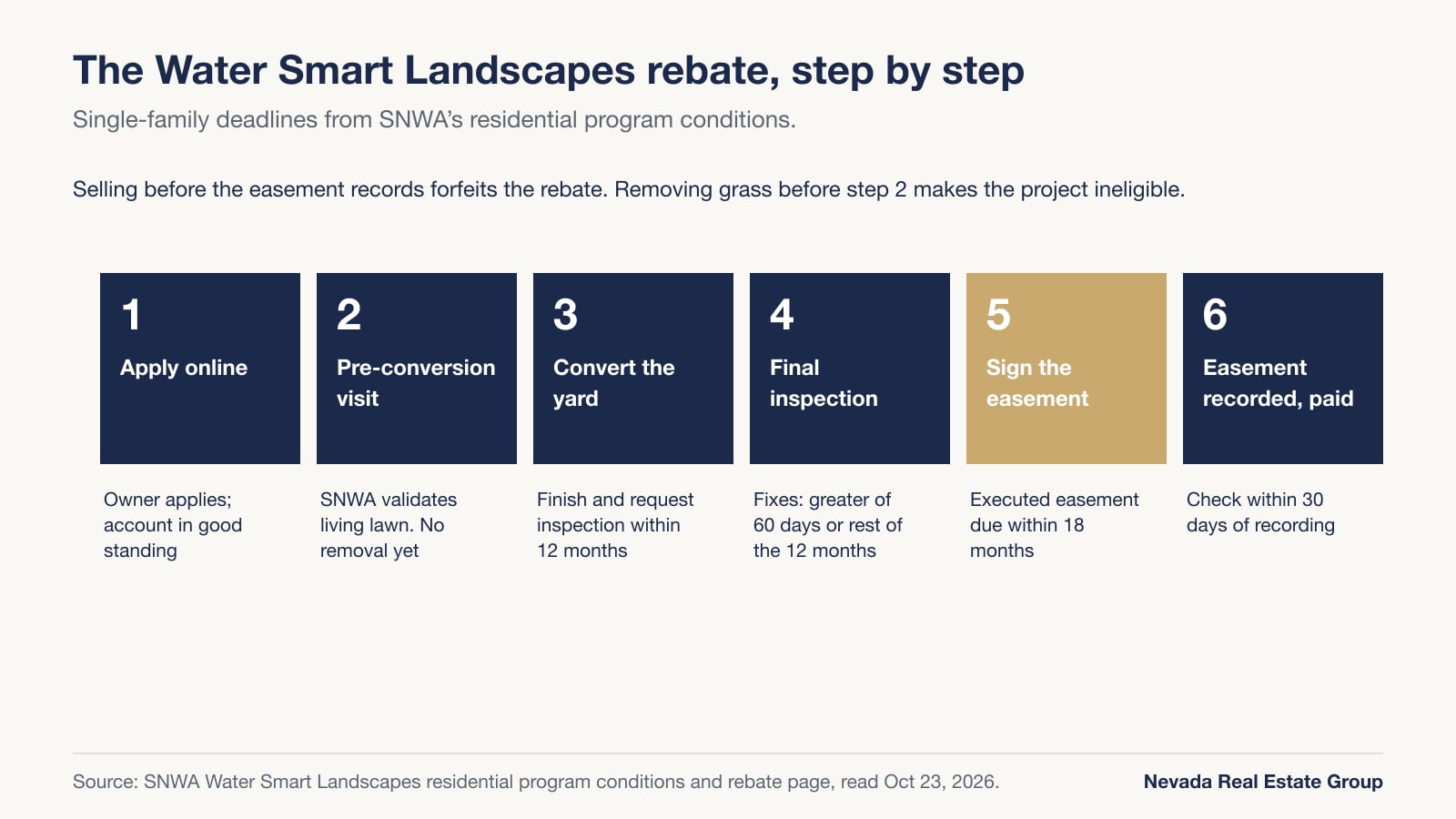
After you apply, SNWA schedules a pre-conversion site visit. Do not remove any grass until it authorizes you to proceed; starting early makes the conversion ineligible. From that inspection you have 12 months to finish the conversion and request the final inspection. If the inspector asks for corrections, you have the greater of 60 days from the notice or whatever remains of the 12 months.
Then comes the paperwork. The residential conditions require the executed conservation easement within 18 months of the agreement's execution, and "failure to meet deadlines will result in forfeiture of the rebate." Checks are issued "within 30 days of recording the easement." SNWA's FAQ describes a check "in less than 60 days" after you complete the project; I would plan around the conditions, which tie payment to the recording date. You may cancel any time before you accept payment, and SNWA keeps the discretion to reject or delay an application or withhold payment if the requirements are not met.
The deadline that matters most in a sale is this one: "Transfer of property prior to recording of the conservation easement will forfeit the rebate." A seller who converts and then closes before the easement records gets nothing. The buyer cannot simply apply for the same area, because the grass the program would have paid for is already gone, and the conditions void any assignment of the agreement made without SNWA's prior written approval.
Taxes are the last item. By signing, the applicant agrees "to accept any tax liability related to payments received," the SNWA's FAQ says rebates "may be considered taxable income," and Henderson notes it may issue a 1099. Ask your tax preparer before you count the check as tax-free.
What Does the SNWA Conservation Easement Actually Say?
SNWA publishes a sample of the document, listed on its rebate page as Restrictive Covenant and Grant of Conservation Easement, marked "sample only, do not sign." A version with the same terms is prepared for your parcel when the conversion is complete. The owner is the grantor and SNWA is the holder, and the recitals say the easement is created under Nevada's Uniform Conservation Easement Act, NRS 111.390 to 111.440.
The operative language is short. Section 1 says the property "shall be held, conveyed, hypothecated, developed, or encumbered subject to this Easement and shall be binding upon the Owner and all successors in interest." Subject to Section 4, it then defines the breach: any intentional modification of the converted landscaping, "including, without limitation, the installation of irrigated lawn or grass, spray irrigation systems, swimming pools, ponds or other bodies of water or water features" inside the areas mapped in Exhibit C.
Section 4 gives you room to garden. You may replace or modify the conversion in the course of normal maintenance without SNWA's consent, as long as the result has equal or greater water efficiency and adds none of the prohibited items. Section 5 covers the way out: SNWA "may agree to waive" the easement, may charge an administrative fee, must find the waiver is not detrimental to the public interest, and "shall require repayment of the amount paid to the Owner" plus a reasonable rate of interest from the original payment date. A waiver binds SNWA only in writing and once recorded. Section 7 gives SNWA every remedy at law and in equity, including damages and injunctions, and says a delay in enforcing is not a waiver. Disputes go to the Eighth Judicial District Court.
Nevada law backs the "forever" part. According to NRS 111.420, a conservation easement "is unlimited in duration" unless the instrument says otherwise or a court terminates or modifies it. The SNWA's FAQ says the same in plain terms: the easement applies "in perpetuity," and SNWA periodically conducts non-intrusive inspections and may ask for voluntary correction or take legal action.
| Change you might want | Status under the easement | Note |
|---|---|---|
| Replace, move or add plants | Allowed | Result must keep equal or greater water efficiency |
| Swap rock for bark or permeable turf | Allowed | FAQ lists changing mulch materials as permitted |
| Complete redesign | Allowed | No notice needed unless the character of the area changes substantially |
| Irrigated lawn or grass | Prohibited | Waiver requires repaying the rebate with interest |
| Spray irrigation | Prohibited | Includes overspray from adjacent zones |
| Swimming pool, pond or water feature | Prohibited | Applies only inside the Exhibit C area |
| Concrete patio | Not named in the list | Exhibit B describes a permeable surface; get SNWA's answer in writing first |
Does the Easement Stay With the House When You Sell?
Yes. The SNWA's FAQ says the easement "runs with the land," meaning that all owners of the property must abide by its terms, and compares it to the covenants most homeowners accept in an HOA. The documents are recorded with the Clark County Recorder. In SNWA's words, "if the property is sold, the easement can be identified through a title search and disclosed to a buyer," and SNWA keeps its own copy.
Some cities add a second layer. Henderson's municipal code, section 14.14.130, requires an owner, and any lessee, renter or occupant, to comply with any recorded deed or instrument that restricts water use or landscaping materials on the property. A tenant who puts a lawn back in a converted Henderson yard would be out of compliance with that ordinance, and the owner with the easement.
What transfers is the restriction, not the money. SNWA paid the prior owner "as consideration" for the conversion, and the buyer receives nothing for the converted area. Any grass that was never converted is a different matter. Nothing in the conditions I read stops a later owner from applying for lawn outside the mapped area, provided it is living and maintained when SNWA inspects it, but SNWA decides eligibility.
Who signs matters as well. The FAQ says every person on title signs before a notary, and a trust, LLC or other entity signs through an authorized trustee, officer or member. If title is changing, for example into a trust, line that up before the easement is prepared; our guide to how to hold title on a Nevada home explains the options. Because the document is recorded, it shows up the same way any other recorded restriction does, which is how a title insurance commitment and the escrow process in Nevada bring it to the buyer's attention.
What Should a Buyer Check Before Closing on a Converted Yard?
Start with the seller's disclosure. The Nevada Real Estate Division's Seller's Real Property Disclosure Form, revised June 1, 2023, asks the question directly at item 14: "Conservation Easements such as the SNWA's Water Smart Landscape Program: Is the property a participant?" Item 2(f) separately asks about "any encroachments, easements, zoning violations or nonconforming uses." According to NRS 113.130, the seller must complete the form, and the seller or the seller's agent must serve it, at least 10 days before the property is conveyed; the seller's agent may not complete it on the seller's behalf. Our guide to seller disclosures in Las Vegas walks through the rest of the form.
Then read the title commitment. Ask the title officer for copies of every recorded document listed as an exception, and look for one naming the Southern Nevada Water Authority. The document's Exhibit C is a map of the converted areas with the incentive amount, and that map tells you where the restriction applies. You can also search the Clark County Recorder's records by parcel number.
The map matters most for pools. If the backyard was converted, a pool inside that area is a breach unless SNWA grants a waiver, and a waiver means repaying what the prior owner received, with interest and any administrative fee SNWA charges. If a pool is in your plans, read our guide to buying a house with a pool in Las Vegas and confirm the pool fits outside Exhibit C before your due-diligence period ends. SNWA also says local jurisdictions adopted a 600-square-foot surface-area limit on new residential pools after its July 2022 resolution.
Three more items belong on the list. Have the inspector run the drip system and check the filter and regulator, since a failing system is a repair item and an easement-maintenance item. Ask for the HOA's written approval of the converted design. And ask whether the seller has an open rebate application. If the grass is gone but the easement has not recorded by closing, the seller forfeits the payment and you cannot apply for that area, because there is no living lawn left to validate. Our guide to home buying contingencies in Nevada covers the deadlines for raising these questions.
What Do Las Vegas Listing Descriptions Say About Converted Yards?
I wanted to know whether a buyer could rely on listing descriptions to flag a converted yard, so we checked. On October 23, 2026, the GLVAR listing feed showed 13,365 active for-sale listings in Las Vegas, Henderson and North Las Vegas. We searched their public remarks for "SNWA," "water smart," "conservation easement," "turf rebate" and "Water Authority," which returned 459 listings. We then checked each of those remarks for the phrases themselves and read every remark that contained one.
Only 15 remarks actually used SNWA, Water Smart or water-authority language. Two were vacant-land listings that mentioned an SNWA waiver tied to building on the lot, not the rebate. One mentioned enrollment in a leak-detection program. Ten used "water smart" as a description of the landscaping, with no reference to the rebate program. Two tied the yard to the SNWA program or its guidelines. None mentioned a conservation easement, and none said a pool or lawn was restricted anywhere on the lot.
The limits of this count are worth stating. A keyword search can miss phrasing we did not test, agents may share the information in private remarks or disclosures, and it is a single day's snapshot. It does not measure how many converted yards are for sale; it measures how often a public description tells you about one. On this evidence the answer is almost never, which is why the disclosure form and the title commitment, not the listing, are where a buyer should look.
None of this suggests anyone is hiding something. Listing remarks are marketing copy, and a recorded easement is a title matter. The fix is procedural: ask the question in writing, read item 14, and get the recorded document before the contingency deadlines pass.
What Should a Seller Disclose, and When Should a Seller Convert Before Listing?
If your yard went through the program, answer item 14 "yes" and attach a copy of the recorded easement, including the Exhibit C map, along with the HOA's approval letter and any drip-system receipts. Disclosing it up front lets a buyer weigh the restriction before writing an offer instead of discovering it in the title commitment during escrow. The seller completes the form personally; the agent cannot fill it in for you.
Timing is the bigger decision. If you are thinking about converting before you list, work backward from your target closing date. The pre-conversion visit can take longer in spring and fall, the conversion window is 12 months, and the payment is tied to the easement recording. Because a transfer before recording forfeits the rebate, a conversion that is still in paperwork when you close pays you nothing. If the timeline is tight, it may be better to leave the lawn healthy and let the buyer decide.
Be careful with marketing language too. A listing should not describe a lawn as "rebate-eligible" or promise the buyer a check. Eligibility depends on SNWA validating living grass at a pre-conversion visit, the buyer's own water account, and program terms that can change. "Living lawn, not previously converted" is a fact; a rebate amount is a projection.
I also would not tell a seller that converting will raise the sale price. I have no data that separates landscaping from lot size, age and location, and I will not invent a premium. What I can say is that a converted yard changes the buyer's checklist and a lawn changes the buyer's water bill; both are worth explaining. Our Las Vegas home selling guide covers the rest of the prep and the costs.
Can Your HOA Stop You From Replacing Grass With Desert Landscaping?
No, but it can shape the design. According to NRS 116.330, an HOA's board and governing documents "shall not" prohibit an owner from installing or maintaining drought tolerant landscaping in the part of the community the owner has the exclusive right to use, "including, without limitation, the front yard or back yard." The statute allows two conditions: you must submit a detailed description or plans for architectural review under the association's procedures, and the landscaping must be selected or designed "to the maximum extent practicable to be compatible with the style of the common-interest community."
The same section tilts the review in the owner's favor. It must be "construed liberally" to encourage drought tolerant landscaping, and the board may not unreasonably deny or withhold approval or unreasonably find a design incompatible. The definition includes mulches "such as decorative rock and artificial turf." According to the SNWA's FAQ, some boards are unaware their covenants conflict with the law, but "in every case, your HOA is still likely to have some say in the design."
Henderson's code goes further. Section 14.14.050(F) prohibits any person or association from imposing covenants or agreements that require lawn, prevent its removal or prevent drought-tolerant landscaping, and says an association may not reject a design solely because it uses drought-tolerant landscaping.
In practice, run the two approvals in parallel. Submit plans to your architectural review committee while you wait for the SNWA site visit, and do not remove grass until you have both. Master plans such as Summerlin publish design guidelines; our Summerlin desert landscaping guide covers that review. If a board refuses outright, Nevada's HOA dispute rules explain the process before you escalate.
Does Nevada Law Require Single-Family Homeowners to Remove Grass?
Not today. Assembly Bill 356, passed in 2021, prohibits using Colorado River water delivered by SNWA member agencies to irrigate nonfunctional grass beginning in 2027. According to SNWA's laws and ordinances page, the law applies to commercial, multifamily, government and other properties and "does not apply to grass in single family residences, such as grass in front and back yards." Turf managed by an HOA that provides no recreational benefit is covered regardless of zoning, which is why common-area streetscapes are coming out while your own front lawn can stay.
Keeping grass and putting it back are different questions, though. Henderson's municipal code, section 14.14.050, has prohibited lawn in the front yard of a detached single-family home since January 1, 2004, unless the lawn was installed on or before December 31, 2003. If an older front lawn is removed or dies, it can be replaced only where it was originally installed and only within one year. The code also caps back- and side-yard lawn on homes permitted before September 19, 2022, and prohibits lawn entirely on homes permitted on or after that date. In Henderson, then, once that one-year window has passed, the city code bars reinstalling a front lawn even without the easement.
The bigger picture is pressure through price rather than mandate. Lake Mead supplies most of the valley's water, SNWA says it has been taking conservation and drought-response actions for more than 25 years, and the rate structures below make heavy irrigation expensive. Our guides to the Las Vegas water supply and Lake Mead and the Colorado River 2036 plan cover what that means for owners. For a single-family homeowner, converting is a financial choice, not a legal requirement.
How Much Will a Conversion Cut Your Water Bill?
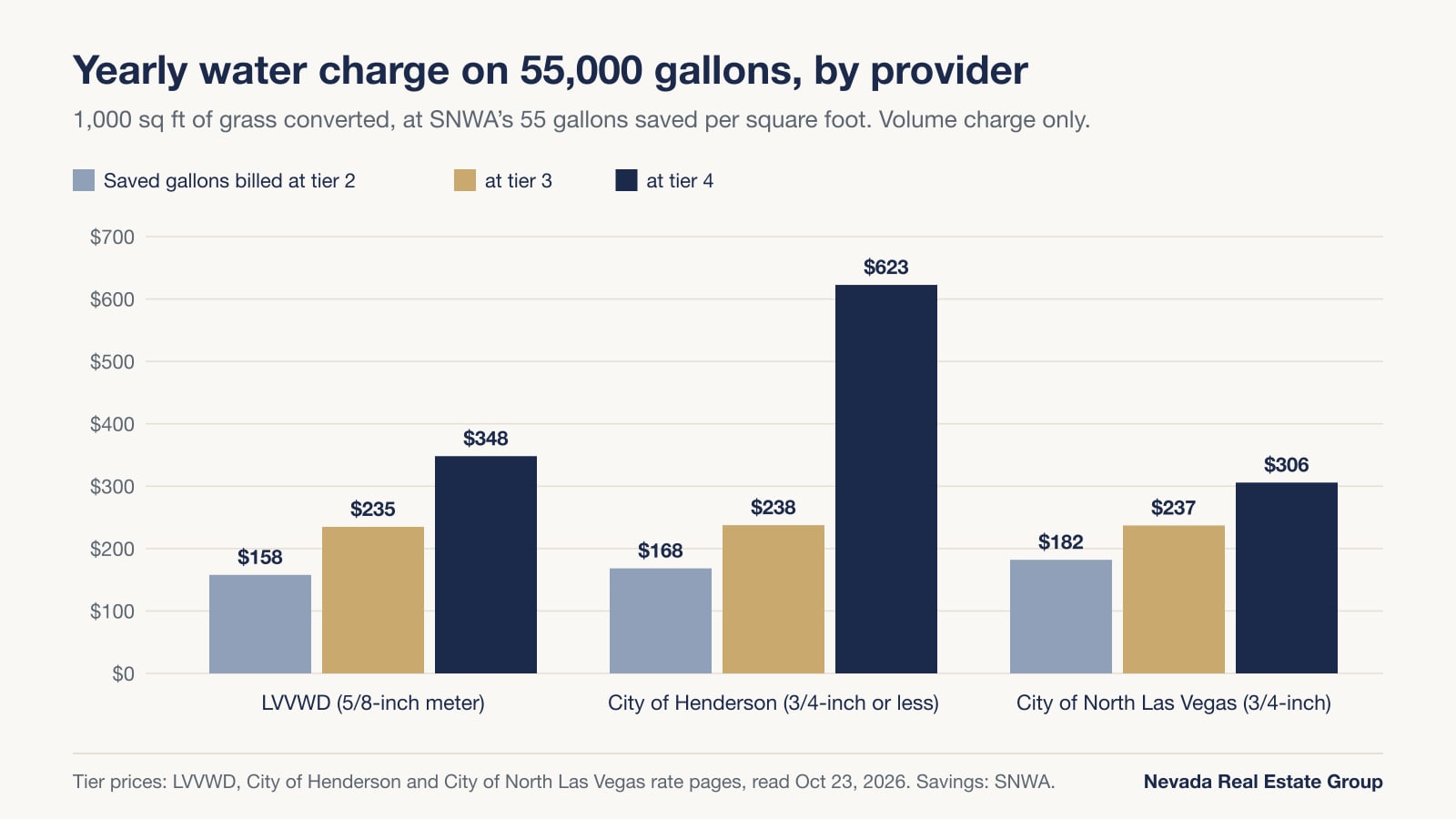
SNWA puts the savings at 55 gallons per square foot for areas converted from turfgrass to drip-irrigated desert landscapes, according to its laws and ordinances page. Its rebate page projects 825,000 gallons a year for an average 15,000-square-foot business conversion, which is the same 55 gallons per square foot per year. A 1,000-square-foot lawn conversion therefore saves about 55,000 gallons a year; 500 square feet saves about 27,500, and 2,500 square feet about 137,500.
What those gallons are worth depends on your provider and on which pricing tier they would have landed in. The LVVWD says its first tier "represents indoor usage for most residential customers," so the water a lawn uses is billed in the higher tiers.
| Provider and meter | Service charge | Tier 1 | Tier 2 | Tier 3 | Tier 4 |
|---|---|---|---|---|---|
| LVVWD, 5/8-inch | $13.88 per 30 days | First 5,000 gal at $1.61 | Next 5,000 at $2.87 | Next 10,000 at $4.27 | Over 20,000 at $6.33 |
| Henderson, 3/4-inch or less | $19.41 per 30 days | First 200 gal a day at $1.84 | Next 333 a day at $3.06 | Next 467 a day at $4.32 | Over 1,000 a day at $11.32 |
| North Las Vegas, 3/4-inch | $0.45 a day | First 6,000 gal at $2.55 | Next 9,000 at $3.31 | Next 9,000 at $4.31 | Over 24,000 at $5.56 |
Rates are per 1,000 gallons, from the LVVWD rates page, Henderson's water and wastewater rates and North Las Vegas water and sewer rates. For a 1,000-square-foot conversion, 55,000 gallons billed at tier 3 is worth $234.85 a year with the LVVWD, $237.60 in Henderson and $237.05 in North Las Vegas. At tier 4 it is $348.15, $622.60 and $305.80. Halve those for 500 square feet; multiply by 2.5 for 2,500.
LVVWD customers in the top bracket save more. Its excessive use charge adds $9 per 1,000 gallons above a seasonal threshold, so every 1,000 gallons cut above that line saves the $9 plus the tier price, or $15.33 at tier 4. According to the LVVWD's excessive use charge FAQ, the charge reaches roughly the top 10 percent of residential users. These figures leave out SNWA's commodity charge and its 0.25 percent reliability surcharge; your actual savings depend on how much the lawn was being watered.
What Watering Schedule Applies After the Grass Is Gone?
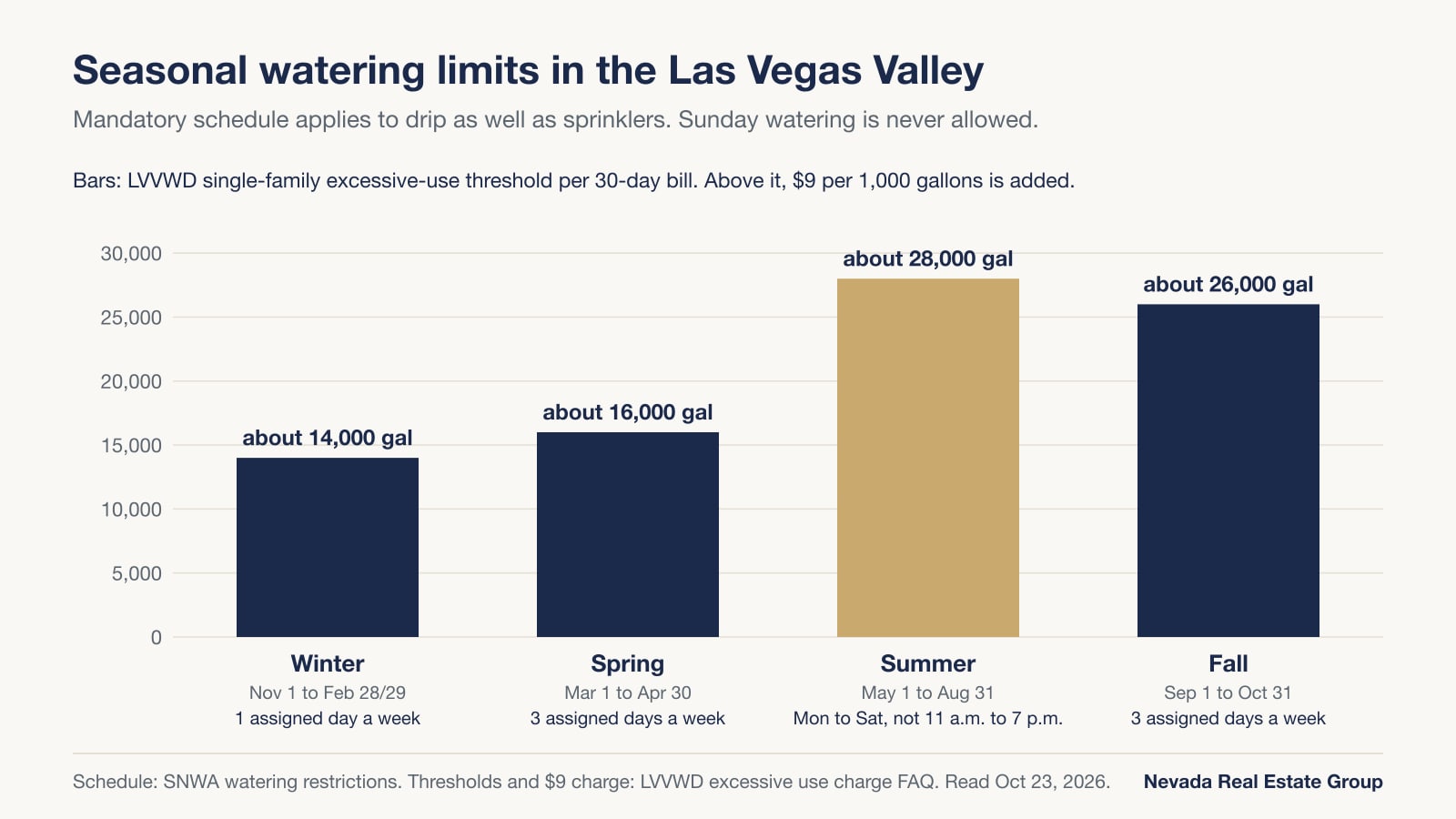
Drip-irrigated plants still follow the valley's mandatory schedule. According to SNWA's watering and maintenance page, watering is limited to one assigned day a week in winter, three assigned days in March and April, Monday through Saturday outside 11 a.m. to 7 p.m. from May 1 through August 31, and three assigned days from September 1 through October 31. "Watering restrictions also apply to drip irrigation," and Sunday is never a watering day. As of October 23, 2026 the fall schedule is in effect, and the winter one-day limit starts November 1.
New plantings get a short break. SNWA says the restrictions allow extra watering of new plants for the first 14 days, and hand-watering is allowed any time. The City of North Las Vegas watering schedule allows daily watering of new or reseeded landscapes for up to 30 days once per calendar year if you notify the city before planting. SNWA's establishment guide runs eight weeks: every one to two days in summer for the first two weeks, tapering to every 7 days by weeks 7 and 8, and less often in cooler months.
Drip runs differently from sprinklers. SNWA says drip should run longer but less often, recommends two days a week for drip in fall, and warns that it is easy to overwater. A smart controller helps; SNWA's rebate covers 50 percent of the price or up to $100, whichever is less.
The chart below pairs the schedule with the LVVWD's excessive-use thresholds, roughly 14,000 gallons per 30-day bill in winter, 16,000 in spring, 28,000 in summer and 26,000 in fall. SNWA also recommends converting in the cool season, if possible, to protect the roots of existing trees, which makes late fall and winter a sensible window. Our guide to your first desert summer covers the rest of the seasonal routine.
How Should You Price a Conversion When No Local Cost Survey Exists?
This is the number everyone wants, and I could not find a dated, published cost survey for Las Vegas conversions as of October 23, 2026. The closest thing is the SNWA's FAQ, which says that for most participants "the rebate will pay about half the cost of a good quality landscape conversion and could cover as much as 75 percent of some customers' conversion costs." That answer carries no date and may predate the September 2025 rate increase, so I would not use it to back into a per-foot price. Get bids.
SNWA keeps a list of Water Smart Landscaper program participants, contractors it describes as licensed, bonded and trained by the Water Authority. Its FAQ says you do not have to use one and can do the work yourself. However you proceed, make every bid itemize the work the inspection will check, so you are comparing the same scope.
| Line item | Why it matters for the rebate | Bid A | Bid B |
|---|---|---|---|
| Grass kill and removal, haul-off | SNWA recommends treating grass with an herbicide before removal | Enter price | Enter price |
| Drip system with filter and regulator | Required parts must be visible at inspection | Enter price | Enter price |
| Plants to 50 percent mature cover | Ask for the coverage worksheet | Enter price | Enter price |
| Qualifying trees | $100 each from SNWA, $50 more in Henderson | Enter price | Enter price |
| Rock or other permeable mulch | No plastic sheeting under it | Enter price | Enter price |
| Capping or adjusting remaining sprinklers | No overspray into the converted area | Enter price | Enter price |
With bids in hand, the break-even math is simple. Subtract the rebate from the bid, then divide by the yearly savings. For an LVVWD customer converting 1,000 square feet, the rebate is $7,000 before trees, so a bid at or below $7,000 is fully covered once the check arrives, before any tax owed on it. Each $1,000 above the rebate takes about 4.3 years to recover at tier-3 pricing ($234.85 a year) or about 2.9 years at tier 4 ($348.15). The SNWA's FAQ adds that its studies found participants' average yearly household water and maintenance costs fell by more than one-third.
On financing, SNWA notes that most banks offer home-improvement loans and some landscapers let you pay the final balance after the rebate check arrives. Get any such arrangement in writing, and remember that the check follows the easement recording, not the last day of work.
Frequently Asked Questions
Does artificial turf qualify for the SNWA grass removal rebate?
Yes, as mulch. SNWA accepts artificial turf in place of rock or bark only if it is permeable, letting air and water pass through. The converted area must still reach 50 percent living plant cover at maturity, and any irrigation must be drip, so a yard that is all turf and no plants will not pass. Nevada's HOA statute also lists artificial turf as drought tolerant landscaping.
Can I get the rebate if my grass is already dead or removed?
Generally no. SNWA requires a living, maintained lawn that its staff validate at a pre-conversion visit, and removing grass before that visit makes the project ineligible. If you shut the water off months ago, call SNWA before you do anything else; do not assume a brown lawn will be accepted.
Is the SNWA grass rebate taxable?
It may be. SNWA's FAQ says rebates "may be considered taxable income" and recommends a tax advisor, and the residential agreement has you accept any tax liability. Henderson says its supplement may generate a 1099 above reporting limits. Ask your preparer how to treat it before you file.
Can I build a pool where my yard was converted?
Not inside the mapped converted area without SNWA's written, recorded waiver. The easement lists swimming pools, ponds and water features among the prohibited changes, and a waiver requires repaying the rebate with interest plus any administrative fee. A pool outside the Exhibit C area is not restricted by the easement, so get the map first.
I am buying a home with a lawn. Can I collect the rebate after closing?
Yes, as the new owner, if the lawn is still living and maintained when SNWA inspects it and your water account is in good standing. Keep the grass watered through the transition, apply in your own name, and wait for the pre-conversion visit before removing anything. A seller's open application cannot be assigned to you without SNWA's prior written approval.
Can the easement ever be removed?
Only by SNWA's written waiver, recorded with the county, or by a court. SNWA decides whether a waiver is detrimental to the public interest and requires repayment of the rebate with interest. Nevada's conservation easement statute makes these easements unlimited in duration unless the document says otherwise.
Will SNWA pay me to convert grass in a brand-new home?
Usually there is nothing to convert. SNWA's 2021 resolution prohibits irrigated grass in the front and back yards of new residential developments, so most new homes are delivered without a lawn. Budget a new-construction yard at full cost.
How Can Nevada Real Estate Group Help With a Converted Yard?
A grass conversion is a homeowner decision with a real-estate tail, and the tail is what people miss. If you own a home with a lawn, the rebate math is straightforward: check your provider, measure the grass, and price the work against the per-foot rate before you call a contractor. If you plan to sell in the next year, decide whether to convert before you list, because a conversion still waiting on its easement at closing pays you nothing.
If you are buying, treat a converted yard the way you would any recorded restriction. Read item 14 of the disclosure form, pull the recorded easement and its Exhibit C map from the title commitment, and confirm that any pool, pond or lawn you have in mind fits outside the mapped area. Ask for the HOA approval and the drip-system records while you still have time to negotiate.
If you are weighing a specific property, I am happy to go through its recorded documents and easement map with you and talk through how a conversion fits around a sale. Start with our buyer services or seller services, or call me directly at (702) 637-1759. We work with buyers and sellers across Las Vegas, Henderson, North Las Vegas and Boulder City.
Which Sources Inform This Grass Removal Rebate Guide?
Every rate, rule and deadline in this guide was read on the publishing agency's own page on October 23, 2026, in a desktop browser. Rebate amounts and water-bill figures are our calculations from those published rates, shown with the inputs. The listing count is our own keyword search and manual read of public remarks in the GLVAR feed on the afternoon of October 23, 2026, covering active for-sale listings in Las Vegas, Henderson and North Las Vegas; it excludes private remarks and disclosures. No contractor bids, client files or transactions were used.
- Southern Nevada Water Authority: Water Smart Landscapes rebate, benefits, process and FAQ
- Southern Nevada Water Authority: residential program conditions
- Southern Nevada Water Authority: sample Restrictive Covenant and Grant of Conservation Easement (PDF)
- Southern Nevada Water Authority: Tree Canopy Enhancement Program conditions
- Southern Nevada Water Authority: laws and ordinances, including AB 356 scope and the 55-gallon savings figure
- Southern Nevada Water Authority: watering and maintaining your landscape
- Southern Nevada Water Authority: mission and member agencies
- Southern Nevada Water Authority: Water Authority charges
- Las Vegas Valley Water District: rebates and the additional $2 incentive
- Las Vegas Valley Water District: rates, fees and charges
- Las Vegas Valley Water District: excessive use charge FAQ
- City of Henderson: water conservation rebate programs
- City of Henderson: water and wastewater rates
- Henderson Municipal Code chapter 14.14, conservation
- City of North Las Vegas: water and sewer rates
- City of North Las Vegas: watering schedule
- Nevada Legislature: NRS 116.330, drought tolerant landscaping in common-interest communities
- Nevada Legislature: NRS 111.420, conservation easement duration
- Nevada Legislature: NRS 113.130, seller disclosure timing
- Nevada Real Estate Division: Seller's Real Property Disclosure Form (PDF)
- Nevada Legislature: AB 356 (2021) bill record
- Clark County Recorder: parcel number search
Chris Nevada · Nevada Real Estate License S.181401 · Nevada Real Estate Group · LPT Realty. This guide explains published program terms; it is not legal or tax advice. Confirm current terms with SNWA and your water provider before you remove any grass.