

Somewhere in your closing package sits a one-line question that will outlive everything else you signed that day: how do you want to take title? The answer decides what happens at a death, what basis the survivor takes, what creditors can reach, and who must sign if you sell. It deserves more thought than whatever your last state did.
Corrected October 31, 2026: earlier versions cited the wrong statute for Nevada's transfer-on-death deed, used old probate limits, said an ex-spouse would inherit through survivorship, and showed a tax saving without the home-sale exclusion. Each is fixed below.
Nevada gives you good options here: a community-property survivorship form with a real federal tax advantage, a deed that skips probate without a trust, and a homestead exemption of $605,000. This guide walks every vesting choice and the math behind them. It is general information, not legal advice. The right answer for blended families, business owners and large estates belongs with a Nevada estate attorney, but after this you will know what to ask.
Nevada owners can hold title as sole owners, joint tenants, tenants in common, community property, community property with right of survivorship, or through a trust. For spouses, NRS 111.064 requires the deed to declare survivorship, and IRS Publication 555 generally gives both community-property halves a new basis at the first death. In joint tenancy, only the decedent's half changes. A deed upon death and a recorded homestead, up to $605,000 of equity, are separate tools.
- Community property with survivorship generally gives both halves a new basis at the first death, per IRS Publication 555.
- Nevada's transfer-on-death tool is the deed upon death under NRS 111.655 to 111.699, recorded while you're alive.
- A recorded homestead declaration protects up to $605,000 of equity, but not mortgages, taxes or HOA liens.
- Divorce generally severs survivorship between ex-spouses under NRS 111.781, but record a writing so later buyers have notice.
- The home-sale exclusion can erase a joint-tenancy gain, so the step-up matters most above it.
What Are the Ways to Hold Title on a Nevada Home?
Nevada recognizes six practical vesting structures for residential property.
- Sole ownership. One person holds title, with full control and probate exposure at death unless paired with a deed upon death or a trust.
- Joint tenancy with right of survivorship. Two or more owners hold together, and when one dies, the survivor takes. NRS 111.065 requires the deed to declare it expressly.
- Tenancy in common. Two or more owners hold in any percentage, and each share passes by will or estate rather than survivorship.
- Community property. Under NRS 123.220, property acquired after marriage is community property unless an exception applies, and NRS 123.225 calls each spouse's interest present, existing and equal.
- Community property with right of survivorship. NRS 111.064 says this right does not arise unless the deed expressly declares it, and that it ends if either spouse transfers their interest during the marriage.
- Trust ownership. The home is deeded into a revocable living trust, with the trustee holding legal title.
The vesting you pick controls four separate outcomes, and they do not travel together: what happens at death, what the IRS does to your cost basis, what creditors can reach, and how easily you can sell or refinance. The rest of this guide takes those one at a time.
Why Do Nevada Couples Look at Community Property With Right of Survivorship?
Because it can address both probate and basis. Nevada is one of nine community-property states listed in IRS Publication 555, and that opens a federal tax treatment joint tenancy cannot match.
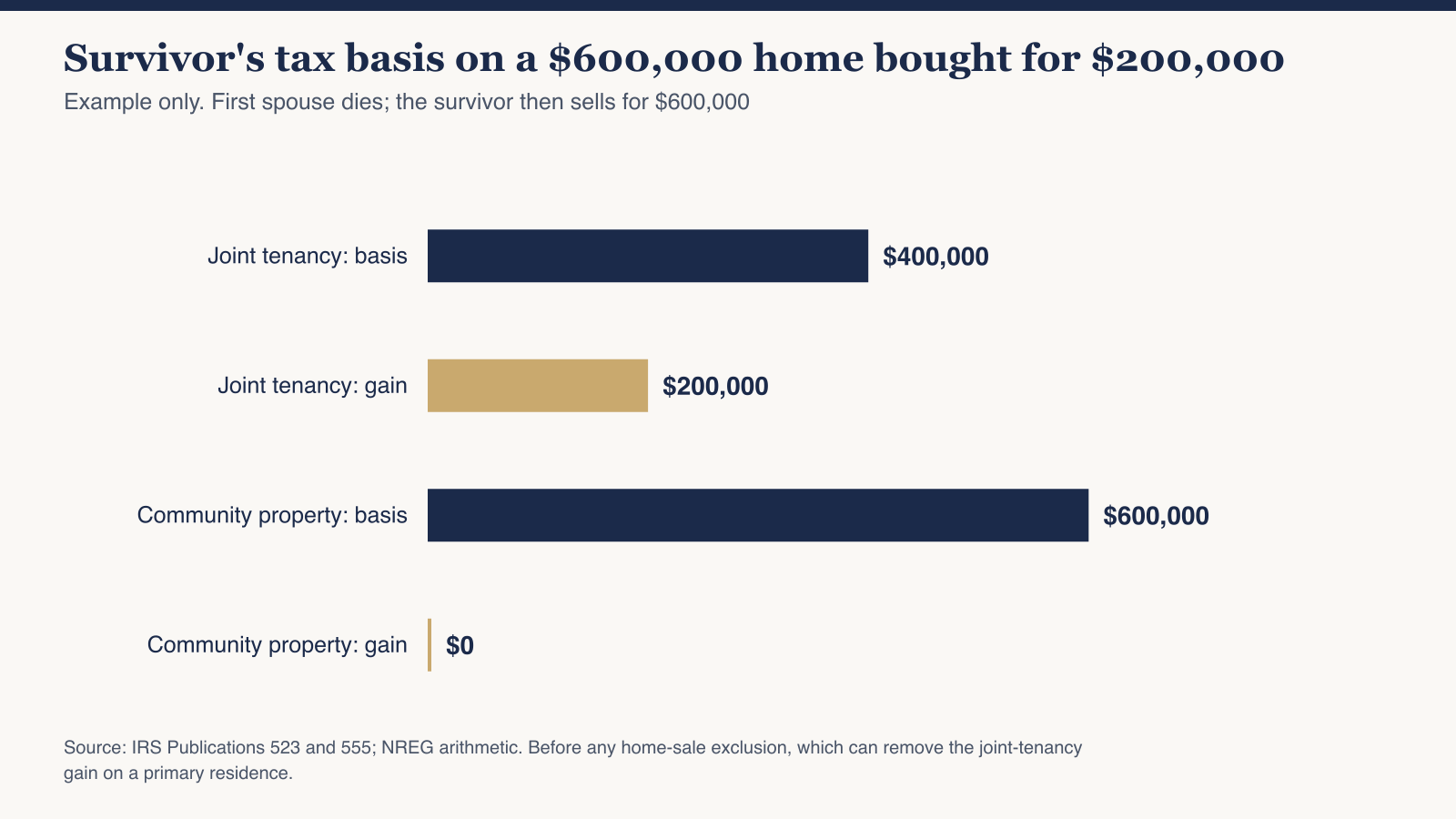
When a spouse dies, Publication 555 says the total fair market value of the community property, including the surviving spouse's part, generally becomes the basis of the entire property, provided at least half of the community interest is includible in the decedent's gross estate. Joint tenancy works differently. IRS Publication 523 says joint tenants are each considered to have owned half, and the survivor's own half keeps its existing basis.
Here is the math on an example home bought for $200,000 and worth $600,000 at the first spouse's death.
| Line | Joint Tenancy | CP With Survivorship |
|---|---|---|
| Decedent's half, new basis | $300,000 | $300,000 |
| Survivor's half, basis | $100,000 (keeps original basis) | $300,000 (also stepped up) |
| Survivor's total basis | $400,000 | $600,000 |
| Gain on a $600,000 sale | $200,000 | $0 |
| Taxable gain if it's the survivor's qualifying home | $0 after the exclusion | $0 |
| Tax at 15% if no exclusion applies, such as a second home | $30,000 | $0 |
That table includes a line many articles skip. Publication 523 lets a single seller exclude up to $250,000 of gain on a qualifying main home, and an unmarried surviving spouse can use up to $500,000 if the sale is within two years of the death and the other tests are met. So on this example, a surviving spouse living in the home owes nothing under either vesting.
The vesting matters when the gain outruns the exclusion or no exclusion applies. Take a home bought for $300,000 and worth $1,400,000 at the first death, sold more than two years later. Under joint tenancy, basis is $850,000, gain is $550,000, and $300,000 stays taxable after a $250,000 exclusion. At the 15% long-term rate the IRS lists for most taxpayers in 2025, that is $45,000 of federal tax before any other federal tax. With community property and a sale at that same value, basis is $1,400,000 and the gain is zero. The same logic applies to a rental or second home, though depreciation changes those numbers, so run it with a tax professional.
The survivorship feature skips probate at the same time, so this vesting gives Nevada couples both results in one line of the deed. The main caution: community property has divorce and creditor implications that differ from joint tenancy, and couples with separate-property histories (inheritances, premarital homes, blended families) should confirm the fit with counsel before re-deeding.
How Do Nevada's Vesting Options Compare Side by Side?
| Factor | Joint Tenancy | CP w/ Survivorship | Tenancy in Common | Revocable Trust |
|---|---|---|---|---|
| Who can use it | Any co-owners | Married couples | Any co-owners | Any owner |
| Avoids probate at first death | Yes, survivor takes | Yes, survivor takes | No, share passes through the estate | Yes, if the home is in the trust |
| Basis at first death | Decedent's half only (spouses) | Both halves | Decedent's share only | Follows the underlying form |
| Unequal shares | No, traditionally equal | No, equal interests | Yes, any split | Per the trust terms |
| Incapacity planning | None | None | None | Successor trustee |
Two patterns are worth pulling out. First, couples already on title as joint tenants can re-vest with a recorded deed between themselves. Check two things before you do. NRS 375.090 lists the transfer-tax exemptions but has no line labeled for spouses, so ask the title officer which exemption the declaration of value should claim. And in Clark County, any recorded ownership document removes your owner-occupied 3% abatement, so return the Assessor's postcard after you record.
Second, the trust column is the only one that answers incapacity, not just death. If an owner loses capacity, survivorship does nothing until death, while a successor trustee can manage or sell the home without a guardianship proceeding. Our Nevada escrow guide shows the transfer-tax and recording costs on a sample purchase.
What Is a Transfer-on-Death Deed and Who Should Use One?
Nevada calls it a deed upon death. NRS 111.655 to 111.699, the Uniform Real Property Transfer on Death Act, lets an owner record a deed that conveys the property to named beneficiaries effective at death. During your life, NRS 111.685 says it does not affect your rights, including your right to transfer or encumber the property, and creates no interest for the beneficiary. It is revocable. NRS 375.090 exempts it from transfer tax.
The recording cost is modest. Clark County's Recorder fee schedule, effective January 1, 2020 and still the schedule linked from the Recorder's fee page on October 31, 2026, lists $42 per document for a standard recording. Confirm the amount with your county, and add the cost of having the deed prepared. After the death, NRS 111.699 requires a Death of Grantor Affidavit, a declaration of value and a copy of the death certificate to be recorded.
Owners often ask about it when the house is the main asset, or as a backstop behind survivorship vesting, because NRS 111.675 lets it take effect at the last surviving owner's death. An attorney should look at it first if a beneficiary is a minor, the family is complex, or the estate needs the management features of a trust. Our inherited-house guide shows what heirs face when none of these tools were used.
These limits are why some owners use a trust instead:
- The beneficiary takes subject to existing liens under NRS 111.691, so the deed transfers ownership, not a payoff.
- A sale during your life voids it under NRS 111.677, and the last recorded deed upon death controls.
- NRS 111.689 lets an insufficient estate enforce claims against the property, and it addresses recovery of public assistance, a question for an elder-law attorney if long-term care is in the picture.
- It does nothing for the rest of the estate, such as bank accounts, vehicles or out-of-state property.
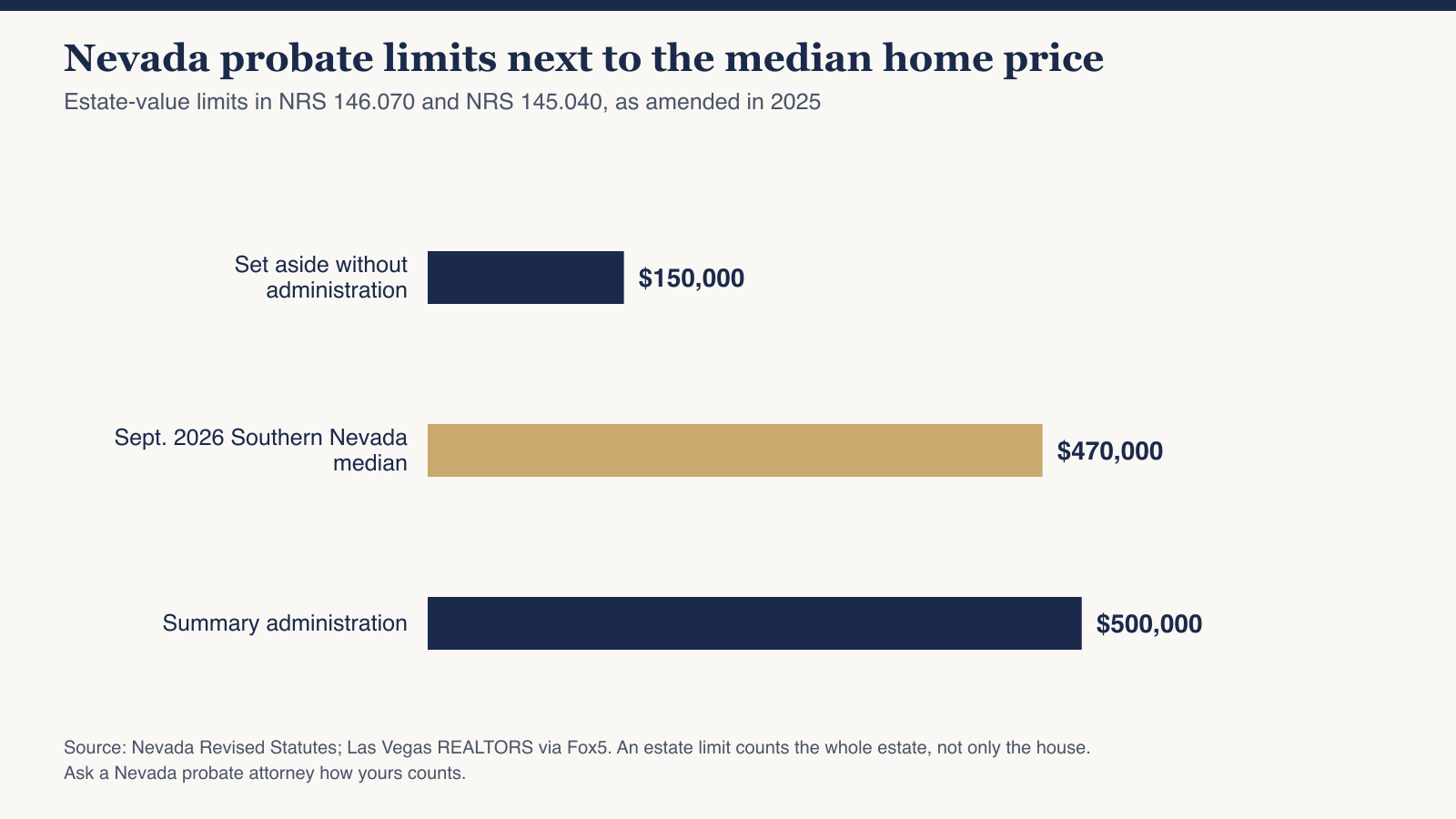
If a named beneficiary dies first, ask an attorney how the deed should be written, because that is where a simple form can go wrong. For a small estate the numbers may also help. Under NRS 146.070, a court may set aside an estate of up to $150,000 without administration. Under NRS 145.040, a court may order summary administration if the gross estate, after encumbrances, is $500,000 or less. Senate Bill 404, approved June 5, 2025, raised those limits from $100,000 and $300,000.
How Does Nevada's Homestead Exemption Protect Your Home Equity?
Separately from vesting, Nevada offers a homestead exemption. Under NRS 115.010, the homestead is not subject to forced sale on execution, up to $605,000 of equity. NRS 115.020 requires a written declaration, signed, acknowledged and recorded the way a conveyance is recorded.
Three practical notes. First, the limits matter. The exemption does not reach purchase-money debt, improvements including mechanics' liens, legal taxes, a mortgage or deed of trust, or a lien such as an HOA's under a recorded declaration. Second, the declaration states an intention to use and claim the property as a homestead, so a rental portfolio is a different conversation. Third, the amount is large for most homes. Las Vegas REALTORS put the Southern Nevada single-family median at $470,000 in September 2026, according to Fox5, so even a paid-off median home sits $135,000 under the limit.
Clark County's Recorder fee page listed a homestead filing at $42 per document on October 31, 2026. Under NRS 115.020, a person who solicits you and charges a fee to record one must first tell you in bold type that you can record it yourself. Our homestead declaration guide covers the details.
For owners with serious asset-protection needs, NRS 166.040 allows a spendthrift trust for the settlor's own benefit under specific conditions. That is specialist-attorney territory, well beyond a vesting line.
How Should Unmarried Partners, Friends, and Investors Hold Title Together?
The default rules may not match what these buyers intend. Joint tenancy hands the whole property to the survivor, whatever the other owner's will says. In tenancy in common, shares can match actual contributions, such as 60/40 or 70/30, and each owner's share passes through their own estate.
The deed is the smaller half of the answer. A co-ownership agreement, which the deed cannot replace, should cover who pays what share of the mortgage and repairs, what happens when one owner wants out, how a buyout price gets set, what happens at a death or default, and who decides on refinancing. Have an attorney draft it before closing. Our co-buying guide goes further.
Investors add one more layer: some deed rentals to an LLC for liability separation. Transferring a financed property can implicate the loan's due-on-sale clause, and the LLC has to be run properly. NRS 375.090 exempts a conveyance to a business organization if the person conveying owns 100% of it. It separately exempts a mere change in identity or form, unless the entity was formed to avoid the tax. Structure it with counsel.

When Should You Change How Your Nevada Home Is Titled?
Title is a snapshot of your life at closing, and lives move. These events should trigger a review:
- Marriage. A pre-marital sole-ownership deed does not become community property by itself under NRS 123.220.
- Divorce. NRS 111.781 generally severs joint tenancy or community property with survivorship into equal tenancies in common and revokes revocable dispositions to the former spouse. The exceptions are the express terms of a governing instrument, a court order or a contract on dividing the marital estate. A third party who acquired an interest for value, relying in good faith on apparent title, can be protected unless a writing declaring the severance is on record.
- A co-owner's death. Clear title now rather than when you sell. Stale title can delay escrow, as our Nevada escrow guide explains.
- Creating a trust. A trust holds only what is deeded into it. A deed that has not been recorded leaves the home outside the trust.
- An out-of-state move. Your old state's vesting concepts may not map to Nevada, so review them with an attorney.
- A new business venture. Revisit your exposure and the homestead when you start signing personal guarantees.
Mechanically, retitling is a deed, prepared correctly and recorded with the county. NRS 375.090 lists the exemptions, including transfers to or from a trust without consideration when a certificate of trust is presented. The recording is cheap. The drafting deserves professional hands, because a botched deed creates the exact title cloud escrow later has to untangle. Afterward, check your 3% tax cap, since a recorded deed can remove the designation.
Which Title Mistakes Can Cost Nevada Owners?
These problems follow from the rules above, and each has a fix.
| Mistake | What It Costs | The Fix |
|---|---|---|
| Married couple defaults to joint tenancy | Half step-up instead of both halves, which matters above the exclusion | Discuss a re-deed to CPWROS with counsel |
| Trust created but home never deeded in | Home can still go through probate | Record the deed into the trust |
| Homestead never recorded | No declared homestead protection, up to $605,000 | Record the declaration with the county recorder |
| Deceased co-owner still on title | Delay when you sell or refinance | Record the death documents your title officer requires |
| Divorce with no recorded change | Survivorship severs by statute, but apparent title can mislead a later buyer | Record the decree or a new deed |
| Kids added to title "to avoid probate" | Possible gift-tax filing, carryover basis, exposure to their creditors | Ask about a deed upon death or a trust |
The last row deserves its own explanation. IRS Publication 551 says the basis of a gift is generally the donor's adjusted basis, so a child's added share keeps your old basis rather than stepping up at your death. It can also expose the home to the child's creditors, and it requires the child's signature to sell or borrow. A deed upon death passes the house without probate and leaves your ownership unchanged during your life. Talk to an estate attorney before you add anyone.
How Does Title Vesting Interact With Selling Your Nevada Home?
Vesting decides who must sign. Every person on title signs the deed, and under NRS 123.230, neither spouse may sell or convey community real property unless both join in the deed. Trusts sell through their trustees, and escrow will want the trust certification early. Estates sell through personal representatives with authority documents. Out-of-state co-owners can sign through a notary, which works when it is planned.
The practical checklist: read your vesting on the preliminary title report as soon as you list, clear any stale names or clouds before a buyer's title search finds them, and if the home sits in a trust or estate, have the authority documents ready for escrow. Talk to your tax professional about basis, the primary-residence exclusion and timing before the sign goes up. Our capital gains guide covers the exclusion rules, and our listing team can help with pre-list prep statewide, at (702) 637-1759 in the south and (775) 277-2120 in the north.

Frequently Asked Questions
What is the best way for a married couple to hold title in Nevada?
No single vesting fits every couple. Community property with right of survivorship passes to the survivor like joint tenancy, and IRS rules generally give both halves a new basis at the first death. The deed must declare it expressly under NRS 111.064. Couples with separate-property histories, blended families or asset-protection concerns should raise the choice with a Nevada estate attorney.
What is the difference between joint tenancy and community property with right of survivorship?
Both pass the home to the survivor without probate. The difference is federal basis: a surviving joint tenant's own half keeps its existing basis, while community property generally takes full fair market value on both halves. On a home bought for $200,000 and worth $600,000, that leaves a $200,000 gain or none. The home-sale exclusion can remove that gain on a qualifying main home.
How does a transfer-on-death deed work in Nevada?
Nevada calls it a deed upon death, under NRS 111.655 to 111.699. You record a revocable deed naming beneficiaries who take at your death, without changing your ownership or your right to sell or borrow while you are alive. Clark County's fee schedule, effective January 1, 2020, lists $42 per document to record. Minor beneficiaries, complex families and estates that need a trust's management features call for an attorney.
What does Nevada's homestead exemption protect?
A recorded declaration protects up to $605,000 of equity in your homestead from forced sale under NRS 115.010. It does not reach purchase-money debt, improvements, legal taxes, mortgages or deeds of trust, or liens such as HOA assessments. Clark County's fee page listed a $42 homestead filing fee on October 31, 2026.
Should I add my adult child to my home's title to avoid probate?
Get advice first. A gift generally carries your old basis to the child, can expose the home to the child's creditors, and requires their signature for a sale or loan. A deed upon death or a revocable trust can avoid probate without those effects, so ask an estate attorney about both.
Do I need a trust if my title already has survivorship rights?
Survivorship handles the first death. It does nothing for the second death or for incapacity. A trust, or at minimum a deed upon death recorded by the survivor, covers the second transfer, and only a trust provides a successor trustee who can manage or sell the home if you become incapacitated.
Does putting my Nevada rental in an LLC trigger transfer tax?
NRS 375.090 exempts a transfer to a business organization if the person conveying owns 100% of it. It also exempts a mere change in identity or form, unless the entity was formed to avoid the tax. Watch the loan too: transferring financed property can implicate the due-on-sale clause, so coordinate with your lender and counsel before recording.
How do I find out how my home is currently titled?
Your recorded deed states the vesting exactly, and your county recorder keeps a copy. If you are preparing to sell, the preliminary title report shows the vesting plus liens and other items that need attention.
Ready to Get Your Title Working as Hard as Your Equity?
Vesting is a short conversation, and it pairs naturally with a sale, a purchase or a life change. Whether you're buying through the advanced search, listing with our seller team, or starting a first-home purchase, ask us which vesting questions to take to your attorney. Our Las Vegas, Henderson and Reno pages show what's for sale now. Call (702) 637-1759 in Southern Nevada or (775) 277-2120 in Northern Nevada, or email info@nevadagroup.com.
Nevada Real Estate Group · 8945 W Russell Rd, Suite 170 · Las Vegas, NV 89148 · (702) 637-1759 · NV License S.181401
Which Sources Inform This Nevada Title Guide?
Statutes were read on the Nevada Legislature's site on October 31, 2026, and IRS publications the same day. This guide is general information, not legal or tax advice. Vesting, trust and asset-protection decisions belong with a Nevada estate-planning attorney and a qualified tax professional.
- NRS Chapter 111, conveyances, survivorship and the deed upon death
- NRS Chapter 115, homesteads
- NRS Chapter 123, community property
- NRS Chapter 145, summary administration
- Statutes of Nevada 2025, Senate Bill 404
- NRS Chapter 146, estates set aside without administration
- NRS Chapter 166, spendthrift trusts
- NRS Chapter 375, real property transfer tax
- IRS Publication 555, Community Property
- IRS Publication 523, Selling Your Home
- IRS Publication 551, Basis of Assets
- IRS Topic 409, Capital Gains and Losses
- Clark County Recorder, fees
- Clark County Assessor, tax abatement