

If you own a home in Summerlin and still have a traditional grass lawn out front, 2026 is the year the rules catch up with you. Nevada Assembly Bill 356 — signed in 2021 and now entering its final enforcement phase — is eliminating nonfunctional ornamental turf across the entire Southern Nevada Water Authority service area by December 31, 2026. That deadline applies to streetscapes, medians, commercial frontages, and common-area turf; single-family residential back yards get a longer runway, but front-yard ornamental grass in new construction has already been prohibited since 2003, and the legislative direction is unmistakable. Meanwhile, the SNWA Water Smart Landscapes rebate is paying homeowners $5 per square foot of converted turf on the first 10,000 square feet — meaning a 500-square-foot lawn conversion generates a $2,500 direct rebate check before you factor in water-bill savings.
What makes Summerlin unique in this landscape is the Summerlin Architectural Review Committee (ARC). Under Nevada Revised Statutes NRS 116.330, no HOA — including the Summerlin Community Association — can legally prohibit drought-tolerant or xeriscape landscaping. But the ARC still controls design: plant palette, rock color, hardscape percentages, and the overall look must meet the community's standards before you break ground. Get the design approval wrong and you'll replant. Get it right and your yard looks like it belongs in a design magazine — which is exactly what the best xeriscape conversions in Summerlin's villages look like. For questions on rebate timing, ARC submission, or what a converted yard does for your resale value in Las Vegas, call Nevada Real Estate Group at (702) 637-1759.
I've watched this transition play out across hundreds of transactions in Summerlin over the past several years. If you're moving to Las Vegas and considering Summerlin, the desert-landscaping picture is actually a positive — new construction arrives compliant, and resale homes with completed conversions are genuinely move-in ready from a water-bill standpoint. The homeowners who convert proactively — collecting the SNWA rebate, clearing ARC design approval, and installing a proper drip-irrigation system — typically see water bills drop $80 to $150 per month in summer and position their homes as move-in ready for buyers who no longer want to maintain grass in the desert. The ones who wait get squeezed between tightening watering restrictions, rising municipal rates, and buyers who increasingly view a turf lawn as a liability. This guide covers everything a Summerlin homeowner needs to know in 2026: the AB356 deadline, the rebate mechanics, ARC design rules, watering-day restrictions, pool and irrigation requirements, what new-construction buyers should expect, and how to run the conversion math.
Nevada AB356 bans nonfunctional ornamental turf in the SNWA service area by December 31, 2026, affecting streetscapes, medians, and common areas first — single-family back yards have a longer window but front-yard new grass has been prohibited since 2003. Summerlin homeowners can collect a $5-per-square-foot SNWA rebate to convert grass to xeriscape, offset gross conversion costs of $5–$15 per square foot, and save $80–$150 per month in summer water bills. ARC design approval is required before starting — NRS 116.330 forbids HOAs from blocking xeriscape but the ARC still controls the design palette and hardscape ratios. Call (702) 637-1759 for rebate timing and resale impact.
- Nevada AB356 eliminates nonfunctional turf across the SNWA service area by December 31, 2026 — common areas and medians are the immediate targets; single-family back yards have additional time.
- SNWA's Water Smart Landscapes rebate pays $5 per square foot on the first 10,000 square feet — a 1,000-square-foot conversion yields a $5,000 rebate check mailed after inspection approval.
- Gross xeriscape conversion costs run $5–$15 per square foot depending on plant density and hardscape complexity; subtract the rebate to calculate your net out-of-pocket.
- NRS 116.330 legally forbids Summerlin's HOA from blocking drought-tolerant landscaping — but the Summerlin ARC still approves every design before work begins; skip the ARC and you'll be forced to redo it.
- Summer watering restrictions ban irrigation between 11 a.m. and 7 p.m. valley-wide; Summerlin households are assigned group watering days and limited to one day per week in winter — violations draw fines.
Want to see real inventory? Explore Summerlin homes for sale for every active listing, updated from the MLS.
What Does Nevada AB356 Actually Require from Summerlin Homeowners?
Nevada AB356, signed by Governor Sisolak in June 2021 and taking effect in phases, prohibits the use of Colorado River water to irrigate nonfunctional or ornamental turf on commercial, institutional, and common-area properties within the SNWA service area by December 31, 2026. The 2026 deadline applies specifically to grass that serves no recreational function — medians, streetscapes, commercial frontages, HOA common areas, and decorative turf strips. Individual single-family residential back yards are not covered by the 2026 deadline under the current law; the Legislative Counsel Bureau analysis notes that single-family back-yard enforcement was left to future legislative action. However, front-yard ornamental grass in new-construction single-family homes has been prohibited since 2003 under SNWA/LVVWD rules.
For existing Summerlin homeowners, the practical AB356 impact is threefold. First, all turf in Summerlin's common areas, medians, and streetscapes — maintained by the Summerlin Community Association and its village HOAs — must be converted before December 31, 2026; the Howard Hughes development team and SCA have already been executing this conversion in phases since 2022, and according to Summerlin.com, the master-planned community was ahead of schedule as of early 2025. Second, if you own a commercial property (retail pad, office building, or multi-family unit) within Summerlin's mixed-use villages, your front-facing turf is covered by the AB356 commercial deadline. Third, front-yard turf on residential lots — while not mandated for removal under AB356 as written — is subject to the SNWA watering-day restrictions that make maintaining a green front lawn progressively more expensive and difficult, and the SCA/ARC is unlikely to approve new turf installations.
According to the Southern Nevada Water Authority, approximately 40 million square feet of nonfunctional turf must be removed across the SNWA service area under AB356 — roughly equivalent to 900 football fields. Summerlin's common-area contribution to that total is significant given the master community's scale (22,500 acres, 100,000+ residents across 27+ villages). The Authority estimates that each square foot of grass removed saves approximately 55 gallons of water per year, meaning full valley-wide conversion will preserve roughly 10 billion gallons annually — critical water given that the Colorado River provides approximately 90% of Southern Nevada's water supply.
Our nonfunctional-turf deadline guide provides a companion to checking the association's own plans.
How Does the SNWA Water Smart Landscapes Rebate Work?
The SNWA Water Smart Landscapes program pays single-family residential applicants $5.00 per square foot for the first 10,000 square feet of qualifying turf converted to water-efficient desert landscaping, and $2.50 per square foot beyond that, on a per-property, per-fiscal-year basis (the fiscal year runs July 1 to June 30). According to the Southern Nevada Water Authority, that $5 rate took effect for new single-family applicants on September 18, 2025 — it replaced the earlier $3 rate, so any figure you saw quoted before that date understates what you can collect today.
Two local adders sit on top of the SNWA amount. Customers of the Las Vegas Valley Water District — which serves Summerlin — who submitted a single-family application on or after January 1, 2025 are eligible for an additional $2 per square foot, taking the effective rate to $7 per square foot on the first 10,000 square feet. The City of Henderson offers a separate $575 additional rebate for its own customers. Rates and program terms do change, so confirm the current figures on the SNWA program page before you budget against them.
The rebate process has five steps. First, apply online at snwa.com/rebates/wsl before the work begins — the SNWA must pre-approve the project. Second, get your Summerlin ARC design approval (required regardless of the rebate timeline — never start work without it). Third, remove the grass and install the qualifying desert-landscape replacement: the SNWA's program requires a minimum of 50% live plants by coverage area, plus drip irrigation or inline emitters on a timer for the plant zones. Fourth, request a post-installation inspection from the SNWA. Fifth, receive your rebate check by mail — typically within 30 to 60 days of passing inspection. According to Las Vegas Valley Water District, the average residential landscape project under the program converts approximately 1,200 square feet, which generates a $6,000 rebate at the current $5 rate — or $8,400 for an LVVWD customer collecting the additional $2 per square foot.
What Are the 2026 Watering-Day Restrictions for Summerlin Households?
Summerlin households are subject to SNWA and Las Vegas Valley Water District seasonal watering restrictions that govern when, how often, and how long outdoor irrigation can run. The core rule is a time-of-day blackout: no irrigation between 11 a.m. and 7 p.m. from April through October — the hottest hours when evaporation rates are highest and water loss is greatest. Water applied during these hours evaporates before it reaches root depth, wasting both money and allocation. The SNWA enforces this restriction via spot inspections, and the Las Vegas Valley Water District can issue fines.
Beyond the time-of-day rule, households are assigned to watering groups (Group A or Group B in most Summerlin villages) that determine which days of the week irrigation is permitted. In winter (November through February), each group is limited to one assigned watering day per week for most of the valley. In spring and fall (March through May, October), groups typically get two or three days per week depending on heat index guidance. In peak summer (June through September), the restrictions relax to three to four days per week because heat stress is the competing concern — but the 11 a.m. to 7 p.m. blackout becomes most critical during these months. According to SNWA watering restrictions guidance, violating the day or time restrictions results in a warning on the first occurrence and fines starting at $75 per day for repeat violations.
| Season | Months | Watering days/week | Time blackout | Notes |
|---|---|---|---|---|
| Winter | November–February | 1 assigned day | 11 a.m.–7 p.m. | Most restrictive — plants dormant |
| Spring transition | March–April | 2–3 assigned days | 11 a.m.–7 p.m. | Increase ahead of summer heat |
| Summer peak | May–September | 3–4 assigned days | 11 a.m.–7 p.m. | Blackout most critical; max evaporation window |
| Fall transition | October | 2–3 assigned days | 11 a.m.–7 p.m. | Step back toward winter schedule |
| Violation fine | All seasons | N/A | N/A | Warning on 1st offense; $75/day fines for repeats |
Drip irrigation is the SNWA-recommended delivery method for all xeriscape plantings and is required for plants installed under the Water Smart Landscapes rebate program. Drip systems apply water directly to root zones at low flow rates, reducing evaporation by up to 70% compared with spray heads. Summerlin's ARC guidelines also prefer drip irrigation in front yards — spray-head coverage that reaches sidewalks or streets is a common ARC violation that triggers compliance notices from the SCA.
How Does the Summerlin ARC Interact with Xeriscape Conversion Projects?
The Summerlin Architectural Review Committee (ARC) is the gatekeeper for any exterior modification to a home in the master community — including landscaping changes. Under NRS 116.330, Nevada law explicitly prohibits HOAs from adopting rules that prevent homeowners from installing xeriscape or drought-tolerant landscaping. The Summerlin Community Association cannot legally reject your conversion application on the grounds that it doesn't include grass or that it uses desert plants. However, the ARC retains full authority over how the xeriscape is designed.
What the ARC reviews and controls includes: the plant palette (specific species must be on the Summerlin-approved plant list or require individual approval), rock color and type (decomposed granite, river rock, and crushed stone must harmonize with the home's exterior palette), hardscape percentage (excessive concrete or synthetic turf often triggers rejections — the ARC typically allows no more than 30% to 40% impervious surface in the front yard), the overall layout and visual composition, border edging materials, and drainage treatment. For a detailed breakdown of ARC submission requirements, timelines, and approval workflows, see our guide at /blog/summerlin-hoa-design-remodel-approval-guide-2026/.
The ARC review timeline is typically 10 to 30 days for landscape projects from the date of completed submission. Rush submittals may be accommodated at the ARC's discretion. The submission package should include: a scaled plan drawing showing existing and proposed plant locations and species, material samples or photos for rock and hardscape elements, paint chips for any new border edging or decorative stone, and the contractor's license number if using a landscaping company. Missing any of these delays the review. The most common ARC rejection reason in landscaping cases — based on In our experience handling Summerlin transactions — is synthetic/artificial turf, which Summerlin's ARC does not permit in front yards.
What Does a Xeriscape Conversion Actually Cost in Summerlin?
Gross xeriscape conversion costs in Summerlin run $5 to $15 per square foot depending on scope, plant density, rock choice, and contractor selection. The $5 floor represents a basic conversion: sod removal, weed barrier, decomposed granite, and a modest assortment of drought-tolerant shrubs with minimal hardscape features. The $15 ceiling reflects high-design xeriscape: custom boulders, ornamental grasses, specimen cacti, flagstone accents, integrated drip system with smart controller, and the premium plant material required for an ARC-friendly show-yard look. Most Summerlin homeowners converting a standard 800-square-foot front lawn land at $8 to $11 per square foot gross, or $6,400 to $8,800 total before the SNWA rebate.
After subtracting the $5-per-square-foot SNWA rebate ($4,000 on 800 square feet), the net cost drops to $2,400 to $4,800 — and to $800 to $3,200 for an LVVWD customer collecting the additional $2 per square foot — and ongoing water savings compound the return quickly. According to the Las Vegas Valley Water District, a typical residential grass lawn in Southern Nevada uses approximately 55 gallons per square foot per year in irrigation. Converting 800 square feet eliminates roughly 44,000 gallons of annual irrigation. At current LVVWD tiered rates averaging approximately $0.004 per gallon in the mid-tier, that's roughly $176 in direct water savings per year — not counting sewer-flow charges that are often proportional to water use. Many Summerlin homeowners report $80 to $150 per month reductions in summer water bills after full front-yard conversion, with the payback period on net conversion cost typically running three to five years.
| Dimension | Small yard (400 sq ft) | Mid-size yard (800 sq ft) | Large yard (1,500 sq ft) |
|---|---|---|---|
| Gross cost (mid-spec) | $3,600 | $7,200 | $13,500 |
| SNWA rebate at $5/sq ft | $2,000 | $4,000 | $7,500 |
| Net after SNWA rebate | $1,600 | $3,200 | $6,000 |
| With LVVWD adder ($7/sq ft total) | $2,800 | $5,600 | $10,500 |
| Net after both rebates | $800 | $1,600 | $3,000 |
| Annual water savings (est.) | $88 | $176 | $330 |
| Monthly summer bill reduction | $40–$75 | $80–$150 | $150–$280 |
| Simple payback at $5 rebate (savings alone) | 18 yrs | 18 yrs | 18 yrs |
| Simple payback at $7 rebate (savings alone) | 9 yrs | 9 yrs | 9 yrs |
| Payback incl. resale premium | 3–5 yrs | 3–5 yrs | 3–5 yrs |
What Landscaping Is Actually Prohibited vs. Allowed in Summerlin Front Yards?
Understanding the distinction between what Nevada law mandates, what SNWA restricts, and what the Summerlin ARC controls is essential before submitting your design. The rules operate at three separate levels, and conflating them leads to costly mistakes. Nevada AB356 prohibits nonfunctional turf on common areas, medians, and commercial frontages — it does not currently mandate removal of existing residential front-yard grass, but it makes maintaining that grass progressively harder by tightening water access. The SNWA watering rules restrict irrigation timing and frequency for all outdoor water use. The Summerlin ARC design standards govern aesthetic and material choices.
What is currently prohibited in Summerlin front yards: new sod or grass installation in new-construction homes (prohibited since 2003); irrigation spray heads that overspray onto sidewalks or streets; synthetic/artificial turf in front yards (SCA ARC restriction, not yet statewide law — but Summerlin's HOA documents specifically disallow it); bright white or non-earth-tone crushed rock that clashes with the community palette; chain-link or similar utilitarian fencing as a landscape element; watering outside assigned hours and days.
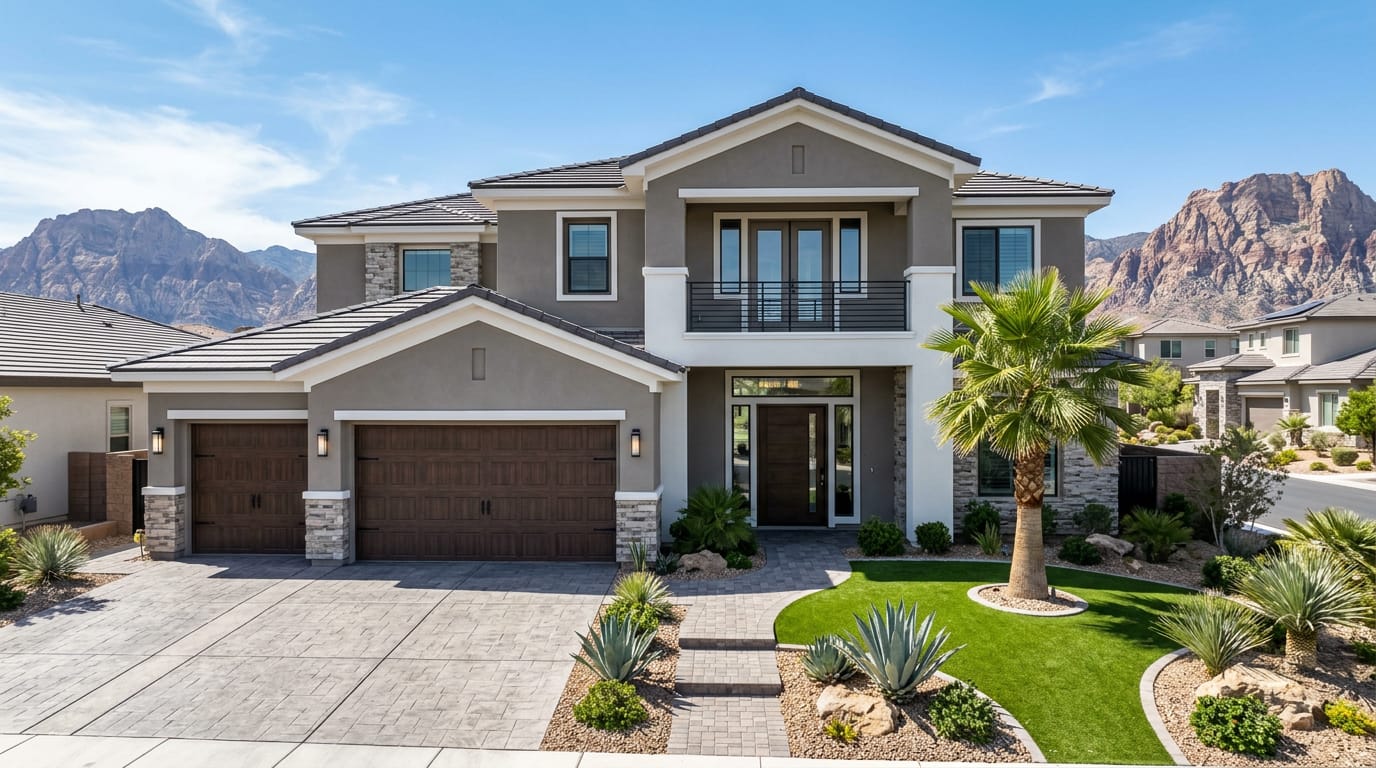
What is allowed and encouraged: decomposed granite in tan, brown, or rust tones; river rock and boulders in earth tones; drought-tolerant plants from the ARC-approved plant list (desert willow, mesquite, palo verde trees, red yucca, agave, lantana, verbena, brittlebush, salvia, and related species); flagstone and concrete accent paths; drip irrigation on a smart controller; ornamental boulders as focal features; shade structures or ramadas in rear yards.
How Do Summerlin's Pool Rules and Evaporation Requirements Work?
Pools represent a significant water-use category for Summerlin homeowners — a standard 15,000-gallon residential pool loses approximately 1 inch of water per day to evaporation in peak summer heat, totaling roughly 20,000 to 30,000 gallons per year through evaporation alone in Las Vegas's climate. The SNWA and LVVWD address pool water loss through a combination of recommendations and code requirements, and the Summerlin ARC governs the aesthetic elements of pool installations.
Pool covers are the most impactful conservation tool: according to the Southern Nevada Water Authority, a pool cover reduces evaporation by up to 95%, potentially saving 15,000 to 25,000 gallons per year on a typical Summerlin pool. The SNWA does not currently mandate pool covers for single-family residential properties, but the savings argument is compelling — at LVVWD mid-tier rates, 20,000 gallons represents approximately $80 in direct water costs, plus the pool cover extends chemical lifespan and reduces heating costs. Pool refills are typically metered at the standard residential rate, not the tiered-penalty rate, so the financial penalty for not covering is modest — but the conservation case is strong.
Summerlin's ARC governs pool aesthetics: pool equipment (pumps, filtration) must be screened from street view, pool barriers (fencing or wall) must match approved materials and heights per Clark County code and Summerlin community standards, and water features (fountains, spillways, grottos) must be submitted for ARC review. Pool decking materials must harmonize with the home's exterior — the ARC commonly rejects poured concrete decks that conflict with flagstone-finish stucco homes. For new-construction Summerlin homes in villages currently under development (Redpoint, Kestrel, Stonebridge), pools are permitted in back yards and are specifically excluded from the AB356 nonfunctional-water prohibition — the law targets ornamental irrigation turf, not swimming pools.
What Do Summerlin's New-Construction Rules Mean for Buyers in 2026?
Every new construction home delivered in Summerlin in 2026 — whether by Toll Brothers, Pulte, Taylor Morrison, Woodside Homes, or Century Communities — arrives with front-yard desert landscaping installed by code. The 2003 SNWA/LVVWD prohibition on new ornamental turf in single-family front yards means no builder has installed a traditional grass front lawn in a new Summerlin home for over two decades. Buyers purchasing in the active Summerlin villages (Redpoint Square, Kestrel, Stonebridge upper sections) should expect decomposed granite, drought-tolerant shrubs, a drip-irrigation system, and possibly a small accent tree as the standard front-yard delivery.
The builder's responsibility under current code ends at the front-yard landscape baseline — back-yard landscaping is typically delivered as raw desert, either bare soil or rough-graded decomposed granite. New buyers must complete back-yard landscaping within 12 months of closing per Summerlin ARC requirements, and that back-yard project also requires ARC approval. According to data from Las Vegas REALTORS, new-construction homes in active Summerlin villages were pricing from approximately $650,000 for a detached single-family home in the entry villages up to $2.5 million and above for estate-tier product in late 2025, with lot premiums and view-orientation driving significant spread. Back-yard landscape budgets for new Summerlin buyers typically run $25,000 to $75,000 for a full build-out including pool, covered patio, artificial turf (rear only — allowed in back yards), and desert planting.
| Item | New construction | Resale with existing xeriscape | Resale with existing grass |
|---|---|---|---|
| Front yard at closing | Desert-landscaped by code | Completed xeriscape | Existing turf (restricted by watering rules) |
| Back yard at closing | Raw grade, bare soil | Varies — may be complete | May include grass (allowed) |
| ARC submission needed | Back yard within 12 months | Changes only | Front-yard conversion if selling or upgrading |
| SNWA rebate eligibility | Back-yard conversion only | No (already converted) | Yes — full rebate on front-yard turf removed |
| Water bill (summer) | Lower (drip only) | Lower | Higher ($80–$150/mo more) |
| Buyer preference (2026 market) | Premium | Neutral to positive | Increasing seller risk |
Buyers planning a new yard can also review the new-construction landscape-requirements guide.
Which Xeriscape Plants Thrive in Summerlin's Climate and ARC Guidelines?
The Summerlin ARC maintains an approved plant palette that reflects both the community's Spanish/Mediterranean design heritage and the Mojave Desert's native plant community. The list is not exhaustive — unlisted species can receive individual ARC approval — but sticking to core approved species accelerates review and produces yards that look cohesive with the neighborhood. According to the Bureau of Reclamation's Lower Colorado regional plant guides, the following categories perform best in the Summerlin/Las Vegas Valley microclimate at elevation 2,000 feet with 4 to 7 inches of annual rainfall.
Shade trees and large shrubs (15+ feet mature): desert willow (Chilopsis linearis) blooms pink and purple through summer and is ARC-approved across Summerlin villages; palo verde (Parkinsonia species) delivers brilliant yellow flowering in spring; velvet mesquite (Prosopis velutina) provides dense canopy but requires root management near foundations. Medium shrubs (4–8 feet): Texas ranger/desert sage (Leucophyllum frutescens) blooms intensely after monsoon rain and is one of the most common Summerlin ARC approval recipients; red bird of paradise (Caesalpinia pulcherrima) delivers tropical color through summer; damianita (Chrysactinia mexicana) is low-growing with yellow flowers. Ground-level plants and accents: red yucca (Hesperaloe parviflora), agave species (century plant, artichoke agave, blue agave), brittlebush (Encelia farinosa), globe mallow (Sphaeralcea ambigua), and verbena. Cacti: saguaro, barrel cactus, and golden barrel are ARC-approved and add dramatic structure.
The ARC generally requires a minimum of 50% live plant coverage by design area (consistent with the SNWA rebate requirement) and discourages all-rock yards that meet the water-conservation goal but create heat-island effects and visual monotony. A well-designed Summerlin xeriscape alternates boulder groupings, plant masses, and mulch zones to create depth and seasonal color throughout the year — a design approach that both satisfies the ARC and maximizes rebate eligibility.
How Does Summerlin's Water Conservation Approach Affect Resale Value?
Across our 9,600+ closings at Nevada Real Estate Group, the market signal on desert landscaping has shifted clearly over the past three years. In 2021 and 2022, a well-maintained traditional grass lawn in a Summerlin resale was roughly neutral on buyer preference — some buyers liked it, some didn't. By 2025 and into 2026, the pattern has inverted: buyers conducting inspections and reviewing utility histories are specifically flagging grass lawns as a future liability, factoring conversion costs into their offer pricing, and in some cases writing credits for anticipated conversion work into purchase agreements. A beautifully executed xeriscape conversion is now a selling point, not a concession.
The resale-value data is harder to isolate precisely because xeriscape quality varies so much — a poorly executed gravel-dump conversion with no live plants actually repels buyers, while a high-design ARC-approved xeriscape with mature specimen plants can genuinely support a $5,000 to $15,000 premium over an identical home with tired grass. According to Las Vegas REALTORS data for Q1 2026, Summerlin's median resale price was approximately $650,000 for detached single-family homes, with the premium villages (The Ridges, The Cliffs, Summerlin Centre) transacting well above $1.2 million at median. In that context, a $7,000 net-cost xeriscape conversion that adds perceived value and eliminates a buyer objection is a rational pre-listing investment. For sellers considering timing, call (702) 637-1759 — our team can review your specific yard's conversion potential before you list.

Should Summerlin Homeowners Convert Before or After the AB356 Deadline?
Convert now if you have existing front-yard turf — the SNWA rebate is live, the ARC is processing conversion submittals efficiently, and doing the work on your timeline beats scrambling alongside hundreds of other Summerlin homeowners as the December 2026 common-area deadline approaches. The rebate program has funded thousands of projects per year and has historically remained open, but rebate rates and program availability can change — the SNWA adjusts based on conservation targets and funding.
The strategic sequencing: (1) get an informal landscape design from a Summerlin-familiar contractor, (2) submit the ARC package and wait for approval (10 to 30 days), (3) file the SNWA pre-approval application, (4) schedule and complete the installation, (5) request the SNWA post-installation inspection, (6) receive the rebate check. This process runs four to eight weeks from ARC submission to check in hand. The hardest bottleneck is ARC queue time — summer months see the highest volume of landscape submittals, so submitting in September through November tends to move faster.
For homeowners currently under contract to sell, coordinate the xeriscape conversion with the close of escrow timeline. A half-completed conversion during the listing period is worse than either leaving the grass as-is or completing the conversion before going live. If listing within 90 days, either complete the conversion before listing or offer a documented credit — our team at Nevada Real Estate Group can help you calculate the credit amount that reflects actual rebate eligibility so you're not overpaying. According to the U.S. Census Bureau, approximately 8,400 housing units in the Summerlin ZIP codes (89135, 89138, 89144, 89117) were estimated as owner-occupied as of 2024, representing a significant total conversion opportunity. The homeowners who move early capture the rebate cleanly and position their properties ahead of the compliance cycle.
Is the AB356 Deadline Being Challenged in Court?
Yes, and any Summerlin homeowner planning around the December 2026 date should know that before deciding when to convert.
A group of valley homeowners sued the Southern Nevada Water Authority over how the nonfunctional-turf rule is being applied, and the case is now in federal court. It is docketed as Nill v. Southern Nevada Water Authority, case number 2:26-cv-01291 in the U.S. District Court for the District of Nevada, filed April 24, 2026 and assigned to Judge Gloria Navarro. SNWA removed it there from the Eighth Judicial District Court in Clark County, where it carried case number A-26-937025-C. The federal docket records it as a putative class action and categorises it under civil rights rather than as a water or environmental matter.
As reported by the Las Vegas Review-Journal and Fox5 Las Vegas, a Clark County judge first granted a temporary restraining order that paused enforcement, then narrowed it to the named plaintiffs' properties. The Nevada Supreme Court subsequently declined SNWA's request to end the case, and additional parties — including HOAs, a church, and golf interests — have since joined.
What this does and does not change for you. It does not repeal AB356, move the December 31, 2026 deadline, or suspend the rebate program, and single-family back-yard turf was never covered by the 2026 mandate in the first place. What it does mean is that the enforcement picture for common-area turf is genuinely unsettled while this proceeds, and that the homeowners driving the suit are largely arguing about consequences — notably mature trees dying once the surrounding turf irrigation is removed.
The practical advice above does not change: converting on your own timeline with the rebate in hand still beats converting under pressure. But if your association is weighing a large common-area removal, this is a live case worth watching, and a question worth putting to your HOA's counsel rather than to a landscaper.
Case status current as of August 17, 2026. Litigation moves; verify before relying on it.
Frequently Asked Questions
Does AB356 require me to remove my back-yard grass in Summerlin?
No — Nevada AB356 as currently enacted does not require removal of single-family residential back-yard turf by the December 2026 deadline. The 2026 mandate applies to nonfunctional ornamental turf on commercial, institutional, and common-area properties. Single-family residential back yards received a longer runway under the legislation, and the Nevada Legislature would need to act separately to extend the mandate to residential back yards. However, the SNWA watering restrictions — including day assignments and the 11 a.m. to 7 p.m. blackout — apply to back-yard irrigation as well.
Can my Summerlin HOA fine me if I replace my grass with rocks and desert plants?
The HOA cannot fine you for choosing xeriscape or drought-tolerant landscaping — NRS 116.330 explicitly prohibits HOA rules that prevent this. However, the Summerlin ARC can and will issue a compliance notice if the xeriscape design was not submitted and approved before installation. The fine risk is for skipping ARC approval, not for the choice of desert landscaping. Always submit the ARC package first — conversions that proceed without approval can be required to be redone to specification.
How long does SNWA Water Smart Landscapes rebate processing take?
According to the Southern Nevada Water Authority, rebate processing typically takes 30 to 60 days after a passing post-installation inspection. The total project timeline from initial application to rebate check usually runs 6 to 12 weeks — apply before starting work, complete the installation, request inspection, and allow the processing window. Processing times may extend during peak conversion periods (spring and late-year deadline rush).
What is the minimum live-plant percentage for SNWA rebate eligibility?
The SNWA Water Smart Landscapes rebate requires a minimum of 50% live plant coverage by area in the converted zones. This means you cannot convert to an all-rock or all-gravel yard and still collect the rebate — the program is specifically designed to fund landscaping that reduces the heat-island effect and supports a more livable outdoor environment, not just turf removal. The Summerlin ARC's similar requirement makes the two standards naturally aligned.
Is artificial/synthetic turf allowed in Summerlin?
Synthetic turf is not permitted in front yards under current Summerlin ARC guidelines. It is generally allowed in back yards as a recreational surface, provided the installation includes adequate drainage and does not create a hot-surface heat-island problem adjacent to the home. Back-yard synthetic turf still requires ARC design approval. Note that Nevada AB356's nonfunctional turf ban targets real grass (natural turf that requires irrigation); the law does not mandate removal of pre-existing synthetic surfaces, but Summerlin's own ARC rules restrict where synthetic turf can be placed.
How does pool evaporation fit into Summerlin's water-use picture?
A typical Summerlin pool loses 20,000 to 30,000 gallons per year to evaporation without a cover — comparable to the irrigation water saved by converting a 400-square-foot front lawn. According to the SNWA, a pool cover cuts evaporative losses by up to 95%. The SNWA currently offers periodic pool-cover rebates (check snwa.com for current program availability); the LVVWD meters pool refills at the standard residential rate. For Summerlin sellers, a well-maintained pool with a current cover is a neutral-to-positive buyer signal; a visibly neglected pool with a high water-use history is a disclosure and negotiation item.
Which Sources Inform This Summerlin Desert Landscaping Guide?
This guide draws on regulatory filings, agency publications, and market data rather than competitor portals or unverified estimates. Every dollar figure and policy detail is sourced from the authorities listed below.
The primary regulatory sources are Nevada Assembly Bill 356 (2021) — turf-elimination mandate via the Nevada Legislature's official statute repository, the Southern Nevada Water Authority (SNWA) for AB356 implementation details, rebate program rules, watering restrictions, and conservation statistics, and the Las Vegas Valley Water District (LVVWD) for residential rate structures, conservation landscape program guidelines, and metering data. NRS Chapter 116 (Common-Interest Communities) governs the HOA restrictions on xeriscape prohibition. The U.S. Bureau of Reclamation, Lower Colorado Region provides Colorado River allocation data and desert-landscape best practices. Howard Hughes Corporation / Summerlin.com is the master developer source for community conversion progress and ARC guidelines. Market transaction data is sourced from Las Vegas REALTORS (GLVAR) for median price and volume statistics. Demographic data is sourced from the U.S. Census Bureau American Community Survey for owner-occupied housing estimates in Summerlin ZIP codes. Clark County Assessor records underpin property-level data citations. The Nevada Department of Taxation and Nevada Revised Statutes provide the statutory framework for HOA governance. Additional context on desert plant species performance comes from the Bureau of Reclamation lower Colorado landscaping guides. For current water rates and tier structures, always verify directly with the LVVWD rate schedule and SNWA program pages as these change with Nevada water-authority board action. Call Nevada Real Estate Group at (702) 637-1759 with questions on resale timing or ARC submission strategy.