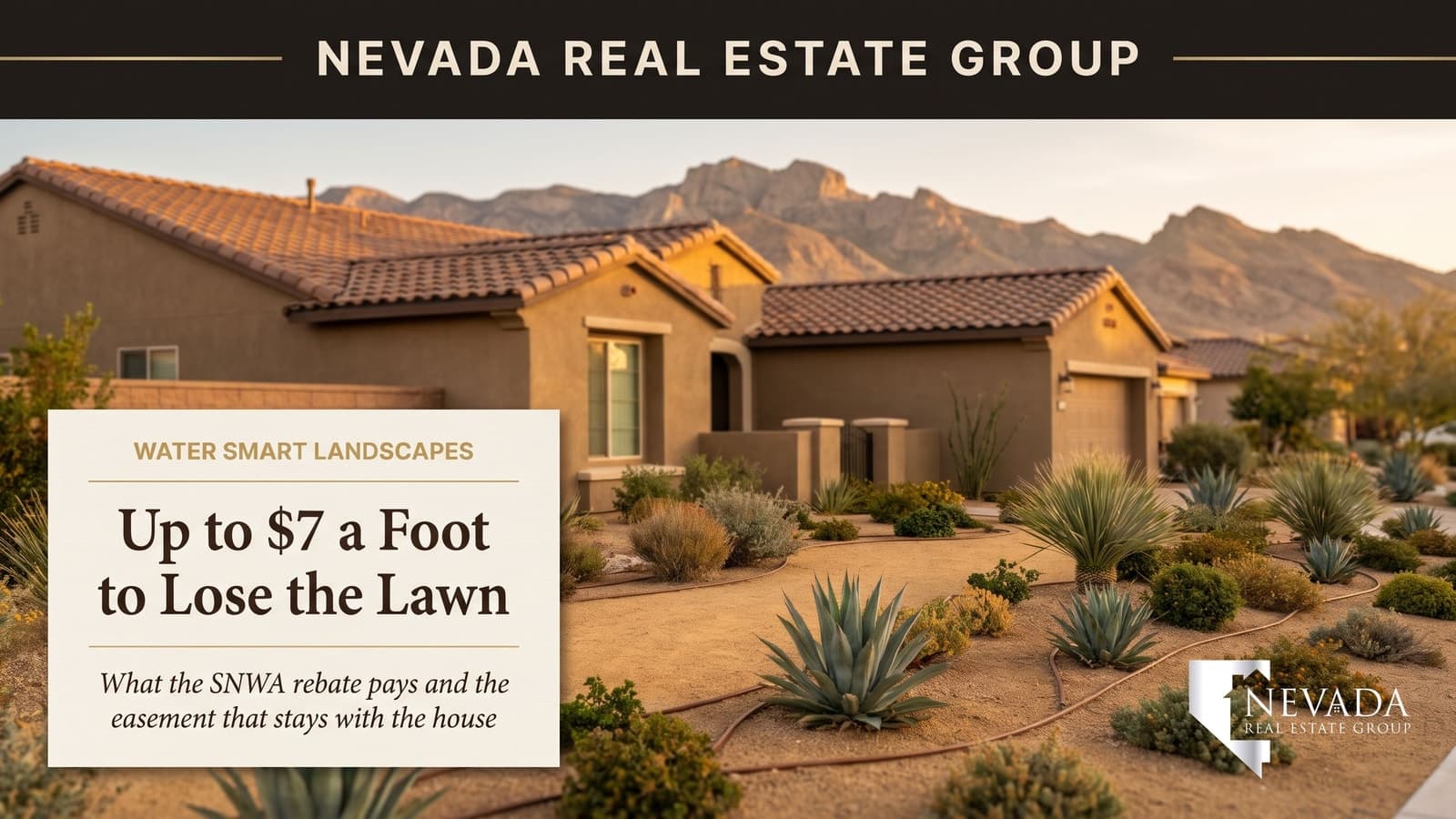

Direct Answer: Las Vegas new construction homes typically deliver with bare-dirt backyards and side yards — and HOAs across most master-planned communities require homeowners to install completed landscape within 30-180 days after close. Most buyers face $10,000-$25,000 in landscape installation costs they didn't include in their original purchase budget. Don't count on the Southern Nevada Water Authority (SNWA) Water Smart Landscapes rebate to offset it: the rebate pays $5 per square foot only for converting an existing, living lawn, and a new home is delivered without one, because irrigated grass is prohibited in the front and back yards of new residential development. Most master-planned communities maintain approved plant lists requiring buyers to select from pre-approved drought-tolerant species. Irrigation system installation typically costs $2,500-$5,500. Hardscape (pavers, walls, water features) adds $5,000-$30,000+. This guide covers HOA timelines by community, approved plant lists, irrigation cost components, contractor selection, where the SNWA rebate does and doesn't apply, and budgeting frameworks.
Las Vegas new construction homes typically deliver with bare-dirt backyards and side yards — and HOAs require completion within 30-180 days after close. Most buyers face $10,000-$25,000 in landscape installation costs they didn't budget for. Don't count on a Southern Nevada Water Authority rebate to offset it: the Water Smart Landscapes program pays $5 per square foot only to convert an existing lawn, and new homes are delivered without grass.
- Las Vegas new builds deliver with bare-dirt yards and HOA deadlines of 30 to 180 days.
- Most buyers face $10,000 to $25,000 in landscape costs they never budgeted at purchase.
- Miss the deadline and fines start at $50 to $200 monthly, escalating with continued non-compliance.
- Rock coverage on a 1,500 to 2,500 square foot backyard runs $2,250 to $7,500.
- Pavers add $4,500 to $12,000 depending on size and pattern, so price them before closing.
What Should Readers Know First?
- New construction homes typically deliver with bare-dirt back and side yards
- HOA landscape installation deadlines range 30-180 days post-close
- Typical complete landscape installation cost: $10,000-$25,000
- Front yard typically builder-installed at most master-planned communities
- Backyard and side yards typically homeowner responsibility
- SNWA's Water Smart Landscapes rebate ($5 per sq ft for the first 10,000 sq ft) pays only to convert an existing lawn, so new builds usually don't qualify
- Most HOAs maintain approved plant lists requiring drought-tolerant species
- Irrigation system installation $2,500-$5,500
- Hardscape adds $5,000-$30,000+ for pavers, walls, water features
- Contractor booking 8-12 weeks during peak season — schedule during construction phase
Why Do New Construction Homes Deliver With Bare Dirt Yards?
The dirt-to-landscape transition is one of the most consistent surprises first-time new construction buyers face in Las Vegas. Understanding why this happens helps buyers plan appropriately.
Builder economics. Builders typically include only minimal landscape in the base home pricing — usually limited to the front yard with basic builder-standard landscape. Backyard and side yard landscape installation is treated as buyer responsibility. The economic logic: buyers have different landscape preferences, and including a standardized landscape package would either disappoint half of buyers or significantly inflate base pricing.
The buyer experience. Buyers move into their new construction home with:
- Front yard: builder-installed basic desert landscape (rock, modest plant material, simple hardscape) — no grass, which, according to the Southern Nevada Water Authority, development codes have barred from new single-family front yards since 2004
- Side yards: bare dirt
- Backyard: bare dirt
- Side gates: typically installed by builder
- Fence: typically installed by builder
The first impression is unsettling for many buyers — the home is beautiful but surrounded by dirt. Las Vegas dust storms become a regular phenomenon during the install period. The backyard has no usable outdoor space until landscape installation completes.
HOA response. Master-planned community HOAs recognize that bare-dirt yards detract from neighborhood aesthetics and create dust and erosion problems. HOA landscape installation requirements force completion within specific timeframes.
What Are Typical HOA Landscape Installation Timelines?
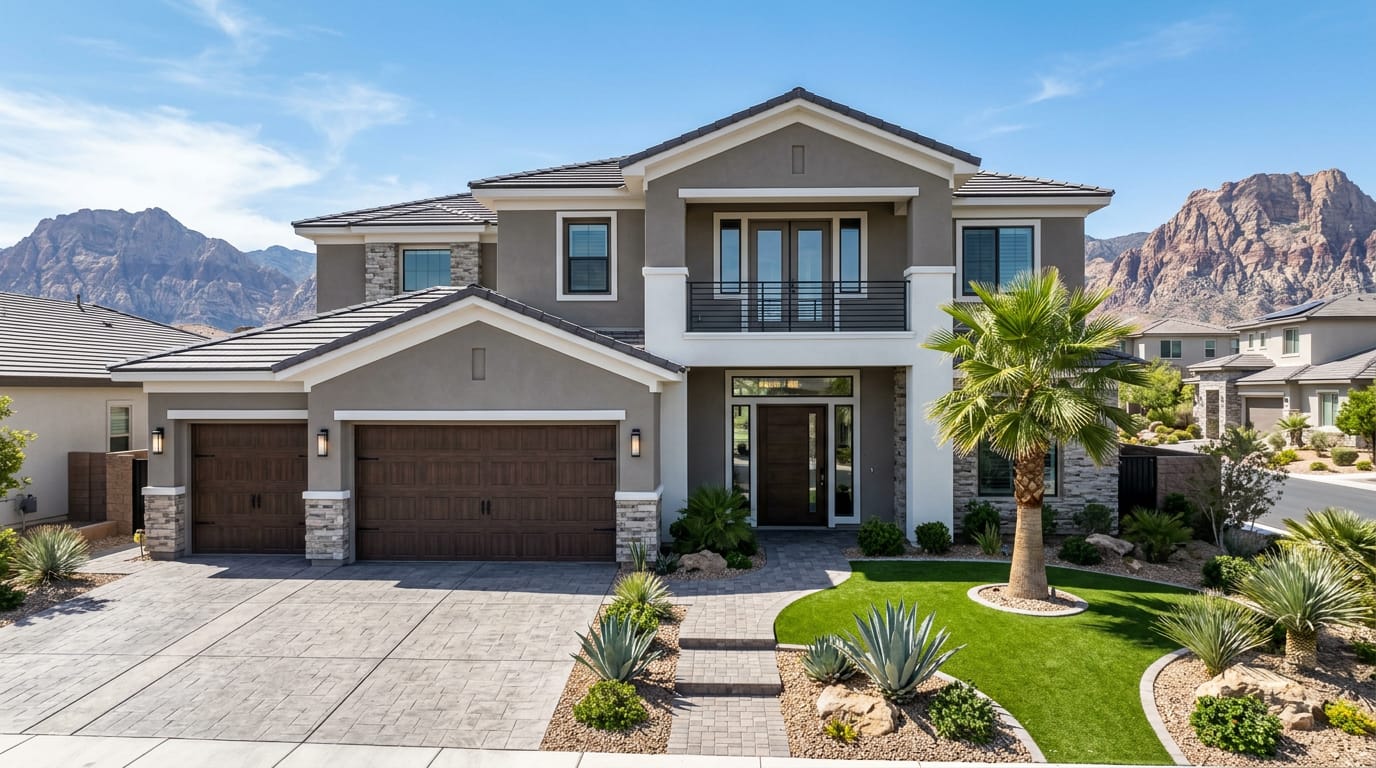
HOA timelines vary across Las Vegas master-planned communities. Generally falling in the 30-180 day range, with specific timelines depending on community standards and enforcement intensity.
| Community Tier | Typical Timeline | Strictness |
|---|---|---|
| Strict luxury communities (The Ridges, Ascaya, MacDonald Highlands) | 30-90 days | Strict enforcement with fines |
| Mid-tier master plans (Summerlin, Henderson luxury) | 60-120 days | Standard enforcement |
| Production master plans (Cadence, Inspirada, Skye Canyon) | 90-180 days | Standard enforcement |
| Affordable master plans | 120-180 days | Lighter enforcement |
| Stand-alone communities | Variable | Variable |
Strict communities. Luxury communities like The Ridges, Ascaya, and MacDonald Highlands enforce shorter timelines and apply meaningful fines for non-compliance. Fines typically start at $50-$200 per month past deadline and can escalate with continued non-compliance.
Standard communities. Most Las Vegas master-planned community HOAs accept the 90-180 day timeline for backyard landscape installation. Enforcement varies — some HOAs send written reminders at specific milestones (e.g., reminder at day 30, formal notice at day 60, formal violation at day 90). Others rely on neighbor complaints to trigger enforcement.
The reality of "deadlines." Most HOAs apply some flexibility when homeowners demonstrate good-faith effort toward compliance. A homeowner who has signed a landscape contract, has installation scheduled, and communicates with the HOA typically receives extension flexibility. Homeowners who simply ignore deadlines face escalating fines and potential lien procedures.
What Are the Typical Components of a Las Vegas New Construction Backyard Installation?
A complete Las Vegas backyard installation typically includes seven major components. Understanding the components helps buyers budget realistically.
Component 1: Site preparation and grading. Initial grading of the dirt yard to support proper drainage, removal of any debris, basic site preparation. Cost: $800-$2,000 depending on yard size and initial site conditions.
Component 2: Hardscape — perimeter and patio. Most backyards include hardscape extending from the house — patio extension, pathways, sometimes perimeter walls or decorative features. Basic concrete patio extension: $2,500-$5,500. Pavers: $4,500-$12,000+ depending on size and pattern. Built-in stone or block walls: $3,500-$15,000+.
Component 3: Irrigation system. Underground irrigation lines, valve boxes, controller, drip irrigation for plants. Required for plant survival in Las Vegas climate. Cost: $2,500-$5,500 for a typical residential backyard.
Component 4: Decorative rock and ground cover. Decorative rock (typically 1-3 inch sizes in browns, tans, or reds) covering ground surfaces. Approximately $1.50-$3.00 per square foot installed. Typical 1,500-2,500 sq ft backyard rock coverage: $2,250-$7,500.
Component 5: Drought-tolerant plants. Approved plant species per HOA list. Typical Las Vegas backyard includes 8-25 plants ranging from small shrubs ($25-$75 each installed) to larger specimen plants ($150-$400 each installed). Total plant material: $1,200-$5,000.
Component 6: Lighting. Low-voltage landscape lighting for outdoor evening use. Basic lighting package: $800-$2,500. More elaborate lighting with multiple zones: $2,500-$6,000.
Component 7: Water features or premium amenities (optional). Water features, fire features, built-in BBQs, pergolas, pools. Highly variable cost. Pools start at $35,000-$50,000+ and can exceed $150,000 for premium installations.
| Component | Basic Range | Premium Range |
|---|---|---|
| Site prep and grading | $800-$1,500 | $1,500-$3,000 |
| Hardscape patio/walls | $2,500-$5,500 | $10,000-$30,000+ |
| Irrigation system | $2,500-$4,000 | $4,000-$8,000 |
| Decorative rock/ground cover | $2,250-$4,500 | $4,500-$10,000 |
| Drought-tolerant plants | $1,200-$3,000 | $3,000-$8,000 |
| Lighting | $800-$2,000 | $2,000-$6,000 |
| Subtotal (basic xeriscape) | $10,050-$20,500 | $25,000-$65,000+ |
| Water/fire features (optional) | — | $5,000-$30,000 |
| Pool installation (optional) | — | $35,000-$150,000+ |
Basic xeriscape budget. Most Las Vegas new construction buyers complete basic xeriscape installation for $10,000-$20,000 across the seven components.
Premium landscape budget. Buyers wanting more elaborate landscape with extensive hardscape, premium plant specimens, water features, or pool can easily reach $30,000-$75,000+ for completion.
How Does the SNWA Water Smart Landscapes Program Work?
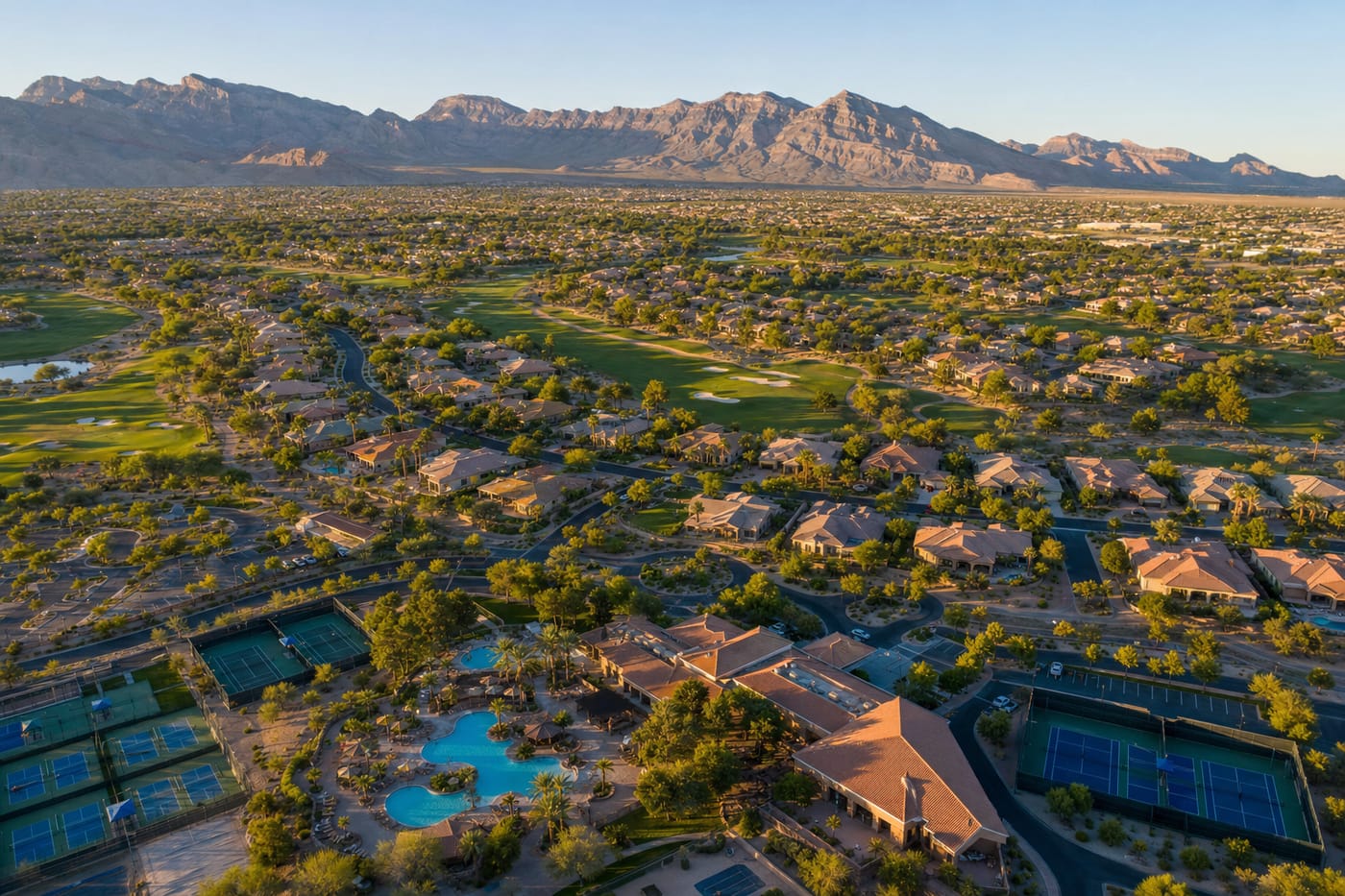
The Southern Nevada Water Authority (SNWA) Water Smart Landscapes Program is a meaningful financial offset for converting an existing lawn to desert landscape. For a new construction buyer with a bare-dirt yard, it is usually worth nothing, and knowing that before you budget is the point of this section.
Program structure. According to SNWA's residential program conditions, new single-family applicants since September 18, 2025 are paid $5.00 per square foot for the first 10,000 square feet of grass converted to desert landscape and $2.50 per square foot thereafter, per property, per fiscal year (July 1–June 30). The Las Vegas Valley Water District adds $2 per square foot for its residential customers — $7 up to 10,000 square feet and $4.50 thereafter — and SNWA's Water Smart Landscapes page lists a $575 City of Henderson supplement and a $100 bonus for each qualifying new tree. The rebate is open to properties served by an SNWA member water agency, or by a well in the Las Vegas Valley Groundwater Basin, with an account in good standing.
Application to new construction. In practice, it usually doesn't apply. The rebate pays only to replace a living, maintained lawn, and a new Las Vegas home is delivered without one: according to the Southern Nevada Water Authority, development codes have barred grass from new single-family front yards since 2004, and in 2021 irrigated grass was prohibited in all new development, including residential front and back yards. The rebate is therefore mostly a resale-home tool:
- A resale home with an existing front or back lawn that the owner converts to desert landscape
- At least 400 square feet of lawn converted (smaller projects only at SNWA's discretion, where less lawn exists)
- Not a new build's bare-dirt yard, which has no lawn to convert
The rebate does NOT apply to bare-dirt yards converted directly to desert landscape, which describes nearly every new construction backyard. SNWA's FAQ is explicit that "you must be currently maintaining a grass lawn."
Specific eligibility. Under SNWA's residential conditions, properties must:
- Use water from an SNWA member water agency (such as the Las Vegas Valley Water District, City of Henderson or City of North Las Vegas) or a well in the Las Vegas Valley Groundwater Basin, with the account in good standing
- Convert a living, maintained lawn that was legal when it was installed (not bare dirt or already-converted desert landscape)
- Reach at least 50 percent living plant cover at maturity, using SNWA's plant list
- Use drip irrigation (if the area is watered) with a filter, pressure regulator and emitters rated at 20 gallons per hour or less, with a permeable mulch such as rock, bark, ungrouted pavers or permeable artificial turf
Application process. Apply before touching the lawn. SNWA requires a pre-conversion site visit and its authorization to proceed; removing grass before that makes the project ineligible. The owner (or contractor) then has 12 months to complete the conversion, SNWA inspects the finished work, and the owner signs a conservation easement that bars reinstalling grass in the converted area. SNWA records the easement with Clark County before the check is issued.
Realistic financial impact. A new construction buyer with a bare-dirt yard typically receives $0, so budget the full installation cost. A resale buyer converting a 600 sq ft front lawn would receive $3,000 from SNWA ($4,200 for an LVVWD customer with the $2 add-on). Converting a larger 1,200 sq ft front and side lawn would return $6,000 ($8,400 for an LVVWD customer). The $5 rate covers the first 10,000 square feet per property per fiscal year; anything beyond that is paid at $2.50.
Important caveat. Rebate amounts have changed before and can change again. Buyers converting an existing lawn should confirm the current terms on SNWA's Water Smart Landscapes page or with their water utility before planning a project around the rebate.
What Are HOA Approved Plant Lists and Why Do They Matter?
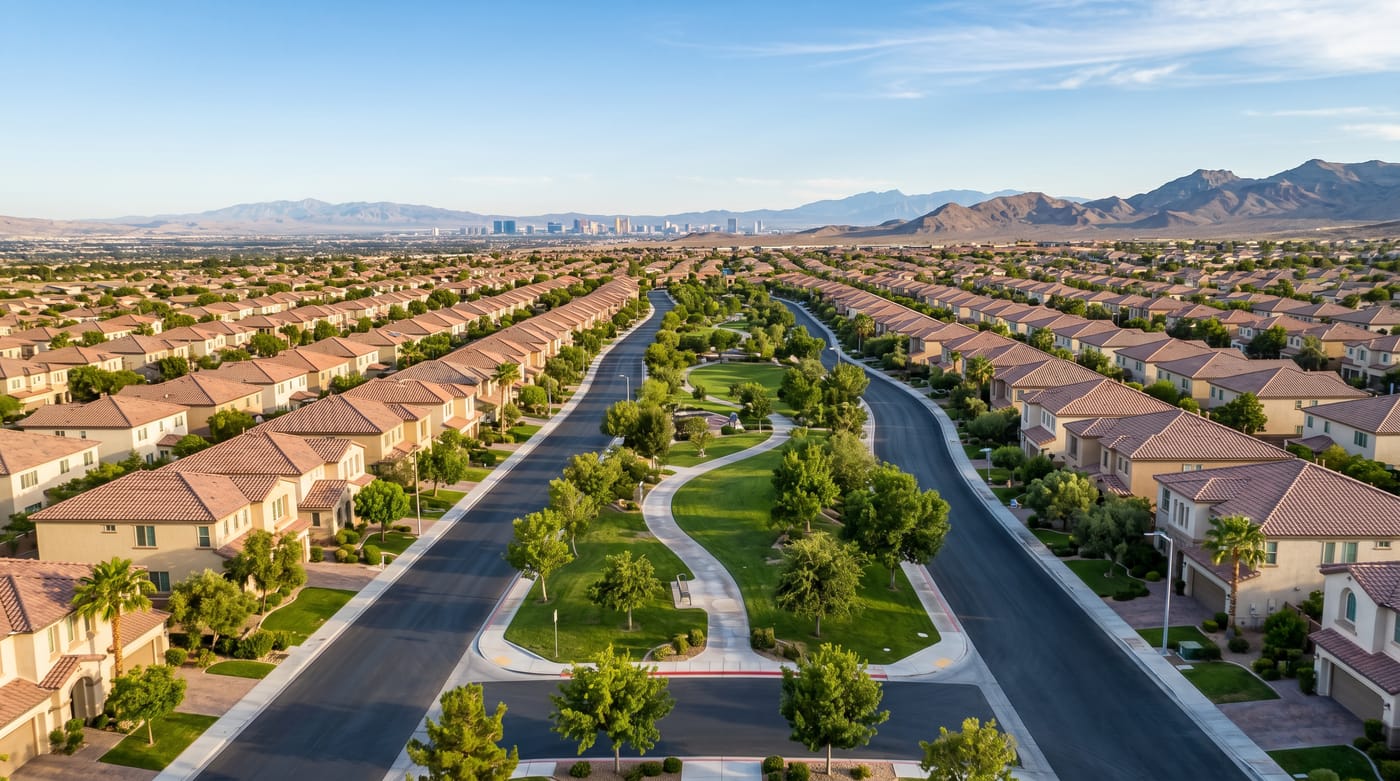
Most Las Vegas master-planned community HOAs maintain approved plant lists requiring homeowners to select landscape plants from pre-approved species. The lists serve community aesthetic cohesion and ensure plant selections meet drought-tolerance and Las Vegas climate requirements.
Typical approved plant categories.
Trees. Common approved species include Desert Willow (Chilopsis linearis), Chaste Tree (Vitex agnus-castus), Texas Mountain Laurel (Sophora secundiflora), Texas Olive (Cordia boissieri), Palo Verde (Parkinsonia florida or microphylla), Mesquite (Prosopis chilensis or velutina), and various drought-tolerant trees suited to Las Vegas climate.
Large shrubs. Common approved species include Yellow Bells (Tecoma stans), Texas Sage (Leucophyllum frutescens), Bird of Paradise (Caesalpinia gilliesii), Lantana (Lantana camara), and various other drought-tolerant large shrubs.
Medium shrubs and groundcover. Common species include Brittlebush (Encelia farinosa), Damianita (Chrysactinia mexicana), Verbena (Verbena rigida), Trailing Lantana (Lantana montevidensis), and various drought-tolerant medium shrubs.
Cacti and succulents. Saguaro Cactus (Carnegiea gigantea), Golden Barrel Cactus (Echinocactus grusonii), Agave species (multiple), Yucca species (multiple), and various other cacti and succulents.
Restricted or prohibited species. Irrigated grass of any species is off the table in a new Las Vegas yard: according to SNWA's laws and ordinances page, a December 2021 SNWA board resolution prohibits installing irrigated grass in the front and back yards of new residential developments, including master-planned communities and custom homes. Beyond that, most HOA lists prohibit invasive species (Russian Olive, Tamarisk), high-water-use ornamental plants, and plants with thorny characteristics that pose pedestrian hazards. Artificial turf is a separate question — SNWA notes that an HOA may restrict it, so check the design guidelines before you plan on it.
How to access approved plant lists. Most HOA management companies provide approved plant lists to homeowners upon request. Some lists are available online at the HOA website. Buyers should request the list immediately upon close (or during contract phase) to inform landscape design decisions.
Working within the list. Approved plant lists typically include 60-150 species. Most landscape designers can create attractive, varied designs within the approved species. Working with experienced Las Vegas landscape designers familiar with the specific community's approved plant list speeds the design process.
What Are Typical Las Vegas Landscape Contractor Costs?
Las Vegas has dozens of established landscape contractors serving the new construction market. Pricing varies based on scope and contractor reputation.
Typical contractor pricing structures.
Per-square-foot pricing. Most contractors price installations on per-square-foot basis. Typical 2026 pricing:
- Basic xeriscape (rock + plants + irrigation): $7-$12 per sq ft
- Enhanced xeriscape with hardscape additions: $12-$20 per sq ft
- Full landscape with extensive hardscape and water features: $20-$50+ per sq ft
Project-based pricing. Larger projects ($25,000+) are sometimes priced as fixed-cost projects rather than per-square-foot.
Hourly pricing. Some contractors use hourly pricing for smaller jobs or specialty work.
Contractor selection factors.
Reputation and references. Established Las Vegas contractors with strong reputations command premium pricing but typically deliver better quality. Verify recent references from new construction installations.
HOA familiarity. Contractors who regularly work in specific master-planned communities know the approved plant lists, ARC submission process, and HOA expectations. This expertise speeds the project.
License and insurance. Verify contractor Nevada landscape contractor license and liability insurance. Unlicensed contractors save money but expose buyers to liability and quality risks.
Warranty. Most established Las Vegas landscape contractors provide 1-year plant warranty. Some provide longer warranty on hardscape (5-10 years on pavers, walls, etc.).
Booking timeline. During peak season (March-May and September-November), established contractors book 8-12 weeks out. Buyers should schedule landscape contracts during home construction phase (months 4-7 of the build) to ensure availability for installation immediately after close.
How Should Buyers Plan and Budget Landscape Installation?
A realistic landscape planning framework spans the new construction timeline.
Phase 1: Pre-contract (before signing builder contract). Budget $15,000-$25,000 for backyard and side yard landscape installation in your overall purchase budget. Don't treat this as optional or deferrable — HOA timelines force completion regardless of buyer preference.
Phase 2: Contract through month 3 of build. Research Las Vegas landscape contractors. Get 3-4 quotes for basic xeriscape installation. Identify your top 2-3 contractor preferences. Don't sign contracts yet — pricing and scheduling will firm up closer to close.
Phase 3: Months 4-6 of build. Engage with your preferred contractor on design development. Schedule preliminary site visit when the home is at framing stage. Refine design and pricing. Reserve installation slot for the period after close.
Phase 4: Months 6-8 of build. Sign landscape contract with selected contractor. Pay deposit per contract terms (typically 30-50%). Confirm installation timing. Submit any required HOA architectural review committee approvals.
Phase 5: Final 30-60 days before close. Confirm installation start date. Order any specialty plants or materials with long lead times.
Phase 6: Close + first 90 days. Installation begins shortly after close. Most basic xeriscape installations complete in 2-4 weeks once contractor begins. Hardscape-heavy installations take 4-8 weeks. A new-build yard normally has no SNWA rebate to file, because there is no lawn to convert; the rebate's application and pre-conversion site visit apply only when an existing lawn is being removed, and both must happen before any grass comes out.
Common planning mistakes.
Mistake 1: Waiting until after close to start planning. Contractors book 8-12 weeks out during peak season. Waiting until after close to start contractor research often results in either rushed work, premium pricing for expedited installation, or HOA timeline violations.
Mistake 2: Underestimating budget. $10,000-$25,000 is the typical realistic range. Buyers who budget $5,000-$8,000 frequently find themselves either taking shortcuts that compromise the result or facing unexpected debt to complete the project.
Mistake 3: Budgeting around an SNWA rebate. The Water Smart Landscapes rebate pays only to convert an existing, living lawn, and a new Las Vegas home is delivered without one, so a new construction buyer should budget the yard at full cost. The buyers who should always apply are resale owners converting a lawn — and they must apply before removing any grass.
How Do Different Las Vegas Master-Planned Community HOAs Differ on Landscape Requirements?
HOA landscape requirements vary across Las Vegas master-planned communities in specific dimensions worth understanding.
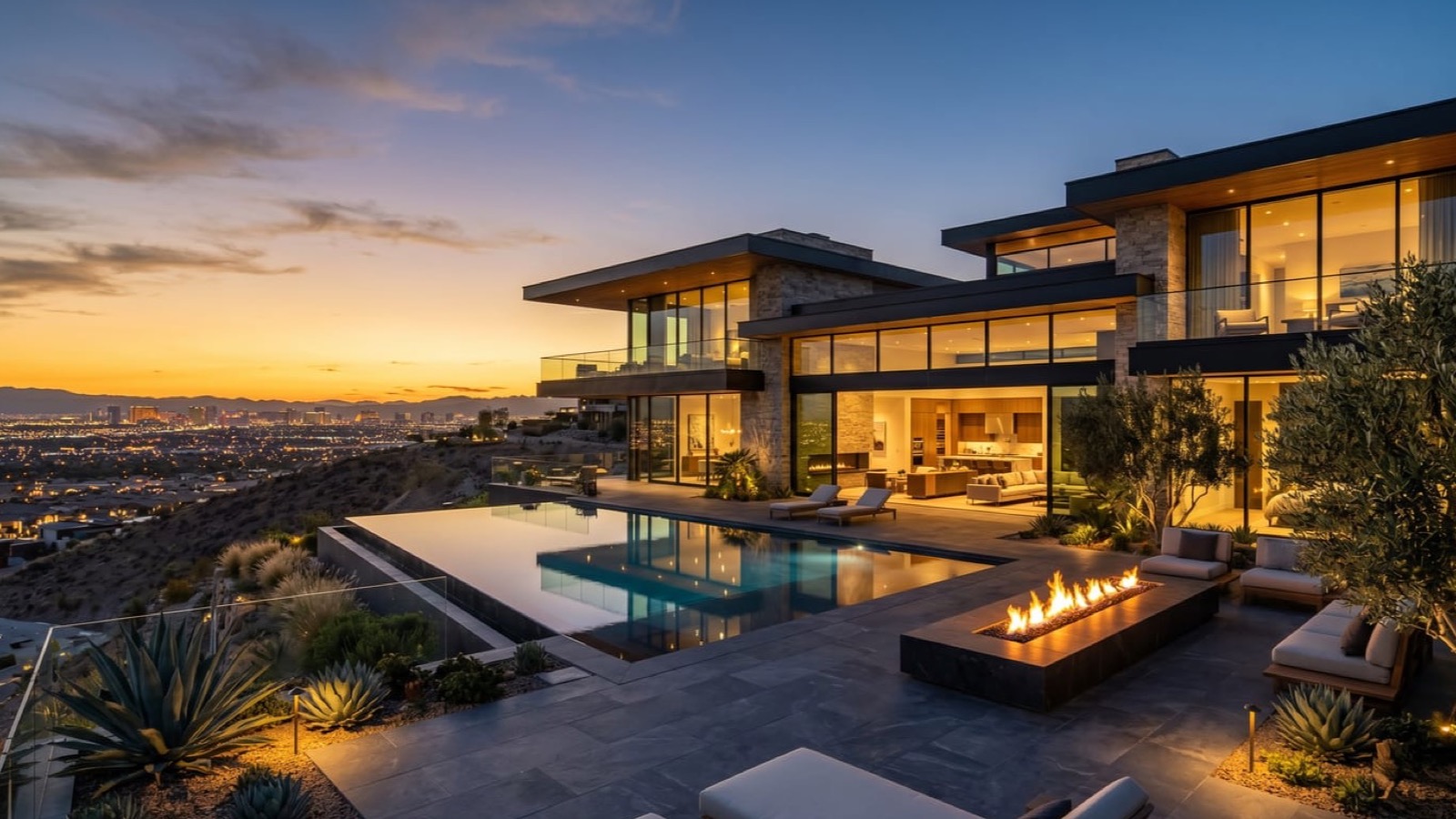
Stricter communities. Luxury communities like The Ridges, Ascaya, MacDonald Highlands, and parts of Summerlin maintain stricter landscape requirements. Specific characteristics:
- Pre-installation ARC (Architectural Review Committee) approval required
- Specific design standards for hardscape materials and colors
- Approved plant lists more curated
- Faster installation timelines (30-90 days)
- Stricter enforcement of completion deadlines
- Sometimes restrictions on plant size (no small specimens that look "incomplete")
Standard production communities. Cadence, Inspirada, Skye Canyon, Tule Springs, and other standard production master plans typically have:
- ARC approval required but typically streamlined
- Approved plant lists with broader options
- 90-180 day installation timelines
- Standard enforcement (written reminders, escalating fines for non-compliance)
- Reasonable flexibility for buyers demonstrating good-faith effort
Affordable-tier communities. Some affordable-tier and standalone communities have lighter landscape requirements:
- Less restrictive plant lists
- Longer installation timelines (often 180 days)
- Lighter enforcement
- More flexibility on hardscape materials
Practical buyer guidance. Buyers should request the HOA's complete landscape requirements during the contract period. Key documents include: approved plant list, ARC submission requirements, installation timeline policy, enforcement policy, examples of approved landscape designs.
What Should Buyers Know About Ongoing Landscape Maintenance Costs?
Initial landscape installation is one-time. Ongoing maintenance is recurring and can affect total cost of ownership meaningfully.
Recurring water costs. Desert landscape with proper drip irrigation typically adds $30-$75 per month to water utility bills during summer months and $10-$30 per month during cooler months. Annual water cost for typical desert landscape: $400-$900. Irrigated grass isn't an option in a new yard, but on a resale home that still has a lawn it costs significantly more to water (typical $800-$2,000 annually).
Plant replacement. Plant survival is good with proper irrigation, but some replacement is normal — typically 5-15% of plant material in the first 2 years and 2-5% annually thereafter. Replacement cost: typically $200-$500 annually for normal replacement, more for buyers replacing larger specimens.
Professional landscape service. Many Las Vegas homeowners use professional landscape services for monthly maintenance — trimming, plant care, weed control, irrigation system maintenance. Typical monthly cost: $80-$200 per month depending on yard size and service scope. Annual professional service cost: $1,000-$2,400.
DIY maintenance. Homeowners performing their own maintenance save the professional service cost but invest 2-6 hours monthly during peak growing season and 1-3 hours monthly during cooler months. Total time investment: 20-50 hours annually.
Irrigation system maintenance. Drip irrigation systems require periodic maintenance — emitter replacement, line repair, controller updates. Typical annual irrigation maintenance: $100-$300 for owner-performed maintenance, $300-$600 for professional service.
Hardscape maintenance. Pavers, walls, and water features require periodic cleaning and sealing. Most Las Vegas hardscape needs sealing every 3-5 years at cost of $0.50-$1.50 per sq ft of paver surface. Water feature maintenance varies widely depending on feature complexity.
Total ongoing landscape maintenance cost. Typical Las Vegas homeowner total annual landscape ongoing cost: $1,400-$3,500 including water, plant replacement, maintenance, and irrigation service. Larger yards and premium installations can run $4,000-$8,000+ annually.
Budget framework. Buyers should plan for total landscape costs including initial installation + ongoing maintenance:
- Year 1 (installation + initial maintenance): $11,000-$28,000
- Years 2-5 (ongoing): $1,500-$4,000 annually
- 10-year total: $25,000-$60,000 for typical Las Vegas backyard landscape ownership
What Are Common Mistakes Buyers Make on New Construction Landscaping?
Mistake 1: Treating front yard differently than other yards. Many builders install the front yard. Buyers sometimes assume they don't need to plan additional landscape for that area. In practice, buyers should evaluate whether the builder-installed front yard meets their preferences. Builder front yards are desert landscape, so there is no lawn to convert and no rebate to claim; the question is upgrades — more plant material, better rock, lighting — which typically go through the HOA's design review.
Mistake 2: Choosing the cheapest contractor. Las Vegas landscape pricing varies meaningfully. Lowest-quote contractors sometimes deliver inferior installation quality, plant survival issues, or warranty disputes. Quality contractors at mid-market pricing typically deliver better total economic outcomes.
Mistake 3: Skipping the irrigation system. Some budget-constrained buyers skip the irrigation system, planning to hand-water plants. This approach fails in Las Vegas climate — plants stress quickly without consistent irrigation, and hand-watering is impractical for typical homeowners. Always include proper drip irrigation.
Mistake 4: Over-planting initially. New plantings look sparse because plants are small. Buyers sometimes over-plant to create an immediate full appearance. Over-planted landscapes look crowded as plants mature, sometimes requiring removal at 3-5 years. Use proper spacing per mature plant size.
Mistake 5: Ignoring drainage. Las Vegas's occasional intense rainfall makes drainage important. Proper grading and drainage planning prevents future yard problems. Cutting corners on drainage during initial installation creates expensive repairs later.
Mistake 6: Planning around the wrong time of year for planting. Las Vegas plant survival rates are highest when plants are installed in October-November or February-April. Summer plantings (June-September) face significant heat stress and lower survival rates. Plan installation timing around plant survival, not just contractor scheduling.
How Does Nevada Real Estate Group Help With Landscape Planning?
Nevada Real Estate Group represents Las Vegas new construction buyers throughout the transaction, including landscape planning support at no additional cost.
HOA requirements review. During the contract period, we obtain the complete HOA landscape requirements documentation and review with buyers. This includes approved plant lists, ARC submission requirements, installation timelines, and enforcement policies.
Contractor referrals. Our buyer network includes established Las Vegas landscape contractors with strong reputations across major master-planned communities. We facilitate connections between buyers and qualified contractors.
Timeline coordination. As home construction progresses through months 4-6, we help buyers coordinate landscape contractor engagement to ensure installation availability shortly after close.
SNWA rebate guidance. For resale buyers converting an existing lawn — the only yards the Water Smart Landscapes rebate covers — we walk through application timing, including SNWA's required pre-conversion site visit before any grass comes out. New construction buyers usually have no lawn to convert, so we budget their yards without a rebate.
Budget planning. During the original purchase budget discussion, we help buyers incorporate realistic $15,000-$25,000 landscape installation budgets into total move-in cost planning.
Part of standard representation. Landscape planning support carries no separate fee, and whether the builder pays our compensation is confirmed in writing before your first visit (see how buyer-broker agreements work in Nevada).
Do I have to landscape my new construction yard in Las Vegas?
Yes. Most Las Vegas master-planned community HOAs require homeowners to complete backyard and side yard landscape installation within specific timeframes (30-180 days depending on community). Bare-dirt yards violate HOA standards and result in escalating fines plus potential lien procedures for continued non-compliance. The front yard is typically installed by the builder; backyards and side yards are typically buyer responsibility.
How much does Las Vegas new construction landscape cost?
Basic xeriscape installation (rock + drought-tolerant plants + irrigation) typically costs $10,000-$20,000 for a typical Las Vegas backyard. Enhanced installations with extensive hardscape (pavers, walls) add $5,000-$15,000. Premium installations with water features, fire pits, or pools can reach $30,000-$150,000+. Don't expect an SNWA rebate to offset any of it on a new build: the Water Smart Landscapes rebate pays only to convert an existing lawn, and new homes are delivered without one.
What is the SNWA Water Smart Landscapes Program rebate?
It is a Southern Nevada Water Authority (SNWA) cash rebate for replacing an existing, living lawn with desert landscape. According to SNWA's residential program conditions, single-family applicants since September 18, 2025 receive $5.00 per square foot for the first 10,000 square feet and $2.50 per square foot thereafter, per property, per fiscal year; Las Vegas Valley Water District customers get an extra $2 per square foot. A 600 sq ft lawn conversion returns $3,000 from SNWA, or $4,200 with the LVVWD add-on. The project must convert at least 400 square feet and pass a pre-conversion site visit before any grass is removed. A new construction home usually doesn't qualify, because irrigated grass is prohibited in new residential yards and there is no lawn to convert. Check current terms on SNWA's Water Smart Landscapes page.
How long do I have to install landscaping after close?
HOA landscape installation timelines range 30-180 days post-close depending on community. Luxury communities like The Ridges, Ascaya, and MacDonald Highlands typically enforce 30-90 day timelines. Standard master plans like Cadence, Inspirada, and Skye Canyon typically have 90-180 day timelines. Some affordable-tier communities allow up to 180 days. Verify the specific timeline for your HOA before close.
What plants can I use in my Las Vegas yard?
Most Las Vegas master-planned community HOAs maintain approved plant lists requiring selection from pre-approved drought-tolerant species. Common approved plants include Desert Willow, Texas Sage, Yellow Bells, Lantana, various agaves and yuccas, Palo Verde and Mesquite trees, and cacti including Saguaro and Golden Barrel. Specific lists vary by community and should be obtained from HOA management during the contract period. Restricted plants typically include invasive species and high-water-use ornamentals, and irrigated grass is prohibited outright in the front and back yards of new residential developments under SNWA's December 2021 resolution.
How do I find a good Las Vegas landscape contractor?
Get 3-4 quotes from licensed Nevada landscape contractors. Verify contractor's Nevada landscape contractor license, liability insurance, and recent new construction references. Prioritize contractors with experience in your specific master-planned community — they know the approved plant list and HOA approval process. Schedule contractor engagement during months 4-6 of the home build to ensure availability for installation after close. Established Las Vegas contractors book 8-12 weeks out during peak season (March-May and September-November).
Can I delay landscape installation if I can't afford it right after close?
Some flexibility exists with most HOAs if homeowners demonstrate good-faith effort toward compliance — signed contract, scheduled installation, clear communication. However, ignoring HOA deadlines results in escalating fines (typically $50-$200/month past deadline) and potential lien procedures for sustained non-compliance. The fines compound over time and create significant financial pressure. Better strategy: budget for landscape installation as part of original purchase budget, finance landscape costs separately if needed, or choose a community with longer installation timelines.
Should I install grass or desert landscape in my Las Vegas backyard?
On a new build, irrigated grass isn't an option. According to the Southern Nevada Water Authority, grass has been barred from new single-family front yards since 2004, and a December 2021 SNWA board resolution prohibited irrigated grass in all new development, including residential front and back yards. So the backyard is desert landscape (xeriscape), which also brings lower water consumption, lower ongoing maintenance, lower water utility bills, and better long-term plant health in the Las Vegas climate. If you want a soft play or pet area, artificial turf is the alternative where the HOA's design guidelines allow it — SNWA notes that an HOA may restrict artificial turf, so confirm before you buy it. (A separate 2021 state law, AB 356, bars using Colorado River water on nonfunctional grass at commercial, multi-family, government and some HOA-managed areas from 2027; it does not apply to grass in single-family front and back yards.)
Are pools included in typical landscape installation budgets?
No. Pool installation is a separate budget category typically running $35,000-$50,000+ for basic installations and $50,000-$150,000+ for premium pools with spas, water features, and elaborate decking. Buyers planning pool installation should add this to overall budget separately. Pool installation timing is typically separate from initial landscape installation — many buyers complete basic xeriscape first, then add pool installation 1-3 years later as budget allows.
Nevada Real Estate Group represents new construction buyers throughout the transaction, including landscape planning support as part of standard buyer representation; whether the builder pays our compensation is confirmed in writing before your first visit. All cost estimates reflect May 2026 market conditions. SNWA program details, HOA requirements, and contractor pricing change over time and should be verified directly with relevant authorities. This guide provides general educational content; specific landscape projects benefit from licensed contractor consultation.
About the Author: Chris Nevada leads Nevada Real Estate Group, the #1 real estate team in Nevada with 150+ licensed agents and 9,097+ verified five-star reviews. Licensed in Nevada (S.181401), Chris has supported new construction buyers across every major Las Vegas builder including Toll Brothers, Lennar, Pulte, KB Home, D.R. Horton, Tri Pointe, Taylor Morrison, Richmond American, and others. For new construction representation, call (702) 637-1759 or email info@nevadagroup.com.
Nevada Real Estate Group · 8945 W Russell Rd, Suite 170 · Las Vegas, NV 89148 · (702) 637-1759
Related Reading:
- New Construction Timeline Las Vegas Build Reality (2026)
- 12 Builder Contract Clauses to Negotiate Las Vegas (2026)
- Pre-Drywall Inspection Las Vegas New Construction (2026)
- Nevada New Home Warranty 1/2/10 Year Coverage (2026)
- 7 First-Time Buyer New Construction Mistakes (2026)
- Las Vegas New Construction Buyer Guide
How Do These Findings Sit Against the Wider Las Vegas Market?
The numbers above reflect a specific corner of the Las Vegas housing market. The three reference tables below put that corner in context against Nevada Real Estate Group's career track record, current valley median price bands, and the mortgage-rate environment Las Vegas buyers and sellers are operating against in 2026.
NREG Career + 2025 Production Track Record
| Metric | Career Cumulative | 2025 Single Year |
|---|---|---|
| Closed transactions | 9,600+ | 789 |
| Closed sales volume | $4.85B+ | $361.5M+ |
| 5-star verified reviews | 9,097+ (Google + Zillow + FastExpert combined) | 1,200+ added in 2025 |
| Licensed agents on team | 150+ | 150+ |
| Years operating in Nevada | 16+ | 16+ |
| Industry rank | #1 Team in Nevada (RealTrends) | #1 Las Vegas FastExpert |
Las Vegas Valley Median Price by Price Band (Q1 2026)
| Price Band | Inventory Share | Median Days on Market | Sale-to-List Ratio |
|---|---|---|---|
| Under $400K (entry-level) | 18% | 24 days | 99.2% |
| $400K–$600K (move-up) | 38% | 21 days | 98.8% |
| $600K–$900K (premium) | 22% | 26 days | 98.4% |
| $900K–$1.5M (luxury entry) | 13% | 35 days | 97.6% |
| $1.5M+ (luxury / custom) | 9% | 52 days | 96.2% |
Current Mortgage Rate + Carrying-Cost Environment (May 2026)
| Loan Type | Typical Rate | Buyer Demographic |
|---|---|---|
| 30-year fixed conventional | 6.6–6.9% | Primary residence, 5–20% down |
| FHA 30-year | 6.4–6.7% | Lower down (3.5%), entry-level + first-time |
| VA 30-year | 6.3–6.6% | Military / veteran (Nellis AFB, retired Navy/Air Force) |
| Jumbo 30-year | 6.8–7.1% | Loans over $832,750 (Clark County 2026 limit) |
| 7/6 ARM | 6.2–6.5% | Move-up buyers planning a 5–8 year hold |
Which Industry Authorities Inform This Analysis?
According to Greater Las Vegas Realtors, the Las Vegas valley absorbed approximately 28,400 closed residential transactions in 2025 with a metro-median price of $465K, against approximately 4.2 months of supply — the most balanced inventory level since 2019.
According to the Clark County Assessor, the 2026 secondary tax rates across the major Las Vegas master plans range from approximately 0.30% (older Aliante bond stack) to 0.78% (Ascaya private infrastructure), with most newer Henderson submarkets clustered in the 0.40–0.55% band.
According to the U.S. Census Bureau American Community Survey, the Las Vegas-Henderson-Paradise MSA gained approximately 45,000 net new residents from California alone over the trailing 24 months ending Q1 2026, driving sustained demand in both entry-level and move-up price bands.
According to the Bureau of Labor Statistics regional payroll data, the Las Vegas MSA added approximately 41,000 non-farm payroll jobs through 2025 with concentrations in healthcare, logistics, and the resort sector, which sustains the $400K–$900K mortgage-qualifying buyer pool.
According to the Freddie Mac Primary Mortgage Market Survey, the 30-year fixed rate has settled into a 6.6–6.9% band through May 2026, allowing builders and sellers to price into a stable carrying-cost environment rather than the wide swings of 2023–2024.
Which Sources Inform This Las Vegas Real Estate Analysis?
According to Greater Las Vegas Realtors, market data, closing volumes, and median price figures in this analysis come from Greater Las Vegas Realtors monthly MLS statistics through April 2026. Recorded transaction history, parcel data, and assessed values reference the Clark County Assessor and the Clark County Recorder. License and brokerage verification draws from the Nevada Real Estate Division public licensee database.
Macro housing context references the U.S. Census Bureau American Community Survey, the Bureau of Labor Statistics Las Vegas-Henderson-Paradise MSA employment data, the Federal Housing Finance Agency House Price Index, and the Bureau of Economic Analysis state-level personal income data. Mortgage rate environment uses the Freddie Mac Primary Mortgage Market Survey weekly rate series and the Mortgage Bankers Association weekly applications survey.
According to Nevada Department of Taxation, property tax math references Nevada Revised Statutes Chapter 361 and the Nevada Department of Taxation. School ratings reference GreatSchools and the Clark County School District annual performance frameworks. Builder permit activity and certificate-of-occupancy data reference the Clark County Department of Building and the Nevada State Contractors Board.
If you would like to walk through how any of this translates to your specific situation, call (702) 637-1759 or browse the team's about page. Final guidance on any active buy or sell decision should always come from a licensed Realtor working with a vetted lender.