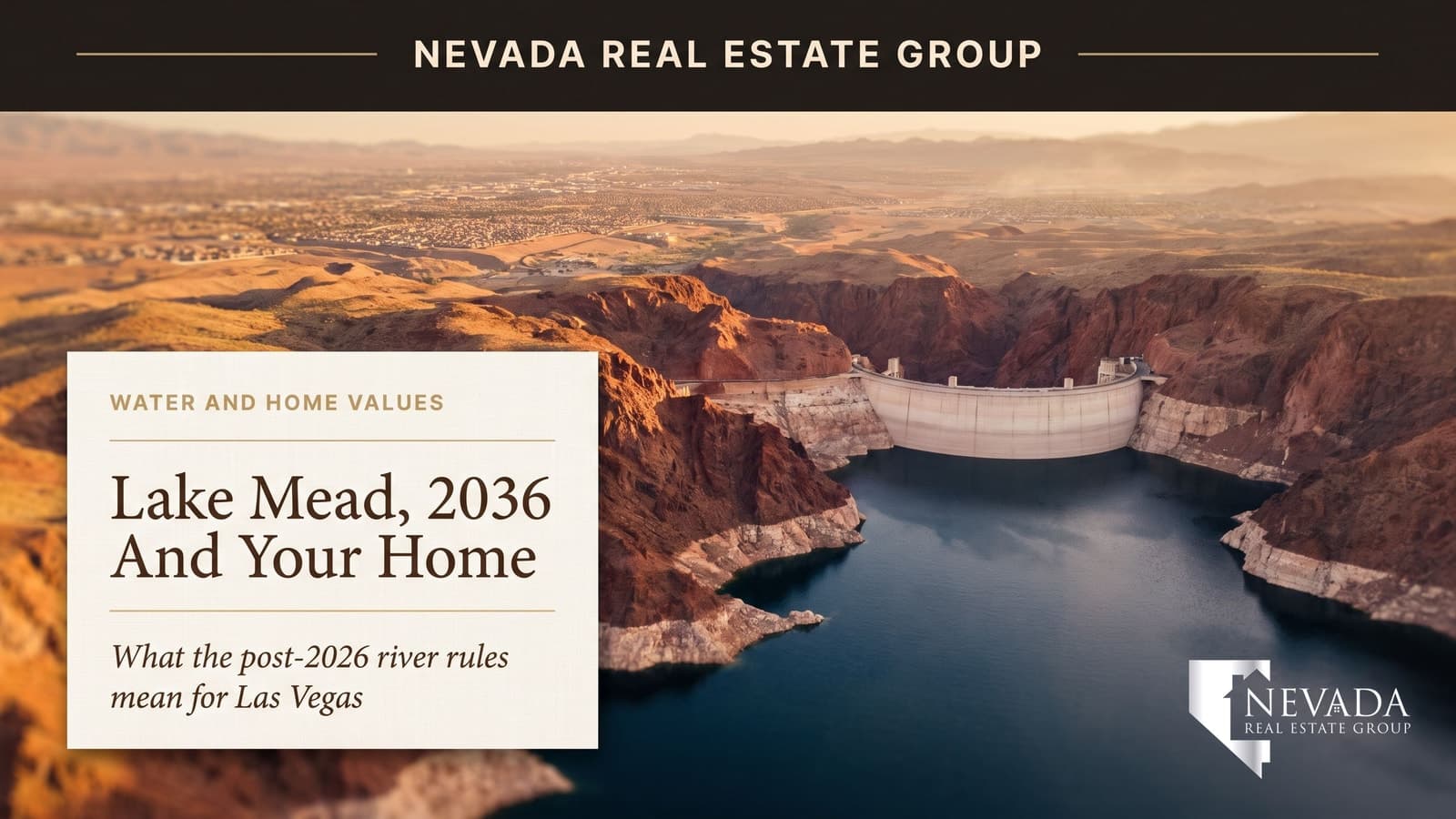

Lake Mead stood at 1,038.38 feet on September 18, 2026, about 26% of capacity, according to the Bureau of Reclamation's Lower Colorado operations data. Three weeks earlier, on August 21, 2026, the Department of the Interior signed the Record of Decision that replaces the 2007 Interim Guidelines when they expire at the end of this year, and with it the operating rules for 2027 and 2028 that cut Nevada's Colorado River allocation from 300,000 acre-feet to 250,000. Three days after that, Nevada sued.
Every buyer relocating to Las Vegas asks me about water, and most of the answers they have read are either reassurance without numbers or alarm without them. This guide takes the numbers as they stand on September 19, 2026: what the "2036 plan" is, how much water Southern Nevada actually uses, why return-flow credits and a $522 million pumping station change the arithmetic, what the turf and pool rules require of a homeowner, and what the September 2026 market report says about prices. No forecasts of price drops here, because nothing in the data supports one. What is known, with dates, follows.
The post-2026 Colorado River framework cuts Nevada's allocation to 250,000 acre-feet for 2027 and 2028, a 50,000 acre-foot reduction. Southern Nevada consumed 198,000 acre-feet in 2025, so the cut leaves about 52,000 acre-feet of headroom, and the region holds more than 2.2 million acre-feet in banked water. Water supply has not moved Las Vegas home prices; check your watering group, HOA landscape rules and the 600-square-foot pool cap before you buy.
- Interior's August 21, 2026 Record of Decision runs through 2036 with operating guidelines reissued every two years.
- Nevada's 2027 and 2028 allocation is 250,000 acre-feet; Southern Nevada used 198,000 acre-feet in 2025.
- Lake Mead measured 1,038.38 feet on September 18, 2026; Intake 3 and the pumping station reach 875 feet.
- Nevada's lawsuit says a worst-case 2029 cut of 213,556 acre-feet would leave under 86,500 acre-feet.
- Buyers should check watering group, HOA turf rules, pool surface area and irrigation before writing an offer.
What Are the 2007 Interim Guidelines, and Why Do They Expire in 2026?
The rules that have governed Lake Mead and Lake Powell for the past two decades were always temporary. According to the Bureau of Reclamation's post-2026 operations page, the 2007 Colorado River Interim Guidelines for Lower Basin Shortages and Coordinated Operations of Lake Powell and Lake Mead expire at the end of 2026, along with the 2019 Drought Contingency Plans and the related provisions of the water treaty with Mexico. The 2007 guidelines created the shortage tiers tied to Lake Mead's January 1 elevation that Southern Nevada has been living under, and they created Intentionally Created Surplus, the accounting system that lets a state store conserved water in Lake Mead for later use.
For Nevada the practical content of those rules has been a ladder of small reductions. According to the Southern Nevada Water Authority's shortage page, a Tier 1 shortage, declared when Lake Mead is projected at or below 1,075 feet on January 1, reduces Nevada's available supply by 21,000 acre-feet, and Nevada's combined Interim Guidelines and Drought Contingency Plan obligations range from zero to 30,000 acre-feet a year depending on the lake's elevation, with the DCP contribution running 8,000 to 10,000 acre-feet. A Tier 1 shortage is in effect for 2026. According to Reclamation's July 2026 24-Month Study, the August 2025 study projected the January 1, 2026 elevation below 1,075 feet and above 1,050 feet, which is what set the 2026 tier, and the same study projects Nevada's consumptive use above Hoover Dam at 0.189 million acre-feet for calendar year 2026.
The reason the guidelines needed replacing rather than renewing is hydrology. According to the SNWA 2026 Water Resource Plan executive summary, the period from 2000 through 2025 was the lowest 25-year runoff period on record in the Colorado River Basin, and as of late 2025 the combined storage in Lake Mead and Lake Powell was 31% of capacity. The 2007 tiers were designed for a lake that would occasionally dip to 1,075 feet, not one that has sat below that line through the shortage declarations for 2025 and 2026 and stood at 1,038 feet in September 2026. That mismatch is what the 2036 plan is meant to fix.
What Is the "2036 Plan" That Interior Adopted in August 2026?
The process ran on a public schedule. According to Reclamation's post-2026 page, the Draft Environmental Impact Statement was released on January 9, 2026, its 45-day comment period closed on March 2, 2026, six alternatives were analyzed, the Final EIS was published on July 31, 2026, and the Record of Decision was issued on August 21, 2026, together with the first set of operating guidelines covering 2027 and 2028. The seven basin states did not bring Interior a consensus agreement on long-term operations, and the agency proceeded on its own preferred alternative.
What Interior adopted is a framework rather than a fixed rulebook. According to the Department of the Interior's Final EIS announcement, the preferred alternative is an adaptive decision framework running through 2036, inside operational sideboards: annual Lake Powell releases between 5.0 and 12.0 million acre-feet, Lower Basin shortages of up to 3.0 million acre-feet, conserved-water storage capacity of 8.0 million acre-feet in Lake Powell and 3.0 million in Lake Mead, and voluntary Upper Basin conservation of up to 200,000 acre-feet. The document notes that Lower Basin consumption averaged 6.5 million acre-feet a year from 2020 through 2024. Operating guidelines are issued for two-year periods, unless a consensus agreement supports something longer.
The first two years are the concrete part. According to Interior's August 21, 2026 release, the 2027 and 2028 guidelines require the Lower Basin to reduce use by 1.25 million acre-feet in each year, split 760,000 acre-feet to Arizona, 440,000 to California and 50,000 to Nevada, with the three states able to voluntarily conserve and store at least another 700,000 acre-feet over the two years. Lake Powell's water-year 2027 release is expected between 6.0 and 7.0 million acre-feet, with the final volume set in April 2027 and operations aimed at holding Powell above 3,510 feet to protect Glen Canyon Dam. Those Lower Basin numbers are the ones the states themselves proposed in the spring; according to Maven's Notebook's May 13, 2026 summary, the Lower Basin proposal paired a 1.25 million acre-foot mandatory reduction beginning in 2027 with at least 700,000 acre-feet of additional conservation. What the states did not get was a matching mandatory obligation on the Upper Basin, which is the heart of the dispute.
How Much Colorado River Water Does Nevada Actually Get?
Nevada's share is the smallest of any basin state, and it was set a century ago. According to Reclamation's Law of the River summary, the 1922 Colorado River Compact gave each basin the right to develop and use 7.5 million acre-feet a year, the 1928 Boulder Canyon Project Act divided the Lower Basin's share among California (4.4 million acre-feet), Arizona (2.8 million) and Nevada (0.3 million), and the 1944 treaty guaranteed Mexico 1.5 million acre-feet. According to the SNWA's water-source page, about 90% of Southern Nevada's supply comes from the Colorado River and roughly 10% from Las Vegas Valley groundwater, and Nevada's negotiators in 1928 believed 300,000 acre-feet would be more than enough for a state with a modest population.
The 300,000 figure is not quite what Las Vegas gets. According to Chapter 3 of the SNWA 2026 Water Resource Plan, the SNWA's total Colorado River entitlement is 276,205 acre-feet a year, made up of 272,205 for its member agencies and 4,000 delivered to Nellis Air Force Base, with the remainder of Nevada's apportionment contracted to other users; the SNWA also holds a right to any unused apportionment of the other Nevada contract holders. The seven member agencies, according to the executive summary, serve more than 2.3 million residents in Las Vegas, Henderson, North Las Vegas, Boulder City and unincorporated Clark County.
The single most important word in the allocation is "consumptive." According to Chapter 3, the Boulder Canyon Project Act defines every apportionment in terms of consumptive use, which is diversions minus any Colorado River water returned to the river. That definition is why a valley of 2.3 million people can run on an allocation designed for a town, and it is the subject of the return-flow section below. A one-acre-foot unit, for scale, is 325,851 gallons, so Nevada's full allocation is about 97.8 billion gallons a year and the 50,000 acre-foot cut is about 16.3 billion.
What Does the 50,000 Acre-Foot Cut for 2027 and 2028 Mean for Southern Nevada?
Start with how much the region uses. According to News 3 Las Vegas's August 21, 2026 report, Southern Nevada's actual consumptive use in recent years has been about 198,000 acre-feet, which SNWA spokesman Bronson Mack put against the 250,000 acre-feet Nevada will have in 2027 and 2028: roughly 52,000 acre-feet of unused supply even after the cut. According to the Nevada Governor's office, 2024 consumption was slightly under 212,500 acre-feet, and the SNWA's own executive summary puts 2024 consumptive use at 212,000 acre-feet, so 2025's 198,000 was a further decline in a year when the population kept growing.
Mack's message to customers was blunt. According to the same News 3 report, "For the average water user, the average resident, the average business in the valley, the message is: Keep doing what we've been doing." That is consistent with what the SNWA's shortage page says about near-term declarations: Nevada is not currently using its full allocation, and near-term shortage declarations will not likely impact current customer use. For 2027 and 2028, the framework's numbers and the region's actual use do not intersect. A household will see no change in water availability from the 2027 cut. Rates are set separately by the member agencies, and according to Chapter 3 of the resource plan the Las Vegas Valley Water District's most recent conservation-rate changes took effect January 1, 2023.
The important caveat is that 2027 and 2028 are the only years with fixed numbers. According to News 3, 2029 is where uncertainty begins for Nevada's supply, because the framework reissues guidelines every two years inside a sideboard that allows Lower Basin shortages of up to 3.0 million acre-feet. The SNWA's plan, written before the decision, already assumed a further 20,000 acre-foot reduction if Lake Mead falls below 1,020 feet and notes that this is not the largest shortage Nevada could be required to take. In other words, the 2027 cut is absorbed; the question everyone in the valley is watching is what the 2029 guidelines say, and that is the reason for the lawsuit.
| Measure | Acre-feet | Source and date |
|---|---|---|
| Nevada apportionment (consumptive use) | 300,000 | Boulder Canyon Project Act, 1928 |
| SNWA entitlement within that apportionment | 276,205 | SNWA 2026 Water Resource Plan, Chapter 3 |
| Tier 1 shortage reduction in effect for 2026 | 21,000 | SNWA shortage page; Reclamation July 2026 24-Month Study |
| Allocation for 2027 and 2028 under the Record of Decision | 250,000 | Interior, August 21, 2026 |
| Southern Nevada consumptive use, 2024 | 212,000 | SNWA 2026 executive summary |
| Southern Nevada consumptive use, 2025 | 198,000 | SNWA via News 3, August 21, 2026 |
| Return flows to Lake Mead, 2025 | 245,000 | SNWA via Las Vegas Sun, June 7, 2026 |
| Banked and stored resources through 2024 | more than 2,200,000 | SNWA 2026 executive summary |
| Worst-case cut cited in Nevada's lawsuit | 213,556 | Nevada Governor's office, August 24, 2026 |
How Do Return-Flow Credits Change the Math?
Return-flow credits are the reason the allocation arithmetic in Las Vegas works differently from Phoenix or Los Angeles. According to Chapter 3 of the SNWA plan, Nevada can divert more than its apportionment from Lake Mead as long as enough treated water is returned to the river that consumptive use does not exceed the authorized amount; about 45% of all water delivered in the SNWA service area becomes highly treated wastewater, and approximately 99% of that is recycled, mostly through the Las Vegas Wash back into Lake Mead. According to the SNWA's water-source page, every gallon returned to the Colorado River through return-flow credits allows Southern Nevada to take another gallon out.
The 2025 numbers show the scale. According to the Las Vegas Sun's June 7, 2026 report, citing SNWA spokesman Bronson Mack, Southern Nevada's consumptive use of Colorado River water in 2025 was 198,000 acre-feet while return flow to Lake Mead was 245,000 acre-feet. Put those together and the valley diverted roughly 443,000 acre-feet and sent more than half of it back. Every shower, dishwasher cycle and toilet flush in a sewered home is, for accounting purposes, nearly free water. What is not free is anything that evaporates or soaks into the ground: lawns, pools, evaporative coolers, and the roughly 14,500 septic systems in the valley that the SNWA's Septic Conversion Pilot Program, launched in 2023, is paying to connect to the sewer.
This is also why the region's conservation rules look the way they do. Since indoor use is recycled, the SNWA's target is outdoor and evaporative use, which Chapter 3 says accounts for about 55% of all water delivered and is primarily landscape irrigation and cooling. A 50,000 acre-foot cut, or a larger one, is therefore not a cut to what comes out of your tap; it is pressure on what goes onto grass and into the air. For a homebuyer, the return-flow system is the single most reassuring fact about Las Vegas water and the single best explanation of why the rules focus on your yard rather than your kitchen.
Why Did Nevada Sue, and What Is the Worst Case the State Is Fighting?
The lawsuit is about 2029 and beyond, not about 2027. According to the National Law Review's August 25, 2026 summary, the State of Nevada, the Colorado River Commission of Nevada and the Southern Nevada Water Authority filed jointly in the U.S. District Court for the District of Nevada on August 24, 2026, alleging violations of the Administrative Procedure Act, the National Environmental Policy Act and the Law of the River, and asking the court to enjoin and vacate the Record of Decision, the operating guidelines and the Final EIS. The same summary lays out the 2027 and 2028 allocations the framework sets: Arizona 2.04 million acre-feet, a 27.1% cut; California 3.96 million, a 10% cut; Nevada 250,000, a 16.7% cut.
The state's objection is the shape of the sideboards. According to the Nevada Governor's office, the framework could eventually cut Nevada's allocation by up to 213,556 acre-feet, leaving less than 86,500 acre-feet a year, while the four Upper Basin states face no mandatory reduction. Governor Joe Lombardo called it "a matter of survival for a community," and SNWA General Manager John Entsminger said that "conservation has its limits, and there is just no way to meet even the basic needs of this community" with that volume. According to the Nevada Independent, Entsminger noted the region had cut its Colorado River consumption by about 40% over 25 years while adding more than 800,000 residents, and the state put a $180 billion economy behind the claim.
Read the worst case for what it is: a scenario inside the framework's sideboards that the state is litigating to remove, not a scheduled cut. Nothing in the 2027 and 2028 guidelines approaches it, and the two-year cycle means any 2029 number will come with its own public process, its own 24-Month Study projections and, if the states reach a consensus deal in the meantime, its own negotiated alternative. What a buyer should take from the lawsuit is that the region's water agency is not treating the framework as settled, and that the number to watch is the 2029 allocation, which will not be known until the next guidelines are drafted.
Where Is Lake Mead Right Now, and What Do the Elevations Mean?
The lake is at a record low for the date. According to Reclamation's Lower Colorado operations data, Lake Mead measured 1,038.38 feet on September 18, 2026, holding about 6,867,000 acre-feet, roughly 26% of capacity, and Lake Powell measured 3,516.84 feet the same day. According to Reclamation's end-of-month record, Lake Mead ended December 2025 at 1,062.24 feet, peaked at 1,066.14 at the end of February 2026, and then fell every month: 1,062.05 in March, 1,056.32 in April, 1,050.00 in May, 1,044.58 in June, 1,041.10 in July and 1,038.83 in August. The 2026 decline tracks a bad year upstream: according to the July 2026 24-Month Study, Reclamation cut Lake Powell's water-year 2026 release from 7.48 million acre-feet to 6.00 million to protect Glen Canyon Dam, and is moving 660,000 to 1 million acre-feet from Flaming Gorge to Powell by April 2027.
| Elevation | What it means | Source |
|---|---|---|
| 1,090 | Nevada's DCP contribution begins (8,000 acre-feet) | SNWA 2026 executive summary |
| 1,075 | Tier 1 shortage trigger; Nevada reduction of 21,000 acre-feet | SNWA shortage page |
| 1,038.38 | Actual elevation on September 18, 2026 | Reclamation Lower Colorado operations |
| 1,025 | DCP ICS credits unavailable at or below this level | SNWA 2026 plan, Chapter 3 |
| 1,020 | SNWA planning assumes a further 20,000 acre-foot reduction below this level | SNWA 2026 executive summary |
| 1,000 | Elevation the SNWA's intake and pumping investments were built to operate below | SNWA 2026 plan, Chapter 3 |
| 895 | Dead pool: no water passes through Hoover Dam downstream | SNWA Intake 3 and pumping station page |
| 875 | Lowest elevation at which Intake 3 and the Low Lake Level Pumping Station preserve Southern Nevada's access | SNWA 2026 executive summary |
The bottom two rows are the ones that separate Las Vegas from every other Lower Basin city. According to the SNWA's Intake 3 and pumping station page, Intake 3 began conveying water in September 2015, and the Low Lake Level Pumping Station, completed in 2020 for $522 million against a $650 million budget, started operating in April 2022 when the lake's drop rendered one of the community's primary pumping stations inoperable; it can deliver up to 900 million gallons a day and was built to draw water below the 895-foot dead pool. According to the 2026 executive summary, the two facilities together preserve Southern Nevada's access to Colorado River water down to a lake elevation of 875 feet. At 1,038 feet, the lake is 163 feet above that floor. Whatever happens to Hoover Dam's power turbines or to downstream deliveries, Las Vegas can physically reach its water until the lake is nearly empty.
What Would a Cut of 50,000, 100,000 or 213,556 Acre-Feet Mean in Plain Terms?
The way to read any cut is against actual use and against storage. According to the SNWA 2026 executive summary, the authority has stored more than 2.2 million acre-feet of water through 2024, which it describes as eleven times Nevada's 2024 consumptive Colorado River use. According to Chapter 3, that portfolio is made of roughly 614,000 acre-feet banked underground in Arizona, recoverable at up to 40,000 acre-feet a year in normal conditions and 60,000 in a declared shortage; about 330,225 acre-feet banked in California, recoverable at 30,000 a year and 50,000 in shortage; about 342,000 acre-feet in the Southern Nevada Water Bank; and roughly 954,000 acre-feet of Intentionally Created Surplus credits in Lake Mead, of which 479,184 acre-feet is Extraordinary Conservation ICS. Not every credit is available in every condition, and the plan notes that DCP ICS cannot be drawn when Lake Mead is projected at or below 1,025 feet.
| Scenario | Nevada allocation | Gap versus 198,000 used in 2025 | Status |
|---|---|---|---|
| 2026 Tier 1 shortage (21,000 cut) | 279,000 | 81,000 acre-feet of headroom | In effect through 2026 |
| 2027 and 2028 guidelines (50,000 cut) | 250,000 | 52,000 acre-feet of headroom | Adopted August 21, 2026; under litigation |
| Cut of 100,000 acre-feet | 200,000 | 2,000 acre-feet of headroom | Hypothetical; allocation would roughly equal 2025 use |
| Worst case cited in Nevada's lawsuit (213,556 cut) | less than 86,500 | About 111,500 acre-feet short of 2025 use | Scenario within the framework's sideboards; not scheduled |
Two things fall out of the table. First, the adopted 2027 and 2028 cut sits entirely inside water the region already does not use, which is why the SNWA's public message is to keep doing what the valley has been doing. Second, a cut near 100,000 acre-feet would take the allocation to about the 2025 use level, and the state's own law already anticipates deeper cuts: according to Chapter 3, Assembly Bill 220, signed in June 2023, lets the SNWA limit single-family use to about 163,000 gallons a year if Nevada's allocation is reduced to 270,000 acre-feet or less and the board votes to implement it. The 2027 allocation of 250,000 acre-feet satisfies the first condition, but the board has not voted, and the SNWA's public message on the 2027 cut is that customers should keep doing what they have been doing. The limit is a tool on the shelf, not a rule in force. The worst-case row is the one being litigated, and it would require drawing on the banked resources at the recovery rates above for years while the region cut outdoor use further. It is not a scenario in which taps run dry; it is one in which the yard, the pool and the golf course change.
How Has Las Vegas Cut Per-Capita Use While Adding 800,000 People?
The conservation record is the reason the 2027 cut is absorbable, so it is worth stating precisely. According to the SNWA's conservation initiatives page, per-capita water use in Southern Nevada declined 58% between 2002 and 2025 while the population grew by approximately 876,000 residents, and Colorado River consumption fell 40% over the same period. According to Chapter 3 of the 2026 plan, which runs through 2024, gallons per capita per day fell 55% between 2002 and 2024 while population increased by about 829,000; the SNWA's board set a goal of 86 gallons per capita per day by 2035, and the plan warns that climate change and an aging system could add 10 gallons per person per day of upward pressure by then.
Grass is where most of the savings came from. According to the conservation page, the Water Smart Landscapes program has removed 250 million square feet of grass since 1999, saving 203 billion gallons of water, and according to Chapter 3 the SNWA has invested more than $391 million in incentive programs since 2000, reducing demand by about 16.2 billion gallons a year. The plan puts the water saving at about 55.8 gallons per square foot per year for a turf-to-desert conversion, which means a 1,000-square-foot lawn removed saves roughly 55,800 gallons annually. Golf courses had their water budgets cut from 6.3 to 4.0 acre-feet per irrigated acre effective January 2024, and the LVVWD and Henderson restricted Colorado River water for new golf course development in 2021.
Pools and cooling are the next frontier. According to Chapter 3, some private pools exceed 3,000 square feet and evaporate more than 145,000 gallons a year; the SNWA's July 2022 resolution, since adopted into local codes, caps new residential pools at 600 square feet of surface area, and each square foot avoided saves an estimated 48.6 gallons a year. Since December 2021 the SNWA has supported a moratorium on evaporative cooling in new development, and new projects seeking a building permit must use dry cooling. The point for a buyer is that the rules you will live under are already written, they target outdoor and evaporative use, and they have a 25-year track record of working.
What Does AB356 Require, and Does It Apply to Your Yard?
The "grass ban" is the most misunderstood water rule in Las Vegas real estate. According to Chapter 3 of the SNWA plan, the Nevada Legislature passed Assembly Bill 356 in 2021 restricting the use of Colorado River water to irrigate non-functional turf in non-single-family residential applications by the end of 2026; the law targets grass in streetscapes, medians, parking lots, traffic circles and other areas not used for recreation, and the SNWA board adopted definitions of functional and non-functional turf and a Nonfunctional Turf Removal Plan in early 2022. According to the conservation page, the prohibition takes effect in 2027 and applies to commercial, common-area and golf-course turf as well as multifamily property.
What it does not do is require you to tear out the lawn at your single-family home. The law applies to property that is not used exclusively as a single-family residence, which means the grass in your HOA's common areas, the strip along the arterial and the apartment complex down the street, not your backyard. Two other rules do reach a new house: according to Chapter 3, the SNWA's December 2021 resolution and the local codes adopted in 2022 and 2023 prohibit new irrigated turf and spray irrigation in new single-family and multifamily development, so a new-construction home in Kestrel or Cadence comes with desert landscaping by code; and the 600-square-foot pool cap applies to new residential pools. An existing resale home with a lawn and a 900-square-foot pool keeps both.
If you want to remove turf, the region pays you to do it. According to the SNWA's Water Smart Landscapes rebate page, single-family properties receive $5 per square foot of grass removed and replaced with desert landscaping for the first 10,000 square feet in a fiscal year and $2.50 per square foot thereafter; commercial, HOA and multifamily properties receive $5 for the first 10,000 square feet and $1.50 after that. A 1,000-square-foot front lawn is therefore a $5,000 rebate, a roughly 55,800-gallon annual saving, and one fewer sprinkler schedule to manage. Our Summerlin landscaping and water-rules guide walks through the conversion process and the HOA approvals it needs.
What Should Buyers Check About Water Before Writing an Offer?
Water due diligence in Las Vegas is a short list, and most of it can be done before you tour. Start with the watering schedule, because it is mandatory and enforced. According to the Las Vegas Valley Water District's mandatory watering schedule, landscape watering is limited to three assigned days a week in spring (March 1 through April 30) and fall (September 1 through October 31), one assigned day a week in winter (November 1 through February 28), and six days a week, Monday through Saturday, in summer (May 1 through August 31); sprinkler watering on Sundays is prohibited year-round, and each address is assigned to one of six watering groups, A through F, by location. Look up the group for the address and confirm the irrigation controller is programmed to it, because watering-day violations carry fines and the previous owner's habits are not your defense.
Next, read the HOA documents with water in mind. Under Nevada Revised Statutes 116.330, a unit owner has the right to install drought-tolerant landscaping subject to reasonable conditions, so an association cannot categorically prohibit a turf conversion, but it can require an approved plant list and an architectural review; find out how long that review takes and what it costs. Check whether the association's common areas have completed their AB356 conversion or whether that expense is still ahead of the budget, because a large common-area turf removal that has not been funded shows up later as an assessment. Ask whether the community irrigates with Colorado River water or reclaimed water, since the law's turf prohibition is specific to Colorado River water.
Then walk the property itself. Measure the pool surface if the home is new or the pool is being added; the 600-square-foot cap applies to new residential pools under the codes described in the SNWA plan. Confirm the home is on municipal sewer rather than septic, because Chapter 3 says water discharged to the roughly 14,500 septic systems in the valley is lost for return-flow purposes and the SNWA is paying owners to convert. Note the cooling system: evaporative coolers are permitted on existing homes but are the second-largest consumptive use in the region, and new development must use dry cooling. Finally, ask for twelve months of water bills, because the conservation rate structures the member agencies use charge sharply higher rates in the upper tiers, and a large lawn on a $700 summer bill is a fact you want before you write, not after. Our first-time buyer guide has the full inspection checklist these items fold into.
Why Hasn't Water Risk Shown Up in Las Vegas Home Prices?
Because the market has had a quarter century to price it, and it has priced the record rather than the headlines. Prices in Las Vegas are set by inventory, rates and incomes, and the current data shows all three at work. According to our September 2026 market report, Las Vegas had 8,330 active listings on September 15, 2026, 43.3% of them carrying at least one price cut at a $20,000 median, with a $469,000 median asking price; July, the last settled month, closed 1,400 sales at a $430,000 median, $480,000 for single-family, at 98.9% of list and a 28-day median market time. According to the Las Vegas REALTORS August 2026 report, the median existing single-family home sold for $475,000 in August, down 1.0% from a year earlier, with more inventory than a year ago. That is a market easing on supply and on a 30-year rate that, according to Freddie Mac, averaged 6.95% for the week of September 17, 2026, not a market repricing a reservoir.
There is no mechanism that would transmit a shortage tier into a purchase price. In our experience, no conventional, FHA, VA or jumbo underwriting guideline contains a Lake Mead elevation condition; what a lender checks is that the property has a documented municipal water connection, and every parcel inside the SNWA service area has one. Property insurance does not rate on reservoir elevation. The Clark County Assessor does not adjust taxable value for it. Water risk would have to reach prices through demand, meaning buyers choosing not to move here, and the population numbers say the opposite: the SNWA's service area added roughly 876,000 residents between 2002 and 2025 while the lake fell about 160 feet, and the region kept building. Water has been a relocation question for 25 years without becoming a relocation deterrent.
That is the observed record, and I want to be careful to state it as such rather than as a promise. If the 2029 guidelines were to bring a cut approaching the worst case in Nevada's lawsuit, the rules on yards, pools and cooling would tighten, and how buyers respond to that is unknowable in advance. What is known, as of September 19, 2026, is that the adopted cut for 2027 and 2028 leaves the region about 52,000 acre-feet of headroom, that the SNWA calls Southern Nevada one of the most water-secure communities on the river, and that the price data in the market report shows a market moving on inventory and rates. Buyers who want to watch the water story alongside the price story can do both from the same page, with the Las Vegas listings counted the same way each month.
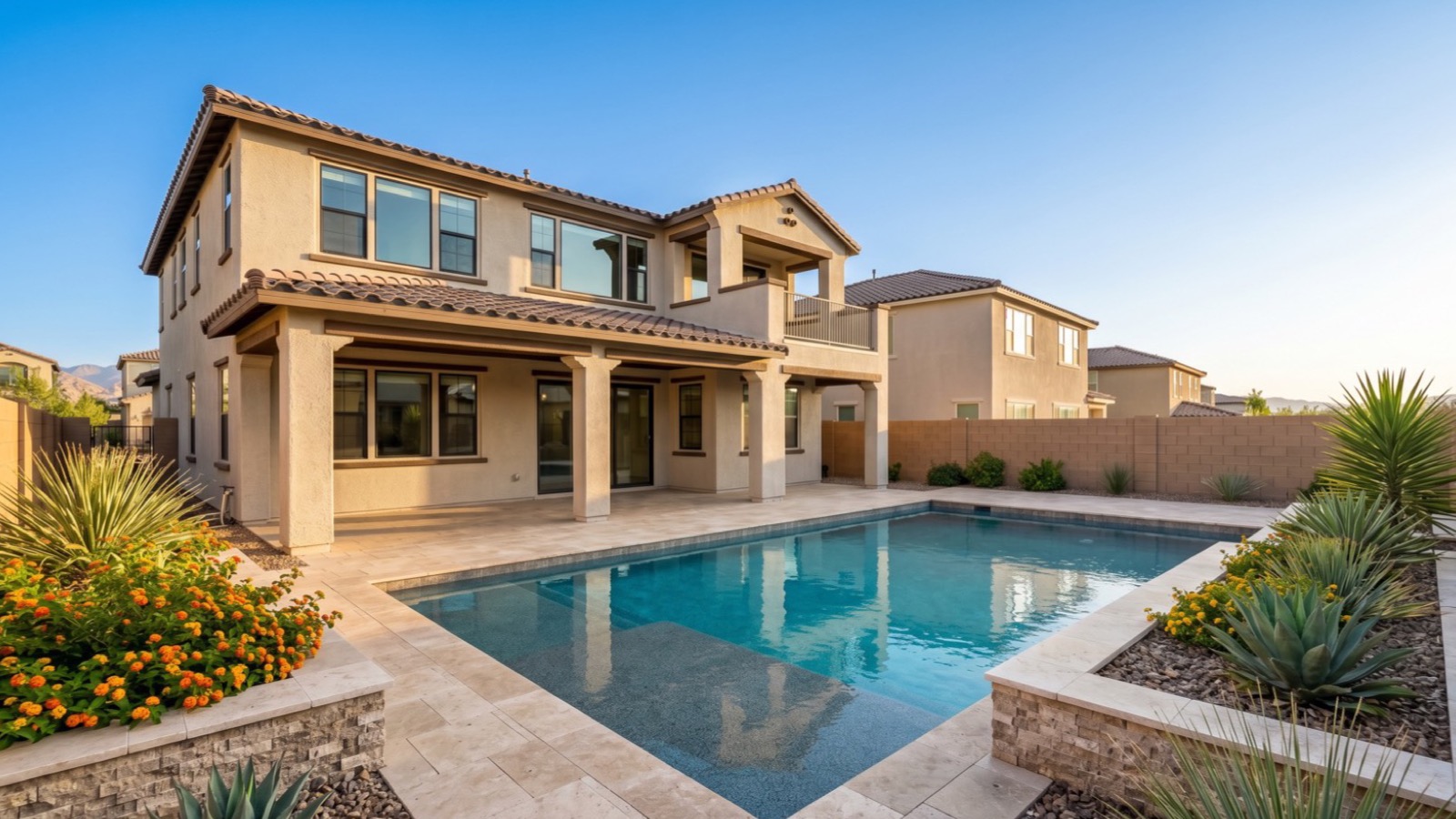
How Does the Water Picture Differ Between Las Vegas, Henderson and a New Build?
The allocation is regional, but the rules and the bills are local. The SNWA is a wholesaler; its seven member agencies, including the Las Vegas Valley Water District, the City of Henderson and the City of North Las Vegas, set their own retail rates and enforce their own codes. According to Chapter 3 of the SNWA plan, the LVVWD's 2022 rate changes took effect January 1, 2023 with seasonal excessive-use surcharges and compressed tiers, and Henderson approved its own conservation-based rate changes; Henderson is also upgrading its meters to advanced metering infrastructure, which the LVVWD, North Las Vegas and Big Bend have already completed, giving near-real-time leak alerts. The practical effect is that a Henderson home and a Las Vegas home with identical landscaping can carry different summer bills, and the twelve months of statements you request in due diligence will tell you which.
New construction is the simplest case. A home permitted after the 2022 and 2023 code changes has no irrigated turf, no spray irrigation, a pool no larger than 600 square feet if it has one, and dry cooling; it was designed for the rules the region is heading toward, and it will need no conversion spending. According to the SNWA's 2026 executive summary, one of the authority's stated priorities is working with member agencies so that new development has the smallest possible consumptive water footprint, and the plan also requires out-of-valley development to return wastewater to Lake Mead for return-flow credit. The trade is that a new build's yard is desert by code and a buyer who wants grass for kids or dogs will need to accept a small functional patch, or none.
Resale is where the choices live. An established Green Valley or Summerlin home with mature trees, a lawn and an older pool is legal to keep as is, costs more to water, and is eligible for the $5-per-square-foot conversion rebate if you choose to change it. The rebate does not require you to convert everything: the SNWA definitions distinguish functional turf, meaning grass people actually use, from non-functional, and a play lawn in a backyard is functional. Across the 9,600+ closings we have represented, the buyers who handle water best are the ones who decide before the offer what they want the yard to be, then price the conversion, the rebate and the bills into the number they write.
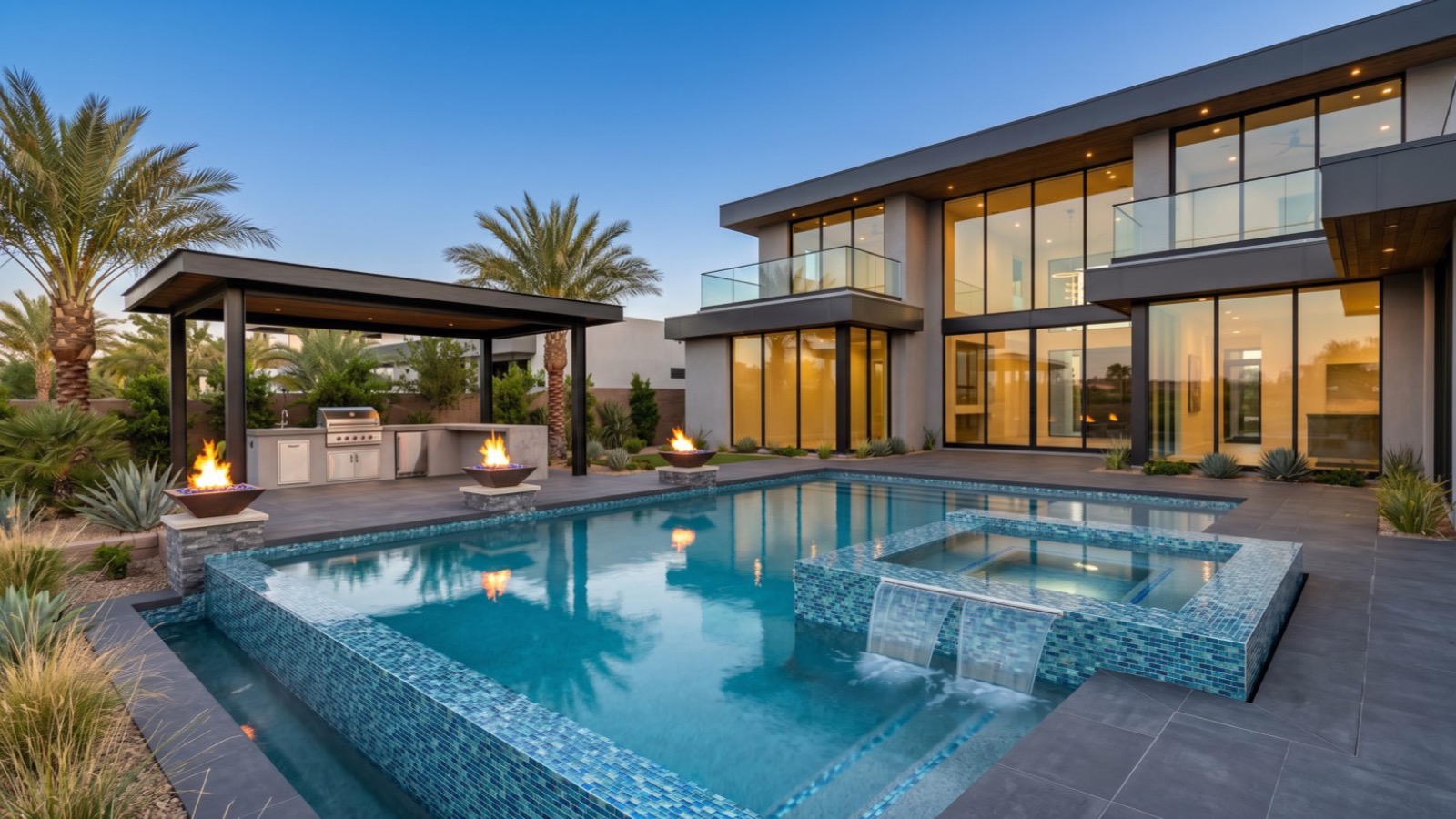
What Are the Dates to Watch Between Now and 2036?
The framework replaces one fixed set of rules with a calendar, so the useful thing a homeowner can do is know the calendar. The 2027 and 2028 operating guidelines take effect on January 1, 2027, the day after the 2007 Interim Guidelines and the 2019 Drought Contingency Plans expire. According to Interior's August 21, 2026 release, the final water-year 2027 release from Lake Powell will be set in April 2027, within the 6.0 to 7.0 million acre-foot range, and the Upper Basin states may enter agreements to operate Flaming Gorge, Aspinall and Navajo to protect Glen Canyon Dam. Reclamation's August 24-Month Study each year is the document that sets the following year's Lower Basin condition, so August 2027 is when the first read on 2028 arrives and August 2028 is when the 2029 guidelines' hydrology is fixed.
The litigation runs alongside. Nevada's suit was filed August 24, 2026 in the District of Nevada, and any ruling on the injunction it seeks would land before or during the first operating year. The two-year guideline cycle means Interior will begin drafting the 2029 and 2030 guidelines during 2028, and according to the Final EIS announcement the framework preserves room for the states, tribes and Mexico to bring a consensus agreement that could be incorporated into years three and four or beyond. The SNWA's own plan says it will update its Water Resource Plan as the timing and magnitude of post-2026 changes become clear; that plan is reviewed by the SNWA board every year, and the 2027 edition will be the first written under the new framework.
For a buyer, the practical reading is that nothing on this calendar changes what comes out of the tap in 2027 or 2028, and that the next real decision point is the 2029 guidelines, whose hydrology will be set by the August 2028 study. If you are moving to the valley now, the relocation guide covers the day-to-day rules, the watering groups and the utility setup. If you already own here, the two things worth doing before 2029 are converting non-functional grass while the $5-per-square-foot rebate is in place and getting a leak-free irrigation system on the right schedule, because those are the changes that will matter under any of the scenarios above.
Frequently Asked Questions
What is the Colorado River "2036 plan"?
It is the operating framework the Department of the Interior adopted in its August 21, 2026 Record of Decision to replace the 2007 Interim Guidelines, which expire at the end of 2026. Rather than a fixed rulebook, it is an adaptive framework running through 2036 with operating guidelines issued in two-year intervals inside set sideboards: Lake Powell releases of 5.0 to 12.0 million acre-feet a year and Lower Basin shortages of up to 3.0 million acre-feet. The first guidelines cover 2027 and 2028.
How much water is Nevada losing in 2027?
Nevada's Colorado River allocation falls from 300,000 acre-feet to 250,000 in both 2027 and 2028, a 50,000 acre-foot or 16.7% reduction, as part of a 1.25 million acre-foot Lower Basin cut that also takes 760,000 acre-feet from Arizona and 440,000 from California. Southern Nevada's consumptive use in 2025 was 198,000 acre-feet, so the region still has about 52,000 acre-feet of headroom under the reduced allocation.
Will Las Vegas run out of water?
Not under any adopted rule. Southern Nevada uses about 198,000 acre-feet a year against a 2027 allocation of 250,000, holds more than 2.2 million acre-feet in banked and stored water, recycles about 99% of indoor water for return-flow credit, and has an intake and pumping station that reach Lake Mead water down to 875 feet, below Hoover Dam's 895-foot dead pool. The lake was at 1,038.38 feet on September 18, 2026. The open question is the size of any 2029 cut, which Nevada is litigating.
Does the grass ban apply to my house?
AB356 prohibits using Colorado River water to irrigate non-functional turf on property not used exclusively as a single-family residence beginning in 2027, so it covers HOA common areas, commercial sites, multifamily property and golf courses, not your own lawn at a single-family home. New homes are different: local codes adopted in 2022 and 2023 prohibit new irrigated turf and spray irrigation in new development, so a new build comes with desert landscaping by design.
What are the pool rules for a new Las Vegas home?
New residential pools are limited to 600 square feet of surface area under the SNWA's July 2022 resolution and the local codes that followed, because each square foot of pool surface evaporates an estimated 48.6 gallons a year. Existing pools are not affected. A new build with a pool will comply automatically; a resale home with a larger existing pool can keep it, and there is no requirement to shrink it.
Has the water situation lowered Las Vegas home prices?
There is no evidence of it in the data. Las Vegas prices are moving on inventory and rates: 8,330 active listings on September 15, 2026 with 43.3% carrying a price cut, a July closed median of $430,000, an August single-family median of $475,000 that was down 1.0% from a year earlier, and a 30-year rate of 6.95%. Lenders, insurers and the assessor do not price reservoir elevation, and the region added roughly 876,000 residents between 2002 and 2025 while the lake fell.
What should I check about water before buying?
The address's watering group and whether the irrigation controller follows it, the HOA's landscape rules and its common-area turf conversion status, the pool's surface area if new, sewer versus septic, the cooling system, and twelve months of water bills. Under NRS 116.330 an HOA cannot categorically bar drought-tolerant landscaping, and the SNWA pays single-family owners $5 per square foot for the first 10,000 square feet of grass they remove.
Ready to Buy in Las Vegas With the Water Facts in Hand From Nevada Real Estate Group?
The water question deserves a straight answer, and the straight answer is that the rules are knowable, the numbers are public and dated, and the adopted 2027 and 2028 cut sits inside water the region already does not use. What is not settled is 2029 and beyond, and the honest position for anyone selling you a house here is to say so. Our team's job is to make sure you buy with the calendar, the codes and the bills in front of you rather than a headline.
That means pulling the watering group for the address before you tour, reading the CC&Rs for the landscape and turf-conversion provisions, requesting the seller's water statements, confirming sewer versus septic, and measuring the pool if the home is new. It also means putting the water story next to the price story: the market report is rebuilt every month from counted MLS data, so you can watch inventory, price cuts and closed medians move alongside Lake Mead's elevation and Reclamation's August study. Across the 9,600+ closings we have represented, the buyers who have done best in this market are the ones who treated water as a due-diligence item with a checklist, not a reason to wait.
If you are relocating, start with the moving to Las Vegas guide and the current Las Vegas listings, then call Nevada Real Estate Group at (702) 637-1759 or visit us at 8945 W Russell Rd, Suite 170, Las Vegas, NV 89148. We will walk you through the water checklist for the specific home you are considering, in Las Vegas or Henderson, before you write an offer. Nevada Real Estate Group is brokered by LPT Realty, license S.181401.
Which Sources Inform This Colorado River and Home Values Guide?
Federal, state and water-authority documents were read between September 15 and September 19, 2026, for this guide. Lake elevations are as of the dates stated; allocation figures are as adopted in the August 21, 2026 Record of Decision and are subject to the pending litigation.
- Bureau of Reclamation, Colorado River post-2026 operations: the Draft EIS, Final EIS and Record of Decision dates, the expiry of the 2007 Interim Guidelines and the two-year guideline cycle through 2036.
- U.S. Department of the Interior, Final EIS announcement, July 31, 2026: the adaptive framework and its operational sideboards.
- U.S. Department of the Interior, 2027-2028 operating guidelines, August 21, 2026: the 1.25 million acre-foot Lower Basin reduction, the state split, Lake Powell release range and Upper Basin provisions.
- Bureau of Reclamation, Lower Colorado River operations and Lake Mead end-of-month elevations: the September 18, 2026 elevation and storage and the 2025-2026 monthly series.
- Bureau of Reclamation, July 2026 24-Month Study: the 2026 shortage tier basis, the Lake Powell release reduction and Nevada's projected 2026 consumptive use.
- Bureau of Reclamation, Law of the River: the 1922 Compact, the 1928 Boulder Canyon Project Act apportionments and the 1944 Mexico treaty.
- Southern Nevada Water Authority, 2026 Water Resource Plan executive summary: 2024 consumptive use, banked resources, shortage assumptions, the 875-foot access elevation and the 86-gallon goal.
- Southern Nevada Water Authority, 2026 Water Resource Plan Chapter 3: the entitlement, return-flow credits, water banks and ICS, conservation history, pool and turf rules, AB356 and AB220.
- Southern Nevada Water Authority, conservation initiatives: the 58% per-capita decline, population growth, grass removed and water saved.
- Southern Nevada Water Authority, water shortages: the Tier 1 reduction, DCP contributions and customer-impact statement.
- Southern Nevada Water Authority, where your water comes from: the 90/10 supply split and the return-flow explanation.
- Southern Nevada Water Authority, Intake 3 and Low Lake Level Pumping Station: completion dates, cost, capacity and the dead-pool elevation.
- Southern Nevada Water Authority, Water Smart Landscapes rebate: the per-square-foot rebate amounts.
- Las Vegas Valley Water District, mandatory watering schedule: seasonal watering days, the Sunday prohibition and watering groups.
- Nevada Legislature, NRS Chapter 116: NRS 116.330 on drought-tolerant landscaping in common-interest communities.
- Nevada Governor's office, lawsuit announcement, August 24, 2026, The Nevada Independent and National Law Review, August 25, 2026: the plaintiffs, claims, the 213,556 acre-foot scenario and the state-by-state 2027-2028 allocations.
- News 3 Las Vegas, August 21, 2026 and Las Vegas Sun, June 7, 2026: Southern Nevada's 198,000 acre-foot 2025 use, 245,000 acre-feet of return flow and the SNWA's customer message.
- Maven's Notebook, May 13, 2026: the Lower Basin states' proposal that the 2027-2028 guidelines adopted.
- Freddie Mac Primary Mortgage Market Survey and Las Vegas REALTORS August 2026 report, via Vegas Inc: the 6.95% rate for the week of September 17, 2026 and the $475,000 August single-family median.
Water allocations, reservoir elevations, conservation rules, rebates and rates change; the post-2026 framework is under litigation and its 2029 guidelines have not been written. Confirm the current rules for the specific property and jurisdiction before making an offer.