

Two things are true about the Southern Nevada turf ban at the same time, and almost every conversation I have about it gets one of them wrong.
The first is that the deadline is real and close. After December 31, 2026, Colorado River water delivered by the Southern Nevada Water Authority cannot be used to irrigate nonfunctional turf on property that is not zoned single-family. That is four and a half months away as I write this.
The second is that the enforcement of it is currently being fought in federal court by a group of valley homeowners, in a case docketed as a class action, joined by HOAs representing thousands of homes. That part has barely reached the people it affects most.
Both facts matter, and they pull in different directions. Here is what a Las Vegas homeowner or HOA board actually needs to know.
Nevada AB 356 prohibits Colorado River water from irrigating nonfunctional turf in the SNWA service area starting January 1, 2027. It targets decorative grass on commercial, institutional, multi-family and HOA common-area property — not single-family front and back lawns, which the 2026 mandate does not cover. Enforcement is being challenged in Nill v. Southern Nevada Water Authority, now in federal court as a putative class action. The deadline stands; how it gets enforced on common areas is unsettled.
- The ban starts January 1, 2027 — removal deadline is December 31, 2026.
- Single-family front and back lawns are not covered by this mandate.
- HOA common areas, medians and streetscapes are the actual target.
- Nill v. SNWA is in federal court, docket 2:26-cv-01291, as a class action.
- Mature trees living off turf irrigation are the most expensive thing at risk.
What Exactly Does AB 356 Ban, and When?
Assembly Bill 356 passed the Nevada Legislature in 2021. Its mechanism is narrow and specific: it prohibits the use of Colorado River water, delivered by SNWA or its member agencies, to irrigate nonfunctional turf. The prohibition takes effect January 1, 2027, which makes December 31, 2026 the practical removal deadline.
Read the mechanism carefully, because it explains the scope. The law does not say "grass is illegal." It restricts a particular water source for a particular category of grass on particular property. According to the Southern Nevada Water Authority, the conservation rationale is straightforward — decorative turf consumes a large volume of water while delivering no recreational use — and the Bureau of Reclamation has documented the Colorado River conditions driving the urgency.
The Real Estate Division publishes an AB 356 summary for common-interest communities, which is the document an HOA board should be reading rather than a news article.
What Are We Actually Seeing in Association Communities?
Across the 9,600-plus transactions our team has closed in Nevada — 789 of them during 2025, representing more than $361.5 million in volume — the overwhelming majority sit inside association-governed communities. That gives us a transaction-level view of this rule that a policy summary does not, and three patterns stand out.
The first is that owners are frightened of the wrong thing. In my experience, the question that comes up at listing appointments is almost always "do I have to tear out my lawn," and the answer for a single-family home is no. Meanwhile the actual exposure — what the association is going to spend on common areas, and whether it has budgeted for it — rarely comes up at all.
The second is that boards vary enormously in readiness. Some associations began converting streetscapes years ago, took the rebate, and are effectively finished. Others have substantial decorative footprints, no line item, and four months left. Two communities a mile apart can be in completely different positions, and nothing visible from the street tells you which is which.
The third is that this is starting to surface in transactions. I have watched buyers' agents ask, mid-escrow, what a community's turf plan is — a question that would not have been asked two years ago. An association that can answer it in a sentence closes cleanly. One that cannot introduces uncertainty at exactly the wrong moment, and uncertainty in escrow is never free.
None of that is a reason to panic, and I am not going to pretend a landscaping rule is the defining issue in this market. It is a reason to ask one more question before you write an offer in a community with a lot of grass, and to ask your own board where things stand if you already own in one.
Does the Turf Ban Apply to Your Single-Family Front Lawn?
No — and this is the single most common misunderstanding in the valley.
The 2026 mandate does not require single-family homeowners to remove their front or back lawns. The restriction applies to property not zoned for single-family use: commercial parcels, institutional campuses, multi-family developments, and homeowner-association common areas.
That distinction gets lost constantly, partly because separate SNWA rules do affect single-family homes — watering-day assignments, seasonal schedules, and restrictions on new turf installation in new construction. Those are real, and they are not this. A homeowner who reads a headline about the "grass ban" and concludes their back lawn must be gone by New Year's has conflated two different rules.
| Dimension | Single-family home | HOA common area | Commercial / multi-family |
|---|---|---|---|
| Covered by the 2026 removal mandate? | No | Yes, where turf is nonfunctional | Yes, where turf is nonfunctional |
| Who decides and pays? | Owner, voluntarily | The association and its members | Property owner |
| Rebate program available? | Yes, voluntary conversions | Yes | Yes |
| Watering-day rules still apply? | Yes | Yes | Yes |
| Exposure in the current litigation | Indirect, through the association | Direct — several HOAs have joined | Direct |
What Actually Counts as Nonfunctional Turf?
Functionality, in this context, means usable — grass people actually walk, play, or gather on. Nonfunctional turf is the decorative kind: entry medians, streetscape strips between a sidewalk and a curb, grass islands in parking areas, and the ornamental green aprons that master-planned communities used to install at every entrance.
Genuine recreational areas — park fields, playgrounds, sports turf, cemeteries — sit in a different category with clearer protection. So does grass at a single-family residence.
The judgment calls live in the middle, and that middle is exactly where the disputes are. In our experience walking communities with owners, the disagreements are rarely about a median strip nobody has ever stood on — everyone concedes that one. They are about the courtyard lawn where residents actually gather, the grass verge children cut across on the way to a bus stop, and the small green square a community built its identity around. Those are the areas where a classification made from an aerial photograph and a classification made by someone who has watched the space get used will reach different answers, and where an association is most likely to find itself arguing. A courtyard lawn that residents picnic on but that was designed as ornamental is a harder question than either extreme, and how those classifications get made is one of the things now under challenge.
Is the Ban Being Challenged in Court Right Now?
Yes. This is the part of the story that has not reached most of the people it affects, so it is worth being precise about what is and is not established.
The case is Nill v. Southern Nevada Water Authority. It began in the Eighth Judicial District Court in Clark County under case number A-26-937025-C, and SNWA removed it to the U.S. District Court for the District of Nevada, where it carries docket number 2:26-cv-01291, filed April 24, 2026 and assigned to Judge Gloria Navarro. The federal docket records it as a putative class action, and — a detail worth noting — categorises it under civil rights rather than as an environmental or water case.
As reported by the Las Vegas Review-Journal, a Clark County judge initially granted a temporary restraining order pausing enforcement, then narrowed it to apply only to the named plaintiffs' properties. Fox5 Las Vegas covered the original order. The Review-Journal has since reported that the Nevada Supreme Court declined SNWA's request to end the case and that a church, golf interests and HOAs have joined.
I am deliberately not predicting an outcome. Litigation of this kind can end in a settlement, a narrowing, a dismissal, or a judgment, and anyone telling you which is guessing.
Case status verified against the public federal docket on August 17, 2026. This is active litigation — verify before relying on it.
Why Are Mature Trees the Real Casualty of Turf Removal?
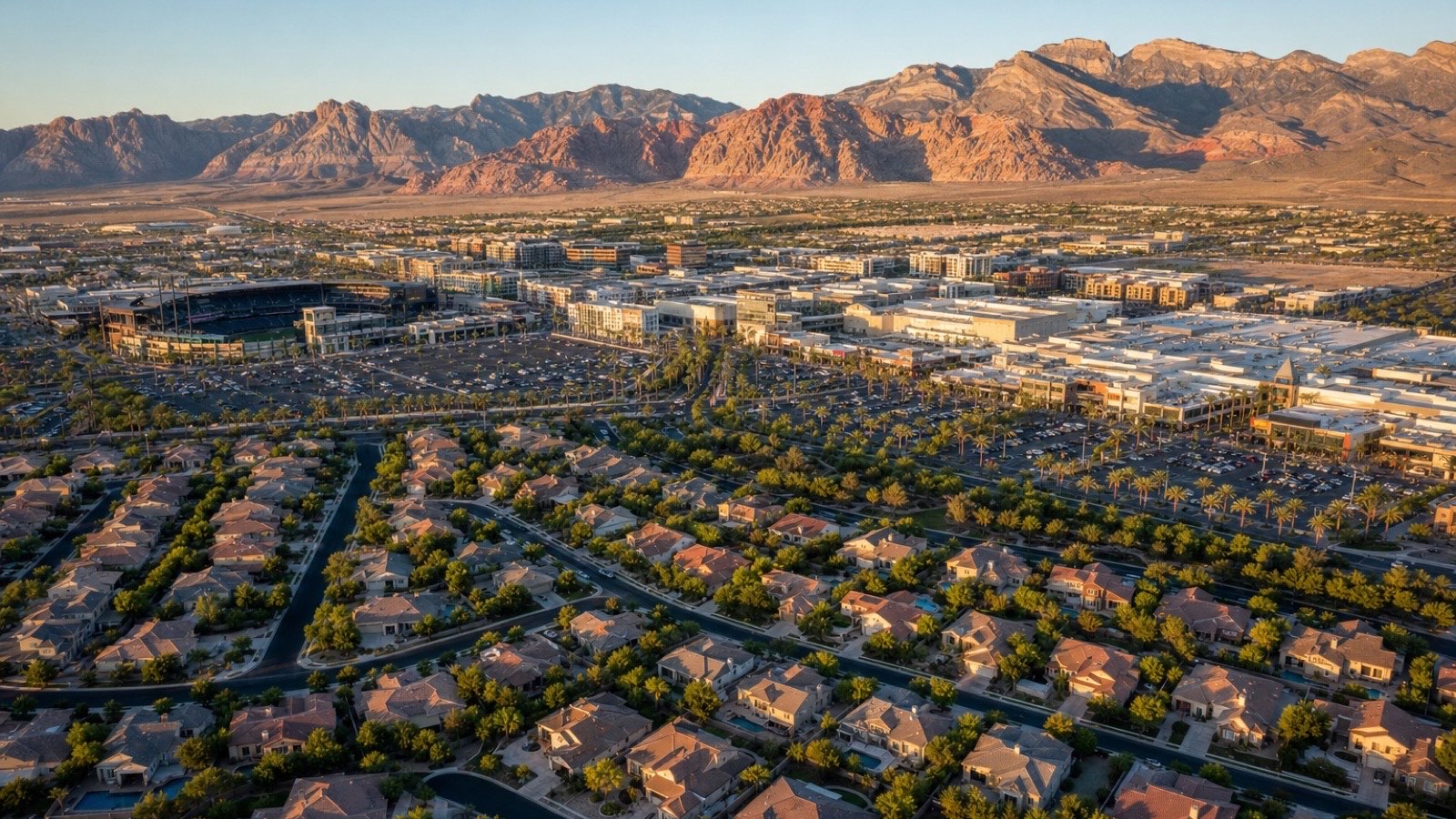
Because a mature tree in a turf area has spent decades building a root system around that irrigation, and pulling the turf pulls its water supply.
This is the heart of the homeowners' complaint in the litigation as reported — that turf removal in their community led to trees dying. Whatever the legal merits, the horticultural point is sound and it is the thing I would most want a board to understand before it signs a contract.
A conversion that simply strips sod and installs gravel, with no dedicated irrigation retrofit for the existing trees, is a slow tree-removal project with extra steps. Mature shade canopy in this valley is genuinely valuable — it cools the ground, it cuts cooling loads, and it takes fifteen to twenty years to replace. Losing it is not a landscaping inconvenience; it is a permanent downgrade to a community's character and comfort.
The fix is not complicated, it is just a line item: convert with a drip system sized for the trees, installed at the same time, before the turf comes out.
What Does a Common-Area Conversion Cost an HOA?
Enough that the number should be modelled, not guessed.
Actual per-square-foot pricing varies with access, grading, plant density, irrigation retrofit, and how much tree protection is designed in — so rather than quote a rate I cannot stand behind for your specific property, here is the arithmetic across a plausible range. Take a bid, find your column, and read across.
| Area converted | At $4 / sq ft | At $8 / sq ft | At $12 / sq ft |
|---|---|---|---|
| 5,000 sq ft | $20,000 | $40,000 | $60,000 |
| 10,000 sq ft | $40,000 | $80,000 | $120,000 |
| 25,000 sq ft | $100,000 | $200,000 | $300,000 |
| 50,000 sq ft | $200,000 | $400,000 | $600,000 |
| 100,000 sq ft | $400,000 | $800,000 | $1,200,000 |
The SNWA Water Smart Landscapes rebate offsets a meaningful share of this, and it is the reason converting deliberately beats converting under duress. According to the Southern Nevada Water Authority's published terms for business, HOA and multifamily properties, non-single-family applicants receive $5.00 per square foot for the first 10,000 square feet and $1.50 per square foot thereafter, without regard to passage of time or the number of project phases. On a 25,000-square-foot common-area conversion that is $50,000 on the first 10,000 feet plus $22,500 on the remaining 15,000 — $72,500 against a project that might cost $200,000.
That tiering is the detail boards miss. The rebate is generous on the first 10,000 square feet and much thinner after, so a community with 60,000 square feet of decorative turf should not assume a linear offset. Note also that SNWA distinguishes functional from nonfunctional turf and has run transitional rates over the years, so a board should confirm its specific project in writing with SNWA rather than budgeting from a summary — including this one. Our Summerlin landscaping and water rules guide walks through the application sequence in detail.
How Should an HOA Board Approach the Next Four Months?
In our experience the boards that handle this well do the same five things, in order.
| Step | What it involves | Why it matters |
|---|---|---|
| 1. Inventory and classify | Measure every turf area; label functional or nonfunctional with a reason | The foundation for budget, bids, and any dispute |
| 2. Counsel on classification | Association attorney reviews the inventory, not just the contract | Classification methodology is what is being litigated |
| 3. Tree protection in scope | Drip retrofit specified for every mature tree before bidding | Every bidder prices the same job; canopy survives |
| 4. Confirm rebate terms in writing | Verify current rate and caps with SNWA directly | Terms change; budgets built on old numbers fail |
| 5. Communicate to owners early | State plainly that single-family yards are not covered | Most owner anger here is surprise, not cost |
Inventory and classify first. Measure every turf area and label it functional or nonfunctional with a defensible reason. This document is the board's foundation for everything downstream, including any dispute.
Get counsel involved on the classification, not just the contract. Given active litigation over how classifications are made, an association's lawyer should see the inventory.
Design tree protection into the scope before bidding. Retrofit irrigation for every mature tree in an affected area, specified in the bid so all bidders price the same job.
Confirm the rebate terms in writing before committing. Program terms change; a board should not budget against an assumed rate.
Communicate to owners early and accurately. Most owner anger here comes from surprise, and from the widespread belief that their own lawn is next. Telling members plainly that single-family yards are not covered defuses much of it.
What Does a Conversion Cost Each Owner Per Door?
This is the number owners actually feel, and boards are often slow to publish it.
A common-area conversion is funded either from reserves, from operating budget, or from a special assessment — and if it lands as an assessment, the community's size decides whether it is an annoyance or a genuine hardship. The same $200,000 project is $2,000 a door in a 100-home association and $400 a door in a 500-home one.
| Project cost | 100 homes | 250 homes | 500 homes |
|---|---|---|---|
| $40,000 | $400 | $160 | $80 |
| $100,000 | $1,000 | $400 | $200 |
| $200,000 | $2,000 | $800 | $400 |
| $400,000 | $4,000 | $1,600 | $800 |
| $800,000 | $8,000 | $3,200 | $1,600 |
Two things follow from that table. First, small associations with large decorative footprints are the most exposed in the valley, and they are also the least likely to have modelled it. Second, the rebate matters most precisely where the per-door number is worst — which is the argument for confirming terms and applying early rather than converting in a rush next December.
According to the Southern Nevada Water Authority, the conservation programs exist specifically to move this cost off individual property owners, and an association that treats the rebate as optional paperwork is leaving members' money on the table. According to the Nevada Real Estate Division, common-interest communities were given their own guidance on this precisely because association obligations differ from those of individual homeowners.
There is also a reserve-study angle worth raising with your board. A conversion is a capital project, and a community that funds it out of reserves without replenishing has simply moved the problem to whatever the reserve study said that money was for — a roof, a pool resurface, a private street. According to the U.S. Department of Housing and Urban Development, reserve adequacy is among the items lenders scrutinise on condominium and association-governed projects, so a depleted reserve can quietly affect financeability for every owner trying to sell.
How Does This Affect a Home You Are Trying to Sell?
Three ways, and the second one surprises sellers.
A converted, well-designed desert landscape reads as finished and low-maintenance to buyers, and that helps. A half-finished conversion during a listing period reads as a project the buyer has to inherit, and that hurts more than leaving the grass alone would have.
The one sellers do not anticipate: a buyer's agent who knows this rule may ask what pending common-area assessment the association is carrying for its conversion. A community that has not budgeted for a large removal has a cost coming, and a diligent buyer will want to know. Associations that planned early can answer cleanly; associations that did not will be answering awkwardly during someone's escrow.
If you are listing in a community with substantial common-area turf, ask your association what its plan is before you go live. Our sellers' resources cover the disclosure side, and you can see what comparable homes are doing across the Las Vegas market.
One more scenario worth naming, because it catches buyers rather than owners. If you are purchasing into an association-governed community this autumn, the turf question belongs on your due-diligence list alongside the reserve study and the resale package. Ask whether the association has completed its conversion, budgeted for one, or done neither. A community that has finished has a known cost behind it; a community with a plan and a funded line item is fine; a community with substantial decorative turf and no plan is carrying an unpriced obligation that will land on whoever owns the unit when it comes due — and that could be you.
The same question is worth asking about new construction, though usually with a happier answer, since communities built to current desert standards have far less nonfunctional turf to begin with. Older guard-gated communities with lush entry treatments are the ones where the answer deserves a careful look, because grand landscaped entrances were the whole point of the design. None of this should stop a purchase. It should just be a question you ask before you are emotionally committed to the house, rather than one you discover afterwards. The resale package is where the answer usually hides, and almost nobody reads it closely enough to find the landscaping line.
Which Las Vegas Communities Are Most Exposed?
The ones built when decorative turf was the default aesthetic.
Older master-planned areas with lush entry treatments, extensive median landscaping, and green streetscape strips carry the most nonfunctional square footage. Parts of Summerlin and the established Henderson communities have significant common-area turf, though many associations there began converting years ago. Newer developments in North Las Vegas were largely built to desert standards and have less to remove.
Golf-course communities occupy their own category, and golf interests are among the parties that have joined the litigation.
What Actually Happens on January 1, 2027?
Water delivery rules change; the sky does not fall.
The prohibition is on using Colorado River water delivered through SNWA and its member agencies to irrigate nonfunctional turf. Enforcement runs through the water agencies and the member utilities rather than through a code officer knocking on doors, and how that enforcement is applied to common areas is part of what the current case concerns.
For a single-family homeowner, January 1 changes nothing about your own yard. For an association with unconverted decorative turf, it is the date a compliance obligation becomes concrete, and the date after which improvisation gets expensive.
What Should a Homeowner Do Between Now and Then?
Very little, if you own a single-family home, beyond understanding that your lawn is not the target and staying current on watering-day rules.
If you sit on a board, or you are buying into a community with heavy common-area turf, do the homework now. According to the U.S. Census Bureau, the Las Vegas metro added households steadily through the last decade, much of that growth into association-governed communities — which means a large share of valley residents have an indirect stake in decisions their boards are making this year. Ask what your association's plan is, what it will cost, and whether the trees are in the scope.
This article summarises a Nevada statute and the public record of active litigation. It is not legal advice. Associations should consult their own counsel before making compliance decisions, and case status can change at any time.
Frequently Asked Questions
Do I have to remove my own front lawn by December 31, 2026?
No. The 2026 mandate applies to nonfunctional turf on property not zoned single-family — commercial, institutional, multi-family, and HOA common areas. Single-family front and back lawns are not covered. Separate SNWA rules about watering days and new turf installation do apply to your home.
What is the lawsuit over the turf ban?
Nill v. Southern Nevada Water Authority, now in federal court as docket 2:26-cv-01291 before Judge Gloria Navarro, removed from Clark County case A-26-937025-C. The federal docket lists it as a putative class action under a civil rights category. A state judge earlier issued a restraining order that was later narrowed to the named plaintiffs.
Does the lawsuit mean the deadline is cancelled?
No. Nothing in the public record repeals AB 356 or moves the December 31, 2026 date. What is contested is enforcement and how classifications are applied. Planning as though the deadline holds is the prudent posture.
Will removing common-area grass kill our community's trees?
It can, and that is the core practical complaint driving the litigation. Trees in turf areas draw from that irrigation. A conversion that installs dedicated drip irrigation sized for existing trees, before the sod comes out, avoids the problem. One that does not is a slow tree loss.
How much does the SNWA rebate pay?
Per SNWA's published terms, non-single-family properties — which includes HOAs — receive $5.00 per square foot for the first 10,000 square feet and $1.50 per square foot thereafter. Single-family applicants receive $5.00 for the first 10,000 square feet and $2.50 thereafter, and Las Vegas Valley Water District customers can add $2.00 per square foot on top. Rates have changed before, so confirm your specific project with SNWA in writing.
Can my HOA assess us for the conversion cost?
Assessment authority comes from your association's governing documents and Nevada's common-interest community law. How and whether a board can fund a conversion is a question for the association's counsel and its CC&Rs. Our guide to Nevada HOA fines and your NRS 116 rights covers the broader framework of what associations can and cannot do.
Does converting help or hurt my home's resale value?
A completed, well-designed conversion generally helps — it reads as finished and low-maintenance. A partially completed one during a listing hurts. The larger resale factor is often whether the association has a funded plan, because informed buyers ask.
Which Sources Inform This Las Vegas Turf Ban Guide?
The case details here were read from the public federal court docket rather than taken from news summaries, because the reporting varies on procedural specifics and none of it noted how the case is actually categorised.
- Nevada Real Estate Division AB 356 publication — the state's own summary for common-interest communities
- Southern Nevada Water Authority — conservation rules, watering restrictions, and program terms
- SNWA Water Smart Landscapes rebate — program overview
- SNWA rebate terms, business / HOA / multifamily — the non-single-family rate schedule quoted here
- SNWA rebate terms, single-family residential — the residential rate schedule
- Nevada Legislature — enacted text and legislative history
- Las Vegas Review-Journal — narrowing of the restraining order
- Review-Journal on the Supreme Court petition — SNWA's failed bid to end the case
- Review-Journal on parties joining — HOAs, church and golf interests
- Fox5 Las Vegas — the original restraining order
- Bureau of Reclamation — Colorado River and Lake Mead conditions
- U.S. Census Bureau — Las Vegas household and housing data
- Clark County — zoning and land-use context
- U.S. Department of Housing and Urban Development — federal housing guidance
Methodology note: docket facts for Nill v. Southern Nevada Water Authority were taken from the public federal court record on August 17, 2026. Conversion costs in the table are arithmetic across a range of price points, presented so a board can locate its own bid — they are not quotes. Rebate figures were read from SNWA's published program terms pages on August 17, 2026; because SNWA has revised these rates before, a board should confirm its own project in writing before budgeting.
Sitting on a board, or buying into a community with a lot of common-area grass? Call me at (702) 637-1759 or reach the team. Knowing what your association is carrying is worth more before you write an offer than after.