
Two homes can arrive on a truck in sections and look the same once they are set. Nevada treats them differently from the first day. One carries a federal HUD label and a state title, much like a vehicle. The other carries a Nevada insignia and is real estate once it is permanently affixed. That split decides where the home can go, whether an older one can be moved, and what a county asks for before it issues a permit.
For this guide we read the Nevada statutes and every county code we could open on November 1, 2026, then pulled 12 months of closings from both MLS boards. Where a code page would not open, we say so and state no rule for that city. Loans have their own page: our Nevada manufactured home financing guide covers chattel loans, mortgages and lot rent. This guide covers what each home is and where it's allowed.
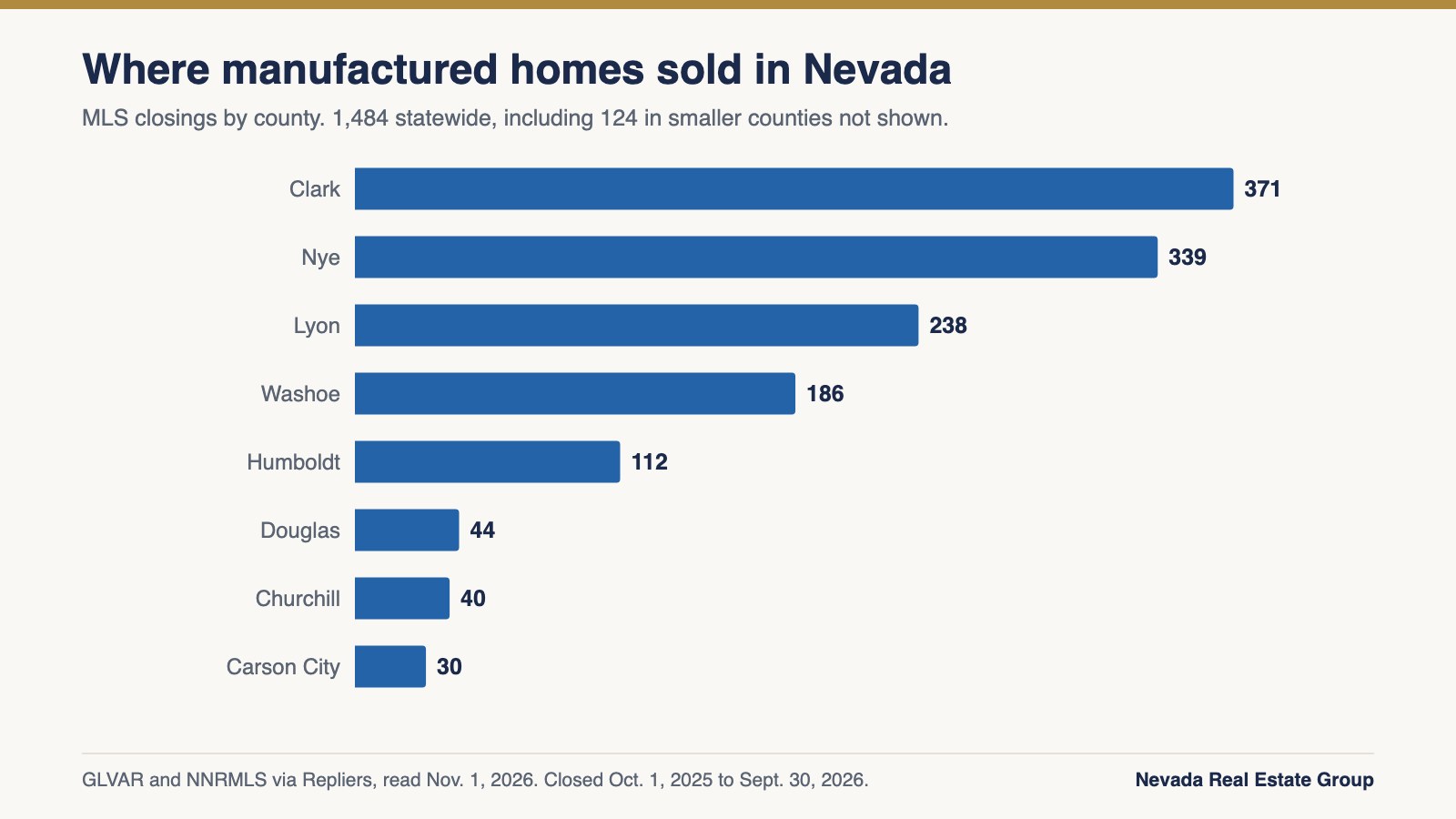
A manufactured home is built to the federal HUD Code and starts as titled personal property in Nevada; a modular home is built to state-adopted building codes under NRS 461 and is real property once permanently affixed. Zoning must count both as single-family homes, but state law sets a six-year age limit for manufactured homes placed outside parks, and small counties may loosen it. MLS boards recorded 1,484 Nevada manufactured closings in the 12 months through September 2026.
- A manufactured home carries a HUD certification label; a modular home carries a Nevada insignia of approval.
- Unincorporated Clark and Washoe, plus Reno, accept 400-square-foot manufactured homes on residential lots within six years.
- Nye County's Pahrump rules allow six or ten years, depending on the zoning district.
- Lyon County's website still states 1,200 square feet and multiple sections, unlike the state text.
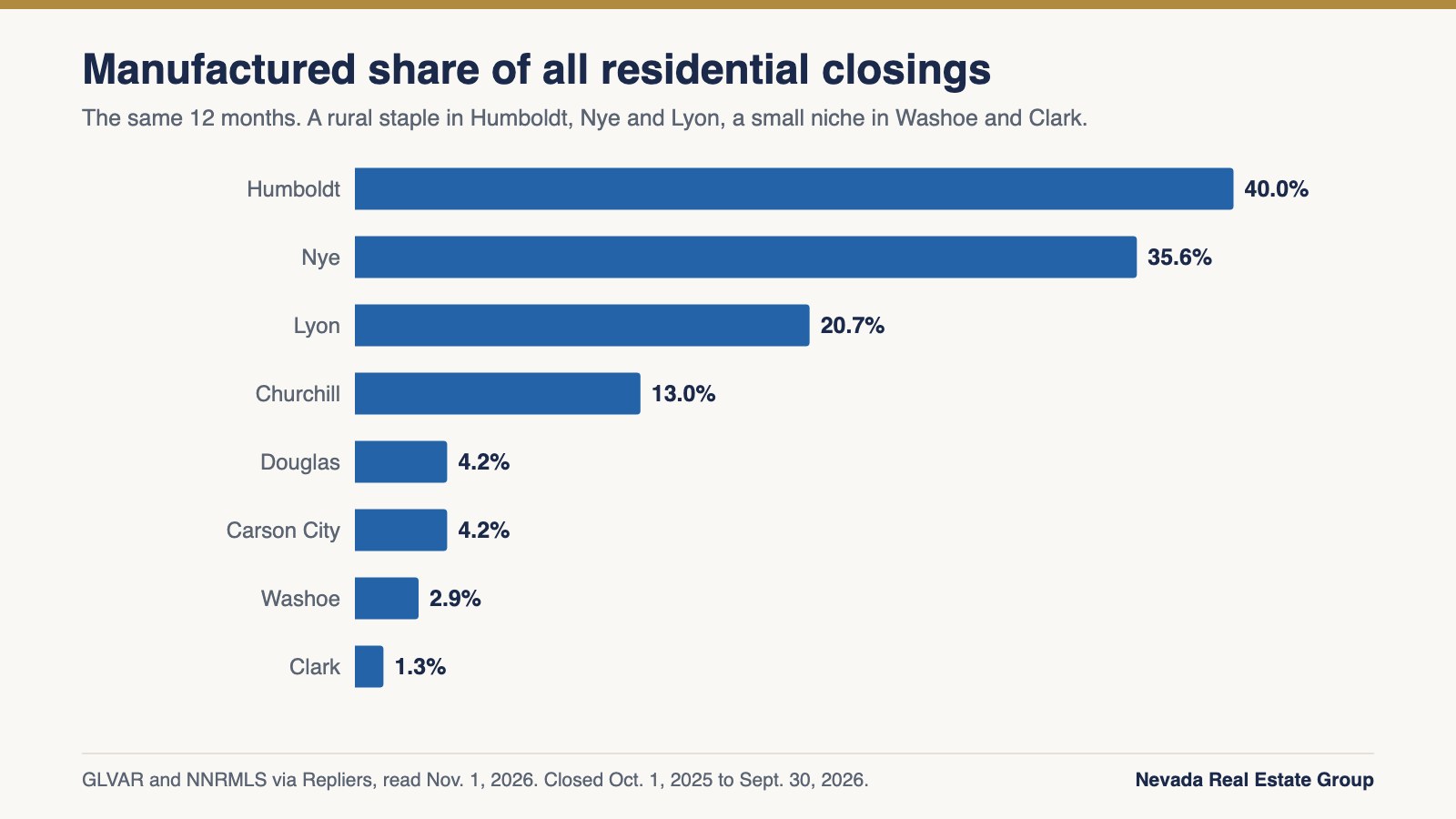
- Manufactured homes were 35.6% of Nye residential closings but only 1.3% of Clark closings.
| Dimension | Mobile home | Manufactured home | Modular home |
|---|---|---|---|
| Built to | No HUD Code; older than June 15, 1976 | Federal HUD Code, 24 CFR Part 3280 | Building codes the Nevada Housing Division applies under NRS 461 |
| What proves it | Age and state title | HUD metal label on each section, plus a data plate inside | Nevada insignia of approval |
| Status at the start | Personal property | Personal property with a state title | Real property once permanently affixed; no state title issued |
| Single-family zoning | Not covered by the state rule | Must be included, if it meets placement standards | Must be included, if built to code |
| Age test | Barred from new placement in Nye County | Six years in the statute; longer in Nye County | None by default; a local area may bar units past six years |
| Who inspects setup | Housing Division or its local delegate | Housing Division or its local delegate | Local building department in Clark; elsewhere local or state |
What Separates a Manufactured Home From a Modular Home?
The dividing line is the code the home was built to, and whose approval it carries. A manufactured home follows one national standard. According to HUD's Office of Manufactured Housing Programs, HUD enforces that code under the National Manufactured Housing Construction and Safety Standards Act of 1974, directly and through state agencies. Freddie Mac's manufactured home page gives the cutoff lenders and counties use: homes built under the HUD Code on or after June 15, 1976.
A modular home follows the building codes used for ordinary construction. Fannie Mae's Selling Guide says it plainly: modular homes are not manufactured housing, they are built under the International Residential Code as adopted by the state where they are installed, and they are treated as one-unit site-built property. Federal law now uses a similar definition. Public Law 119-101, Section 302, describes a modular home as one built in a factory in modules that meet state and local building codes, then transported and installed on foundations.
Neither label says anything about quality on its own. Both are factory products, and both can be well or poorly set on the lot. The practical difference shows up in paperwork. Washoe County's code states the point directly: modular placements follow the same regulations and standards as site-built homes, while manufactured homes get a separate list of placement, foundation and design tests. Park models are a third case. Nevada's manufactured-home and manufactured-building definitions both exclude recreational park trailers, and our guide to tiny homes in Las Vegas walks through that category.
How Does Nevada Law Define Each Type of Home?
Nevada spreads these definitions across two chapters, and the wording trips people up. NRS 489.113 defines a manufactured home as a structure built on a permanent chassis, designed for use with or without a permanent foundation, transportable in one or more sections, and at least 8 feet wide or 40 feet long in transit, or 320 square feet when erected. It also covers chassis homes whose maker files the HUD certification, and any structure built in compliance with NRS Chapter 461. NRS 489.120 defines a mobile home separately and excludes manufactured homes from it.
Chapter 461 handles the rest. NRS 461.080 defines factory-built housing as a residential building wholly or substantially made off site and assembled on site, excluding mobile homes. NRS 461.143 defines a modular building in similar terms for offices, apartments, schools and other buildings. Here is the trap: NRS 461.132 says a "manufactured building" means a modular building or one built with modular components. So in Nevada law a manufactured building is not a manufactured home, even though the two phrases sound interchangeable.
County codes add their own vocabulary. Nye County's Pahrump rules speak of "manufactured homes and factory-built homes" together. Washoe County uses "fabricated housing" for modular, manufactured and mobile homes as a group. Clark County's Title 30 pairs "manufactured or tiny home."
Federal law moved in 2026 and Nevada's text hasn't caught up. Section 301 of Public Law 119-101 changed the federal definition to cover homes built with or without a permanent chassis, and states must certify that their laws treat those homes equally. NRS 489.113 still says "built on a permanent chassis." Our ROAD to Housing Act explainer covers Nevada's July 11, 2028 deadline.
How Can You Tell Which Home You Are Looking At?
Look for the physical evidence, not the listing description. A HUD Code home carries a certification label at the taillight end of each transportable section. 24 CFR 3280.11 describes an aluminum plate about 2 by 4 inches. Inside, 24 CFR 3280.5 requires a data plate near the main electrical panel or another reachable spot, listing the plant, serial number, model and date of manufacture. HUD's label page adds that the plate is often in a kitchen cabinet or bedroom closet, that HUD doesn't reissue lost labels, and that a verification letter comes through the Institute for Building Technology and Safety. A modular home instead should carry the Nevada insignia that NRS 461.190 requires before a first sale in the state.
The MLS won't settle it. Across both Nevada boards, only one closing in the 12 months through September 2026 was filed under a modular style field. Searching the remarks of every closed listing found eight more homes described as modular. Four sat under Manufactured Home, three under Single Family and one under Other. One of those "modular" homes was built in 1969, seven years before the HUD Code took effect, and another was described as "manufactured/modular."
Sellers use the word loosely. If a listing says modular, ask for the insignia, the plans and how the county taxes it. A HUD label means it's a manufactured home, whatever the remarks say. A title search costs $20 on the Housing Division's schedule dated November 10, 2025.
How Does Nevada Approve a Modular Home?
A modular home is approved before it reaches the lot. Under NAC Chapter 461, the manufacturer files plans stamped by a design professional with the Housing Division or an approved third-party reviewer (NAC 461.100). The Administrator endorses plans that conform to the technical codes (NAC 461.110). Each unit must be inspected at least once during construction (NAC 461.300), and it must carry the Division's insignia before it leaves the plant (NAC 461.130). Nevada can accept units inspected by another jurisdiction with equivalent codes under NRS 461.190.
Which code edition applies is a fair question. NAC 461.205 still lists the 2012 International Residential Code in its codified text, while the Division's permits page says plan reviews and inspections have followed the 2018 IBC and IRC since December 24, 2024. Ask the manufacturer which approval number and code cycle cover your plan.
The Division's fee schedule, dated November 10, 2025, lists $100 for plan approval on factory structures, $500 for a system of construction and $60 per insignia.
Once the unit arrives, local government takes over more of the job than it does with a manufactured home. NRS 461.260 says agencies in counties of 700,000 or more must enforce and inspect installation. Clark is Nevada's only county that large at 2,265,461 people in the 2020 census, as tabulated by the Legislative Counsel Bureau. Smaller counties may do so, and the Division steps in if a local agency hasn't acted within 10 days of a request. The same section reserves zoning, setbacks, side and rear yards, site development and architectural review entirely to local jurisdictions.
What Does State Law Make Local Zoning Accept?
Nevada has two parallel rules, and they aren't identical. NRS 278.0209 covers factory-built housing. A zoning ordinance's definition of single-family residence must include factory-built housing built to the single-family standards of the Uniform Building Code. A city or county must apply the same setbacks, parking, aesthetic, minimum-size and design standards it applies to a conventional home on that lot. It may ask for higher safety standards only if a site-built home on the same lot must meet them too. It may bar installation in a specified area if more than six years have passed since manufacture, or if the area has special historical character. So age is an option for factory-built housing, not a default.
NRS 278.02095 covers manufactured homes and asks more. Outside a mobile home park, the local standards must require that the home be:
- permanently affixed to a residential lot
- manufactured within the six years immediately before it is affixed
- sided and roofed like nearby single-family homes
- one or more sections
- at least 400 square feet of living area, unless the local body approves less by administrative variance, based on lot size or the size of nearby homes
An elevated foundation must be masked. Standards must be objective and may not be adopted to discourage attainable housing. For a home that isn't new, the owner must surrender the certificate of title to the Housing Division before a building department issues the placement permit. Senate Bill 40 of 2023 cut the floor from 1,200 to 400 square feet and replaced "more than one section" with "one or more sections." Older county text may still reflect the earlier rule.
Three limits apply. Neither statute overrides a recorded covenant, so CC&Rs can still block a home. Historic areas are carved out. And local governments in a county under 52,000 people may adopt looser standards for manufactured homes. On the 2020 census count, Nye (51,591), Douglas (49,488) and Churchill (25,516) sit under that line, while Lyon (59,235) and Carson City (58,639) sit above it.
What Do Clark, Washoe, Nye and Lyon Actually Require?
The table below shows what each code says about a manufactured home on a residential lot. It reflects what we could read on November 1, 2026. Nye County's rows come from bill text in county agenda packets. Commission minutes show the bills passed, but the codified Nye County Code refused our request, so confirm the current wording with county planning.
| Jurisdiction | Age at placement | Minimum size | Sections | Foundation and title |
|---|---|---|---|---|
| State baseline, NRS 278.02095 | Within 6 years | 400 sq ft | One or more | Permanently affixed; elevated foundation masked |
| Unincorporated Clark County | Within 6 years | 400 sq ft habitable | One or more | Permanently affixed |
| Unincorporated Washoe County | Within 6 years | 400 sq ft | One or more | Permanent foundation; must convert to real property |
| City of Reno | Within 6 years | 400 sq ft | One or more | Full perimeter foundation; must convert to real property |
| Pahrump district: RE-1, SE, VR zones | Within 6 years | 400 sq ft | One or more | Perimeter foundation; must convert to real property |
| Pahrump district: RH-9.5, RH-4.5, RE-2 zones | Within 10 years; commission waiver possible | 400 sq ft | One or more | Perimeter foundation; must convert to real property |
| Nye County outside Pahrump district | Within 20 years; older by waiver | Not stated in the section | Not stated in the section | Engineered pad, poured footings |
| Lyon County, per county FAQ | Not more than 6 years | 1,200 sq ft | More than one | Poured perimeter foundation or engineered equal |
We couldn't read current rules for five places, so we state none. The City of Las Vegas archives its old Title 19 and its current code viewer showed no code text to our tools. Henderson's code host refused the request, and Carson City's placement forms did too. We didn't open an official code page for North Las Vegas or Sparks. Ask each planning department directly, and don't assume a city matches its county's rule. All five sit in counties above the 52,000 small-county line on the 2020 census, so the state standards are the place to start.
Older local rules can differ from the current statute. That's why a written answer tied to your address beats any summary, including this one. Bring the parcel number, the home's manufacture date and its dimensions.
Where Can You Place a Manufactured Home in Clark County?
Outside the incorporated cities, Clark's rule is Title 30, Section 30.04.05E.6, in the county's current PDF, labeled effective October 7, 2026 in its file name. It applies to any manufactured home on a residential lot used as a single-family dwelling, and says these standards can't be waived or varied unless NRS 278.02095 says otherwise. The home must be manufactured within six years of the year it is affixed, consist of one or more sections, be permanently affixed, and contain 400 square feet of habitable area, not counting garages and patios. A smaller home needs Administrative Design Review based on the lot or nearby homes.
The county's general single-family design standards also apply to manufactured homes on individual lots, including at least two architectural features on each facade. Title 30 counts a manufactured home as a single-family detached dwelling when it sits on its own lot, so a qualifying home follows the normal residential path. That's a real difference from a park.
Parks are a separate use. Table 30.03-1 lists a manufactured or tiny home park as a special use in the RS5.2, RM18, RM32 and RM50 districts, with minimum spaces of 2,880 square feet for a single-wide and 4,000 for a double-wide. Parks in place by August 27, 1976 are legal nonconforming, and new homes there follow the rules in effect when the park was established.
Clark's sales tell a matching story. Its 371 MLS closings sat on a median lot of 0.14 acre, with a median year built of 1983. Only 14 were within six years of their closing year. Desert Inn Mobile Estates and Sunrise Trailer Estates alone made up 141 of the 371, which points to resales in older recorded subdivisions rather than new placements. If your plan is a casita rather than a main home, Title 30 treats that differently, and our Clark County ADU guide covers it.
What Are the Rules in Washoe County and Reno?
Unincorporated Washoe County works from Article 312, Fabricated Housing, last changed by Ordinance 1714, effective March 29, 2024. That ordinance dropped the old 1,200-square-foot floor and the special findings for smaller homes. Section 110.312.05 now allows manufactured homes of at least 400 square feet, built within six years of placement, on an individual lot that permits a single-family home. New placements are barred in commercial, industrial, open space, parks, public facility zones and historic districts.
The extra requirements are specific, and they cost money to meet:
- a foundation meeting Chapter 100 for conversion to real property, no higher than 36 inches at the perimeter, with at least one section no higher than 16 inches
- hitch and wheels removed at final inspection
- complete perimeter skirting
- one required parking space inside a garage or, in the old Trailer Overlay, a carport, unless a variance waives it
- non-reflective, non-metallic siding, and a sloped roof with eaves of at least 6 inches, for homes invoiced since January 1, 1994
- a notarized statement that CC&Rs don't prohibit the home
- a conversion affidavit filed with the Assessor before final occupancy
Areas designated Trailer (TR) Overlay before May 26, 1993 get looser treatment, including single-section homes without the six-year test. Ask whether your parcel carries that overlay, especially in Sun Valley, whose addresses made up 86 of Washoe's 186 closings.
The City of Reno's Title 18, amended June 3, 2026, lists a manufactured home as a permitted use in all ten of its residential districts. Section 18.03.302(a)(6) requires a full perimeter foundation, conversion to real property, manufacture within six years of being affixed, roofing that contrasts with the siding, one or more sections, at least 400 square feet, and siding within 12 inches of grade. New or expanded mobile home parks need a conditional use permit under the same section. Reno's Manufactured Home Guidelines, updated July 1, 2025, require state approval for any addition structurally attached to the home.
How Does Nye County Treat Pahrump Differently?
Nye County runs two sets of rules. Inside the Pahrump Regional Planning District, Section 17.04.820 covers manufactured and factory-built homes together and sorts zoning districts into two groups:
- RE-1, SE and all VR districts: the home must be manufactured within six years before it is affixed.
- RH-9.5, RH-4.5 and RE-2 districts: the limit is ten years.
Both groups require conversion to real property through the Assessor, siding and roofing similar to homes within 1,000 feet, one or more sections, at least 400 square feet, and an approved permanent foundation with a perimeter supporting wall backfilled to within 12 inches of the floor. Bill 2023-14 set the 400-square-foot and one-or-more-section terms, and commission minutes show it passed 5-0 on November 7, 2023, effective November 27. Bill 2025-01 added a Regional Planning Commission waiver from the ten-year limit, and the April 15, 2025 minutes show it passed 5-0, effective May 5. That waiver doesn't cover the six-year group, and the section keeps a flat ban on pre-HUD homes anywhere in the district. It doesn't reach approved parks or subdivisions with their own standards.
Outside the district, the rule we read is Section 15.16.092. Bill 2023-15 sets a 20-year limit, lets the Planning Director waive it, and allows exceptions to promote affordable housing or for flood zones, poor soils and rough terrain. It calls for a soils report, an engineer-certified pad and poured reinforced concrete footings. It also bars new placement of pre-HUD homes anywhere in the county. The November 2023 minutes show this bill passed in the same 5-0 vote. We read the bill text, not the codified code, and we found no other bill naming either section on commission agendas through October 2026. Confirm the current wording with county planning.
These looser numbers fit the statute's small-county exception. Nye had 339 manufactured closings, 35.6% of all residential closings, on a median lot of 1.07 acres. Our Pahrump housing market guide has the local pricing, and the Pahrump land guide covers wells, septic and parcel diligence. Rural buyers should also read our Nevada well and septic guide before budgeting a placement on raw land.
Why Does Lyon County's Published Rule Look Stricter?
Lyon County's building FAQ, read November 1, 2026, says a manufactured home may be a single-family dwelling in most residential zones if it is not more than six years old when moved and is certified to the federal standards. It then sets a 1,200-square-foot minimum and says the home must have more than one section. An administrative variance may be considered based on lot size or smaller nearby homes. The same FAQ limits a parcel to one manufactured residence, whatever its size, and won't permit one as a guest house, office or storage building, with narrow exceptions.
The size and section numbers differ from NRS 278.02095, which now says 400 square feet and one or more sections. We found no Lyon ordinance adopting the 2023 change, but that isn't proof none exists, and we aren't telling you the county is wrong. The right step is a written answer from the Lyon County Building Department for your parcel before you order a home.
The foundation rule is firmer. The county's Manufactured Home Foundation Policy quotes Lyon County Code 15.351.04(A)(6): a full, poured-in-place perimeter foundation with a crawl space, or an equivalent the building official approves. A foundation meeting the prescriptive standards of the 2024 International Residential Code doesn't need to be engineered, although the county recommends it. Anything else needs a Nevada-registered engineer, and footings must extend below the 18-inch frost line. But the same policy also says all structural foundation systems must be designed and stamped by a Nevada design professional, and the FAQ says a registered engineer must do the design. Ask the building department which applies before you skip the stamp.
Lyon's market is large for its size. It had 238 closings, 20.7% of all residential closings, on a median lot of a full acre. Of those, 44 were built in 2020 or later, the most of any county. Silver Springs addresses alone made up 98, and Fernley another 24.
Can You Still Put a Home in a Park or Replace an Older One?
The age and size standards above stop at the park gate. NRS 278.02095 applies to homes placed outside a mobile home park, Clark's section says it doesn't apply inside one, and Washoe sends park homes to Article 314. Nye's Pahrump section also excludes approved parks and subdivisions with their own standards. Park rules and the lease then decide what a park accepts, and NRS Chapter 118B makes a landlord pay to fix an approved placement that breaks local ordinances. A tenant bringing a home new to the park must also show the landlord a state-licensed installer's license.
Older homes are where the rules bite. The age clock runs to the date a home is affixed, so it governs a new placement, not the resale of a home already lawfully in place. A 1985 home can sell on its existing lot. Moving it to a different residential lot in unincorporated Clark, Reno or unincorporated Washoe outside the old Trailer Overlay is another matter, because it would fail the six-year test there.
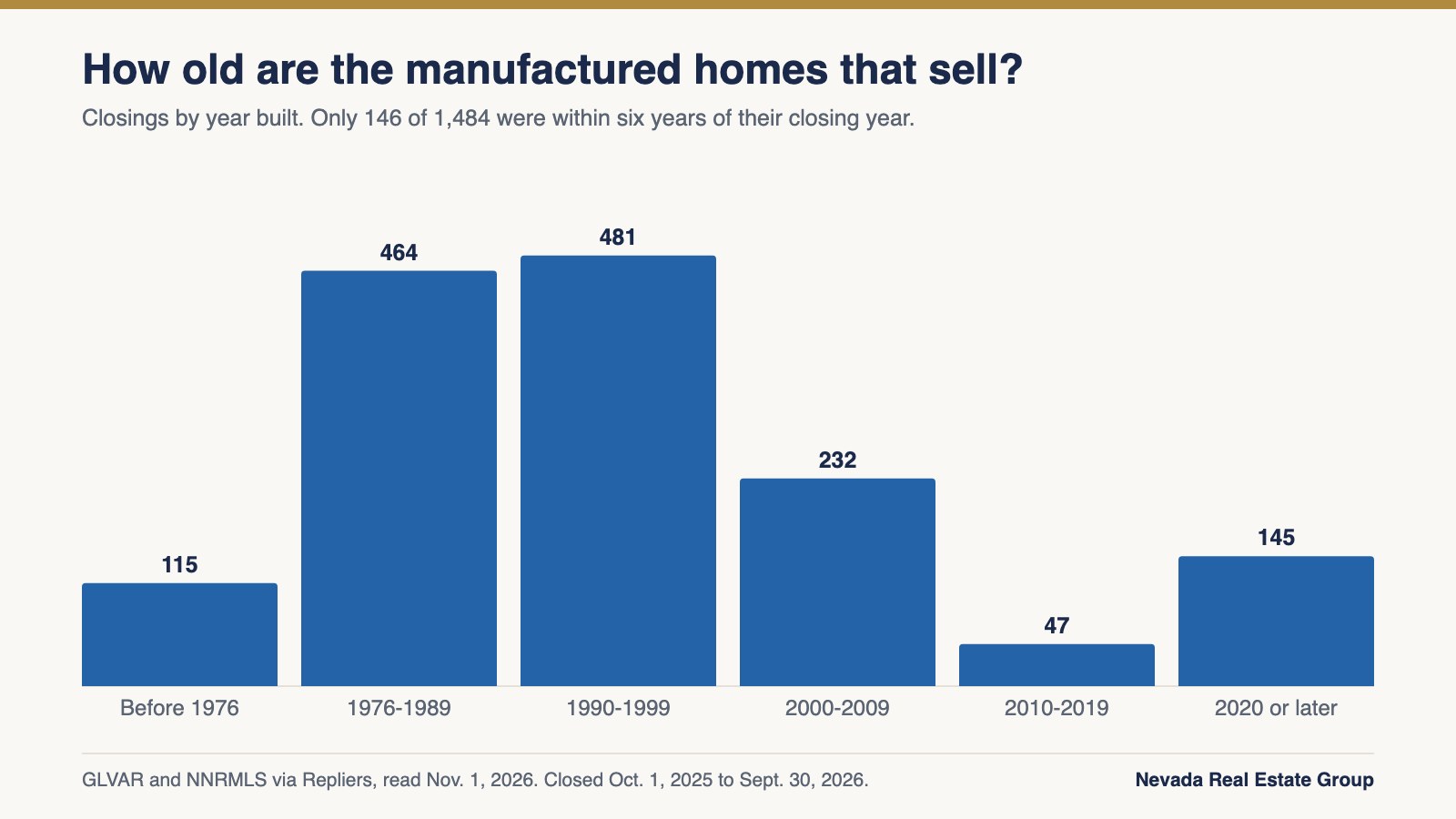
Our closings show the scale of that. Just 146 of 1,484, or 9.8%, were within six years of their closing year. The other 90% would fall outside a six-year window if the buyer planned to relocate the home to a new lot in those jurisdictions. Moved homes also raise separate loan problems, which the financing guide covers.
Mobile homes are narrower still. Washoe allows new mobile home placements only in the old Trailer Overlay, and only on lots that had a mobile or manufactured home on the assessment roll within 12 months of the application. Nye's code sections bar new pre-HUD placements outright. Reno has a separate use line for mobile home subdivisions. So a pre-1976 home on a lot today is usually a keep-it-where-it-is asset. Replacing it can mean meeting current standards with a newer unit. Check before you assume the old home's use carries over.
How Does a Manufactured Home Become Real Property in Nevada?
NRS 361.244 gives three routes. Clark's Assessor puts the starting point plainly: a manufactured home is personal property by definition, and once converted to real estate it is no longer treated as one.
Route 1, conversion. The home must be permanently affixed to land you own, or to leased land if it is financed under Fannie Mae, Freddie Mac, USDA or similar guidelines. The statute also counts a life estate, lease or contract for sale as owned land. The assessor can't place it on the roll until four things happen: the Housing Division verifies the conversion, the personal property tax for the current fiscal year is paid in full, an affidavit of conversion is recorded with the county recorder, and the dealer or owner delivers a copy and the home's documents to the Division.
The current form is Form T10, revised November 2025. Some county pages still name the older TL-110. On the form you affirm that the running gear is off and the home was installed to state and local codes, and you accept that liens on the home may become liens on the land. Clark, Elko, Humboldt, Lander, Lyon, Pershing and Nye require a building department sign-off. The county assessor signs too. The form says the conversion isn't valid until a Real Property Notice goes to the assessor, and the home then joins the next tax roll. The Division's fee schedule lists $60, matching Washoe's instructions.
Route 2, placement under the zoning statute. Since July 1, 2001, NRS 361.244(5) says the assessor must place a home permanently affixed to a residential lot under an NRS 278.02095 ordinance on the roll as real property, regardless of those four conditions. It doesn't apply in a mobile home park or an area designated for placement without conversion.
Route 3, factory-built housing. A modular home permanently affixed on or after July 1, 1979, to land you own or qualifying leased land, is real property under NRS 361.244(4), and NRS 489.541 says the Division won't issue a title for it.
Conversion can be reversed. NRS 361.2445 requires at least 30 days' notice, consent affidavits from everyone with an interest in the land, a sign-off on any security interest, paid taxes and a recorded affidavit.
Listings rarely settle this. Of 1,484 closings, 173 remarks said the home was converted and 28 said it wasn't, which leaves most silent. Ask for the recorded document and the Real Property Notice.
Where Do Nevadans Actually Buy Manufactured Homes?
Manufactured homes are a rural staple and an urban niche. We pulled every closing marked Manufactured Home on both MLS boards, GLVAR and NNRMLS, by closing date from October 1, 2025 through September 30, 2026, and removed six in a California county that the northern board serves. That left 1,484 closings at a $295,000 median, about 1,440 square feet and a median year built of 1993.
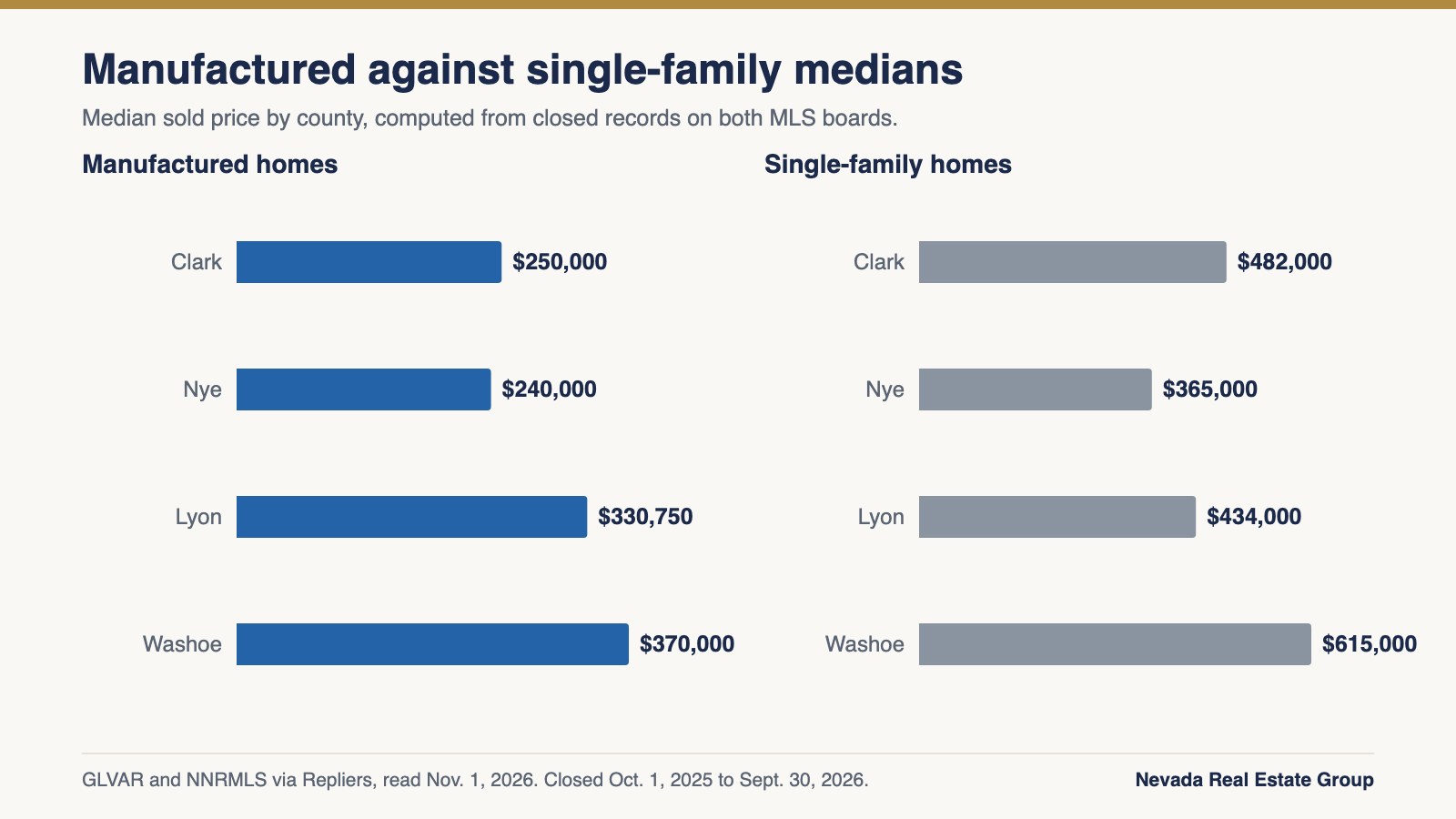
| County | Manufactured closings | Share of residential closings | Manufactured median | Single-family median | Median lot, acres | Median year built |
|---|---|---|---|---|---|---|
| Clark | 371 | 1.3% | $250,000 | $482,000 | 0.14 | 1983 |
| Nye | 339 | 35.6% | $240,000 | $365,000 | 1.07 | 1996 |
| Lyon | 238 | 20.7% | $330,750 | $434,000 | 1.00 | 1998 |
| Washoe | 186 | 2.9% | $370,000 | $615,000 | 0.35 | 1990 |
| Humboldt | 112 | 40.0% | $339,900 | $406,000 | 1.25 | 1998 |
| Douglas | 44 | 4.2% | $313,500 | $710,400 | 1.33 | 1987 |
| Churchill | 40 | 13.0% | $352,500 | $405,000 | 2.37 | 1998 |
| Carson City | 30 | 4.2% | $347,950 | $552,486 | 0.18 | 1989 |
Read the table with its limits in mind. The style field is what the listing agent chose, so a misfiled home can land in either column. The MLS misses private sales, and most of these records carry a lot size, so sales inside rented parks are thinly represented. Douglas, Churchill and Carson City are small samples. And a median compares different homes on different land: a Humboldt double-wide on 1.25 acres isn't a Clark single-family tract home. Monthly closings ran between 102 and 160, with no outlier month.
What Does a New Manufactured Home Cost Before the Land?
The best public number comes from the Census Bureau's Manufactured Housing Survey. Its average price table puts new manufactured homes in Nevada at $150,500 in 2025: $104,500 for a single-section home and $164,900 for a double. The Western average was $145,100 and the national average was $127,200. Nevada's figures are less precise, with a 5.6% relative standard error on the total and 12.1% on single-section homes, so treat them as rough.
Those prices don't describe a finished project. The survey glossary says dealers are told to include set-up costs, but other costs of preparing a unit for occupancy may not be included. It doesn't state how land or delivery is handled. In Nevada, that gap holds the expensive parts: the lot, foundation, utilities, permits and any well or septic work.
We found no public average price for a modular home in Nevada, and we won't invent one. The MLS can't supply it either, with a single closing filed under that style in 12 months. Price a modular project from a written builder contract that spells out factory price, freight, set, foundation and finish work.
State fees are small next to all that. The Division's schedule lists $320 for installing a multi-section manufactured home, $200 for single-section, and $60 for an installation label and certificate. Lyon's foundation policy shows why the site bill grows: a stamped design, soil bearing of at least 1,500 pounds per square foot and footings below the frost line. Washoe's list adds a garage or carport and masking.
Resale prices offer a reality check. Manufactured homes built in 2020 or later closed at a $345,000 median statewide. If a new placement pencils above what a similar recent home sells for nearby, that's worth knowing before you buy land. Compare the math with new construction near you too.
What Should You Check Before You Buy or Place One?
Work through these in order, because each one can stop the project:
- Identify the home. Read the HUD label and data plate, or ask for the Nevada insignia. Get the manufacture date in writing.
- Find the governing code. A city address and an unincorporated one can sit a block apart, and their rules differ.
- Read the recorded covenants. State law leaves them in force, so a parcel that passes zoning can still fail its CC&Rs.
- Match age and size to the parcel. Ask whether a six-year, ten-year or twenty-year limit applies, and whether a waiver exists.
- Get the foundation requirement. Ask whether the county wants a poured perimeter, an engineered equal or a certified pad.
- Confirm the title path. Find out whether the home converts by affidavit, goes on the roll at placement, or is already real property.
- Test the land. Check water, sewer or septic, power and delivery access. Our USDA rural loans guide also shows which towns mapped eligible.
Bring those answers to a lender before you commit. The financing guide explains how title, land and age change the loan.
If you'd like a second set of eyes, send us the address and whatever paperwork you have, and we'll work through these questions with you. You can also search current listings statewide, including Pahrump homes for sale and homes near Carson City. Nevada Real Estate Group works across the state with 150+ agents. Call (702) 637-1759 in Southern Nevada or (775) 277-2120 in Northern Nevada, or contact us online.
Frequently Asked Questions
Is a modular home the same as a manufactured home in Nevada?
No. A manufactured home is built to the federal HUD Code on a permanent chassis and starts as personal property with a state title. A modular home is built to the building codes Nevada applies under NRS 461, carries a Division insignia, and is real property once permanently affixed. The Housing Division doesn't issue a title for one that is real property.
Can I put a manufactured home on my lot in Las Vegas?
In unincorporated Clark County, a home within six years of manufacture and at least 400 square feet can go on a residential lot if it is permanently affixed and meets design standards. We could not read the City of Las Vegas's current code, so ask city planning for that address. CC&Rs can still prohibit it either way.
How old can a manufactured home be when it is placed in Nevada?
The state standard is six years for a home placed outside a mobile home park, and unincorporated Clark and Washoe and the City of Reno follow it. Nye County's code sections use six or ten years in the Pahrump district and 20 years elsewhere. The limit applies at placement, not when an installed home is resold.
What is the minimum size for a manufactured home in Nevada?
NRS 278.02095 sets 400 square feet of living area, with less possible by administrative variance based on the lot or nearby homes. Unincorporated Clark and Washoe and the City of Reno use 400 square feet. Lyon County's FAQ states 1,200 square feet, so get that county's answer in writing. The state's definition of a manufactured home is a separate test: 8 feet wide or 40 feet long in transit, or 320 square feet when erected.
Can CC&Rs or an HOA block a manufactured or modular home?
Yes. Both NRS 278.0209 and NRS 278.02095 leave recorded restrictive covenants in place. Washoe County goes further and requires a notarized statement that covenants don't prohibit the home before it issues a permit outside the old Trailer Overlay. Read the covenants in your title report before you buy the land.
Are mobile homes built before 1976 still allowed in Nevada?
Existing ones can stay and be sold, and 115 of our 1,484 closings were built before 1976. New placement is another matter. Nye County's code sections bar pre-HUD homes, and Washoe limits mobile homes to the old Trailer Overlay on lots with a recent mobile or manufactured home assessment, plus parks. Ask the local planning office first.
Does a manufactured home become real estate automatically?
Usually not, unless it was placed on a residential lot under an NRS 278.02095 ordinance, which the assessor must roll as real property. Otherwise the owner records an affidavit on Form T10, pays the current personal property tax, and waits for the Housing Division's Real Property Notice. The schedule lists a $60 fee.
Which Sources Inform This Guide?
State law. NRS 278.0209, NRS 278.02095, NRS 361.244, NRS 361.2445, NRS Chapter 461, NRS Chapter 489, NRS Chapter 118B, NAC Chapter 461 and Senate Bill 40 of 2023, all read November 1, 2026.
Federal. HUD's manufactured housing program, HUD label guidance, 24 CFR 3280.5, 24 CFR 3280.11, Public Law 119-101 and the Census Manufactured Housing Survey.
State agency. The Nevada Housing Division's fee schedule, Form T10 and permits page.
Local codes. Clark County Title 30, Washoe County Development Code Division Three, Reno Title 18, Nye County Bills 2023-14, 2023-15 and 2025-01 with commission minutes of November 7, 2023 and April 15, 2025, and Lyon County's FAQ and foundation policy.
Other. Fannie Mae Selling Guide B2-3-02 and the Clark County Assessor.
How we built the numbers. MLS figures come from GLVAR and NNRMLS data through Repliers, pulled November 1, 2026, using the closing date rather than the contract date, for closings October 1, 2025 through September 30, 2026, with the listing style field set to Manufactured Home. Remarks counts come from a text search of those 1,484 records, read by hand for the modular group. County residential totals use the Residential property type on both boards. Census counts are from the Legislative Counsel Bureau's 2020 county table. This guide isn't legal advice, and local rules change, so confirm any rule for your parcel with the agency named.