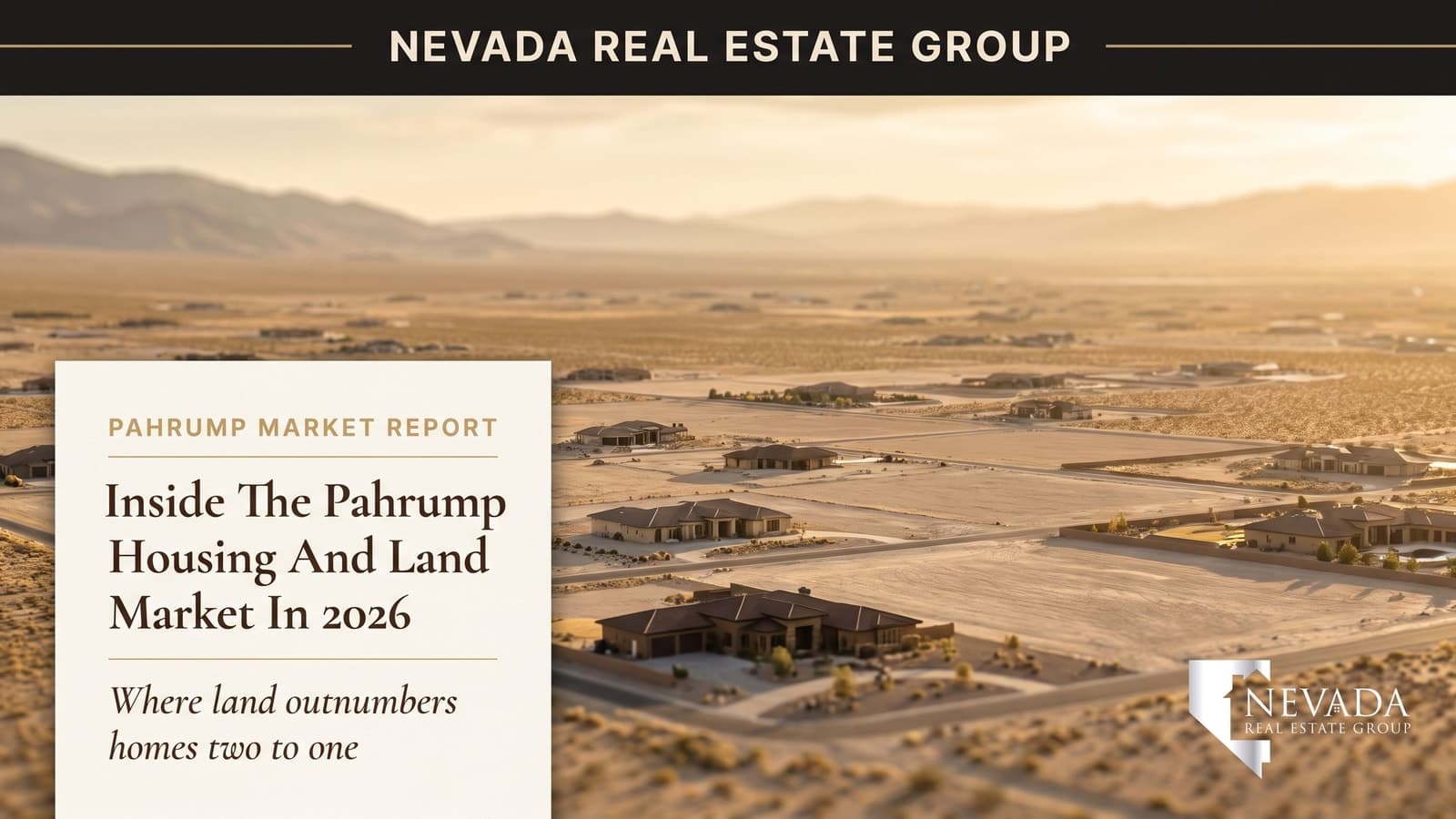

Pahrump sits about an hour west of Las Vegas over the Spring Mountains, in Nye County, and it is one of the most misunderstood housing markets in Nevada. Buyers who arrive expecting a smaller version of Las Vegas find something structurally different: a valley where raw land, not finished homes, dominates the for-sale inventory, where a manufactured home on five owned acres trades in the same week as a golf-course villa, and where the median home still starts with a "1." In 2026, Pahrump has quietly become the affordability release valve for Southern Nevada — and the numbers tell a story that a drive-by never could.
This guide stays on the data: what homes actually cost, why there is so much vacant land, how manufactured and site-built values differ, what wells and septic systems do to a deal, how prices stack up against Las Vegas, and where the market goes from here. If you want the lifestyle-and-livability angle instead — schools, weather, commute, things to do — start with our companion post on whether Pahrump is a good place to live. Here, we count.
To decide whether the price difference fits your routine, compare Pahrump versus Las Vegas price and commute trade-offs using the commute you would actually make.
Pahrump's median sold home price in 2026 is about $195,000 (GLVAR/Repliers, trailing 12 months) — roughly half the Las Vegas metro median — with homes taking a median of 50 days to sell and 63% closing below list. The market's defining feature is land: at mid-2026 roughly 1,234 active vacant-land parcels were for sale against only about 552 homes, better than two-to-one. Manufactured and mobile homes make up nearly a third of sales.
- Median sold home price is about $195,000 at roughly $197 per square foot — near half the Las Vegas median.
- Vacant land outnumbers homes on the market roughly 1,234 to 552, better than two-to-one.
- Manufactured and mobile homes are about one in three detached home sales here.
- 63% of homes sold below list and median days on market ran 50 — real buyer leverage.
- No state income tax and a 0.65% effective property-tax rate keep Nye County carrying costs low.
What Do Pahrump Home Prices Look Like in 2026?
Pahrump is an affordability market, and the headline number proves it. Based on NREG's analysis of the Pahrump homes that closed on the Greater Las Vegas Association of REALTORS (GLVAR) MLS in the trailing twelve months through mid-2026 — more than 900 residential closings — the median sold price landed at roughly $195,000, with an average of $208,378 and a typical price near $197 per square foot. Homes took a median of 50 days to go from list to contract (the average stretched to 100, dragged up by a long tail of hard-to-move rural and fixer inventory), and 63% of closed sales settled below the seller's last list price.
Put that beside the broader Southern Nevada picture and the gap is stark. The Las Vegas metro median hovers near $480,000 in 2026; Pahrump trades at roughly 40 cents on that dollar. For a buyer priced out of Las Vegas or Henderson, an hour's drive west can mean the difference between renting indefinitely and owning outright.
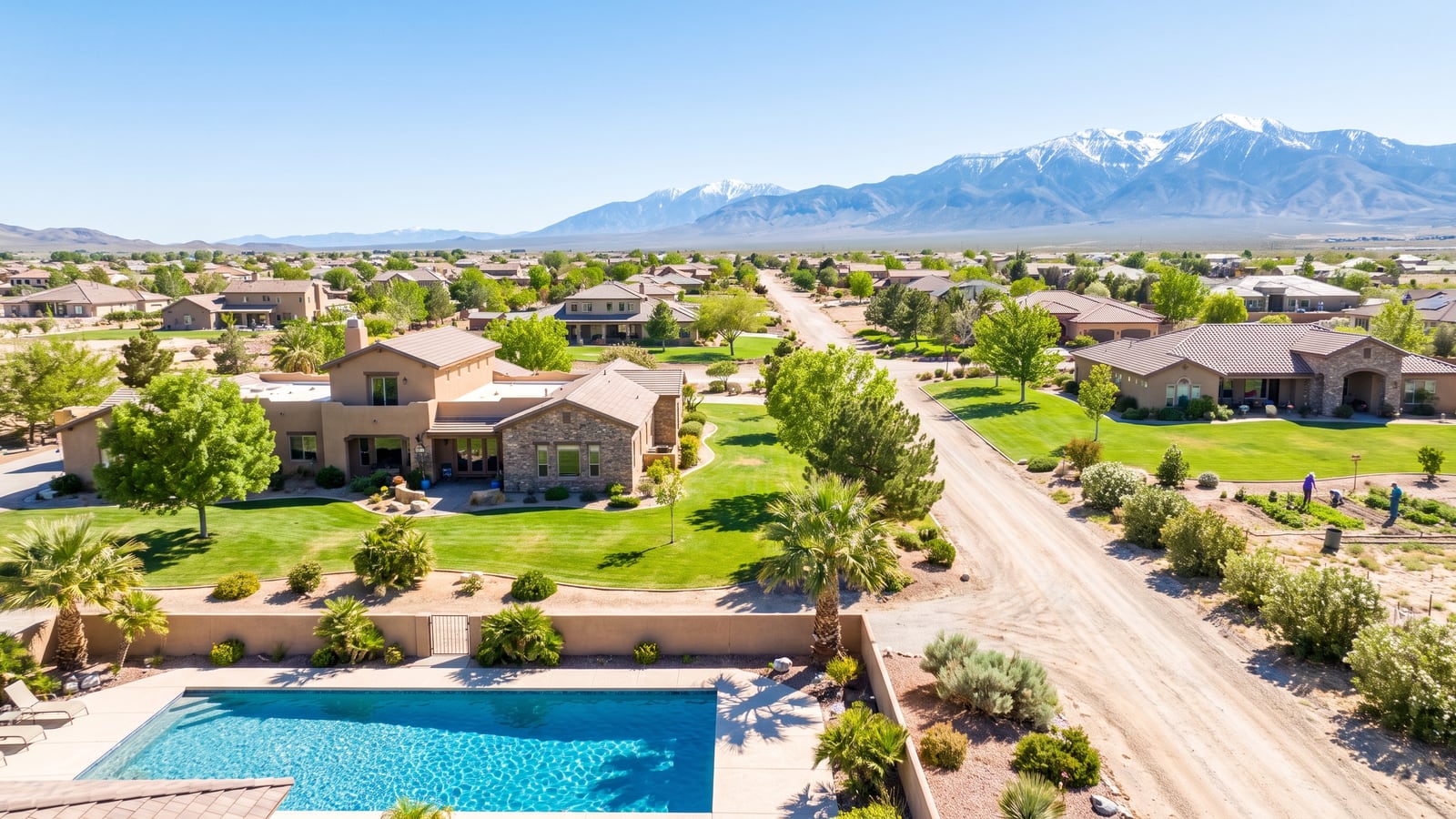
But the median hides the market's real character. According to the U.S. Census Bureau, Nye County spans more than 18,000 square miles — larger than nine U.S. states — and Pahrump is its population center at roughly 45,000 residents on a valley floor still measured in acres and section lines. That geography is why price per square foot alone never tells the whole story here: you are frequently buying land as much as house. The table below sets the 2026 baseline.
| Metric | Homes (residential) | Vacant land |
|---|---|---|
| Median sold price | $195,000 | Low five figures, lot-dependent |
| Average sold price | $208,378 | Wide range by acreage |
| Active for-sale count | ≈ 552 | ≈ 1,234 |
| Closings (12 mo) | ≈ 907 | ≈ 553 |
| Median days on market | 50 | Often 6–18 months |
| % sold below list | 63% | Higher |
The single most important fact in that table is the active count: 1,234 vacant parcels versus 552 homes. No other Southern Nevada market is even close to that ratio. Browse the live Pahrump homes-for-sale feed as you read and the split is obvious — page after page of land between the houses.
Why Does Pahrump Have More Vacant Land Than Homes for Sale?
This is the question that separates Pahrump from every other Nevada market, and the answer is historical. In the 1960s and 1970s, developers platted the Pahrump Valley into tens of thousands of half-acre to five-acre residential lots — most famously the sprawling Calvada Valley grid, recorded in units numbered 1 through 14 and beyond. Far more lots were recorded than were ever built on. The result, six decades later, is a valley carpeted with legally buildable parcels that have never held a home.
That inheritance shows up directly in the 2026 inventory. Of the roughly 1,786 active for-sale listings we tracked in mid-2026, 1,234 were vacant land and only about 552 were homes — a land-to-home ratio better than two-to-one. On the sold side, the trailing twelve months recorded roughly 907 home closings against 553 land closings, meaning raw parcels accounted for nearly four of every ten transactions. In Las Vegas or Boulder City, vacant-land sales are a rounding error; in Pahrump they are a core segment of the market.
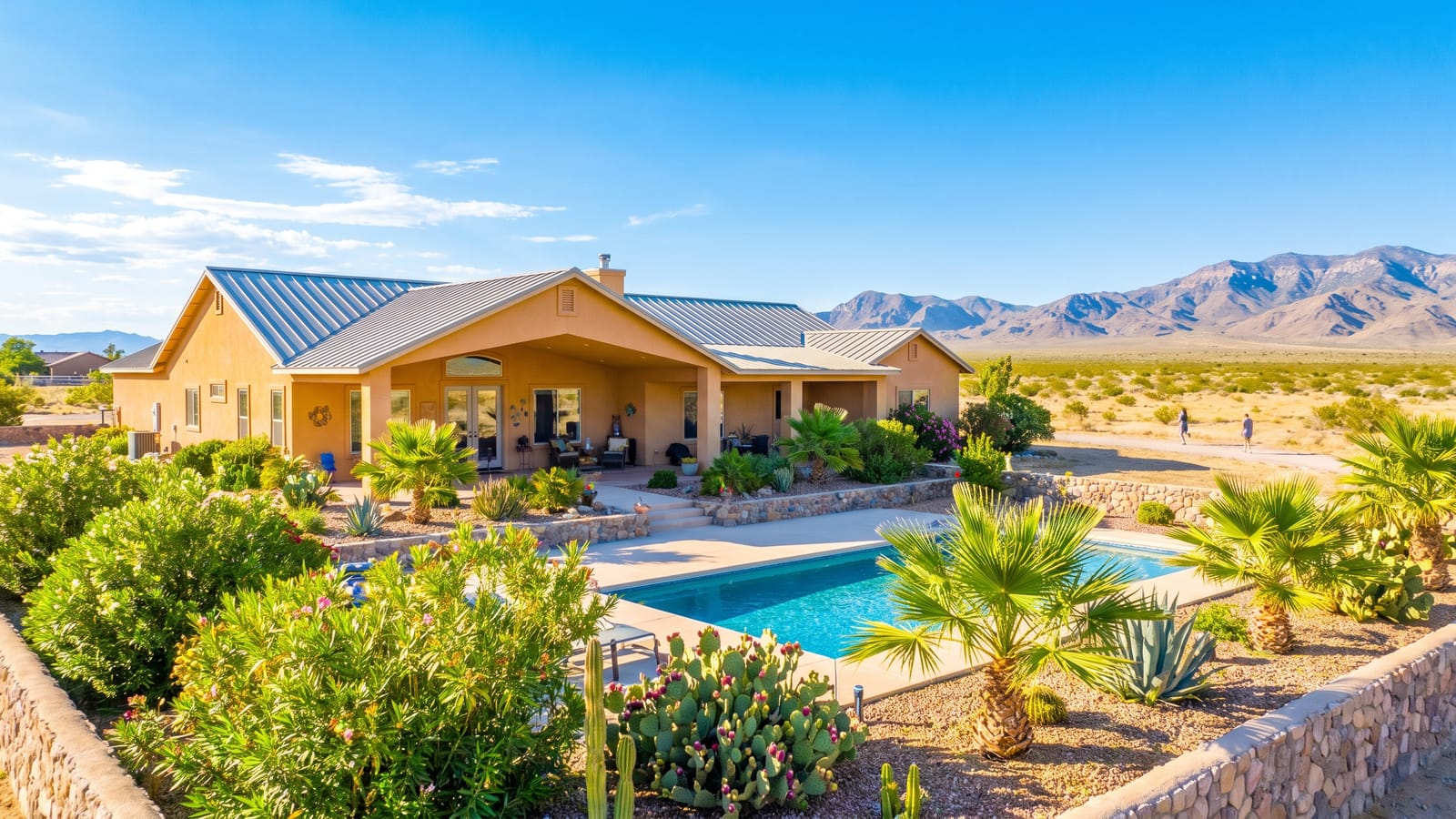
For buyers, this land glut is both an opportunity and a trap. The opportunity is that a buildable lot can still be had for a fraction of a finished home, letting you place a manufactured or custom home exactly where you want it. The trap is that not every parcel is truly build-ready. According to the Nevada Division of Water Resources, Pahrump sits over a designated, over-appropriated groundwater basin (Basin 162), and new domestic wells have faced tightening rules — so a cheap lot without an existing water source or a bankable well permit can cost far more to develop than the sticker suggests. We tell every land client the same thing: price the well, the septic, the power drop, and the road before you fall in love with the dirt.
How Much Does a Home Actually Cost in Pahrump Right Now?
Strip out the land and look only at finished homes, and Pahrump still reads as one of the most affordable places to own in Nevada. The $195,000 median covers a broad spread: entry-level manufactured homes on rented or owned lots trade in the $90,000s to $150,000s, solid site-built three-bedroom homes on a quarter-to-half-acre run $220,000 to $320,000, and the valley's ceiling — custom estates and golf-course homes — reaches well past $600,000, with a handful of trophy acreage properties listed into seven figures (the top active list price in mid-2026 was $7.5 million).
Because 63% of homes sold below list and the median home took 50 days to sell, 2026 is a genuine buyer's market at the entry and mid tiers. According to Freddie Mac's Primary Mortgage Market Survey, 30-year fixed rates parked in the mid-6% range through 2026 have kept payment-sensitive buyers cautious, and that caution shows up first in a low-price market like Pahrump, where most buyers are financing tightly or paying cash from a home sale elsewhere. The practical effect: sellers who price sharply still move in under three weeks, while aspirational listings sit for months.
| Price band | What it buys | Typical share of home inventory |
|---|---|---|
| Under $150K | Manufactured/mobile on lot; older fixers | Entry tier |
| $150K–$250K | Updated manufactured; small site-built | Largest band |
| $250K–$400K | Site-built 3–4 bed on 0.25–1 acre; Mountain Falls | Move-up core |
| $400K–$600K | Larger site-built; acreage homes; newer builds | Upper-mid |
| $600K+ | Custom estates, golf homes, large acreage | Luxury tail |
If you want to filter live inventory by what matters most in Pahrump, the no-HOA homes, homes with a pool, and RV-parking homes pages pull directly from the same GLVAR feed these numbers come from. For first-time buyers stretching a budget, our first-time buyer resources walk through financing an entry-tier Pahrump purchase.
What Should Buyers Know About Manufactured vs Site-Built Homes Here?
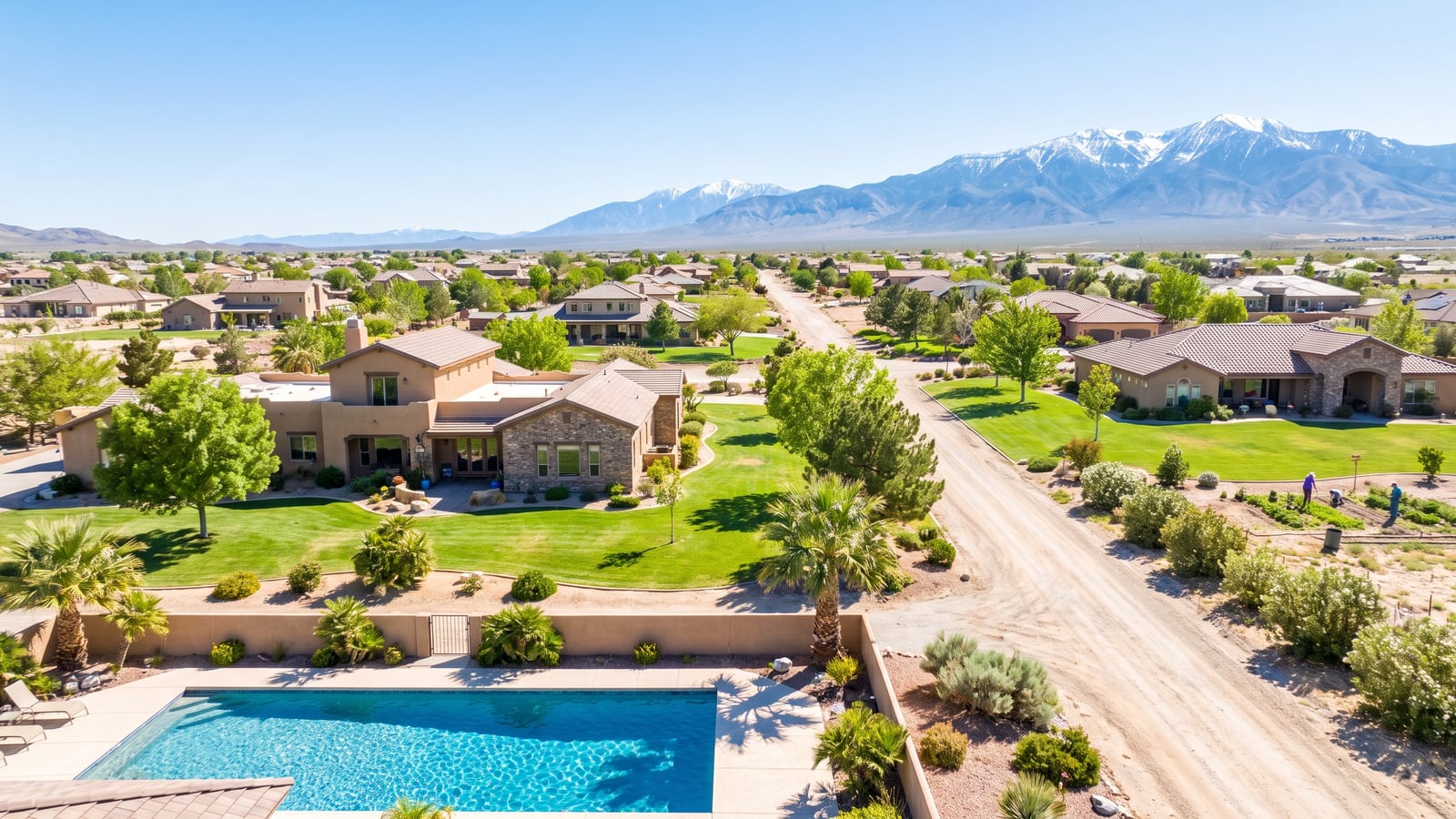
This is where Pahrump diverges most sharply from the rest of Southern Nevada. Manufactured and mobile homes are not a fringe of this market — they are a load-bearing pillar of it. In our analysis of the trailing-twelve-month sold data, manufactured homes accounted for roughly one in three of the detached homes that sold (about 338 manufactured closings against 655 single-family-residence closings), with additional mobile-home sales on top. On the active side, manufactured and mobile inventory made up close to a quarter of listed homes. That single fact is the biggest reason the median sits at $195,000 rather than $350,000.
The value distinction is real and buyers must understand it before writing an offer. A site-built (stick-built) home on a permanent foundation appreciates and finances like any conventional house — standard 30-year mortgages, standard appraisals, standard resale. A manufactured home splits into two very different situations: one on owned land with a permanent foundation (and the title retired into real property) finances and appreciates far more like a site-built home, while one on leased land or still titled as a vehicle is a personal-property purchase that behaves more like a depreciating asset and needs specialty financing.
USDA's zero-down Rural Development loans are not a lever here for now. On the U.S. Department of Agriculture's property eligibility map, Pahrump addresses currently fall outside the eligible rural area after USDA's 2023 rural-area review, so cash-tight buyers here usually look at FHA, VA or state down payment assistance instead. The map changes, so check the specific address. The takeaway for buyers: confirm three things in writing before you commit to any manufactured home — that the land is owned (not leased), that the home is on a permanent foundation, and that the title has been converted to real property. Those three items decide whether you are buying an appreciating home or a depreciating box, and they drive more Pahrump financing surprises than the price itself.
How Do Well, Septic, and Rural Utilities Change the Deal?
Away from the valley's core subdivisions, most Pahrump properties are not on municipal water and sewer — they run on private wells and septic systems. That is normal here, and thousands of homeowners live comfortably that way, but it changes due diligence completely, and it is the source of more renegotiated Pahrump deals than any other single factor.
A private well introduces questions a city buyer never asks: What is the well's depth, age, and gallons-per-minute flow? Is there a current, valid permit? Is the pump and pressure tank sound, and when were they last serviced? A septic system adds its own checklist — tank size, drain-field condition, last pump-out, and setback compliance. According to the Nevada Division of Environmental Protection, septic systems must meet state design and separation standards, and a failed or non-compliant system can cost $10,000 to $30,000 to replace. We walk buyers through the entire rural-utility checklist in our Nevada well and septic buyer guide — required reading before you tour acreage out here.
Water rights are the higher-stakes version of the same issue. Because Basin 162 is over-appropriated, a lot without an existing well and permitted water right may not be able to secure one, or may face costly hauling or shared-well arrangements. For buyers chasing space, the Pahrump horse properties and acreage inventory is deep and affordable — but every one of those parcels needs the water, well, and septic questions answered in writing before earnest money goes hard. This is precisely where a local agent earns their keep; it is not a market to navigate alone from a Las Vegas ZIP code.
For the representation decision, use our guide to choosing a Pahrump real estate agent to ask about the local property types and transaction checks.
How Much Cheaper Is Pahrump Than Las Vegas?
The one-hour drive over Mountain Springs Summit on Highway 160 buys a dramatic discount, and quantifying it is the reason many buyers land in Pahrump in the first place. The Pahrump median home near $195,000 is roughly 40% of the Las Vegas metro median near $480,000 — a gap of nearly $285,000 on the median home. Per square foot, Pahrump's roughly $197 undercuts the metro's $290-plus by a third or more. For an equity-rich buyer selling a Las Vegas or California home, that gap can mean owning free-and-clear with cash left over.
| Dimension | Pahrump | Las Vegas | Henderson |
|---|---|---|---|
| Median sold price | ≈ $195,000 | ≈ $480,000 | ≈ $525,000 |
| Median $/sq ft | ≈ $197 | ≈ $290 | ≈ $300 |
| Typical lot | 0.25–5+ acres | Subdivision lot | Subdivision lot |
| Utilities | Often well & septic | Municipal | Municipal |
| Best for | Value, land, retirees | Jobs, amenities, resale | Master-plans, schools |
| Commute to Strip | ~60 min | 10–25 min | 15–30 min |
What you trade for the discount is proximity and services. Pahrump has a growing but limited retail and medical base, and the daily Strip or airport commute is roughly an hour each way over a mountain pass that occasionally closes for weather. For retirees and remote workers, that trade is easy; for a household with a downtown Las Vegas job, it is the whole decision. If you are weighing the move west against staying in the metro, our moving-to-Las Vegas guide frames the metro side, and the Pahrump city hub covers the full local picture.
Who Is Buying in Pahrump in 2026?
Pahrump's buyer pool is a specific and predictable blend, and understanding it explains the price behavior. Retirees are the largest group — drawn by Nevada's lack of a state income tax, cheap land, a warm-but-slightly-milder climate than the Las Vegas floor, and the ability to own a home and toys (RV, boat, shop) on acreage for what a condo costs in the metro. The valley's 55-plus enclaves, led by Ovation at Mountain Falls, cater directly to them.
Second are Las Vegas price-refugees — working households and first-time buyers who cannot clear the metro's $480,000 median and trade the commute for ownership. Third are land and lifestyle buyers: horse owners, off-grid and self-sufficiency enthusiasts, RV and motorsports hobbyists, and small-acreage homesteaders who specifically want what the metro zoning forbids. Fourth, a smaller but growing slice, are cash investors buying cheap parcels and manufactured-home rentals for yield.
According to the Bureau of Labor Statistics, Nevada's tax structure and cost profile continue to make the state a magnet for retirees and equity migrants leaving higher-cost markets, and Pahrump captures the most price-sensitive end of that flow. That mix is why the tiers move differently: the entry manufactured-home tier is the most rate- and payment-sensitive, the mid site-built tier draws steady move-up and relocation demand, and the acreage/luxury tail runs largely on cash and is nearly immune to mortgage rates.
Which Pahrump Neighborhoods Hold Their Value Best?
Pahrump is not one uniform grid — a handful of named communities carry most of the resale demand and hold value better than scattered rural parcels. The dominant one by sheer size is Calvada (the Calvada Valley and Calvada Meadows units), an estimated 2,675-plus-home patchwork platted from 1976 onward that anchors the valley's core and produces the bulk of its sub-$250,000 resale inventory. Calvada's active listings alone number in the hundreds — Calvada Valley Unit 3 topped 100 active listings in mid-2026 — making it the valley's true price-discovery engine.
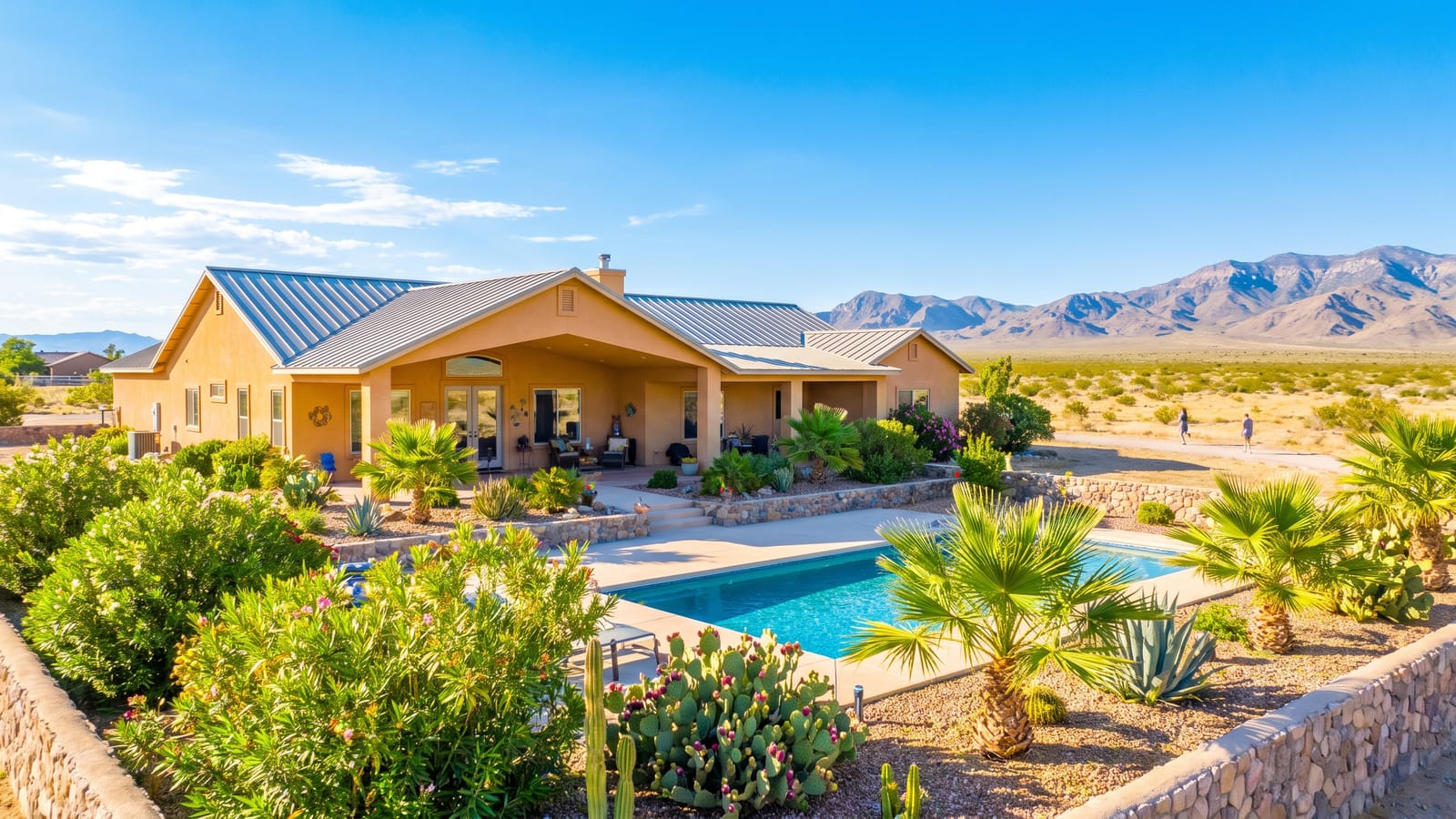
At the higher end, Mountain Falls is Pahrump's signature golf master plan on the valley's south side in ZIP 89061 — a planned community with a golf course, amenity center, and homes typically in the $320,000 to $400,000 range at HOA dues near $110 to $119 a month. Inside it, Ovation at Mountain Falls is the newer 55-plus active-adult neighborhood (built since 2018, with Taylor Morrison still building in 2026, priced from the $290,000s into the $540,000s), and it is where much of the valley's newest and most amenity-rich inventory lives; our tour of Taylor Morrison's Daffodil model at Ovation walks through its smallest current plan. Smaller planned pockets — Artesia, Country View Estates, Mountain View Estates, Spring Mountain Estates, and Tesora — round out the mid-tier. In our experience representing buyers across the valley, homes inside a named, HOA-governed community with paved roads and established utilities resell faster and hold value better than comparable homes on isolated rural parcels — the amenity and infrastructure premium is real. Browse current new-construction homes to see what builders are delivering into these pockets.
What Is Vacant Land and Acreage Really Worth in Pahrump?
Because land is two-thirds of the market, pricing it correctly is its own skill. Value swings enormously on four variables: acreage, water, access, and location. A half-acre interior Calvada lot with power at the street and a nearby water source might trade in the low-to-mid five figures; a fully improved five-acre parcel with an existing permitted well, septic, and a graded pad can command well into the six figures. The single biggest value driver is water — a parcel with an existing well and a bankable water right is worth multiples of an identical dry lot, precisely because of the Basin 162 constraints discussed above.
According to the Nye County Assessor, the county maintains parcel-level records that let a buyer verify lot size, zoning, and existing improvements before making an offer — an essential step, because MLS land listings vary widely in how completely they disclose well status and water rights. In our experience, the most common land mistake is underpricing the cost to build: a lot that looks like a bargain at $30,000 can require $40,000 to $80,000 in well, septic, power, and site work before a home ever arrives, so the true delivered cost of "cheap land plus a manufactured home" often lands surprisingly close to buying an existing home outright.
For buyers who genuinely want space, though, the math still works — Pahrump remains one of the only places within an hour of Las Vegas where owning multiple acres is realistic on a normal budget. The horse-property and RV-parking inventory is where that demand concentrates, and it is deep enough that patient buyers can negotiate hard.
How Do Property Taxes and Carrying Costs Work in Nye County?
One of Pahrump's quiet advantages is how little it costs to own once you are in. Nevada has no state income tax, and according to the Nevada Department of Taxation, the state's property-tax structure is among the most favorable in the West. Nye County's effective property-tax rate runs near 0.65% of market value — so a $250,000 Pahrump home carries roughly $1,600 a year in property tax, a figure that would be two to three times higher in most California counties.
Nevada also caps annual property-tax increases: under NRS 361.4723, the taxable-value increase on an owner-occupied primary residence is limited to 3% per year, protecting long-term owners from tax spikes even as values climb. That abatement is applied for qualifying owner-occupants, though buyers should confirm it transfers correctly at closing.
Carrying costs diverge from a standard metro purchase in two ways. First, utilities: well-and-septic homes have no monthly water or sewer bill but do carry maintenance and eventual replacement risk (a new well can run $15,000 to $30,000-plus). Second, special assessments: some Pahrump properties sit inside town or improvement districts, and master-planned communities like Mountain Falls layer HOA dues (around $110 to $119 a month) on top. Before you write an offer, price the full monthly picture — mortgage, base tax, any district assessment, HOA dues, and a reserve for well and septic upkeep — not just the payment. A current home-value estimate is the right starting point for either side of the transaction.
Is Pahrump a Good Investment or Just a Cheap Place to Buy?
The honest answer is that Pahrump is primarily an affordability and lifestyle market, not an appreciation play — and buyers should size their expectations accordingly. Home values here have risen with the broader Southern Nevada tide, but the low absolute prices and the enormous land overhang cap the pace of appreciation: with thousands of buildable lots waiting, Pahrump can add housing supply faster than a land-constrained market like Boulder City, which structurally limits how fast prices can run.
That said, the investment case is not empty. Cash yields on entry manufactured-home rentals can be attractive relative to the metro, cheap land offers a long-horizon option on the valley's continued growth, and according to the Nevada Governor's Office of Economic Development, Southern Nevada's steady in-migration continues to push demand toward affordable outlying markets. Pahrump also benefits from being the nearest large affordability outlet to a metro of 2.3 million people — a structural tailwind that is unlikely to reverse.
For a primary-residence buyer, the calculus is simpler: you are buying a low monthly cost of living and space you cannot get in the metro, with modest appreciation as a bonus rather than the thesis. For an investor, the play is yield and land banking, not quick flips. Either way, working with an agent who actually closes deals out here matters — our breakdown of the best real estate agent in Las Vegas covers how the NREG team approaches Southern Nevada representation, Pahrump included.
What Is the 2026 Outlook for the Pahrump Market?
Three forces will shape Pahrump through the rest of 2026 and into 2027. First is affordability-driven demand: as long as the Las Vegas metro median sits above $480,000 and rates stay in the mid-6% range, the price-refugee flow west continues, and Pahrump is the closest release valve. Second is the land overhang: the two-to-one land-to-home ratio means supply can respond quickly, which keeps a lid on appreciation and preserves the buyer-friendly conditions we see now — expect the entry tier to stay negotiable.
Third is water policy. The Basin 162 constraints are the wildcard: if new-well rules tighten further, the premium on parcels with existing water rights climbs, and finished homes with secure water become relatively more valuable versus raw land. That is a slow-moving structural story, but it is the one to watch. Our read for 2026: a durable buyer's market at the entry and mid tiers with real negotiating leverage, steady cash-driven demand at the acreage and luxury tail, and modest overall appreciation — a market where value hunters and space-seekers can both act with confidence, provided they do the well, septic, and water homework first.
How Should Buyers and Sellers Play This Market?
For buyers, 2026 rewards patience and diligence. Get pre-approved (and confirm your lender handles manufactured-home and rural financing before you shop), use days-on-market as your leverage gauge, and never skip the well, septic, and water-rights verification on anything off municipal utilities. With 63% of homes selling below list, there is room to negotiate on price, repairs, and closing costs — but move decisively on well-priced Mountain Falls and Calvada inventory, which still clears in under three weeks. Start with the live Pahrump homes-for-sale feed, run a full Southern Nevada map search to compare neighboring markets, and lean on our buyer resources. If you are leaning toward a brand-new build, our region-wide new-construction hub shows what builders are delivering across the valley.
For sellers, the message is pricing discipline and presentation. The days of naming a number and waiting are over at the entry and mid tiers; sharp, market-supported pricing gets you sold in 50 days or less, while aspirational pricing earns 90-plus days of showings and a price cut. If your home is on well and septic, having current, documented service records and a valid well permit ready removes the single biggest buyer objection. Begin with a real home valuation, review the seller resources and our Pahrump sell-my-house tools, and price to the data, not to hope.
Whether you are buying a manufactured home on five owned acres or listing a Mountain Falls golf home, the Nevada Real Estate Group team is ready to help — call our Southern Nevada office at (702) 637-1759 or reach out through our contact page to talk through your specific parcel, budget, and timeline. You can learn more about our team and, for the broader luxury and estate picture across the region, our luxury-communities and guard-gated-communities hubs round out the comparison.
Frequently Asked Questions
What is the median home price in Pahrump, Nevada in 2026?
The median sold home price in Pahrump is about $195,000 in 2026, with an average near $208,378 and a typical price around $197 per square foot, based on GLVAR/Repliers closings over the trailing twelve months. That is roughly 40% of the Las Vegas metro median near $480,000. The figure sits low largely because manufactured and mobile homes make up close to a third of what sells. Site-built three-bedroom homes on a quarter-to-half-acre more typically run $220,000 to $320,000.
Why is there so much vacant land for sale in Pahrump?
Developers over-platted the Pahrump Valley in the 1960s and 1970s — recording tens of thousands of half-acre to five-acre residential lots, especially in the Calvada Valley grid — far more than were ever built on. Six decades later that leaves a market where vacant land outnumbers homes for sale roughly 1,234 to 552, and where raw parcels account for nearly four of every ten transactions. It is the single most distinctive feature of the Pahrump market.
Are manufactured homes a good buy in Pahrump?
They can be, but the details decide everything. A manufactured home on owned land, on a permanent foundation, with the title retired into real property finances and appreciates much like a site-built home. One on leased land or still titled as a vehicle is a personal-property purchase that behaves more like a depreciating asset and needs specialty financing. Confirm land ownership, permanent foundation, and real-property title in writing before you commit — those three items matter more than the price.
Do most Pahrump homes have well and septic instead of city water?
Away from the core subdivisions, yes — most Pahrump properties run on private wells and septic systems rather than municipal utilities. That means no monthly water or sewer bill, but it adds due-diligence steps: well depth, flow, age, and permit; pump and pressure tank condition; septic tank and drain-field status. A failed septic system can cost $10,000 to $30,000 to replace, and Pahrump sits over an over-appropriated groundwater basin, so verify water rights before buying land.
How far is Pahrump from Las Vegas?
Pahrump is about 60 miles and roughly a one-hour drive from Las Vegas, west over Mountain Springs Summit on State Route 160. That proximity is why Pahrump functions as Southern Nevada's affordability release valve — close enough for an occasional metro trip, far enough for acreage and lower prices. The trade-off is a mountain-pass commute that occasionally closes for weather and a more limited local retail and medical base than the metro.
Is Pahrump a good place to invest in real estate?
Pahrump is primarily an affordability and lifestyle market rather than a fast-appreciation play. The large land overhang lets supply respond quickly, which caps price growth, but entry manufactured-home rentals can offer attractive cash yields, and cheap land is a long-horizon option on the valley's continued growth. For a primary residence, the appeal is low monthly cost and space; for an investor, the play is yield and land banking, not quick flips.
What are property taxes like in Nye County?
Low. Nye County's effective property-tax rate runs near 0.65% of market value, so a $250,000 home carries roughly $1,600 a year — a fraction of what the same home would cost in most California counties. Nevada has no state income tax and caps annual taxable-value increases on owner-occupied primary homes at 3% under NRS 361.4723. Watch for HOA dues in communities like Mountain Falls (around $110 to $119 a month) and any town or improvement-district assessments.
Which Sources Inform This Pahrump Market Guide?
Every price, inventory, days-on-market, and property-mix figure in this guide comes from Pahrump listings recorded on the Greater Las Vegas Association of REALTORS (GLVAR) MLS via Repliers, compiled through NREG's market analysis of the trailing twelve months of closings and active inventory through mid-2026. Year-over-year context uses the same window in 2025. Supporting economic, tax, water, and demographic data is drawn from the authorities below.
- U.S. Census Bureau — Nye County QuickFacts
- Nevada Department of Taxation
- Nye County Assessor
- Nevada Revised Statutes 361.4723 — property-tax abatement
- Nevada Division of Water Resources
- Nevada Division of Environmental Protection
- U.S. Department of Agriculture — Rural Development property eligibility map
- Nye County School District
- Nevada Governor's Office of Economic Development
- Freddie Mac — Primary Mortgage Market Survey
- U.S. Bureau of Labor Statistics
- Federal Housing Finance Agency — House Price Index
Nevada Real Estate Group is the #1 real estate team in Nevada (RealTrends) and #44 nationally, with more than $4.85 billion in career sales volume, 9,600+ closings, 150+ agents, and 9,146+ verified five-star reviews at 4.9 stars. In 2025 the team closed 789 transactions worth more than $361.5 million. Licensed in Nevada, S.181401. For Pahrump buyers and sellers, reach our Southern Nevada office at (702) 637-1759.