

Closing day is the finish line for the purchase and the starting line for something most new owners underestimate: Nevada is hard on houses, and the first 90 days set the tone for the next decade of repair bills. In Las Vegas, that means summer heat above 110°F, tap water the Southern Nevada Water Authority classifies as "very hard," monsoon microbursts, blowing dust and relentless UV. Four hundred miles north in Reno and Sparks, the same house faces a first hard freeze that arrives while the irrigation is still charged, roof snow loads the county designs for in hundreds of pounds per square foot, wildfire embers, and a granite geology that puts more than one in five tested Washoe County homes above the federal radon action level.
Across the 9,600+ closings Nevada Real Estate Group has represented since 2011, including the 789 homes we closed in 2025, the biggest predictor of a happy first year has been whether the owner did the boring maintenance early or waited for something to break. This is the checklist we hand buyers at closing, now written for both ends of the state. The southern half keeps everything a Mojave home needs: the swamp-cooler-versus-AC decision, hard water, pool chemistry, stucco and tile, the SNWA watering schedule and desert pests. The northern half adds freeze protection, snow load and ice-barrier rules, radon testing, defensible space, gutters and ice dams, and well and septic upkeep for the outlying valleys.
Start with the systems your climate attacks first. In Las Vegas that is the HVAC or swamp cooler, 16-grain hard water, the pool and the SNWA watering schedule. In Reno and Sparks it is draining irrigation and hose bibs by Nevada Day, checking roof snow load and radon (21.9% of tested Washoe homes are at or above 4 pCi/L), and clearing TMFPD defensible space. Do the boring tasks early and you skip the expensive surprises.
- Las Vegas tap water runs 16 grains per gallon, so flush the water heater every six months, not annually.
- SNWA allows one sprinkler day a week from Nov. 1 through Feb. 28, and Sunday watering is prohibited year-round.
- TMWA tells Reno-Sparks owners to shut off and drain irrigation by Nevada Day, before the first hard freeze.
- Washoe County requires ice-barrier underlayment above 5,300 feet, and design snow loads run 43 to 315 psf.
- Test for radon in month one: 21.9% of tested Washoe homes meet or exceed the 4 pCi/L action level.
Why Does a Nevada Home Need a Climate-Specific Maintenance Plan?
A house in Nevada ages on a different clock than one in a temperate climate, and the clock runs differently at each end of the state. Southern Nevada is Mojave Desert: the cooling system runs for months, the water carries a heavy mineral load, and the summer sun degrades roof underlayment, exterior paint and irrigation tubing faster than anywhere a relocating buyer has lived. According to the Southern Nevada Water Authority, local tap water measures 280 parts per million, or 16 grains per gallon, which the agency categorizes as "very hard," and roughly 90 percent of it comes from Lake Mead.
Northern Nevada is high desert at 4,400 to 6,000 feet, with real winters on top of the dry summers. According to Washoe County's building design requirements, homes here are engineered for a 24-inch frost depth, a 120 mph design wind speed, Seismic Design Category D2 and ground snow loads that start at 43 pounds per square foot on the valley floor west of US 395 and reach 315 psf at 6,000 feet in the Lake Tahoe Basin. Those numbers explain why a Reno checklist leads with freeze protection and roof condition rather than air conditioning.
The two halves share more than buyers expect: evaporative coolers and drip irrigation are standard in both regions, and both water authorities publish assigned-day rules. In our experience, the owners who struggle are the ones who import habits from a wetter climate, changing the filter twice a year, ignoring the water heater, watering on a summer schedule in January, or leaving a hose connected through the first Reno freeze. Whether you bought resale, a new build or a foothill home on acreage, the checklist below puts the highest-consequence, lowest-cost tasks first.
What Should You Do the First Week — Safety Baseline and Warranty Registration?
Week one is about safety, security and a baseline, and almost all of it is free. Before the furniture arrives, walk the house with the list below and photograph the breaker panel, the water heater's data plate, the HVAC or cooler model numbers, the irrigation controller settings and, in the north, the irrigation shutoff and drain. You will want those photos for warranty registration and service calls.
| Task | Why it matters in Nevada | DIY or pro |
|---|---|---|
| Re-key or replace exterior locks | You do not know who holds old keys | DIY kits or a locksmith |
| Change every HVAC filter | Movers stir up dust; start the monthly check habit | DIY |
| Find and test the main water shutoff | A burst line in summer heat or a winter freeze is a fast disaster | DIY |
| Label the breaker panel | Nobody labeled it for you | DIY |
| Test smoke and CO detectors | Batteries are often years old | DIY |
| Locate the irrigation controller, valves and (north) the drain | Northern systems must be drained before freeze | DIY |
| Photograph every data plate | Needed for warranty registration and service calls | DIY |
| Deep-clean before furniture | Easiest access you will ever have | DIY or a cleaning service |
The second half of week one is paperwork, the part most owners skip. Warranties are only worth what you register, and the clock starts at closing. Gather the builder or structural warranty on a new build (note every reporting deadline), the appliance and HVAC warranties (register each serial number online), any home warranty you bought or the seller provided (read the service-call fee and exclusions now), and the full closing packet.
The packet matters more in Nevada than buyers realize. According to NRS 113.130, a seller must complete the residential disclosure form at least 10 days before the property is conveyed and must tell you in writing, as soon as practicable, about any defect discovered after the form was served. NRS 113.140 adds the other half: the form is not a warranty, and a seller need not disclose a defect they were not aware of. Your inspection report and the seller's disclosure are therefore your record if a problem surfaces in the first 90 days, so file both with the buyer's closing statement.
Which HVAC Tasks Come First, and When Do You Switch a Swamp Cooler to AC?
The cooling system is the most expensive mechanical system in a Las Vegas home, and no afterthought in Reno, so it leads the list. According to the ENERGY STAR maintenance checklist, homeowners should inspect, clean or change air filters monthly, because a dirty filter slows airflow and forces the system to work harder, and airflow problems alone can reduce efficiency by up to 15 percent. The same checklist says to have a contractor check the cooling system in spring and the heating system in fall, and lists what the visit should include, from thermostat settings and electrical connections to the condensate drain, refrigerant level, coils and blower. If your closing lands in summer, book the cooling check in your first month regardless of the calendar.
Many Nevada homes cool with an evaporative cooler instead of, or alongside, refrigerated air, and the seasonal switchover is new to buyers from humid climates. According to the U.S. Department of Energy's Building America Solution Center, evaporative coolers can use about one-fourth as much energy as central air conditioners and work best in dry climates where the summer design wet-bulb temperature is below 70°F, which describes most of Nevada most of the summer. The guide lays out the two seasonal jobs: at spring startup, replace or clean the pads, check belt tension, and clean and inspect the cabinet; at winterization, shut off the water line, drain and clean the pan, and install a winter cover. In Las Vegas the cooler carries the shoulder seasons and the AC takes over when monsoon humidity arrives in July; in Reno the cooler is often the only cooling, and winterization is not optional because a charged water line will freeze.
One permitting note for southern owners: according to Clark County Building and Fire Prevention, an A/C-furnace replacement under 5 tons, a condenser-pump combo replacement and a furnace replacement are all "simple" online residential permits in the unincorporated county. A change-out needs a permit, the county made it easy to pull, and a contractor who offers to skip it is your cue to find another.
How Do You Protect Against Hard Water and Scale?
At 16 grains per gallon, Las Vegas water scales the inside of the water heater, clogs aerators and shower heads, spots glass and shortens the life of every water-using appliance. Two first-90-days moves protect you, and the first is a flush. According to Rheem, a tank water heater should be flushed once a year in a normal household and every 6 months in a hard-water area, because sediment on the tank bottom reduces heat transfer, strains the heating elements or burner, and shortens the tank's life. The procedure is straightforward: shut off power or gas and the cold inlet, connect a hose to the drain valve, open the pressure-relief valve and then the drain, close both when the tank is empty, refill with the hot taps open, and restore power once water flows. Do it in your first month for a baseline, then put the six-month reminder on the calendar.
The second move is the softener decision. The SNWA's water-quality page lists household softeners among the ways to manage hard-water effects and publishes the 280 ppm and 16 gpg figures so owners can calibrate one. In unincorporated Clark County a softener, a reverse-osmosis system and a water heater replacement are all simple online residential permits. At minimum, replace scaled aerators and shower heads and keep the dishwasher and washer on the manufacturer's hard-water schedule.
Truckee Meadows water is generally softer, but according to the Truckee Meadows Water Authority, hardness comes from naturally occurring calcium and magnesium, varies by location, and is published for each area of the system through the water-quality lookup on its site. Look up your neighborhood in your first week; a home on a well in Washoe Valley or Palomino Valley may see far harder water than one on the municipal system in Sparks, and the flush schedule should follow the number, not the region.
What Roof, Stucco and Exterior Checks Matter Before Monsoon Season?
Southern Nevada's monsoon season, roughly July through September, brings microbursts with driving rain and high gusts, and they find every weak point on a roof that UV has been degrading all year. Before the first storm, walk the exterior or hire a roofer, and check the four places water gets in. First, tile or flat-roof condition: cracked or slipped concrete tiles, blistered or chalking flat-roof coating, and worn underlayment at the eaves. Second, flashing and seals around vents, skylights and the rooftop AC or cooler curb. Third, stucco: UV opens hairline cracks that let water and pests in, and the weep screed at the base of the wall must stay clear of soil and mulch so the wall can drain. Fourth, gutters, downspouts and grading, because monsoon volume overwhelms poor drainage and pushes water toward the foundation.

Concrete and clay tile dominates the valley's master plans, from Henderson to the northwest, and the thing new owners get wrong is treating the tile as the waterproofing. The tile sheds most of the water and shades the underlayment; the underlayment does the sealing. That is why a roofer's walk focuses on the eaves, valleys and penetrations, and why a tile roof that looks fine from the driveway can still leak at a valley. Ask the roofer to photograph the underlayment at the eave for a dated baseline.
Register findings while you still may have recourse. A resale home's disclosures under NRS 113 or a builder's warranty on new construction may cover a defect you document in the first 90 days that they will not cover at year two. Our companion guide to surviving your first desert summer covers the heat-specific tasks that follow.
How Do You Set Irrigation to the SNWA or TMWA Watering Schedule?
In a Nevada yard the irrigation system is life support, and a hidden leak runs silently until the water bill lands. In your first weeks, run each zone manually and watch for leaks, broken emitters, geysering heads and dry spots, then set the controller to the rules where you live, because both water authorities enforce assigned-day watering and the rules differ.
| Rule | SNWA (Las Vegas Valley) | TMWA (Reno-Sparks) |
|---|---|---|
| Summer (May 1 to Aug. 31) | No irrigation 11 a.m. to 7 p.m.; three days rising to four in May, then only as needed | Three sprinkler days per week by address |
| Fall (Sept. 1 to Oct. 31) | Three assigned days per week | Three days by address; drain the system by Nevada Day (Oct. 31) |
| Winter (Nov. 1 to Feb. 28) | One assigned day per week | System drained and off |
| Spring (March 1 to April 30) | Three assigned days per week | Start-up after the last hard freeze; three days by address |
| Which days | Assigned watering group, printed on the monthly bill | Even addresses Tue/Thu/Sat; odd addresses Wed/Fri/Sun |
| Prohibited day | Sunday, year-round | Monday, a rest day for the system |
| Drip and hand watering | Exempt from the assigned-day rule | Always permitted |
| Enforcement | Water-waste fee or citation | TMWA patrols for water waste |
According to the Southern Nevada Water Authority, assigned watering groups are mandatory for all municipal customers, Sunday sprinkler watering is prohibited in every season, and from May 1 through Aug. 31 irrigation is prohibited between 11 a.m. and 7 p.m. Its drip guidance is blunt: running drip too many days a week is the biggest mistake most homeowners make. According to TMWA's June 2026 reminder, every Truckee Meadows customer has three sprinkler days a week keyed to the street address, Monday is a rest day, and drip and hand watering are always permitted.
There is money on the table in the south. According to the SNWA Water Smart Landscapes rebate page, single-family owners who remove grass and replace it with desert landscaping receive $5 per square foot for the first 10,000 square feet and $2.50 per square foot thereafter, per property per fiscal year; the Las Vegas Valley Water District adds $2 per square foot, the City of Henderson adds $575, and the Tree Enhancement Program pays $100 for every qualifying new tree. Removing the lawn before the pre-conversion site visit makes the project ineligible, so apply first. Photograph the controller settings once dialed in; across the guard-gated communities we list, the best-appraising yards are maintained all year.
How Do You Take Over a Pool in Your First 90 Days?
A pool is the amenity buyers pay for and the system they most often inherit blind, so treat the first 90 days as a handover. Start with the water. According to the CDC's home pool guidance, free chlorine should be at least 1 ppm in a pool, or at least 2 ppm if you use cyanuric acid stabilizer, pH should sit between 7.0 and 7.8, and both should be tested at least twice a day when the pool is in use. The CDC also names sunlight among the things that reduce chlorine, which matters in a Las Vegas July. Buy a proper test kit in week one and log two weeks of readings; you will learn whether the chemistry was stable or propped up by a weekly service.
Then learn the equipment: the pump and its schedule, the filter type, the automatic fill valve, the skimmer and main drain, and where the sewer clean-out is. According to the SNWA's pools and spas page, the average in-ground pool loses 48.6 gallons of water per square foot per year to evaporation, which for the typical 470-square-foot Southern Nevada pool is as much as 22,842 gallons a year; a pool cover reduces evaporation by 90 percent, limits windblown debris and conserves energy. The same page says to wash cartridge filters when the pump's operating pressure rises by 10 psi, to keep the water at a conservative 78°F because warmer water evaporates faster, and to run a bucket test if you suspect a leak: turn off the auto-fill, set a weighted bucket on a step with the levels matched, wait several hot days, and if the pool drops noticeably below the bucket, call a leak-detection specialist.
Two rules matter when you eventually drain. Pool water must go to the sanitary sewer through the clean-out port, never to the street or storm drain, and never into a septic tank, which can overfill. And since a July 2022 SNWA resolution, new residential pools in Southern Nevada are limited to a 600-square-foot surface area. Northern owners with a pool have one more job: TMWA's winterizing guidance says to drain the pool and its supply lines per the installer's directions before the freeze, and not to put antifreeze in those lines unless directed.
What Pest-Control Baseline Should a New Owner Set?
Desert homes share the neighborhood with scorpions, roof rats, ants and the occasional snake; northern homes trade scorpions for mice, voles, wasps and wildlife. In both regions the first 90 days are when you set the exclusion baseline, because exclusion, not spraying, is what keeps pests outside. According to the U.S. Environmental Protection Agency, the first steps are to remove sources of food, water and shelter, fix leaky plumbing, caulk cracks and crevices around cabinets and baseboards, fill spaces around pipes with steel wool, and get rid of the stacks of cardboard and paper that give pests hiding places.
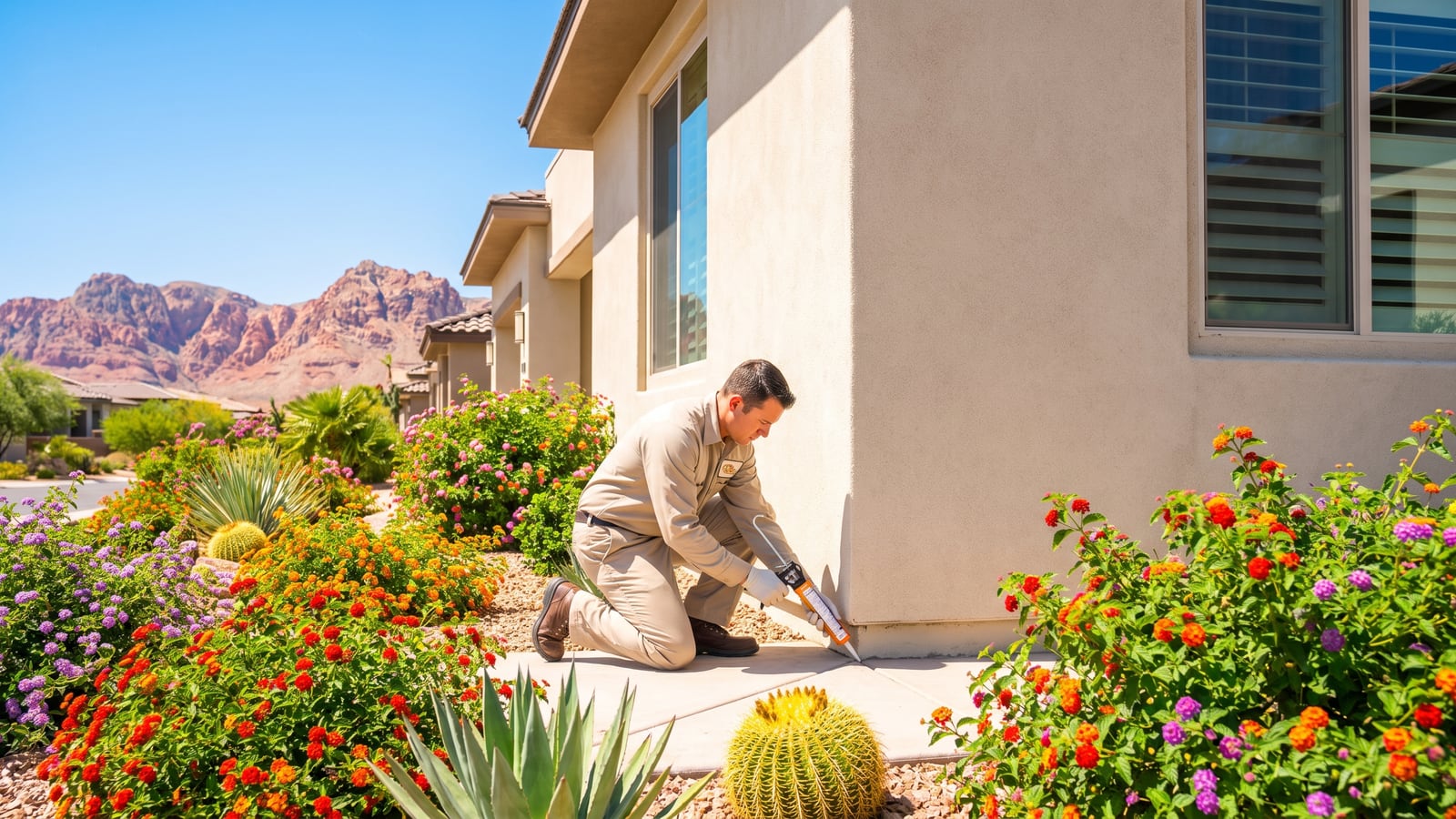
Walk the exterior with that list and a tube of sealant. Seal where pipes and wires enter the wall, replace worn weatherstripping and add door sweeps, check the garage-door threshold, and keep the stucco weep screed clear so it drains without becoming a highway. Move woodpiles, pavers and stored material off the wall. In Las Vegas, a UV-flashlight walk on a warm night gauges scorpion pressure; our Las Vegas scorpion and pest guide walks the exclusion checklist room by room.
If you add a service, hire it properly. According to University of Nevada, Reno Extension's guide to hiring a pest control operator, only individuals holding a Nevada custom pest control license may apply pesticides for hire, the license carries a photo ID you can ask to see, and the Nevada Department of Agriculture verifies licensure at 775-353-3600. The same publication tells you what to ask: what training employees receive, whether the company will discuss integrated pest management options, whether it can show references and proof of insurance, what the guarantee covers, and whether it will use the least-toxic product available.
What Does a Northern Nevada Home Need Before the First Hard Freeze?
Everything above applies in Reno, Sparks, Carson City and the Carson Valley. The northern list adds one deadline that matters more than any other item: the first hard freeze. According to Climate Central's October 2025 analysis of 1970 to 2024 data, Reno's first freeze (the first day from Aug. 1 at 32°F or below) now arrives 41 days later than in the early 1970s, the largest shift of the 179 cities studied. That is a trap, not a reprieve: a later average freeze means more owners are still watering, and still connected, when the first cold snap lands.
Hose bibs, irrigation and the meter box
According to the Truckee Meadows Water Authority, customers should have irrigation systems turned off and winterized by Nevada Day, or Halloween, and should watch the forecast rather than trust the calendar. Water expands as it freezes with enough pressure to burst plastic or metal pipe, and the lines that freeze most often are the exposed ones: hose bibs, pool supply lines, sprinkler lines, and pipes in unheated garages, crawl spaces and attics. Shut off and drain the irrigation system yourself rather than assuming the landscaper did it. Disconnect and drain outdoor hoses, because a single hard overnight freeze can burst the pipe or the faucet, and TMWA has seen spigot lines freeze and go unnoticed until a high summer bill reveals the break. Close foundation vents, and make sure the insulating blanket is still inside the water meter box; if it is missing, TMWA replaces it. Inside, wrap pipes in unheated spaces, tag the master shutoff valve, and if you travel, leave the heat no lower than 55°F. TMWA hosts free winterization workshops every October, and its emergency shutoff service runs $25 during business hours and $50 after hours per the same page. Winterize the evaporative cooler the same week: water line off, pan drained, cover on.
Roof snow load and the 5,300-foot ice-barrier line
A Reno roof was designed for a snow load, and the number depends on where the house sits. According to Washoe County's design requirements, ground snow loads run from 43 psf at 4,500 to 5,000 feet west of US 395 to 92 psf at 5,300 feet, 203 psf at 6,000 feet and 245 psf at 6,500 feet, while the Lake Tahoe Basin starts at 315 psf at 6,000 feet; the minimum final roof snow load anywhere in the county is 29 psf, and ice-barrier underlayment is required above 5,300 feet.
| Location | Elevation | Ground snow load (psf) |
|---|---|---|
| West of US 395 (Reno valley floor) | 4,500 to 5,000 ft | 43 |
| West of US 395 | 5,300 ft | 92 |
| West of US 395 (upper foothills) | 6,000 ft | 203 |
| East of US 395 | 5,100 ft | 45 |
| East of US 395 | 8,000 ft | 123 |
| Lake Tahoe Basin | 6,000 ft | 315 |
| Minimum final roof snow load, countywide | Any | 29 |
The ice barrier is the item to check on any foothill purchase. According to Washoe County's ice-barrier inspection policy memorandum, effective April 1, 2026 under the 2024 International Residential Code, structures at or above 5,300 feet require an ice barrier extending a minimum of 24 inches inside the exterior wall line, and the county now accepts photo documentation to verify it. If you bought in Galena Forest, Montreux, upper ArrowCreek or the Lake Tahoe and Incline Village market, pull the roof permit and inspection record in your first month.
Gutters and ice dams
Ice dams are the winter version of the monsoon flashing problem. According to University of Minnesota Extension, a dam forms when snow on a roof surface above freezing melts, the water runs down to the part of the roof below 32°F and refreezes, and the ice backs water up under the roofing. The fix is in the attic, not the gutter: make the ceiling airtight so warm, moist air cannot reach the attic, add insulation, and keep natural roof ventilation working so the deck stays uniformly cold. Clean gutters and downspouts in October, and remove snow from the roof edge after a big storm. A tree-lined lot in Caughlin Ranch fills its gutters twice a fall; put the second cleaning after the last leaf drop.
Should You Test for Radon in Your First 90 Days?
Yes, and in the north it belongs in month one. Radon is a naturally occurring radioactive gas that moves up through soil and into a home through the foundation, and northern Nevada's granite geology produces a lot of it. According to the University of Nevada, Reno Extension's Nevada Statewide Radon Map, which compiles completed tests from 1989 through 2026, 2,341 of 10,700 valid Washoe County tests, or 21.9 percent, came back at or above 4 pCi/L, compared with 411 of 3,713 Clark County tests, or 11.1 percent; statewide, 6,303 of 24,271 tests, or 26.0 percent, met or exceeded that level. One in nine tested Clark County homes is not a reason for southern buyers to skip the test, only a reason it ranks below the water heater on the southern list.
According to the U.S. Environmental Protection Agency, 4 pCi/L is the level at which the agency recommends a home be fixed, and it also recommends that homeowners consider fixing a home that tests between 2 and 4 pCi/L. Mitigation is a routine trade in Reno: a sealed sub-slab pipe with a small fan that vents the gas above the roofline. Most Washoe County resale contracts already include a radon contingency, and the UNR program's January 2026 announcement noted that in northern Nevada about 40 percent of homes are tested by certified professionals during a sale.
The test itself is cheap and quick. According to UNR Extension's January 2026 announcement, test kits were free statewide at Extension offices and partner locations through Feb. 28, 2026 while supplies last, a short-term test takes three days, and results come back in a few weeks; outside the giveaway window the program sells low-cost kits year-round. Test on the lowest lived-in level with windows closed. If you are in Cold Springs, Verdi or the west-side foothills, where the county map shows the highest ZIP-level potential, do it before you finish unpacking.
How Much Defensible Space Does TMFPD Require Around a Foothill Home?
If your new home sits in the Truckee Meadows Fire Protection District's wildland-urban interface, defensible space is code, not a suggestion, and the first 90 days are when to bring the lot into compliance. According to the Truckee Meadows Fire Protection District, the district adopted the International Wildland-Urban Interface Code in August 2013, and Table 603.2 sets the required defensible-space distance by hazard class: 30 feet for a moderate-hazard lot, 50 feet for high hazard and 100 feet for extreme hazard. Depending on the water supply available when the home was built, the property may have been required to provide 1.5 times the Table 603.2 distance, and the district can increase distances after a site-specific analysis. Two tree rules apply inside that space: crowns within 10 feet of any structure must be pruned to keep a 10-foot horizontal clearance, and limbs lower than 6 feet above the ground must be removed.
The distances tell you how far; the zones tell you what to do. According to Living With Fire, the program run by University of Nevada, Reno Extension with the Nevada Division of Forestry, the BLM and the U.S. Forest Service, the zone within 5 feet of the house is the ember-resistant zone: gravel or hardscape is the usual construction, and it must stay clear of woodpiles, wood mulch and flammable vegetation, including under any attached deck. Beyond that, a lean, clean and green zone runs to 30 feet and a reduced-fuel zone to 100 feet and more, matching the TMFPD table.
Practically, that means a fall weekend in ArrowCreek, Galena or the Sparks foothills spent moving firewood off the wall, swapping bark mulch for rock in the first five feet, limbing the pines and thinning the sage and juniper. Photograph the finished zones; insurers writing wildfire-exposed homes increasingly ask for that documentation at renewal.
How Do You Maintain a Well and Septic System in the Outlying Areas?
Many northern Nevada acreage homes, from Washoe Valley to Palomino Valley and the Carson Valley, run on a private well and a septic system, and neither comes with a utility to call. According to Northern Nevada Public Health, its Environmental Health Services division regulates residential septic systems in Washoe County, the District Board of Health adopted revised sewage, wastewater and sanitation regulations on Jan. 22, 2026, and every septic replacement, abandonment or repair, and every addition, garage or barn on a septic-served parcel, needs a permit, with a stated 7-day review for repairs and 14 days for new systems. NNPH keeps a septic and well records request on the same page; pull your parcel's file in the first month for the tank size, drainfield location and date of the last permitted work.
According to the U.S. Environmental Protection Agency, the average household septic system should be inspected at least every three years by a professional and pumped every three to five years, with the interval driven by household size, wastewater volume, the solids in it and tank size; alternative systems need a look about once a year. The drainfield rules are simple: do not park or drive on it, keep roof drains and sump discharge away from it, plant trees at a distance, and never flush grease, wipes or chemicals. And, as the SNWA says, never drain a pool into a septic tank.
On the well side, NNPH permits construction, deepening and abandonment (the driller must be licensed by the Nevada Division of Water Resources) but, according to its Domestic Well Program page, it does not regulate domestic well water quality, so testing is on you. According to University of Nevada, Reno Extension's Water Testing for Private Well Owners, hosted by the Nevada Division of Environmental Protection, test every year for nitrate, pH, total dissolved solids and total coliform bacteria, run a broad domestic analysis every 5 to 10 years, use only NDEP-certified labs, and retest after flooding at the wellhead, after work on the system, or when purchasing a home. Washoe County's roughly 9,000 residential well owners also had access to free PFAS sampling through NNPH under a state grant announced in April 2026. For homes with land and horse property, the well and septic file is the most valuable document in your first 90 days.
What Are the Days 30 to 90 Tasks, and What Should You Budget?
With week one and the climate-specific big systems handled, days 30 to 90 are about dialing in, catching what you missed while unpacking, and building the calendar you will keep for years. Here is the full first-quarter timeline in one place, with the northern add-ons in their own rows; the columns are checkpoints, not permission to wait.
| System | By day 7 | By day 30 to 60 | By day 60 to 90 |
|---|---|---|---|
| HVAC or swamp cooler | New filters; photograph model numbers | Pre-season contractor check | Thermostat schedule; cooler switchover |
| Water heater and fixtures | Test main shutoff | Flush the tank; replace scaled aerators | Softener decision; flush reminder |
| Roof, stucco, exterior | Visual scan | Pre-monsoon roof and seal check (south) | Repair; document underlayment |
| Irrigation | Locate controller, valves and drain | Leak audit; set SNWA or TMWA schedule | WSL rebate application (south) |
| Pool | Find the sewer clean-out and auto-fill | Two weeks of chemistry logs; bucket test | Cover decision; filter baseline |
| Pests | Seal obvious gaps | Exclusion walk; licensed operator | Re-check exclusion points |
| Documents | File closing packet and disclosures | Register all warranties | Build the recurring calendar |
| North: freeze protection | Find irrigation shutoff and drain | Drain irrigation and cooler by Nevada Day | Cover hose bibs; check meter-box blanket |
| North: roof and gutters | Pull roof permit; note elevation | Gutters cleaned after leaf drop | Ice barrier check above 5,300 ft |
| North: radon | Order a test kit | Three-day closed-house test | Mitigate at 4 pCi/L or higher |
| North: defensible space | Identify the hazard class | Clear the 0 to 5 ft zone; move woodpiles | Limb trees; photograph zones |
| North: well and septic | Request the NNPH file | Annual water test; locate the drainfield | Inspection; pump-out clock |
Days 30 to 60 are also when your first full utility bills arrive. Change the HVAC filter again, test the irrigation on its new schedule, and walk the house for the small stuff: running toilets, dripping faucets, weatherstripping gaps and garage-door balance. It is the window to shop insurance, too; our Las Vegas homeowners insurance guide explains how desert risks price into a policy.
The budget question deserves an honest answer rather than an invented one. Rates for tune-ups, roofers, pumpers and pest services vary too much by home and contractor for a "typical" range to be trustworthy, so get two written quotes for anything you hire out and treat the published figures below as the fixed points.
| Item | Published figure | Source and date |
|---|---|---|
| Grass-to-desert conversion rebate (south) | $5 per sq ft for the first 10,000 sq ft, then $2.50; LVVWD adds $2 per sq ft; Henderson adds $575 | SNWA, as of September 24, 2026 |
| Tree Enhancement bonus (south) | $100 per qualifying new tree (Henderson adds $50) | SNWA, as of September 24, 2026 |
| Radon test kit (statewide) | Free through Feb. 28, 2026 while supplies last; low-cost otherwise | UNR Extension, January 2026 |
| Irrigation winterization workshop (north) | Free, each October | TMWA |
| TMWA emergency water shutoff (north) | $25 during business hours, $50 after hours | TMWA, published October 2023 |
| Residential well PFAS sampling (Washoe) | Free under a state grant | NNPH, reported April 2026 |
| Septic permit plan review (Washoe) | 7-day turnaround for repairs; 14 days for new systems | NNPH, updated August 2026 |
| Water heater, softener and small HVAC permits (Clark County) | Simple online residential permits | Clark County, as of September 24, 2026 |
Fund a monthly reserve for the rest. The last day-60-to-90 task is the one most owners skip: build a recurring calendar. Monthly filter checks, a cooling check every spring and a heating check every fall, a water-heater flush every six months in the south, a roof check before monsoon season, a radon retest every few years, the septic pump-out on its three-to-five-year clock, and in the north a hard "Nevada Day" entry that says drain the irrigation. In our experience the misses are always the same four: the filter cadence, the water-heater flush, the silent irrigation leak and the unregistered warranty. None is hard or expensive; they are just easy to defer while the boxes are still in the garage.
Ready to Protect Your New Nevada Home With Nevada Real Estate Group?
Helping a buyer protect the home does not stop at closing, and that is true at both ends of the state. Nevada Real Estate Group is the #1-ranked real estate team in Nevada, with 9,600+ closings, $4.85 billion+ in sales volume and 150+ licensed agents across Las Vegas, Henderson, Reno, Sparks and Carson City, and we hand this checklist to every buyer at the closing table because the first 90 days are when the good habits get built. If you want a walk-through of your home's systems or a referral to the HVAC, plumbing, roofing, pest, radon and septic professionals our clients have used, we are glad to help.
For Southern Nevada, call (702) 637-1759 or visit our office at 8945 W Russell Rd, Suite 170, Las Vegas. For Reno, Sparks, Carson City and the outlying valleys, call (775) 277-2120. If you are still shopping rather than settling in, the same team can show you what the maintenance profile looks like before you buy: the swamp-cooler-versus-AC question on a Las Vegas resale, the elevation and ice-barrier record on a Reno foothill home, or the well and septic file on an acreage parcel. Buyers moving to Las Vegas or moving to Reno from a milder climate get the most out of that conversation, because the questions they do not know to ask are the ones on this list.
One request in return: run the checklist. The tasks are cheap, the deadlines are real, and the difference between a smooth first year and a string of surprise repairs is almost always whether the owner did the boring work early or waited for the July compressor failure or the November burst pipe. Browse the communities and northern Nevada communities we serve, and when you are ready, we will bring the referrals and local knowledge that go with them.
Frequently Asked Questions
How often should I change my AC filter in Las Vegas?
Check it monthly and change it whenever it looks dirty, not on the twice-a-year cadence common in milder climates. ENERGY STAR's maintenance checklist tells homeowners to inspect, clean or change filters monthly because a dirty filter slows airflow and forces the system to work harder, and airflow problems alone can cut efficiency by up to 15 percent. Desert dust loads a filter far faster than a temperate climate does, so the monthly check is the cheapest insurance for the most expensive system in the house.
Do I really need a water softener in Las Vegas?
You do not strictly need one, but the numbers make the case. The Southern Nevada Water Authority reports its water at 280 parts per million, or 16 grains per gallon, and categorizes it as very hard. That mineral load scales water heaters, clogs fixtures and shortens appliance life, which is why Rheem tells owners in hard-water areas to flush a tank water heater every six months instead of annually. A softener addresses the cause rather than the symptom, and in unincorporated Clark County it is a simple online residential permit.
When is monsoon season and what should I check before it?
Roughly July through September in Southern Nevada, with microbursts that bring driving rain and strong gusts. Before it starts, check, or have a roofer check, tile and flat-roof condition, the underlayment at the eaves, flashing and seals around vents, skylights and the AC or cooler curb, stucco cracks and the weep screed, exterior caulk, and drainage around the foundation. Report anything you find while a builder warranty or the seller's NRS 113 disclosure may still apply.
When should I winterize irrigation and hose bibs in Reno or Sparks?
By Nevada Day, Oct. 31, according to the Truckee Meadows Water Authority, and earlier if the forecast shows a hard freeze. Shut off and drain the irrigation system yourself, disconnect and drain every hose, cover the hose bibs, drain pool supply lines per the installer's directions, and winterize the evaporative cooler by shutting the water line, draining the pan and installing a cover. Climate Central's October 2025 analysis found Reno's first freeze now arrives 41 days later than in the early 1970s, so more owners are still connected when the first cold snap lands.
Does my Reno roof need an ice barrier?
If the home sits at or above 5,300 feet, yes. Washoe County's design requirements require ice-barrier underlayment above 5,300 feet, and the county's ice-barrier inspection memorandum, effective April 1, 2026 under the 2024 International Residential Code, specifies a barrier extending at least 24 inches inside the exterior wall line. Design snow loads on the same page run from 43 psf on the valley floor west of US 395 to 203 psf at 6,000 feet and 315 psf in the Lake Tahoe Basin. On a foothill purchase, pull the roof permit and inspection record in your first month.
Should I test for radon in Las Vegas, or is it only a Reno problem?
Test in both places, but the priority differs. The University of Nevada, Reno Extension's statewide radon map, compiled from tests run between 1989 and 2026, shows 21.9 percent of tested Washoe County homes at or above 4 pCi/L versus 11.1 percent in Clark County, with 26.0 percent statewide. The EPA recommends fixing a home at 4 pCi/L and considering a fix between 2 and 4. In Reno the test belongs in month one and most resale contracts already include it; in Las Vegas roughly one in nine tested homes is elevated, which is a reason to test, not to skip.
How much defensible space does a Reno foothill home need?
The Truckee Meadows Fire Protection District's Table 603.2, adopted from the International Wildland-Urban Interface Code in August 2013, requires 30 feet for a moderate-hazard lot, 50 feet for high hazard and 100 feet for extreme hazard. Within that space, tree crowns within 10 feet of a structure must be pruned to a 10-foot horizontal clearance and limbs under 6 feet must be removed. Living With Fire adds the practical layer: keep the first 5 feet ember-resistant with gravel or hardscape and no woodpiles or wood mulch.
How often should a septic tank be pumped on a northern Nevada acreage lot?
The EPA says the average household septic system should be inspected at least every three years by a professional and pumped every three to five years, with the interval set by household size, wastewater volume, solids and tank size; alternative systems need a look about once a year. In Washoe County, Northern Nevada Public Health regulates residential septic systems, adopted revised regulations on Jan. 22, 2026, and permits every repair, replacement and addition on a septic-served parcel. Request your parcel's file from NNPH in the first month, keep vehicles and roof drainage off the drainfield, and test the well annually for nitrate, pH, total dissolved solids and coliform.
Which Sources Inform This Nevada Homeowner Checklist?
Every schedule, design value and program figure above was re-verified on the linked page in September 2026; service prices are left to written quotes because no published rate card covers them. For referrals, call (702) 637-1759 in Southern Nevada or (775) 277-2120 in Northern Nevada.
- Southern Nevada Water Authority: water quality facts — hardness and softener guidance
- Southern Nevada Water Authority: change your irrigation clock — seasonal watering restrictions
- Southern Nevada Water Authority: pools and spas — evaporation, covers, filters, draining rules
- Southern Nevada Water Authority: Water Smart Landscapes rebate — rebate amounts
- Truckee Meadows Water Authority: how to winterize your home — Nevada Day deadline, shutoff fees
- Truckee Meadows Water Authority: know your watering days — assigned-day schedule, June 2026
- Truckee Meadows Water Authority: water quality — hardness lookup
- Washoe County Building: design requirements — snow loads, ice barrier, frost depth
- Washoe County Building: ice barrier inspection policy memorandum — 24-inch barrier, effective April 2026
- Truckee Meadows Fire Protection District: defensible space — Table 603.2
- Living With Fire: Zone 0, the ember-resistant zone — 0 to 5 ft guidance
- University of Nevada, Reno Extension: Nevada Statewide Radon Map — Washoe 21.9%, Clark 11.1%
- University of Nevada, Reno: free radon test kits announcement — January 2026
- U.S. EPA: radon action level — 4 pCi/L
- Northern Nevada Public Health: septic systems and liquid waste — 2026 regulations, permits
- Northern Nevada Public Health: domestic well program — well permits
- University of Nevada, Reno Extension (hosted by NDEP): Water Testing for Private Well Owners — annual testing
- U.S. EPA: how to care for your septic system — inspection and pumping intervals
- ENERGY STAR: heating and cooling maintenance checklist — filters and seasonal checkups
- U.S. DOE Building America Solution Center: evaporative cooling systems — startup and winterization
- Rheem: how often to flush your water heater — flush intervals
- CDC: home pool and hot tub water treatment and testing — chlorine and pH
- U.S. EPA: do's and don'ts of pest control — exclusion
- University of Nevada, Reno Extension: questions to ask before hiring a pest control operator — licensing
- Clark County Building and Fire Prevention: residential simple online permits — equipment permits
- University of Minnesota Extension: dealing with and preventing ice dams — prevention
- Climate Central: later first freeze in 179 U.S. cities — Reno 41 days later
- Nevada Legislature: NRS Chapter 113 — seller disclosure