
Pahrump is the exception to almost everything else in Southern Nevada real estate. While North Las Vegas buyers are competing against one another and 61 percent of homes sell at or above asking, Pahrump buyers are negotiating: the median sale closed at 98.5 percent of list, only 41 percent of homes reached asking, and 38 of 135 sat past ninety days.
It is also the market where what you are buying differs most from the rest of the state. Fifty-two of the 284 sales here this summer were manufactured homes. The median lot ran 0.41 acres, and 32 of 124 sales with lot data sat on an acre or more. Plenty of these properties run on a well and a septic system. Each of those facts changes your loan, your inspection and your diligence in ways a Las Vegas guide will never mention.
Buying a home in Pahrump takes about 48 days to find one plus 30 to 45 days to close. The median single-family home sold for $362,000 between June and August 2026 at $201 per square foot, and only 41 percent of sales reached asking — so there is real negotiating room. Budget extra diligence for wells, septic systems and manufactured-home financing.
- Pahrump's median single-family sale was $362,000 across 135 closings from June to August 2026.
- Only 41 percent closed at or above asking — the weakest ratio in Nevada, and your advantage.
- 52 of 284 total sales were manufactured homes, which finance very differently.
- The median lot was 0.41 acres and 32 of 124 sales sat on an acre or more.
- Wells and septic systems are common and need their own inspections and contingencies.
What Does the Pahrump Market Look Like for Buyers?
The most buyer-friendly market in Southern Nevada, by a clear margin.
Across the 135 single-family homes that closed in Pahrump between June 1 and August 31, 2026, the median sale was $362,000 at $201 per square foot on a median 1,815 square feet built around 2018 — notably newer stock than most of the state. The median took 48 days to sell with a mean of 69.
The negotiating picture is where Pahrump separates itself. The median sale closed at 98.5 percent of asking, the mean at 97.9 percent, and only 55 of 135 sales — 41 percent — reached or beat the asking price. Compare that with 61 percent in North Las Vegas and 64 percent in Sparks and the difference is stark: in Pahrump, the majority of homes sell for less than the seller asked.
| Days on market | Homes | Share | What it means for a buyer |
|---|---|---|---|
| 0 to 7 days | 15 | 11 percent | Genuinely well priced; move decisively |
| 8 to 30 days | 32 | 24 percent | Priced correctly; modest room |
| 31 to 60 days | 32 | 24 percent | Room to negotiate on price and terms |
| 61 to 90 days | 18 | 13 percent | Seller reassessing; ask for concessions |
| More than 90 days | 38 | 28 percent | Substantial leverage; find out why |
More than a quarter of Pahrump homes sat past ninety days — the highest share of any Nevada market measured. That is your opening. On those listings you can reasonably ask for price, closing-cost credits, a contribution toward your agent's fee, repairs, or all four.
The one caution: 15 homes did sell within a week, so well-priced inventory still moves. Read the days on market on each listing rather than assuming the whole market is soft.
What Does Your Budget Buy in Pahrump?
Considerably more house, on considerably more land, than anywhere else in Southern Nevada.
| Price band | Homes sold | Share of market |
|---|---|---|
| Under $300,000 | 24 | 18 percent |
| $300,000 to $400,000 | 61 | 45 percent |
| $400,000 to $500,000 | 36 | 27 percent |
| $500,000 to $650,000 | 11 | 8 percent |
| Above $650,000 | 3 | 2 percent |
Ninety percent of the market trades under $500,000, and nearly two-thirds under $400,000. At $201 per square foot — against $231 in North Las Vegas, $267 in Henderson and $363 in Reno — Pahrump is the cheapest finished housing in the state by a wide margin.
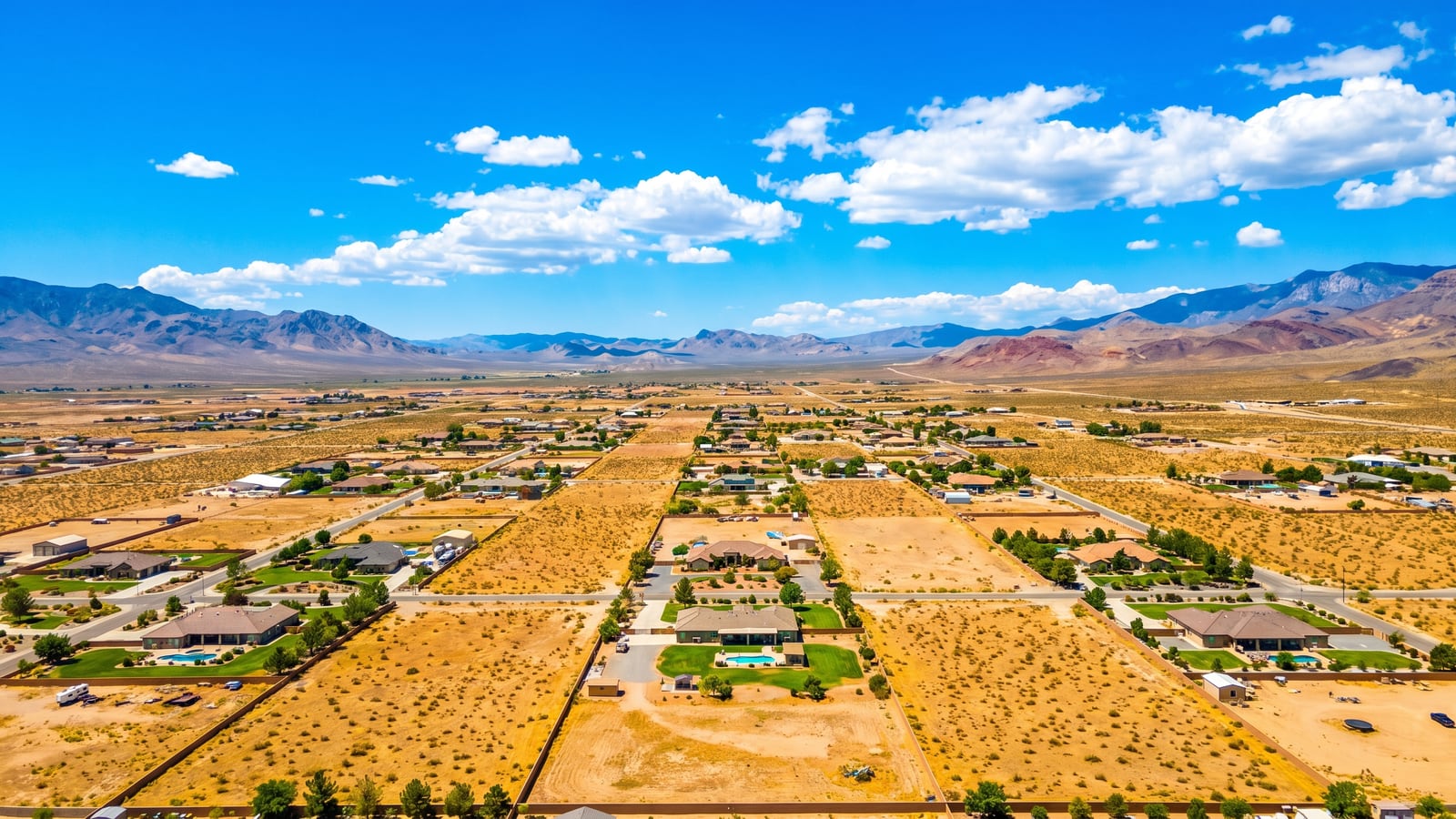
The land is the other half of the value. A median lot of 0.41 acres, with 32 of 124 sales on an acre or more, means Pahrump buyers routinely get space that would be extraordinary in the Las Vegas valley, where North Las Vegas recorded a 0.13-acre median and not a single sale on a full acre.
Manufactured homes are a major segment, not a footnote: 52 of the 284 total sales, at a $251,750 median. They are a legitimate route to ownership here and they finance differently, which the next section covers.
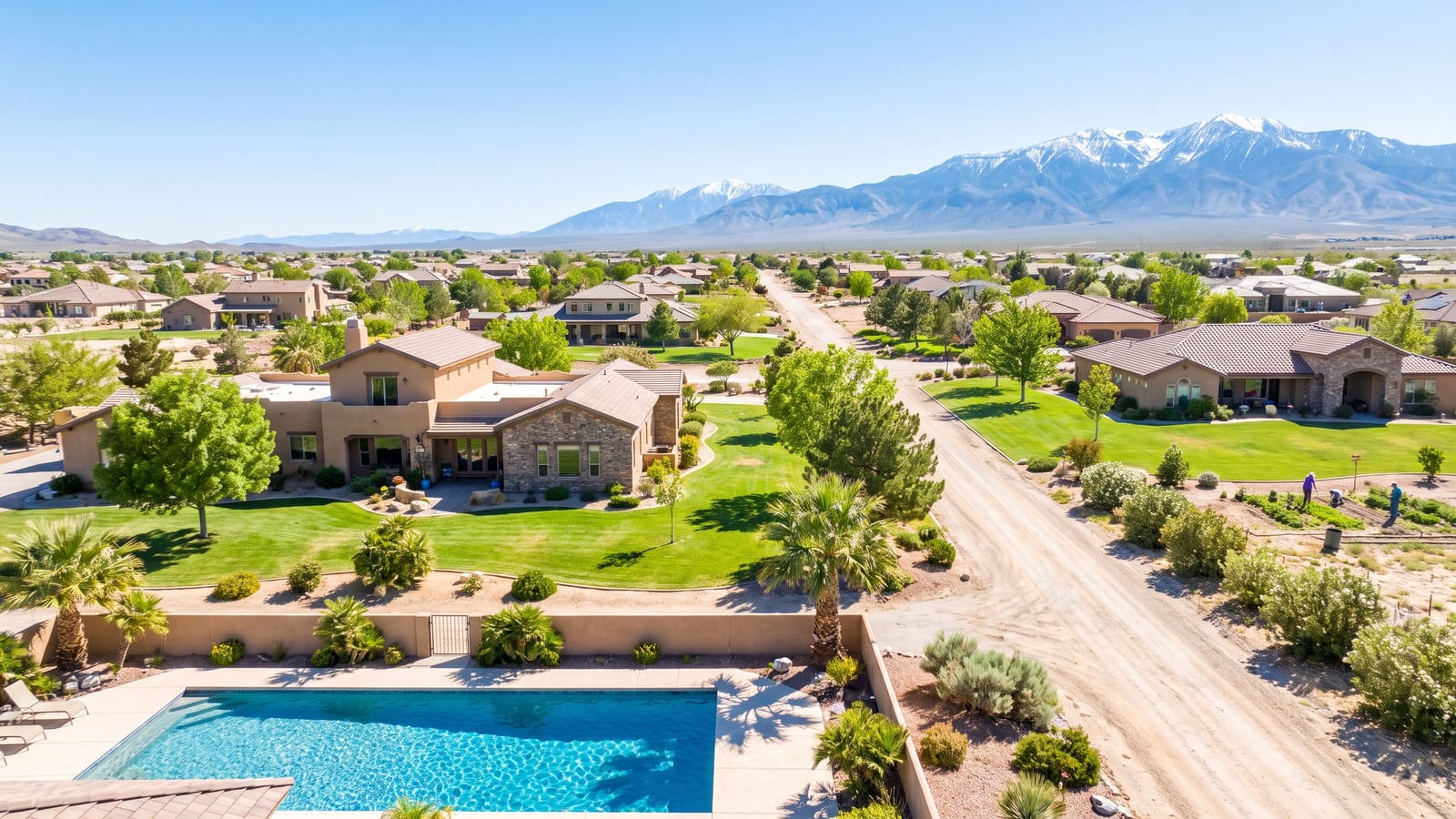
What you trade is distance. Pahrump sits roughly an hour from the Las Vegas valley across the Spring Mountains, and that commute is the entire reason the price difference exists. Buyers who will make that drive daily should do it at the actual hour, in winter, before committing.
How Does Financing Work Differently in Pahrump?
Three ways, and each can surprise a buyer who assumed a Las Vegas process.
Manufactured homes need the right loan and the right land. A manufactured home on owned land, permanently affixed and titled as real property, can generally be financed conventionally or with FHA and VA. One on leased land, or still titled as personal property, is a different transaction with different lenders and different terms. With 52 of 284 local sales being manufactured, this is a mainstream consideration here. Establish early whether the home is real property and whether the land conveys.
Well and septic affect the appraisal. Government-backed loans have requirements around water supply and sewage disposal. According to the U.S. Department of Housing and Urban Development, FHA appraisals assess minimum property standards alongside value, and on a well-and-septic property that can mean water testing and system condition become loan conditions rather than optional diligence. Plan for it rather than discovering it at week five.
Rural programs may apply. Parts of Nye County fall within areas eligible for USDA Rural Development financing, which offers zero down for qualifying buyers within income limits. Eligibility is address-specific, so have your lender check the particular parcel rather than assuming the town qualifies as a whole.
On rates, according to Freddie Mac's Primary Mortgage Market Survey the 30-year fixed averaged 6.76 percent and the 15-year 6.09 percent in the week ending September 10, 2026.
Down payment on the $362,000 median: $12,670 at FHA's 3.5 percent, $10,860 on a conventional 3 percent loan, $18,100 at 5 percent, or $72,400 at 20 percent to eliminate mortgage insurance. VA requires nothing down for eligible veterans.
First-time buyers should check Home Is Possible here, because Pahrump prices fit it comfortably. According to the program page, it provides up to 4 percent of the loan amount for down payment and closing costs, needs a 640 credit score (660 for manufactured homes) and first-time buyer status, and requires a homebuyer education course. It is a 30-year non-forgivable second mortgage — repaid, not gifted, despite being widely described as a grant.
What Do You Need to Check on a Well?
This is the diligence item with the most money attached, and it is entirely absent from Las Vegas buying guides.
A property on a domestic well is responsible for its own water: the well itself, the pump, the pressure tank, the electrical serving it, and the water quality. None of that is anyone else's problem after you close.
What to establish before removing contingencies:
- The well log. According to the Nevada Division of Water Resources, well logs are public records searchable by location, showing drilled depth, static water level and the yield the driller reported. Pull the log for the subject property and for neighbours.
- Current yield and water level, tested rather than assumed. A well that produced well twenty years ago may not today.
- Water quality testing. Arsenic occurs naturally in parts of Nevada groundwater, and testing for it along with bacteria and general chemistry is standard practice rather than paranoia.
- Pump and tank age and condition, since these are mechanical items with finite lives and meaningful replacement costs.
- Whether the well is shared. A shared well involves a written agreement governing maintenance, cost-sharing and access. Read it; a poorly drafted or absent agreement is a genuine problem.
Basin status matters too. In basins the State Engineer has designated, new domestic wells can face conditions, and groundwater management in the Pahrump Valley has been an active regulatory subject for years. If your plans depend on drilling a new well rather than using an existing one, confirm what is permitted for that specific parcel before you buy.
What About the Septic System?
Second only to the well, and more likely to be neglected during the inspection period.
A septic system needs a tank in sound condition, a functioning leach field, and soil that absorbs effluent at an acceptable rate. On a property that already has one, treat it as a used mechanical asset: have it pumped and inspected, and establish the age, the tank material, whether the leach field has ever been replaced, and when it was last serviced.
If you are buying vacant land or a property where a system must be added, the controlling questions are whether the soil will pass a percolation test and whether there is room to site both a primary and a replacement leach field at the required setbacks from wells, property lines and structures. Onsite sewage systems require permitting through the county health authority, and a failed perc test can make a parcel unbuildable for a conventional system, pushing you toward an engineered alternative at substantially higher cost.
Two practical points. Write the contingency to cover the specific risk — a general inspection clause is weaker than an explicit septic inspection and, on raw land, a passing perc result. And budget for the possibility. Septic replacement is a five-figure item, and a buyer who discovers a failing system after closing has no recourse against anyone.
How Should You Structure an Offer in Pahrump?
Like a buyer with leverage, because you have more of it here than anywhere else in Southern Nevada.
Start with days on market. With 38 of 135 homes sitting past ninety days and 56 past sixty, the listing's age tells you how much room you have. On a ninety-day listing, an offer meaningfully below asking is a normal opening rather than an insult.
Ask for more than price. Closing-cost credits, a contribution toward your agent's fee, repairs identified in inspection, or a home warranty are all reasonable on aged inventory — and sellers who have watched the market pass them by will frequently take terms over another price cut.
Keep every contingency. In a market where the median home sells at 98.5 percent of asking, you never need to waive inspection to win. On a well-and-septic property, waiving it would be reckless regardless.
Write in the specific diligence. Your contingency should explicitly cover the well test, water quality, septic inspection and, where relevant, the perc result — not just "inspection."
Earnest money at 1 percent — about $3,620 on the median — is standard here.
Verify the property type in writing. On a manufactured home, confirm it is titled as real property and that the land conveys, because that determines whether your financing works at all.
What Happens After Your Offer Is Accepted?
Nevada's statutory clocks run the same in Nye County as in Clark, with extra diligence layered on top.
Escrow opens with a neutral title and escrow company. Nevada is an escrow state; no attorney is required for a standard residential purchase.
The Seller's Real Property Disclosure. According to NRS 113.130, the seller must complete the form personally — their agent is prohibited from doing it for them — and serve it on you at least 10 days before conveyance. If it is not properly served you may rescind at any time before conveyance without penalty, and the seller has a continuing duty to disclose newly discovered or worsened defects in writing. On a rural property, read the water and sewage sections with particular care.
The HOA resale package, where applicable. Under NRS 116.4109, homes in common-interest communities come with the governing documents, budget, reserve study and assessment disclosures, plus a five-day right to cancel from receipt. A smaller share of Pahrump homes sit in HOAs than in the valley, but some do.
The title commitment. Read the exceptions rather than the vesting — on rural parcels, easements, access agreements, mineral reservations and water-right matters all surface there, and access in particular deserves attention. Confirm there is a recorded legal route to a public road.
Run your well, septic and property-type diligence inside the inspection window. It is the only period where new information gives you renegotiating power.
What Does It Cost to Close in Pahrump?
Two to three percent of the purchase price for a buyer, plus the down payment and a few rural-specific line items.
| Cost | Who pays | Typical amount |
|---|---|---|
| Real property transfer tax | Seller by custom | Statewide base of $1.95 per $500; confirm the Nye County rate |
| Lender's title insurance | Buyer | $700 to $1,100 |
| Owner's title insurance | Negotiable, often seller | $800 to $1,200 |
| Escrow and settlement | Usually split | $500 to $900 buyer share |
| Appraisal | Buyer | $600 to $900, more on rural or manufactured |
| Home inspection | Buyer | $350 to $600 |
| Septic inspection and pump | Buyer | $300 to $700 |
| Well inspection and water testing | Buyer | $300 to $800 |
| Recording fees | Buyer | $125 to $200 |
| Prepaid taxes and insurance | Buyer | Several months impounded |
According to the Nevada Department of Taxation, the real property transfer tax carries a statewide base of $1.95 per $500 of value, with counties permitted to add. Pahrump is in Nye County rather than Clark, so confirm the local figure with your escrow officer rather than assuming the Clark County rate.
The two lines that do not appear in a valley purchase are the well and septic inspections, together running roughly $600 to $1,500. That is the cheapest money you will spend in the entire transaction.
On property tax, according to NRS 361.4723 the annual increase on an owner's primary residence is capped at 3 percent, and only one Nevada property may be claimed as that residence. The county mails a claim card after purchase — return it.
How Does Buyer Representation Work Now?
You sign a written agreement before touring, and in Pahrump you have unusual room to negotiate who pays for it.
Under the practice changes following the National Association of Realtors settlement, a written buyer-representation agreement stating the compensation amount or rate is required before you tour a home with an MLS participant, and the fee must be described as negotiable. Offers of buyer-broker compensation were removed from the MLS.
The Pahrump advantage: in a market where the median home sells below asking and 28 percent sit past ninety days, a seller contribution toward your agent's fee is one of the most achievable terms in your offer. Sellers here are competing for a smaller buyer pool and have generally been on the market long enough to value a committed buyer.
Ask any agent you interview what they charge, what happens if the seller contributes less, and whether the shortfall falls to you — and then ask them to negotiate it as part of the offer, because here it usually can be.
According to the Nevada Real Estate Division, every licensee's status is publicly searchable, and Nevada's agency rules under NRS Chapter 645 require a duties-owed disclosure setting out who represents whom. That matters in a smaller market like Pahrump, where the same agent may be approached by both sides of a transaction more often than in a large metro. Read the agency paperwork rather than signing it in the car.
What Do Buyers Get Wrong in Pahrump?
Six things, and the first two cost the most.
Skipping the well and septic diligence. These are five-figure systems with no recourse after closing, and inspecting them costs a few hundred dollars.
Assuming a manufactured home finances like a stick-built one. Title status and land ownership determine whether your loan works. Establish both before you are emotionally committed.
Not negotiating. In the one Southern Nevada market where the median home sells below asking, paying full price on a ninety-day listing is leaving money on the table.
Underestimating the commute. An hour each way across a mountain pass is a different proposition in January than in June. Drive it before you decide.
Ignoring legal access on rural parcels. A recorded easement to a public road is not optional, and its absence is not always obvious from the listing.
Treating the town as uniform. Lot sizes, utilities, road surfaces and well conditions vary enormously across the valley. A property two miles away can be a completely different purchase.
Forgetting insurance and services. Rural addresses can price differently for homeowners insurance, and response times for fire and emergency services vary with distance from a station — both worth establishing during the contingency period rather than after. According to the Federal Emergency Management Agency, flood hazard is also mapped parcel by parcel, and desert washes mean some Pahrump parcels carry designations their neighbours do not.
Assuming the newest homes are the safest bet. Pahrump's median build year of 2018 is the newest of any Nevada market measured, which is genuinely reassuring on systems — but newer construction on a well and septic still carries every rural diligence item in this guide. New does not mean municipal.
If you want the current picture on a specific Pahrump property — the well log, the septic history, what comparable homes have actually closed at — call Nevada Real Estate Group at (702) 637-1759 or start with our Pahrump listings.
Frequently Asked Questions
How much does a house cost in Pahrump in 2026?
The median single-family home sold for $362,000 between June 1 and August 31, 2026, at $201 per square foot on a median 1,815 square feet built around 2018, across 135 closings. Ninety percent of the market traded under $500,000 and nearly two-thirds under $400,000. Manufactured homes, a substantial segment at 52 of 284 total sales, sold at a $251,750 median. At $201 per square foot Pahrump is the cheapest finished housing of any Nevada market measured.
Is Pahrump a buyer's market?
The most buyer-friendly market in Nevada right now, on the measured evidence. The median sale closed at 98.5 percent of asking with a mean of 97.9 percent, and only 55 of 135 sales — 41 percent — reached or beat the asking price, meaning the majority sold for less than the seller wanted. Twenty-eight percent of homes sat past ninety days, the highest share measured. That said, 15 homes did sell within a week, so well-priced inventory still moves; read days on market listing by listing.
Do I need a well inspection when buying in Pahrump?
If the property is on a well, yes, without exception. You are buying responsibility for the well, pump, pressure tank, electrical and water quality, with no recourse after closing. Pull the well log from the Nevada Division of Water Resources, which shows drilled depth, static water level and reported yield, and pull neighbouring logs too. Test current yield and water quality, including arsenic, which occurs naturally in parts of Nevada groundwater. Establish the pump and tank age, and if the well is shared, read the shared-well agreement carefully.
Can you get an FHA or VA loan on a Pahrump home?
Yes, with two caveats specific to this market. On a well-and-septic property, FHA appraisals assess minimum property standards alongside value, so water testing and system condition can become loan conditions rather than optional diligence. On a manufactured home, financing depends on the home being permanently affixed, titled as real property, and on land that conveys with the sale — a manufactured home on leased land or still titled as personal property is a different transaction entirely. Parts of Nye County may also qualify for USDA Rural Development financing at zero down.
How much land do you get in Pahrump?
Considerably more than anywhere in the Las Vegas valley. The median lot on summer sales was 0.41 acres, and 32 of the 124 sales with lot data sat on an acre or more — about a quarter of the market. For comparison, North Las Vegas recorded a 0.13-acre median with not one sale on a full acre. That space is the core of Pahrump's value proposition alongside the price, and it is why horse property and workshop-style properties are common here and rare in the valley.
How long does it take to buy a house in Pahrump?
About 48 days to find and go under contract plus 30 to 45 days of escrow, so roughly two and a half to three months. Build in extra time for rural diligence: well testing, water quality results and septic inspection each take days to schedule and return, and on a government-backed loan some of them gate the appraisal. The 48-day median means you are rarely rushed into a decision, which is fortunate, because this is the Nevada market where the property itself needs the most investigation.
Is Pahrump worth the commute from Las Vegas?
That depends entirely on how often you make it. Pahrump sits roughly an hour from the Las Vegas valley across the Spring Mountains, and the price gap — a $362,000 median against $482,500 in the valley, at $201 per square foot against $257 — is essentially payment for that distance. For remote workers, retirees and anyone commuting a few times a month, the arithmetic is compelling. For a daily commuter it is a significant lifestyle cost, and the honest test is driving it at your actual hour, in winter, before you commit.
Should I buy a manufactured home in Pahrump?
They are a legitimate and mainstream route to ownership here — 52 of 284 summer sales, at a $251,750 median, which is roughly $110,000 below the site-built median. The questions that determine whether it works are whether the home is permanently affixed and titled as real property, whether the land is owned and conveys, the age and HUD-code status of the unit, and whether your lender handles them. Home Is Possible requires a 660 credit score for manufactured homes rather than 640. Resale pools are smaller than for site-built homes, so plan a longer horizon.
Which Sources Inform This Pahrump Home Buying Guide?
Every market figure above was measured directly from the GLVAR-fed listing data covering all closings recorded in Pahrump between June 1 and August 31, 2026 — 284 transactions, of which 135 were single-family, 52 manufactured and 1 condo. Sales were pulled month by month and deduplicated so no server-side result cap could truncate the counts. The single-family set produced a $362,000 median at $201 per square foot on a median 1,815 square feet built around 2018, a 48-day median time on market with a 69-day mean, a 98.5 percent median sale-to-list ratio with a 97.9 percent mean, and 55 of 135 sales at or above asking. Days-on-market bands, price bands and the 0.41-acre median lot come from the same set, as does the observation that 32 of 124 sales with lot data sat on an acre or more. North Las Vegas, Henderson and Reno comparisons come from the same summer window. Live inventory changes daily; the Pahrump page carries current listings.
Rural and statutory sources: the Nevada Division of Water Resources for well logs, basin designations and groundwater administration; NRS 113.130 for the Seller's Real Property Disclosure, its 10-day service requirement and the buyer's rescission right; NRS 116.4109 for the common-interest resale package and five-day cancellation right; NRS 361.4723 for the 3 percent primary-residence tax abatement; the Nevada Department of Taxation for transfer tax rates; the U.S. Department of Housing and Urban Development for FHA appraisal and property standards; the Nevada Housing Division's Home Is Possible program for assistance terms; Freddie Mac for the 6.76 percent 30-year average in the week ending September 10, 2026; and the National Association of Realtors settlement FAQs for buyer-representation practice changes.
For the other side of the transaction, see our guide to selling your Pahrump home. Buyers weighing the town itself will find is Pahrump a good place to live useful, and anyone considering vacant land rather than an existing home should read the Pahrump land and acreage buying guide.