
Most Nevada buyers believe zero-down mortgages died with the 2008 crash. They didn't — they just moved outside the city limits. The U.S. Department of Agriculture still guarantees 100% financing on homes across the majority of Nevada's land area in 2026, and almost nobody in Las Vegas or Reno talks about it, because the program doesn't work inside the metros where most agents spend their careers.
Nevada Real Estate Group closes across the entire state — 9,600+ transactions and $4.85 billion in career volume, including 789 closings in 2025 alone — and a meaningful slice of our rural business from Pahrump to Fernley runs on USDA financing that buyers didn't know they qualified for until we mapped their address. With the Las Vegas metro median sold price at $442,713 in our May 2026 locked market data and Northern Nevada at $529,500 on the Reno data desk, the towns 45 minutes outside those metros are where zero-down math still pencils.
USDA guaranteed loans finance 100% of the purchase price — zero down — in USDA-designated rural Nevada, including Pahrump, Fernley, Dayton, and Fallon. Qualifying in 2026 takes household income under roughly $112,450 for a 1-4 person household, a 640+ credit profile, and a primary residence inside the eligibility map. Monthly costs typically run below FHA because USDA's 0.35% annual fee is about half of FHA's 0.55%. Check your address on the USDA map first.
- USDA loans require $0 down with a 1% upfront fee plus 0.35% annual fee — cheaper than FHA's 0.55%.
- Pahrump, Fernley, Dayton, Fallon, and most rural Nevada map as eligible; the Vegas and Reno metros do not.
- Income caps sit near $112,450 for 1-4 person households in most Nevada counties.
- Eligibility is parcel-by-parcel and maps get redrawn — verify the exact address before offering.
- Sellers can pay up to 6% of closing costs, making an almost-nothing-out-of-pocket close realistic.
What Is a USDA Loan and Why Does Zero Down Still Exist in 2026?
The USDA Rural Development Single Family Housing program exists to push homeownership into communities that private capital underserves. According to USDA Rural Development, the guaranteed program backs loans made by ordinary private lenders — your bank or credit union writes the mortgage, and the federal government guarantees it, which is why lenders accept 0% down from borrowers they'd otherwise require 3-20% from.
The program traces to the Housing Act of 1949 and has quietly financed millions of rural homes since — it's not a crisis-era experiment, it's one of the oldest continuously running mortgage programs in the country. That guarantee structure is why it survived every credit tightening of the last two decades. The government isn't lending its own money on the guaranteed program; it's absorbing tail risk so lenders will serve markets they'd otherwise redline out of inertia. For a buyer in Pahrump or Silver Springs, the practical effect is simple: a 30-year fixed mortgage at rates competitive with conventional — Freddie Mac's Primary Mortgage Market Survey has 30-year conventional money in the high-6% range through mid-2026, and USDA loans typically price at or slightly below it — with no down payment and mortgage insurance cheaper than FHA's.
There are actually two programs under the USDA umbrella, and confusing them costs buyers time:
- Guaranteed loans — for moderate-income households (up to 115% of area median income), written by private lenders. This is the program 90%+ of USDA buyers use and the main subject of this guide.
- Direct loans (Section 502) — for low and very-low income households, funded directly by USDA, with payment assistance that can subsidize the effective rate to as low as 1%. Slower, capped, and income-restricted, but life-changing for the households that fit.
Which Nevada Towns Qualify for USDA Financing?
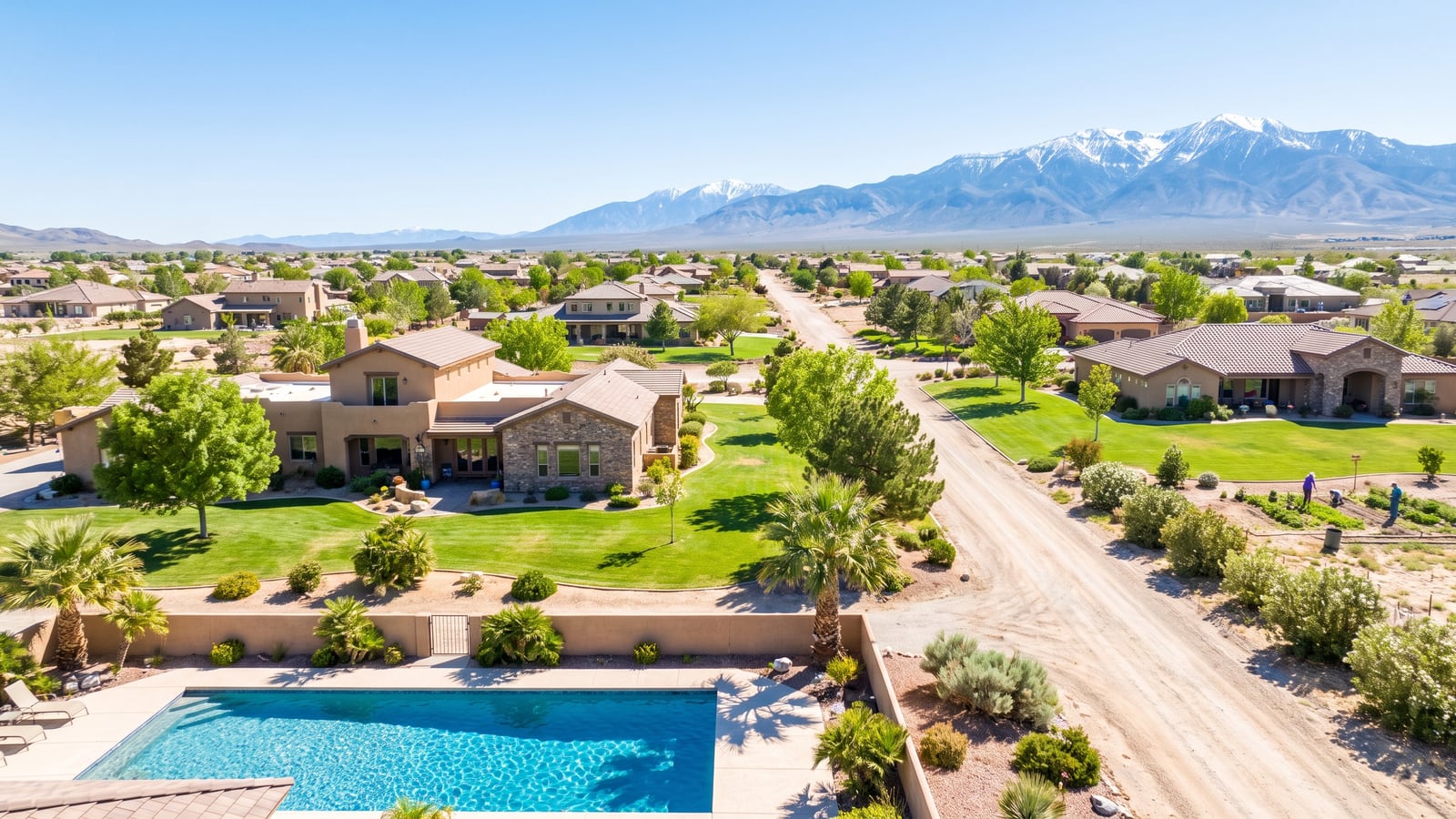
Eligibility is geographic, parcel-by-parcel, and checked on the official USDA eligibility map. The general rule excludes cities and urbanized areas — which knocks out Las Vegas, Henderson, North Las Vegas, Reno, Sparks, and Carson City's core — while leaving most of the rest of the state eligible.
Here's how the map plays out across the towns where we actually close USDA deals:
| Town | Region | Drive to metro jobs | Why buyers pick it |
|---|---|---|---|
| Pahrump | Southern NV (Nye County) | About 60 min to SW Las Vegas | Acreage, no HOA culture, prices far below the Vegas metro |
| Sandy Valley | Southern NV (Clark County) | About 45 min to SW Las Vegas | True rural living inside Clark County |
| Moapa Valley (Logandale/Overton) | Southern NV (Clark County) | About 60 min to Las Vegas | Agricultural roots, tight community, Lake Mead access |
| Amargosa Valley | Southern NV (Nye County) | About 90 min to Las Vegas | Lowest entry prices in Southern Nevada |
| Fernley | Northern NV (Lyon County) | About 30 min to Reno-Sparks | Commuter town with new construction under Reno prices |
| Dayton | Northern NV (Lyon County) | About 20 min to Carson City | Carson corridor value play |
| Fallon | Northern NV (Churchill County) | About 60 min to Reno | NAS Fallon, agriculture, stable small-city economy |
| Silver Springs | Northern NV (Lyon County) | About 40 min to Reno or Carson | Acreage at the lowest Northern entry prices |
| Yerington | Northern NV (Lyon County) | About 75 min to Reno | Ranch-country prices, Walker River valley |
| Winnemucca / Elko / Ely | Rural NV | Mining-economy hubs | Strong wages, chronically tight housing |
Two mapping realities to respect. First, the boundaries are weirder than you'd guess — parts of the Dayton corridor map eligible while a parcel across the highway doesn't. Second, USDA periodically redraws maps after each census; a town that's eligible today can lose eligibility at the next review (loans already closed are unaffected). We check the parcel the same day we write the offer, every time.
How Do USDA Income Limits Work in Nevada?
USDA guaranteed loans cap household income at 115% of area median income. According to the USDA income eligibility tool, the 2026 limit for a 1-4 person household sits near $112,450 in most Nevada counties, stepping up for 5-8 person households to roughly $148,450. A few counties with higher medians run higher — always pull your county's current number rather than assuming.
Three quirks trip up Nevada applicants:
- It's household income, not borrower income. Your spouse's W-2 counts toward the cap even if they're not on the loan. So does a working adult child living at home. Lenders document everyone over 18 in the house.
- It's gross qualifying income with adjustments. USDA allows deductions — $480 per minor child, documented childcare costs, elderly-household deductions — that can pull a household back under the cap. We've seen a family at $118,000 gross qualify after adjustments.
- The cap is generous relative to rural prices. A household earning $110,000 is comfortably under the cap and can carry roughly a $400,000 purchase at 2026 rates — well above what most eligible-town homes cost.
Which USDA Program Fits: Guaranteed or Direct?
| Feature | Guaranteed | Direct (502) |
|---|---|---|
| Who lends | Private lenders, USDA guarantees | USDA lends directly |
| Income band | Up to 115% of area median (about $112,450 for 1-4 in most NV counties) | Low/very-low income (50-80% of median) |
| Down payment | $0 | $0 |
| Rate | Market rate (high-6s in mid-2026) | Fixed by USDA; payment assistance can subsidize to as low as 1% |
| Speed | Normal 30-45 day escrow | Slower — funding queues, direct USDA processing |
| Where to start | Any USDA-approved lender | USDA Rural Development state office |
For most working households the guaranteed program is the answer — it moves at normal escrow speed and any USDA-approved lender can write it. The direct program matters for lower-income households, and the Nevada Rural Housing Authority layers state-level down-payment and closing-cost assistance on top of both for buyers who qualify.
How Much Does a USDA Loan Actually Cost vs FHA and Conventional?
This is where USDA quietly wins. Every low-down-payment program charges for the privilege; USDA just charges less than FHA, on both ends.
| Cost dimension | USDA Guaranteed | FHA | Conventional 5% down |
|---|---|---|---|
| Down payment | $0 | $11,550 (3.5%) | $16,500 |
| Upfront fee | 1.0% ($3,300, financeable) | 1.75% UFMIP ($5,573, financeable) | None |
| Annual fee / MI | 0.35% (about $96/mo) | 0.55% (about $146/mo) | PMI roughly $105-180/mo at 620-740 scores |
| MI removable? | No (life of loan) | No at under 10% down (life of loan) | Yes, at 20% equity |
| Income cap | Yes (about $112,450 for 1-4) | No | No |
| Geography cap | Rural-eligible areas only | Anywhere | Anywhere |
| Cash to close (with 3% seller credit) | Often under $1,500 | Roughly $13,000-15,000 | Roughly $18,000-20,000 |
According to the Consumer Financial Protection Bureau, the guarantee-fee structure makes USDA the lowest-cash-to-close mainstream mortgage in America. The trade-offs are the income cap, the geography, and the fact that the 0.35% annual fee never falls off — on a $330,000 loan that's about $96 a month for the life of the loan, which is why buyers who later build 20%+ equity often refinance into conventional to shed it.
The monthly picture on that same $330,000 purchase at a 6.75% note rate: principal and interest about $2,161 on the USDA loan (financing the $3,300 fee brings the balance to $333,300), plus the $96 annual fee, plus roughly $172 in property taxes (Nye County's effective rates are low — see how Nevada property taxes abate) and about $120 insurance: roughly $2,550 all-in, having brought almost nothing to closing.

What Credit Score and Debt Ratios Do You Need?
USDA publishes no hard minimum credit score. In practice, the automated system that approves guaranteed loans (GUS — the Guaranteed Underwriting System) gives clean approvals at 640 and above; below 640 a loan needs manual underwriting with documented compensating factors, which many lenders simply won't do. So treat 640 as the practical floor and 680+ as the comfort zone.
Debt-to-income guidance runs 29% housing / 41% total as the baseline, with GUS routinely approving into the mid-40s for borrowers with reserves, stable work history, or low payment shock. Two USDA-specific underwriting notes:
- No reserves are required for most GUS approvals — another cash-to-close advantage over conventional.
- Payment shock matters. If your new payment is triple your current rent, expect the file to get a harder look even with a clean score.
Across the closings our team has represented, the USDA files that die don't die on credit — they die on income documentation (a household member's income pushing past the cap) or on the parcel falling outside the map. Get both checked before you shop, not after.
What Kinds of Properties Pass USDA Rules?
USDA finances primary residences only — no second homes, no rentals, no flips you don't occupy. Beyond that, the property rules are more flexible than the program's reputation suggests:
- Existing homes, new construction, PUDs, and most manufactured homes (new units on permanent foundations meeting HUD code) all work. For manufactured specifics, our manufactured-home financing guide goes deep.
- Acreage is fine when it's typical for the area — which in Pahrump or Silver Springs means multiple acres raise no eyebrows. What draws scrutiny is income-producing agricultural use: a hobby barn passes, a working alfalfa operation doesn't.
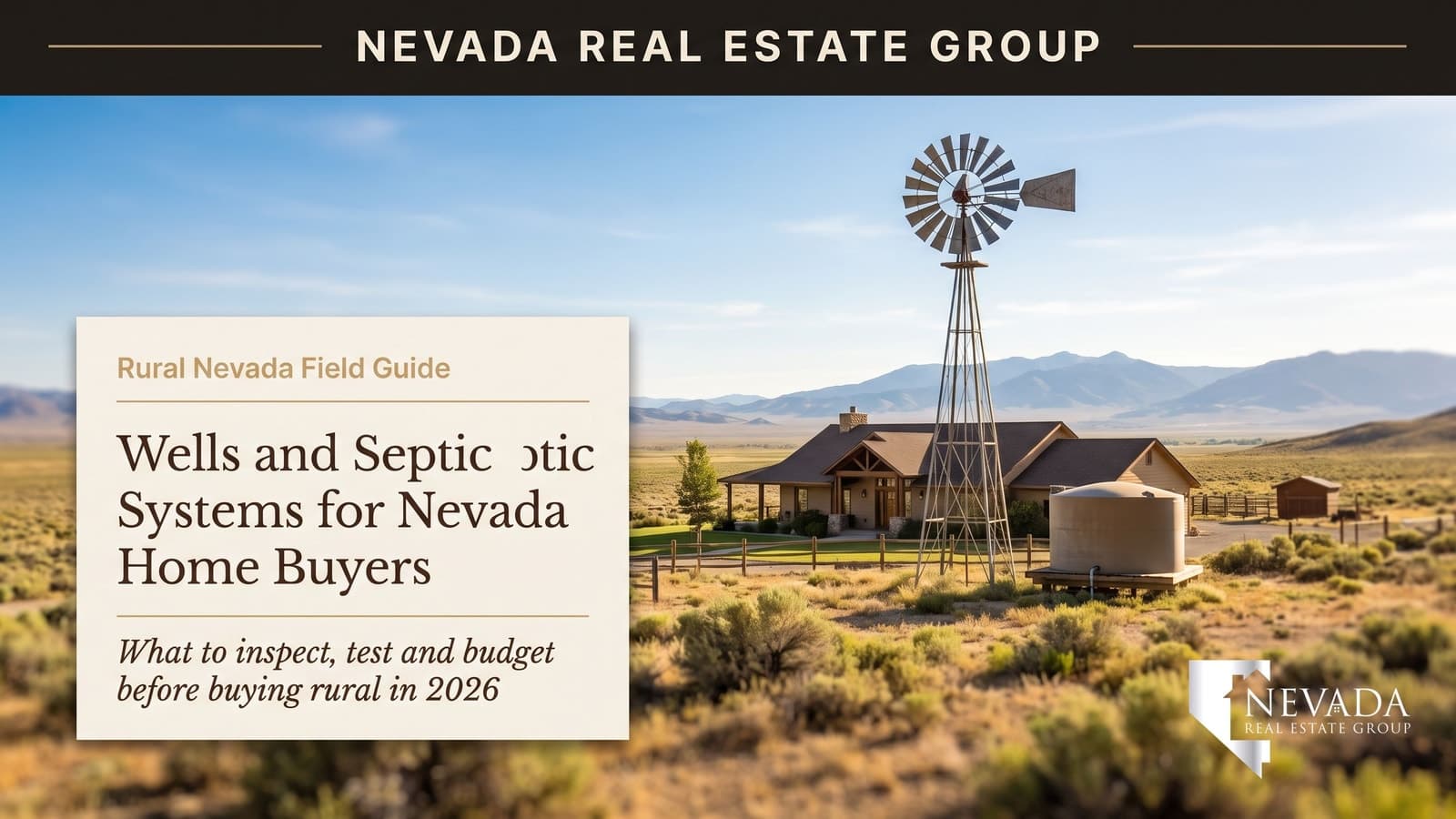
- Wells and septic systems are financeable — the norm, not the exception, in rural Nevada — but they must pass inspection and meet separation distances. Budget $300-600 for well and septic inspections and read our field checklist before you offer on one.
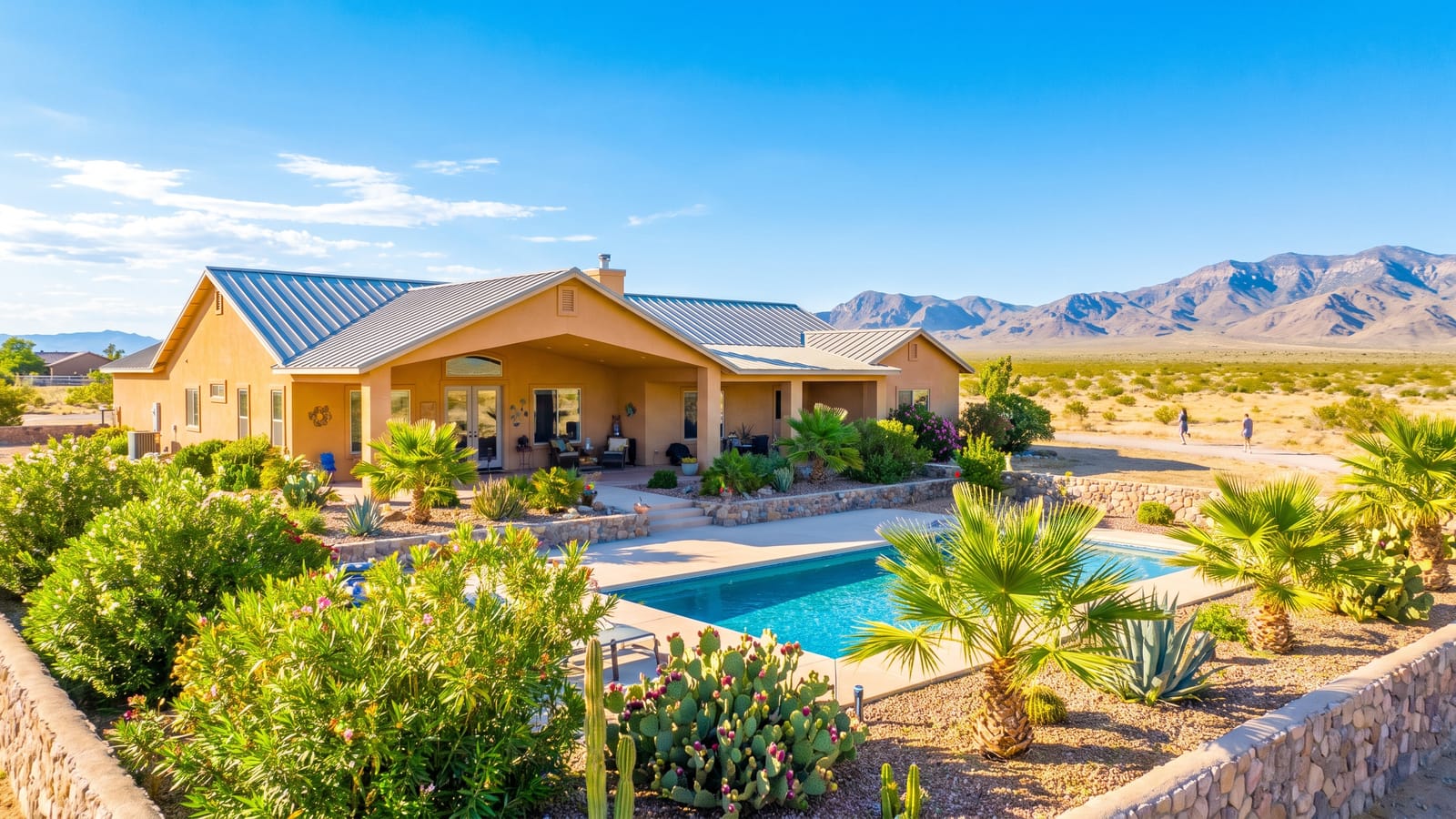
- In-ground pools, outbuildings, fencing — all fine in 2026 rules.
The appraisal must confirm the home meets HUD minimum property standards: functioning heat, sound roof, safe electrical, potable water. In practice that standard kills deals on neglected rural properties — peeling exterior paint on a pre-1978 home, a roof at end-of-life, a dead well pump. If you're eyeing a project property, USDA isn't your loan; look at renovation products or read our fixer-upper guide first.
How Does the USDA Appraisal and Inspection Process Work?
The escrow timeline runs like FHA's with one extra step: after your lender's underwriter signs off, the file goes to USDA's state office for a conditional commitment — typically 2-5 business days in Nevada, longer in high-volume months or during federal funding gaps. Build a 35-45 day escrow rather than promising a 30-day close, and have your agent set that expectation with the listing side up front.
The appraisal itself is ordered like any other, but the appraiser completes it to USDA/HUD standards. On acreage properties expect the appraiser to allocate value between site and improvements; extremely high land-value ratios can draw underwriter questions. Inspections aren't federally mandated beyond the appraisal, but in rural Nevada we treat well flow/quality tests, septic pump-and-inspect, and a standard home inspection as non-negotiable — that's $700-1,100 well spent on a purchase where the nearest municipal utility is 20 miles away. A well test typically measures flow rate in gallons per minute plus bacteria and nitrate levels; a septic inspection confirms the tank was pumped and the leach field accepts water. Neither is expensive relative to what failure costs: a replacement well can run $15,000-30,000 in Nevada's deeper basins, and a new septic system $10,000-20,000. No lender's appraisal protects you from either.
What Does a Zero-Down Purchase Look Like in Pahrump?
Here's the anatomy of a typical Pahrump USDA close, using round 2026 numbers on a $330,000 home on an acre-plus lot:
| Line item | Amount | Notes |
|---|---|---|
| Purchase price | $330,000 | Acre-plus lot, 3/2 site-built home |
| Down payment | $0 | 100% financing |
| Upfront guarantee fee | $3,300 | 1%, rolled into the loan |
| Total loan amount | $333,300 | |
| Closing costs + prepaids | About $9,500 | Title, escrow, taxes, insurance, appraisal |
| Seller credit (negotiated 3%) | $9,900 toward costs | USDA allows up to 6% |
| Buyer cash to close | Under $1,000 | Mostly earnest money already deposited |
| Monthly P&I at 6.75% | About $2,161 | 30-year fixed |
| Monthly annual fee | About $96 | 0.35% of balance |
| Taxes + insurance | About $290 | Nye County effective rates run low |
| Total monthly | About $2,550 |
Compare that to renting: a comparable Pahrump house rents for $1,900-2,200 a month in 2026, so the ownership premium is a few hundred dollars — before the principal paydown (about $290 of month one's payment) and any appreciation. The same buyer in the Las Vegas metro would need a $490,000 budget to match the June 2026 record single-family median that Las Vegas REALTORS reported — and at least $17,000 down on FHA. That spread is the entire USDA thesis, and you can browse the current inventory it applies to on our Pahrump homes for sale page.
What About Northern Nevada — Fernley, Dayton, and Fallon?
The Northern Nevada version of the play is commuter arbitrage. With the Reno-Sparks median at $529,500 on our May 2026 data desk, the USDA-eligible ring around the metro prices 20-40% lower:
- Fernley — the volume market. New-construction communities in the low-to-mid $400s, I-80 straight into Sparks' industrial corridor (30 minutes to the logistics jobs, per typical commutes). USDA-eligible townwide as of the current map.
- Dayton — Highway 50 corridor, 20 minutes to Carson City state jobs. Newer subdivisions in the mid-$400s that would cost $550,000+ in Reno.
- Fallon — anchored by NAS Fallon and agriculture. Median prices in the $300s make it the strongest affordability story in the region; military families often compare USDA against VA here (VA usually wins if you have the entitlement — no annual fee — but USDA covers the civilian workforce).
- Silver Springs and Yerington — the deepest value, with acreage properties in the high-$200s to $300s that simply don't exist elsewhere within an hour of Reno.
According to the U.S. Census Bureau, Fernley and Pahrump have both grown double-digits since 2020 — these aren't dying farm towns, they're the release valve for two metros whose medians outran their median incomes. That's exactly the demand picture you want under a zero-down purchase. According to the Nevada Rural Housing Authority, its Home At Last program can layer state down-payment and closing-cost assistance on top of a USDA loan for qualifying households — meaning some Northern Nevada buyers close with the earnest money as their entire cash investment.
One Northern-specific caution: the eligibility ring is tighter around Reno-Sparks than around Las Vegas. Spanish Springs, Cold Springs, and most of the North Valleys sit inside the urbanized exclusion despite feeling semi-rural, while Fernley — ten miles further out — qualifies townwide. The map, not the vibe, decides.
What Are the Biggest USDA Mistakes Nevada Buyers Make?
We've watched variations of the same handful of errors sink or delay rural files for years. Every one of them is avoidable in the first week of the process, which is exactly when almost nobody is thinking about them:
- Falling in love with the house before checking the parcel. The map, first, always. Two minutes on USDA's site saves a heartbreak.
- Forgetting household income counts everyone. A working adult child's $30,000 pushes a $95,000 household to $125,000 — over the cap. Surface it in the first lender conversation.
- Writing 30-day closes. The USDA conditional-commitment step adds days. A blown closing date costs you the seller's goodwill and sometimes a per-diem penalty.
- Skipping well and septic diligence because the loan doesn't force it. The appraisal checks the water is potable, not that the well won't need a $15,000 redrill in three years.
- Not negotiating seller credits. Zero down doesn't mean zero closing costs. In 2026's balanced rural markets, a 2-3% credit is a routine ask that turns $9,500 of costs into a three-figure cash-to-close.
- Ignoring the refinance path. The 0.35% annual fee never drops off. Buyers who reach 20% equity should run conventional refi math — our refinance guide covers the breakeven calculation.
- Assuming the maps are stable. Boundaries get redrawn. If your town is eligible today and you're planning to buy "next year," understand next year isn't guaranteed.
How Do You Start a USDA Purchase With NREG?
The sequence that works, in order: pull the eligibility map for your target towns; get pre-approved with a lender who writes USDA weekly (not one who "can look into it"); then shop with an agent who closes rural — wells, septics, easements, and propane leases are a different sport from tract-home escrows.
That last part is where we come in. Nevada Real Estate Group covers the whole map — Las Vegas to Boulder City to Mesquite in the south, Reno to Carson City to Fallon in the north — with 150+ agents and 9,061+ verified five-star client reviews statewide. Start a search on our statewide search, tell us your income and target town, and we'll tell you in one conversation whether USDA, FHA, or a first-time buyer program wins for your file. Southern Nevada: (702) 637-1759. Northern Nevada: (775) 277-2120. Or send us a note and we'll map your address the same day.
Frequently Asked Questions
Is Pahrump really USDA-eligible even though it has 45,000 people?
As of the current USDA map, the Pahrump Valley shows as eligible — the program's rural definitions consider census-designated boundaries and urbanization, not just raw population, and grandfathering provisions have kept many growing towns eligible through map reviews. But eligibility is parcel-specific and maps change after census reviews, so verify the exact address on USDA's eligibility site the week you write your offer, not from a blog post — including this one.
What credit score do I need for a USDA loan in Nevada?
USDA sets no official minimum, but the practical floor is 640 — that's where the automated underwriting system issues clean approvals. Between 580-639, some lenders will manually underwrite with strong compensating factors, but many won't touch it. Above 680, USDA underwriting generally feels no tighter than FHA.
Can I make too much money for a USDA loan?
Yes — that's the program's defining cap. Household income must stay under 115% of area median, roughly $112,450 for a 1-4 person household in most Nevada counties in 2026 (about $148,450 for 5-8 people). Every adult's income in the home counts, whether or not they're on the loan, though child and childcare deductions can pull a borderline household back under.
Are USDA rates higher than conventional rates?
No — they typically price at or slightly below conventional, because the federal guarantee removes most of the lender's risk. Where USDA wins outright is the total monthly cost at low down payments: its 0.35% annual fee is roughly half of FHA's 0.55% and usually cheaper than PMI on a 5% conventional loan for average-credit borrowers.
Can I buy a manufactured home with a USDA loan?
Yes, with conditions: generally new manufactured units on permanent foundations, titled as real property, meeting HUD code — plus a limited pilot allowing some existing units. Rules are lender-dependent and stricter than for site-built homes, so lead with the manufactured question when you shop lenders.
How long does a USDA loan take to close in Nevada?
Plan 35-45 days. The loan processes like any other mortgage until final approval, then adds USDA's conditional-commitment review — usually 2-5 business days at the Nevada state office, occasionally longer in peak season or during federal funding lapses. An experienced agent writes the contract timeline around that step from day one.
Can the seller pay my closing costs on a USDA loan?
Yes — up to 6% of the purchase price, one of the most generous seller-credit allowances of any loan type. On a $330,000 purchase that's up to $19,800 of headroom, far more than the roughly $9,500 in typical costs and prepaids. A negotiated 3% credit routinely brings USDA buyers to the closing table with under $1,000 out of pocket.
Which Sources Inform This USDA Loan Guide?
Program rules and figures in this guide come from USDA Rural Development's guaranteed loan program and Section 502 direct program pages, the official USDA property and income eligibility tool, and the USDA guaranteed underwriting technical handbook. Rate context is from Freddie Mac's Primary Mortgage Market Survey; consumer protections from the CFPB; market medians from Las Vegas REALTORS and NREG's locked monthly data desks; population and growth data from the U.S. Census Bureau; state assistance programs from the Nevada Rural Housing Authority; manufactured-home standards from HUD; and property-tax context from the Nevada Department of Taxation. Worked examples use mid-2026 market rates and typical Nye and Lyon County cost figures; your quote will differ — verify current numbers with your lender.