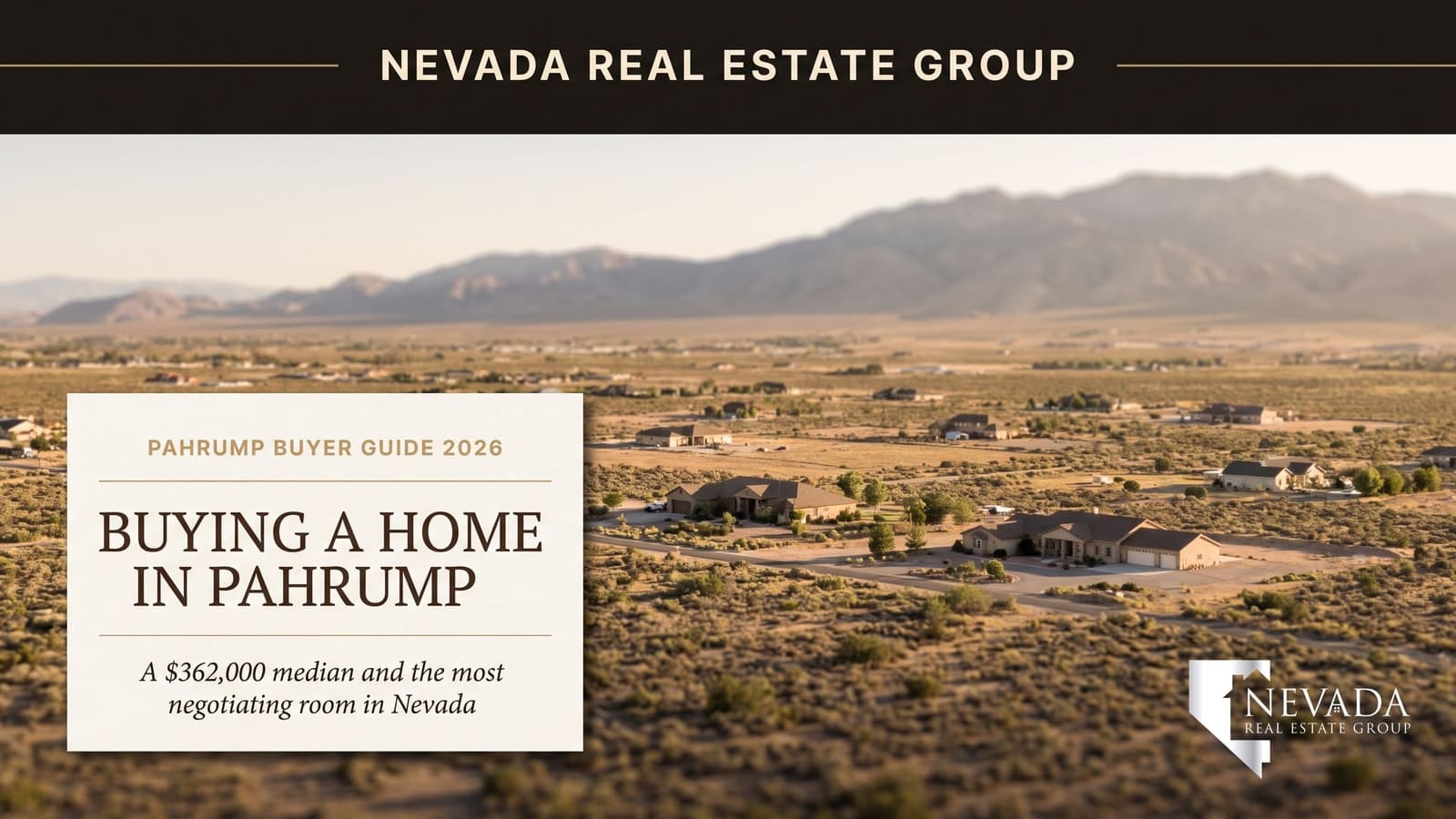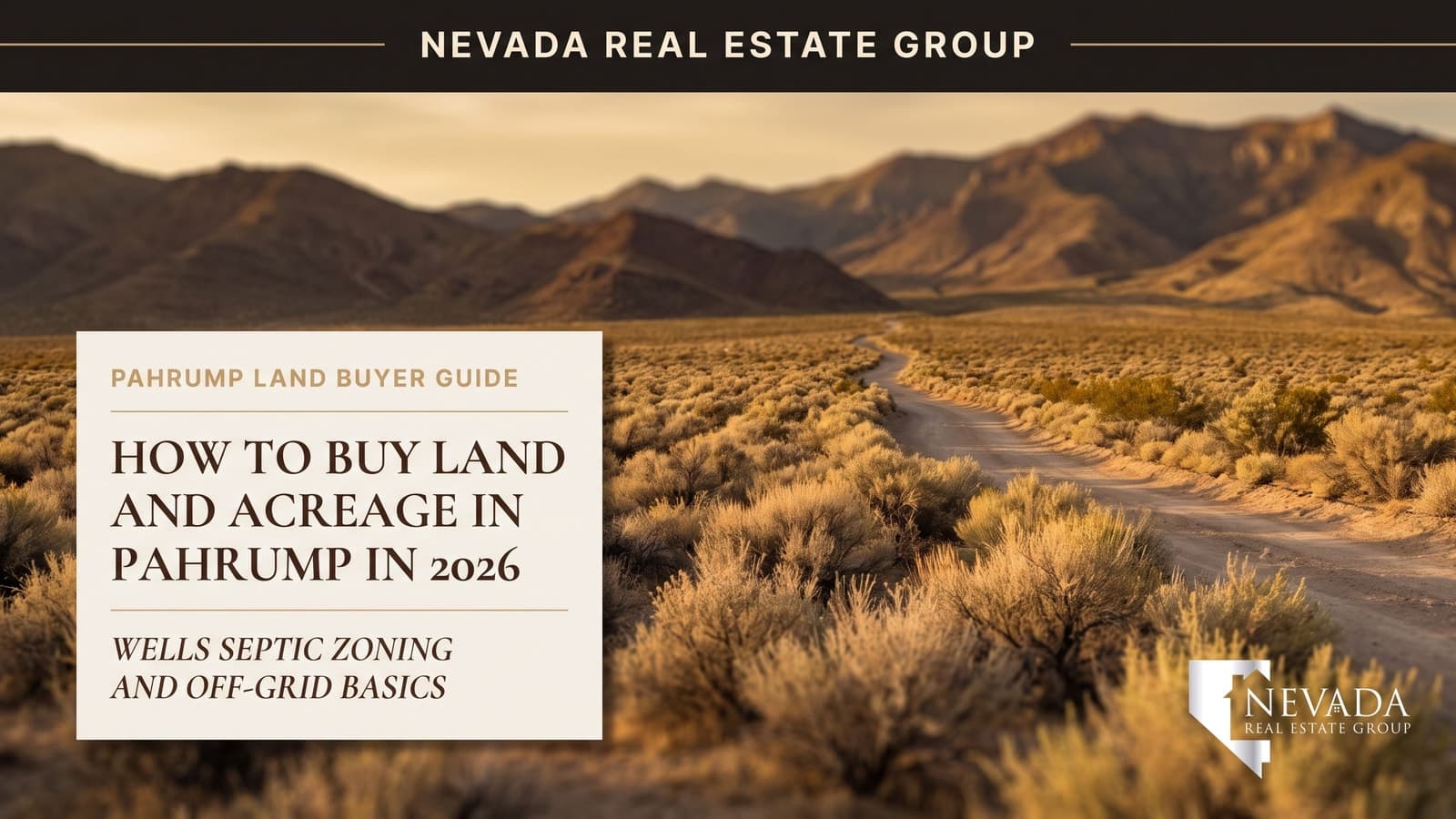

Most Nevada towns are home markets with a little land around the edges. Pahrump is the opposite. This wide Nye County valley about 60 miles west of Las Vegas is, first and foremost, a land market — a place where buying a parcel and shaping what goes on it is the signature move, and where a modest budget still buys real acreage under an enormous desert sky. If you have ever wanted room for horses, an RV, a workshop, a well, and space between you and the next roofline, Pahrump is the closest place to Las Vegas where that is genuinely affordable.
But raw land is not a smaller version of buying a house. It is a different transaction with its own rulebook: water rights and well permits, septic and percolation tests, power lines that may or may not reach your parcel, Nye County zoning, manufactured-home placement standards, legal access and easements, and a financing market that treats dirt very differently from a finished home. I'm Chris Nevada, owner of Nevada Real Estate Group, and this guide walks all of it — with live 2026 numbers from our MLS feed and the exact due-diligence steps we run before a client writes an offer on Pahrump land.
Pahrump had roughly 1,234 active vacant-land parcels versus about 552 active homes in mid-July 2026 — more than two land listings per home (Nevada Real Estate Group MLS, July 13, 2026). Median land list is about $35,000; land that sold over the past year closed at a $27,500 median. Before buying, confirm water, septic feasibility, legal access, power, and Nye County zoning. Call (702) 637-1759.
- Pahrump lists about 1,234 vacant parcels against roughly 552 homes — land outnumbers homes two to one (MLS, July 2026).
- Median land list is near $35,000; sold land ran a $27,500 median over 72 days.
- Most rural parcels rely on a private well (up to 2 acre-feet a year) plus a septic system.
- Nye County zones rural land RE-1 (1 acre), RE-2 (2 acres), and RH-9.5 (9.5 acres) — verify before you offer.
- Raw land rarely qualifies for a normal mortgage; expect a land loan, seller carry, or cash.
Want to see what is on the market right now? Pahrump homes and land for sale shows live MLS listings with prices, acreage, and instant filters, and our Pahrump community hub covers the valley end to end.
Why Does Pahrump Have More Land Parcels Than Homes for Sale?
Here is the single fact that defines this market, pulled directly from Nevada Real Estate Group's Southern Nevada MLS feed on July 13, 2026: Pahrump had approximately 1,234 active vacant-land listings against roughly 552 active single-family homes. That is more than two parcels of dirt for every finished house — an inventory profile you see almost nowhere else in the state — not in Las Vegas, Henderson, Summerlin, or North Las Vegas.
The reason is historical. In the 1960s and 1970s, developers subdivided enormous stretches of the Pahrump Valley into speculative one-acre and larger lots — the Calvada Valley and Calvada Meadows tracts alone platted thousands of parcels — and sold them nationwide, often sight-unseen, to buyers who never built. Decades later, a huge share of that paper subdivision is still vacant, changing hands as raw land. Across the 9,600-plus closings our team has represented statewide, I can tell you Pahrump is the one Southern Nevada submarket where a first-time buyer's very first purchase is frequently a parcel rather than a house.
That oversupply of dirt is exactly why land here is cheap relative to a finished home, and why patient buyers hold the leverage. According to Las Vegas REALTORS, whose data covers the Pahrump submarket, the valley draws value buyers, retirees, and homesteaders precisely because the same dollar buys land you could never touch inside the Las Vegas beltway. Many of the buyers I work with here are relocating from the Las Vegas metro or comparing Pahrump against other affordable Southern Nevada edges like Boulder City. The trade-off is that a parcel is only as good as its water, septic feasibility, access, and power — and those are what the rest of this guide is about.
What Does Pahrump Land Actually Cost per Acre in 2026?
Land pricing in Pahrump is not one number — it is a wide range driven by size, location, and whether utilities are already at the parcel. From our July 13, 2026 MLS pull, active vacant land carried a median list price of about $35,000, an average of roughly $99,381 (skewed up by a handful of large commercial and multi-parcel listings), and a spread running from about $4,900 for a small remote lot to $7.5 million for a large development tract. Land that actually closed over the trailing year sold at a $27,500 median and a $47,744 average, with 553 parcels closing in that window — so this is a liquid, active market, not a graveyard of stale listings.
One number worth internalizing: in our sample of active parcels, the median price worked out to roughly $50,000 per acre, but the range was enormous — from about $4,091 per acre on a 2.2-acre lot in an outlying tract to nearly $116,803 per acre for a small quarter-acre in-town parcel with utilities close by. Per-acre pricing falls fast as parcels get bigger and move away from the town center, which is why acreage in Pahrump can feel like a bargain and a small utility-ready lot can feel expensive.
| Price tier | Share of active land (sample) | Typical parcel | What you are buying |
|---|---|---|---|
| Under $25,000 | About 27% | 0.5–2.5 acres, outlying | Remote, few or no utilities near the lot |
| $25,000–$50,000 | About 30% | 1–2.5 acres | The core rural-homesite band |
| $50,000–$100,000 | About 17% | 1–5 acres, better location | Power closer, some near community water |
| $100,000 and up | About 26% | In-town lots or large tracts | Utility-ready, prime, or development-scale |
For context on finished product, Pahrump homes were listing at a $374,900 median and closing at a $335,000 median in the same feed — so the gap between a $27,500 lot and a $335,000 home is essentially the cost of water, septic, power, and vertical construction. Understanding that gap is the whole build-versus-buy decision, and we come back to it below. If you would rather skip the dirt entirely, our what your budget buys in Pahrump breakdown covers finished homes by area.
How Big Are Pahrump Parcels, and What Do the Sizes Mean?
The workhorse Pahrump parcel is one acre to two and a half acres. That is large enough for a home, a detached shop or barn, RV parking, a garden, and a couple of horses, while still being small enough to fence, service, and insure without turning into a ranch operation. In our active-land sample, the great majority of residential parcels fell between roughly 1.0 and 2.2 acres, with a scattering of smaller in-town lots (0.24 to 0.5 acre) and a long tail of larger 5-, 10-, and 40-acre parcels for buyers who want real isolation.
Size drives more than price. It drives what you are allowed to build, whether you can keep livestock, how far your well and septic must sit from property lines and from each other, and whether the county treats your project as a simple homesite or something closer to agricultural use. It also drives resale: a fenced, graded, utility-ready one-to-two-acre parcel is the most liquid land product in the valley, which matters if your plans change. Buyers who want the horse-and-barn lifestyle should start with our Pahrump horse properties inventory, where acreage and zoning already fit that use.
Which Pahrump Subdivisions and Areas Should Land Buyers Know?
Pahrump land is not homogeneous — it trades by subdivision, and the name on the legal description tells an experienced buyer a lot. From our MLS data, the most active land tracts include Calvada Valley and Calvada Meadows (the original 1970s paper subdivisions that still supply most of the valley's one-acre inventory), Mountain View Estates, Green Saddle Ranch, Golden Spring Ranch, Vegas Acres, and the Landmark area. Prices swing hard by tract: our sample showed a 2.2-acre parcel in an outlying tract at about $4,091 per acre while a utility-close lot ran more than $90,000 per acre.
The practical questions that separate a good tract from a problem one are always the same: Is community water available at the street, or is this well country? Does Valley Electric Association power run to the parcel, or will you pay to extend it? Is the access a maintained county road or an unmaintained dirt easement? Is the parcel inside the Pahrump nitrogen-management area, which can push septic toward a more advanced (and pricier) system? Two parcels a mile apart can differ by tens of thousands of dollars in true cost once those answers land. This is where local representation earns its keep — the same reason our guide to the best real estate agent in Las Vegas applies just as much to Pahrump dirt.
How Do You Get Water on Pahrump Land — Well, Hauled, or Community?
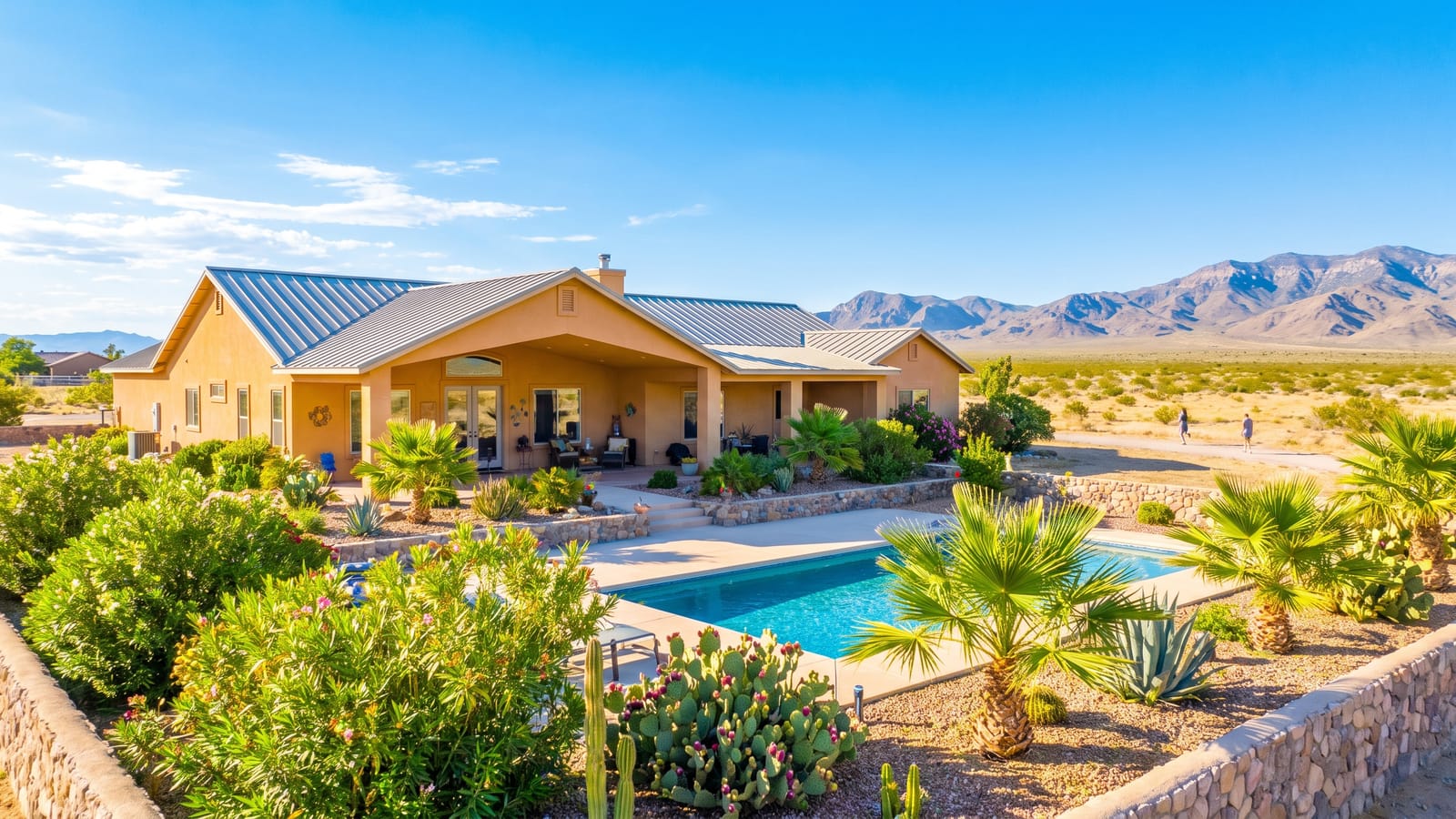
Water is the first question on any Pahrump parcel, and there are three real answers: a private well, hauled water into a storage cistern, or a community water connection. Which one applies changes your budget, your timeline, and sometimes whether the parcel is buildable at all.
According to the Nevada Division of Water Resources, a domestic well serving a single-family home does not require a separate water-right permit as long as it draws no more than 2 acre-feet per year — roughly 651,700 gallons, far more than a household uses — but you still need a well-drilling permit, and the well must be drilled by a licensed driller. The priority date for a domestic well is the date the well is completed. Importantly, if an authorized community water provider can already serve the parcel, state law generally requires you to connect rather than drill. A new domestic well in the valley commonly runs $15,000 to $35,000-plus depending on depth, casing, pump, and pressure tank.
Where a well is not practical, many owners haul water into an above- or below-ground cistern (often 2,500 to 5,000 gallons) and pump from there — a lower up-front cost but an ongoing chore and expense. A community water connection, where available, is the simplest path but is limited to parcels near an existing main. The comparison below is the framework we walk every land client through.
| Dimension | Private Well | Hauled Water + Cistern | Community Water |
|---|---|---|---|
| Typical up-front cost | $15,000–$35,000+ | $3,000–$8,000 (tank + pump) | Connection/meter fees, then usage |
| Ongoing cost | Power to pump, maintenance | Water delivery per fill | Monthly water bill |
| Permitting | State well-drilling permit | Minimal; tank standards | Provider application |
| Availability | Most rural parcels | Anywhere; fallback option | Only near existing mains |
| Best for | Long-term homesteads on acreage | Budget starts, temporary use | In-town or edge-of-town lots |
The gotcha most out-of-area buyers miss: a parcel advertised as "buildable" is not the same as a parcel with water proven. Before you remove your contingency, we confirm neighboring well logs and depths through state records, verify whether community water reaches the street, and price the actual well or cistern job — never assume. Our statewide Nevada well and septic buyer field guide goes deeper on the mechanics that apply to any rural Nevada purchase.
What Should You Know About Septic Systems and Perc Tests?
If there is no sewer — and on rural Pahrump land there almost never is — your parcel needs a septic system, and that starts with a percolation ("perc") test to prove the soil will absorb effluent. According to the Nevada Division of Environmental Protection, individual sewage disposal systems require approval from the administrative authority, and the perc rate has to fall inside an acceptable window: broadly, a rate faster than about 6 to 10 minutes per inch at the quick end and no slower than roughly 60 minutes per inch at the slow end, with two perc tests typically required per absorption field. Caliche — the cement-hard calcium-carbonate layer common in this valley — is the usual villain; it can slow percolation and force a larger or engineered system.
A standard conventional septic system in the valley commonly runs $8,000 to $20,000, but Pahrump adds a wrinkle: parts of the valley sit inside a nitrogen-management area, where nitrate loading in the shallow aquifer has led regulators to require more advanced treatment systems on some parcels — which can push the cost meaningfully higher. Per the state's onsite-sewage program, whether your parcel routes through NDEP, a health authority, or Nye County depends on location, so we confirm the reviewing agency and the nitrogen-area status before you buy, not after. A failed or expensive perc result is the most common way a cheap parcel turns into a bad deal.
How Do You Get Power to Pahrump Land — Grid, Off-Grid, or Solar?
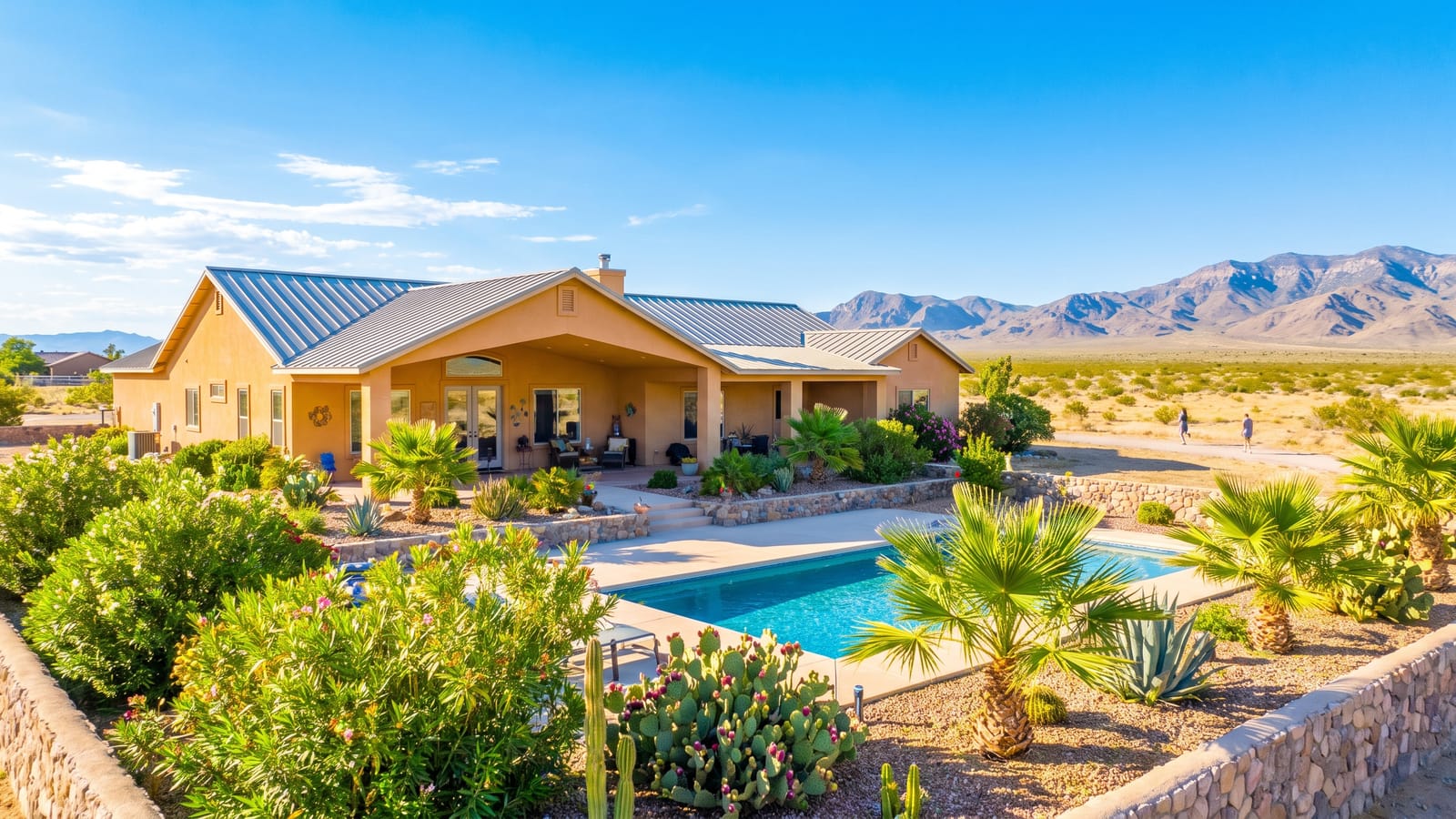
Electricity in the Pahrump Valley comes from Valley Electric Association (VEA), the member-owned cooperative founded in 1965. According to Valley Electric Association, the co-op serves roughly 45,000 customers across a 6,800-square-mile service territory east of Death Valley, and it operates its own solar arm, SolPower, along with a growing utility-scale solar-and-storage footprint in the valley. If grid power already runs along your parcel's frontage, connecting is straightforward. If it does not, extending a line from the nearest pole can run anywhere from $10,000 to $30,000 or more depending on distance, terrain, and whether the co-op requires new poles — a cost that can dwarf the price of the land itself on a remote parcel.
That math is exactly why off-grid solar is a legitimate strategy in Pahrump, not a fringe one. With more than 300 sunny days a year, a properly sized photovoltaic array with battery storage — commonly $20,000 to $45,000 installed for a full-home off-grid system — can pencil out cheaper than a long line extension, and it removes your monthly power bill entirely. Grid-tied solar through the co-op is another path for parcels where the line is already close. The right answer depends entirely on distance to the nearest pole, which is why "how far is power?" is one of the first questions we ask on any land showing.
What Are the Nye County Zoning Rules for Rural Land?
Nye County regulates Pahrump land through the Pahrump Regional Planning District (PRPD), and the zoning district on your parcel controls minimum lot size, what you can build, and whether you can keep animals. According to Nye County ordinances, the rural-residential districts run on a size ladder — and buying a parcel without confirming its district is one of the most expensive mistakes a land buyer can make.
| Zone | Minimum lot size | Character | Common uses |
|---|---|---|---|
| RE-1 (Rural Estates) | 1 gross acre | Standard rural homesite | Home, shop, limited animals |
| RE-2 (Rural Estates) | 2 gross acres | Larger homesite, more privacy | Home, barn, horses, RV |
| RH-4.5 (Rural Homestead) | 4.5 gross acres | Homestead scale | Home plus agricultural use |
| RH-9.5 (Rural Homestead) | 9.5 gross acres | Low-density homestead | Home, livestock, farming |
Zoning also determines setbacks (how far a structure must sit from property lines), whether you can run a home-based business, and how many animals you may keep. If your dream is a barn and a couple of horses, an RE-2 or larger parcel is the safe target; if you want RV living while you build, note that the county allows RVs or mobile homes as a temporary residence only under a temporary-use permit. Buyers who plan to keep an RV on the property long-term should review our Pahrump RV-parking homes and no-HOA Pahrump properties inventory, where the zoning and covenants already allow it.
Can You Put a Manufactured Home on Pahrump Land?
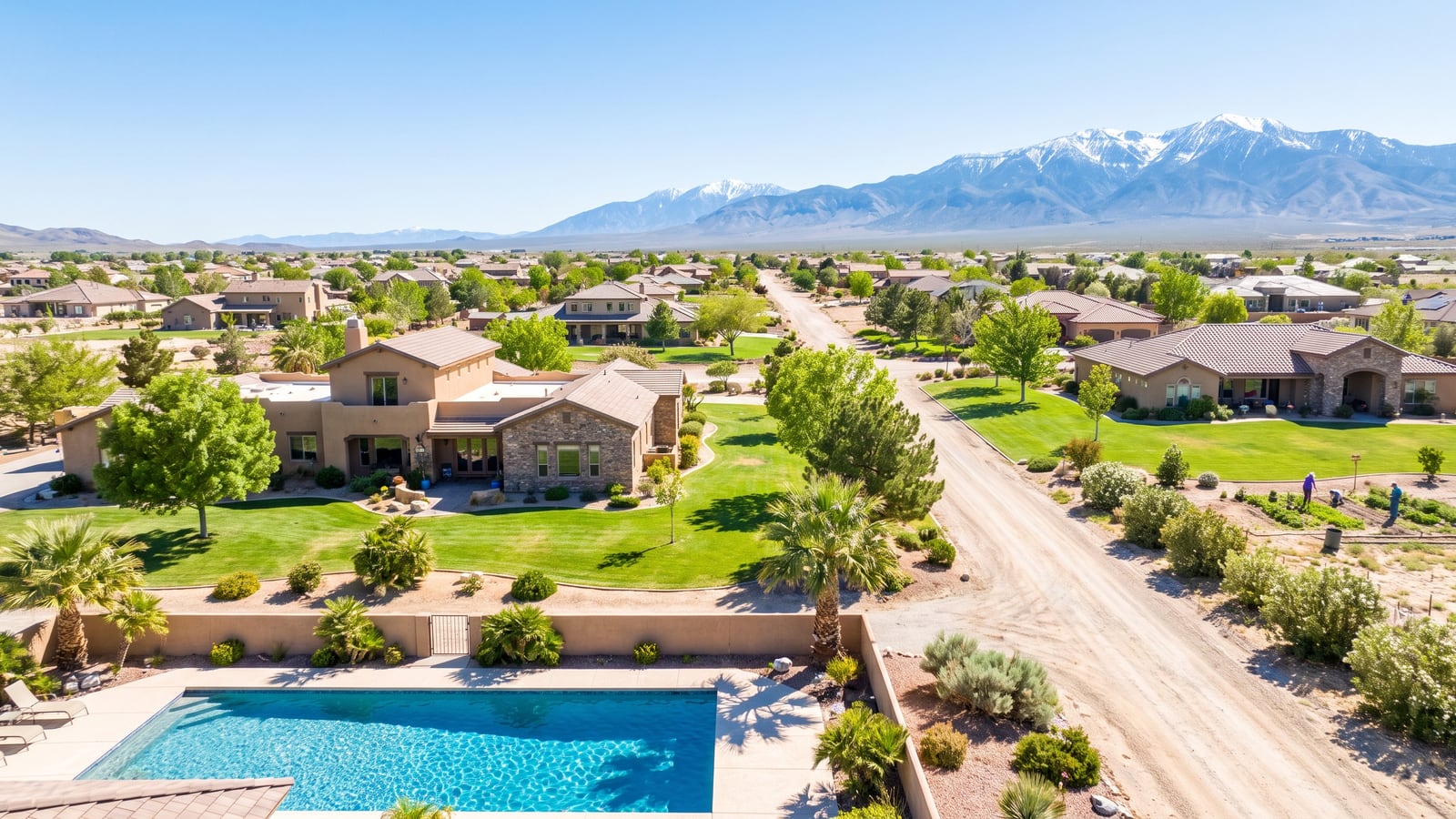
Yes — and for many Pahrump land buyers, a manufactured home is the fastest, most affordable way to turn a parcel into a residence. Nevada law helps here: under NRS 278.02095, a manufactured home that meets local standards is treated as a single-family residence for zoning purposes, so counties cannot categorically ban it from residential land. But "allowed" comes with specific placement standards.
According to Nye County's PRPD ordinances, a manufactured home placed on rural-residential land generally must be permanently affixed to the parcel and converted to real property through the Assessor's Office (so it is taxed and financed as real estate, not as a vehicle), contain at least 1,150 square feet of living area, and sit on an approved permanent foundation with the perimeter wall backfilled to within about 12 inches of the floor elevation. Skirting-only installations and title-in-place mobile homes do not meet the affixed-and-converted standard for most residential zones. Doing this correctly matters for financing, too — a properly converted manufactured home on owned land can qualify for far better loan terms than a titled mobile home, which is why the conversion step is worth doing before you finance. Budget roughly $150,000 to $250,000-plus all-in for a new manufactured home delivered, set, and connected, on top of the land — still typically well under the $335,000 median for an existing Pahrump home.
How Do Access and Easements Affect a Pahrump Parcel?
A parcel is worthless if you cannot legally reach it, and Pahrump's paper-subdivision history means access is a genuine variable — not a formality. Some lots front a maintained Nye County road; others are reached only by an unmaintained dirt easement across neighboring land, and a handful are effectively landlocked with no recorded legal access at all. Legal access and physical access are two different things: a parcel can have a recorded easement on paper while the actual road is impassable to a delivery truck or a well-drilling rig.
Before we let a client remove contingencies, we confirm three things through the title commitment and the Nye County Assessor's parcel map: that there is a recorded legal easement or public-road frontage granting access, that utility easements exist (or can be obtained) for a power line and any water line, and that the physical road is drivable for construction equipment. We also check for shared-road maintenance obligations, which can carry cost and neighbor-coordination headaches. Buyers financing the purchase should know that lenders and title companies scrutinize access hard — a landlocked parcel is often uninsurable and unlendable, which quietly caps its value no matter how cheap the per-acre price looks.
Should You Buy Raw Land or a Home Already on Acreage?
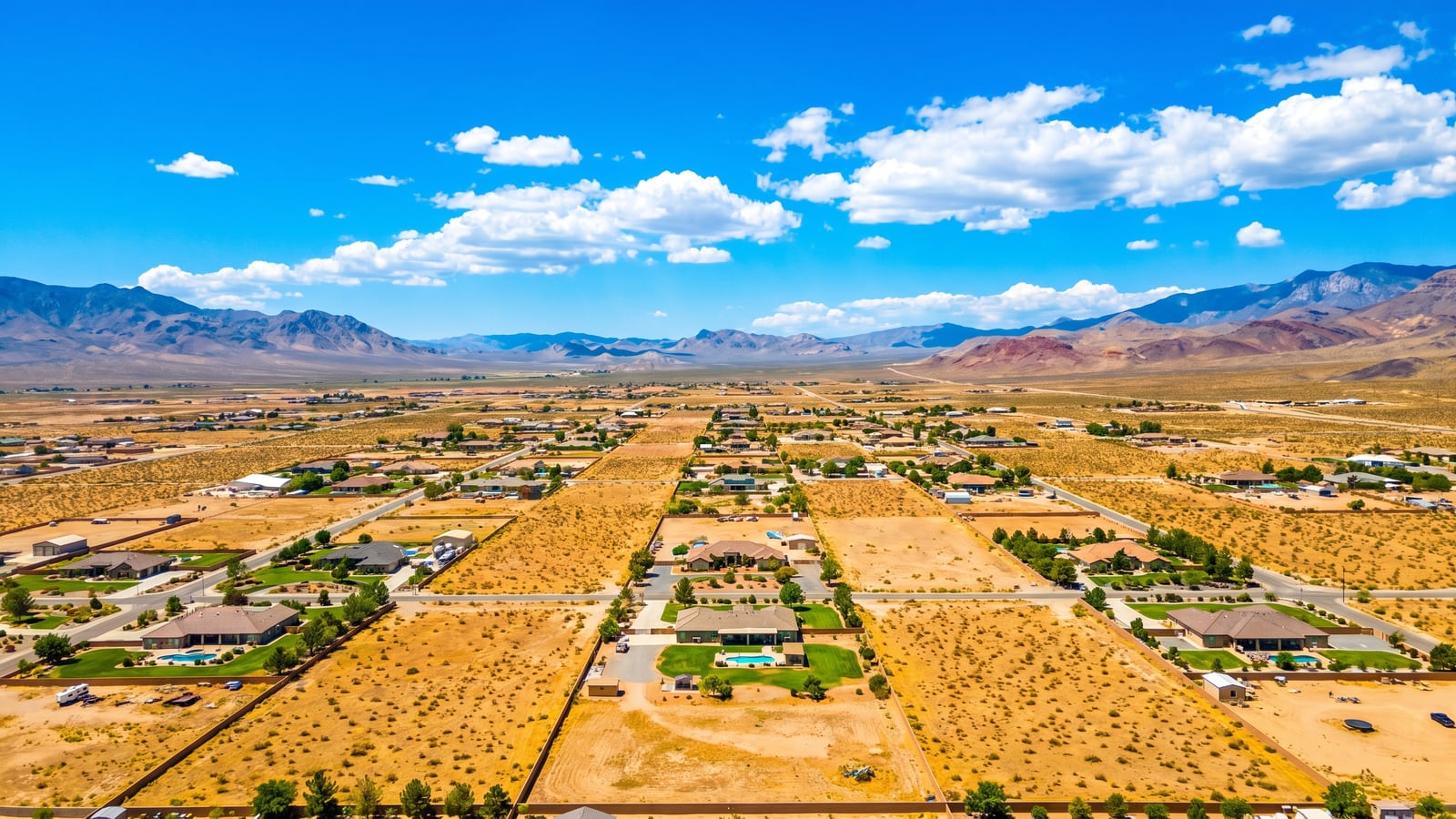
This is the decision every Pahrump buyer eventually faces, and the honest answer depends on your timeline, your tolerance for a project, and your financing. Buying raw land and building gives you exactly what you want — your floor plan, your shop, your utilities — but it is slower, requires cash or specialized financing, and exposes you to the full stack of water, septic, power, and permitting risk this guide describes. Buying an existing home on acreage costs more up front (a $335,000-ish median versus a $27,500 lot) but hands you proven water, a working septic, connected power, and legal access on day one — risks already retired by the previous owner.
In my experience, the buyers happiest with raw land are the ones who genuinely want the build project and have the cash or seller-carry terms to absorb an 18-to-30-month timeline. The buyers who should buy an existing home on acreage are the ones who want the rural lifestyle now and would find the utility gauntlet stressful. There is no wrong answer — there is only the answer that fits your situation, which is exactly the conversation to have with an agent before you fall for a listing. If a finished home on land is the direction, our Pahrump homes for sale and horse properties pages filter for acreage directly, and first-time buyers can start with our buyer basics.
How Do You Finance Raw Land in Pahrump?
Financing is where land buyers get surprised, because a bare parcel does not qualify for a conventional mortgage. Lenders view raw land as higher risk — there is no house to foreclose on and resell — so the paths are narrower and the terms are tougher. The four realistic options are cash, a land loan, seller financing (owner carry), and, for the right buyer, a construction-to-permanent loan once you are ready to build.
| Method | Typical down payment | Notes | Best for |
|---|---|---|---|
| Cash | 100% | Fastest close, strongest offer on a $27,500 lot | Most valley land buyers |
| Land / lot loan | 20%–50% | Shorter term, higher rate than a home loan | Buyers building within a few years |
| Seller financing | Negotiable (often 10%–30%) | Owner carries the note; flexible terms | Buyers who cannot get a land loan |
| Construction-to-perm | Varies | Rolls land + build into one loan at build time | Ready-to-build buyers with plans |
Because so many Pahrump parcels trade for under $50,000, cash is genuinely common here — a $27,500 median lot is within reach for many buyers without any loan at all, and a cash offer closes in days rather than weeks. Seller financing is also widespread in this market precisely because the price points are low and many sellers are out-of-state owners of long-held speculative lots who would rather carry a note than wait for a cash buyer. According to the Consumer Financial Protection Bureau, buyers should still document any owner-carry note carefully and record it properly. When you are ready to build, financing shifts to a construction loan, and the new-construction process takes over.
What Belongs on Your Pahrump Land Due-Diligence Checklist?
Every Pahrump land purchase we represent runs the same due-diligence gauntlet during the contingency period — because on land, the contingency period is where you earn (or lose) your money. Work this list before you remove contingencies:
- Water: Is community water at the street, or is this well country? Pull neighboring well logs and depths; price the actual well or cistern job.
- Septic: Order a perc test; confirm the reviewing agency and whether the parcel sits in the nitrogen-management area that requires an advanced system.
- Power: Measure distance to the nearest Valley Electric pole; get a line-extension estimate or price an off-grid solar system.
- Zoning: Confirm the exact Nye County district (RE-1, RE-2, RH-4.5, RH-9.5), setbacks, and whether your intended use and animals are allowed.
- Access: Verify recorded legal access and a physically drivable road through the title commitment and Assessor parcel map; rule out landlocked parcels.
- Flood: Check the FEMA flood map — parts of the valley carry flood-zone designations that affect building and insurance.
- Title and taxes: Order title insurance, confirm there are no back taxes or liens, and verify the legal description matches the parcel you walked.
- Manufactured-home standards: If placing a manufactured home, confirm the affixed-and-converted, foundation, and 1,150-square-foot requirements up front.
Run every line, and a cheap parcel stays a good deal. Skip a line, and the item you skipped is usually the one that bites. You can search every Nevada listing on our site to compare parcels side by side, and when you are ready to sell land or a finished home later, our Pahrump listing team and home-value estimator help you price it right. The full Pahrump real estate agent page explains how we represent both sides of a dirt deal.
Frequently Asked Questions
How much does an acre of land cost in Pahrump in 2026?
It varies widely by location and size. Across our July 2026 MLS sample, active land carried a median list price near $35,000 and a rough median of about $50,000 per acre, but per-acre pricing ranged from around $4,091 on a large outlying parcel to more than $116,803 on a small utility-ready in-town lot. Bigger, more remote parcels cost far less per acre; small lots near town water and power cost the most. Land that actually sold over the past year closed at a $27,500 median.
Does Pahrump really have more land for sale than homes?
Yes. As of July 13, 2026, our Southern Nevada MLS feed showed about 1,234 active vacant-land parcels versus roughly 552 active single-family homes in Pahrump — more than two parcels for every home. That land-heavy inventory is the valley's signature, a legacy of 1960s and 1970s paper subdivisions like Calvada Valley and Calvada Meadows that platted thousands of one-acre lots still trading as raw land today.
Can you drill a well on Pahrump land?
Usually, yes. Nevada allows a domestic well serving a single-family home to draw up to 2 acre-feet per year (about 651,700 gallons) without a separate water-right permit, though you still need a state well-drilling permit and a licensed driller. A new well commonly runs $15,000 to $35,000-plus. If an authorized community water provider can already serve the parcel, state law generally requires you to connect instead of drilling. Always verify neighboring well depths before you buy.
What kind of septic system does Pahrump land need?
Rural Pahrump parcels almost always need an individual septic system, which requires a percolation test to confirm the soil absorbs effluent within the acceptable range (broadly 6 to 10 minutes per inch at the fast end, up to about 60 at the slow end). A conventional system runs roughly $8,000 to $20,000. Parts of the valley sit in a nitrogen-management area where regulators may require a more advanced, costlier system — confirm that status before you buy.
Can you put a manufactured home on land in Pahrump?
Yes. Nevada law treats a qualifying manufactured home as a single-family residence, and Nye County allows them on rural-residential land when they are permanently affixed to the parcel, converted to real property through the Assessor, at least 1,150 square feet, and set on an approved permanent foundation. Expect roughly $150,000 to $250,000-plus all-in for a new manufactured home delivered and connected, on top of the land cost.
How do you finance raw land in Pahrump?
Raw land does not qualify for a conventional mortgage. The realistic paths are cash (very common here given median lots near $27,500), a land or lot loan (typically 20% to 50% down, shorter term, higher rate), seller financing where the owner carries the note, or a construction-to-permanent loan once you are ready to build. Many out-of-state owners of long-held speculative lots are open to carrying a note.
What is the biggest mistake people make buying Pahrump land?
Assuming "buildable" means "ready." The most expensive mistakes come from skipping due diligence on water, septic feasibility, power distance, and legal access. A parcel with no proven water, a failed perc test, a mile to the nearest power pole, or no recorded access can be far more expensive to develop than it looked — or effectively unbuildable. Run the full checklist during your contingency period, ideally with a local agent who knows the tracts.
Which Sources Inform This Pahrump Land Buying Guide?
Live inventory and pricing figures come from Nevada Real Estate Group's Southern Nevada MLS (GLVAR/Repliers) feed, pulled July 13, 2026: approximately 1,234 active vacant-land parcels versus about 552 active homes; a $35,000 median land list price (avg $99,381; range $4,900–$7.5M); a $27,500 median sold-land price (avg $47,744) across 553 closings with a 72-day median days-on-market; a rough $50,000-per-acre median; and a $374,900 home list / $335,000 home sold median for context. Regulatory and market context draws on these authorities:
- Nevada Division of Water Resources — domestic well permits, 2 acre-foot limit, water rights
- Nevada Revised Statutes Chapter 534 — underground water and wells
- Nevada Division of Environmental Protection — septic and individual sewage disposal systems, perc rates
- Nye County, Nevada — Pahrump Regional Planning District zoning and manufactured-home standards
- Nevada Revised Statutes 278.02095 — manufactured homes as single-family residences
- Valley Electric Association — electric cooperative service and solar programs
- Nevada Department of Taxation — property tax administration and land use codes
- Las Vegas REALTORS — Southern Nevada and Pahrump submarket data
- U.S. Census Bureau — Pahrump and Nye County population and housing baselines
- Federal Emergency Management Agency — flood-zone maps affecting buildability
- Consumer Financial Protection Bureau — land financing and owner-carry note guidance
- GreatSchools — Nye County School District ratings
Ready to buy land in Pahrump the right way? Call or text Nevada Real Estate Group at (702) 637-1759 — we represent both dirt and finished homes across Pahrump, Las Vegas, and Southern Nevada. Start your search on our Pahrump land and homes page, or contact us to talk through a specific parcel before you offer.