
Ask how much land Howard Hughes has left in Summerlin and you'll get several answers, some of them thousands of acres apart. The company's own websites give about 5,000 gross acres in one place and about 2,000 in another, and neither figure carries a date. Its SEC filings do carry dates, and they answer a narrower, more useful question: how much land is left to sell.
We lined up every Howard Hughes 10-K from 2014 through 2025 with the 2026 quarterly reports, then set the acres beside MLS closings by closing date. The latest published count is as of June 30, 2026. The company has scheduled its third-quarter results for November 5, 2026, so treat every land figure below as a mid-2026 reading until that report arrives.
Howard Hughes reported 2,384 saleable acres left in Summerlin at June 30, 2026: 1,890 residential and 494 commercial, about 10.6% of the 22,500-acre plan. It estimates residential sell-out in 2043. The count leaves out anticipated bulk sales, roads, parks and open space. It shows how long new-home land could last, not where prices go: residential acres fell 59% since 2014, while the Summerlin price premium shrank, then partly recovered.
- Howard Hughes held 1,890 residential and 494 commercial saleable acres in Summerlin at June 30, 2026.
- Residential acres fell 59% from 4,621 in 2014, even though apparent plan changes added about 337 acres since 2021.
- The company estimates a 2043 sell-out; our arithmetic on the 2019 to 2025 pace points to 2034 or 2035.
- Superpad prices rose 167% from 2019 to first-half 2026; the four-ZIP median rose 63% through September 2026.
- Most Summerlin purchases are resales, so price the home you want from its closed comparable sales.
What Is the Latest Count of Howard Hughes Land in Summerlin?
The latest count is 2,384 saleable acres, as of June 30, 2026. According to Howard Hughes Holdings' second-quarter 2026 supplemental, that is 1,890 residential acres and 494 commercial acres. Against the 22,500 gross acres in the 2025 10-K, it works out to about 10.6% of the plan.
| Measure | Residential | Commercial |
|---|---|---|
| Remaining saleable acres | 1,890 | 494 |
| Estimated price per acre | $1,966,000 | $899,000 |
| Estimated residual land value | $3.716 billion | $444 million |
| Estimated final year | 2043 sell-out | 2039 build-out |
Saleable is the word that matters. The 10-K defines gross acres as everything inside the plan's borders, including parcels already sold and non-saleable land such as roads, parks, recreation areas and conservation areas. So 2,384 is the land the company expects to sell, not a title search of everything it holds. We didn't find a filing that totals every acre Howard Hughes holds in Summerlin, and income properties such as Downtown Summerlin are reported in a separate segment. Commercial is also broader than it sounds: the 10-K's category covers retail, office and hospitality land, condominium and apartment sites, and land for government, schools and not-for-profit uses.
The count passes a simple test. It was 1,978 residential acres at December 31, 2025, 1,963 at March 31, 2026 and 1,890 at June 30. The second-quarter 10-Q shows 88.1 residential acres closed over those six months, 15.0 in the first quarter and 73.1 in the second. The drops match the sales.
One exclusion matters. A footnote says the Summerlin count "excludes anticipated bulk sales in which the Company delivers unfinished lots at a lower price per acre." The company doesn't publish that acreage, so 2,384 is a floor on unsold land, not a ceiling. That wording first appears in the first-quarter 2026 supplemental, and earlier counts worked differently: the 231-acre bulk sale came out of the count when it closed, as the 319-acre drop in the third-quarter 2025 supplemental shows. So the series isn't strictly like for like from 2026 on.
Why Do You See 2,000, 5,000 and 6,000 Acres Quoted for Summerlin?
Because those numbers measure different things, and most carry no date. Here's what each one is.
| Figure | Where it appears | What it measures | As of |
|---|---|---|---|
| 22,500 acres | 2025 10-K | Gross plan area, including land already sold | December 31, 2025 |
| About 5,000 gross acres | Howard Hughes Communities Nevada page | Land "reserved for future growth," including infrastructure and open space | Undated |
| About 2,000 gross acres | Summerlin history page | Land "left to develop" | Undated |
| 5,472 saleable acres | 2014 10-K | Residential plus commercial land to sell | December 31, 2014 |
| 2,384 saleable acres | Q2 2026 supplemental | Residential plus commercial land to sell | June 30, 2026 |
The Howard Hughes Communities Nevada page says Summerlin "still has approximately 5,000 gross acres reserved for future growth," covering infrastructure, open space, and commercial and residential uses. That can sit alongside 2,384 saleable acres, because gross land includes the roads and open space that never get sold.
The Summerlin history page says "approximately 2,000 gross acres left to develop." That one can't be a current gross figure, since gross land can't be smaller than the 2,384 saleable acres inside it. It's closer to the residential count than to anything labelled gross. Both pages are undated, and they can't both be current on the same definition.
A figure near 6,000 doesn't match anything we read. The highest year-end saleable total in the 12 annual reports was 5,472 acres at the end of 2014, so anyone quoting 5,000 or more as saleable land today is using a number more than a decade old. For a decision, use the dated filing and note its date. Our Summerlin master plan guide covers the rest of the plan's basics, and the history of Summerlin explains how the original 30,000-acre purchase became today's footprint.
How Fast Has the Land Bank Shrunk Since 2014?
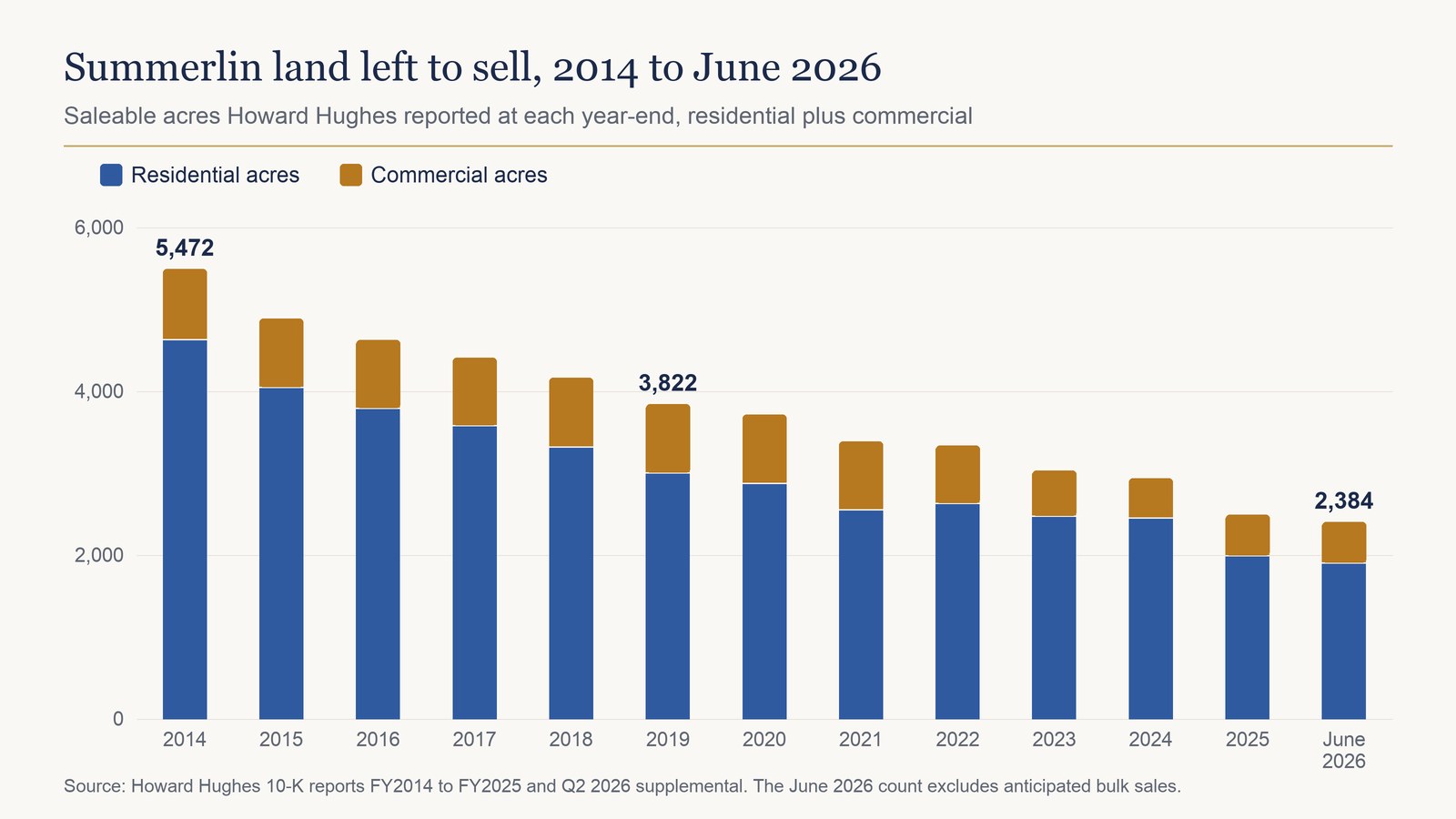
Residential acres fell from 4,621 at the end of 2014 to 1,890 at June 30, 2026, a 59% drop. Commercial acres fell from 851 to 494. Total saleable land went from about 24% of the plan to about 10.6%. Over nearly the same stretch, the company's resident estimate rose from 105,400 in the 2014 10-K to 132,000 in the 2025 10-K.
| Period end | Residential acres left | Commercial acres left | Total saleable | Residential acres closed | Change in residential count |
|---|---|---|---|---|---|
| December 2014 | 4,621 | 851 | 5,472 | Not compiled | Not compiled |
| December 2018 | 3,311 | 831 | 4,142 | 244.8 | -257 |
| December 2019 | 2,991 | 831 | 3,822 | 319.4 | -320 |
| December 2020 | 2,864 | 831 | 3,695 | 126.9 | -127 |
| December 2021 | 2,543 | 825 | 3,368 | 322.6 | -321 |
| December 2022 | 2,618 | 700 | 3,318 | 96.6 | +75 |
| December 2023 | 2,462 | 551 | 3,013 | 169.9 | -156 |
| December 2024 | 2,443 | 473 | 2,916 | 220.3 | -19 |
| December 2025 | 1,978 | 494 | 2,472 | 415.0 | -465 |
| June 2026 (six months) | 1,890 | 494 | 2,384 | 88.1 | -88 |
The rows aren't perfectly uniform. The 2014 and 2015 reports headed the column "Remaining Saleable and Developable Acres" and counted townhomes and condominiums as high-density residential. From 2016 the heading is "Remaining Saleable Acres," and condominium and apartment sites sit in commercial. The counts show no jump at that change, so we kept the years together.
From 2019 through 2021 the count behaved like a countdown. The 2019, 2020 and 2021 reports show the residential count falling within about two acres of what closed each year. After 2021 that stops being true, and the reason is worth a section of its own.
Why Did Residential Acres Rise in 2022 and Barely Move in 2024?
Most likely because the plan changed, not because land stopped selling. In the 2022 10-K, the residential count rose 75 acres even though 96.6 acres closed, which means about 172 acres were added. In the 2024 10-K, it fell only 19 acres while 220.3 acres closed, which means about 201 were added. In 2025 it went the other way: the count fell 465 acres against 415.0 closed, so about 50 came out.
Add it all up from the end of 2021 to June 30, 2026, and 990 residential acres closed while the count fell only 653. That leaves a net 337 acres that sales don't explain. Over the same span, commercial acres fell 331, and only 16.6 of those closed, so about 314 came out of the commercial column beyond sales.
The quarterly reports show when it happened. From the third quarter of 2022 through June 2026, every one of those non-sale changes landed in a fourth quarter, starting with the fourth-quarter 2022 supplemental, and each time residential and commercial moved in opposite directions. In the other 12 quarters, the residential count stayed within an acre of what closed and commercial didn't move.
That timing, and two totals that nearly cancel, fit year-end plan updates that shifted commercial land to residential. They don't prove it. The swings don't match year by year: in the fourth quarter of 2023, commercial lost 149 acres while residential gained about 14. No filing gives an acreage for a plan change or names a parcel, and the 2025 change could include land set aside under the bulk-sale exclusion. The only explanation offered is a footnote, printed since the fourth-quarter 2024 supplemental, that remaining acres move with "land sales or changes to the community's master plans."
The sell-out date moved with it. Every 10-K from 2014 through 2021 showed a 2039 residential sell-out, and every one since 2022 has shown 2043.
Two things follow for a buyer. The residential count isn't a straight countdown, so don't divide it by anything and treat the result as a promise. And a commercial label on a vacant parcel can change. If the land next to a home matters to you, check the current plan and any pending application with the city or county, as our Las Vegas land supply guide explains. That guide also covers the federal boundary around the valley, so we won't repeat it here. This count is land the company already holds, so BLM auctions don't feed it.
What Have Builders Paid for Summerlin Land?
Builders paid an average of $1,728,000 an acre for Summerlin superpads in the first six months of 2026, up 7% from $1,615,000 a year earlier, according to the second-quarter 10-Q. The 10-K describes superpads as generally 10- to 25-acre parcels where the company brings major utilities and roads to the border and the builder finishes the on-site work and lots.
| Period | Superpad acres | Average per superpad acre | Custom-lot acres | Average per custom-lot acre |
|---|---|---|---|---|
| 2019 | 315.9 | $648,000 | 3.5 | $1,701,000 |
| 2020 | 121.2 | $738,000 | 5.7 | $1,502,000 |
| 2021 | 310.9 | $656,000 | 11.7 | $1,903,000 |
| 2022 | 94.6 | $1,144,000 | 2.0 | $4,455,000 |
| 2023 | 169.2 | $1,321,000 | 0.7 | $2,857,000 |
| 2024 | 216.5 | $1,345,000 | 3.8 | $6,048,000 |
| 2025 | 412.3 | $970,000 | 2.7 | $7,472,000 |
| January to June 2026 | 85.9 | $1,728,000 | 2.2 | $7,159,000 |
The 2025 dip isn't a price drop. According to the company's fourth-quarter 2025 release, that year's total includes a 231-acre bulk sale at about $434,000 an acre. The other 181 acres, in seven superpad sales, set a record near $1.7 million. Hoodline, summarizing Review-Journal reporting, described a sale of about 240 acres called the Back Bowl for roughly $100.4 million. The filing doesn't name that parcel, and its acreage differs slightly.
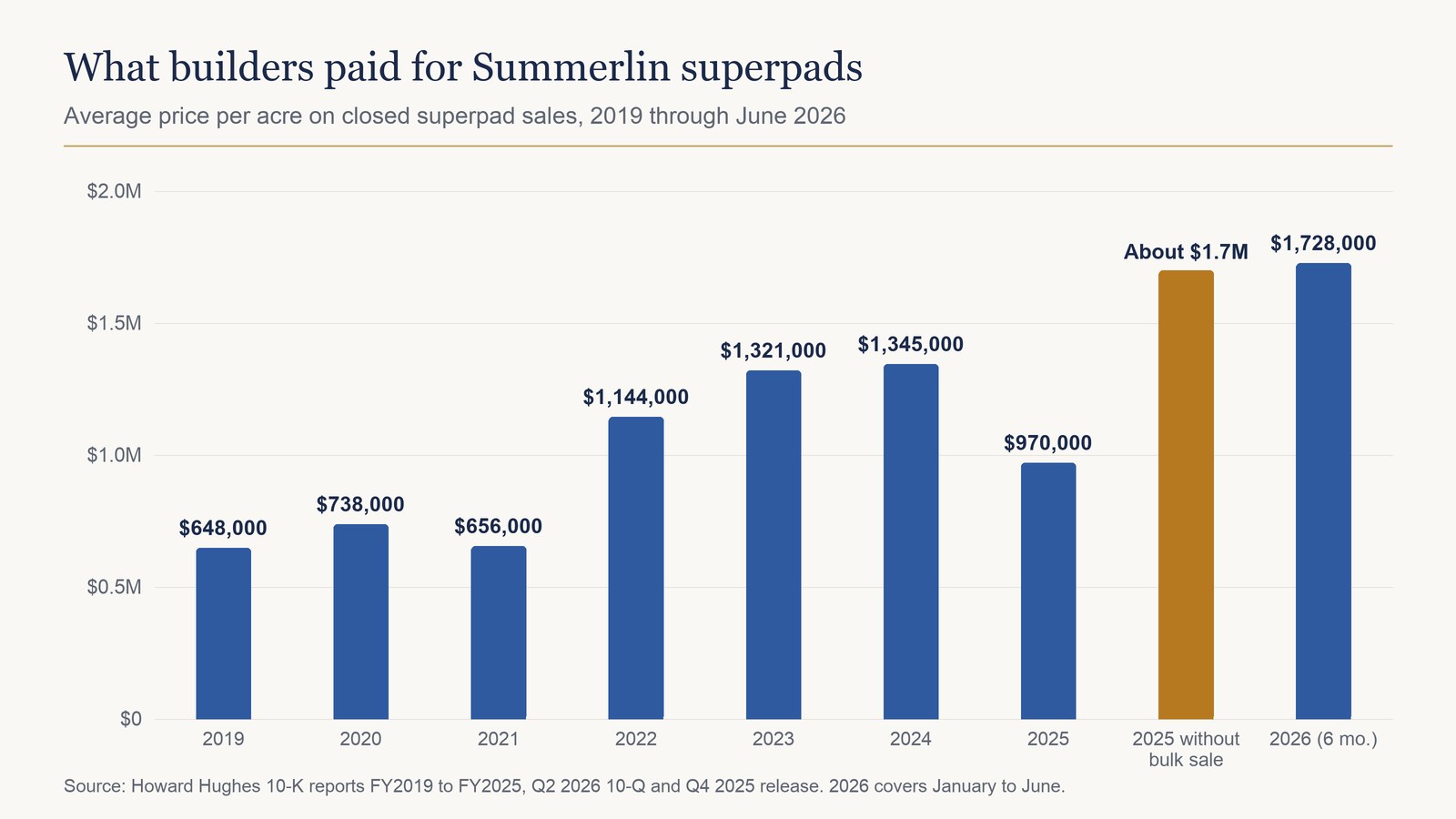
Don't confuse sales with estimates. The $1,966,000 in the land bank table is a forecast: the supplemental defines it as an average, uninflated price expected over the next five years, excluding bulk sales. The 10-K's $1,719,000 is an estimate for 2026 alone, so the two aren't a 14% jump. On the same basis, the estimate moved from $1,936,000 at March 31 to $1,966,000 at June 30.
What those land prices do to a home's price per square foot is the subject of our guide to why Summerlin new construction costs more. This post sticks to how much land is left.
Does a 2043 Sell-Out Mean New Summerlin Homes Run Out in 2043?
Not exactly, and the year itself is an estimate. To last through the end of 2043, 1,890 acres would need to sell at about 108 acres a year. From 2019 through 2025, the company closed about 239 residential acres a year, or about 206 without the 231-acre bulk sale.
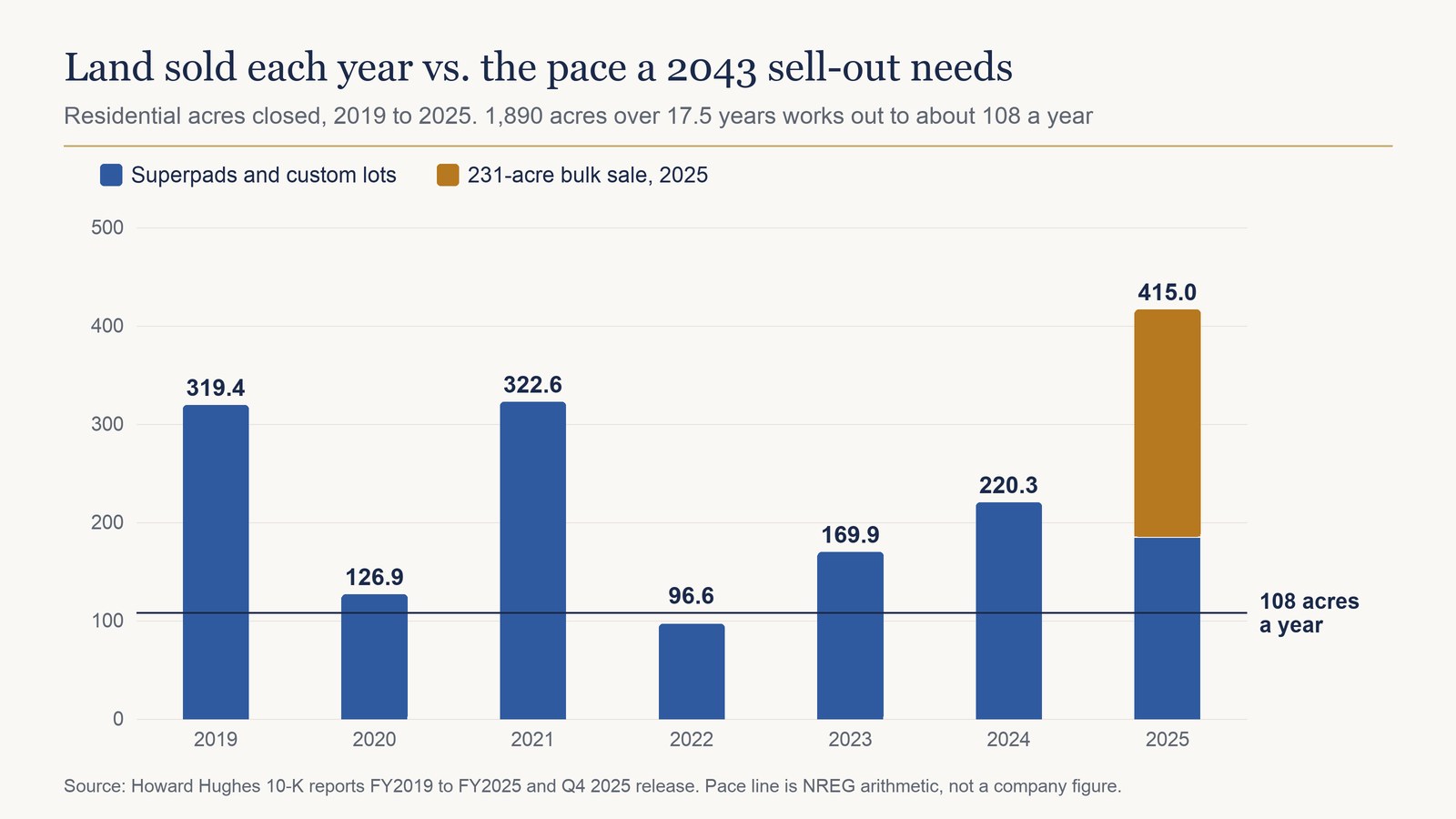
At those recent paces the land would be gone in about eight to nine years, around 2034 or 2035. That's our arithmetic, not a company estimate or a forecast, and there are good reasons the company's date could still hold:
- Sales can slow. Acres closed swing hard from year to year, from 96.6 in 2022 to 415.0 in 2025.
- Custom lots sell slowly. They averaged about 4.3 acres a year from 2019 through 2025, and they make up a growing share of what's left, as the next section shows.
- The plan can add acres. A net 337 residential acres beyond sales, most likely from plan changes, joined the count in under five years.
- The date doesn't track the count closely. It has stayed at 2043 for four annual reports while 728 acres left the residential count.
Selling land also isn't the same as selling homes. The 10-K says the time between a land sale and closing on a completed home "can take up to three years." The last homes would close after the last land sale, and home sales run on their own pace, with builders averaging 79 sales a month in 2025, per the fourth-quarter 2025 supplemental.
Don't read a neighborhood closing out as the plan running out. A Summerlin notice lists ten neighborhoods with fewer than 20 homes left or under 20% of inventory. That's one parcel finishing. Our Summerlin new-home guide tracks what's selling now, village by village.
What Kind of Land Is Left in Summerlin?
The mix is moving toward larger custom lots. The company's supplementals project how the remaining residential land will be used, and the custom share has about doubled since 2022 while the projected custom lot size more than doubled.
| As of | Superpads, projected share | Superpad lot size | Custom homes, projected share | Custom lot size | Builder sales a month, trailing 12 months |
|---|---|---|---|---|---|
| September 30, 2022 | 82% | 0.25 acre | 18% | 0.45 acre | 57 |
| December 31, 2023 | 66% | 0.25 acre | 34% | 1 acre | 89 |
| December 31, 2024 | 69% | 0.25 acre | 31% | 1 acre | 87 |
| December 31, 2025 | 64% | 0.25 acre | 36% | 1.18 acres | 79 |
Those rows come from the Q3 2022, Q4 2023, Q4 2024 and Q4 2025 supplementals. They don't say whether the shares are of acres or lots, so don't multiply them into a home count. The two 2026 supplementals we read dropped the table.
The company stopped publishing a remaining-lot count, too. The 2021 10-K showed 17,858 remaining residential lots, and the column is gone from the 2022 report on. The 34,719 in the 2020 report came with a note calling it remaining entitlements, not necessarily lots to be sold, so the two aren't a like-for-like drop. We won't extrapolate from a figure that old. Nobody outside the company can say how many homes the remaining land will hold.
Summerlin's custom homesites page shows where some of this is going. It lists Astra at La Madre Peaks, The Summit Club and The Ridges, and says custom homesites in The Ridges are sold out. Custom land is priced very differently from superpads, at $7,159,000 an acre across 2.2 acres in the first half of 2026.
The filings include no map, so they can't tell you which of the 1,890 acres sit in which village. The 494 commercial acres are just as unmapped, and the company estimates their build-out by 2039. For the villages selling today, start with new construction in Summerlin.
Do The Summit's 609 Acres Count as Howard Hughes Land?
Not in the 1,890, as far as the filings show. The Summit is a joint venture with Discovery Land Company. According to the 2025 10-K, the original 555-acre community is nearing completion and is expected to hold about 245 homes and 32 condominiums, and Howard Hughes contributed another 54 acres in July 2022 for about 28 custom home sites. Together that's 609 acres, about 2.7% of the plan.
The land went into the venture, and Howard Hughes now takes a share of its profits. The company put the original land in during 2015 at an agreed value of $125.4 million, or $226,000 an acre. The Summit has no line in the land bank table, which lists Summerlin at 100% economic ownership and shows joint-venture communities such as Floreo separately.
The two contributions look different in the counts. In 2015 the residential count fell 585 acres against 198.4 acres sold, so far more left the count than sold. The gap doesn't equal 555 acres, so it can't be pinned on The Summit alone. The July 2022 contribution left no such mark: the count fell from 2,494 acres at June 30, 2022 to 2,470 at September 30, a 24-acre drop that matches the 23.6 acres closed that quarter, and the commercial count held at 808. So the filings don't show those 54 acres leaving the count. They may never have been in it, or they may have moved in a later plan update. The filings don't say which.
So don't add 609 to the 2,384, and don't subtract it. Treat The Summit as a separate pool that's mostly sold. Our Summit Club guide covers its recorded sales and what's on the market.
Does Howard Hughes Still Earn Money After It Sells the Land?
Yes, on some homes. The 2025 10-K describes builder price participation: when a builder sells a home above a predetermined breakpoint, the excess is shared between the builder and Howard Hughes at closing, at a previously agreed percentage.
The numbers aren't small. In the fourth quarter of 2025, Summerlin produced $11.3 million of the company's $12.9 million in participation revenue, according to the fourth-quarter supplemental. Across all its communities, the company reported $44.5 million for the 12 months ending June 30, 2026, down from $50.0 million a year earlier.
Read that carefully. The filing describes a split of the builder's sale price, not a separate fee, and nothing in it describes a charge to the home buyer. The breakpoints and percentages aren't published, so you can't tell whether a given home triggers one. And the balance may be shifting: the second-quarter supplemental blames part of a decline on a "reduction in margin-eligible homes resulting from higher upfront pricing on land sales." That reads as more of the money being collected in the land price.
The other link between land sales and your home is infrastructure debt. The 10-K says special improvement district bonds are issued by the municipalities and secured by assessments on the land, and that land buyers assume a proportionate share at closing. According to the 10-Q, land buyers assumed $8.5 million of those obligations in the first six months of 2026, and the bonds carried fixed rates of 4.13% to 6.05% with maturities from 2030 to 2055. That's why a new Summerlin home can arrive with an assessment on top of association dues. Our true-cost guide to Summerlin new builds puts numbers on it, and the Summerlin HOA fees guide covers the dues.
Did a Shrinking Land Bank Push Summerlin Home Prices Up?
The data doesn't show that. Prices rose, and land shrank, but Summerlin's lead over the wider valley didn't move in step with the land.
We compared Summerlin's four main ZIP codes (89134, 89135, 89138 and 89144) with Las Vegas, Henderson and North Las Vegas combined, using MLS closings by closing date. Residential acres fell 35% from December 31, 2014 to December 31, 2019, and the four-ZIP premium over the three-city median narrowed from 52% in calendar 2014 to 39% in calendar 2019. Acres then fell 37% to June 30, 2026, and the premium widened to 46% for the 12 months through September 30, 2026. Similar percentage drops came with opposite moves in the premium, so this comparison can't show that land drives it in either direction.
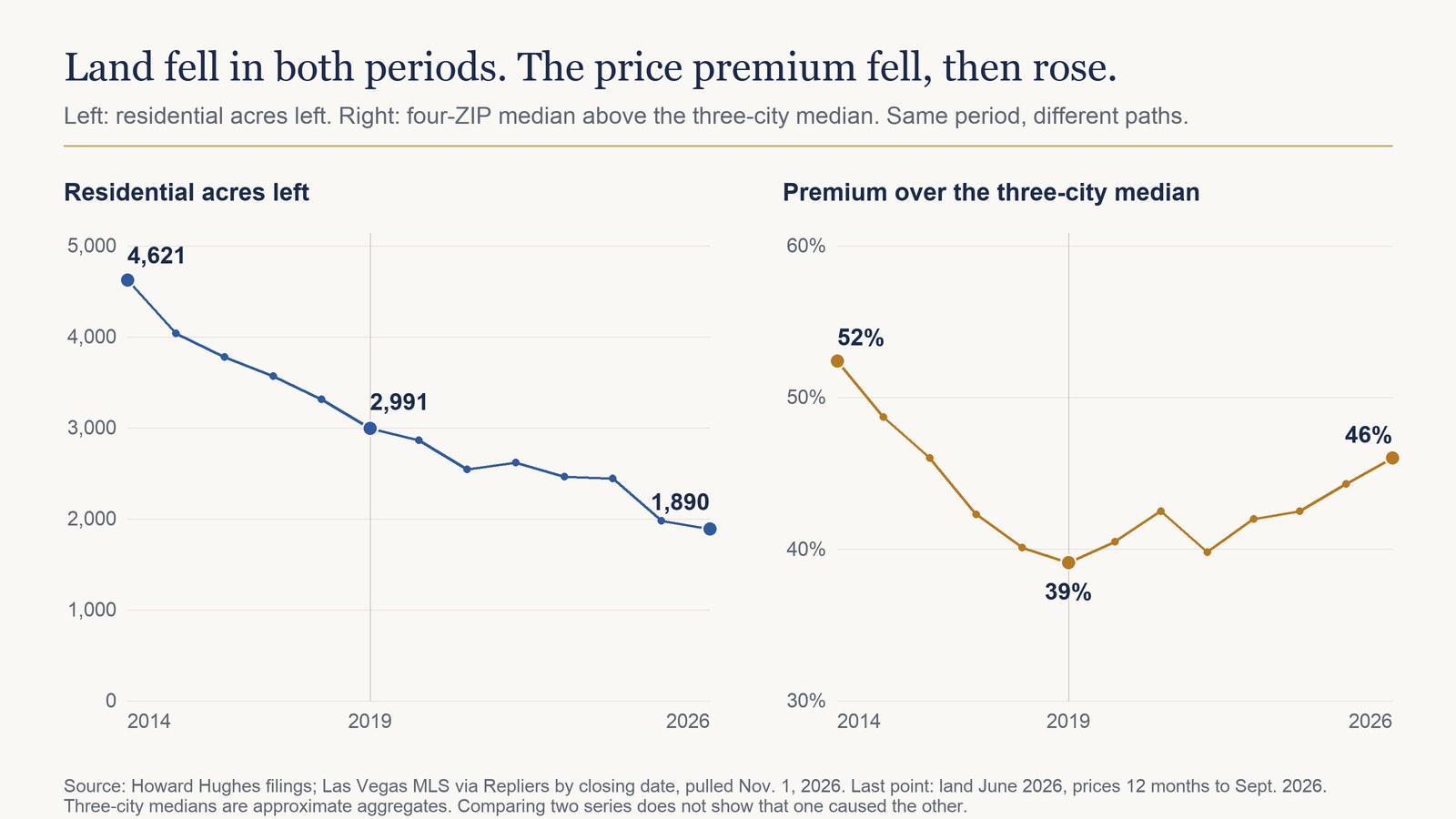
| Period | Residential acres left | Four-ZIP closings | Four-ZIP median | Three-city median | Four-ZIP premium |
|---|---|---|---|---|---|
| 2014 | 4,621 | 2,239 | $278,000 | $182,000 | 52% |
| 2016 | 3,778 | 2,521 | $310,000 | $212,000 | 46% |
| 2018 | 3,311 | 2,643 | $380,000 | $271,000 | 40% |
| 2019 | 2,991 | 2,698 | $397,000 | $285,000 | 39% |
| 2021 | 2,543 | 3,680 | $520,000 | $365,000 | 42% |
| 2023 | 2,462 | 2,296 | $580,000 | $409,000 | 42% |
| 2025 | 1,978 | 2,293 | $640,000 | $444,000 | 44% |
| 12 months to September 30, 2026 | 1,890 (June 30) | 2,449 | $649,000 | $444,000 | 46% |
The start date changes the story, which is itself the point. Measured from 2014, the four-ZIP median rose 133% and the three-city median 144%, so Summerlin lagged. Measured from 2019, Summerlin rose 63% and the three cities 56%, so Summerlin led.
Land and home prices also don't march together. Superpad prices rose 167% from 2019 to the first half of 2026, far more than either median. From the first half of 2025 to the first half of 2026, superpads rose 7%. The four-ZIP median moved from $644,500 for the 12 months through September 2025 to $649,000 for the 12 months through September 2026, about 0.7%.
So a shrinking land bank is a fair background fact. It isn't evidence that home prices must rise. For what the premium does buy, our analysis of the Summerlin price premium is the better read.
What Can't a Land Count Tell You About Home Prices?
Quite a lot. These are the limits we'd want a reader to keep in mind, including limits of our own comparison.
- Cause may run the other way. The 10-K says "new home sales are an important indicator of future demand for our superpad sites." Builders bid for land based on what they expect homes to sell for, so strong home prices can raise land prices rather than the reverse.
- Most purchases are resales. Of the 2,449 four-ZIP MLS closings in the 12 months through September 30, 2026, 2,197 were homes built before 2025, at a $645,000 median. A superpad sold this year has no direct bearing on what a 2005 home resells for.
- The MLS undercounts new homes. Only 184 homes built in 2024 or later closed through the MLS in these ZIPs in 2025, while Howard Hughes reported 949 net new home sales in Summerlin that year. Many builder sales don't appear to reach the MLS. Setting 949 beside the year's 2,108 resales suggests roughly two of three purchases were resales, though one number counts contracts and the other closings.
- ZIP codes aren't the master plan. Our four ZIPs are a proxy, and medians move with the mix of homes sold. A run of luxury closings can lift a median without any home gaining value.
- The estimates come from the seller. Sell-out years, future prices and residual land values are the company's own numbers, in documents meant for investors.
- Two series aren't an experiment. Interest rates, jobs, migration and new supply elsewhere all moved over these 12 years. Two lines on a chart can't separate those effects from land.
The company's median home sales price in Summerlin went from $578,000 in 2019 to $779,000 in 2025, according to its 10-K reports. That's a 35% rise, and it reflects what builders chose to build as well as what buyers paid. It doesn't show that any one home gained 35%.
Does Pershing Square's Stake Change How the Land Gets Sold?
Nothing we read says it does, but the company behind the land has changed, so it's worth knowing who's selling. According to the 2025 10-K, Howard Hughes Holdings began moving in 2025 from a pure real estate company to a diversified holding company. Pershing Square bought 9 million new shares for $900 million in May 2025. William Ackman, its chief executive, is the board's executive chairman, and through Pershing Square he was listed as beneficial owner of 46.6% of the common stock as of August 17, 2026, according to the 2026 proxy statement.
The company then bought a specialty insurer. The 10-Q says the acquisition of Vantage Group Holdings closed June 4, 2026, for about $2.1 billion in cash, and that the company issued $1.0 billion of preferred stock to Pershing Square Holdings the same day to support the funding. The 10-K said the combination creates the opportunity to grow the insurer "using reinvested real estate cash flows while continuing to invest in HHH's core real estate development business."
So the company has said its real estate cash flow can help grow more than real estate. That's a fact about the seller's priorities, not a prediction. We found no statement in the 10-K or the 10-Q that the company plans to sell Summerlin land faster, slower or at different prices because of it.
Summerlin is also central to the company's value. It accounts for $3.374 billion of the $5.735 billion in margin-affected land value in the second-quarter land bank table, about 59%, using the company's estimates. A seller with that much riding on one community has reasons to protect pricing, and reasons to keep land moving. The filings don't settle which wins in any given quarter. The company's 2026 outlook did say master-plan earnings should normalize after a record 2025 that included outsized Summerlin superpad sales.
This post isn't investment advice on Howard Hughes stock. It's here because the company on the other side of Summerlin's land sales is no longer the same kind of company it was in 2024.
What Should a Buyer Do With This Land Count?
Use it to settle one question and then set it aside: new-home land isn't about to run out. On the company's date or on our arithmetic from recent sales, it lasts at least into the mid-2030s. That removes "buy now before the land is gone" as a reason on its own. The rest of the decision runs on the specific home.
| Your decision | What the data supports | What it can't tell you | What to get in writing or check |
|---|---|---|---|
| Buying a new home now | Land isn't about to run out on either timeline; builders paid about $1.7 million a superpad acre in early 2026 | Whether this builder's price will rise or fall | Lot premium, incentives, assessment balance and association budgets |
| Waiting for a lower price | The four-ZIP median moved about 0.7% in the 12 months through September 2026, while first-half superpad prices rose 7% | Where prices go next | Closed sales in the subdivision, not a valley-wide trend |
| Buying a resale | About nine of ten MLS closings here are resales, priced by nearby sales | Anything about one home's value | Comparable closings from the last six months, by closing date |
| Buying beside vacant land | 494 commercial acres remain, and about 314 left that column beyond sales since 2021 | Which parcel is which; the filings have no map | Current zoning and pending applications with the city or county |
| Buying a custom lot | Projected custom share rose to 36%, with lots near 1.18 acres | Which lots release and when | Design rules, build timeline and club terms with the seller |
The tradeoff for new construction is real. You get a new home, and you likely take on an assessment and a land cost that's already in the price. A resale has no builder incentives and may need work, but its neighbors have already sold, so the comparable sales are easier to read. If your budget is the tight constraint, our Summerlin versus southwest Las Vegas budget guide compares the monthly numbers.
Our Summerlin neighborhoods guide has closed prices by area, and Summerlin homes for sale shows what's on the market today.
What Does the Land Count Mean for Summerlin Sellers?
It means builders stay your competition for years, and how much depends heavily on your ZIP code. The new-home pressure isn't spread evenly. In the 12 months through September 30, 2026, ZIP 89138 took 208 of the 245 MLS closings of homes built in 2025 or later.
| ZIP | Closings | Median sold price | Closings built 2025 or later |
|---|---|---|---|
| 89138 | 745 | $769,000 | 208 |
| 89135 | 665 | $850,000 | 36 |
| 89144 | 308 | $552,500 | 1 |
| 89134 | 731 | $487,550 | 0 |
A seller in 89138 competes directly with builders, who can offer incentives that a resale seller can't easily match. More than a quarter of that ZIP's MLS closings were homes built in 2025 or later, and many builder sales don't appear to reach the MLS at all. A seller in 89134 or 89144 is mainly up against other resales.
A land-scarcity pitch isn't pricing evidence, so be careful with it. "They're running out of land" won't move an appraiser or a buyer's lender. Closed comparable sales will, and the last year's median moved less than 1%. Nor does a 2043 estimate mean a resale gets scarcer on a schedule, since homes come to market when owners decide to sell, whatever the land count says.
The practical use of the land data is local. If the vacant parcel near you is a pending superpad, its homes may compete with yours when you sell, and a sale can take up to three years to reach closings. If your view depends on an empty lot, find out what's planned there before you price a premium for it. When you're ready for a number, start from closed sales on your street, not from the land count. Our page on selling a house in Summerlin is the place to begin.
What Would Change This Read?
Several things, starting with the next report. Howard Hughes has scheduled third-quarter results for after the market closes on November 5, 2026, with a call the next morning. When the next count lands, we'd look at six things:
- Whether the drop matches the sales. If residential acres fall by more or less than what closed, something beyond sales moved the count. Since mid-2022 that has happened only in fourth quarters, so the year-end report is the bigger test.
- Any bulk sale. A bulk sale lowers the reported average. The 2025 sale did reduce the count, but the current footnote excludes anticipated bulk sales, so a future one may not. Read the footnote before reading the average.
- The sell-out year. It has held at 2043 since the 2022 report. A move in either direction would be the first in four years.
- Whether the superpad average holds near $1.7 million. The second-quarter average was $1,725,000, and one quarter can be a small sample.
- Builder sales pace. Summerlin's net new home sales rose 6% in the first quarter, per the first-quarter release, and 2% in the second, per the supplemental. Pace ultimately sets how fast land can sell.
- Builder price participation. A continued drop would support the idea that the company is taking more of its money up front.
Longer term, the 10-K lists risks that could slow all of this, including water and electricity shortages in the Las Vegas region and the company's dependence on homebuilders to buy superpads and lots. Those are risk disclosures, not predictions, but they're a reminder that the land count isn't the only limit.
Frequently Asked Questions
How many acres does Howard Hughes own in Summerlin?
The latest dated figure is 2,384 saleable acres at June 30, 2026: 1,890 residential and 494 commercial, per the company's second-quarter 2026 supplemental. That's land it expects to sell, not a total of everything it holds. The count excludes anticipated bulk sales, and it doesn't include roads, parks or open space, or income properties such as Downtown Summerlin. We didn't find a filing that states a full ownership total.
Is Summerlin running out of land?
Not soon. Howard Hughes estimates residential sell-out in 2043, and even at the faster pace of 2019 through 2025, the remaining 1,890 acres would last until about 2034 or 2035. The nearer change is mix: the company's projections shifted toward larger custom lots, and superpads fell from 82% of projected use in 2022 to 64% at the end of 2025.
Why does a Howard Hughes website say 5,000 acres are left?
That page says about 5,000 gross acres are reserved for future growth, which includes infrastructure, open space, and commercial and residential uses. Gross acres aren't the same as saleable acres. The SEC filings count saleable land, which was 2,384 acres at June 30, 2026. The website figure is undated, so the filing is the safer number to quote.
Will Summerlin home prices rise as the land runs out?
This post doesn't forecast prices, and the data doesn't support that shortcut. From the end of 2014 to the end of 2019, residential land fell 35%, and the four-ZIP premium over the three-city median narrowed. From then to June 2026, land fell 37%, and the premium widened through the 12 months to September 2026. In the 12 months through September 2026, the four-ZIP median moved about 0.7%, while superpad prices rose 7% from the first half of 2025 to the first half of 2026.
How much does an acre of Summerlin land cost a builder?
Builders paid an average of $1,728,000 an acre for superpads in the first six months of 2026, according to the company's 10-Q. Custom lots averaged $7,159,000 an acre on just 2.2 acres. A 231-acre bulk sale in 2025 went for about $434,000 an acre, because bulk land is delivered unfinished. Those are prices for land, not finished lots.
Can commercial land in Summerlin become homes?
It appears to have happened, though no filing says so directly. Since the end of 2021, commercial acres fell by about 314 beyond what sold, while residential acres rose by a net 337 beyond sales, and those changes landed in the same fourth quarters. The filings only say remaining acres change with land sales or master-plan changes. The company's commercial category also already includes condominium and apartment sites. Treat any vacant parcel's label as current, not permanent, and check zoning and pending applications with the city or county.
Who owns Howard Hughes Holdings now?
It's a publicly traded holding company. William Ackman, Pershing Square's chief executive and the company's executive chairman, was listed as beneficial owner of 46.6% of the common stock as of August 17, 2026, according to the proxy statement. The company also bought the insurer Vantage on June 4, 2026, for about $2.1 billion in cash. The filings we read don't announce any change to how Summerlin land is sold.
When will the next land count come out?
Howard Hughes scheduled third-quarter 2026 results for after the market closes on November 5, 2026, with a conference call on November 6. Its results package normally includes updated land figures. Until then, the June 30, 2026 count of 1,890 residential and 494 commercial acres is the latest published number.
How Can We Help You Read the Land Around a Specific Address?
The land count is a plan-wide number, and your decision is about one address. The most useful version of this conversation is specific: one home, one map and the public file for the ground around it.
If you're buying new, we'd start with the parcel. Which builder holds it, what the assessment balance is, what the association budgets show and what's next door. If you're buying a resale, we'd start with closings on nearby streets by closing date, because that's what an appraiser will read. If you're selling, we'd look at how many builder homes are competing within reach of your ZIP, and what's planned on any vacant land near you.
What we won't do is tell you the land count proves a price. It doesn't. It tells you new-home land should last for years on any reading, that the mix is shifting toward larger lots, and that the seller's estimates deserve a date beside them.
Everything cited in this guide, from the SEC filings to the company's own pages, is free to read. Browse Summerlin homes for sale or the wider Summerlin community page, or contact us with an address and we'll go through the public record with you. Phone: (702) 637-1759. Email: info@nevadagroup.com. Nevada Real Estate Group is brokered by LPT Realty, license S.181401.
Which Sources Inform This Summerlin Land Guide?
Company filings
- Howard Hughes Holdings, Q2 2026 supplemental (filed August 5, 2026): land bank table, acres, estimates, footnotes, participation revenue.
- Howard Hughes Holdings, Q2 2026 10-Q: 2026 land sales, SID bonds, Vantage closing and preferred stock.
- Howard Hughes Holdings, Q1 2026 supplemental and Q1 2026 earnings release: March 31, 2026 acres, estimates and new home sales.
- Howard Hughes Holdings, Q4 2025 supplemental and Q4 2025 earnings release: land mix, participation by community, bulk sale, 2026 outlook.
- Howard Hughes Holdings, 2025 10-K: gross acres, residents, The Summit, superpad definition, builder price participation, ownership, risks.
- 10-K reports for 2024, 2023, 2022, 2021, 2020, 2019, 2018, 2017, 2016, 2015 and 2014: year-end acres, land sales, sell-out dates, new home sales.
- Supplementals for Q4 2024, Q4 2023, Q3 2022 and Q2 2022: land mix, builder pace, 2022 acres.
- Quarterly supplementals used for the quarter-by-quarter acre check: Q4 2022, Q1 2023, Q2 2023, Q3 2023, Q1 2024, Q2 2024, Q3 2024, Q1 2025, Q2 2025 and Q3 2025.
- Howard Hughes Holdings, 2026 proxy statement (filed August 19, 2026): beneficial ownership as of August 17, 2026, executive chairman.
Company websites, read November 1, 2026
- Howard Hughes Communities, Nevada overview
- Summerlin, history
- Summerlin, custom homesites
- Summerlin, neighborhoods reaching final inventory
Other
- Howard Hughes Holdings third-quarter earnings date announcement, October 12, 2026, via Finviz
- Hoodline, Summerlin land sales, February 25, 2026
Method. MLS figures are our own pull of Las Vegas MLS data through Repliers on November 1, 2026, and aren't official Las Vegas REALTORS statistics. They use the feed's closing date, not the contract date, and late-posting closings can still change the most recent months. Older records carry one date in both fields, as every 2014 and 2019 record we tested did, so those years can't be separated by date type; shifting a calendar-year window 30 days moved the four-ZIP median by 0% to 1.5% in the three years we tested. Four-ZIP medians are computed from individual residential records sold above $20,000. Three-city medians cover Las Vegas, Henderson and North Las Vegas mailing cities, which include the four ZIPs, and come from aggregate statistics, so they're approximate and rounded. We tested four periods: 49.9% to 50.5% of closings fell at or below each figure, and adding a $20,000 floor moved each by less than $100. "Resale" and "new" use the MLS year-built field. Land totals and pace figures are our arithmetic on the company's published numbers, and the premium is the four-ZIP median divided by the three-city median. The company's estimates aren't guarantees, and its saleable counts exclude anticipated bulk sales.
This article is informational and isn't investment, legal or land-use advice. Confirm parcel-specific facts with the City of Las Vegas, Clark County and the seller before making a decision.