
Is Summerlin worth the price premium in 2026? The master-planned community on the western rim of the Las Vegas Valley commands a median home price roughly $200,000 above the rest of the metro, and buyers reasonably ask whether the extra money is justified. This guide breaks down exactly how big the premium is, what it buys in schools, parks, and appreciation, and which buyers should pay it — and which should pocket the difference and buy elsewhere.
Yes, for the right buyer. Summerlin's median home price runs about $686,000 in 2026 versus $478,000 valley-wide — a premium of roughly $200,000, or about 44%. That money buys more than 300 parks, over 200 miles of trails, top-ranked schools, and historically stronger appreciation. For families and long-term owners those advantages justify the cost; for budget-focused or short-term buyers, the rest of the valley delivers more square footage per dollar.
- Summerlin's median runs about $686,000 versus $478,000 valley-wide — roughly a $200,000 premium.
- The premium buys more than 300 parks, over 200 miles of trails, and 26 schools.
- Summerlin's five-year appreciation ran about 12 points ahead of the metro through 2025.
- Sun City Summerlin offers 55-plus entry near $499,900 — the most affordable way in.
- The premium is worth it for families and long-term owners, less so for short-term budget buyers.
Is Summerlin Worth the Price Premium in 2026?
The honest answer is that Summerlin is worth it for buyers who will actually use what they are paying for. Summerlin is not expensive by accident — it is expensive by design, a 22,500-acre master plan built by Howard Hughes to be the best address in Las Vegas, and priced accordingly. According to Howard Hughes, the community has ranked among the country's top 10 best-selling master-planned communities for nearly two decades, which is the market voting with its wallet.
If you have school-age kids, value walkable parks and trails, and plan to own for five-plus years, the premium typically pays for itself in lifestyle and resale. If you are a single buyer chasing square footage, an investor optimizing pure yield, or someone planning to move in two years, the same dollars stretch much further in other parts of the valley. The premium is real; whether it is "worth it" is entirely a question of who you are and how long you will stay.
How Big Is the Summerlin Price Premium?
Let us put hard numbers on it. According to local MLS data, Summerlin's overall median home price sits near $686,000 in 2026, up nearly 10% year over year — well ahead of the valley's pace. Compare that to the $478,000 valley-wide median reported by Las Vegas REALTORS, and the premium is roughly $208,000, or about 44%.
| Area | Median home price | Premium vs valley |
|---|---|---|
| Las Vegas Valley (overall) | About $478,000 | Baseline |
| Summerlin (overall) | About $686,000 | +$208,000 |
| Summerlin South | About $712,766 | +$235,000 |
| Summerlin West | About $800,000 | +$322,000 |
| Sun City Summerlin (55+) | About $499,900 | +$22,000 |
The premium also shows up in the cost-of-living index: Summerlin sits around 130.6 where the national average is 100 — roughly 30% above the rest of Las Vegas, according to relocation cost indices. So before deciding whether it is worth it, be clear-eyed that you are paying a real, six-figure housing premium plus a modestly higher everyday cost of living. Browse current Summerlin homes for sale to see how the premium plays out at your target price point.
Why Does Summerlin Cost More Than the Rest of Las Vegas?
The premium is not marketing fluff — it is built on infrastructure that most of Las Vegas simply does not have. According to Howard Hughes, Summerlin spans 22,500 acres with about 5,000 acres still remaining for future growth, and it has been built to a single coherent vision since 1990. That master-planning shows up in everything from underground utilities and wide landscaped parkways to a deliberate mix of villages, schools, and retail.
Five things drive the price difference: the parks-and-trails network, the schools, the proximity to Red Rock Canyon, the Downtown Summerlin urban core with the Las Vegas Ballpark, and the simple scarcity of remaining lots in a land-constrained valley. According to the National Association of Home Builders, Summerlin has been named Master-Planned Community of the Year — a national recognition that translates directly into buyer demand and pricing power. When everyone wants in and the land is finite, prices rise. Compare the value equation against Henderson and broader Las Vegas and the premium starts to make sense for the right buyer.
What Do Summerlin's Parks and Trails Add to the Price?
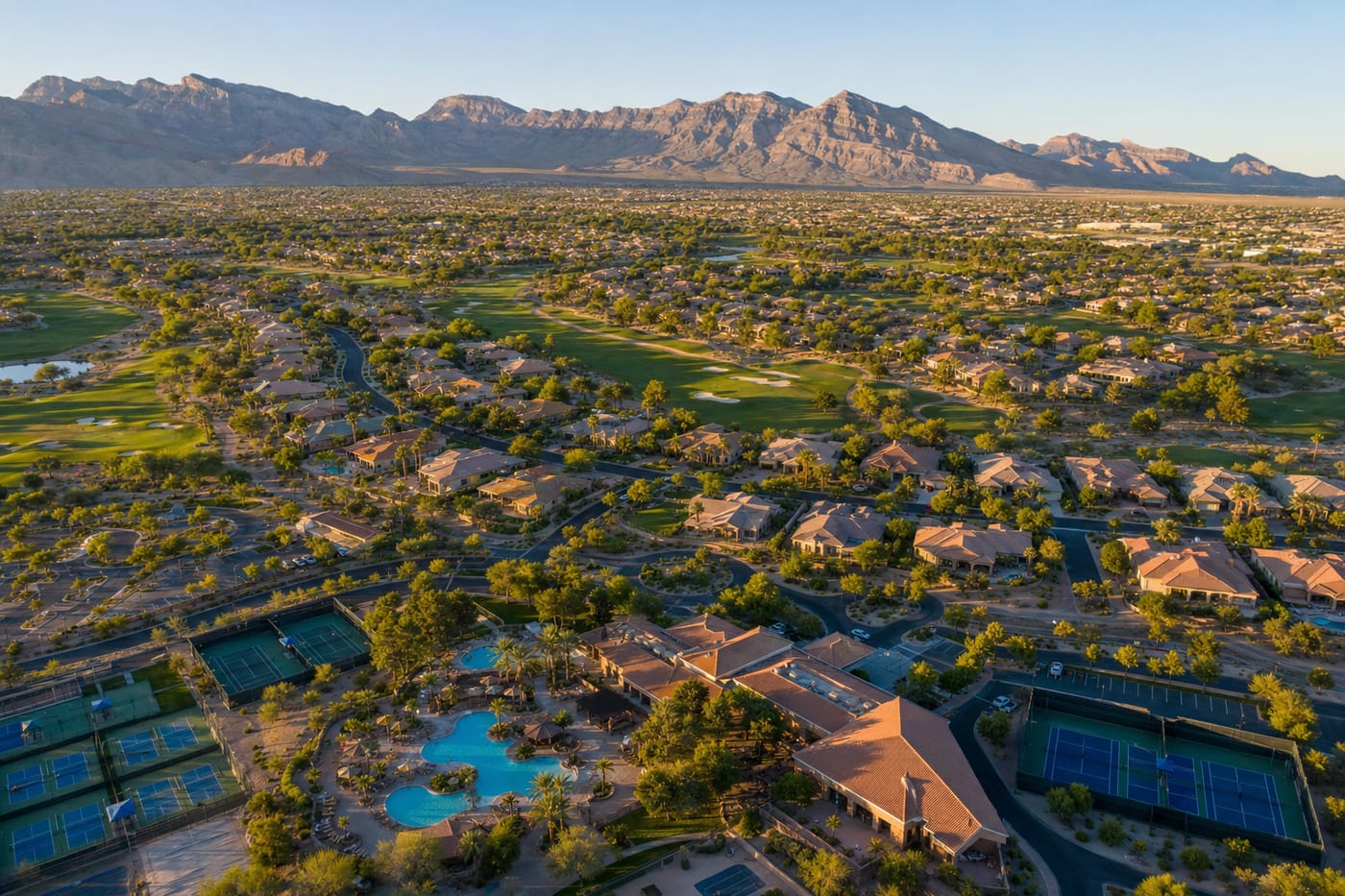
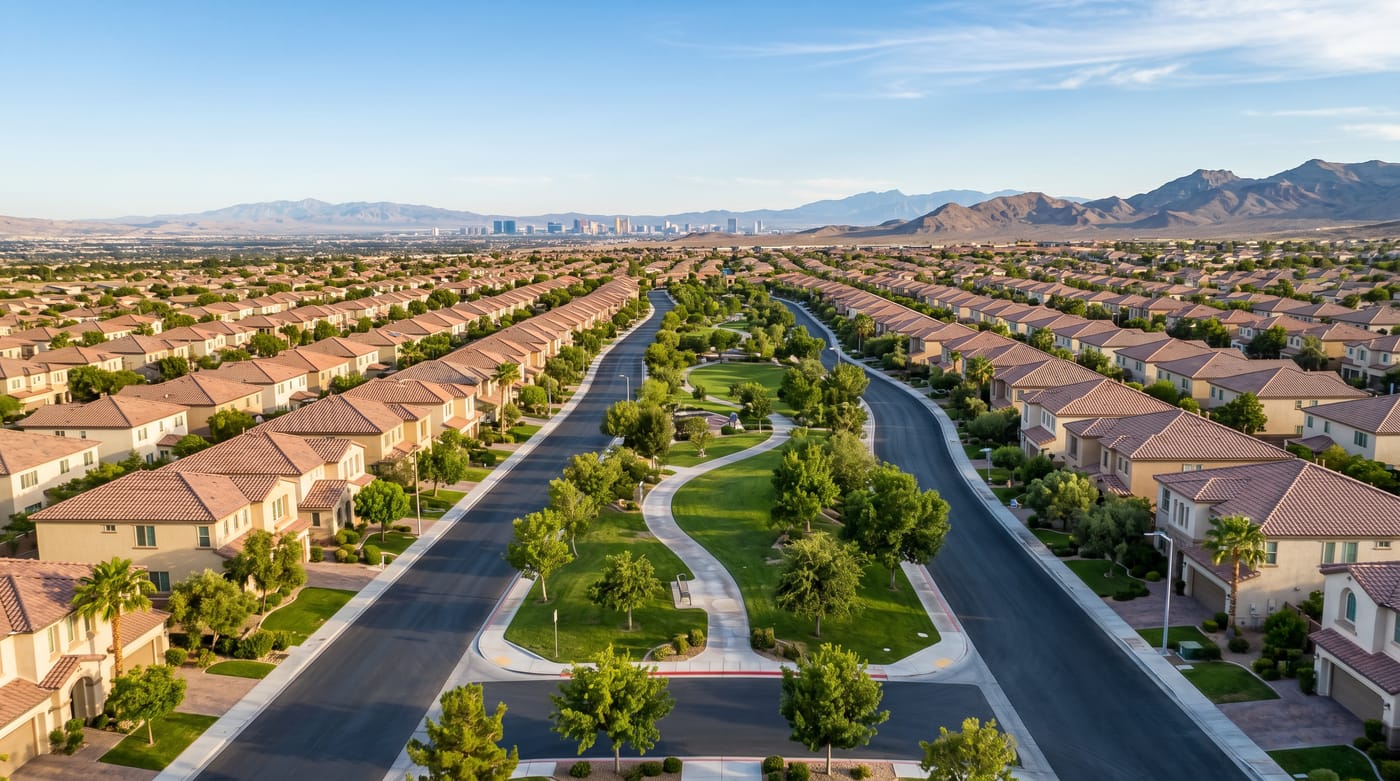
This is the amenity residents value most, and it is genuinely hard to replicate. According to Summerlin, the community offers more than 300 neighborhood and village parks and over 200 completed miles of trails — and in resident surveys, the trail system consistently ranks as the single most popular amenity. That is not a token greenbelt; it is a walkable, bikeable network that connects villages, schools, and retail.
For families, that infrastructure has real economic value. A home where kids can safely bike to a park or a friend's house, and where adults can walk to a trailhead, commands a premium because it delivers a lifestyle that car-dependent suburbs cannot. Summerlin also achieved Nevada's first LEED precertification for a master-planned community from the U.S. Green Building Council, signaling a level of sustainability planning baked into the price. When you ask what the extra $200,000 buys, a meaningful slice of the answer is "the ability to live outside your car."
How Good Are Summerlin's Schools?
Schools are the number-one reason families pay the Summerlin premium, and the community is built for it. According to Summerlin, it contains 26 public and private schools — more educational choices than any other community in Las Vegas, including several of the city's top-ranked public schools and its finest private academies.
This matters financially as well as personally. In most metros, families pay either a housing premium for a good public-school zone or private-school tuition that can run $15,000 to $30,000 per child per year. Summerlin offers strong public options that can make private tuition optional, which reframes the housing premium: $200,000 spread over a 30-year mortgage is roughly $1,100 a month, and avoiding even one private tuition of $20,000 a year offsets a large chunk of that. According to GreatSchools ratings, Summerlin's top schools score among the highest in the region. For a two-child family, the school math alone can justify the premium.
Does Summerlin Hold Its Value Better Than the Rest of the Valley?
Historically, yes — and this is the part budget-focused buyers underrate. Summerlin trades higher base prices for stronger and steadier appreciation. According to local market data, Summerlin's five-year price growth ran roughly 12 percentage points ahead of the broader Las Vegas metro through 2025, and the community's median rose nearly 10% year over year into 2026 while the valley overall rose about 3.7%.
The reason is structural: limited remaining land, sustained demand, and amenities that do not depreciate. When the broader market cools — as it has into a balanced 2.9 months of supply — premium master plans like Summerlin tend to hold value better and recover first, a pattern I detailed in our analysis of whether Las Vegas real estate will crash. In my experience, the Summerlin premium is partly a resale-insurance policy: you pay more going in, but you are buying into the segment that historically falls least and rebounds fastest. Over a long hold, stronger appreciation can recoup the entire premium and then some.
How Does Summerlin Compare to Henderson on Value?
Summerlin's main rival for premium buyers is Henderson, and the two communities split the high end of the valley. Henderson — Nevada's safest large city — offers a slightly lower entry point, with a median in the low $500,000s, while Summerlin's $686,000 median sits at the top.
| Factor | Summerlin | Henderson |
|---|---|---|
| Median home price | About $686,000 | Low $500,000s |
| Parks and trails | 300+ parks, 200+ mi trails | Extensive, slightly fewer |
| Schools | 26 schools, top-ranked | 7 to 9 out of 10 |
| Best for | Trails, golf, Red Rock access | Safety, value, Lake Las Vegas |
Neither is objectively "better" — they serve different priorities. Summerlin wins on trail networks, golf, and proximity to Red Rock Canyon; Henderson wins on the safety ranking, a lower entry price, and waterfront options. For a full side-by-side, see our Henderson vs Summerlin breakdown. The roughly $150,000 to $180,000 gap between their medians is the price of Summerlin's specific amenity edge.
What Does the Premium Look Like in Real Monthly Dollars?
Abstract premiums are easy to dismiss; monthly payments are not. Take the $208,000 gap between the $686,000 Summerlin median and the $478,000 valley median. Financed at a 6% mortgage rate over 30 years, that extra $208,000 adds roughly $1,250 a month to the payment before taxes and insurance — call it $1,100 to $1,300 depending on your down payment.
So the real question becomes: is the Summerlin lifestyle worth about $1,200 a month to you? For a family that would otherwise pay $20,000 a year in private-school tuition, the answer is clearly yes — the schools alone more than cover it. For a remote-working couple with no kids who rarely use trails, $1,200 a month buys a lot of travel and savings elsewhere. On a 20% down purchase, the Summerlin home also requires about $137,000 down versus $95,600 on the valley-median home — roughly $41,000 more cash up front. Run those two numbers honestly against your life, and the worth-it question usually answers itself.
Which Summerlin Villages Offer the Best Value?
Summerlin is not one price; it is a spectrum across its villages. The best value typically sits in the established eastern and central villages — areas like The Mesa, The Trails, and parts of The Hills — where mature landscaping and resale homes can be found below the community median, sometimes in the $500,000s for well-kept single-family product. Newer western villages like Stonebridge, Kestrel, and Redpoint command the top prices, often $700,000 to over $1 million, because they offer the latest construction and the closest Red Rock access.
For buyers who want the Summerlin address without the Summerlin West premium, the older villages are the smart play — you get the same parks, trails, and schools at a meaningful discount. New-construction shoppers willing to pay up can offset rates with builder incentives; compare active new construction homes in Las Vegas options against resale. The villages are where a knowledgeable agent earns their keep, because the price-per-amenity varies dramatically across a single community.
Is Sun City Summerlin a Cheaper Way Into the Community?
For buyers 55 and older, absolutely. Sun City Summerlin, the community's largest active-adult neighborhood, offers a median near $499,900 — barely above the valley median and roughly $186,000 below the overall Summerlin median. It is the single most affordable way to own a Summerlin address.
The trade-off is that Sun City is age-restricted (at least one resident 55 or older) and its homes are generally older and smaller than Summerlin's newer villages. But for downsizing retirees, the value proposition is compelling: you get Summerlin's location, safety, and amenity access, plus dedicated 55-plus golf, recreation centers, and community programming, at a price that leaves room in the budget. According to local market data, active-adult demand in Sun City has stayed firm even as the broader market cooled, reflecting how many retirees specifically want the Summerlin name at an attainable entry point.
What Are the Downsides of Paying the Summerlin Premium?
No honest value analysis skips the cons. First and most obvious: you pay roughly $200,000 more and put up about $41,000 more in down payment than you would for the valley-median home — capital that could go toward investments, a second property, or simply a lower monthly payment. Second, you generally get less square footage per dollar than newer, outer-edge communities in North Las Vegas or the southwest.
Third, nearly every Summerlin home carries HOA dues plus the master-association assessment, commonly $50 to $150 a month or more, on top of the mortgage. Fourth, the western villages sit farther from the airport and the Strip — a real consideration for hospitality workers and frequent travelers. And fifth, the premium is least recoverable on a short hold; if you might move within two or three years, the transaction costs can swamp any appreciation edge. We've represented buyers on both sides of this decision, and the ones who regret the premium are almost always the short-timers who did not stay long enough to capture Summerlin's resale advantage.
Who Is the Summerlin Premium Worth It For?
The premium makes the most sense for four groups. Families with school-age children get the strongest return, because Summerlin's schools can replace private tuition worth $15,000 to $30,000 per child annually. Long-term owners benefit from the stronger appreciation that historically recoups the premium over a five-to-ten-year hold. Outdoor-oriented buyers who will genuinely use the 200-plus miles of trails and Red Rock access extract daily value others leave on the table.
| Buyer type | Worth the premium? |
|---|---|
| Families with school-age kids | Yes — schools alone often justify it |
| Long-term owners (5+ years) | Yes — appreciation recoups it |
| Active-adult / 55+ buyers | Yes via Sun City near $499,900 |
| Short-term owners (under 3 years) | Usually not — transaction costs |
| Pure-yield investors | Often not — better cash flow elsewhere |
The fourth group is retirees, who can capture the Summerlin name affordably through Sun City. Across the 9,600-plus closings Nevada Real Estate Group has handled since 2011, these are consistently the buyers who look back on the premium as money well spent.
Who Should Skip the Premium and Buy Elsewhere?
Be honest with yourself if you fall into these camps. Short-term owners who may relocate within two or three years rarely hold long enough to recover the premium through appreciation — the roughly $40,000 in extra closing-adjacent costs and the transaction friction usually win. Pure investors optimizing cash-on-cash return typically find better rent-to-price ratios in entry-level corridors in Las Vegas and North Las Vegas, where a cheaper home rents for proportionally more.
Single buyers and couples without kids who do not use trails or care about school zones are paying for amenities they will not consume — they often do better buying more space or banking the difference. And budget-stretched first-time buyers should think hard before maxing out for a Summerlin address; our first-time buyer resources lay out more attainable paths. There is no shame in skipping the premium — for a large share of buyers, the rest of the valley, Henderson, or even Reno up north simply delivers more home and more savings.
What Will Happen to the Summerlin Premium Going Forward?
The premium is more likely to widen than shrink. According to Howard Hughes, Summerlin has roughly 5,000 acres left to develop out of its original 22,500 — a finite runway in a valley that is itself running out of land. As the last villages build out, the supply of new Summerlin homes tightens, and scarcity pushes prices up, not down. The community is also still investing in itself: Downtown Summerlin continues to add Class-A office space, multifamily housing, and entertainment around the Las Vegas Ballpark, deepening the urban core that underpins home values.
Forecasters project moderate Summerlin appreciation of roughly 3% to 5% a year as the community competes with Henderson for premium buyers — slower than the double-digit pandemic surge, but ahead of many alternatives. That matters for the worth-it calculation. A $686,000 home appreciating at 4% gains about $27,000 in a year; the same rate on a $478,000 valley home adds only about $19,000 — so the premium home builds roughly $8,000 more equity annually in absolute dollars, compounding the head start year after year. If Summerlin keeps appreciating even a couple of points faster than the valley, the premium you pay today quietly recoups itself.
The one real risk is an affordability ceiling: if rates hold near 6% and incomes lag, the very top villages like Summerlin West could see slower growth as buyers balk at $800,000-plus entry points. But the broad community, anchored by its schools and trails, has the demand depth to hold its premium. Premium buyers who want water instead of trails still cross-shop Lake Las Vegas, and budget-conscious shoppers keep an eye on quieter, cheaper corners like Boulder City — but for the core Summerlin proposition, betting against its long-term value has been a losing trade for two decades, and nothing in the 2026 data suggests that is about to change.
How Do You Decide If Summerlin Is Worth It for You?
Reduce it to a simple test: list what you would actually use, then price it. If you have kids who will attend Summerlin schools, count the tuition you avoid. If you will hike or bike the trails weekly, that is real recurring value. If you plan to own for seven years, weight the appreciation edge. Add those up against the roughly $1,200-a-month and $41,000-up-front premium, and the math gets concrete fast.
In my experience, buyers who do this exercise honestly rarely regret their choice in either direction — the families and long-haul owners pay the premium happily, and the short-timers and budget buyers walk away relieved. The mistake is paying the premium for a status address you will not use, or skipping it to save money you will lose to weaker resale.
One more practical filter: stress-test the premium against your worst-case timeline, not your best. Assume rates stay near 6%, assume you might need to move in four years instead of ten, and assume appreciation lands at the low end of the 3% range rather than the high end. If the Summerlin premium still pencils out under those conservative assumptions — usually because the schools or the daily trail use carry it — then it is a genuinely safe call. If it only works in the rosy scenario, that is a signal to either drop to a lower-priced village, look at Sun City, or choose a different community entirely. When you are ready to pressure-test the decision against real listings and your real timeline, call Nevada Real Estate Group at (702) 637-1759 — we will tell you honestly whether Summerlin is worth it for your situation, even when the answer is no.
Frequently Asked Questions
Is Summerlin worth the price premium in 2026?
For families, long-term owners, and outdoor-oriented buyers, generally yes. Summerlin's median runs about $686,000 versus $478,000 valley-wide — a roughly $200,000 premium — but that buys top-ranked schools, 300-plus parks, 200-plus miles of trails, and historically stronger appreciation. For short-term owners, pure investors, or buyers who will not use the amenities, the premium is harder to justify and the rest of the valley offers more home per dollar.
How much more does Summerlin cost than Las Vegas?
Summerlin's overall median is about $686,000 compared to the $478,000 valley-wide median — a premium of roughly $208,000, or about 44%. Summerlin West runs even higher near $800,000, while Sun City Summerlin offers the most affordable entry around $499,900. Financed at a 6% rate, the $208,000 gap adds roughly $1,200 a month to a mortgage payment before taxes and insurance.
Why is Summerlin so expensive?
Summerlin is a 22,500-acre Howard Hughes master plan built to a single vision since 1990, with more than 300 parks, over 200 miles of trails, 26 schools, 10 golf courses, and the Downtown Summerlin urban core. It has been named Master-Planned Community of the Year and ranks among the nation's top-selling communities. Limited remaining land plus sustained demand for that infrastructure drives the premium pricing.
Does Summerlin appreciate faster than the rest of Las Vegas?
Historically yes. Summerlin's five-year price growth ran roughly 12 percentage points ahead of the broader Las Vegas metro through 2025, and its median rose nearly 10% into 2026 versus about 3.7% valley-wide. Limited land and durable demand mean premium master plans like Summerlin tend to hold value better in downturns and recover first, which can recoup the purchase premium over a long hold.
What is the cheapest way to buy in Summerlin?
Sun City Summerlin, the community's largest 55-plus neighborhood, offers a median near $499,900 — only about $22,000 above the valley median and roughly $186,000 below Summerlin's overall median. It is age-restricted and the homes are generally older, but it delivers the Summerlin location, safety, and amenity access at the lowest entry price. Established eastern villages are the best value for buyers under 55.
Is Summerlin or Henderson the better value?
It depends on your priorities. Summerlin's median is about $686,000 versus Henderson's low $500,000s, so Henderson offers a lower entry price and Nevada's top safety ranking. Summerlin wins on trail networks, golf, and Red Rock access. Families prioritizing specific top schools or trail living often choose Summerlin; value- and safety-focused buyers frequently prefer Henderson. Both hold value well.
Should a first-time buyer pay the Summerlin premium?
Usually only if they have school-age kids or plan a long hold. For most first-time buyers, maxing out the budget for a Summerlin address strains the finances when more attainable homes in Las Vegas, North Las Vegas, or Henderson deliver more space per dollar. A smarter path is often to buy an entry-level home first, build equity, and move up to Summerlin later if the lifestyle fit is there.
Which Sources Inform This Summerlin Value Analysis?
This analysis draws on local MLS data, the master-plan developer's published figures, federal and nonprofit ratings, and relocation cost indices. According to the sources below, every figure cited is verifiable as of June 2026. Prices are rounded and vary by village and home type; confirm current numbers before making a transaction.
- Las Vegas REALTORS — local market statistics
- Howard Hughes — Summerlin master plan and figures
- Summerlin — parks, trails, schools, and amenities
- National Association of Home Builders — Master-Planned Community of the Year
- U.S. Green Building Council — LEED precertification
- GreatSchools — Las Vegas and Summerlin school ratings
- U.S. Census Bureau — Las Vegas population and housing
- Freddie Mac Primary Mortgage Market Survey — mortgage rates
- Clark County Assessor — property data
- Bureau of Labor Statistics — Las Vegas metro data