

Start this comparison with two homes you could actually buy, not two neighborhood reputations. A $700,000 house with several association charges and a $550,000 house with a different commute can lead to very different decisions even when both have the right bedrooms. The useful question is which address meets your requirements at an acceptable total cost.
We collected a six-ZIP MLS shopping sample on October 21, 2026 and applied the same basic filters to each ZIP. It is original asking-price research, not an appraisal or proof that location alone causes a price premium. ZIP codes are shopping proxies; they do not trace master-plan boundaries. The comparison below shows the sample, its limits and a worksheet you can reuse on actual listings.
In our October 21, 2026 common-filter sample, median asking prices ranged from $674,500 to $699,777 in three Summerlin-area shopping ZIPs and $499,900 to $539,900 in three Southwest ZIPs. These are ZIP samples, not community-wide values or matched-home premiums. Compare individual homes, complete association costs and your actual routes before deciding whether a higher price buys features you will use.
- Six ZIP samples use identical basic filters, but homes still differ in condition, lots and amenities.
- Asking prices measure available choices, not accepted offers or final values.
- A $150,000 price difference changes both down payment and monthly borrowing cost.
- Association layers, assessments and maintenance require address-specific documents.
- Test the actual commute and property features before choosing an area.
What Are We Comparing When We Say Summerlin and Southwest Las Vegas?
Summerlin is a named master-planned community with multiple villages and products. Southwest Las Vegas is a broader shopping-area description that can include different neighborhoods, associations and jurisdictions. Treating the two labels as equivalent units creates misleading averages. This guide uses six clearly named ZIPs to make a reproducible shopping comparison, then returns to individual addresses for the purchase decision.
Our Summerlin-area search proxies are 89134, 89135 and 89138. Our Southwest proxies are 89148, 89178 and 89179. These labels do not mean every property in a ZIP belongs to Summerlin or that these six ZIPs capture every relevant choice. They are starting points for a search. A ZIP can include different communities, products, fee structures and use restrictions. Even a familiar neighborhood name in an MLS description should be checked against the parcel and association documents.
According to the Clark County Assessor's property-record search, buyers can look up records by address, parcel or subdivision. Use those identifiers to reconcile the property you are touring with its recorded location. The Summerlin community page helps orient a broader search, while Las Vegas listings let you apply your own property filters. Neither substitutes for the exact home's documents.
This distinction also prevents an unfair lifestyle comparison. One home may sit close to the route or amenity you use; another home under the same broad label may not. A detached house, attached home and age-restricted property may have different conditions of use even within a single ZIP. Verify eligibility and restrictions without assuming they apply uniformly. The comparison should follow your stated needs—layout, cost, maintenance and travel—not inferred demographic preferences or sweeping labels about who belongs in an area.
What Did the Same Home Filters Show in October 2026?
According to NREG's October 21, 2026 GLVAR/Repliers aggregate extract, the common-filter samples below contained between 9 and 54 active records per ZIP. We searched residential sale listings identified as single-family residences, with three or four bedrooms, 2,000–3,000 square feet, year built 1995 or later and asking prices no higher than $800,000. We also used the MLS city field “Las Vegas.” That is a reproducible field selection, not a verified municipal boundary.
| Shopping proxy | ZIP | Records | Median asking price |
|---|---|---|---|
| Summerlin-area | 89134 | 16 | $674,500 |
| Summerlin-area | 89135 | 29 | $699,777 |
| Summerlin-area | 89138 | 17 | $699,000 |
| Southwest | 89148 | 54 | $539,900 |
| Southwest | 89178 | 43 | $529,900 |
| Southwest | 89179 | 9 | $499,900 |
The filters narrow the question to a shopping range many buyers can recognize. They do not fully match the homes. A 1996 property and a 2025 property both qualify, as can different lot sizes, renovation levels, garages, views, pools and association packages. We did not measure a causal “Summerlin premium,” and the table should not be used to adjust an appraisal by a fixed percentage.
The $800,000 ceiling also matters. It excludes higher-priced choices by design, so these medians answer “what is currently available within this search?” rather than “what does the entire area cost?” The 89179 result rests on only nine records, making it especially sensitive to individual homes entering or leaving the sample. We did not remove properties based on age-restriction status; verify each listing's eligibility requirements separately.
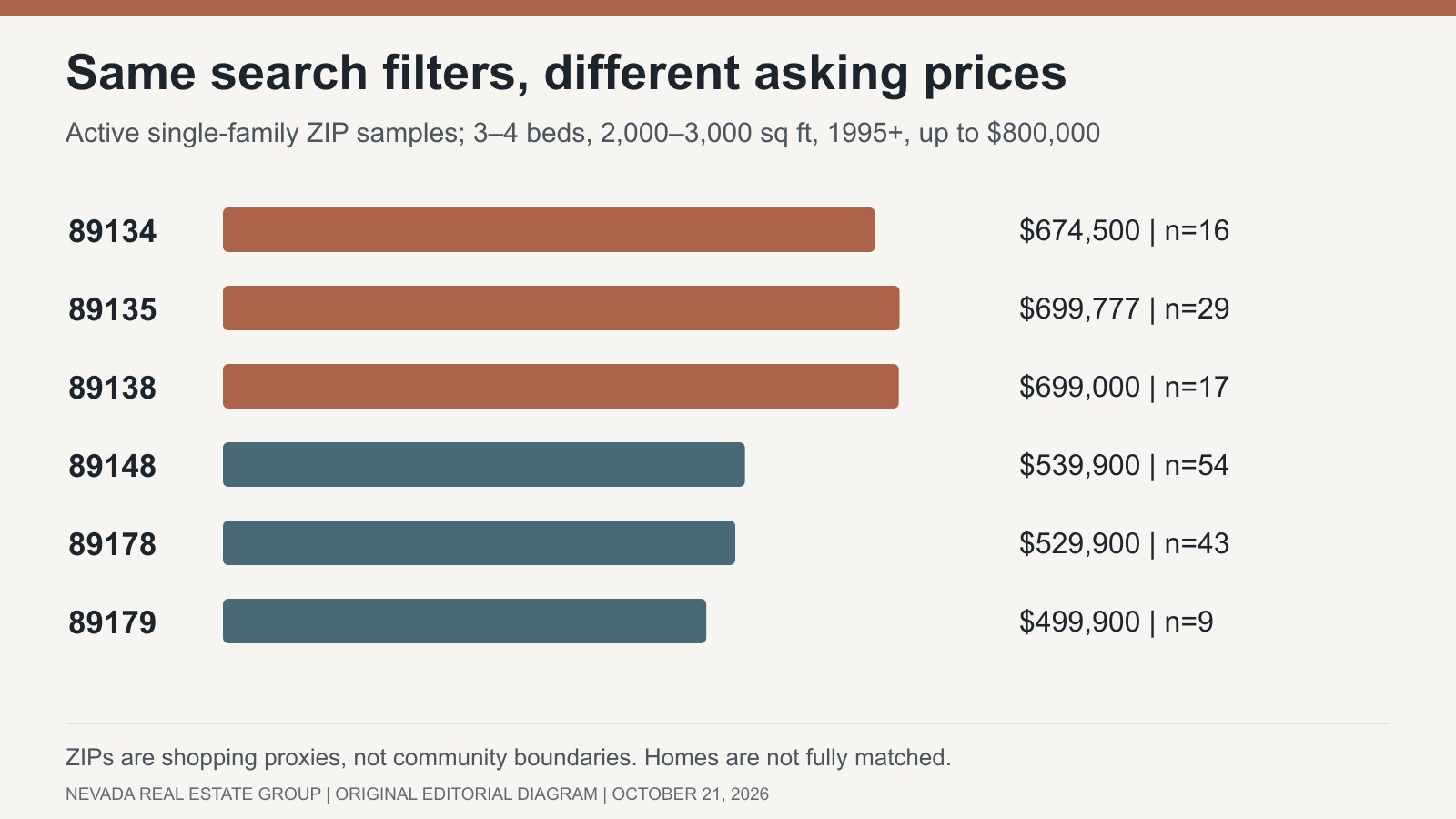
Use the result to decide where to look first, then inspect the actual choices. A buyer who needs an additional bedroom, a smaller single-story footprint or a higher price ceiling should rerun the search; carrying these medians into a different set of requirements would answer the wrong question.
Why Do Broad ZIP Medians Differ So Much From a Focused Search?
A broad median changes when the mix of available homes changes. That makes it useful for orientation but weak as a stand-alone estimate for a particular house. According to NREG's separate October 21, 2026 active single-family extract, removing the bedroom, size, age and price-cap filters produced these broader ZIP results. The board, sale status, residential type and Las Vegas city-field selection remained the same.
| ZIP | Active records | Median asking price | Interpretation |
|---|---|---|---|
| 89134 | 204 | $549,450 | Broader mix than the common-filter sample |
| 89135 | 279 | $1,100,000 | Includes homes excluded by the $800,000 cap |
| 89138 | 302 | $935,850 | Different sizes, ages and price tiers |
| 89148 | 255 | $535,000 | Area mix, not a matched property value |
| 89178 | 215 | $528,619 | Area mix, not a matched property value |
| 89179 | 64 | $485,000 | Broader sample than the nine-home subset |
The 89134 broad median is lower than its filtered median, while the opposite is true in 89135 and 89138. There is no contradiction: the filters select different slices of each area's inventory. A broad list can contain smaller homes below your required size, and a price cap can remove larger or more expensive properties. Median is the middle observation in the specified group, not a promise about the home you want.
Do not subtract a sold median from an active median and call the difference a negotiation discount. Those are different groups of homes. A defensible sale-to-list comparison uses the same completed transactions and the relevant list-price field. Likewise, a larger count does not prove one area has better choices for your needs; ten unsuitable homes add little value to your search.
The practical response is to keep the filters visible. Save the search date, property type and excluded features with any number you use. For wider context, our Las Vegas market report covers a different question. For an offer, use recent comparable sales with similar features and condition rather than a ZIP median or a forecast about which side of the valley will appreciate faster.
How Much Does a $150,000 Price Difference Change the Payment?
Consider two illustrative purchases at $550,000 and $700,000, each with 20% down and a 30-year fixed loan. These prices are round-number scenarios chosen to demonstrate a budget difference, not quotes for homes in either area. The higher purchase requires $30,000 more down payment and $120,000 more borrowing before closing costs. At the same 7.40% rate, the monthly principal-and-interest difference is about $831.
According to Freddie Mac's Primary Mortgage Market Survey, 7.40% was the national 30-year fixed average on October 15, 2026. Your lender's quote can differ with credit, loan type, down payment, points and timing. The rate is a dated input here, not a prediction or an offer. Both scenarios use the same rate so the calculation isolates the financing effect of price.
| Item | $550,000 purchase | $700,000 purchase |
|---|---|---|
| Down payment | $110,000 | $140,000 |
| Loan amount | $440,000 | $560,000 |
| Monthly principal and interest | About $3,046 | About $3,877 |
| Additional borrowing payment | Baseline | About $831 per month |
According to the CFPB Loan Estimate explainer, principal and interest are only part of the full payment, and cash to close is a separate number. Add address-specific taxes, insurance, assessments and any mortgage insurance before deciding the higher-priced home fits. Then leave room for maintenance and the cash reserve you want after moving.
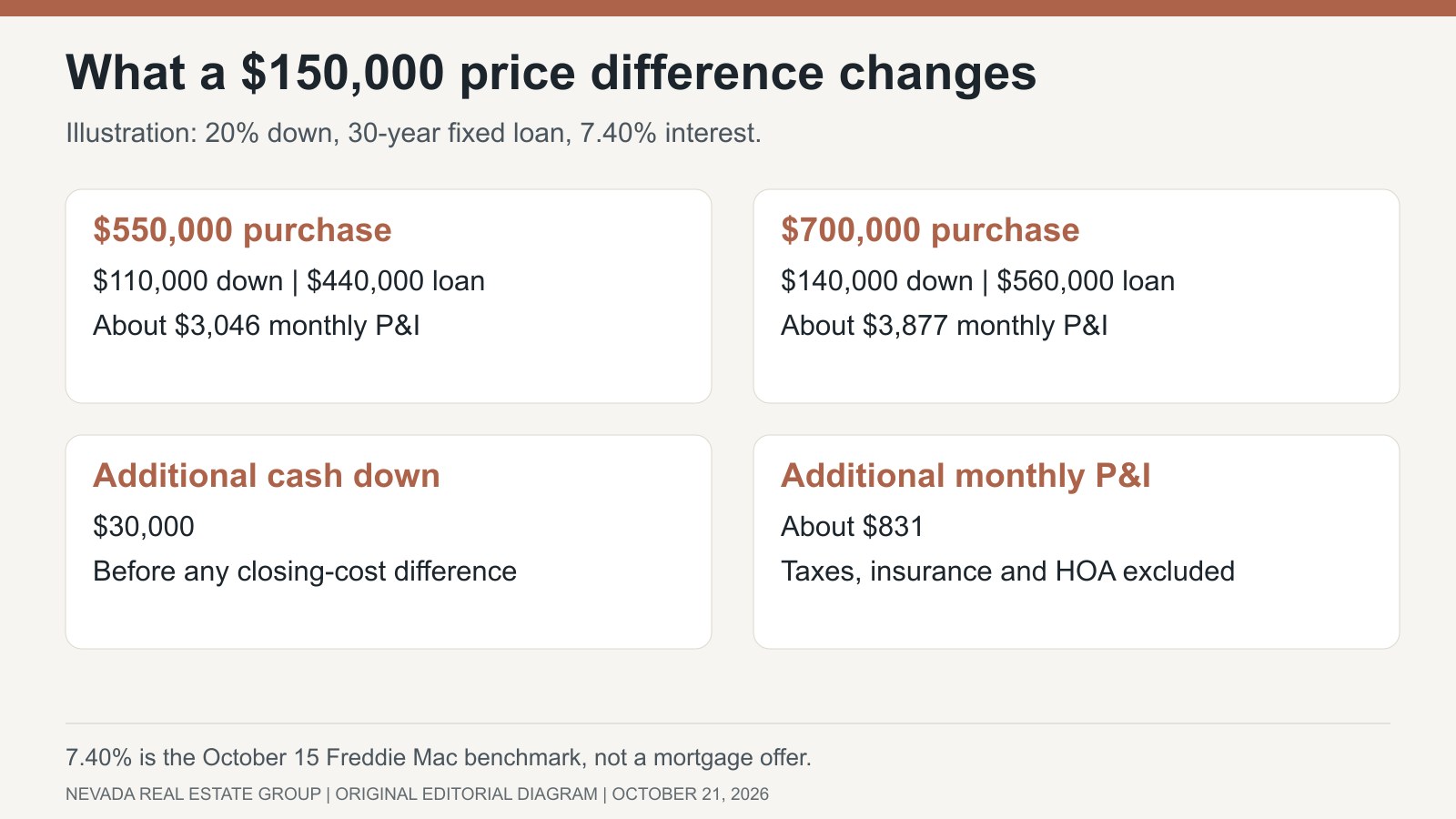
Run a second version of the budget with the cash you actually intend to put down. Keeping the same percentage down is useful for the illustration, but buyers sometimes have a fixed dollar amount available. In that case, the higher-priced property changes the loan-to-value ratio as well as the balance, and the lender may price the two loans differently. Ask for the resulting mortgage-insurance treatment and available terms rather than scaling the example blindly. Also separate money spent at closing from money retained afterward. Using every available dollar to reach a desired down-payment percentage can leave too little for an unexpected repair, a moving expense or a temporary income interruption. Set that reserve requirement before deciding how much of the price gap you can absorb. The two-home comparison is complete only when both versions use financing that is actually available to you.
Ask what you receive for the additional outlay. If the answer is a feature you use every day, you can decide what it is worth within your budget. If the answer is only a neighborhood name or an assumption about resale, obtain better evidence before stretching. The mortgage calculator and rate-change guide let you test the same comparison at your actual loan amount.
How Should You Compare HOA Dues, Assessments and Maintenance?
Compare the complete ownership package for each address. A single HOA number on a listing may not resolve every association layer, separate assessment or owner obligation. This guide does not publish a universal Summerlin fee or claim that Southwest homes avoid association costs. Both shortcuts could make an otherwise careful payment comparison wrong. Obtain the current documents and the title or escrow estimate for the actual properties.
Put the costs into three groups: recurring assessments, one-time transaction charges and work the owner must pay for directly. Then record what each assessment covers. Exterior maintenance included in one ownership arrangement may remain the owner's responsibility in another. A lower monthly fee does not automatically mean lower total cost if it purchases fewer services or leaves more maintenance outside the budget.
According to the CFPB Loan Estimate explainer, some assessments may not be escrowed in the lender payment. Ask the lender to identify those separately. Our Summerlin HOA discussion and Las Vegas association-cost guide provide question lists, but the current property documents should supply the amounts used in your decision.
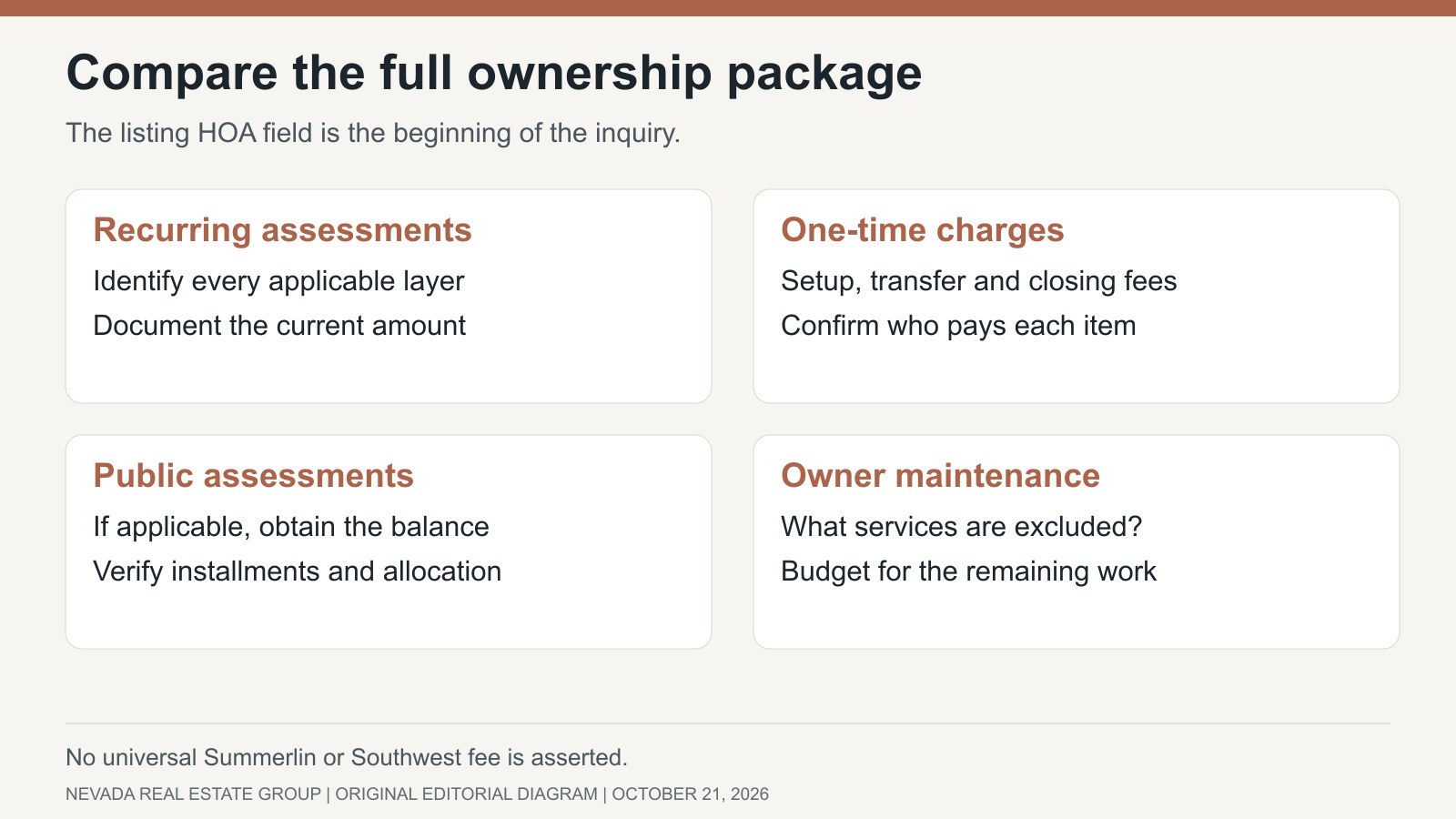
For a public improvement assessment, obtain the current balance, installment terms and proposed closing allocation rather than assuming the seller pays it off. Our SID/LID balance guide explains how to organize that inquiry. For association finances, ask about the budget, reserve information and pending or approved assessments. Treat unanswered questions as open items, not as zero-dollar costs. The better choice can change after documentation: a house that looked less expensive on the search screen may require more cash or maintenance than the alternative you initially preferred.
Which Home Features Should You Match Before Comparing Value?
Match the features that affect your actual use and the cost of ownership. Begin with usable interior area, bedroom arrangement, stairs, garage capacity, lot utility and condition. A nominally larger house may devote more space to circulation, while a smaller house may fit your furniture and daily routines better. The MLS size field starts the comparison; a floor plan and an in-person visit finish it.
Separate features you cannot reasonably change from those you can. Orientation, lot position, shared walls and location relative to a road are different from paint or flooring. For changeable items, obtain an appropriate estimate instead of inventing a blanket renovation allowance. A renovated kitchen may be valuable to you, but the seller's spending does not establish an equal increase in market value. A buyer requiring immediate occupancy should compare move-in condition on both sides of the search, rather than a finished home with a project requiring extensive work.
Our common-filter sample does not control for all those variables. For example, 2,000 and 3,000 square feet occupy the ends of a wide range. A property built shortly after 1995 can have very different systems from one built recently. The sample also does not tell you whether advertised upgrades are permitted, whether a pool needs repairs or whether the garage fits your vehicle. Those questions belong in inspection and document review.
Use Summerlin listings alongside Mountain's Edge homes and other actual Southwest candidates to build a short list with the same requirements. Do not use a neighborhood label as a substitute for a matching property. A useful comparison sheet has one row per requirement, a link or document supporting it, the observed tradeoff and a condition that would change your choice. This forces the decision to rest on evidence you can check rather than on broad claims that one area is more desirable.
How Can You Test Commute, Amenities and School Assignment Fairly?
Use the exact origin, destination and time of day for each candidate. A map's distance is not the same as reliable travel time, and a neighborhood-wide commute estimate cannot cover every work location. Drive the route when you would normally use it, include the time needed to leave the subdivision and park, and repeat it if the result is close enough to influence the purchase. Keep your observations dated and avoid treating one unusually quiet trip as typical.
For amenities, list what you would actually use and how often. A park that looks close on a map may require a route you would not choose on foot. A facility shown in marketing may have separate membership, access or operating rules. Verify those terms before assigning value to it. The comparison is not “which area has more amenities?” but “which candidate gives me practical access to the places I use?” A home without a particular amenity can still be the better fit if its other features meet your priorities.
According to CCSD's zoning page, the district provides an address-based zoning search. Use the exact property and applicable school year, and confirm uncertain results directly with the district. A nearby campus, ZIP code or listing remark is not enough to establish assignment. This guide does not rank schools, infer school quality from area labels or suggest where a household should live based on its composition.
Our Summerlin relocation guide provides broader orientation, while the Las Vegas community overview can help identify additional alternatives. Keep those resources separate from your address-level checks. If the higher-priced home saves time on a route you use daily, document that benefit. If your destination changes or the route is unreliable at your travel time, the conclusion may change. This is a personal requirement test, not a permanent ranking of the two areas.
Should You Compare New Construction With Resale in Both Areas?
Yes, if both can meet your required move date and budget. Otherwise you can accidentally compare a new builder product in one area with an older resale in the other and attribute all the differences to location. Match delivery status, included features, usable size and full cost as closely as possible. A model-home presentation is not evidence that the advertised base-price home includes every finish you see.
For a builder candidate, obtain a specific home or lot, its current status, included features, premiums, options, delivery terms and financing conditions. For a resale, obtain the current asking price, disclosures, relevant inspections and a realistic closing plan. Compare what you would actually receive, including any near-term work and the uncertainty around moving. A new home's future maintenance needs should not be assumed to be zero, and a resale should not be assumed to require major work without inspection evidence.
According to the CFPB's rate-lock explanation, a lock applies for a specified period and can carry extension costs or conditions. That matters when the two candidate homes have very different closing schedules. Ask whether a builder incentive is contingent on using a particular lender or closing by a particular date. Compare another lender's terms and the full payment after any temporary subsidy ends.
The new construction versus resale guide and builder buydown analysis cover those tradeoffs. Buyers who are also considering a downtown future project can read The Foundry buyer guide, which distinguishes announced plans from homes available for delivery. Keep that third option separate from this six-ZIP sample; it is not evidence about Summerlin or Southwest inventory. The goal is a fair comparison of actual alternatives, not an assumption that “new” or “resale” automatically wins.
What Evidence Should Shape an Offer in Either Area?
Use recent comparable closed sales, current competition and the condition of the specific property. The October 21 asking-price tables show shopping choices, not what a seller will accept. A median from a ZIP is especially weak evidence for an unusual floor plan, premium lot or heavily renovated home. Ask which comparable sales support your proposed price and which differences require judgment rather than a mechanical adjustment.
Keep price and concessions visible separately. A higher contract price with a credit may solve a cash-to-close problem, but it does not necessarily produce the same loan balance, appraisal risk or long-term cost as a lower price. A temporary payment subsidy is also different from a permanent rate reduction. The lender should confirm which credits are eligible and how the entire package affects your approval before the offer is submitted.
For a valuation shortfall, establish your maximum exposure in advance. A lender's appraisal requirement and the contract's appraisal contingency are different questions. Review the inspection, financing and appraisal dates together so you know what information will arrive before each deadline. Our Nevada contingency guide provides examples, and buyer resources explain the broader sequence. Do not remove protections merely because a broad area is described as competitive.
Finally, distinguish a property's history from assumptions about the seller. A price reduction or longer marketing period can justify asking questions, but it does not reveal private motivation or guarantee a discount. Verify whether status or terms changed, whether a previous transaction failed for a property issue, and whether a recent improvement alters the comparison. Your offer should reflect what the home is worth to you within a supported budget, with a clear fallback if negotiations fail. Neither area label requires you to exceed that limit.
How Do You Choose the Better Fit for Your Budget and Routine?
Choose the home that satisfies your most important requirements with the fewest unacceptable tradeoffs. A higher-priced Summerlin-area candidate can make sense if its specific layout, location or access is valuable enough to justify the verified cost. A Southwest candidate can make sense if it provides the needed space and routes at a lower total outlay. These are conditional decisions about actual properties, not declarations that one area is best for every buyer.
Use a three-column worksheet: requirement, evidence and tradeoff. Write a maximum full monthly payment and minimum cash reserve before touring. Then record the actual property features, cost documents and route observations. If a requirement remains unsupported, mark it unresolved rather than giving the property credit for it. This method makes it easier to revisit the decision when an inspection, insurance quote or association document changes the facts.
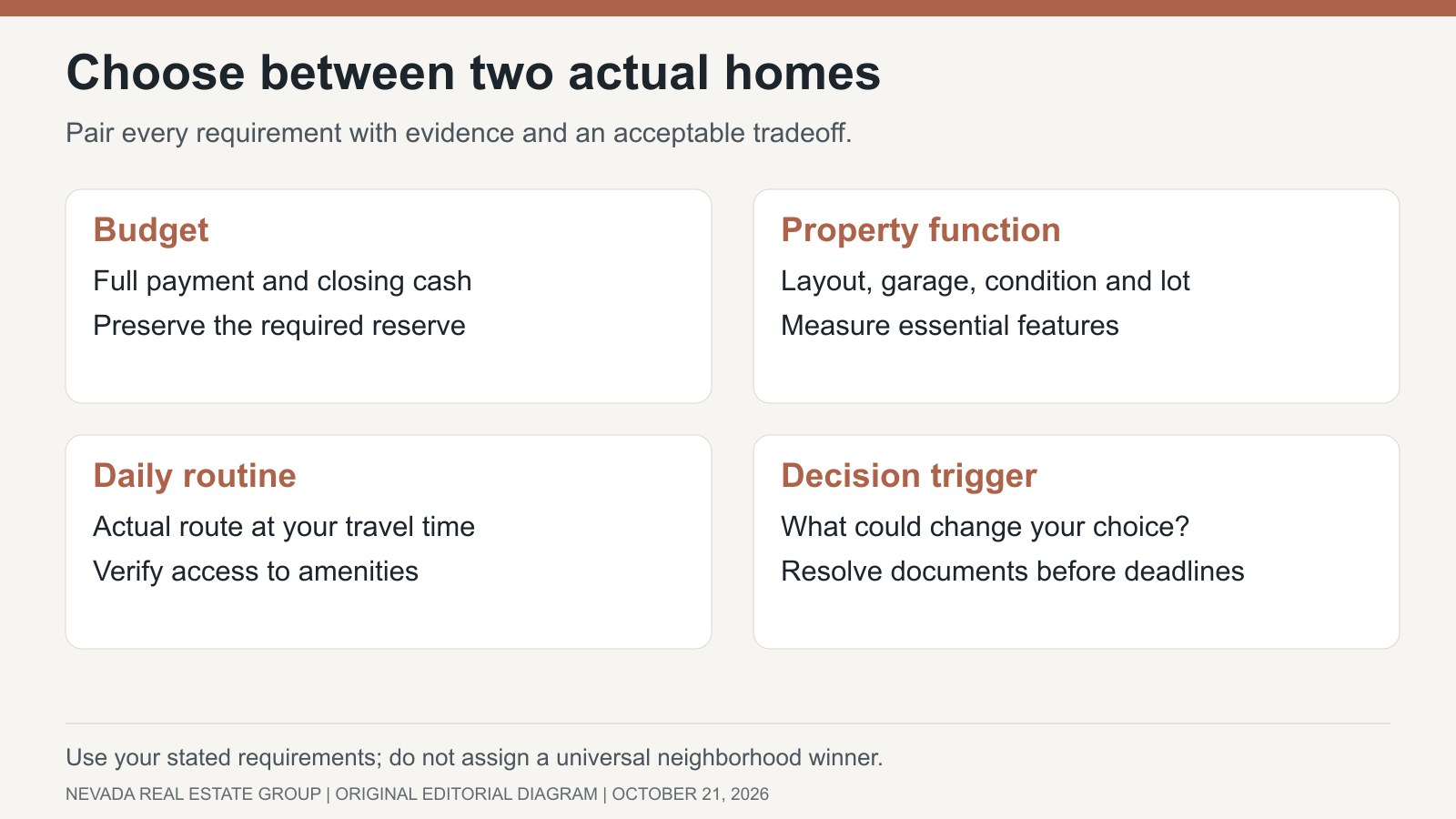
For example, a buyer who values a particular daily route should compare observed travel time with the additional monthly cost, without pretending time has the same dollar value for everyone. A buyer prioritizing low maintenance should compare ownership obligations and reserves, not simply select the lower HOA line. A buyer needing a certain garage size should measure it even if both listings advertise the same number of spaces. Those are concrete reasons to prefer a property; a reputation alone is less useful.
If you want help narrowing the search, contact Nevada Real Estate Group with your price range, full-payment limit, move date and property requirements. We can build a current comparison of actual homes and identify the documents still needed. The six-ZIP study is a starting snapshot. It is not a promise of availability, appreciation, a mortgage approval or a particular negotiation outcome.
Frequently Asked Questions
Is Southwest Las Vegas cheaper than Summerlin?
The October 21, 2026 common-filter sample showed lower median asking prices in the three Southwest ZIP proxies. It does not establish that every Southwest home costs less or that location caused the difference. Compare similar actual homes and full ownership costs.
Are ZIP codes the same as Summerlin community boundaries?
No. ZIPs are search proxies in this study. They can contain different communities, ownership arrangements and restrictions. Confirm a property's subdivision, parcel and association documents rather than relying on its ZIP or marketing description.
How much more is the payment on a $700,000 versus $550,000 home?
At 20% down, 7.40% fixed interest and a 30-year term, principal and interest are about $3,877 versus $3,046 monthly: roughly $831 more. The higher purchase also requires $30,000 more down payment. Taxes, insurance and other ownership charges are additional.
Does Summerlin always have higher HOA fees?
This research does not establish that. Compare each home's actual association layers, assessment schedule, services, reserves and owner maintenance responsibilities. A single listed fee or neighborhood label is insufficient to calculate total ownership cost.
Can I use the ZIP median to decide what to offer?
Use it for broad shopping context, then obtain recent comparable sales for the specific property. These are asking-price medians across different homes, not appraised values, accepted offers or measurements of a standard negotiation discount.
Which area has the better commute or schools?
There is no universal answer in this study. Test the route between the actual home and your destination at your travel time. Use CCSD's address-level zoning resource for the applicable school year; this guide does not assign school quality to a neighborhood label.
Why are September closed sales not used in this comparison?
The question here is current shopping choice, so the study uses active asking prices on October 21. A closed-sales study would need a separate consistent sample and reporting-lag review. Combining current listings with incomplete recent closings would not create a valid price premium.
Which Sources and Methods Support This Comparison?
Original MLS method: NREG collected aggregate GLVAR data through Repliers on October 21, 2026. Both samples used active sale status, Residential, Single Family Residence and the city field Las Vegas, separately for ZIPs 89134, 89135, 89138, 89148, 89178 and 89179. The common-filter subset added three to four bedrooms, 2,000–3,000 square feet, year built at least 1995 and maximum asking price $800,000. No client records or private seller facts were used. Counts are feed records; listing changes and corrections can alter later results. The analysis did not control for lot size, condition, views, eligibility restrictions or association costs, and does not infer a causal location premium. Source aggregate snapshots and calculation evidence are retained with the October 21 editorial review.
Financial examples use the standard 360-payment amortization formula and Freddie Mac's dated benchmark. The CFPB Loan Estimate guide and rate-lock explanation support financing distinctions. Clark County property records and CCSD zoning support address-level verification. We did not conduct property tours, a school ranking, an insurance-price survey or a commute-time study. The charts and worksheets are original; the cover is conceptual AI artwork.