

A winter home in the desert sounds simple: find a house in Las Vegas or Henderson, close, and come down when it gets cold at home. For a Canadian citizen, the house is the easy part. The harder questions sit around it. How many days can you stay? When does the IRS start treating you like a U.S. resident? What does Canada want reported? And what happens to your money when you sell?
Canadians are not a niche among foreign buyers. The National Association of REALTORS' 2026 international transactions release says foreign buyers bought 67,100 U.S. homes from April 2025 through March 2026, 14% fewer than a year earlier, while Canada rose to 16% of those purchases and returned as the top country of origin. This guide works through each rule with our own calculations: a day-count table for the IRS test, FIRPTA withholding on a sale at a real Las Vegas and Henderson price, and five years of the Nevada property-tax cap. It is general information, not tax or legal advice; the cross-border pieces are exactly where a professional who files both U.S. and Canadian returns earns the fee.
Yes. A Canadian citizen can buy a home in Las Vegas or Henderson, and Canadians were the top foreign buyers of U.S. homes from April 2025 to March 2026, per NAR. The day count is the catch: spending more than 121 days in the U.S. every year meets the IRS substantial presence test, so Form 8840 becomes part of each year's paperwork. At resale, the buyer usually withholds 10% or 15% of the price.
- A steady 121 days a year stays under the IRS test; 122 days a year meets it.
- Meeting the test, a timely Form 8840 claims a closer connection to Canada instead.
- A Clark County winter home gets the general cap, 8.0% for 2026-27, not the 3% cap.
- Selling at Las Vegas's $480,000 September 2026 house median means $72,000 withheld at 15%.
- A Form 8288-B certificate can cut that toward the seller's maximum tax, $8,000 in our example.
Can a Canadian citizen buy a home in Las Vegas or Henderson?
Yes. Non-citizens buy U.S. homes every year, and the federal tax code plans for them: IRS Publication 519's own example of rental income is a nonresident alien who owns a single-family house in the United States, and FIRPTA, the withholding rule covered later in this guide, exists because foreign persons own and sell U.S. homes. The NAR figures above put Canadian purchases at about 10,700 homes worth $5.2 billion in the twelve months ending March 2026. The same release says 48% of foreign buyers paid all cash, against 28% of all existing-home buyers, which matters for how you plan to pay.
The purchase steps are the ones every Nevada buyer follows. You make an offer, open escrow with a title company, inspect, and close when the deed records. Our guide to how escrow works in Nevada walks through each step, and our Nevada closing-costs guide breaks down what a buyer pays at the table. Before you sign anything, decide how you will hold title. Individually, jointly or through a trust or company each carries different consequences for estate planning and for taxes on both sides of the border, and our explainer on how to hold title to a Nevada home covers the Nevada options. A cross-border adviser should weigh in before closing, not after.
If you plan to buy without walking the house first, read our guide to buying a Las Vegas home sight unseen, which covers directing a live video tour, what an inspection establishes that video can't, remote signing and verifying wiring instructions. And if your real question is whether a second home makes sense at all, our broader Las Vegas second-home guide covers carrying costs, insurance and lock-and-leave layouts for any out-of-state owner. This guide stays on the rules that apply because you live in Canada.
How long can a Canadian stay in the United States each year?
Your stay is set by the visitor rules, not by the deed. The Government of Canada's travel advice for the United States, updated November 27, 2026, says Canadian visitors "can usually stay in the United States for 6 months without a visa," and that you must declare your intended length of stay when you enter. To stay longer, you apply to U.S. Citizenship and Immigration Services for an extension once you're in the country and before your authorized stay runs out.
The same page warns that a border officer may ask for evidence of residential, employment or educational ties to Canada, and that if the officer suspects you spend more time in the U.S. than in Canada, it is up to you to prove you are a temporary visitor. Form 8840, covered below, asks the same kind of question for tax purposes, so keep your Canadian ties documented: your home, your provincial health card, your Canadian tax filings.
There is also a registration rule for longer stays. USCIS's alien registration page, last updated November 19, 2026, says people 14 and older who weren't registered when they applied for a visa, and who stay in the U.S. 30 days or longer, must register, and that the requirement applies to each trip of 30 days or more. It lists Canadian visitors who entered at a land border and weren't issued evidence of registration as not registered. Registration is online through a USCIS account using Form G-325R, and an I-94 record can count as registration. Travel.gc.ca adds that you can check whether you were registered automatically by looking up your I-94 on the CBP website. Check before every long winter, since USCIS treats a land-border entry without evidence of registration as unregistered.
How does the IRS count your days in Nevada?
Immigration and tax use different clocks. The IRS substantial presence test makes you a U.S. resident for tax purposes in a calendar year if you were present at least 31 days that year and at least 183 days over three years, counting every day this year, one-third of last year's days and one-sixth of the days the year before. The IRS counts you as present on any day you are in the country "at any time during the day," so your arrival day and your departure day both count. Days in transit for less than 24 hours between two foreign points don't count, and neither do days you can't leave because of a medical condition that developed while you were here.
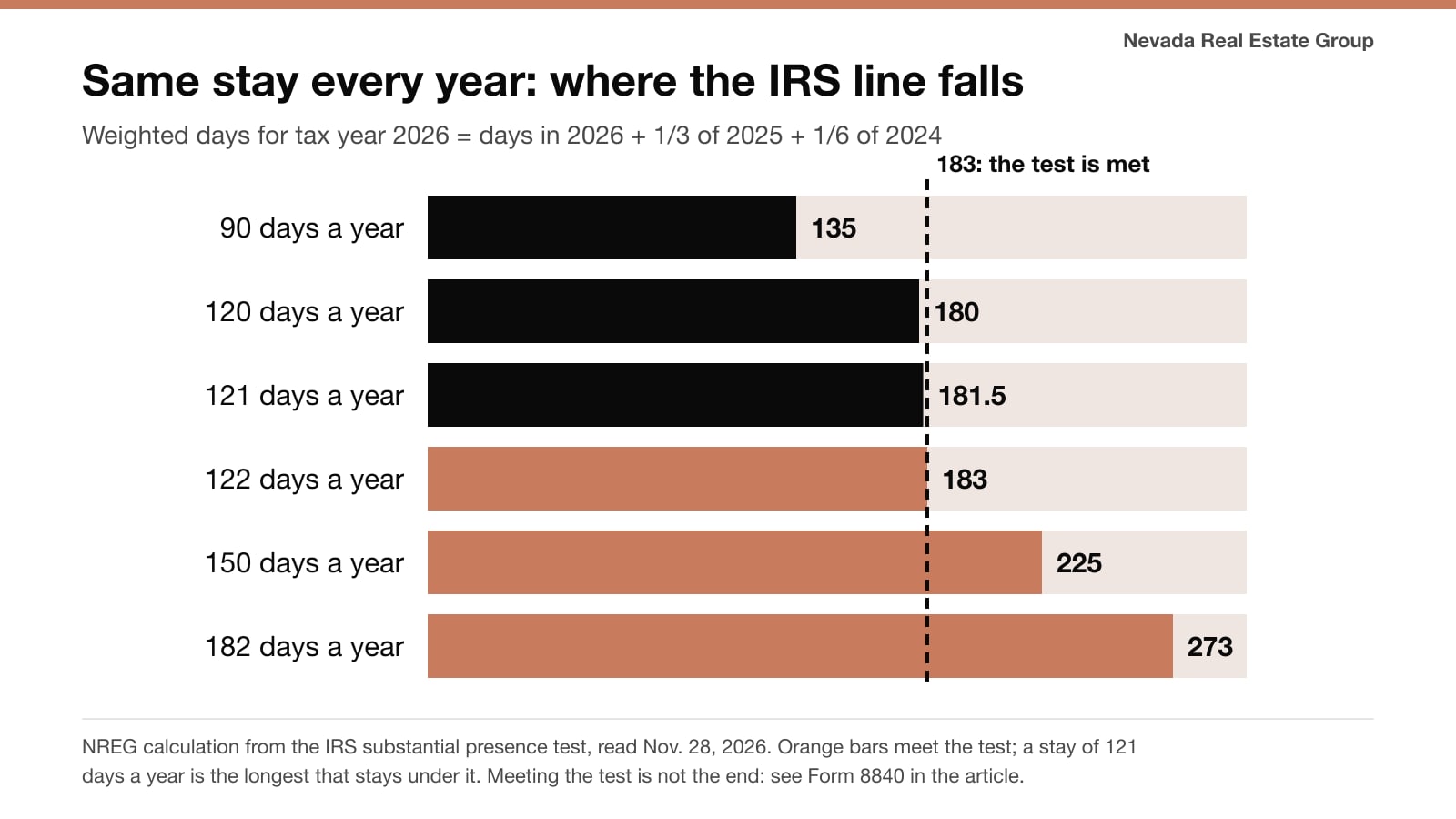
Because the weights add up to one and a half, a stay that is the same every year crosses the line at a fixed point. We calculated it: 183 divided by 1.5 is 122. The IRS's own worked example uses 120 days in each of three years, which totals 180 and does not meet the test. One more day a year still falls short, at 181.5. One day after that, 122 days every year, totals exactly 183 and meets it. So the longest steady stay that stays under the test is 121 days a year, about four months.
| Days in the U.S. each year, 2024 to 2026 | Weighted days for 2026 | Meets the substantial presence test? |
|---|---|---|
| 90 | 135 | No |
| 120 | 180 | No |
| 121 | 181.5 | No, the longest steady stay that stays under |
| 122 | 183 | Yes |
| 150 | 225 | Yes |
| 182 | 273 | Yes |
Count every day in the United States, not only the days at the house. A March golf trip to Arizona, a summer week in another state and a weekend shopping trip across the border all add to the same total.
Which winter schedules cross the 183-day line?
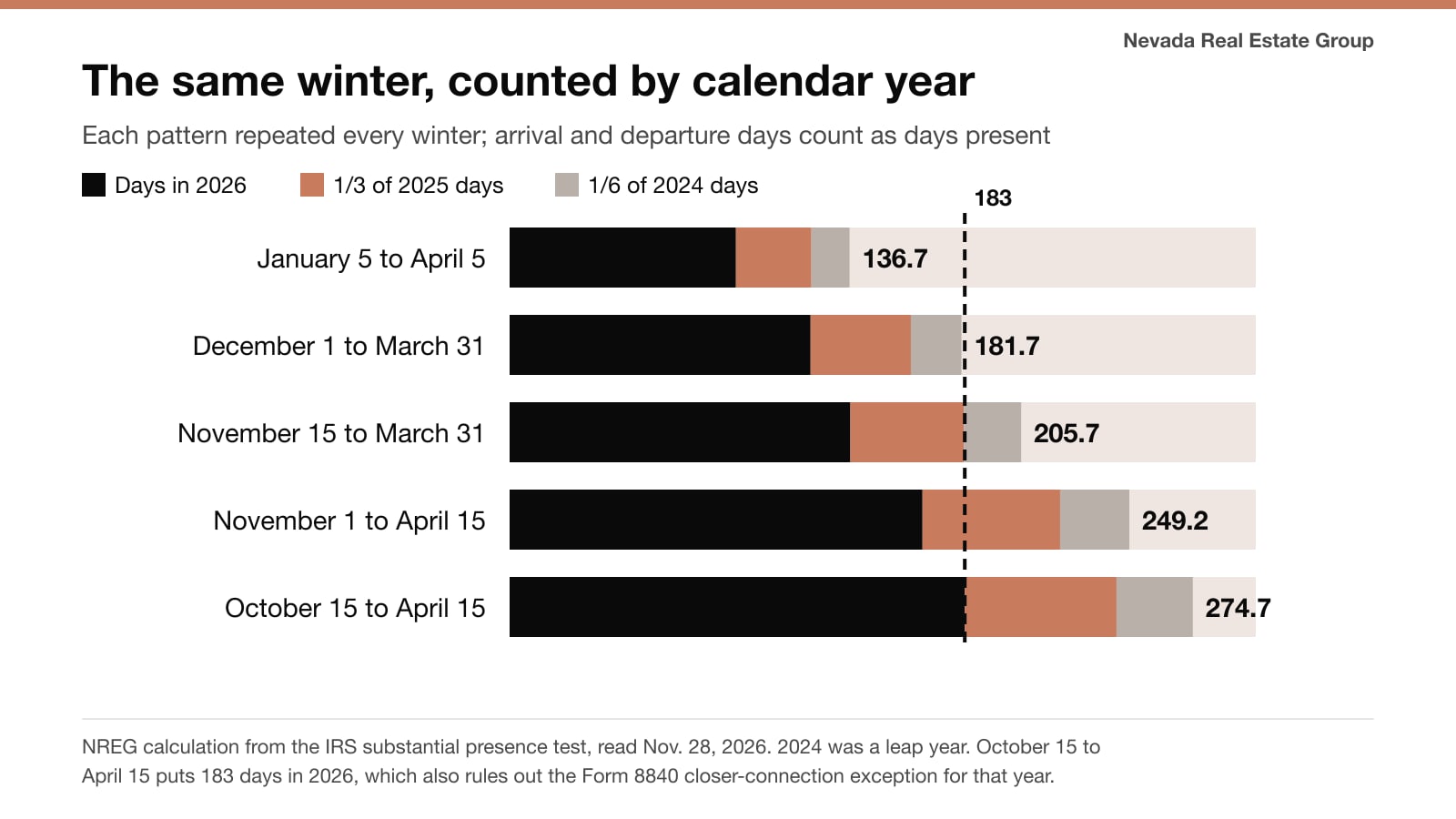
Winters don't respect calendar years, and the IRS counts by calendar year. A season from November to April puts some days in each of two tax years, so the same winter repeated every year shows up in three years of the formula at once. We ran five sample schedules, each repeated every winter, and counted the days that land in 2026, 2025 and 2024, including both travel days and the leap day in 2024.
| Winter schedule | Days in 2026 | Days in 2025 | Days in 2024 | Weighted days | Result |
|---|---|---|---|---|---|
| January 5 to April 5 | 91 | 91 | 92 | 136.7 | Under the test |
| December 1 to March 31 | 121 | 121 | 122 | 181.7 | Under, by 1.3 days |
| November 15 to March 31 | 137 | 137 | 138 | 205.7 | Meets the test; Form 8840 available |
| November 1 to April 15 | 166 | 166 | 167 | 249.2 | Meets the test; Form 8840 available |
| October 15 to April 15 | 183 | 183 | 184 | 274.7 | Meets the test; Form 8840 not available |
The December-to-March winter is the useful benchmark. It lands just under the line, with 1.3 days to spare, so a week's extension, two extra days in the current year, or one extra day every winter tips it over. A November-to-April winter meets the test comfortably at 249.2 weighted days, which is fine as long as the closer-connection paperwork in the next section is done every year.
The last row is the dangerous one. Repeating an October 15 to April 15 season every year puts 183 days into each calendar year: 105 from January to mid-April plus 78 from mid-October to December. At 183 days in the current year, the closer-connection exception is off the table for that year, and the only remaining route to nonresident status is a tax-treaty claim. It also uses the entire six-month visitor stay described above, leaving no margin on either clock.
When do you need Form 8840, and when is it due?
Meeting the substantial presence test does not have to make you a U.S. tax resident. The IRS closer-connection exception, last reviewed July 16, 2026, lets you stay a nonresident if four things are true for the year: you were present fewer than 183 days that year, you kept a tax home in one foreign country for the entire year, you had a closer connection to that country than to the U.S., and you had not applied for or taken steps toward a green card. You claim it on Form 8840, the Closer Connection Exception Statement for Aliens.
The 2026 Form 8840 asks for your days in the U.S. in 2026, 2025 and 2024, where your tax home was, and a list of your ties: where your permanent home, car, personal belongings, bank, driver's license and voter registration are. Each person files their own form, so two co-owners who both winter here file two. If you file a 2026 Form 1040-NR, attach Form 8840 to it. If you don't have to file a return, the form's instructions say to mail it to the IRS Service Center in Austin, Texas, by the due date for Form 1040-NR. IRS Publication 519 sets that date for someone without U.S. wages at the 15th day of the sixth month after the tax year ends; for 2025 it was June 15, 2026, so for 2026 it is June 15, 2027.
Missing the deadline matters. Form 8840 says that if you don't file it on time, you aren't eligible for the exception and may be treated as a U.S. resident, unless you can show by clear and convincing evidence that you took reasonable steps to learn the rules and comply. If you were present 183 days or more in the year, or have applied for a green card, the form says you aren't eligible for the exception at all. Its instructions add that you may still qualify as a nonresident under a tax treaty, which is claimed with Form 8833 attached to a Form 1040-NR. That is a heavier filing, and one more reason to keep each calendar year under 183 days.
How would you pay for a Las Vegas home from Canada?
Cash is the simplest route, and it is common. The NAR release cited above found 48% of foreign buyers paid all cash in the year ending March 2026. Paying cash still means moving money across the border, so plan the currency conversion and the wire well before closing, and verify the wiring instructions by phone every time, as our escrow guide recommends.
A standard U.S. conforming loan may not fit a seasonal visitor. Fannie Mae's Selling Guide section B2-2-02 says it buys loans made to non-citizens who are "lawful permanent or non-permanent residents of the United States" on the same terms as citizens. A Canadian resident who visits for the winter is not described by either category, so ask any U.S. lender, up front, which program it would use for you and what it requires.
Some lenders publish programs built for this situation. One example is RBC Bank's U.S. mortgage page for Canadians, read November 28, 2026: it says the program is built for Canadians buying U.S. property in any state, requires 20% down on a primary, second or vacation home and 25% on an investment property, and reviews both Canadian and U.S. credit. We list it as an example of a published program, not a recommendation; compare it with other lenders and with a Canadian home-equity line.
However you pay, budget for the full cost of owning, not just the price. Our second-home guide works through the carrying costs of a home that sits empty part of the year, utilities included, and our Las Vegas homeowners insurance guide explains what drives premiums here.
What will a Las Vegas or Henderson home cost?
Prices differ sharply by city and by property type, so start with the right number. In NREG's Las Vegas market report for November 2026, which counts GLVAR MLS closings through Repliers, the MLS city of Las Vegas closed at a $435,000 median in September 2026 across 1,437 sales, with houses at $480,000 and condos and townhomes at $265,000. The Henderson report put Henderson at a $505,000 median in September 2026 across 470 sales, with houses at $539,000 and condos and townhomes at $335,000.
| Measure | Las Vegas (MLS city) | Henderson (MLS city) |
|---|---|---|
| All home types | $435,000 (1,437 closings) | $505,000 (470 closings) |
| Houses | $480,000 | $539,000 |
| Condos and townhomes | $265,000 | $335,000 |
| FIRPTA withholding at 15% on the house median | $72,000 | $80,850 |
| At 10% if the buyer will live there | $48,000 | $53,900 |
Those medians shape more than the purchase. Every house median in this table, and Henderson's condo median, sits between $300,000 and $1 million, the band where FIRPTA withholding on your eventual sale is either 10% or 15% depending on the buyer's plans, which is why the last two rows are there. Las Vegas's $265,000 condo median is under $300,000, where a buyer who will live in the home withholds nothing, covered in the FIRPTA section below.
For a seasonal owner, property type is also a maintenance decision. An attached home with association-maintained exteriors is easier to leave for eight months than a detached house with a pool. If an age-restricted community appeals to you, our guides to Sun City Anthem in Henderson and Sun City Summerlin cover their rules, dues and housing stock, and our overview of 55+ communities in Las Vegas lists the others. Read the association's rental and vacancy rules before you buy, because they decide whether the house can earn anything while you're in Canada.
What does Nevada tax, and what does it leave alone?
Nevada has no individual income tax. The Nevada Department of Taxation says plainly that the state "does not impose a state income tax on individuals." For a Canadian owner, that means rent from the Nevada house and the gain when you sell carry no Nevada income tax. Federal U.S. tax still applies to both, and so does Canadian tax, since Canada taxes its residents on their world income. Our full answer to whether Nevada has a state income tax covers the business taxes and fees Nevada uses instead.
What Nevada does tax is the property. Clark County, which includes Las Vegas, Henderson and Summerlin, bills real property tax every fiscal year, and the bill can rise each year only up to a cap. Two caps exist. NRS 361.4723 limits the increase to 3% a year for a single-family residence that is the owner's primary residence. NRS 361.4722 sets a general cap for everything else: the greater of the county's ten-year average change in assessed value and twice the prior year's rise in the Consumer Price Index, but never more than 8%. Which cap applies decides how fast your bill can grow, so it gets its own section next.
The bigger tax risk for a Canadian owner isn't a Nevada tax at all: the U.S. federal estate tax reaches U.S. real estate owned by nonresidents, covered later in this guide. A home you rent out can also trigger local business-licensing and room-tax rules, depending on where it sits and how long each stay is, which our guides to Las Vegas short-term rental rules and Henderson short-term rental permits cover in detail.
Why does a seasonal home get the 8% property-tax cap?
Because it isn't your primary residence. The Clark County Assessor's abatement page says the 3% cap applies to the tax bill on "the owner's primary residence," that only one property in Nevada can be selected as a primary residence, and that a cap of up to 8% applies to residences that are not owner occupied. A Canadian whose primary residence is in Canada isn't claiming the Nevada house as one, so expect the general cap.
For fiscal 2026-27 that general cap is 8.0% in Clark County. The Department of Taxation's final tax-cap factors for fiscal 2026-27 show Clark County's ten-year moving average growth at 8.1% and twice the CPI change at 5.4%, so the cap hits the 8.0% ceiling that NRS 361.4722 allows. The residential cap is 3.0%. Two more points from the Assessor's page: any ownership document recorded on the parcel removes the existing owner-occupied 3% abatement, and new construction gets no cap in its first fiscal year.
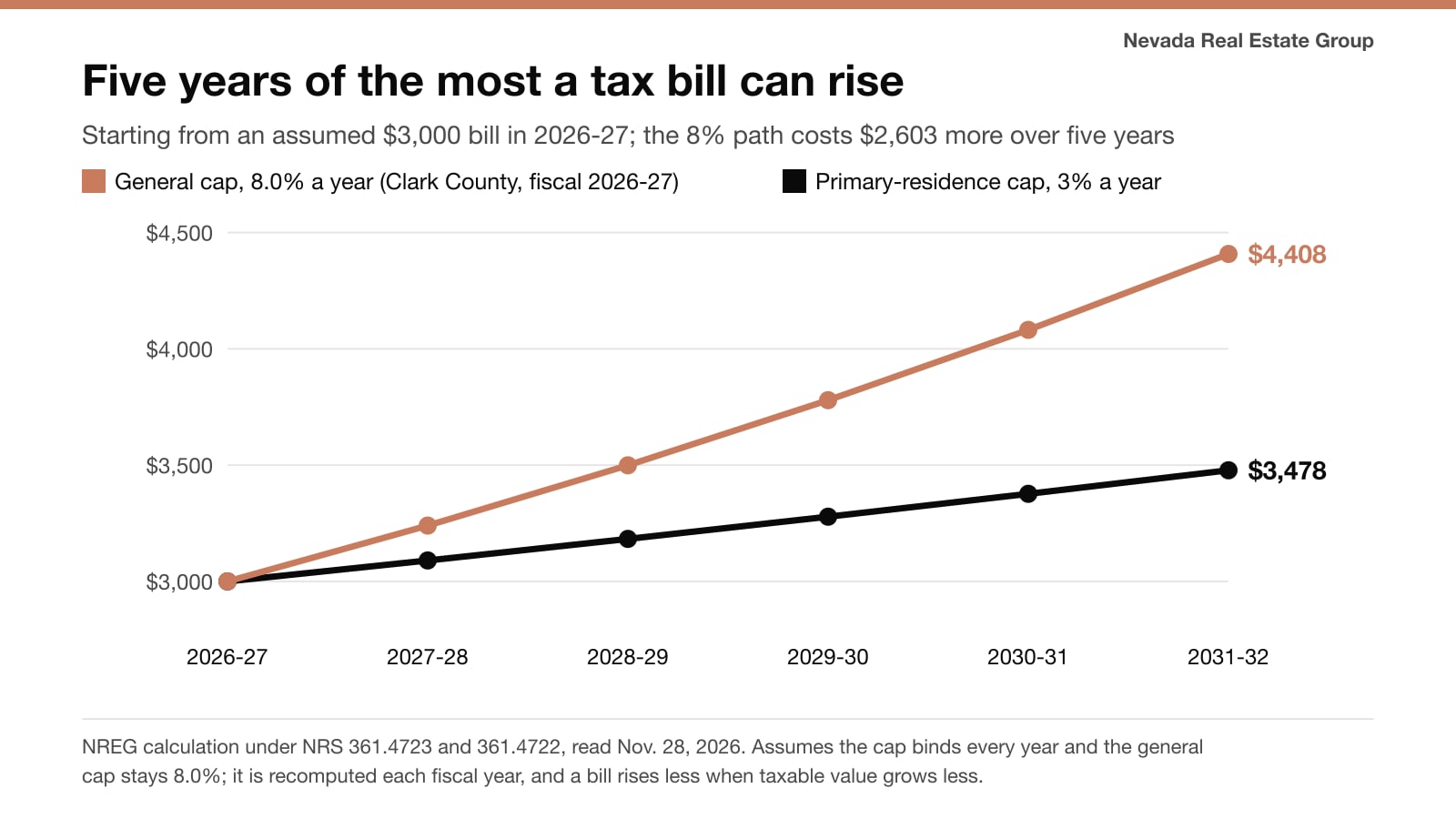
To see what the difference is worth, we started from an assumed $3,000 tax bill in 2026-27 and let each cap bind every year for five years.
| Fiscal year | 3% primary-residence cap | 8.0% general cap | Difference |
|---|---|---|---|
| 2026-27 | $3,000.00 | $3,000.00 | $0.00 |
| 2027-28 | $3,090.00 | $3,240.00 | $150.00 |
| 2028-29 | $3,182.70 | $3,499.20 | $316.50 |
| 2029-30 | $3,278.18 | $3,779.14 | $500.96 |
| 2030-31 | $3,376.53 | $4,081.47 | $704.94 |
| 2031-32 | $3,477.82 | $4,407.98 | $930.16 |
At the ceiling, the 8% path costs $2,602.56 more over the five years and leaves the bill 26.7% higher than the 3% path by 2031-32. Treat that as a worst case, not a forecast. The cap only binds when the home's taxable value grows faster than the cap, and the general cap is recomputed every fiscal year. When you look at a listing, ask what the current bill is, and run the cap from that number rather than from the purchase price. Our guide to Nevada's 3% and 8% caps explains how the Assessor calculates and corrects each one.
What happens if you rent the house out while you're in Canada?
Renting the house for the months you're away changes three things: U.S. tax, Canadian reporting and local permits. Start with U.S. tax, because the default is harsh. IRS Publication 519 says rent from U.S. real property that isn't connected to a U.S. business is taxed at a flat 30% of the gross rent, and its example has the tenants withholding that tax and reporting it on Form 1042-S. The IRS page on taxation of nonresident aliens adds that no deductions are allowed against income taxed this way. Publication 519's own example is a nonresident who rents out a U.S. house for $10,000 a year: at 30%, that is $3,000 of tax on the gross, whether or not the house made money after expenses.
The alternative is an election to treat all of your U.S. real property income as effectively connected income. The same IRS page says effectively connected income is taxed after allowable deductions at the same graduated rates U.S. citizens pay. Under Publication 519, you make the choice by attaching a statement to your Form 1040-NR, it covers all of your U.S. real property income, and it stays in effect for later years unless you revoke it. You give whoever pays you the rent Form W-8ECI, which the IRS's Form W-8ECI page says is for income that is, or is deemed to be, effectively connected, so 30% isn't withheld from the gross. You then file a 1040-NR every year and deduct your rental expenses.
Depreciation has a cost at sale. IRS Topic 703 says allowable depreciation reduces your adjusted basis, and Topic 409 caps the rate on that part of the gain, unrecaptured section 1250 gain, at 25%, which seller C in our FIRPTA example shows. On the Canadian side, renting can turn the house into reportable foreign property, covered in the next section. And locally, short-term stays need the right license, zoning and HOA permission, which our second-home guide summarizes before you list a single night.
What do you file in Canada for a Las Vegas home?
As long as you keep your home and ties in Canada, the CRA treats you as a Canadian resident who happens to winter south. Its page for Canadian residents going down south, modified January 20, 2026, says that if you spend part of the year in the U.S. and keep residential ties in Canada, the CRA usually considers you a factual resident, and you continue to pay tax on your world income. That page also tells you to keep records for any U.S. rental income and expenses, and to determine for yourself whether you are a U.S. resident or nonresident for tax purposes.
If you pay U.S. tax on U.S. income that you also report in Canada, the CRA's foreign tax credit page says a Canadian resident can generally claim a credit, calculated on Form T2209 and entered on line 40500. That is the mechanism that keeps U.S. tax on your rent or your gain from being taxed twice in full, which is also why the U.S. return has to be right first.
Then there is Form T1135. According to the CRA's T1135 questions and answers, you file it when the cost of your specified foreign property tops CAD 100,000, and specified foreign property does not include personal-use property. A Florida condo used only as a vacation property is the CRA's own example of a property you don't report. Rent it out and that can change: in the CRA's example, a condo rented for eight months a year with a reasonable expectation of profit and used personally for four is not held primarily for personal use, and must be reported.
| Filing | Country | When it applies | Timing |
|---|---|---|---|
| Form 8840 | U.S. | You meet the substantial presence test with fewer than 183 days this year | With Form 1040-NR, or mailed by its due date; June 15, 2027 for tax year 2026 without U.S. wages |
| Form 1040-NR | U.S. | Net-basis rental election, or the year you sell, to report the gain and claim the withholding | 15th day of the sixth month after year end without U.S. wages |
| Form W-8ECI | U.S. | You elect net-basis tax on rent | Give it to the tenant or other payer of the rent |
| Form 8288-B | U.S. | You want less FIRPTA withholding on a sale | Submit by the closing date so the withholding can be held |
| Form T2209 | Canada | You paid U.S. tax on income reported in Canada | With your Canadian return |
| Form T1135 | Canada | Specified foreign property costs more than CAD 100,000; rental use can make the house count | With your Canadian return |
What does FIRPTA withholding mean when you sell?
FIRPTA, the Foreign Investment in Real Property Tax Act, makes the buyer of your house the IRS's collection agent. The IRS FIRPTA withholding page, last reviewed July 21, 2026, says the rate is generally 15% of the amount realized, which is the cash paid plus any other property and liabilities the buyer takes on; in most sales that is the contract price. The buyer, in most cases, is the withholding agent, and a buyer who fails to withhold can be held liable for the tax. Ask your escrow officer early how the withholding will be handled on your file.
The rate depends on the buyer's plans, not yours. The Form 8288 instructions, revised January 2026, set a reduced rate of 10% when the buyer acquires the home to use as a residence and the amount realized is $1 million or less, and no withholding at all when one or more individuals buy it as a residence for $300,000 or less. The IRS's exceptions page defines a residence purchase: the buyer or a member of the buyer's family must have definite plans to live there at least half of the days it's used in each of the first two years after closing, and for the $300,000 exemption the buyer must also be an individual. An investor buying your house to rent it out means 15%.
The money then travels on a fixed schedule. According to the IRS page on reporting and paying FIRPTA tax, the buyer generally files Form 8288 and pays the withholding within 20 days of the sale. The IRS stamps copy B of Form 8288-A and sends it to you, and you attach it to a U.S. tax return to get credit for what was withheld. In other words, the withholding is a deposit against your tax, not the tax. If the deposit is larger than what you owe, you get the rest back when you file Form 1040-NR for the year of the sale, which for a seller without U.S. wages is due the following June 15, unless a withholding certificate authorizes an early refund. Our checklist of documents needed to sell a house in Nevada shows where the FIRPTA certification sits in the escrow paperwork.
How much can a withholding certificate free up after closing?
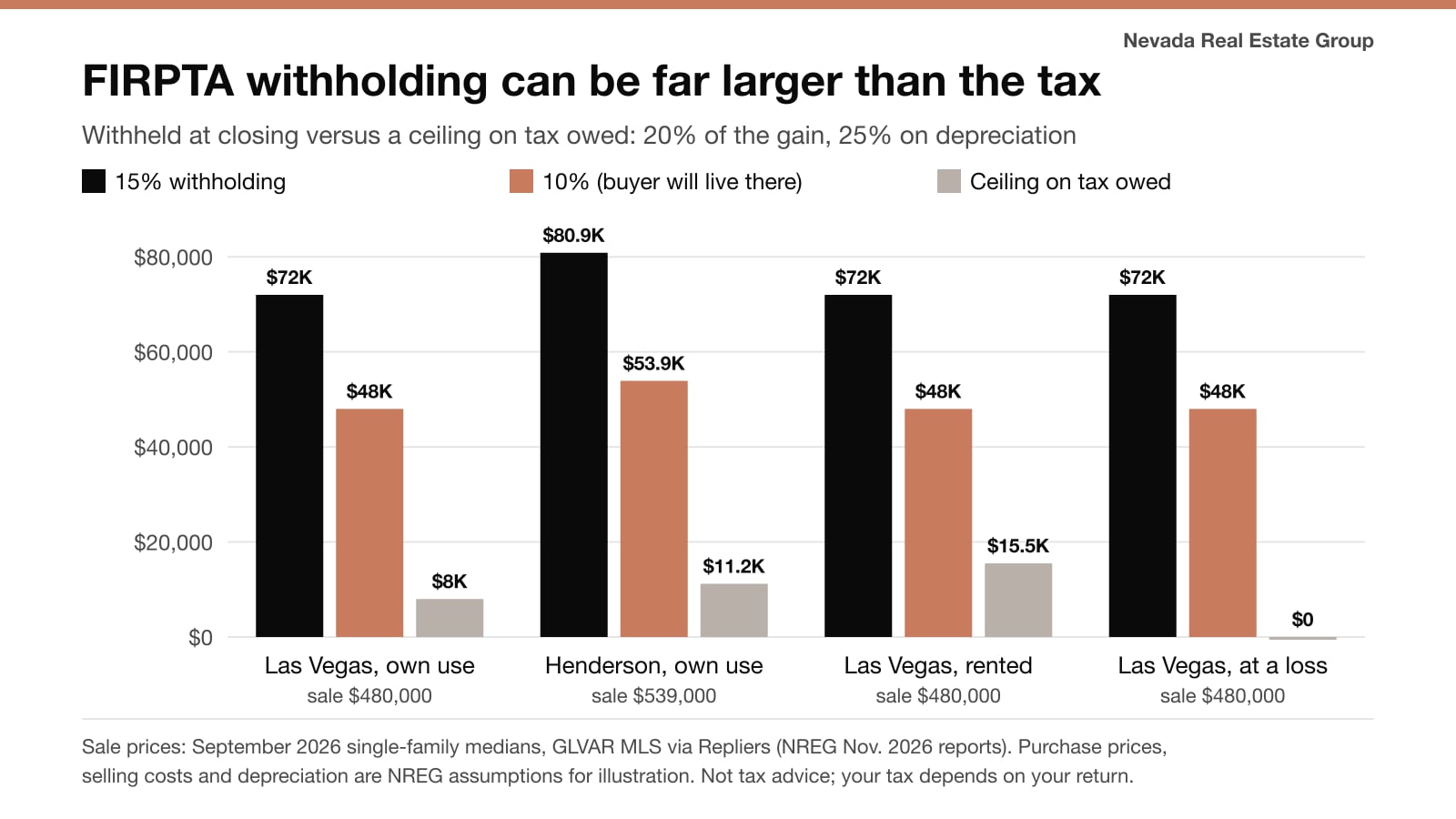
Enough to matter, on our numbers. We took the September 2026 house medians, $480,000 in Las Vegas and $539,000 in Henderson, assumed purchase prices, improvements, selling costs and depreciation for four sellers, and compared the withholding with a ceiling on the tax each could owe. For the ceiling, which assumes a home held more than a year, we used 20%, the top long-term capital-gain rate in IRS Topic 409, and 25% on the depreciation portion, the maximum that page gives for unrecaptured section 1250 gain. The IRS's net investment income tax Q&A says nonresident aliens are not subject to that 3.8% tax, so none is added. Gain is the sale price less selling costs and adjusted basis.
| Seller | A: Las Vegas, own use | B: Henderson, own use | C: Las Vegas, rented | D: Las Vegas, at a loss |
|---|---|---|---|---|
| Sale price | $480,000 | $539,000 | $480,000 | $480,000 |
| Assumed purchase price plus improvements | $410,000 | $450,000 | $410,000 | $500,000 |
| Assumed depreciation claimed | $0 | $0 | $30,000 | $0 |
| Assumed selling costs | $30,000 | $33,000 | $30,000 | $30,000 |
| Gain or loss | $40,000 gain | $56,000 gain | $70,000 gain | $50,000 loss |
| Ceiling on tax, held over a year (20%, 25% on depreciation) | $8,000 | $11,200 | $15,500 | $0 |
| Withheld at 15% | $72,000 | $80,850 | $72,000 | $72,000 |
| Withheld at 10% | $48,000 | $53,900 | $48,000 | $48,000 |
| Withheld at 15% above the ceiling | $64,000 | $69,650 | $56,500 | $72,000 |
In every case the withholding is several times the most tax the seller could owe, and in the loss case all of it is excess. That gap is what Form 8288-B is for. The form and its instructions, revised December 2025, let the buyer or seller ask the IRS to reduce withholding to the seller's maximum tax, with a calculation and evidence: the signed contract, closing statements and receipts for improvements that prove your basis, depreciation records, and the rates you applied. The IRS normally acts within 90 days of receiving everything it needs. If the application is submitted on or before the sale date, the withholding is still taken at closing but isn't sent to the IRS until 20 days after the IRS mails its decision, and you must tell the buyer in writing that you applied. Every party needs a U.S. taxpayer number on the application; a seller without one can apply for an ITIN by attaching the 8288-B to Form W-7.
Without a certificate, seller A's $64,000 of excess waits for the 1040-NR refund. On a sale closing in spring 2027, that return isn't due until June 15, 2028.
Does U.S. estate tax reach a Canadian's Las Vegas home?
It can, and it is easy to overlook because it only arises at death. The IRS page on nonresidents with U.S. assets, reviewed November 23, 2026, lists real estate located in the U.S. as a U.S.-situated asset and says a Form 706-NA estate tax return is required when the fair market value of the decedent's U.S.-situated assets exceeds $60,000 at death. Nearly any Las Vegas or Henderson house crosses that line. The Form 706-NA instructions, revised September 2025, put the general unified credit for a nonresident estate at $13,000 and the filing deadline at nine months after the date of death.
The Canada–U.S. tax treaty softens this for residents of Canada. Article XXIX B of the treaty text the IRS publishes gives the estate of a Canadian resident who isn't a U.S. citizen the greater of the nonresident credit and a prorated share of the credit a U.S. citizen's estate gets, prorated by the U.S. assets' share of the worldwide estate. If the Las Vegas house is a quarter of everything you own, your estate gets a quarter of the citizen's credit. The treaty allows that larger credit only if the estate provides the information needed to verify it, which means disclosing the worldwide estate.
There is a small-estate rule in the same article: when a Canadian resident's whole worldwide estate is $1.2 million U.S. or less, the U.S. can impose estate tax only on property whose gain the U.S. could tax under the treaty's gains article. U.S. real property is exactly that kind of property under Article XIII, so a Nevada house stays within reach of U.S. estate tax even in a small estate. Canada has its own rules at death as well. This is the section to take to a cross-border estate planner before you choose how to title the house.
How long can you be away from your provincial health plan?
The U.S. visitor stay and your provincial health coverage run on separate clocks, and the provincial one can be the tighter limit. Each province sets its own rule, so read yours. Two examples from the provinces' own pages, read November 28, 2026:
- British Columbia's Medical Services Plan eligibility page requires residents to be physically present in B.C. at least six months in a calendar year, and says residents outside B.C. only for vacation are allowed a total absence of up to seven months in a calendar year.
- Alberta's page on leaving Alberta and health coverage says someone away on vacation on a recurring basis for up to 212 days in a 12-month period might be eligible for continued coverage, and to contact the Alberta Health Care Insurance Plan before leaving and on returning. It also sets the general expectation of being physically present in Alberta at least 183 days in a 12-month period.
| Rule | Limit as published | Counting period | Source |
|---|---|---|---|
| U.S. visitor stay | Usually 6 months without a visa | Per entry, as declared | Government of Canada travel advice |
| U.S. registration | Required for stays of 30 days or longer | Each trip | USCIS |
| IRS substantial presence | 121 days a year, steady, stays under | Calendar year, weighted over 3 years | IRS, NREG calculation |
| B.C. Medical Services Plan | Vacation absence up to 7 months | Calendar year | B.C. government |
| Alberta Health Care Insurance Plan | Recurring vacation absence up to 212 days, if eligible | 12-month period | Alberta government |
Notice that a winter that keeps you under the IRS line also sits inside both provinces' vacation allowances, while a full six-month season leaves little margin anywhere. Travel.gc.ca warns that foreign visitors without travel health insurance pay out of pocket for treatment, and recommends coverage that includes hospital stays and medical evacuation, so price a policy for the full length of your winter.
What should you settle before you make an offer?
Four decisions shape everything above, and each is easier to settle before closing than after. First, pick your winter calendar and count it the IRS's way, by calendar year, both travel days included. If you want to stay under the test outright, December 1 to March 31 is about the longest steady season that does; if you plan longer, put the Form 8840 deadline in your calendar now. Second, decide whether the house will ever be rented. That one choice drives the U.S. election, your T1135, your HOA's rental rules and, at sale, the depreciation in seller C's numbers.
Third, decide how you will hold title, with a cross-border adviser, because it decides how the estate-tax rules land. Fourth, keep the records a withholding certificate needs from day one: the closing statement, every improvement receipt and your depreciation schedule. Seller A's $64,000 depends on being able to prove a basis years later.
Then choose the house. Start with homes for sale in Las Vegas, Henderson or Summerlin, and for the practical side of a part-year home, our snowbird guide to Las Vegas covers lock-and-leave living, healthcare access and the residency steps that apply only if you ever decide to move here for good, which our guide to establishing Nevada residency for taxes explains. Our Las Vegas buyer's guide walks through the purchase from search to closing.
When you're ready to look at homes, call (702) 637-1759 or contact us online. Bring your winter calendar and your rental plans, and line up your cross-border tax adviser alongside us, because the questions in this guide are theirs to answer for your situation.
Frequently Asked Questions
Can a Canadian buy a house in Las Vegas without living there?
Yes. Non-citizens own U.S. homes, IRS Publication 519 uses a nonresident alien who owns a U.S. house as its own rental example, and Canadians were the top foreign buyers of U.S. homes in the year ending March 2026, at 16% of foreign purchases, per NAR. Your stay is still set by the visitor rules: the Government of Canada says Canadian visitors can usually stay up to six months without a visa.
How many days can a Canadian spend in the U.S. without paying U.S. tax?
There's no single tax-free day count, but there is a line for being treated as a U.S. resident. Under the substantial presence test, the same stay every year stays under the test at 121 days and meets it at 122. Meeting it doesn't make you a resident if you were here fewer than 183 days that year, kept your tax home and closer connection in Canada, haven't taken steps toward a green card, and file Form 8840 on time.
Do I have to file Form 8840 every year?
You file it for each year you meet the substantial presence test and want to claim a closer connection to Canada. If your days stay under the test, you don't need it for that year. Each person files separately, attached to Form 1040-NR or mailed to the IRS in Austin by the 1040-NR due date, June 15, 2027 for tax year 2026 without U.S. wages.
Does a Canadian pay Nevada state income tax on rent from a Las Vegas home?
No. Nevada doesn't impose an individual income tax. Rent is still subject to U.S. federal tax, by default 30% of gross rent withheld, or tax on the net if you make the real property election and file Form 1040-NR, and it is reportable in Canada, where a foreign tax credit can offset the U.S. tax.
Can a Canadian owner get Nevada's 3% property-tax cap?
The 3% cap is for a single-family residence that is the owner's primary residence, and only one Nevada property can be claimed. A seasonal home owned by someone whose primary residence is in Canada falls under the general cap instead, 8.0% in Clark County for fiscal 2026-27. The cap limits how much the bill can rise; it isn't the tax rate.
How much is FIRPTA withholding on a $480,000 Las Vegas house?
$72,000 at the standard 15%, or $48,000 at 10% if the buyer is an individual who plans to live in the home. On our illustrative numbers the seller's maximum tax was $8,000, so a Form 8288-B withholding certificate could cut the withholding to about that $8,000 once the IRS issues it, normally within 90 days of a complete application, instead of waiting for a refund after filing Form 1040-NR.
Does the U.S. estate tax apply to a Canadian's Las Vegas home?
It can. U.S. real estate is a U.S.-situated asset, and an estate return is required when those assets exceed $60,000. The Canada–U.S. treaty gives a Canadian resident's estate the greater of $13,000 and a share of the U.S. citizen's credit prorated by the U.S. share of the worldwide estate, if the estate discloses the information needed to verify it, and its $1.2 million small-estate rule doesn't exempt U.S. real property.
When does a Canadian owner need an ITIN?
When you file with the IRS. Publication 519 says a taxpayer number must be on returns and that someone not eligible for a Social Security number applies for an ITIN, so you need one for Form 1040-NR, including the year you sell or elect net-basis rental tax. The Form 8288-B instructions let a seller without one apply by attaching the 8288-B to Form W-7.
Which Sources Inform This Guide?
Our calculations. Three original calculations support this guide, made November 28, 2026 by scripts/canadian-snowbird-cross-border-calcs.ts, with inputs and results saved in this post's records. The day counts apply the IRS formula to steady stays and to five winter schedules repeated each season, counted by calendar date with arrival and departure days included and 2024's leap day counted. The FIRPTA comparison uses the September 2026 house medians from our Las Vegas and Henderson November 2026 reports, which count GLVAR MLS closings through Repliers; purchase prices, improvements, selling costs and depreciation are our assumptions, and the tax ceiling uses 20% on gain and 25% on depreciation. The property-tax table assumes a $3,000 bill in 2026-27 and a cap that binds every year. None of this is a tax estimate for any person.
U.S. federal. IRS pages on the substantial presence test, the closer-connection exception, taxation of nonresident aliens, FIRPTA withholding, FIRPTA exceptions, reporting and paying FIRPTA tax, Topic 409, the net investment income tax, nonresident estate returns and Form W-8ECI; Publication 519 for 2025 returns; the 2026 Form 8840; Form 8288 instructions, Form 8288-B and Form 706-NA instructions; the Canada–U.S. tax treaty; USCIS on alien registration; and Fannie Mae Selling Guide B2-2-02. All read November 28, 2026.
Canada. Government of Canada travel advice for the United States; the CRA on Canadian residents going down south, the foreign tax credit and Form T1135; B.C. MSP eligibility and Alberta AHCIP absences. All read November 28, 2026.
Nevada and market. NRS chapter 361, the Clark County Assessor's abatement page, the Department of Taxation's fiscal 2026-27 tax-cap factors and its income tax page; NAR's July 29, 2026 international transactions release; and RBC Bank's U.S. mortgage page for Canadians, cited as an example of a published program, not an endorsement.
This guide is general information, not tax, legal or immigration advice. Tax rules on both sides of the border change and depend on your whole situation, so have a cross-border tax professional who prepares both U.S. and Canadian returns review your plan before you buy, rent or sell.