

Published May 11, 2026 · Updated September 14, 2026 · By Chris Nevada, Nevada Real Estate Group · NV License S.181401
Direct Answer: A new home’s tax bill can rise when completed improvements enter the assessment. Nevada assesses 35% of taxable value, not automatically 35% of purchase price. New construction does not qualify for the cap in its first fiscal year; later eligibility depends on the property. There is no universal promise that taxes double in year two or that protection starts only in year three. Ask for a completed-property estimate before closing.
A new home’s tax bill can rise when completed improvements enter the assessment. Nevada assesses 35% of taxable value, not automatically 35% of purchase price. New construction does not qualify for the cap in its first fiscal year; later eligibility depends on the property. There is no universal promise that taxes double in year two or that protection starts only in year three. Ask for a completed-property estimate before closing.
- A land-only or partial-construction bill may omit part of the finished home’s cost.
- Taxable value, assessed value and purchase price are different inputs.
- The qualifying 3% cap limits tax-bill growth, with new-construction exceptions.
- Use the parcel’s district rate and a completed-property estimate before budgeting.
- Ask the lender how that estimate affects escrow; keep separate assessments and HOA dues separate.
What Should Readers Know First?
Start with three documents: the current parcel bill, the assessor’s valuation record and a completed-property estimate. They answer different questions. The bill shows what is currently due, the valuation shows which improvements are included, and the estimate helps you budget for the completed house.
Confirm whether any supplemental assessment is expected and which fiscal year it affects. Nevada’s fiscal year runs July through June, but the closing month alone does not identify the assessment or guarantee a particular percentage increase. Ask the Assessor to explain the parcel’s treatment. See Clark County’s assessment explanation and Clark County’s abatement guidance.
Do not use a tax estimate to judge a builder’s motives. Have the sales office, title company and lender identify the assumptions in writing and resolve differences before closing.
How Does Property Tax Work in Clark County, Nevada?
The usual calculation begins with the assessor’s taxable value: land value plus replacement cost of improvements less statutory depreciation. Assessed value is 35% of taxable value. Multiply assessed value by the parcel’s tax-district rate per $100 to calculate gross ad valorem tax. Apply any eligible exemptions and abatements; confirm separate assessments independently.
A purchase price is evidence about the market, not an automatic replacement for taxable value. The Assessor updates values annually. A resale transfer does not by itself reset the valuation to the recorded sale price. Clark County’s assessment explanation explains both the cost method and the assessment ratio.
The qualifying primary-residence abatement constrains annual tax-bill growth to 3%. Other property uses the applicable general cap of no more than 8%, and some rentals qualify for the lower cap. New construction and changes in use are excluded in their first fiscal year, with eligibility beginning the following fiscal year under Clark County’s abatement guidance.
Why Does Property Tax Spike So Much in Year 2 of a New Build?
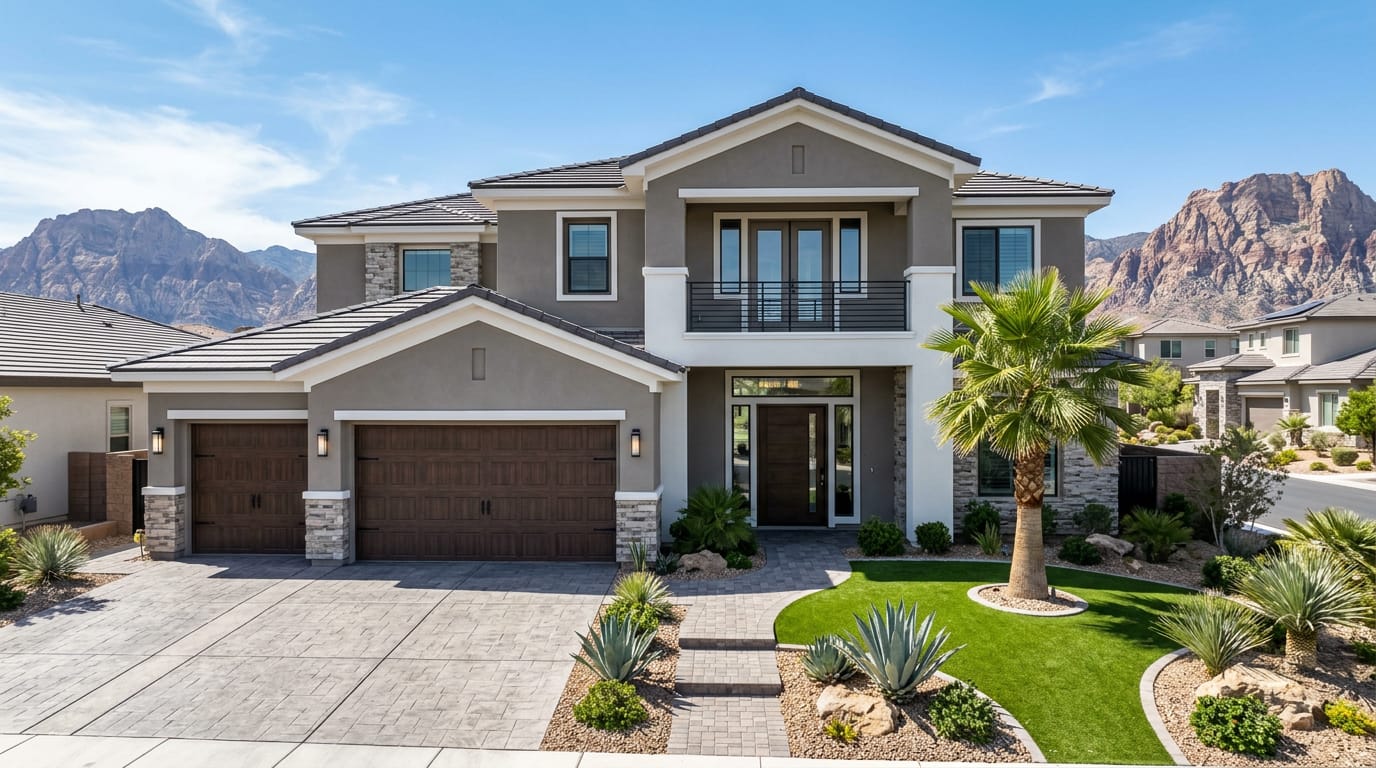
The important distinction is a partial-property bill versus a completed-property bill, not simply year one versus year two of ownership. A parcel may have been valued as land or partly completed improvements when a buyer first reviews it. Adding the completed house can change gross tax substantially. A supplemental assessment may also need attention.
For a home in Skye Canyon, Cadence or another community, ask which improvements are already in the current value. Do not infer that answer from the model-home price or completion percentage reported by a salesperson.
The exact timing and amount depend on the parcel record, construction and county assessment process. A buyer whose first quoted bill already reflects the completed house may have a different experience from a buyer quoted a land-only amount. Neither a fixed doubling nor a fixed year-three cap start is established by Clark County’s abatement guidance.
What Does the Actual Year 1 vs Year 2 Math Look Like?
Here is an illustrative calculation, not a recorded Cadence transaction or a forecast of the year a bill arrives. Assume a $3.05 rate per $100 assessed value and the taxable values shown. Gross taxes exclude exemptions, abatements and separate assessments.
| Valuation stage | Assumed taxable value | Assessed value (35%) | Illustrative gross annual tax |
|---|---|---|---|
| Partial improvements | $130,000 | $45,500 | $1,387.50 |
| Completed improvements | $500,000 | $175,000 | $5,337.50 |
| Later valuation example | $550,000 | $192,500 | $5,871.25 |
The first two rows differ by $3,950, or approximately 284.7%. That large percentage is a consequence of the assumed low starting value, not an observed typical increase.
If the completed-property bill were $5,337.50 and the following year qualified for the 3% primary-residence cap with no exception, the capped amount would be at most $5,497.63, even though the third row’s gross tax is higher. This demonstrates why a tax-bill cap does not cap taxable or assessed value.
Does the Nevada 3% Tax Cap Protect Me From the Year 2 Increase?
It depends on which fiscal year contains the new construction and the property’s eligibility. Clark County’s abatement guidance states that new construction and changes in use do not receive the cap in their first fiscal year, but can receive the qualifying cap beginning the next fiscal year.
That is different from saying every buyer receives no protection until the third year after closing. Ownership dates and fiscal-year treatment do not always line up. Ask the Assessor which year the improvements enter the assessment and which cap applies afterward.
Respond to the owner-occupancy notice after a recorded ownership change. The homeowner designation is not the same as a homestead declaration, and a prior owner’s paperwork does not complete your new-owner notice for you.
How Do Builders Quote Property Taxes During the Sales Process?
A quote can be based on the current bill, a percentage allowance or a completed-property estimate. Ask which one you are being shown, whether it includes all improvements and what tax district it assumes.
- Current bill: useful for checking present charges, but may still reflect land or partial construction.
- Percentage allowance: useful for an initial budget only when its assumptions are explicit; it is not the parcel’s actual tax rate.
- Completed-property estimate: uses anticipated taxable value, the district rate and identified adjustments. This is the appropriate figure to reconcile with the lender before closing.
The same questions apply at D.R. Horton, Lennar and other builders. A discrepancy is a reason to request documentation, not evidence that a particular representative withheld information. The formula should follow Clark County’s assessment explanation.
What Do Closing Disclosures and Escrow Statements Show?
The tax amount on a closing disclosure is an estimate used for the transaction and escrow setup. Ask the lender whether it anticipates the completed property and any expected change. Do not assume every lender uses the land-only bill or that the payment will change in one fixed month.
Using the illustrative taxes above, an old annual allowance of $1,387.50 equals $115.63 monthly. A new annual tax of $5,337.50 equals $444.79 monthly: an increase of about $329.17, before insurance or a cushion changes.
If the servicer separately identifies a $3,950 shortage and recovers that over 12 months, the illustrative shortage component is another $329.17 monthly. The combined increase would be about $658.33, not the entire new tax payment plus the shortage added on top of the old allowance. Actual analyses depend on payment dates, balances, insurance and permitted cushions.
See the CFPB explanation of mortgage-payment changes and request your servicer’s itemized escrow analysis.
How Do Year 2 Tax Increases Vary Across Major Las Vegas Communities?
Community names alone cannot establish a tax bill or a typical percentage jump. Parcels inside one master plan can differ in district, improvements and assessment history. Use this comparison checklist when collecting estimates.
| Area | Property record to compare | Additional document to request |
|---|---|---|
| Cadence | Completed-home taxable value and district | Any separate assessment balance/installment statement |
| Skye Canyon | Improvements included in the current bill | Written completed-property estimate |
| Summerlin West | Exact parcel and tax district | Master/subassociation dues and assessment disclosures |
| The Ridges | Custom-home improvements and valuation | Private infrastructure and association obligations |
| Ascaya | Land and completed custom improvements | Association budget and any separate obligations |
These are document requests, not assertions that every parcel has every listed charge. Keep HOA dues outside the ad valorem calculation and avoid double-counting an installment already included in an estimate.
How Does the July 1 Lien Date Affect My Specific Year 1 Bill?
July 1 begins Nevada’s fiscal year. It is useful context for a bill, but a closing-month chart cannot reliably turn a builder’s completion percentage into a household’s tax payment. Ask the county when the improvements are included and whether a supplemental assessment is expected.
| Timing question | Who can confirm it | Why it matters |
|---|---|---|
| What improvements are in the current valuation? | Assessor | Identifies a land-only or partial estimate |
| Is a supplemental assessment pending? | Assessor/Treasurer | Identifies charges missing from a current statement |
| Which fiscal year receives cap eligibility? | Assessor | Avoids a false “year three” assumption |
| Which charges are prorated at closing? | Escrow/title | Separates settlement amounts from annual costs |
| When will escrow be reviewed? | Loan servicer | Helps plan the payment adjustment |
Keep the written answers with your closing documents. A November close and a March close do not, by themselves, prove a particular dollar difference.
How Can Buyers Estimate the Real Annual Tax Burden Before Closing?
- Obtain the anticipated completed-property taxable value; do not substitute purchase price without identifying it as an assumption.
- Multiply taxable value by 0.35 to obtain assessed value.
- Apply the exact parcel’s district rate per $100 assessed value.
- Confirm exemptions, abatement eligibility, supplemental charges and separate assessments with the county and title company.
- Give the completed estimate to the lender and reconcile the escrow allowance.
For example, assumed taxable value of $500,000 × 0.35 = $175,000 assessed value. At an assumed $3.00 per $100 rate, gross annual tax is $5,250, or $437.50 a month before adjustments. These are illustration inputs, not a quote for all homes priced at $500,000.
Use the Treasurer’s tax-district lookup and Clark County’s assessment explanation for the actual calculation. Separate special-assessment installments from HOA dues and ordinary ad valorem tax.
What Should I Do If My Loan Servicer Sends an Escrow Shortage Letter?
Compare the tax and insurance disbursements, beginning balance, monthly deposits and projected balance on the analysis. Ask for an explanation of any charge you cannot reconcile to the county bill or insurance statement. A tax increase and repayment of a previous shortage are separate components.
Request the options available for your loan and the terms in writing. Do not assume a 60-month plan, interest charge, lump-sum demand or removal of escrow is automatically available. Regulation X’s escrow rules govern how covered accounts are analyzed and shortages handled.
If the valuation appears wrong, contact the Assessor promptly. Clark County’s assessment explanation explains review and appeal to the County Board of Equalization, generally by January 15 with holiday/weekend adjustments. Appealing does not itself establish that you can stop paying; ask the county and servicer how to handle amounts currently due.

How Should New Construction Buyers Protect Themselves Before Closing?
Ask for a written completed-property estimate early enough to change the budget. Send it to the lender, confirm what is included in the proposed escrow payment and ask how an anticipated tax increase will be handled.
Keep a checklist with the parcel number, district, taxable-value assumption, cap eligibility, special-assessment statement and HOA dues. If two estimates differ, identify the different input instead of simply averaging the numbers.
After closing, respond to ownership/occupancy notices, review new county statements and contact the servicer when the completed valuation or bill becomes available. A calendar reminder to review the records is more reliable than assuming a universal month-14 adjustment. Preserve copies of revised estimates and explanations so another person can reproduce the budget.
What Are the Three Biggest New Construction Tax Mistakes Buyers Make?
Mistake 1: Treating the current bill as the completed-home budget. Confirm the improvements included before using it for escrow planning.
Mistake 2: Multiplying purchase price by a universal percentage. Identify taxable value, assessed value and district rate separately; an illustrative percentage is not a parcel quote.
Mistake 3: Mixing tax, separate assessments and HOA dues. Obtain the statements and count each charge once.
Why does my property tax bill go up so much in year 2 of a Las Vegas new build?
A current bill may reflect land or partial improvements. A later valuation can include the completed home. The size and fiscal-year timing depend on the parcel; a universal doubling is not established.
Does Nevada's 3% property tax cap apply to new construction in year 2?
New construction is excluded in its first fiscal year and may receive the applicable cap in the next fiscal year. That is not necessarily the same as year two after your closing. Confirm the parcel’s dates and designation with the Assessor.
How do I calculate my expected property tax bill on a new construction Las Vegas home?
Use completed taxable value × 35% × the district rate per $100 assessed value. Then confirm applicable adjustments and separate assessments. Purchase price is not automatically taxable value.
Why doesn't the builder warn me about the year 2 tax increase?
Ask what valuation and district rate the quoted tax estimate uses. A current-bill quote may omit completed improvements. Get the assumptions in writing and reconcile them with the lender instead of assuming the representative’s reason.
What is the July 1 lien date and why does it matter for new construction?
July 1 marks the start of the fiscal year. Ask the Assessor when completed improvements enter your parcel’s valuation and whether a supplemental assessment is expected. A closing month or construction percentage alone does not establish the bill.
Can I appeal my Clark County property tax assessment after a new construction reassessment?
You can discuss valuation evidence with the Assessor and, if still disputed, follow the County Board of Equalization appeal process. The ordinary filing deadline is January 15, adjusted for holidays or weekends. Follow the county’s instructions for your tax year.
How much should I budget for property tax on a $700,000 new construction home?
Obtain the completed-property taxable value and actual district rate. If taxable value were $700,000 and the rate $3.20 per $100 assessed value, gross tax would be $7,840 before adjustments. That illustration is not a quote for every $700,000 purchase.
Are special assessment districts included in my Clark County property tax bill?
Billing varies with the obligation. Request a parcel-specific assessment balance and installment statement from title and the responsible agency, and check whether each charge is already included in your estimate. Do not treat HOA dues as the district tax rate.
How do new construction property taxes compare to resale homes?
Compare actual valuations, bills and cap status. Nevada updates property values annually; a resale does not simply reset to sale price. New construction has different abatement treatment in its first fiscal year. Respond to the new-owner occupancy notice for a resale as well.
Nevada Real Estate Group represents new construction buyers in transactions at no cost to the buyer — the builder pays our commission. All property tax data reflects Clark County Assessor practices as of May 2026 and is intended as general guidance, not legal or tax advice. Tax rates, assessment methodologies, and Nevada statutes can change. Consult a licensed Nevada tax professional or the Clark County Assessor for property-specific guidance.
About the Author: Chris Nevada leads Nevada Real Estate Group, the #1 real estate team in Nevada with 150+ licensed agents and 9,061+ verified five-star reviews. Licensed in Nevada (S.181401), Chris has closed 400+ new construction transactions across every major Las Vegas builder. For new construction buyer representation, call (702) 637-1759 or email info@nevadagroup.com.
Nevada Real Estate Group · 8945 W Russell Rd, Suite 170 · Las Vegas, NV 89148 · (702) 637-1759
Related Reading:
- How Much Do Builder Closing Cost Credits Actually Save You in Las Vegas (2026)
- The 2-1 Rate Buydown Explained (2026 Real Math)
- Las Vegas New Construction Buyer Guide
Which Industry Authorities Inform This Analysis?
According to Greater Las Vegas Realtors, the Las Vegas valley absorbed approximately 28,400 closed residential transactions in 2025 with a metro-median price of $465K, against approximately 4.2 months of supply — the most balanced inventory level since 2019.
Tax-district rates and separate assessment obligations must be verified for the actual parcel. See Clark County’s assessment explanation and the Treasurer’s rate lookup. A master-plan name is not a universal secondary tax rate.
According to the U.S. Census Bureau American Community Survey, the Las Vegas-Henderson-Paradise MSA gained approximately 45,000 net new residents from California alone over the trailing 24 months ending Q1 2026, driving sustained demand in both entry-level and move-up price bands.
According to the Bureau of Labor Statistics regional payroll data, the Las Vegas MSA added approximately 41,000 non-farm payroll jobs through 2025 with concentrations in healthcare, logistics, and the resort sector, which sustains the $400K–$900K mortgage-qualifying buyer pool.
According to the Freddie Mac Primary Mortgage Market Survey, the 30-year fixed rate has settled into a 6.6–6.9% band through May 2026, allowing builders and sellers to price into a stable carrying-cost environment rather than the wide swings of 2023–2024.
Which Sources Inform This Las Vegas Real Estate Analysis?
According to Greater Las Vegas Realtors, market data, closing volumes, and median price figures in this analysis come from Greater Las Vegas Realtors monthly MLS statistics through April 2026. Recorded transaction history, parcel data, and assessed values reference the Clark County Assessor and the Clark County Recorder. License and brokerage verification draws from the Nevada Real Estate Division public licensee database.
Macro housing context references the U.S. Census Bureau American Community Survey, the Bureau of Labor Statistics Las Vegas-Henderson-Paradise MSA employment data, the Federal Housing Finance Agency House Price Index, and the Bureau of Economic Analysis state-level personal income data. Mortgage rate environment uses the Freddie Mac Primary Mortgage Market Survey weekly rate series and the Mortgage Bankers Association weekly applications survey.
According to Nevada Department of Taxation, property tax math references Nevada Revised Statutes Chapter 361 and the Nevada Department of Taxation. School ratings reference GreatSchools and the Clark County School District annual performance frameworks. Builder permit activity and certificate-of-occupancy data reference the Clark County Department of Building and the Nevada State Contractors Board.
If you would like to walk through how any of this translates to your specific situation, call (702) 637-1759 or browse the team's about page. Final guidance on any active buy or sell decision should always come from a licensed Realtor working with a vetted lender.