
A bigger house in the Las Vegas Valley costs more than its mortgage payment. Property tax, homeowners association dues, electricity for a long cooling season, water for a bigger lot, insurance on a larger rebuild cost and, more often than not, a pool all grow with the home, though not at the same pace. This guide puts a number on each one for four size bands, so two homes can be compared on what they cost to keep, not only on what they cost to buy.
The figures come from two places. The first is our own pull of 5,711 single-family closings in Clark County, selected by closing date from March 1 through August 31, 2026, in the GLVAR MLS. The second is the rate each utility, tax office and regulator publishes, read in a browser on October 25, 2026. Where nobody publishes a local number, as with pool service, roof work and pest control, this guide says so rather than guessing.
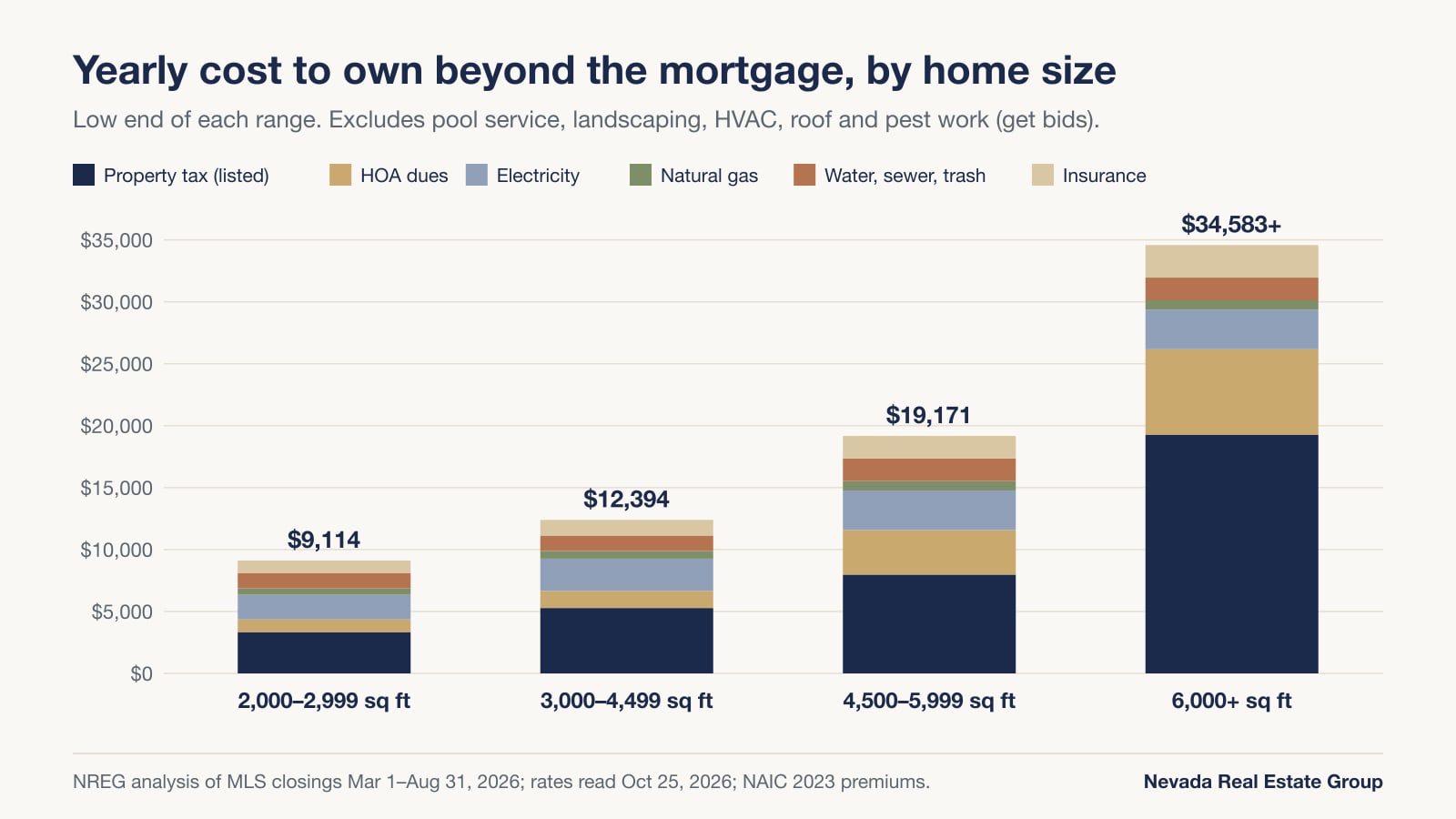
Beyond the mortgage, a 2,000 to 2,999 sq ft Las Vegas-area home costs about $9,100 to $10,000 a year in property tax, HOA dues, utilities and insurance. A 3,000 to 4,499 sq ft home runs about $12,400 to $13,600, a 4,500 to 5,999 sq ft home about $19,200 to $20,300, and a 6,000+ sq ft home $34,600 or more. Tax and dues drive the jump. Based on March–August 2026 closings and October 2026 rates; pools add more.
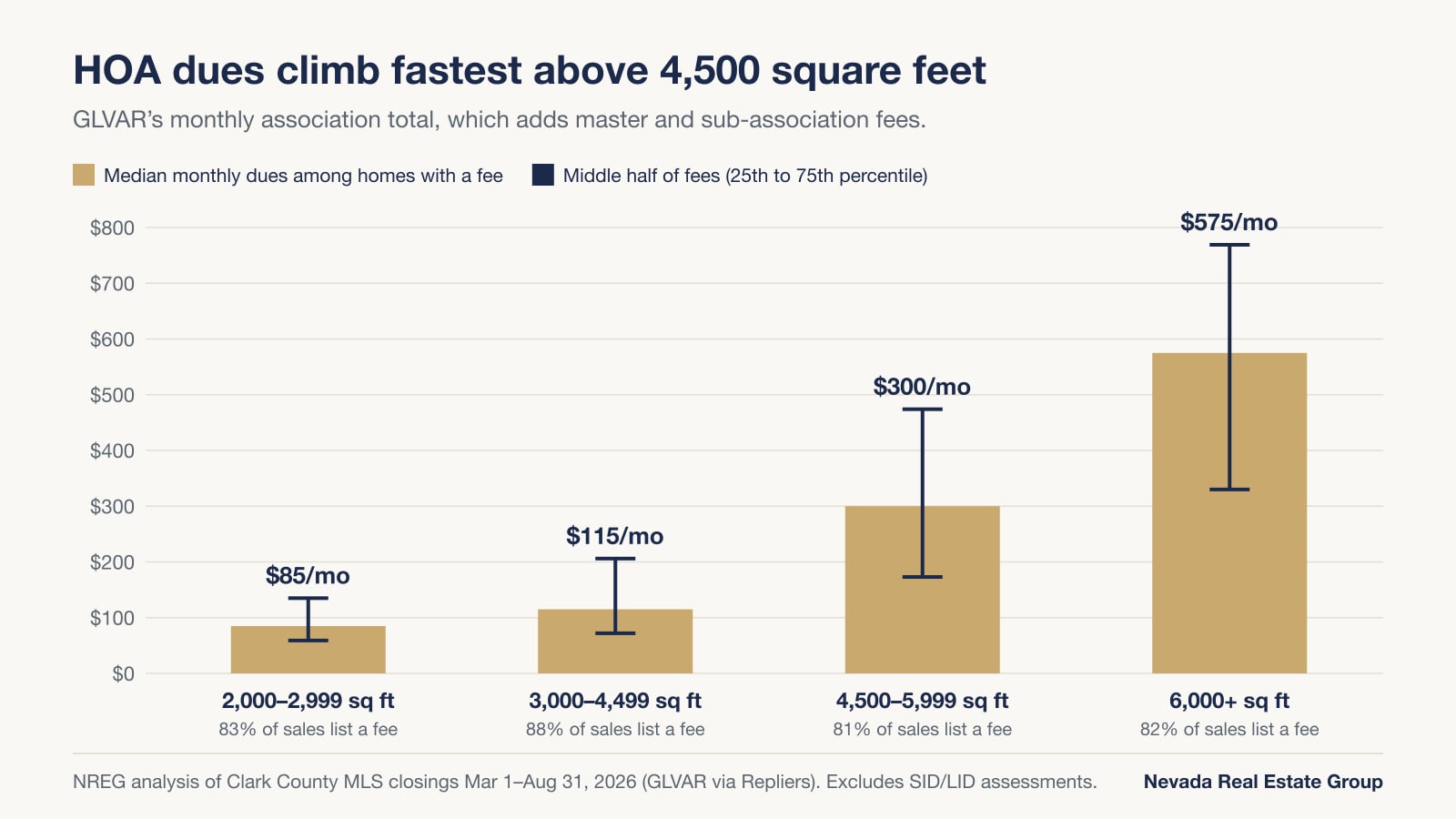
- Median HOA dues on March–August 2026 closings ran $85 a month at 2,000–2,999 sq ft, $575 above 6,000.
- Resale homes closed March–August 2026 showed median listed taxes of $3,337 to $19,278; a sale keeps the cap history.
- Claim the 3 percent owner-occupied cap after closing; Clark County's general cap for 2026-27 is 8 percent.
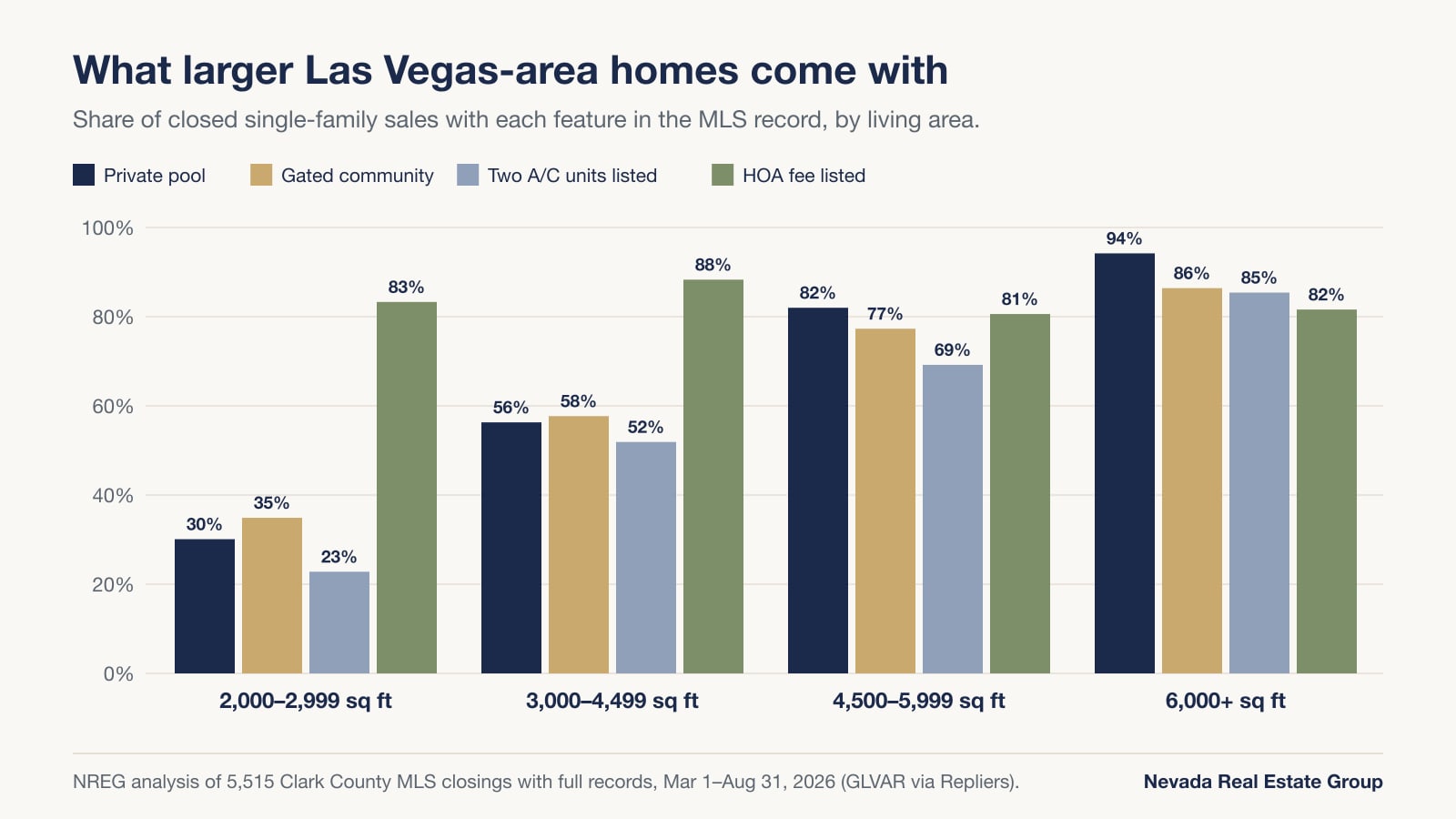
- Private pools came with 30 percent of 2,000–2,999 sq ft closings and 94 percent above 6,000 (March–August 2026).
- Ask for 12 months of NV Energy, water and gas bills before you write an offer.
| Cost item | 2,000–2,999 sq ft | 3,000–4,499 sq ft | 4,500–5,999 sq ft | 6,000+ sq ft |
|---|---|---|---|---|
| Closings in the window | 3,949 | 1,438 | 219 | 105 |
| Median closed price | $560,000 | $863,500 | $1,600,000 | $4,350,000 |
| Property tax (median shown on the listing, resale) | $3,337 | $5,278 | $7,977 | $19,278 |
| HOA dues (median, homes with a fee) | $1,020 | $1,380 | $3,600 | $6,894 |
| Electricity (NV Energy) | $1,989 | $2,606 | $3,192 | $3,192 or more |
| Natural gas (Southwest Gas) | $517 | $620 | $760 | $760 or more |
| Water (LVVWD usage scenarios) | $682 to $1,269 | $682 to $1,269 | $1,269 to $1,549 | $1,269 to $1,549 |
| Sewer and trash (composite of published rates) | $563 to $625 | $563 to $625 | $563 to $625 | $563 to $625 |
| Homeowners insurance (NAIC 2023, assumed dwelling limit) | $1,006 to $1,265 | $1,265 to $1,810 | $1,810 to $2,627 | $2,627 or more |
| Total per year | $9,114 to $10,022 | $12,394 to $13,588 | $19,171 to $20,330 | $34,583 or more |
| Total per month | $760 to $835 | $1,033 to $1,132 | $1,598 to $1,694 | $2,882 or more |
How Did We Measure What a Larger Home Costs to Own?
The sales data is our own. We pulled every single-family residence of 2,000 square feet or more in Clark County that the GLVAR MLS shows as closed, using the closing date rather than the contract date, between March 1 and August 31, 2026. Those are the six most recent months that had settled by October 25, 2026; September closings were still posting to the feed. We split the 5,711 closings by the living area on the MLS record: 3,949 between 2,000 and 2,999 square feet, 1,438 between 3,000 and 4,499, 219 between 4,500 and 5,999, and 105 at 6,000 or more. The pull used our site's existing Repliers connection and 60 paged requests.
Before using a month, we checked it against its neighbors. In the 2,000 to 2,999 band, monthly closings ran 578, 633, 636, 659, 556 and 572 from March through August, with no outlier month. Those six months add up to 3,634 of the band's 3,949 closings; the other 315 were selected by the feed's closing-date filter but carry no closing date in the detailed MLS field block (176) or have no detailed block at all (139). Across all four bands, 196 records lacked the detailed block, so the dues, tax and feature figures use the 5,515 that had it.
Dues come from GLVAR's association-fee total, a field that converts quarterly, semiannual and annual fees to a monthly figure and adds the master association to any sub-association. 1,304 records carried a second, nonzero fee. A record with no fee is treated as having no HOA, and the dues medians are among homes that list a fee. Property tax is the annual amount entered on the listing; we used resale homes built in 2023 or earlier, because the Assessor treats new construction differently in its first fiscal year, so a recent build's listed bill is not comparable. The pool share uses the MLS private-pool flag.
Everything else is a published rate, dated, and applied with the arithmetic shown in each section. Where the guide assumes something, such as how many gallons a lot uses or what dwelling limit an insurer sets, it says so beside the number. No client files, addresses or MLS photographs were used.
What Do Homes in Each Size Band Sell For and Include?
Size changes more than the price. Across the March through August 2026 closings, the share of homes with a private pool, a gate and a second air-conditioning system climbs with every band, and those features are where much of the yearly cost comes from. The lots also roughly quadruple, from a median 0.14 acre at 2,000 to 2,999 square feet to 0.52 acre above 6,000, which is what drives outdoor water use.
| Measure | 2,000–2,999 sq ft | 3,000–4,499 sq ft | 4,500–5,999 sq ft | 6,000+ sq ft |
|---|---|---|---|---|
| Median living area | 2,377 sq ft | 3,432 sq ft | 4,960 sq ft | 7,068 sq ft |
| Median price per sq ft | $237 | $247 | $320 | $531 |
| Median lot | 0.14 acre | 0.19 acre | 0.35 acre | 0.52 acre |
| Private pool | 30.1% | 56.3% | 82.0% | 94.2% |
| Gated community | 34.9% | 57.7% | 77.3% | 86.4% |
| Two A/C units listed | 22.8% | 51.9% | 69.2% | 85.4% |
| Single-story | 38.4% | 30.8% | 22.7% | 22.3% |
| Solar panels, owned or leased | 13.5% | 14.0% | 12.3% | 8.7% |
| SID or LID flagged | 11.1% | 12.8% | 4.3% | 1.9% |
Put in plain terms, a private pool appears on about 30 percent of 2,000 to 2,999 square-foot sales and on about 94 percent of sales above 6,000 square feet. More than half of the 3,000 to 4,499 band sits behind a gate, and more than half lists two air-conditioning units. Natural gas heat is close to universal: between 90 and 93 percent of the records in every band list it, which is why gas gets its own line in the cost table.
The bands also differ in where they are. The 2,000 to 2,999 band is spread across Las Vegas, Henderson and North Las Vegas, while the 6,000-plus band is almost entirely Las Vegas and Henderson addresses. If you want to see the inventory itself, our pages for luxury homes over $1 million and single-story next-generation homes are the closest starting points.
How Much Property Tax Does a Larger Clark County Home Pay?
On the listings in our window, the median annual tax shown for resale homes built in 2023 or earlier was $3,337 in the 2,000 to 2,999 band, $5,278 at 3,000 to 4,499, $7,977 at 4,500 to 5,999 and $19,278 above 6,000 square feet. The middle half of bills ran $2,537 to $4,512, $3,951 to $7,056, $6,072 to $11,548 and $13,084 to $29,349 in the same order. Measured against what each home sold for, the median bill came to 0.52 to 0.57 percent of the price. That ratio is an observation about these closings, not a tax rate, and it should never be used to quote a specific home.
The listed bill matters because a Nevada sale does not reset it. The cap that limits how fast a bill can grow is measured against the property's tax for the prior fiscal year, and that history stays with the parcel. According to the Clark County Assessor, NRS 361.4723 caps the increase at 3 percent for an owner's primary residence, a cap of up to 8 percent applies to homes that are not owner occupied, and "any ownership document recorded will remove your Owner Occupied 3% abatement." In other words, the buyer must claim the 3 percent cap again; until then the general cap applies.
How high is the general cap this year? According to the Nevada Department of Taxation's final 2026-27 cap factors, Clark County's general cap is 8.0 percent and its residential cap is 3.0 percent; the general cap is recalculated every year. Applied to the median listed bills, the 3 percent cap would let the following year's bill rise by at most about $100 to $580 across the four bands, to roughly $3,437, $5,436, $8,215 and $19,856. At this year's 8 percent general cap, the ceiling would be about $3,604, $5,700, $8,614 and $20,820.
Two exceptions change the picture. A newly built home, or one with a change in use, gets no cap in its first fiscal year, according to the same Assessor page, which is why we left 2024 through 2026 builds out of the medians; our guide to new-construction tax reassessment in Clark County walks through that first bill. And a cap only limits growth: a home whose full assessed tax is lower than the capped figure pays the lower amount. The full mechanics are in our Las Vegas property tax guide and our explainer on the 3 percent versus 8 percent cap.
How Is a Clark County Tax Bill Calculated From Taxable Value?
A Nevada tax bill starts from taxable value, not from the sale price. According to the Clark County Assessor's real property page, taxable value is generally the market value of the land plus the replacement cost of the improvements, less depreciation of 1.5 percent a year for up to 50 years. NRS 361.225 then sets the assessed value at 35 percent of taxable value. The bill is the assessed value multiplied by the district's combined rate per $100, less any abatement and exemption.
The district rate is set by where the parcel sits, and it differs more than most buyers expect. These are the fiscal 2026-27 combined rates from the state's rate book.
| Taxing entity | Rate per $100 assessed | Gross tax on $400,000 taxable value ($140,000 assessed) |
|---|---|---|
| City of Henderson | 2.9613 | $4,145.82 |
| City of Las Vegas | 3.2782 | $4,589.48 |
| City of North Las Vegas | 3.3544 | $4,696.16 |
| Summerlin (Summerlin South), Spring Valley, Enterprise and Paradise towns (unincorporated) | 2.9328 | $4,105.92 |
The $400,000 figure is an illustration of the arithmetic, not an estimate for any home or size band; the Assessor sets taxable value parcel by parcel. Some districts inside a town carry a slightly different rate, and the parts of Summerlin inside the City of Las Vegas pay the city's 3.2782, so check the parcel's district number on the county's records before you budget.
What the formula explains is why two homes of the same size and price can carry very different bills. A newer home has less depreciation on its improvements; an older one in an established neighborhood may carry years of capped growth that keep its bill well below what the formula would produce today. The capped history passes to you, but the full-formula number is the ceiling the cap is working against. For a Henderson address, our Henderson property tax guide covers the city's districts. For any home on a short list, pull the parcel's current bill and its district before you compare it with another.
How Much Are HOA Dues on Larger Homes in Las Vegas?
Dues climb faster than any other cost in the table. Among March through August 2026 closings that listed a fee, the median monthly total was $85 at 2,000 to 2,999 square feet, $115 at 3,000 to 4,499, $300 at 4,500 to 5,999 and $574.50, about $575, above 6,000. The middle half ran $59 to $135, $72 to $206, $173 to $474 and $330 to $769. Between 81 and 88 percent of sales in every band listed a fee, so a larger home without an HOA is the exception rather than the rule.
The gate explains much of the jump. In the 2,000 to 2,999 band, gated homes with a fee had median dues of $127.50 a month against $67 for homes outside a gate. In the 3,000 to 4,499 band, the split was $158.50 against $62, and at 4,500 to 5,999 it was $301 against $190, though only 17 non-gated sales in that band listed a fee. Above 6,000 square feet, 81 gated sales had a median fee of $638.33; only three non-gated sales listed one, too few to compare.
The tail is long. Forty-seven sales in the 3,000 to 4,499 band and 45 above 6,000 square feet listed dues of more than $500 a month, and 11 sales above 6,000 square feet topped $1,000, with the highest at $2,760. Because GLVAR's total adds master and sub-association dues, it is closer to what an owner pays than a single fee line, but it still leaves out two things. Special assessments for reserves or repairs are not in it, and neither are Special and Local Improvement District payments. According to the Clark County Treasurer, special assessments are different from real property taxes, are billed separately and are typically collected semiannually; 11 to 13 percent of the records in the two smaller bands were flagged for one.
Before you rely on a listing's dues, read the resale package. Our guide to what HOA fees are normal in Las Vegas covers the reserve and assessment questions, and the guard-gated communities buyer's guide explains what the gate dues pay for.
Does the Same Size Home Cost More in Summerlin or Henderson?
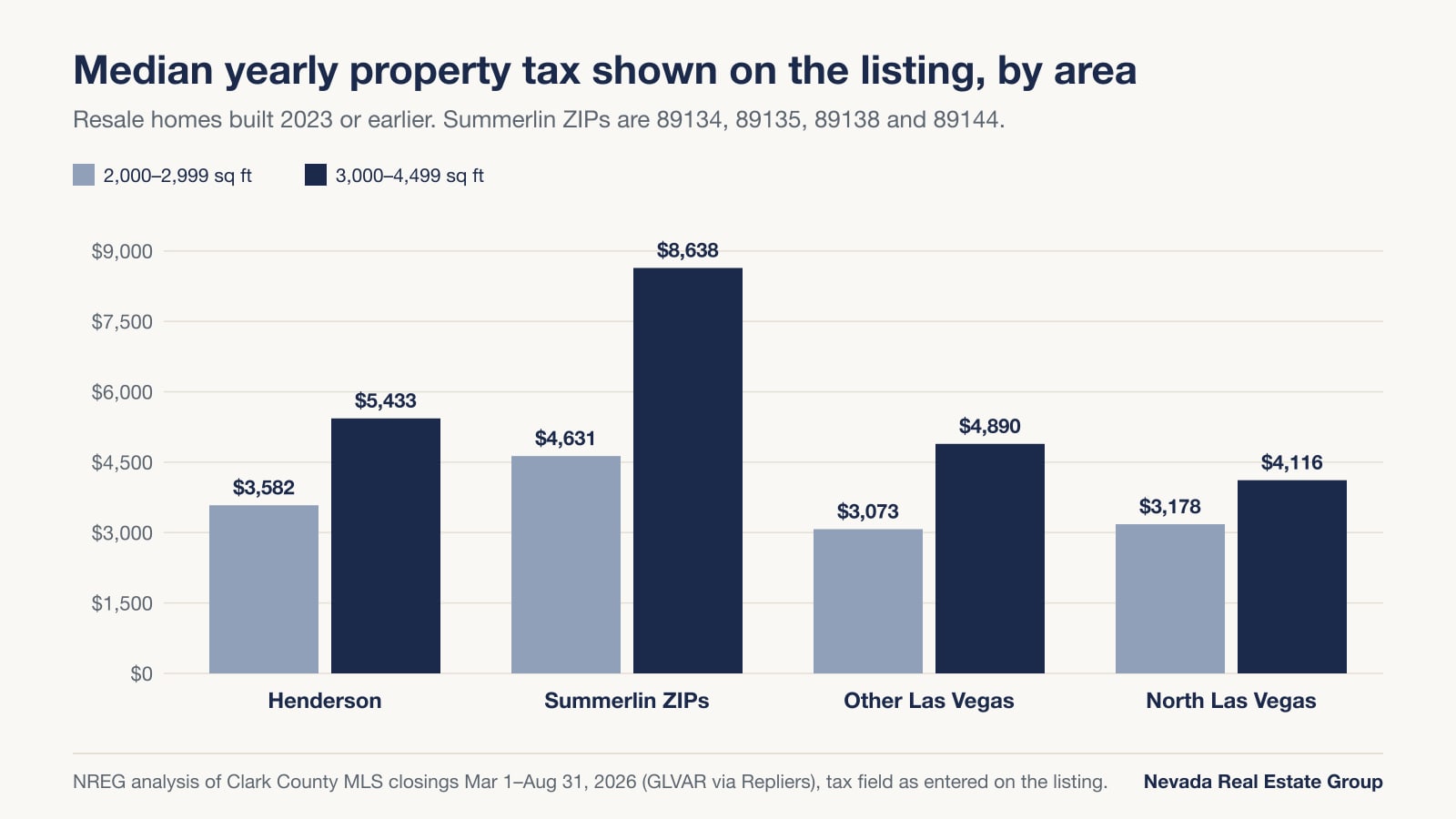
Location also moves the yearly cost. In the 3,000 to 4,499 square-foot band, the median closed price, listed tax and dues all differ by area, even though the homes are close in size. We grouped four Summerlin-area ZIP codes, 89134, 89135, 89138 and 89144, and compared them with the rest of Las Vegas, Henderson and North Las Vegas.
| Area | Closings | Median price | Share listing an HOA fee | Median monthly dues | Median listed tax | Private pool |
|---|---|---|---|---|---|---|
| Summerlin ZIPs | 230 | $1,425,000 | 100.0% | $208 | $8,638 | 62.2% |
| Henderson | 328 | $900,000 | 94.2% | $125 | $5,433 | 58.5% |
| Other Las Vegas addresses | 694 | $810,000 | 80.8% | $100 | $4,890 | 59.2% |
| North Las Vegas | 120 | $587,000 | 99.2% | $95 | $4,116 | 24.2% |
Every Summerlin-ZIP sale in the band listed an association fee, and the median listed tax there was $8,638. North Las Vegas has the highest city rate in the table above, 3.3544, yet its median listed bill in this band was the lowest at $4,116, because the bill follows taxable value and history as well as the rate. The pattern holds in the smaller band too: at 2,000 to 2,999 square feet the median listed tax was $4,631 in the Summerlin ZIPs, $3,582 in Henderson, $3,178 in North Las Vegas and $3,073 elsewhere in Las Vegas.
The lesson for a buyer comparing two similar homes is to compare their bills and dues directly rather than assume a price difference will carry through. Current listings for each area are on our Summerlin homes for sale and Henderson homes for sale pages.
How Much Electricity Does a Bigger Desert Home Use?
No utility publishes household electricity use by home size for Las Vegas, so we used the federal government's survey. The U.S. Energy Information Administration's 2020 Residential Energy Consumption Survey releases household-level microdata, and its Mountain South division covers Arizona, Nevada and New Mexico. We averaged the survey's weighted annual electricity use for single-family detached homes in that division by size. According to EIA's RECS 2020 microdata, those homes used about 14,530 kilowatt-hours a year at 2,000 to 2,999 square feet (188 surveyed homes), 19,615 at 3,000 to 4,499 (76 homes) and 24,440 at 4,500 square feet or more (19 homes, a thin sample).
Cooling is the reason the curve is steep. In the same survey, cooling alone averaged about 4,934 kilowatt-hours a year in the 2,000 to 2,999 group and 7,534 in the 3,000 to 4,499 group. The MLS shows the same story from the other side: 22.8 percent of 2,000 to 2,999 square-foot sales listed two air-conditioning units, against 85.4 percent above 6,000 square feet.
To price that use, we read NV Energy's current schedule. According to NV Energy's Southern Nevada residential rate schedule, effective October 1, 2026, the Residential Single-Family rate has an $18.00 monthly basic service charge and a total effective rate of $0.11514 per kilowatt-hour. A Universal Energy Charge of $0.00039 per kilowatt-hour is added, and the schedule says Clark County's Local Government Fee is currently 5 percent of the bill subtotal. That works out to about 12.1 cents per kilowatt-hour plus about $227 a year in fixed charges, or roughly $1,989, $2,606 and $3,192 a year for the three survey groups.
Three caveats apply. The survey reflects 2020 use, not your home's. It has no separate figure above 4,500 square feet, so for a 6,000-plus home the $3,192 is a floor, not an estimate. And NV Energy's Large Residential Service schedule, available to single-family homes with three-phase service, carries a $98.70 monthly basic charge and $0.10145 per kilowatt-hour. Owned solar panels offset part of the bill, while panels owned by a third party mean an agreement with that company, so see our guide to buying a home with solar panels and our desert A/C age guide before you budget.
What Does Natural Gas Add for a Larger Home?
Gas is smaller than electricity, but almost every larger home has it: 90 to 93 percent of the MLS records in each band list natural gas heat. According to Southwest Gas, after its gas cost adjustment effective October 1, 2026, the average Southern Nevada single-family customer's bill is about $35.59 a month on 32 therms, with a summer average of $24.74 on 18 therms and a winter average of $45.65 on 45 therms. That is about $427 a year for an average home of any size.
Larger homes burn more. In EIA's RECS 2020 microdata, Mountain South single-family homes that used natural gas consumed about 554 hundred cubic feet a year at 2,000 to 2,999 square feet, 693 at 3,000 to 4,499 and 884 at 4,500 square feet or more. Between 67 and 81 percent of the survey homes in those groups used gas at all.
To turn that use into dollars, we used Southwest Gas's own estimated bills. The summer and winter figures imply roughly $10.80 a month in fixed charges and about $0.77 for each additional therm; that is our arithmetic from the company's published examples, not a tariff quote. In therms, using the survey's own heat-content field, those homes used about 500, 634 and 814 therms, which come to about $517, $620 and $760 a year. As with electricity, the top figure is a floor for a 6,000-plus home, especially one that heats a pool or spa with gas.
Rates may move soon. According to Southwest Gas's Nevada rates page, the company filed a general rate case with the Public Utilities Commission of Nevada on March 17, 2026, seeking new rates effective in October 2026, so check the current statement of rates when you compare homes. The most reliable number for any specific house is still the seller's last 12 months of Southwest Gas bills. Our utilities move-in playbook lists who provides gas, power and water by address, and how to start each service.
What Will Water, Sewer and Trash Cost on a Bigger Lot?
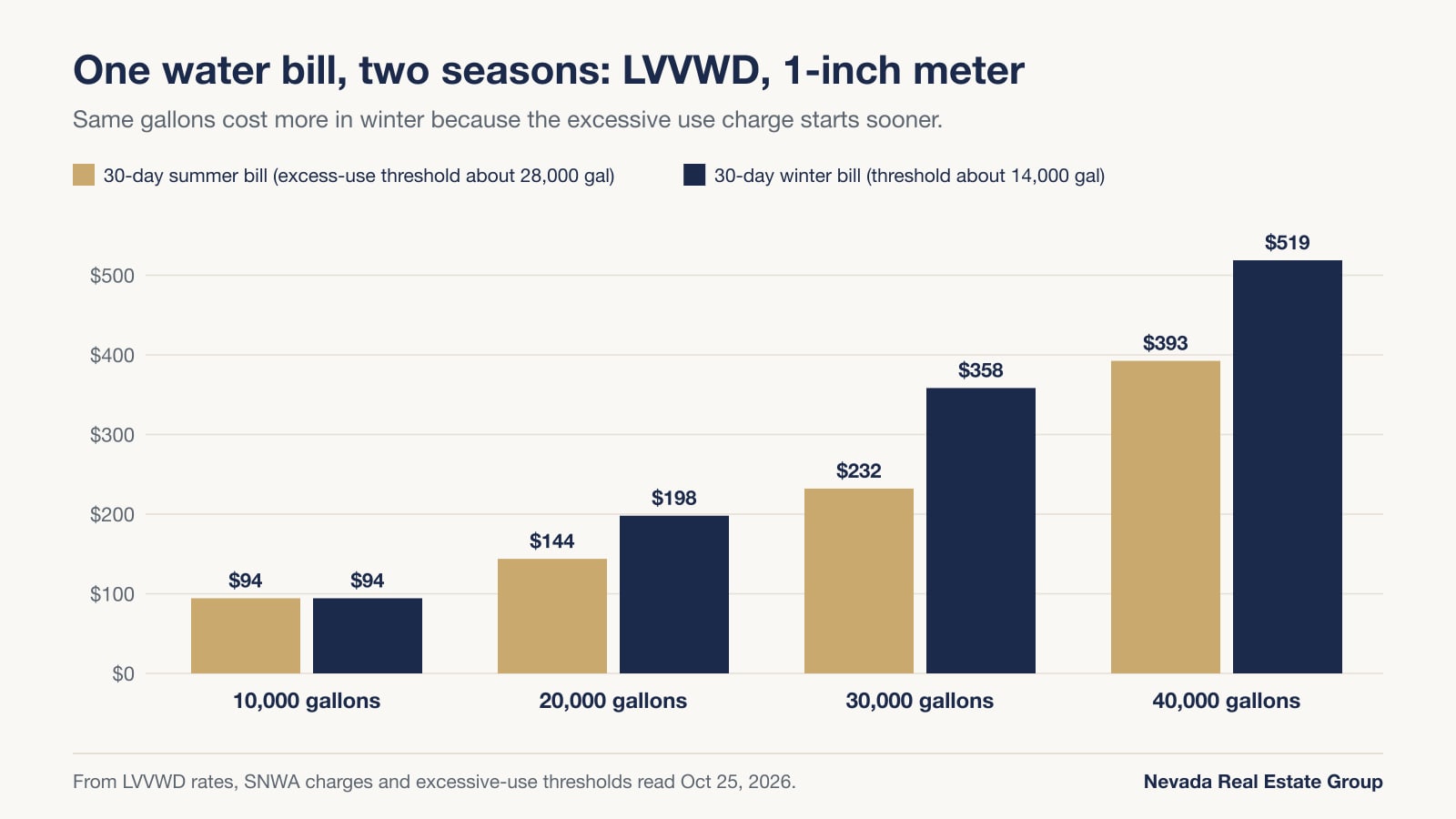
Water is the one utility that follows the lot more than the house. According to the Las Vegas Valley Water District, single-family customers pay a daily service charge by meter size, $13.88 per 30 days for a 5/8-inch meter, $15.98 for 3/4-inch, $20.19 for 1-inch and $30.70 for 1.5-inch, plus four tiers per 30 days: $1.61 per 1,000 gallons for the first 5,000, $2.87 for the next 5,000, $4.27 for the next 10,000 and $6.33 above 20,000. Southern Nevada Water Authority charges are added to the same bill. In LVVWD's own bill estimator on October 25, 2026, 15,000 gallons on a 1-inch meter came to $119.11, including a $10.05 SNWA commodity charge and a $44.94 SNWA infrastructure charge.
High use costs more again. LVVWD adds an excessive use charge of $9 per 1,000 gallons above seasonal thresholds of about 14,000 gallons per 30 days in winter, 16,000 in spring, 28,000 in summer and 26,000 in fall. According to LVVWD's excessive use charge FAQ, a customer can use 252,000 gallons a year without triggering it, the median half-acre property uses 145,000 gallons a year, and about 80 percent of large lots stay under the thresholds.
| Yearly use | 3/4-inch meter | 1-inch meter | Basis for the usage level |
|---|---|---|---|
| 100,000 gallons | $682 | $1,068 | Illustration for a smaller lot; LVVWD publishes no median by lot size |
| 145,000 gallons | $883 | $1,269 | LVVWD's median for half-acre properties |
| 200,000 gallons | $1,163 | $1,549 | Illustration below the 252,000-gallon threshold total |
Our calculator reproduces LVVWD's estimator to the cent at 10,000, 12,000, 15,000, 25,000 and 40,000 gallons. The meter alone is worth about $386 a year at the same use, mostly through the SNWA infrastructure charge, so check the meter size on the seller's bill. Henderson sets its own water rates: according to the City of Henderson, a 3/4-inch or smaller meter carries $19.41 per 30 days and a 1-inch meter $39.86, with tiers of $1.84, $3.06, $4.32 and $11.32 per 1,000 gallons.
Sewer and trash do not scale with the house. According to the Clark County Water Reclamation District's service rules, whose service area is unincorporated Clark County, a single-family residence is one equivalent residential unit, billed $307.16 a year from July 1, 2026 through June 30, 2027, plus a $4 quarterly account charge of up to $16 a year. Addresses inside a city are billed by that city instead; Henderson's single-family wastewater charge is $31.61 per 30 days, about $385 a year. The City of Las Vegas Republic Services rate sheet for 2026-27 sets weekly trash and recycling at $20.02 a month, with an optional second cart at $18.11. Other jurisdictions set their own trash rates, and we could not find a published single-family trash rate for unincorporated Clark County or Henderson. So the $563 to $625 line in the cost table is a composite, sewer at the CCWRD or Henderson rate plus trash at the City of Las Vegas rate, and a guide rather than any one home's bill.
How Much Does a Private Pool Add Each Year?
A pool adds three kinds of cost: water lost to evaporation, electricity for the pump, and service and repairs. Only the first two have published local numbers. According to the Southern Nevada Water Authority, an average in-ground pool loses 48.6 gallons of water per square foot each year to evaporation, a typical Southern Nevada pool of around 470 square feet loses as much as 22,842 gallons a year, and a pool cover reduces evaporation by 90 percent. SNWA also notes that it approved a resolution in July 2022 supporting a 600-square-foot surface-area limit on new residential pools, which LVVWD and other local jurisdictions then put into their rules and codes.
At LVVWD's tier prices plus the SNWA commodity charge, replacing 22,842 gallons costs about $113 a year if it is billed in the third tier, $160 in the fourth tier, and about $365 if it pushes a summer bill over the excessive-use threshold. A cover changes that line more than anything else. For the pump, EIA's RECS 2020 microdata shows Mountain South homes with a pool pump using about 2,177 kilowatt-hours a year for it, about $264 at NV Energy's current residential rate. A gas or electric pool heater adds to that, by an amount that depends on how warm the water is kept.
That leaves service, chemicals and equipment. We could not find a published local survey of pool service prices for Las Vegas, so this guide does not print one; get at least three written bids, and ask each company what is included. The MLS shows how common the cost is: about 30 percent of 2,000 to 2,999 square-foot sales had a private pool, 56.3 percent at 3,000 to 4,499, 82.0 percent at 4,500 to 5,999 and about 94 percent above 6,000 square feet.
Because the electricity figures in the cost table are survey averages that already include whatever pools those homes had, we did not add the pump to the totals; the pool numbers here are for comparing a pool home with one that has none. Before you remove contingencies on a pool home, have the pool inspected on its own. Our guide to the cost of a pool in Las Vegas covers construction and inspection, and our homes with pools page shows what is listed now.
What Does Homeowners Insurance Cost for a Large Nevada Home?
The most useful published data on homeowners premiums is organized by the amount of dwelling coverage, not by the sale price. The National Association of Insurance Commissioners publishes average premiums by state and by that amount of insurance. According to the NAIC homeowners report, whose newest edition covers 2023 data, Nevada's average HO-3 premium was $1,013 against a countrywide average of $1,737.
| Dwelling coverage (amount of insurance) | Nevada average HO-3 premium, 2023 |
|---|---|
| $400,000 to $449,999 | $942 |
| $450,000 to $499,999 | $1,006 |
| $500,000 to $599,999 | $1,108 |
| $600,000 to $699,999 | $1,265 |
| $700,000 to $999,999 | $1,810 |
| $1,000,000 and over | $2,627 |
| All Nevada HO-3 policies | $1,013 |
The average rises about 80 percent from the $450,000 tier to the $700,000 tier and climbs again above $1 million in coverage. In the cost table at the top, we assumed dwelling limits of $450,000 to $699,999 for the 2,000 to 2,999 band, $600,000 to $999,999 for 3,000 to 4,499, $700,000 to $1 million-plus for 4,500 to 5,999 and $1 million-plus above 6,000 square feet. Those are assumptions for illustration, not estimates for any home; the dwelling limit on your quote is the number to look up.
Two more cautions. The NAIC averages are for 2023, so a quote today will differ, and a custom or very large home can sit far above the $1 million-plus average because that tier has no ceiling. Coverage choices and the details of the house move a premium. Get the quote, with the dwelling limit shown on it, during your inspection period. Our Las Vegas homeowners insurance guide covers coverage types and the questions to ask an agent.
Which Upkeep Costs Have No Published Local Figure?
Several of the costs that worry owners of large homes have no published local price that we could verify, so they are not in the totals. They are air-conditioning service and replacement, roof repairs and underlayment work, pest control, landscape maintenance, pool service, and the general repairs every home needs. For each, the honest instruction is the same: get written bids from licensed contractors before you commit, and compare the scope line by line. We are not printing a number for any of them because we could not find one that is published, local and dated.
What is published can still guide the budget. The MLS tells you how much equipment there is to maintain: about half of the 3,000 to 4,499 square-foot sales listed two air-conditioning units, and the median lot above 6,000 square feet is about half an acre. A home inspection, with separate pool and HVAC inspections where they apply, tells you the age of what you are inheriting. Our first 90 days homeowner maintenance checklist lists the seasonal tasks to schedule.
Landscaping is one place where a published program changes the math. According to SNWA's Water Smart Landscapes rebate page, a single-family owner who replaces grass with desert landscaping is paid $5 a square foot for the first 10,000 square feet and $2.50 after that; LVVWD customers get an additional $2 a square foot, the City of Henderson pays a $575 additional rebate, and new trees earn a $100 bonus. That lowers outdoor water use as well as maintenance, but the program comes with a recorded easement, which our SNWA grass removal rebate guide explains in full.
The practical step is to ask the seller for receipts and service records for the A/C units, roof and pool, and the age of each major system. A large home with new equipment and an old one of the same size can differ by thousands of dollars in near-term repairs, which no average will show.
What Changes the Yearly Total the Most?
Six factors account for most of the difference between two homes of similar size, and all of them can be checked before you write an offer.
Association dues. In our window, gated homes with a fee paid roughly twice the dues of non-gated homes in the two smaller bands, $127.50 against $67 a month at 2,000 to 2,999 square feet and $158.50 against $62 at 3,000 to 4,499. Above 6,000 square feet the median for gated homes was $638.33 a month.
The tax district and the tax history. The same taxable value costs about 14 percent more in the City of North Las Vegas than in an unincorporated town such as Spring Valley or Summerlin South, at 3.3544 against 2.9328 per $100. Years of capped growth can keep an older home's bill well below a new home's, and that history transfers with the parcel.
The pool. Evaporation and pump energy alone come to roughly $377 to $629 a year at the rates above, before any service contract, chemicals or repairs.
Solar. Between 8.7 and 14.0 percent of sales in each band listed solar panels, owned or leased. Owned panels offset part of the power bill; panels owned by a third party come with an agreement the buyer should read before closing.
More cooling. A second air-conditioning system often goes with more conditioned space. In the RECS survey, cooling use rose from about 4,934 to 7,534 kilowatt-hours a year between the 2,000 to 2,999 and 3,000 to 4,499 groups, about $315 more at the current rate.
Lot size and the water meter. A half-acre median of 145,000 gallons on a 1-inch meter costs about $1,269 a year, and the same use on a 3/4-inch meter would cost about $883. Special and Local Improvement District assessments, billed separately from the tax bill, add a separate line for the 11 to 13 percent of smaller-band homes flagged for one.
What Does the Full Monthly Payment Look Like With a Mortgage?
Ownership costs sit on top of the loan payment, so it helps to see both. According to Freddie Mac's Primary Mortgage Market Survey, the 30-year fixed rate averaged 7.32 percent as of October 22, 2026, down from 7.40 percent a week earlier. Using that rate, a 20 percent down payment and the median closed price in each band, principal and interest alone come to the figures below. Taxes, dues, insurance and utilities are shown separately, because a lender's escrow covers only some of them.
| Size band | Median price | Loan at 80% | Principal and interest | Ownership costs | Monthly total |
|---|---|---|---|---|---|
| 2,000–2,999 sq ft | $560,000 | $448,000 | $3,077 | $760 to $835 | $3,837 to $3,912 |
| 3,000–4,499 sq ft | $863,500 | $690,800 | $4,745 | $1,033 to $1,132 | $5,778 to $5,877 |
| 4,500–5,999 sq ft | $1,600,000 | $1,280,000 | $8,793 | $1,598 to $1,694 | $10,391 to $10,487 |
| 6,000+ sq ft | $4,350,000 | $3,480,000 | $23,905 | $2,882 or more | $26,787 or more |
Two limits on this table matter. Freddie Mac's survey covers conventional loans within the conforming limits FHFA sets, and according to FHFA, the 2026 baseline limit for a one-unit home is $832,750. The loans in the two largest bands are above that limit, so they are jumbo loans whose rates lenders set separately; the 7.32 percent figure is a reference point for them, not a quote.
The second limit is that the ownership-cost column is the yearly estimate divided by twelve, and some of those costs arrive as larger, less frequent bills. Association dues may be billed quarterly, and the Water Reclamation District's annual sewer charge carries a quarterly billing option. Plan the cash flow as well as the total. If the payment math is close, our first-time buyer resources cover the debt-to-income ratio lenders look at.
How Should You Compare Two Larger Homes Before You Write an Offer?
The averages in this guide are a starting point. The numbers that decide between two specific homes come from the homes themselves, and most of them can be gathered during the inspection period.
Ask the seller for 12 months of NV Energy, water and Southwest Gas bills. They capture the real cooling load, the pool, the landscape and the meter size in a way no survey can. Pull the parcel's current tax bill and district from the county, and note whether the home is new enough to face an uncapped first year. Read the HOA resale package for the full dues, any special assessment and the reserve study, and ask the title company about any SID or LID balance. If the home has solar, get the lease or purchase agreement. If it has a pool, get a pool inspection, and get an insurance quote that shows the dwelling limit before your contingency ends.
Then put the two homes side by side on the same table this guide uses: tax, dues, power, gas, water, sewer, trash, insurance and the pool. A home that costs $40,000 more to buy can still cost less to own each year, and the reverse is just as common.
If you are weighing specific homes in Las Vegas, Henderson or Summerlin, I am glad to help you gather those records and compare them before you write an offer. Start with our buyer services, browse luxury communities across the valley, or call me directly at (702) 637-1759.
Frequently Asked Questions
Is property tax on a $1 million home in Las Vegas about 1 percent a year?
Usually less. In our March through August 2026 window, the median annual tax shown on resale listings was 0.52 to 0.57 percent of the sale price across the four size bands. Nevada taxes 35 percent of taxable value at a district rate of roughly $2.93 to $3.35 per $100 in the main valley jurisdictions, and caps how fast a bill can grow, so a specific home's bill can be well above or below that range.
Does buying a home reset the property tax in Nevada?
No. The cap is measured against the property's tax for the prior fiscal year, and that history stays with the parcel. A recorded deed does remove the 3 percent owner-occupied abatement, so the new owner must claim it again; until then a general cap of up to 8 percent applies, and Clark County's general cap for 2026-27 is 8.0 percent.
How much does it cost to cool a 4,000-square-foot home in Las Vegas?
The closest published estimate is EIA's 2020 survey, in which Mountain South single-family homes of 3,000 to 4,499 square feet used about 7,534 kilowatt-hours a year for cooling. At NV Energy's residential rate effective October 1, 2026, including the 5 percent Clark County fee, that is about $914 a year, out of about $2,606 for all electricity. The seller's bills are the better guide.
Are HOA dues higher in gated communities?
Yes, in our data. Among March through August 2026 closings that listed a fee, gated homes had median dues of $127.50 a month in the 2,000 to 2,999 square-foot band against $67 outside a gate, and $158.50 against $62 in the 3,000 to 4,499 band. Above 6,000 square feet, the gated median was $638.33 a month.
How much water does a half-acre lot use in Las Vegas?
According to the Las Vegas Valley Water District, the median half-acre property uses about 145,000 gallons a year, well below the 252,000 gallons a year that can be used without triggering the excessive use charge. On a 1-inch meter at the rates read October 25, 2026, 145,000 gallons comes to about $1,269 a year.
Do sewer and trash bills go up with a bigger house?
Generally not. The Clark County Water Reclamation District, which serves unincorporated Clark County, bills each single-family home as one unit, $307.16 a year for July 2026 through June 2027 plus a small account charge. Henderson's single-family wastewater charge is a flat $31.61 per 30 days, and the City of Las Vegas trash rate for 2026-27 is a flat $20.02 a month.
How much should I budget for maintenance on a large Las Vegas home?
We could not find a published local figure for air-conditioning, roof, pest, landscape or pool service costs, so we do not quote one. Get written bids from licensed contractors, ask the seller for service records and system ages, and order separate pool and HVAC inspections during the inspection period.
Which Sources Inform This Large-Home Cost Guide?
The sales figures are Nevada Real Estate Group's analysis of GLVAR MLS records retrieved through Repliers on October 25, 2026: 5,711 Clark County single-family closings with a closing date from March 1 through August 31, 2026, split by MLS living area, with dues, tax and feature figures drawn from the 5,515 records that carried full detail. Dues use GLVAR's monthly association-fee total; tax uses the amount entered on each listing for resale homes built in 2023 or earlier. Utility, tax and loan figures were read on each publisher's own page on October 25, 2026, in a desktop browser, and the bills are our calculations from those rates, shown with their inputs. Electricity and gas use come from our weighted analysis of EIA's RECS 2020 public microdata (version 7). No client files, addresses or MLS photographs were used.
- Clark County Assessor: tax abatement (3 percent and up to 8 percent caps)
- Clark County Assessor: real property, taxable value and the 35 percent assessment ratio
- Nevada Department of Taxation: fiscal 2026-27 tax rates, rate book page iii (PDF)
- Nevada Department of Taxation: final 2026-27 tax cap factors (PDF)
- Nevada Legislature: NRS chapter 361, including 361.225, 361.227, 361.4722 and 361.4723
- Clark County Treasurer: understanding special improvement districts
- NV Energy: Nevada Power residential rate schedules effective October 1, 2026 (PDF)
- U.S. Energy Information Administration: RECS 2020 microdata
- Southwest Gas: Nevada gas cost rates and average bills
- Southwest Gas: Nevada rates and regulation, general rate case filing
- Las Vegas Valley Water District: rates, fees and charges
- Las Vegas Valley Water District: excessive use charge FAQ
- Las Vegas Valley Water District: water bill estimator
- Southern Nevada Water Authority: pools and spas, evaporation and pool size limits
- Southern Nevada Water Authority: Water Smart Landscapes rebate
- City of Henderson: water and wastewater rates
- Clark County Water Reclamation District: service rules effective July 1, 2026 (PDF)
- City of Las Vegas: Republic Services rates, July 1, 2026 to June 30, 2027 (PDF)
- NAIC: Dwelling Fire, Homeowners Owner-Occupied and Homeowners Tenant and Condominium/Cooperative Unit Owners Insurance, data for 2023 (PDF)
- Freddie Mac: Primary Mortgage Market Survey
- FHFA: conforming loan limit values for 2026
Chris Nevada · Nevada Real Estate License S.181401 · Nevada Real Estate Group · LPT Realty. This guide uses published rates and our own MLS analysis to estimate typical costs; it is not tax, insurance or legal advice. Confirm every figure for a specific home before you rely on it.