

Published May 10, 2026 · Updated May 10, 2026 · By Chris Nevada, Nevada Real Estate Group · NV License S.181401
Direct Answer: Las Vegas is one of the top luxury retirement destinations in the American West, offering zero state income tax (saving a retired couple with $1.2 million income $84,000-$120,000 annually versus California), no inheritance or estate tax, 310+ clear-sky days, and eight luxury 55+ and age-friendly communities ranging from $720,000 (Sun City Anthem) to $4.5 million (The Ridges). Retirees and snowbirds comprise approximately 31% of inbound Clark County migration, per U.S. Census Bureau data. The optimal buying window is January through March when $1M+ inventory is 35-40% higher than fall.
Retirees and snowbirds make up 31% of Las Vegas inbound migration. Zero state income tax saves a retired couple with $1.2M income $84,000-$120,000 annually. Here are the top luxury communities, tax strategies, and practical logistics for 2026. For the full tax breakdown, our Nevada tax advantages guide covers income tax, capital gains, and estate planning in detail.
- Retirees and snowbirds make up about 31% of inbound Clark County migration per Census data.
- Zero state income tax saves a retired couple with $1.2M income $84,000 to $120,000 annually.
- A $2 million home costs roughly $12,000 in annual property tax versus $20,000 in California.
- Across a 20-year retirement that difference preserves $1.68 to $2.4 million in capital.
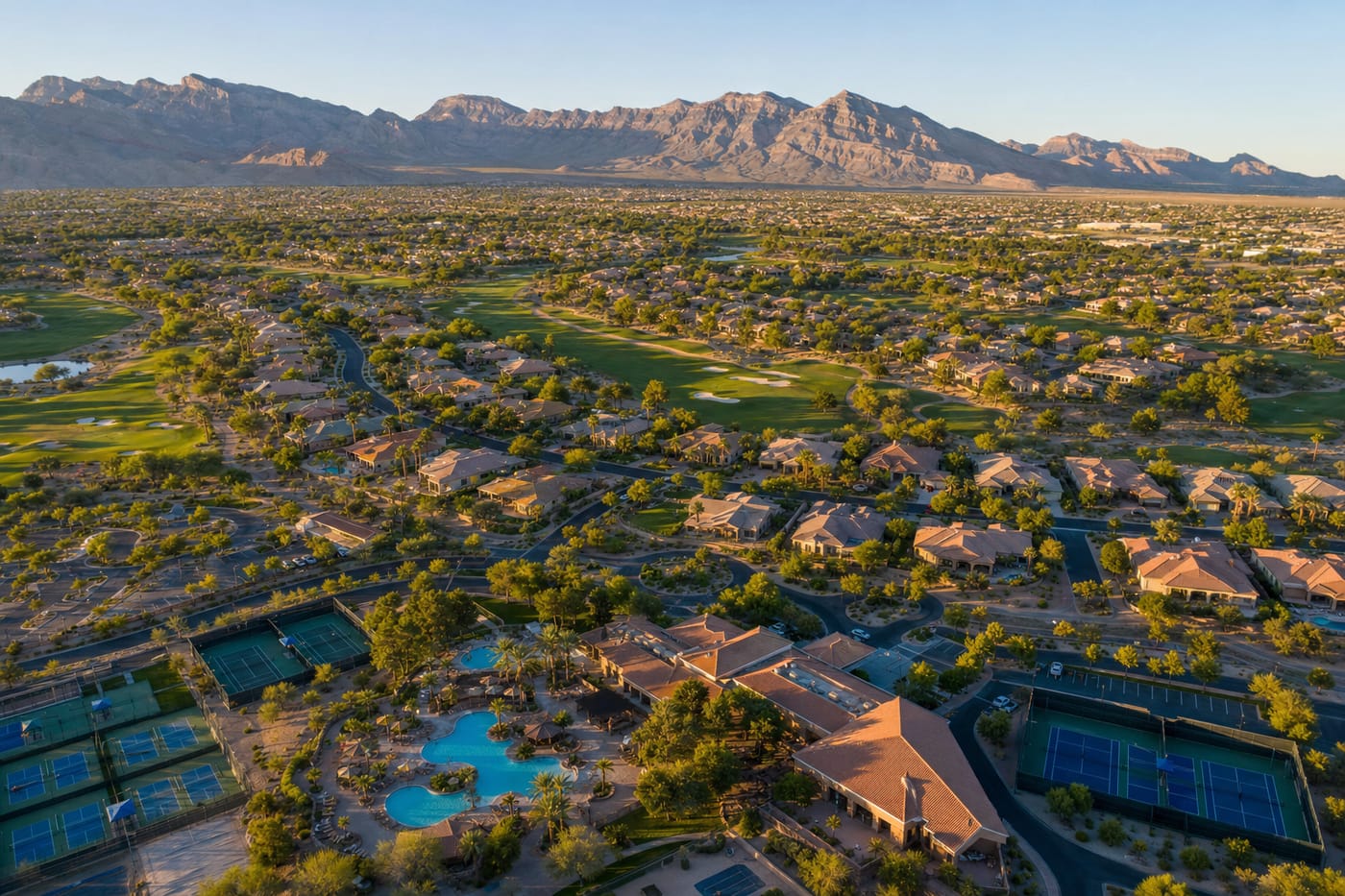
- Siena offers 800 homes in a guard-gated Summerlin enclave with golf, spa and concierge service.
What Should Readers Know First?
- Retirees relocating from California with $1.2 million in annual income save $84,000-$120,000 per year in state income tax. Over 20 years, that is $1.68-$2.4 million in preserved capital, per Tax Foundation comparative data.
- Eight luxury communities serve the 55+ market: Sun City Summerlin ($780,000 median), Sun City Anthem ($720,000), Siena ($1.2M-$2.8M), The Ridges ($2.1M-$4.5M), Lake Las Vegas ($850,000-$3.8M), Anthem Country Club, Seven Hills, and Trilogy at Sunstone ($1.1M-$2.2M).
- Nevada's 3% annual property tax cap for primary residences protects retirees from reassessment shocks. A $2 million home costs approximately $12,000 annually in property tax — versus $20,000+ in California.
- Snowbirds occupying properties October through April can generate $4,500-$6,500/month in seasonal rental income during their absence, partially offsetting carrying costs.
- January-March is the optimal purchase window: $1M+ inventory runs 450-520 active listings versus 320-380 in September, and seller motivation is highest in winter.
I have helped hundreds of retirees and snowbirds transition to Las Vegas since founding Nevada Real Estate Group. The financial case is overwhelming — but the lifestyle and logistics questions are where most buyers need the most guidance. This guide covers every community, every tax angle, and every practical detail from lock-and-leave management to healthcare access.
For the full tax breakdown, our Nevada tax advantages guide covers income tax, capital gains, and estate planning in detail. For community-specific pricing, see our 55+ communities page.
Why Are 31% of Las Vegas Newcomers Retirees and Snowbirds?
The Las Vegas metro grew 2.1% annually from 2020-2025, adding approximately 127,000 residents. Retirees and snowbirds comprise about 31% of that inbound migration — the single largest buyer demographic after working-age families.
Three factors drive the trend:
Tax savings that compound over decades. A retired couple with $1.2 million in combined income (pensions, Social Security, investment distributions) saves $84,000-$120,000 per year in state income tax by moving from California to Nevada. Over a 20-year retirement, that is $1.68-$2.4 million in preserved capital — before considering investment returns on the saved amount.
A retiree with $2 million in assets generating 5% returns ($100,000 annually) preserves $8,000-$12,000 per year in state taxes. Compounded over 20-30 years, that single savings stream grows to $160,000-$360,000.
Climate that supports year-round outdoor activity. Las Vegas averages 310+ clear-sky days annually with a January high of 58 degrees F. Retirees from the Midwest, Northeast, and Pacific Northwest can golf, hike, and swim outdoors 12 months per year. Mt. Charleston (50 minutes) provides ski access in winter. Red Rock Canyon offers 26 hiking trails 15 minutes from Summerlin.
Low natural disaster exposure. No hurricanes, minimal earthquake risk, no flooding in master-planned communities, and no tornado corridor. For retirees leaving Florida's hurricane insurance crisis or California's wildfire zones, Nevada's risk profile is a material quality-of-life advantage.

Which Luxury Communities Serve Retirees in Las Vegas and Henderson?
Eight communities target the affluent 55+ buyer. Each serves a different lifestyle and budget.
Luxury Retirement Community Comparison (2026)
| Community | Price Range | HOA/Month | Age Req. | Key Amenity | Best For |
|---|---|---|---|---|---|
| Sun City Summerlin | $650K-$1.2M | $380-$480 | 55+ | 3 golf courses (fees separate), swim center | Active golfers, established community |
| Sun City Anthem | $550K-$950K | $320-$420 | 55+ | 77K sqft Anthem Center, Revere golf adjacent | Henderson lifestyle, trails |
| Siena (Summerlin) | $1.2M-$2.8M | $500-$750 | 55+ | 18-hole semi-private golf, spa, concierge | Affluent downsizers |
| The Ridges | $2.1M-$4.5M | $400-$800 | None (50+ typical) | Club Ridges, Amara Golf (2027) | Ultra-luxury, views |
| Lake Las Vegas | $850K-$3.8M | $200-$475 | None | 60-acre lake, yacht club, golf | Waterfront, resort lifestyle |
| Anthem CC | $685K-$2M+ | $120-$280 | None | Championship golf, trails | Guard-gated golf community |
| Seven Hills | $650K-$3M+ | $180-$350 | None | Guard-gated, Strip views | Luxury, established Henderson |
| Trilogy at Sunstone | $1.1M-$2.2M | $350-$500 | 55+ | Resort pool, modern architecture | Younger active adults (55-75) |
Source: Las Vegas REALTORS MLS Q1 2026, community HOA records, Nevada Real Estate Group retirement transaction data.
Sun City Summerlin is the flagship — 8,000+ residents, three golf courses (the 18-hole Palm Valley and Highland Falls plus the par-60 executive Eagle Crest), a swim center, and comprehensive healthcare services on-site. Get the golf math right here, because it is the most common thing buyers are told wrong: the HOA of $380-$480/month covers fitness, pools, clubhouses and security, but it does not include golf. Golf Summerlin sells residents separate annual memberships, published on its own site — $4,200 a year for the unlimited Diamond tier down to $500 a year for Silver, which still charges a reduced daily fee.
Siena is the luxury play — a guard-gated Summerlin enclave wrapped around Siena Golf Club, an 18-hole par-72 Brian Curley and Lee Schmidt design that opened in 2000, with a full spa and concierge services. The course is semi-private, not resident-only: it still releases public and twilight tee times and posts peak-season visitor rates. At $1.2M-$2.8M, Siena attracts affluent downsizers who want country-club atmosphere without the scale of Sun City, and golf is paid per round or by membership rather than bundled into the assessment.
Lake Las Vegas offers waterfront living on a 320-acre private lake with marina access, two Jack Nicklaus courses — the private SouthShore and the public daily-fee Reflection Bay — and the Hilton Lake Las Vegas Resort. For retirees who want the waterfront lifestyle without coastal property tax and hurricane insurance, Lake Las Vegas delivers at 40-60% of comparable coastal pricing.
For a complete 55+ community guide, see our 55+ communities page.
How Does Nevada's Tax Structure Save Retirees Hundreds of Thousands?
Nevada's tax advantages are not marginal for retirees — they are transformational over a 20-30 year retirement horizon.
Retirement Tax Savings: Nevada vs California vs New York
| Tax Category | Nevada | California | New York | 20-Year Nevada Savings |
|---|---|---|---|---|
| State income tax | 0% | Up to 13.3% | Up to 10.9% | $160K-$2.4M |
| Social Security taxation | Not taxed | Not taxed | Not taxed | — |
| Pension/annuity taxation | 0% | Up to 13.3% | Up to 10.9% | Significant |
| Capital gains tax | 0% | 13.3% | 10.9% | Per transaction |
| Estate tax | None | None | 3.06-16% over $6.94M | Up to $3.2M saved |
| Inheritance tax | None | None | None | — |
| Property tax ($2M home) | approximately $12,000/yr | approximately $20,000/yr | $20,000-$30,000/yr | $160K-$360K |
Source: Tax Foundation 2026 comparative rates, California FTB, New York State DTF.
Estate planning impact: A retiree with a $20 million estate relocating from New York to Nevada avoids $600,000-$3.2 million in state estate taxes. New York imposes 3.06-16% estate tax on amounts exceeding $6.94 million. Nevada has zero estate tax at the state level.
Community property election: Nevada married couples can elect community-property treatment for all assets, providing stepped-up basis for surviving spouses. When one spouse dies, the surviving spouse receives a full step-up in basis on all community property — not just 50%. This saves substantial capital gains tax if the surviving spouse later sells investment properties or the primary residence.
Nevada living trusts enable property transfers to beneficiaries without probate — avoiding California's 3-7% probate costs on large estates and maintaining privacy. Nevada is one of the most trust-friendly states in the nation.
What Monthly Operating Costs Should Luxury Retirees Budget?
Beyond the purchase price, monthly carrying costs vary significantly by community tier.
Monthly Operating Costs by Community Tier
| Expense | Sun City Summerlin | Siena / Ridges | Lake Las Vegas |
|---|---|---|---|
| HOA dues | $380-$480 | $500-$750 | $200-$475 |
| Property tax | $160-$220 | $250-$350 | $200-$300 |
| Insurance | $80-$120 | $150-$200 | $120-$180 |
| Utilities | $150-$250 | $200-$300 | $180-$280 |
| Pool maintenance | $125-$175 | $150-$200 | $125-$175 |
| Total monthly | $895-$1,245 | $1,250-$1,800 | $825-$1,410 |
Source: Nevada Real Estate Group client cost data 2024-2026.
Important context: Sun City Summerlin's $380-$480 HOA includes golf, fitness, pools, and security — a $300-$600 value if purchased separately. When you factor in the included amenities, the net monthly carrying cost is competitive with independent living in a non-amenity neighborhood.
20-year comparative analysis:
- Nevada vs Florida: Nevada saves $72,000-$144,000 in property taxes plus hurricane insurance premiums ($3,000-$8,000/year in Florida)
- Nevada vs Arizona: Comparable property taxes, but Nevada's zero income tax saves $5,000-$120,000 annually depending on income
- Combined tax advantage over 20-year retirement: $250,000-$500,000+ in preserved wealth
What Do Snowbirds Need to Know About Lock-and-Leave Living?
Snowbirds who occupy their Las Vegas home October through April (6-7 months) need a property management and security plan for the off-season.
Professional property management ($300-$800/month) includes:
- Monthly interior inspections
- HVAC and plumbing system checks
- Pool maintenance and chemical balance
- Landscape watering and pest control
- Mail collection and package management
- Emergency response coordination
Insurance alert: Standard homeowner policies may not cover extended unoccupied periods (60+ days). Snowbirds need either a landlord policy or a vacant-home endorsement — $1,200-$1,800 annually. Many HOAs prohibit absences beyond 6 months unless professionally managed.
Smart home technology for remote monitoring:
- Smart thermostats (Nest, Ecobee) for remote temperature management — critical in Las Vegas summers where indoor temps can exceed 130 degrees F in an unoccupied home
- Security systems with door/window sensors, motion detection, and professional monitoring
- Flood detection sensors that alert property management to water leaks within hours
Rental income opportunity: Snowbird properties in Summerlin and Lake Las Vegas rent for $4,500-$6,500/month during the October-April season. This income can offset $27,000-$45,500 of annual carrying costs — in many cases covering the full HOA, property tax, and management fees.
What Healthcare Access Supports Retiree Decision-Making?
Healthcare proximity is a non-negotiable factor for retirees. Las Vegas delivers strong access:
Primary hospital systems:
- Sunrise Hospital (10 minutes from Summerlin — 24-hour emergency, cardiology, orthopedics)
- MountainView Medical Center (Henderson — geriatric services specialty)
- Spring Valley Hospital (southwest Las Vegas)
- Desert Springs Hospital (east Las Vegas)
- Henderson Hospital (Henderson — newest facility)
- St. Rose Dominican (three Henderson campuses)
Specialty access: Cardiology, orthopedics, oncology, and neurology specialists are concentrated along the Eastern Avenue / Horizon Ridge corridor in Henderson. Sun City Anthem and Seven Hills residents are within 10-15 minutes of this medical corridor.
Regional access: Mayo Clinic Phoenix is a 4-hour drive for complex cases requiring regionally significant specialty care.
Medicare: 200+ Medicare Advantage plans are available in Clark County — one of the highest plan counts in the nation, providing retirees with competitive coverage options and provider choice.
When Is the Best Time to Buy a Luxury Retirement Home in Las Vegas?
January through March is the optimal purchase window for $1M+ luxury homes. The data:
Seasonal Inventory and Pricing ($1M+ Segment)
| Month | Active Listings | Avg. Days on Market | Negotiation Room | Advantage |
|---|---|---|---|---|
| January | 450-480 | 55-65 | $50K-$100K below ask | Highest inventory, motivated sellers |
| February-March | 480-520 | 50-60 | $40K-$80K below ask | Peak inventory, fastest processing |
| June-August | 380-420 | 45-55 | $20K-$40K below ask | Competition from relocators |
| September-October | 320-380 | 60-70 | $30K-$60K below ask | Lowest inventory |
Source: Las Vegas REALTORS MLS seasonal data 2023-2026.
Why winter works: Snowbirds who spent their first season in Las Vegas and decided it is not for them list in January. Retirees whose health changed or whose family dynamics shifted put properties on the market. These are motivated sellers with realistic price expectations. Appraisals and inspections move faster in winter (fewer competing transactions), and closing timelines shrink to 30-35 days versus 38-45 in summer.
For buyers ready to start the search, call (702) 637-1759 or fill out our home valuation form if you are also selling a property in another state.
What Residency Requirements Must Retirees Meet to Claim Nevada Tax Benefits?
Establishing Nevada residency is straightforward but must be documented properly — especially for retirees leaving California, where the Franchise Tax Board actively audits residency changes.
Nevada residency checklist:
- Purchase or lease a primary residence in Nevada
- Register vehicles in Nevada (within 30 days)
- Obtain Nevada driver's license (within 30 days)
- Update voter registration to Nevada
- Maintain Nevada residence 183+ days annually
- File Nevada state taxes (none required — no income tax)
California clawback risk: The California FTB challenges retirees claiming Nevada residency while maintaining substantial California ties — a vacation home, active business, or family property in California. A retiree with a $2 million Lake Tahoe vacation home cannot credibly claim Nevada primary residency while spending 4 months per year at the Tahoe property. The FTB has prevailed in multiple high-profile cases.
Documentation that protects you: Utility bills showing Nevada usage, Clark County library card, Nevada bank accounts, physician and dental records transferred to Nevada providers, church or social organization membership in Nevada. The more daily-life documentation you have in Nevada, the stronger your residency claim.
For retirees also considering a 1031 exchange as part of the move, establishing Nevada residency before executing the exchange provides the cleanest tax treatment. Our team coordinates with multi-state tax advisors to structure the residency change and property acquisition in the correct sequence — minimizing audit risk and maximizing tax efficiency.
How Do Golf and Club Privileges Work in Luxury Retirement Communities?
Golf is the lifestyle anchor for most Las Vegas luxury retirees. Here is how access and pricing compare:
Sun City Summerlin: Three courses on site — Palm Valley and Highland Falls at 18 holes each, plus the par-60 executive Eagle Crest. Golf is a separate cost from the HOA, and Golf Summerlin publishes its resident tiers: $4,200 a year buys unlimited rounds and range balls across all three, while $1,100 a year buys reduced daily fees of $30 at Palm Valley and Highland Falls and $25 at Eagle Crest. For a retiree playing three rounds a week, the unlimited tier works out to well under $30 a round — genuinely one of the best golf values in Las Vegas retirement living, just not a free one.
Siena: An 18-hole par-72 layout by Brian Curley and Lee Schmidt, open since 2000 and run as a semi-private club — residents get preferred access and pricing, but the course also sells public and twilight tee times, and peak-season visitor rates run near $189 with cart. Conditioning is held to private-club standards year-round, which is why it draws outside play at that price.
The Ridges: Amara Golf Club, the former Jack Nicklaus-designed Bear's Best Las Vegas, is mid-way through a $300 million redevelopment after Mulligan Holdings bought the course for $30.5 million. It closed to public play in June 2025, construction started that September, and the private members-only club is targeting an October 2026 reopening, with boutique villas following by December 2027. Membership pricing has not been published by the club, so treat any initiation figure you are quoted by a listing agent as unconfirmed. What is confirmed and worth planning around: retirees buying a fairway-fronting Ridges home in 2026 are buying alongside an active construction site, with the amenity arriving after close rather than before it.
Lake Las Vegas: Reciprocal golf access with other resort-style courses in the Summerlin and Henderson networks. Some Arizona course reciprocal arrangements are available for snowbirds who spend part of the year in Scottsdale or Tucson.
For a complete golf community comparison, see our golf communities page.
What Cultural and Lifestyle Activities Support Year-Round Retirement?
Las Vegas offers a cultural calendar that most retirement destinations cannot approach — 150+ resident shows per week, regionally significant dining, and performing arts that rival New York and San Francisco.
Performing arts:
- The Smith Center for the Performing Arts: Broadway touring productions, Nevada Ballet Theatre, Las Vegas Philharmonic, Desert Chorale
- Season subscriptions: $800-$2,500 — a fraction of comparable programs in New York or San Francisco
- The Sphere: 18,600-seat immersive entertainment venue, the most technologically advanced concert space on Earth
Culinary access:
- More Michelin-starred restaurants per capita than any U.S. city outside New York and San Francisco
- Celebrity chef restaurants: Wolfgang Puck, Jose Andres, Emeril Lagasse, Guy Savoy
- Wine tasting events and culinary clubs within luxury retirement communities
Outdoor recreation (year-round):
- Red Rock Canyon: 26 hiking trails, 15 minutes from Summerlin. January average high: 58 degrees F — perfect hiking weather
- Lake Mead: Boating, fishing, kayaking, 30 minutes from Henderson
- Mt. Charleston: Skiing December-March (50 minutes from Summerlin), summer hiking at 8,000-11,000 feet with 30-degree temperature relief
Community engagement:
- Sun City Summerlin operates 80+ chartered clubs (woodworking, photography, bridge, pickleball, bocce, theater)
- Sun City Anthem has similar programming with 70+ clubs
- The Ridges and Siena host private social events, wine dinners, and holiday celebrations
For families with grandchildren visiting, the Discovery Children's Museum (58,000 sq ft), Springs Preserve (180 acres), and the Neon Museum provide multi-generational entertainment within 20 minutes of any master-planned community.
How Does Airport Access Support Family Connections for Retirees?
Harry Reid International Airport is one of the most-connected airports in the Western U.S. — and flight costs to Las Vegas are consistently among the lowest in the nation.
Flight Cost Comparison: Visiting Las Vegas vs Other Retirement Destinations
| Route | Las Vegas (round trip) | Phoenix (round trip) | Florida (round trip) |
|---|---|---|---|
| From Chicago | $180-$320 | $280-$420 | $350-$550 |
| From New York | $200-$380 | $350-$500 | $250-$400 |
| From Seattle | $150-$280 | $250-$400 | $400-$600 |
| From Los Angeles | $80-$150 | $150-$280 | $300-$500 |
| From Denver | $100-$200 | $150-$280 | $300-$500 |
Source: Google Flights average fares, May 2026.
Harry Reid offers 140+ direct domestic and international flights daily. Southwest, Spirit, and Allegiant operate Las Vegas hubs, driving prices down through competition. Ground transportation from the airport to Summerlin (12 miles) runs $20-$35 via Uber/Lyft.
Family visitation impact: Low flight costs enable 4-6 family weekend visits per year at $150-$380 per person round trip — supporting intergenerational relationships that can weaken when retirees move to less-connected destinations. Many Sun City Summerlin and Lake Las Vegas residents tell me their children and grandchildren visit more frequently than when they lived in their previous state, because the flights are cheap and Las Vegas has entertainment for every age group.
What Closing Costs and Homestead Protections Apply in Nevada?
The acquisition-cost picture favors Nevada arrivals. Closing costs run roughly 1.5-2.5% of purchase price — slightly friendlier than California's 2.5-3% — so a $2 million purchase in The Ridges typically carries $30,000-50,000 in title insurance, escrow, and recording fees, with prorated property taxes and HOA dues adding $8,000-15,000 depending on closing date. Owner's title insurance ($1,500-3,500 on a $2 million home) is the line out-of-state buyers shouldn't economize on: it protects against unknown liens and title defects in a property history you have no local knowledge of.
Two Nevada-specific protections deserve precision, because they're widely misunderstood. The Nevada homestead exemption (NRS 115, filed as a one-page declaration with the county recorder) protects up to $605,000 of primary-residence equity from most creditors — it is asset protection, not a property-tax discount, and for retirees carrying substantial equity it's among the strongest homestead shields in the country. The actual tax benefit of primary-residence status is the 3% annual property-tax abatement cap: owner-occupied primary residences cap year-over-year increases at 3%, while second homes — including snowbird properties that stay Arizona- or Canada-primary — fall under the higher cap of up to 8%. For a snowbird weighing whether to make Las Vegas the legal primary residence, that cap difference compounds with the income-tax math above and belongs in the same conversation with your tax advisor.
What Estate Planning Strategies Should Las Vegas Retirees Use?
Nevada offers some of the most favorable estate planning laws in the country. For retirees with $5 million+ estates, the structural advantages are significant.
Nevada living trusts: Property transfers to beneficiaries without probate — avoiding California's 3-7% probate costs on large estates and maintaining complete privacy. A $5 million estate that would cost $150,000-$350,000 in California probate fees transfers to heirs at near-zero cost through a Nevada living trust.
Community property election: Nevada married couples can elect community-property treatment for all assets — including assets acquired in other states. This provides a full stepped-up basis for surviving spouses on all community property when one spouse dies. In non-community-property states, only 50% of jointly held assets receive the step-up, potentially costing heirs $100,000+ in capital gains tax.
Dynasty trusts: Nevada allows perpetual trusts (no rule against perpetuities for personal property trusts). A retiree can establish a dynasty trust that holds real estate and financial assets for multiple generations, shielding them from estate taxes, creditors, and divorce settlements. Few states offer this level of trust protection.
1031 exchange + estate planning: Retirees who hold investment property through serial 1031 exchanges can pass the entire portfolio to heirs with stepped-up basis at death — permanently eliminating all deferred capital gains. Combined with Nevada's zero estate tax, this creates the most tax-efficient multi-generational wealth structure available in the U.S. For the full 1031 strategy, see our 1031 exchange guide.
Example: A retiree with a $5 million estate (including a $1.5 million Las Vegas luxury home) structured in Nevada avoids state-level tax drag that would reduce the estate by $150,000-$800,000 in California (probate + estate administration) or $200,000-$3.2 million in New York (estate tax on amounts exceeding $6.94 million). The Nevada retiree's heirs receive the full $5 million with stepped-up basis and zero state-level friction.
What are the best retirement communities in Las Vegas?
Sun City Summerlin ($650K-$1.2M) and Sun City Anthem ($550K-$950K) are the two largest active-adult 55+ communities. Siena ($1.2M-$2.8M) serves affluent downsizers. The Ridges ($2.1M-$4.5M) and Lake Las Vegas ($850K-$3.8M) offer ultra-luxury options without age restrictions. Trilogy at Sunstone ($1.1M-$2.2M) targets younger active adults (55-75).
How much does a retired couple save by moving to Nevada from California?
A retired couple with $1.2 million in annual income saves $84,000-$120,000 per year in state income tax. Over a 20-year retirement, that is $1.68-$2.4 million in preserved capital. Add property tax savings ($8,000/year on a $2M home) and the total advantage exceeds $1.8-$2.6 million.
Is Las Vegas good for snowbirds?
Yes. Snowbirds can occupy properties October through April (prime season), generate $4,500-$6,500/month in rental income during their absence, and benefit from professional property management ($300-$800/month) for lock-and-leave security. HOA communities handle landscaping, pool maintenance, and exterior upkeep year-round.
What are the monthly costs of luxury retirement living in Las Vegas?
Sun City Summerlin: $895-$1,245/month (including HOA with golf, fitness, pools). Siena/The Ridges: $1,250-$1,800/month. Lake Las Vegas: $825-$1,410/month. These costs include HOA, property tax, insurance, utilities, and pool maintenance.
How does Nevada property tax compare to Florida and Arizona for retirees?
Nevada primary residence property tax: approximately $12,000/year on a $2M home with a 3% annual cap. Florida: $15,600/year with higher hurricane insurance ($3,000-$8,000/year). Arizona: comparable property tax but 2.5% state income tax. Over 20 years, Nevada saves $72,000-$144,000 in property taxes versus Florida alone.
What healthcare is available for retirees in Las Vegas?
Six major hospital systems serve the Las Vegas Valley: Sunrise, MountainView (Henderson, geriatric specialty), Spring Valley, Desert Springs, Henderson Hospital, and three St. Rose Dominican campuses. 200+ Medicare Advantage plans are available in Clark County. Mayo Clinic Phoenix is 4 hours away for complex specialty care.
When is the best time to buy a retirement home in Las Vegas?
January through March. The $1M+ segment has 450-520 active listings in February-March versus 320-380 in September. Seller motivation is highest in winter. Price flexibility of $50,000-$100,000 below asking has higher acceptance in March than June. Closing timelines are faster: 30-35 days versus 38-45 in summer.
Do I need to live in Nevada full-time to avoid California taxes?
You must maintain Nevada residence 183+ days annually and avoid exceeding residency thresholds in your former state. California's FTB actively audits residency changes — maintain comprehensive Nevada documentation (driver's license, voter registration, vehicle registration, utility bills, medical records) and minimize California ties.
This guide is for informational purposes and does not constitute tax, legal, or financial advice. Tax laws are complex and subject to change. Consult a qualified CPA and estate planning attorney before making residency or investment decisions.
About the Author: Chris Nevada leads Nevada Real Estate Group, the #1 real estate team in Nevada with 150+ licensed agents and 9,146+ verified five-star reviews. Licensed in Nevada (S.181401), Chris has helped hundreds of retirees and snowbirds transition to Las Vegas luxury living. For a retirement home consultation, call (702) 637-1759 or email info@nevadagroup.com.
Nevada Real Estate Group · 8945 W Russell Rd, Suite 170 · Las Vegas, NV 89148 · (702) 637-1759
Which Industry Authorities Inform This Analysis?
According to Greater Las Vegas Realtors, the Las Vegas valley absorbed approximately 28,400 closed residential transactions in 2025 with a metro-median price of $465K, against approximately 4.2 months of supply — the most balanced inventory level since 2019.
According to the Clark County Assessor, the 2026 secondary tax rates across the major Las Vegas master plans range from approximately 0.30% (older Aliante bond stack) to 0.78% (Ascaya private infrastructure), with most newer Henderson submarkets clustered in the 0.40–0.55% band.
According to the U.S. Census Bureau American Community Survey, the Las Vegas-Henderson-Paradise MSA gained approximately 45,000 net new residents from California alone over the trailing 24 months ending Q1 2026, driving sustained demand in both entry-level and move-up price bands.
According to the Bureau of Labor Statistics regional payroll data, the Las Vegas MSA added approximately 41,000 non-farm payroll jobs through 2025 with concentrations in healthcare, logistics, and the resort sector, which sustains the $400K–$900K mortgage-qualifying buyer pool.
According to the Freddie Mac Primary Mortgage Market Survey, the 30-year fixed rate has settled into a 6.6–6.9% band through May 2026, allowing builders and sellers to price into a stable carrying-cost environment rather than the wide swings of 2023–2024.
Which Sources Inform This Las Vegas Real Estate Analysis?
According to Greater Las Vegas Realtors, market data, closing volumes, and median price figures in this analysis come from Greater Las Vegas Realtors monthly MLS statistics through April 2026. Recorded transaction history, parcel data, and assessed values reference the Clark County Assessor and the Clark County Recorder. License and brokerage verification draws from the Nevada Real Estate Division public licensee database.
Macro housing context references the U.S. Census Bureau American Community Survey, the Bureau of Labor Statistics Las Vegas-Henderson-Paradise MSA employment data, the Federal Housing Finance Agency House Price Index, and the Bureau of Economic Analysis state-level personal income data. Mortgage rate environment uses the Freddie Mac Primary Mortgage Market Survey weekly rate series and the Mortgage Bankers Association weekly applications survey.
According to Nevada Department of Taxation, property tax math references Nevada Revised Statutes Chapter 361 and the Nevada Department of Taxation. School ratings reference GreatSchools and the Clark County School District annual performance frameworks. Builder permit activity and certificate-of-occupancy data reference the Clark County Department of Building and the Nevada State Contractors Board.
Golf and club facts in this guide were verified in September 2026 against the operators themselves: Golf Summerlin for Sun City Summerlin's three courses and its published resident membership tiers, Siena Golf Club for its 18-hole semi-private format, Sun City Anthem for the Anthem Center's square footage, and Club + Resort Business for the Bear's Best purchase, closure and Amara conversion timeline.
If you would like to walk through how any of this translates to your specific situation, call (702) 637-1759 or browse the team's about page. Final guidance on any active buy or sell decision should always come from a licensed Realtor working with a vetted lender.