
If your Las Vegas home has a septic tank instead of a sewer line, you have probably wondered whether it will cost you when you sell. Maybe an inspector flagged the system, maybe a neighbor told you buyers won't touch septic, or maybe you followed the fight over the Health District's proposed septic rules earlier this year and want to know where things stand. Those are fair worries, and most of what you'll find online is national advice that doesn't fit a desert valley where septic homes sit on half-acre lots between newer subdivisions.
So we measured it. We pulled every residential sale in Clark County that closed through the GLVAR multiple listing service from October 1, 2023 through September 30, 2026 with a septic system recorded in the MLS Sewer field: 1,379 homes. Then we matched the valley sales against sewer-connected detached homes on lots of the same size in the same 21 ZIP codes, and read the rules from the Southern Nevada Health District, the Southern Nevada Water Authority, the Clark County Water Reclamation District and Nevada's disclosure statute. The answer is more encouraging than the rumors, with one big exception: a system that is actually failing.
Septic by itself hasn't cost Las Vegas Valley sellers much. From October 2023 through September 2026, 1,379 Clark County homes on septic sold through the MLS. In the 21 valley ZIP codes where septic is common, they sold for a median $291 per square foot, against $294 for sewer homes on similar lots. A failing system is the exception: disclose it, pull the Health District's records and price the repair before listing.
- 1,379 Clark County septic homes sold from October 2023 to September 2026, a median 33 days on market.
- Matched to sewer homes in the same ZIP codes, septic homes sold at $291 versus $294 per square foot.
- Cash, VA and FHA buyers bought septic and sewer homes at nearly identical rates.
- A known septic defect belongs on Nevada's disclosure form; NRS 113.150 allows triple repair costs if hidden.
- The Health District withdrew its proposed septic rules in March 2026; the water authority still pays up to $40,000 toward sewer conversion.
| Measure | Septic | Public sewer |
|---|---|---|
| Closings | 929 | 1,217 |
| Median sale price | $830,000 | $1,050,000 |
| Median price per square foot | $291 | $294 |
| Median home size | 2,968 sq ft | 3,710 sq ft |
| Median year built | 1986 | 2004 |
| Median days on market | 30 | 34 |
| Median sale price vs original list price | 95.4% | 95.5% |
| In an HOA | 8.2% | 58.1% |
| On a private or shared well | 41.7% | 4.7% |
| Bought with cash | 27.9% | 28.0% |
How many septic homes sell in Clark County, and where are they?
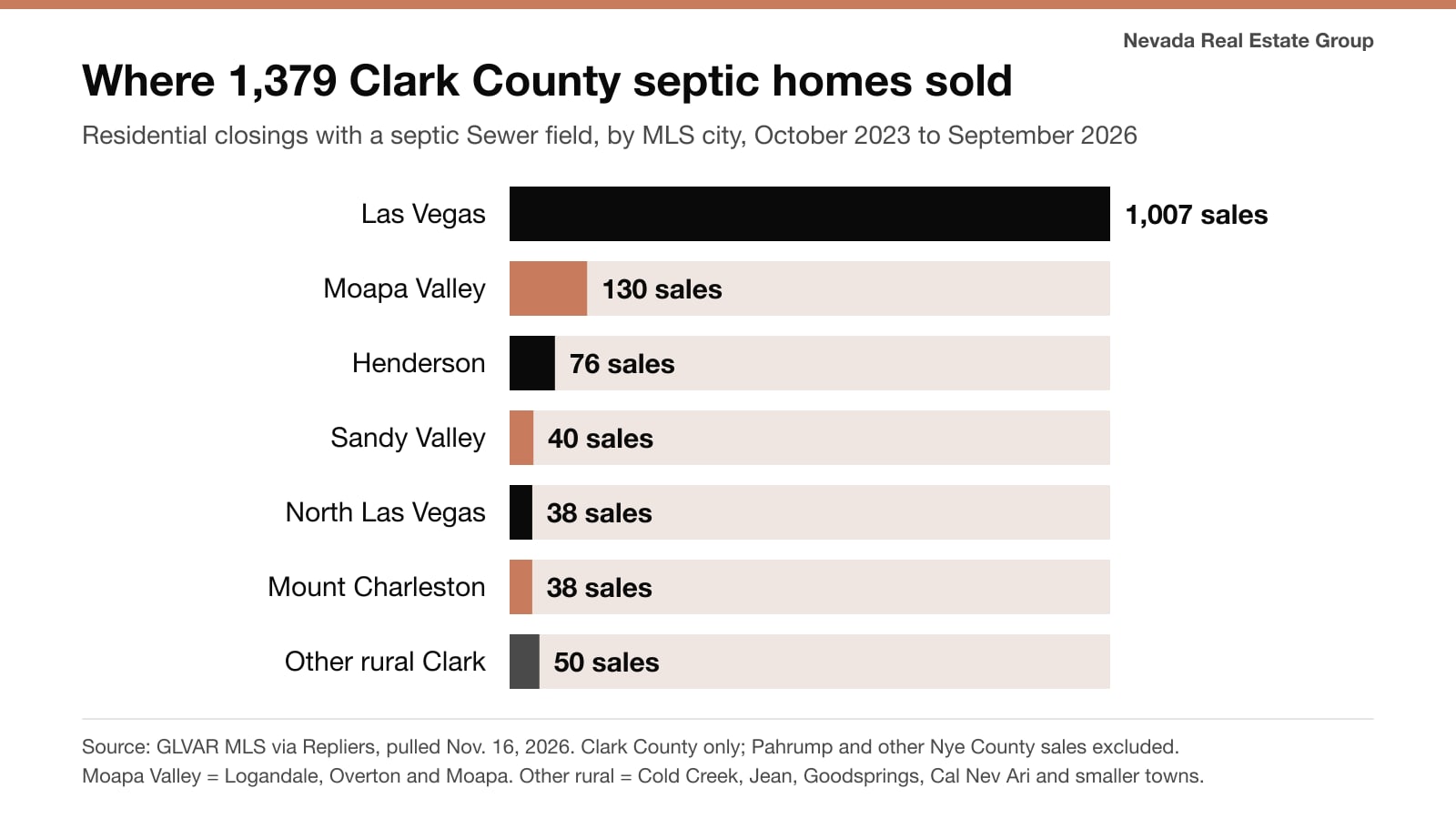
A steady stream of them. Between October 2023 and September 2026, 1,379 residential sales in Clark County carried a septic system in the MLS Sewer field, roughly 38 a month, and the monthly count never fell below 21 or rose above 53. Of those, 1,121 were inside the Las Vegas Valley: 1,007 with an MLS city of Las Vegas, 76 in Henderson and 38 in North Las Vegas. The other 258 were outside those three cities, mostly in rural towns, led by Moapa Valley (Logandale, Overton and Moapa) with 130, Sandy Valley with 40 and Mount Charleston with 38. Pahrump sits in Nye County, and Nye County sales were excluded; one record with a Pahrump address carried a Clark County code and remains in the count. Pahrump sellers have their own Pahrump selling guide.
Inside the valley, septic is concentrated in older large-lot pockets. The busiest ZIP codes over the three years were 89149 in the northwest with 139 septic sales, 89117 on the west side with 112, 89108 with 81, 89139 in the southwest with 76 and 89146 with 68. Some of these streets also allow horses, which is why our horse property study found most horse-permitted homes on septic too. If you want to see what is listed in these areas now, the Lone Mountain and Las Vegas homes with acreage pages show current inventory.
The Southern Nevada Water Authority's program page says about 8,000 of its municipal water customers are on septic, and the Nevada Independent, citing the water authority, reported roughly 14,000 septic tanks in the region in March 2026, 8,300 of them on municipal water; the two figures come from different dates and rounding. Either way, a few hundred MLS sales a year is a small but steady slice of a real market, not an oddity.
Do septic homes sell for less than sewer homes in Las Vegas?
Not on a per-square-foot basis, once you compare like with like. The raw medians look worse than they are: the 929 matched septic homes sold for a median $830,000 and the 1,217 matched sewer homes for $1,050,000. But the sewer group is made up of newer, bigger houses. Its median home was built in 2004 and measured 3,710 square feet; the median septic home was built in 1986 and measured 2,968. Divide price by size and the gap nearly disappears: $291 per square foot for septic, $294 for sewer, a difference of about 1%.
To build that comparison we kept only detached single-family homes on lots from 0.4 to 2.49 acres, in the 21 valley ZIP codes that had at least 10 septic sales, and only homes whose MLS Sewer field said either septic or public sewer. Condos and townhomes were dropped because their lot size in the MLS is often the whole complex, which would have mixed attached homes into a lot band meant for ranch-style estates. The matching is still rough: it can't see condition, views, garages, pools or the exact street. Treat the result as a market-wide pattern from October 2023 to September 2026, not an appraisal of your house.
What the numbers do say is that these sales show no septic discount once size is accounted for. The septic homes also sold at the same discount to their original asking price as the sewer homes, a median 95.4% versus 95.5% from October 2023 to September 2026, and about three in four of each group sold below the first list price. For how close Las Vegas homes come to asking more broadly, see our sale-to-list ratio analysis.
Why do septic homes sell for less overall but the same per square foot?
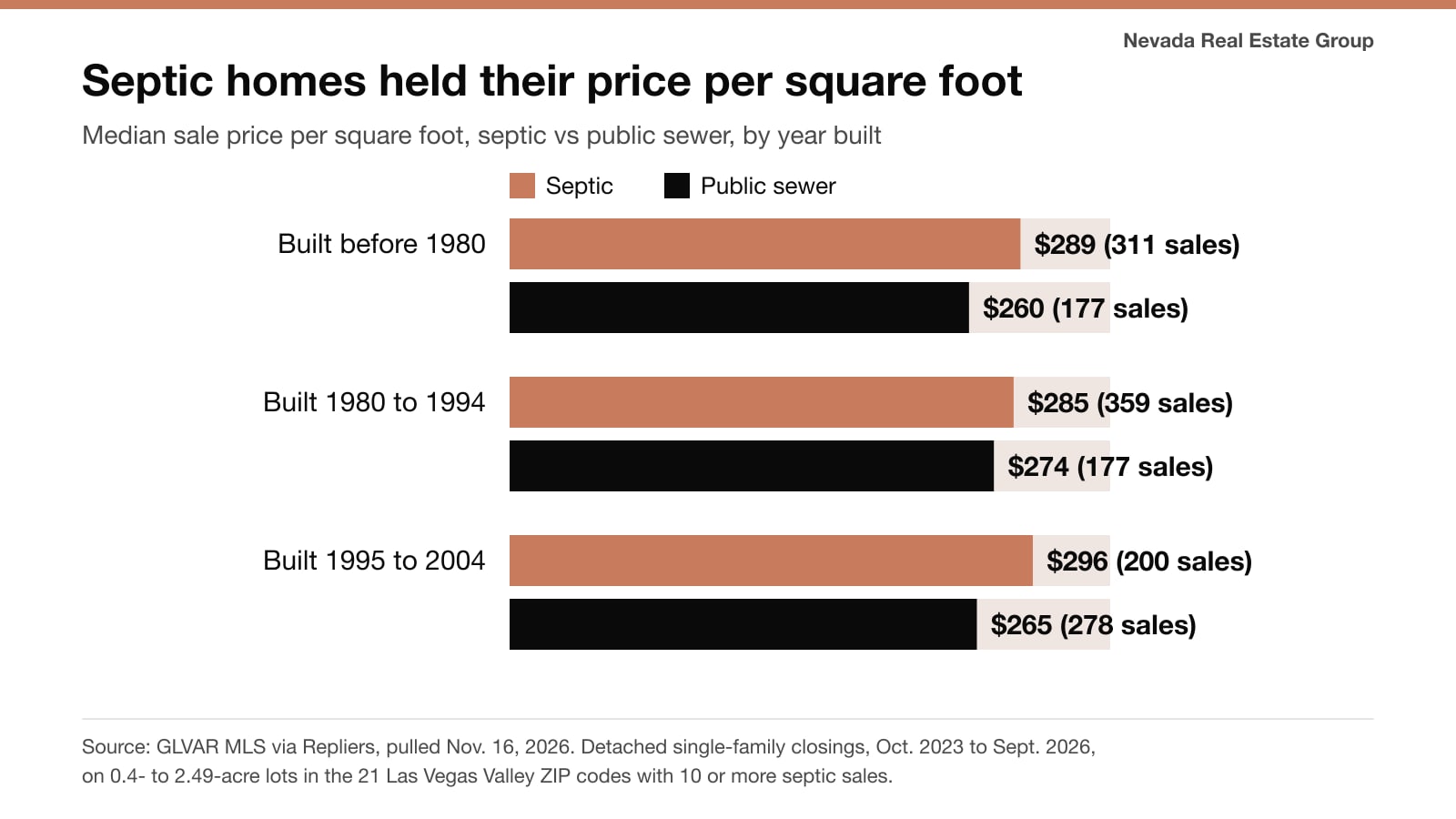
The gap in total price lines up with age and size rather than with the tank. When we split the matched group by the year the house was built, the septic homes sold for as much or more per square foot in every era with enough sales to measure, October 2023 to September 2026. Homes built before 1980 sold for a median $289 per square foot on septic against $260 on sewer. Homes from 1980 to 1994 sold for $285 against $274, and homes from 1995 to 2004 sold for $296 against $265.
Part of that edge may be the land. Among the matched sales from October 2023 to September 2026, septic homes sat on a median 0.53 acre against 0.48 for the sewer homes, and only 8.2% of them were in an HOA, compared with 58.1% of the sewer homes. Buyers looking for Las Vegas homes with no HOA, RV parking and room to spread out may be paying for those things, and on these older streets they come with a septic tank attached. Our guide to Las Vegas neighborhoods with no HOA covers the same tradeoff from the buyer's side.
The ZIP-by-ZIP picture is mixed, which is what you would expect from a feature that matters less than location. Of the 18 ZIP codes with at least five septic and five sewer sales in the matched band from October 2023 to September 2026, septic homes sold for a higher median price per square foot in 10 and a lower one in 8. The biggest septic shortfalls, in 89002, 89118, 89149 and 89113, came where the median sewer comparison home was built in 2013 or later, so newer construction, not plumbing, is the likelier explanation for those gaps.
| ZIP code | Part of the valley | Septic sales | Septic price per sq ft | Sewer sales | Sewer price per sq ft | Median year built, septic vs sewer |
|---|---|---|---|---|---|---|
| 89149 | Northwest | 137 | $288 | 199 | $329 | 1996 vs 2018 |
| 89117 | West | 110 | $290 | 98 | $298 | 1986 vs 1997 |
| 89108 | Northwest | 76 | $263 | 30 | $276 | 1975 vs 1978 |
| 89139 | Southwest | 73 | $324 | 40 | $322 | 1984 vs 2020 |
| 89146 | West | 67 | $270 | 62 | $263 | 1976 vs 1979 |
| 89129 | Northwest | 64 | $294 | 85 | $309 | 1994 vs 2004 |
| 89131 | Northwest | 57 | $329 | 160 | $276 | 1990 vs 2006 |
| 89118 | Southwest | 51 | $290 | 34 | $338 | 1981 vs 2018 |
| 89110 | East | 47 | $224 | 101 | $232 | 1980 vs 1989 |
| 89123 | South | 47 | $306 | 55 | $296 | 1987 vs 1992 |
| 89120 | Southeast | 40 | $285 | 92 | $267 | 1974 vs 1979 |
| 89130 | Northwest | 36 | $323 | 30 | $263 | 1980 vs 2003 |
Will FHA and VA buyers make offers on a septic home?
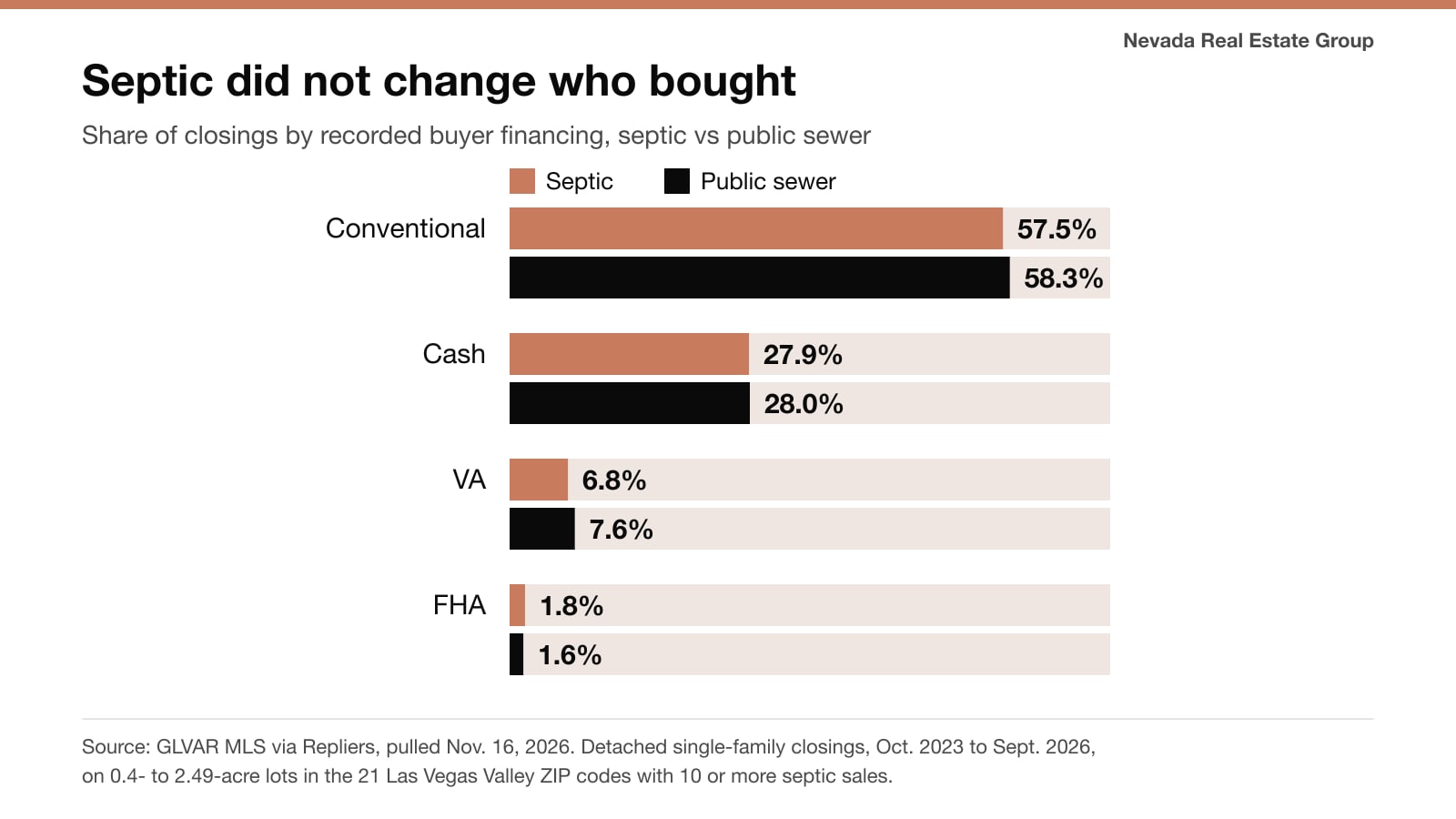
Yes, at about the same rate as on sewer homes. In the matched valley group from October 2023 to September 2026, 1.8% of septic sales closed with FHA financing against 1.6% of sewer sales, and 6.8% closed with a VA loan against 7.6%. Conventional loans financed 57.5% of septic sales and 58.3% of sewer sales, and cash buyers took 27.9% and 28.0%. The FHA numbers are small, 17 septic loans against 19 sewer loans, and VA was 63 against 92, so read them as a pattern rather than proof. But nothing in them suggests septic homes lost government-backed buyers or tilted toward cash investors.
FHA shares are low in both groups, and these neighborhoods sit at median prices of $830,000 and $1,050,000. Where prices are lower, government loans show up on septic homes too. Across all 1,379 Clark County septic sales from October 2023 to September 2026, 20.5% of homes under $500,000 closed with FHA financing, and in Sandy Valley, where the median septic sale was $251,000, a quarter of buyers used FHA over the same three years. In Moapa Valley, 17.7% used FHA and 13.1% used VA.
That doesn't mean lenders ignore the system. The Southern Nevada Health District's own certification page says a septic certification is typically done during real estate transactions and is "often required by lenders." Expect the buyer's lender, appraiser or inspector to ask questions, and have the answers ready: where the tank is, when it was last pumped, whether the Health District has a permit on file, and whether the home also has a well. Our statewide well and septic buyer guide explains what buyers' inspectors look for, so you can prepare for the same checklist from the other side.
Can you sell a Las Vegas house with a bad septic system?
Yes, but a failing system changes the sale from a pricing question into a disclosure-and-repair question. The MLS can't tell us how many of the 1,379 systems were failing, because condition isn't a structured field. What it can show is how sellers described their homes. We searched the public remarks of all 1,379 septic sales from October 2023 to September 2026 and read every match. Only 54, 3.9%, said the home was being sold as-is, and only 8 asked for cash offers only. Just 5 advertised a new or replaced septic system or leach field, and 15 said the system had been pumped, serviced or inspected. One fixer listing said outright that the septic tank needed service. Most sellers said nothing about the septic at all.
A bad system can show up in one of three ways: the buyer's inspection or a septic contractor finds a cracked tank, failed baffles or a saturated leach field; a Health District certification finds the system out of compliance; or the seller already knows about backups, odors or wet ground over the drain field. Once you know, you have four realistic paths. You can repair or replace the system under a Health District permit before or during escrow. You can connect to sewer if a line is close enough. You can disclose the problem and give the buyer a price reduction or credit. Or you can sell as-is, disclosed, to a buyer who wants the project, possibly for cash.
Which one makes sense depends on the cost of the fix against the price hit of leaving it. A pumped tank with a cracked lid is a small repair. A failed leach field on a half-acre lot is a bigger construction job. A conversion that needs a long sewer extension is a bigger one still. Price the work first, through the Health District's records and a licensed contractor's written bid, before you decide. Our guide to seller concessions in Las Vegas explains how seller credits work if you go that route.
What does Nevada law require you to disclose about a septic system?
Nevada's seller disclosure law is NRS 113.100 through 113.150, and it applies to homes with one to four dwelling units. A "defect" is a condition that "materially affects the value or use" of the property in an adverse manner, and a failing septic system fits that description. Under NRS 113.130, the seller must complete the disclosure form and serve it on the buyer at least 10 days before the property is conveyed. If you discover a new defect, or find that a known one has gotten worse, after you served the form, you must tell the buyer in writing as soon as practicable and before closing.
The penalties for staying quiet are steep. Under NRS 113.150, if a seller conveys the home without disclosing a defect the seller knew about, and the contract didn't limit the repair cost, the buyer can recover three times the amount needed to repair or replace it, plus court costs and reasonable attorney's fees. A buyer has until one year after discovering the defect, or after the point when they reasonably should have discovered it, or two years after closing, whichever is later, to sue. Three times the cost of a septic replacement can easily exceed the price cut that disclosing it would have cost.
Two parts of the law work in a careful seller's favor. NRS 113.140 says a seller doesn't have to disclose a defect the seller isn't aware of, and that the completed form isn't a warranty. And NRS 113.150 says the buyer can't collect those triple damages for an error on the form that came from relying on information from a government employee doing their job, or from a licensed contractor or certified inspector. A recent Health District certification or a licensed septic contractor's report, attached to your disclosures, is one practical way to document what you knew and where it came from. This is general information, not legal advice; a Nevada real estate attorney can review your situation.
What is a Health District septic certification, and should you order one before listing?
A certification is an inspection of your septic system, and optionally your well, done by the Southern Nevada Health District itself. The Health District says it is the only entity in the Clark County area that can issue official septic certifications. It is different from a private septic inspection: a contractor's inspection looks at the system's physical condition, while the certification checks whether the system still meets the regulatory requirements and is in compliance. The Health District notes that septic systems typically have a 40-year life span and that many are inspected only when they are installed. The median matched septic home in our October 2023 to September 2026 study was built in 1986. The MLS doesn't record when a tank was installed or replaced, so a home's age isn't its system's age, but many of these houses are now about 40 years old.
The process is straightforward but has real costs beyond the Health District's fee. The tank lids, usually buried, have to be uncovered so the inspector can see inside, and the inspector decides whether the tank must be pumped unless it was pumped within the last 12 months. Locating and uncovering the tank and any pumping are paid to outside contractors. The Health District lists the fee on its environmental health fee schedule and issues the certification one business day after it has everything it needs.
There is a catch to weigh before you order one. The Health District says the findings affect the status of your existing septic permit, and a property that fails to complete the corrective action it recommends gets flagged with a compliance issue, which blocks building permits until it's fixed. So a certification is best ordered when you are prepared to act on the result, or when a buyer's lender requires it anyway. For many sellers the better first step is cheaper: pull the system's records through the Health District's "Find My Septic System Plans" search or a public records request, and get a private pumping and inspection report you can share. Our pre-listing inspection guide covers how to decide what to inspect before you list.
| Question | Who answers it | What they say |
|---|---|---|
| Permits, records, repairs and certifications | Southern Nevada Health District | Permits, inspects and regulates all residential septic systems and keeps the records for existing systems in Clark County |
| Whether a home must connect to sewer | The local sewer agency: Clark County Water Reclamation District, or the City of Las Vegas, Henderson or North Las Vegas | The Health District says it does not determine or enforce sewer connection requirements |
| Help paying for a conversion | Southern Nevada Water Authority | Partially funded pathway pays 85% of eligible costs, up to $40,000, as a reimbursement |
| Sewer fees after conversion, unincorporated county | Clark County Water Reclamation District | $3,020 connection fee per residential unit on the last listed schedule, a $1,600 septic conversion fee and a $307.16 annual service charge from July 1, 2026 |
| What the seller must tell the buyer | Nevada law, NRS 113.130 and 113.150 | Known defects on the disclosure form at least 10 days before closing; triple repair costs if a known defect is hidden |
Did the 2026 septic rule changes affect people selling their homes?
No, because they never took effect. In 2025 the Southern Nevada Health District proposed updating its septic regulations, which were 17 years old. As reported by the Nevada Independent, the early version would have required a $226 permit every five years, could have compelled homes within 400 feet of a sewer main to connect when they needed major septic work, and called for a notice within 30 days of a home's sale so the new owner could receive information on septic care. After pushback in October 2025, the five-year permit was narrowed to new septic tanks, and in February 2026 roughly 1,000 residents turned out for a public meeting that ended without a vote.
On February 25, 2026, the Health District clarified its revised proposal: no new permits or fees for existing owners, permit renewals only for new systems and for systems needing a construction permit, such as a replacement tank or major leach-field repairs, and a simple notification within 30 days of a sale. Then, on March 11, 2026, the Southern Nevada District Board of Health voted at a special meeting not to move forward, and the Health District said it would not advance the residential portion of the updates. The existing regulations stay in place. So as of November 2026 there is no new septic inspection requirement at sale, no new transfer notice and no five-year permit for an existing home.
That history still matters to a sale, because buyers remember the headlines. Some sellers on sewer even advertise the fact; one valley listing in our data said that having no septic meant no potential mandate costs. If a buyer raises the rules, the accurate answer is that the proposal was withdrawn on March 11, 2026, and that the Health District says existing permits stay valid unless a system fails or sewer becomes available and the local sewer agency legally requires a connection.
When does a failing septic system have to connect to sewer?
The Health District's February 2026 statement is the clearest summary of the rule as it stands: existing septic operating permits remain valid "unless a system fails or sewer infrastructure becomes available, and connection is legally required by the appropriate sewer authority." It also says the Health District itself "does not determine or enforce sewer connection requirements; those decisions are made by the appropriate local jurisdiction." So whether a failing system can be repaired in place or must be replaced by a sewer connection is a question for your sewer agency as much as for the Health District.
Which agency that is depends on where the home sits. The Southern Nevada Water Authority lists four: the City of Henderson, the City of North Las Vegas, the City of Las Vegas, and the Clark County Water Reclamation District, whose service area covers all unincorporated parts of Clark County, including towns such as Spring Valley and Enterprise. Each can tell you where your nearest point of connection is. Before you list a home whose system is failing or near the end of its life, ask that agency how far the nearest sewer main is and what connecting would require. The answer sets the realistic range of repair costs a buyer will ask about.
For rural owners the situation is different. The Health District's statement listed Moapa, Bunkerville, Sandy Valley and Mount Charleston among communities that rely on domestic wells or have no municipal sewer access, and said its proposal would not have imposed a sewer connection requirement there. In practice, where no sewer line is within reach, a failing system is replaced or repaired under a Health District permit rather than converted. Some rural towns do have limited sewer service, since the Clark County Water Reclamation District runs small treatment plants in places such as Moapa Valley, Searchlight and Indian Springs, so ask before you assume. Sellers of Mount Charleston cabins should ask the same question.
How much does converting from septic to sewer cost, and who helps pay?
There is no single local price. The water authority says each conversion depends on factors such as the distance to the sewer main, landscaping and design challenges. The Nevada Independent reported in March 2026 that some residents said a conversion could cost upwards of $500,000, and that the cost can also be as low as $10,000. Neither is a published price list, and no agency publishes a typical conversion cost. What the agencies do publish are the fees and the help available.
The Southern Nevada Water Authority runs a voluntary Septic to Sewer Conversion Program with two paths. The partially funded path covers 85% of eligible costs up to $40,000, paid as a reimbursement after the work is done. You apply, collect bids from three class A contractors using the authority's template, complete the project and submit a closeout package. Eligible costs include permits, connection and design fees, digging and pipeline work on your lot and in the public right-of-way, like-for-like landscape replacement and abandoning the old tank in place; removing the tank and landscape upgrades aren't covered. Homes on a well can take part without giving up the well. The fully funded path has no application: homes next to an existing sewer main are chosen with local wastewater agencies, and selected owners are contacted directly.
In unincorporated Clark County, the Clark County Water Reclamation District lists a connection fee of $3,020 per residential unit on its most recent posted schedule, a $1,600 septic conversion fee, and an annual sewer service charge of $307.16 starting July 1, 2026. The district has also run a grant-funded pilot that converts eligible homes near existing sewer lines at no out-of-pocket cost. The National Association of Clean Water Agencies, which gave the pilot an award in 2025, described construction taking about five to ten days with a four- to six-hour water shutoff for the final connection. Cities set their own fees, so check with yours.
Should you repair, convert, give a credit or sell as-is?
Decide after you know three numbers: the repair or replacement bid, the cost and feasibility of connecting to sewer, and what similar homes sold for. With those in hand, the tradeoffs are easier to see. A modest repair is usually worth doing before you list: buyers in these neighborhoods paid about the same per square foot for septic and sewer homes from October 2023 to September 2026, and a documented, working system gives them less reason to discount yours. A large repair you can't fund in time may be better handled with a disclosed credit, so the buyer controls the work after closing.
| Path | What it involves | Who signs off | Best when |
|---|---|---|---|
| Repair or replace the system | Licensed contractor bid, Health District construction permit, work completed before or during escrow | Southern Nevada Health District | The fix is affordable and there is no nearby sewer main |
| Convert to sewer | Agency confirms the nearest connection point; contractor bids; tank abandoned in place | Your sewer agency and the Health District; the water authority if you seek funding | Sewer is close, or the water authority's program can cover most of the cost |
| Disclose and credit the buyer | Written disclosure plus a price reduction or credit sized to the repair bid | The buyer, in the purchase contract | The repair can't be finished before closing or you'd rather not manage it |
| Sell as-is, disclosed | Defect stated on the disclosure form; buyer accepts the condition | The buyer | You want a simpler sale and accept a buyer who takes on the project |
The conversion path is worth pricing out, because the water authority's reimbursement can cover up to $40,000 of eligible costs. The catch is time: you pay the contractor first and get reimbursed after the project is approved, and a conversion has to be designed, permitted and built. If you plan to sell within a few months, the program helps most when you start before you list. If time is short, a buyer can take on the conversion after closing instead, and the price or credit can reflect that.
Selling as-is is a legitimate choice, not a failure, as long as the defect is on the disclosure form. If speed matters more than price, you can also request a cash offer for your Las Vegas home and compare it with an open-market listing, or read our list of Las Vegas home improvements that pay back before deciding what to fix.
How long do septic homes take to sell?
Septic homes did not sell more slowly. In the matched valley group from October 2023 to September 2026, the median septic home sold in 30 days on market against 34 for sewer homes, and 18.4% of septic sales took more than 90 days against 19.5% of sewer sales. Across all 1,379 Clark County septic sales, including the slower rural towns, the median was 33 days.
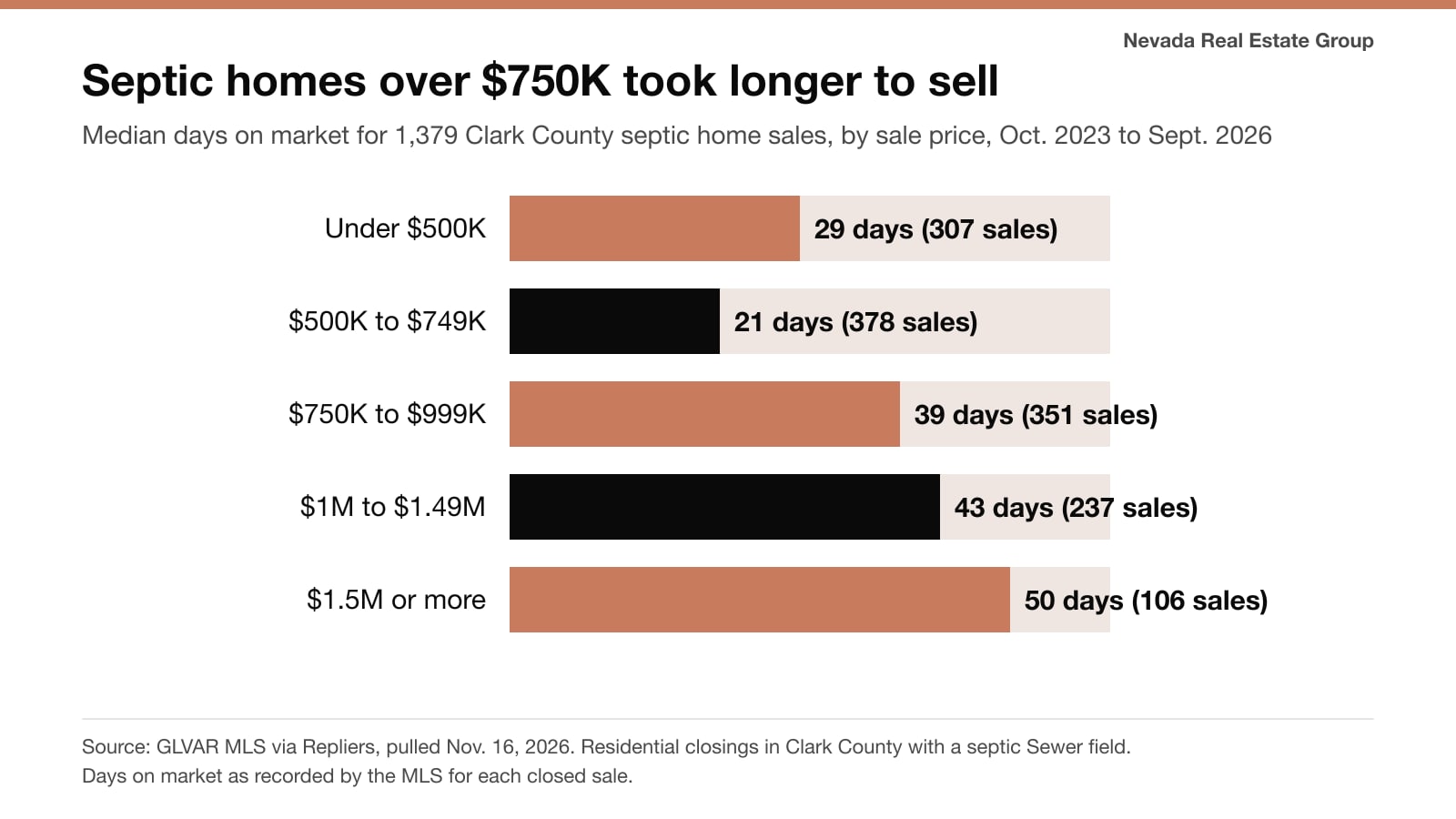
Price mattered more than plumbing. Across those 1,379 sales over the same three years, septic homes from $500,000 to $749,999 sold fastest, in a median 21 days, and sold for a median 97.0% of their original asking price. Homes under $500,000 took 29 days. Above $750,000 the pace slowed: 39 days from $750,000 to $999,999, 43 days from $1 million to $1.49 million and 50 days at $1.5 million or more, where the median sale came in at 92.2% to 93.6% of the original price. A septic seller at the top of the market should plan for a longer listing and price against recent nearby sales rather than an ambitious first number.
We also tried to count listings that ended without a sale, but the MLS feed returned expired and withdrawn records only from February 2026 onward, too short a window to compare fairly, so this guide doesn't report a failure rate.
Today's active listings look slower, though days since listing aren't directly comparable with the days on market of closed sales. As of November 16, 2026, there were 278 active Clark County listings on septic, with a median asking price of about $916,000. Their median listing had been on the market 88.5 days, 48.6% had been listed more than 90 days, and 48.9% were asking less than their original price. If yours is one of them, our guide to what to do after a Las Vegas listing expires walks through the relaunch choices.
What should your listing say about the septic system?
Say more than most sellers do. Only 124 of the 1,379 septic sales from October 2023 to September 2026, 9%, mentioned septic anywhere in the public remarks, and on November 16, 2026, just 11.9% of active septic listings did. The MLS Sewer field tells buyers' agents the home is on septic, but a field marked "septic tank" with no detail invites the worst assumptions, especially after a year of headlines about septic rules.
A short, factual line does more than marketing language. The most useful remarks in our data named a date, such as when the tank was last pumped or serviced, or stated that the system had been inspected or replaced. One Moapa Valley listing noted that sewer was at the street, which tells a buyer conversion is possible, and another said the owner was paying for a city sewer hookup. Two valley listings coded as public sewer said the home had already been converted from septic to sewer, a selling point worth stating plainly if it applies to you.
Behind the listing, put the paperwork together before the first showing: the Health District's records for your system, the most recent pumping receipt, any repair permits, a private inspection report if you have one, and a well report if the home has a well. Hand it to buyers early rather than waiting for the inspection period. Sellers in older large-lot areas like Enterprise and the northwest valley compete for the same buyers, and documents in hand answer the questions buyers' lenders and inspectors are likely to raise. Early answers can also head off surprises during escrow, when deals can fall apart, a problem we looked at in our study of back-on-market listings after failed contracts.
Are rural septic homes in Moapa Valley, Sandy Valley and Mount Charleston different?
Yes, in price, pace and buyers. From October 2023 to September 2026, 130 septic homes sold in Moapa Valley for a median $445,000 on 1.97 acres, with a median 49.5 days on market. Sandy Valley's 40 septic sales had a median of $251,000 on 2.06 acres and took a median 64.5 days. Mount Charleston's 38 cabins and mountain homes sold for a median $694,500 on a quarter acre, took 54.5 days, and 47.4% went to cash buyers.
Financing looks different too. Over the same three years, 17.7% of Moapa Valley septic buyers used FHA and 13.1% used VA, and in Sandy Valley 25% used FHA. In our data, lower-priced septic homes drew more government-backed buyers, so rural sellers should expect lender questions about the septic system and the well and have records ready. Many of these homes also sit on private or shared wells, and the Health District offers a courtesy well inspection alongside its septic certification.
The other difference is sewer access. The Health District's February 2026 statement described communities such as Moapa, Bunkerville, Sandy Valley and Mount Charleston as relying on domestic wells or lacking municipal sewer access, and said its proposal would not have imposed the 400-foot connection requirement there. For rural sellers without a sewer line nearby, a failing system means a repair or replacement under a Health District permit, priced and disclosed like any other major defect. Rural septic homes in our data also took longer to sell, by median days on market, so price to the most recent nearby sales rather than to valley numbers.
| Area | Sales | Median sale price | Median lot | Median days on market | Bought with cash |
|---|---|---|---|---|---|
| Las Vegas | 1,007 | $815,000 | 0.51 acre | 32 | 28.3% |
| Moapa Valley | 130 | $445,000 | 1.97 acres | 49.5 | 27.7% |
| Henderson | 76 | $815,000 | 0.51 acre | 28.5 | 32.9% |
| Sandy Valley | 40 | $251,000 | 2.06 acres | 64.5 | 25.0% |
| North Las Vegas | 38 | $516,750 | 0.43 acre | 11.5 | 21.1% |
| Mount Charleston | 38 | $694,500 | 0.25 acre | 54.5 | 47.4% |
What should a septic-home seller do before listing?
Start with records, not repairs. Pull your system's plans and permit history from the Health District, find the last pumping receipt, and have the tank located, pumped if it's due, and inspected by a licensed septic contractor. If anything is wrong, get a written bid for the repair and ask your sewer agency how far the nearest main is, so you know whether replacement or conversion is the realistic fix. If you are close to a sewer line, look at the water authority's program before you list, because its reimbursement only helps if you start the work in time.
Then decide on the path with real numbers in front of you, and write your disclosures with the same documents. Disclose what you know on the Seller's Real Property Disclosure form, attach the reports, and describe the system briefly and factually in the listing. Price against recent sales of similar homes on similar lots in your ZIP code, not against newer sewer homes nearby, because in our data age, size and land lined up with most of the price gap. If the home has a well as well as a septic system, have the well tested too; 41.7% of the matched valley septic homes that sold from October 2023 to September 2026 were on a private or shared well.
If you'd like help sorting through it, Nevada Real Estate Group can review your septic records, comparable sales and options with you. Start with an instant home value estimate, read how we sell homes in Las Vegas, or see how we market and sell homes. If a long listing commitment is the concern, our 7-day listing agreement is another option to review. When you're ready to talk through your septic records and pricing, call (702) 637-1759 or contact us online.
Frequently Asked Questions
Can you sell a house with a bad septic system in Las Vegas?
Yes. You must disclose a known defect on Nevada's disclosure form, then repair it, connect to sewer, offer a credit or sell as-is. From October 2023 to September 2026, 54 of 1,379 Clark County septic sales, 3.9%, said in their remarks that the home was being sold as-is.
Do septic homes sell for less in Las Vegas?
Not per square foot in our matched comparison. From October 2023 to September 2026, valley septic homes on 0.4- to 2.49-acre lots sold for a median $291 per square foot, against $294 for sewer homes in the same ZIP codes. Their lower total prices lined up with being older and smaller.
Is a septic inspection required to sell a house in Clark County?
Not by the Health District as of November 2026. It describes its septic certification as a requested inspection that lenders often require, and its proposal to add a 30-day notice after a sale was withdrawn on March 11, 2026. A buyer's lender or contract can still require an inspection.
How long does a septic system last in Las Vegas?
The Southern Nevada Health District says septic systems typically have a 40-year life span, and many are inspected only when installed. The median septic home in our matched valley group, sold October 2023 to September 2026, was built in 1986. The MLS doesn't record when a tank was installed or replaced, so ask for the permit records.
How much does it cost to convert from septic to sewer in Las Vegas?
No agency publishes a typical cost; the water authority says it depends on factors such as the distance to the sewer main. The Nevada Independent reported in March 2026 that some residents put the cost upwards of $500,000, and that it can be as low as $10,000. The water authority's partially funded program reimburses 85% of eligible costs, up to $40,000.
Will an FHA or VA buyer purchase a home on septic?
Yes. From October 2023 to September 2026, 1.8% of matched valley septic sales closed with FHA financing and 6.8% with VA, nearly the same as the 1.6% and 7.6% for comparable sewer homes. Lower-priced septic homes drew more FHA buyers: 20.5% of Clark County septic sales under $500,000 over the same three years.
What happens if I don't disclose a septic problem in Nevada?
Under NRS 113.150, if you knew about the defect and didn't disclose it, the buyer can recover three times the repair or replacement cost, plus court costs and reasonable attorney's fees. The buyer has until one year after discovering the defect, or when they reasonably should have, or two years after closing, whichever is later, to sue.
Where can I find my septic system's permit and plans?
The Southern Nevada Health District keeps the records for existing septic systems in Clark County. You can search its "Find My Septic System Plans" database from the Health District's septic program page or submit a public records request.
Which Sources Inform This Septic Seller Guide?
MLS study. Sales data comes from the GLVAR multiple listing service through Repliers, pulled November 16, 2026. The population is every sale listing in Clark County with a residential property type and a raw MLS status of Closed, with a closing date from October 1, 2023 through September 30, 2026, whose structured Sewer field records a septic tank: 1,379 homes after removing six duplicate closings of the same address. Nye County, including Pahrump, and other counties carried by GLVAR were excluded; one record with a Pahrump address but a Clark County code remains in the count. The comparison group is Las Vegas Valley closings (MLS city Las Vegas, Henderson or North Las Vegas) whose Sewer field says public sewer, limited to detached single-family homes on 0.4- to 2.49-acre lots in the 21 ZIP codes with at least 10 septic sales; septic homes were limited the same way for the matched figures. A pull of expired, withdrawn and canceled listings returned off-market dates only from February 2026 onward, so no failure rate is reported. Active listings were pulled November 16, 2026; their days on market count Pacific calendar days since the listing date. Public remarks were searched for plain phrases (septic, as-is, cash only, pumped, inspected, new septic, sewer available), and every match was read; uses unrelated to the sale or the system, such as a spa or trailer conveyed as-is, were dropped. A remark counts what an agent wrote, not a verified condition. Six records were re-read from the live feed by MLS number and matched the saved data; a random sample of 12 septic records was reviewed by address, and one, a 0.10-acre 1995 home in 89147, looked mis-coded. The script is scripts/clark-county-septic-home-sales-study.ts, and its output, recompute check and spot check are saved with this post's records.
Limits. The Sewer field is entered by listing agents and can be wrong or blank; about 714 records in the large-lot pulls carried no MLS detail at all and could not be classified. The MLS has no field for septic condition, so the study can't separate working systems from failing ones. Off-MLS sales are not included. The comparisons show association, not cause.
Rules and programs, all read November 16, 2026. Southern Nevada Health District: the septic system program page, the certification procedures for septic systems and wells, its February 25, 2026 statement on the proposed regulations and its March 11, 2026 release on withdrawing them. Southern Nevada Water Authority: the Septic to Sewer Conversion Program. Clark County Water Reclamation District: rates, connection fees and the septic conversion fee and its service area and treatment plants. National Association of Clean Water Agencies: Clark County's septic conversion pilot. The Nevada Independent: septic system changes in Las Vegas, updated March 11, 2026. Nevada Revised Statutes chapter 113: NRS 113.130 on the disclosure form, NRS 113.140 on unknown defects and NRS 113.150 on remedies.
This guide is general information, not legal, engineering or financial advice. Septic rules, fees and programs change, so confirm the current requirements with the Health District, your sewer agency and a Nevada real estate attorney before you act.