
A listing that says "back on market" carries a short, uncomfortable story. Someone wanted the house, signed a contract, opened escrow, and then the deal ended before closing. For the seller, that usually means weeks lost, a moving plan on hold and a decision about what to change. For a buyer scrolling the listings, it raises a fair question: what went wrong, and should that worry me?
Most of what gets written about failed contracts is national or anecdotal. We wanted the local picture, so on November 15, 2026 we pulled every active residential sale listing in Clark and Nye counties from the GLVAR multiple listing service and identified the ones whose most recent major MLS change was a return to Active status after being under contract. That gave us 566 homes out of 12,549 active listings. The numbers below show where those homes are, what they cost, how long ago they came back, whether their prices moved and what their listing descriptions actually say.
A Las Vegas home marked back on the market had a buyer under contract who did not close. On November 15, 2026, 566 of 12,549 active residential listings in Clark and Nye counties (4.5%) carried that flag, about 20 for every 100 homes then under contract. Most came back recently, a median 25 days earlier, and 53.9% were still asking their original price or more.
- 566 of 12,549 active Southern Nevada listings (4.5%) were back on the market on November 15, 2026.
- Homes under $300,000 led at 6.1%; homes from $600,000 to $999,999 had the lowest share, 3.4%.
- Only 9 listing descriptions mention the return, and 3 give a reason.
- 53.9% were still asking their original price or more.
- Listings older than 180 days were about five times likelier to carry the flag than listings under 60 days old.
| Measure, November 15, 2026 | Back on market | All other active listings |
|---|---|---|
| Listings | 566 | 11,983 |
| Median asking price | $409,495 | $450,000 |
| Median days since the listing date | 121 | 62 |
| Asking less than the original price | 46.1% | 44.3% |
| Came back within the last 30 days | 55.7% | Not applicable |
What does "back on market" mean on a Las Vegas listing?
In the Las Vegas MLS, a listing moves through a set of statuses. It starts as Active (or Coming Soon), changes to Active Under Contract or Pending once the seller accepts an offer, and normally ends as Closed. "Back on market" describes a listing that went under contract and then returned to Active instead of closing. The MLS records it as a major change with its own date, which is how we could find these homes in the data feed. Real estate websites, including ours, often show a small badge or a note in the price history when it happens.
The flag says the contract ended. It does not say why, and it does not say who ended it. A buyer may have lost loan approval, cancelled during an inspection or appraisal period, failed to sell their own home, or simply changed their mind within a period the contract allowed. A seller and buyer may also have agreed to cancel together. Our guide to home-buying contingencies in Nevada explains the main contract periods during which a buyer can still walk away, and how escrow works in Nevada covers what happens to the paperwork and deposits when one ends.
Two things the flag is not. It is not a price cut, though some sellers change the price when they relaunch. And it is not an expiration or a withdrawal, which happen when a listing agreement ends or the seller pulls the home without a contract. A back-on-market home is still listed with the same brokerage under the same MLS number and is open to new offers. That distinction matters for buyers, because the seller often has a fresh inspection report, appraisal or repair list from the first contract that a new buyer can ask about.
How many Southern Nevada homes are back on the market right now?
On November 15, 2026, the GLVAR MLS listed 12,549 active residential sale listings in Clark and Nye counties, counting houses, condos, townhomes, manufactured homes and small multifamily properties, but not land. Of those, 566, or 4.5%, had "back on market" as their most recent major change. On the same day, 2,890 listings in the same counties were under contract: 1,566 Pending, 1,283 Active Under Contract and 41 Contingent. So for every 100 homes in the contract pipeline, there were about 20 actives that had recently fallen out of it.
That ratio is a snapshot, not a fall-through rate. Contracts close and new ones open every day, and the 566 homes returned over several months, not all at once. The NAR Realtors Confidence Index, as displayed on November 15, 2026, reported that 7% of contracts nationwide were terminated in the prior three months, unchanged from a month earlier and a year earlier, and that 14% had delayed settlements. That survey asks agents about their own recent deals, so its 7% and our 4.5% measure different things, but together they say a failed contract is not rare.
Our count is also a floor. The MLS keeps only the most recent major change on each listing, so a home that came back and then took a price cut shows "price change" instead of "back on market," and it drops out of our count. A contract that ended with the seller withdrawing the listing entirely is also invisible here. The true number of active homes that had a failed contract at some point in their listing is higher than 566. For the broader context of how long homes are taking to sell in the valley, see our average days on market in Las Vegas report.
How long ago did these homes come back?
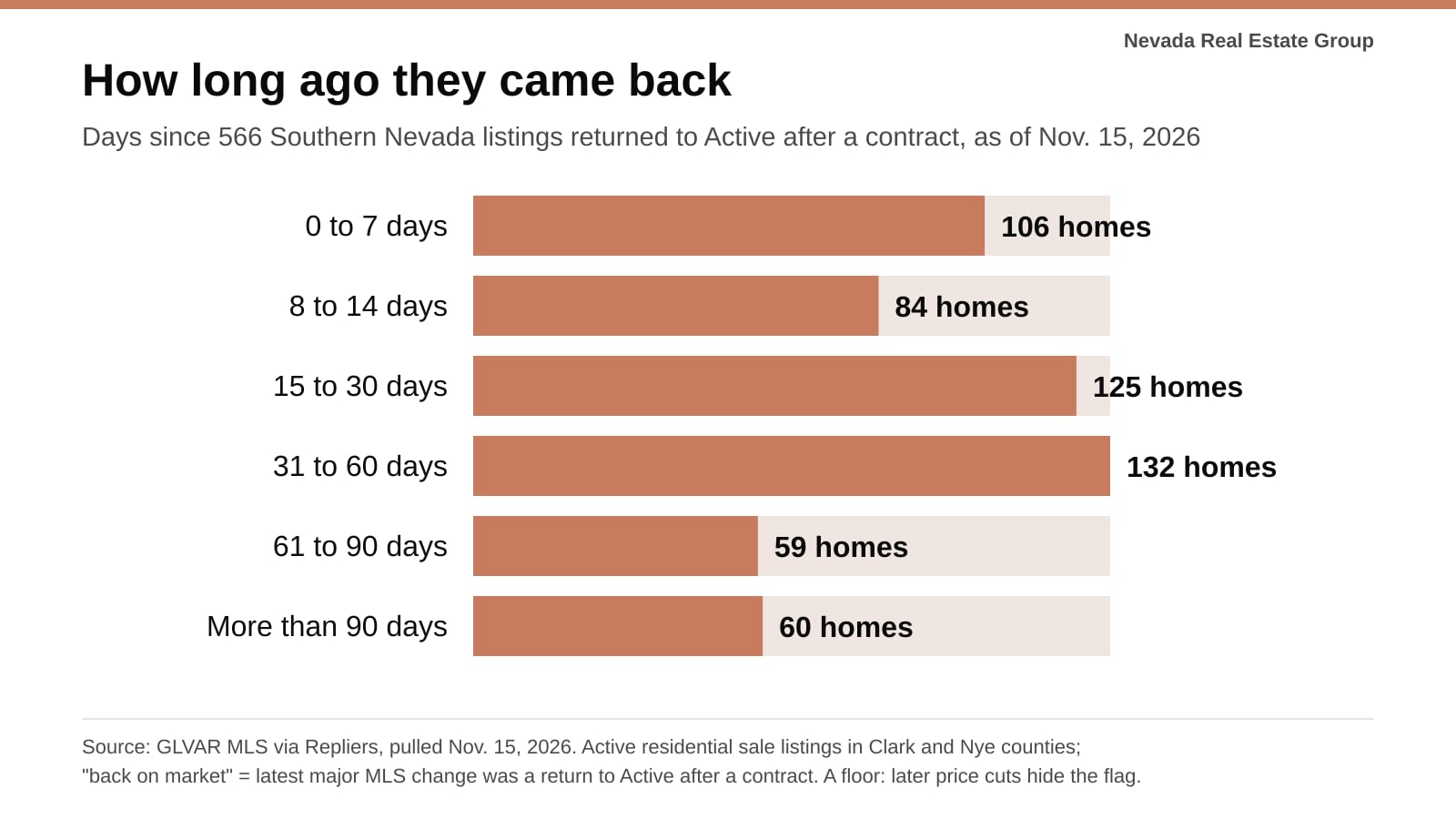
Most of them came back recently. Measured in Pacific calendar days from the date the MLS recorded the return to November 15, 2026, the median back-on-market listing had been available again for 25 days. Of the 566, 106 (18.7%) came back within the last week and 315 (55.7%) within the last 30 days. Another 132 returned 31 to 60 days earlier, and 119 have been back for more than two months.
The recent concentration has a simple explanation and one that matters more. The simple one: a home that comes back and then sells again leaves the active list, and a home that comes back and later takes a price cut loses the flag, so the longer ago a return happened, the less likely the listing is to still show it. The more useful one: a home that returned within the last week or two has a seller who is probably still deciding what to change, and often still has fresh paperwork from the failed deal.
For sellers, the first two weeks are where the momentum is. Buyers who saw the house the first time may still be looking, and a buyer who wrote a backup offer may be able to move into first position. If your home just came back, our backup offers guide explains how a backup can move into first position. For buyers, a recent return is often the best time to ask what the first buyer found, because the seller's agent has the inspection response, repair requests or appraisal result close at hand. After 60 days, that history is still available, but it tends to come with a seller who has been waiting longer and may be more flexible on terms.
Does price range change the odds of a deal falling through?
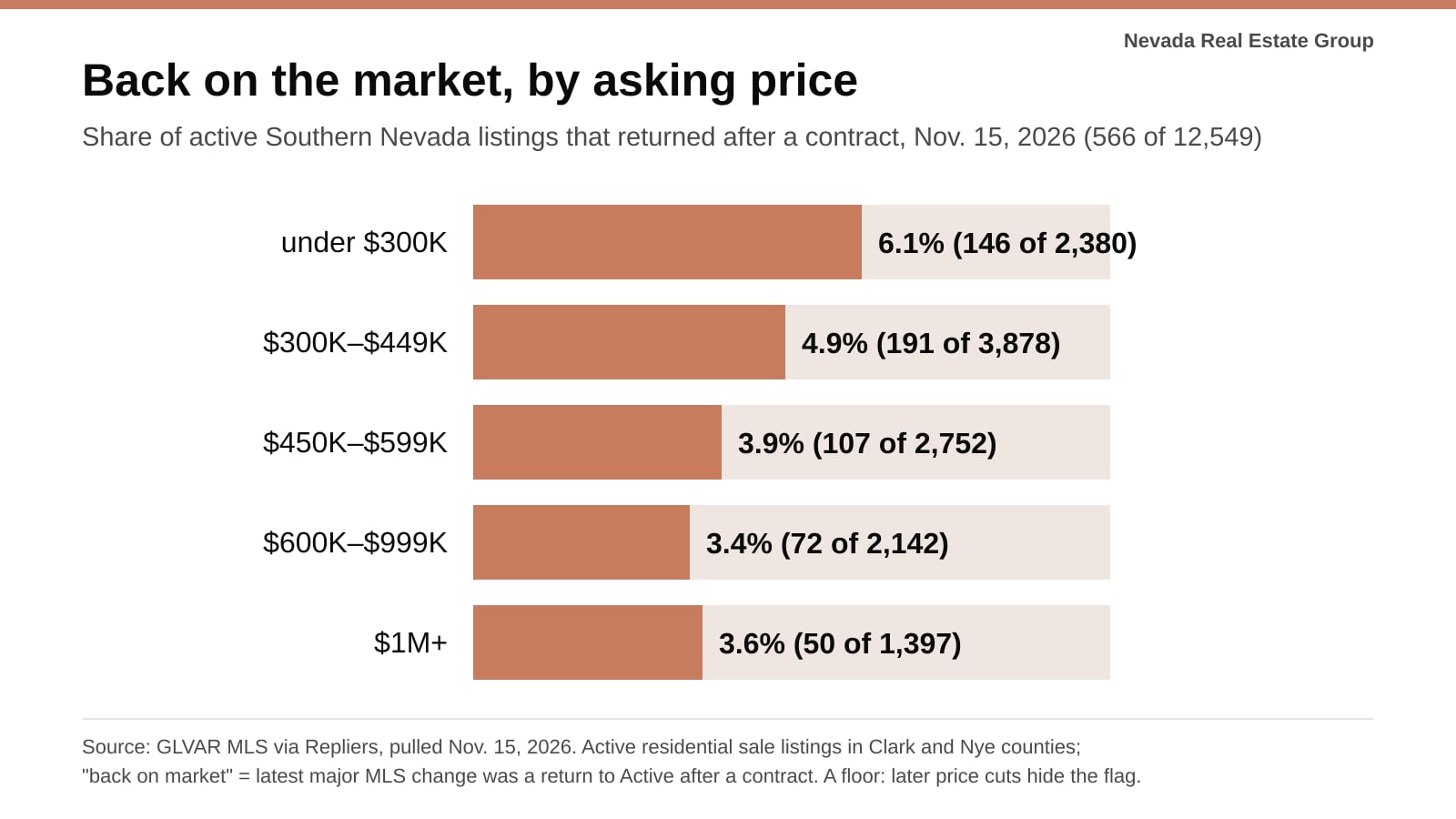
It does, and the pattern runs toward the lower end of the market. On November 15, 2026, 6.1% of active listings under $300,000 were back on the market, against 4.9% from $300,000 to $449,999, 3.9% from $450,000 to $599,999, 3.4% from $600,000 to $999,999 and 3.6% at $1 million and above. The median back-on-market condo ($203,900) and manufactured home ($279,999) both sit in that band, and both property types ran above the overall share, as the next section shows.
| Asking price | Back on market | All actives | Share | Median days since return | Below original price |
|---|---|---|---|---|---|
| Under $300,000 | 146 | 2,380 | 6.1% | 24.5 | 53.4% |
| $300,000 to $449,999 | 191 | 3,878 | 4.9% | 23 | 47.1% |
| $450,000 to $599,999 | 107 | 2,752 | 3.9% | 22 | 44.9% |
| $600,000 to $999,999 | 72 | 2,142 | 3.4% | 24.5 | 38.9% |
| $1 million and above | 50 | 1,397 | 3.6% | 44 | 34.0% |
The data can't tell us why lower-priced deals fail more often, and we won't guess at causes the MLS doesn't record. What we can see is the mix: the median back-on-market condo was asking $203,900, and condos had the highest back-on-market share of any major property type (see the next section). A condo loan can depend on the building's own finances and eligibility as well as the buyer's, and our condo financing and HOA reserve guide explains how a project's status can stop a loan late in escrow.
At the top of the market the share is lower, but returns linger. Homes at $1 million and above had been back a median 44 days, close to twice as long as every other band, and only 34.0% were asking less than their original price. Luxury sellers who lose a buyer seem more likely to wait for the next one at the same price than to cut, which fits a segment where fewer buyers are shopping at any one time. For how that plays out in pricing decisions, see our guide to pricing a $1 million Las Vegas home.
Are condos and North Las Vegas homes more likely to come back?
Both run above the valley-wide 4.5%. By property type on November 15, 2026, 6.4% of active condos were back on the market (101 of 1,574), against 4.2% of single-family houses (351 of 8,402), 4.5% of townhomes (62 of 1,370) and 4.7% of manufactured homes (17 of 362). Small multifamily properties ran highest at 6.8%, but that is 9 of 132 listings, too few to read much into. Condos are the clearest signal, and a condo deal can also be exposed to a building-level problem, such as an HOA's insurance, reserves or litigation, surfacing after the contract is signed.
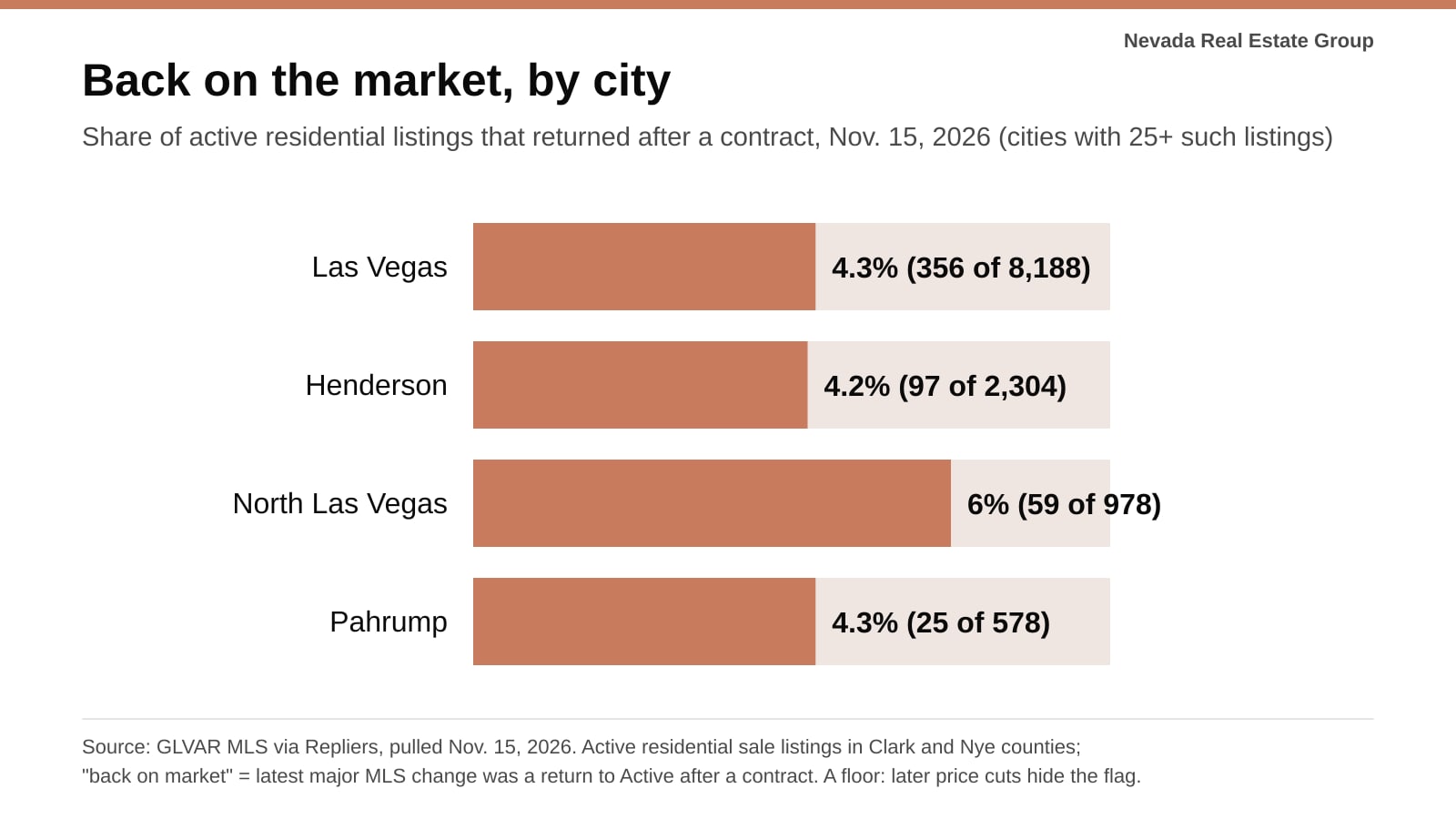
By city, North Las Vegas stood out at 6.0% (59 of 978 active listings), while Las Vegas (4.3%, 356 of 8,188), Henderson (4.2%, 97 of 2,304) and Pahrump (4.3%, 25 of 578) sat close to the overall rate. Boulder City (8 of 112) and Laughlin (12 of 179) ran higher, but on counts that small a handful of homes moves the percentage several points. North Las Vegas homes that came back had also been back slightly longer, a median 29 days, and only 10.2% had returned within the last week, compared with about 20% elsewhere.
ZIP codes vary more, though the counts get thin. Among ZIP codes with at least 150 active listings, the highest shares were in 89119 near the airport and east of the Strip, 89101 downtown and 89130 in the northwest, with 89029 in Laughlin close behind, and the lowest were in 89138 and 89166 on the far west and northwest edges and 89178 in the southwest. The table shows each count so you can judge how much weight it deserves.
| ZIP code | Back on market | All actives | Share |
|---|---|---|---|
| 89119 | 14 | 169 | 8.3% |
| 89101 | 13 | 167 | 7.8% |
| 89130 | 12 | 154 | 7.8% |
| 89029 | 12 | 179 | 6.7% |
| 89110 | 11 | 163 | 6.7% |
| 89015 | 16 | 258 | 6.2% |
| 89011 | 24 | 630 | 3.8% |
| 89178 | 4 | 227 | 1.8% |
| 89138 | 5 | 307 | 1.6% |
| 89166 | 5 | 308 | 1.6% |
None of these differences proves that a neighborhood is riskier to buy in. They reflect the mix of homes, prices and buyers in each place on one day. If you're shopping a specific area, browse current North Las Vegas homes for sale or Henderson homes for sale and look at each listing's own history rather than the ZIP average.
Why do Las Vegas contracts fall through?
The MLS does not record a reason, so no local data set can answer this with a percentage, and you should be wary of anyone who quotes one. What the contract itself tells you is where deals can end. Our contingencies guide explains the inspection, document review, appraisal and loan periods a purchase agreement can include, and what a buyer's rights are inside and outside them. Your own contract's wording decides how a particular cancellation is treated, and our earnest money guide walks through who keeps the deposit in common situations.
The national survey points the same direction. NAR's Realtors Confidence Index, as displayed on November 15, 2026, put contract terminations at 7% over the prior three months and said 4% of contracts were delayed by appraisal issues, down from 6% a year earlier. Delays are not terminations, but appraisal and financing problems are the ones most likely to turn a delay into a cancellation.
Rates are part of the backdrop this fall. Freddie Mac's Primary Mortgage Market Survey put the average 30-year fixed rate at 7.11% for the week of November 12, 2026, against 6.24% a year earlier. A buyer who wrote an offer without locking a rate can see the payment rise during escrow, and the Consumer Financial Protection Bureau's rate lock explainer notes that a lock holds only if the loan closes within its time frame and the application stays unchanged, and that extending one can be expensive. We can't link any single return in our data to rates, but a rising-rate month is when loan approvals and buyer budgets are tested hardest. For buyers, the best protection is a full approval before the offer; our pre-approval versus pre-qualification guide explains the difference.
Do the listings say why the deal failed?
Almost never. We read the public remarks on all 566 back-on-market listings. Only 9 (1.6%) mention the return at all, usually as a headline such as "back on the market" or "back on market at a new and improved price." Only 3 give any reason, and all 3 point at the buyer: two cite the buyer's personal or life circumstances and one cites buyer funding. Two say the return came through no fault of the property. Six descriptions mention an appraisal figure, either to say the home appraised at or above the price or that it is now offered under an appraised value, and two of those six are short sales.
That leaves 557 of 566 listings, 98.4%, with nothing in the description about the failed contract. That isn't necessarily evasive. Listing remarks are marketing copy with a limited length, and an agent may prefer to explain the history privately when a buyer's agent calls. But it does mean a buyer cannot learn what happened from the listing page, and should not read anything into the silence either way.
What a seller can share, and when, is shaped by Nevada law. NRS 113.130 requires a seller who discovers a new defect after serving the disclosure form, or finds that a disclosed defect has become worse, to tell the buyer in writing as soon as practicable and no later than the conveyance. NRS 645.252 requires a licensee acting as an agent to disclose material and relevant facts the licensee knows about the property. Neither statute requires a listing to explain why a previous buyer left. That makes the questions a buyer asks, covered below, more important than anything in the description.
Do back-on-market homes come back at a lower price?
Usually not at first. On November 15, 2026, 53.9% of the 566 back-on-market listings were asking their original price or more (we counted anything within half a percent of the original as unchanged), and the median change from the original price was zero. The other 46.1% were asking less than their original price. That compares with 44.3% of every other active listing, so a home that lost a buyer was only slightly more likely to be priced below where it started than a home that never had one.
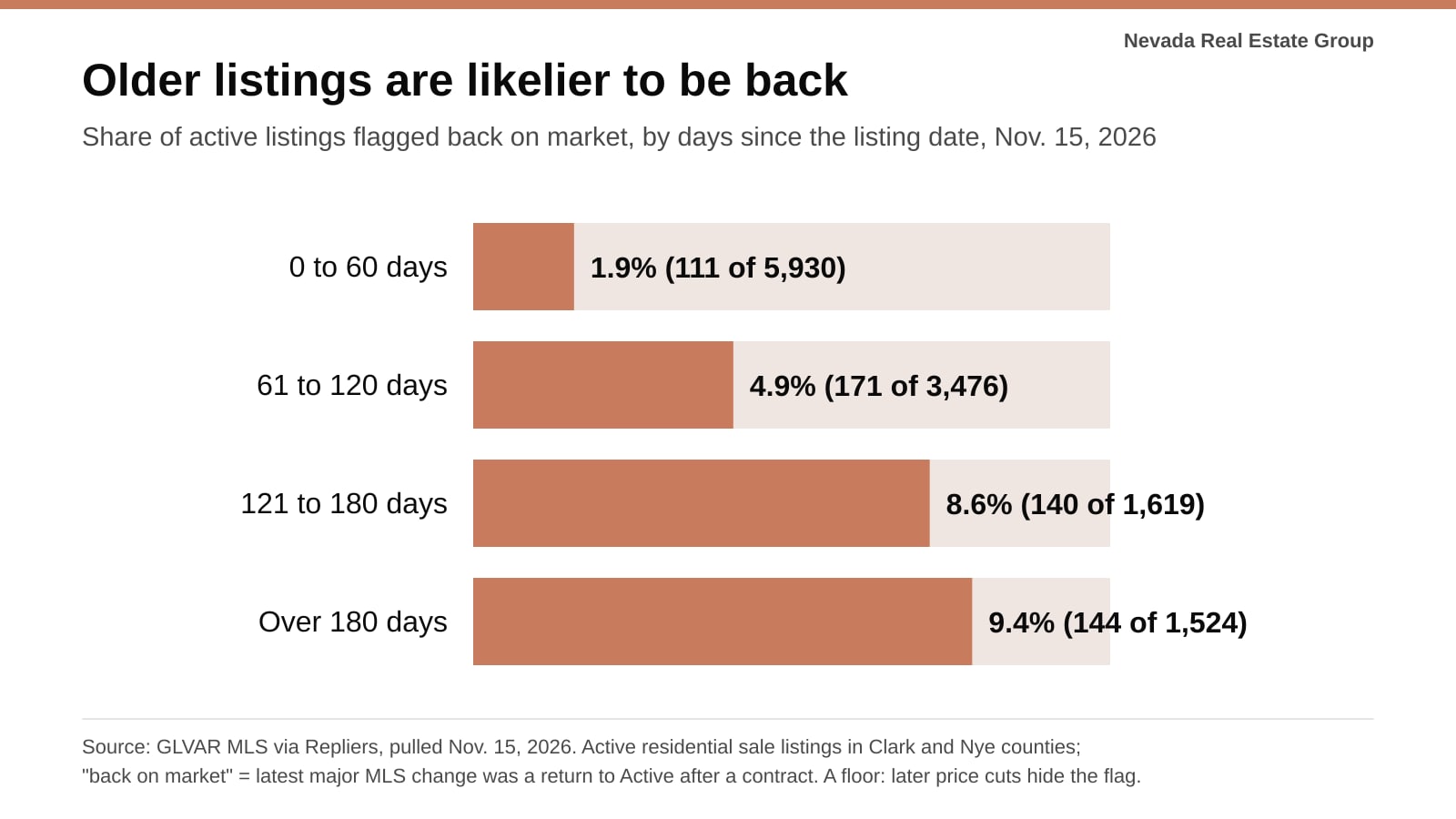
The bigger driver is how long the home has been listed. Back-on-market homes are older listings: their median listing date was 121 days before November 15, against 62 days for other actives, which makes sense because a home has to be listed, go under contract and spend time in escrow before it can come back. And the older the listing, the more likely the flag. Only 1.9% of listings under 60 days old were back on the market, rising to 4.9% at 61 to 120 days, 8.6% at 121 to 180 days and 9.4% beyond 180 days.
Price follows the same curve. Among back-on-market homes listed within the last 60 days, 16.2% were below their original price. Among those listed more than 180 days earlier, 66.7% were, and the group's median asking price sat 4.0% below its original. Condos that came back were below original 51.5% of the time, with the group's median 1.2% below. So the typical recent return is a home at its first price, with a seller who believes the market already accepted that number once. The long-listed return is more often a home whose price has already been tested and lowered. Our buyer guide to Las Vegas price reductions covers how to read a price history before you write an offer.
What should a seller do in the first week after a buyer cancels?
Start with paperwork, not price. Get the signed cancellation and release so the contract is clearly over and the earnest money question is settled; if the two sides disagree about the deposit, ask your agent and escrow officer how your contract handles it before you sign anything new. Then collect everything the failed deal produced: the buyer's inspection report if your agent received a copy, the repair request, any appraisal value the buyer's side shared, and the lender's or buyer's written reason for cancelling if one was given. That file tells you whether the problem was the buyer, the house or the price.
Next, sort the reason into one of those three buckets, because each calls for a different fix. If it was the buyer, such as a job change, a loan denial unrelated to the home, or a sale that collapsed on their side, your price and condition may be fine, and the best move is to relaunch quickly while the earlier showing traffic is still warm. If it was the house, such as a roof, HVAC or plumbing finding, decide whether to repair it, price for it or offer a credit, and remember the disclosure duty above. If it was the price, typically an appraisal that came in low, a fresh comparison of recent closings is the starting point.
Finally, have your agent contact the agents of buyers who showed interest the first time, including anyone who wrote a backup offer or lost out in a multiple-offer situation. Our Las Vegas home appraisal guide explains how appraisers pick comparable sales if the appraisal is what broke the deal.
When should a seller lower the price after a failed contract?
Lower it when the evidence says the price was the problem, not as a reflex. A failed contract caused by the buyer's personal circumstances or financing does not, by itself, tell you the market rejected your price; it accepted it, at least once. In our November 15, 2026 snapshot, 53.9% of back-on-market sellers were holding their original price, and most of those returns were recent, so the market had not yet had time to respond to the relaunch.
There are three situations where a price change usually deserves a serious look. The first is a low appraisal: if a licensed appraiser valued the home below the contract price and the buyer could not cover the gap, the next financed buyer's appraiser may well reach a similar number from the same recent sales. The second is an inspection finding you choose not to repair; buyers price a known problem, and an honest price adjustment can cost less than a long string of renegotiations. The third is time. Our data showed that back-on-market homes listed more than 180 days earlier were below their original price 66.7% of the time, and the longer a listing sits, the more buyers assume something is wrong with it.
Before you decide, get a current view of the market rather than relying on the comparison you used at listing. Run a free comparative market analysis on your address and compare it with recent closings in your subdivision. The Las Vegas home pricing playbook for sellers shows how to read list-to-sale ratios and price bands, and if you are weighing whether to keep going at all, our study of what Las Vegas sellers did after an expired listing shows how relisting, price cuts and changing brokerages turned out for 696 sellers between May and July 2026.
What must a seller disclose after a failed inspection?
Nevada's Seller's Real Property Disclosure law is the starting point. Under NRS 113.130, the seller completes a disclosure form and serves it on the buyer at least 10 days before the property is conveyed, and a seller's agent may not complete the form on the seller's behalf. If, after serving the form but before conveyance, the seller or the seller's agent discovers a new defect, or finds that a disclosed defect has become worse than the form indicated, the seller must tell the buyer in writing as soon as practicable. The same section says that if the seller won't repair or replace the defect, the buyer may rescind the agreement or close and accept the property with the defect as disclosed, without further recourse.
NRS 113.140 adds that the law does not require a seller to disclose a defect the seller is not aware of. A failed inspection changes that: once a report has named a problem, the seller is aware of it. So if a buyer's inspection turned up a roof leak, an electrical issue or evidence of a water intrusion, the practical expectation is that the next buyer's disclosure reflects it, whether the seller fixes it or not. The seller's agent, as a licensee, also has a separate duty under NRS 645.252 to disclose material facts they know about the property.
This is general information, not legal advice, and whether a particular finding counts as a defect can be a judgment call. If you aren't sure, ask your agent to raise it with their broker, and consider talking with a Nevada real estate attorney. Some sellers also order their own pre-listing home inspection before relaunching, so they know exactly what the next buyer will find and can repair, disclose or price for it on their own terms.
Is a back-on-market home a red flag for a buyer?
Not by itself. In our November 15, 2026 snapshot, the three listing descriptions that gave a reason all pointed at the buyer, not the house, and the national survey data point at financing and appraisals as common trouble spots. A home can come back because the previous buyer's job moved, their loan failed for reasons that had nothing to do with the property, or they found another house they liked better while they could still cancel under their due diligence period. None of those tells you anything about the home.
It can also be an opportunity. A seller who has already packed, lined up a next home or started paying two mortgages has a reason to want a buyer who can close cleanly, and that can show up as flexibility on closing date, repairs or credits, even when the asking price hasn't moved. More than half of the back-on-market homes in our snapshot were still at their original price, which leaves room to negotiate on the terms that matter to you. The previous buyer's due diligence may also save you time if the seller shares it.
What makes a return a red flag is a pattern, not the flag itself. Look at the full price and status history: a home that has gone under contract and come back more than once, or one that came back right after an inspection or appraisal period ended, deserves more questions than one that came back after a buyer's financing collapsed. Watch for disclosure updates that appeared after the first contract, and compare the asking price with recent sales nearby. You can see active inventory, including back-on-market homes, on our Las Vegas homes for sale search.
What should a buyer ask before offering on a back-on-market home?
Ask your agent to get answers to five questions from the listing agent before you write an offer. First, why did the previous contract end, and at what stage: during inspection, during the appraisal, at loan approval, or after? Second, was there an inspection, and will the seller share the report and the repair request? A seller isn't required to hand over another buyer's report, but some will, and the findings may already be reflected in an updated disclosure. Third, was there an appraisal, and what value did it reach, if the seller knows? Fourth, has the Seller's Real Property Disclosure been updated since the first contract? Fifth, has anything been repaired since, and are there receipts?
Then do your own work anyway. Order your own inspection, because the previous report was written for someone else and you can't rely on it the same way. If the home is a condo, confirm early that the building works for your loan type. If a low appraisal was the problem, talk to your lender about how much of a gap you could cover, and consider writing the appraisal terms into your offer with that in mind. Our guide to Nevada contingencies explains which protections you keep while you investigate.
Finally, match your offer to what the history tells you. A seller who lost a buyer to financing will usually value a buyer with full approval, a strong deposit and a realistic closing date. Those terms can matter as much as price. First-time buyers can find more on structuring offers in our first-time buyer resources.
How do you keep your own contract from falling through?
On the seller's side, most of the protection happens before you accept an offer. Ask for the buyer's pre-approval letter and, where possible, a call between your agent and the lender to confirm what has actually been verified. Weigh the loan type, down payment and deposit, not only the price, because a slightly lower offer with a stronger buyer can be worth more than a higher one that collapses in week three. Disclose known issues up front so they don't surface as surprises during the buyer's inspection. And get your HOA documents ordered early, since delays there can push a buyer past a contract deadline.
On the buyer's side, get fully approved before you shop, keep your finances unchanged during escrow, ask your lender about locking your rate, and schedule the inspection and any specialist follow-ups at the start of your inspection period instead of the end. If something does come up, raise it within the contract period, in writing, so you keep your options and your deposit.
For both sides, a contract that falls through is a setback, not a verdict on the house or the buyer. On November 15, 2026, 566 Southern Nevada homes were back on the market, and every one of them had already found at least one buyer. If your home just came back, or you're weighing an offer on one that did, Nevada Real Estate Group can review the history with you. Start with an instant home value estimate, read how we sell homes in Las Vegas, or see how we market and sell homes across the valley. If a long listing commitment is the worry, our 7-day listing agreement lets you cancel at any time. Pahrump sellers and buyers can also browse Pahrump homes for sale to see current competition. When you're ready to talk it through, call (702) 637-1759 or contact us online.
Frequently Asked Questions
What does back on market mean in real estate?
It means a home went under contract with a buyer and then returned to Active status instead of closing. The contract ended for a reason the MLS does not record. On November 15, 2026, 566 of 12,549 active residential listings in Clark and Nye counties (4.5%) carried the flag in the GLVAR MLS.
Is a back-on-market house a bad sign?
Not on its own. Only 3 of 566 back-on-market listing descriptions in our November 15, 2026 snapshot gave a reason, and all 3 pointed at the buyer, not the house. Ask why the contract ended, whether an inspection or appraisal happened, and whether the disclosure was updated, then order your own inspection.
Why do home sales fall through in Las Vegas?
The MLS does not record reasons, so no local percentage exists. A purchase agreement's inspection, appraisal and loan periods are where a buyer can cancel under the contract's own terms. Nationally, NAR's Realtors Confidence Index page reported 7% of contracts terminated in the prior three months as of November 15, 2026, with 4% delayed by appraisal issues.
Do sellers lower the price after a deal falls through?
Most don't right away. On November 15, 2026, 53.9% of Southern Nevada back-on-market listings were still at their original price. Longer-listed homes were different: 66.7% of those listed more than 180 days earlier were below their original price, and that group's median sat 4.0% below.
Does a seller have to disclose why the last buyer backed out?
Nevada law does not require a listing to explain why a buyer left. Under NRS 113.130 a seller must disclose known defects, including new or worsened ones found after serving the disclosure form, and under NRS 645.252 an agent must disclose material facts they know about the property.
Can I see the previous buyer's inspection report?
Sometimes. The seller isn't required to share another buyer's report, but some do, and any defects it found should appear on an updated Seller's Real Property Disclosure. Ask through your agent, then order your own inspection, because the earlier report was written for a different buyer.
How long does it take a back-on-market home to sell again?
Our snapshot measures how long homes have been back, not how long they take to resell. As of November 15, 2026 the median back-on-market listing had been available again for 25 days, and 55.7% had returned within the previous 30 days. Homes at $1 million and above had been back a median 44 days.
Do condos fall out of escrow more often?
In our November 15, 2026 snapshot they returned more often: 6.4% of active condos were back on the market, versus 4.2% of single-family houses. Condo loans depend partly on the building's HOA finances and eligibility, which can raise problems after the contract is signed.
Which Sources Inform This Guide?
MLS study. Listing data comes from the GLVAR multiple listing service through Repliers, pulled November 15, 2026. The population is every sale listing in Clark and Nye counties with a residential property type and a raw MLS status of Active: 12,549 listings. A listing counts as back on market when its most recent major MLS change is a return to Active after being under contract (MajorChangeType "BackOnMarket"); the date of that change is the return date, converted to Pacific time. Listings under contract on the same day (1,566 Pending, 1,283 Active Under Contract and 41 Contingent) were pulled the same way. Price bands use the current asking price; listing age counts Pacific calendar days from the listing contract date. Public remarks on all 566 back-on-market listings were searched by keyword and then read record by record to count mentions of the return and any stated reason. Five records (MLS 2814544, 2821422, 2803819, 2824707 and 2805581) were spot-checked by MLS number against the live feed the same day; the check is saved as spot-check.txt with the study output. The analysis script, scripts/back-on-market-study.ts, and its output are kept with this post's records.
Limits. The MLS keeps only a listing's latest major change, so a home that came back and then changed price is not counted; 566 is a floor. Contracts that ended with the listing withdrawn are not visible. The MLS does not record why a contract ended. This is a one-day snapshot, not a fall-through rate, and the comparisons show association, not cause.
National and legal sources. The National Association of Realtors' Realtors Confidence Index, Freddie Mac's Primary Mortgage Market Survey for the week of November 12, 2026, the Consumer Financial Protection Bureau's rate lock explainer, and the Nevada Revised Statutes, chapter 113 and section 645.252, all read November 15, 2026.
This guide is general information, not legal or financial advice. Purchase agreements differ, so confirm your own contract's terms with your agent, escrow officer or a Nevada real estate attorney.