
Buying a home you can keep horses on in Southern Nevada is a narrower search than it looks. Plenty of listings say "horse property," but the homes that actually allow horses are scattered across a few older parts of the Las Vegas valley, the town of Pahrump an hour west, and the farm towns of the Moapa Valley to the northeast. They come with septic tanks and private wells more often than not, they rarely sit inside a homeowners association, and the zoning on the parcel, not the listing remarks, decides how many animals you can keep.
To put real numbers on it, we pulled every residential sale in Clark and Nye counties that closed between October 1, 2025 and September 30, 2026 from the GLVAR multiple listing service, and kept the 467 homes the MLS itself marks as allowing horses. Below is what they sold for, where they are, how they compare with other large-lot homes in the same ZIP codes, what was for sale on November 12, 2026, and the zoning, water and financing questions to settle before you write an offer.
Horse property in Southern Nevada sold for a median $465,000 on 1.1 acres between October 2025 and September 2026, based on 467 MLS closings in Clark and Nye counties. Location sets the price: the Las Vegas valley's 196 sales had a median of $800,000 on 0.65 acre, while Pahrump's 211 sales had a median of $309,000 on 1.13 acres. Most were older homes on septic, and two in three used a well.
- 467 horses-allowed homes closed in Clark and Nye counties, October 2025 to September 2026.
- Pahrump had 211 of them at a $309,000 median; the Las Vegas valley's 196 had an $800,000 median.
- Only 112 of the 467 listed any horse facility, such as corrals or an arena; most simply allowed horses.
- 83.1% were on septic and 67.7% on a private or shared well, so inspections change.
- Parcel zoning decides animal limits, so confirm it with the county or city before you offer.
| Measure | Las Vegas valley | Pahrump | Moapa Valley | Sandy Valley |
|---|---|---|---|---|
| Closings | 196 | 211 | 35 | 10 |
| Median sale price | $800,000 | $309,000 | $445,000 | $325,000 |
| Median lot | 0.65 acre | 1.13 acres | 2.07 acres | 2.08 acres |
| Median price per living sq ft | $314 | $198 | $200 | $172 |
| Median sale as share of original list | 94.9% | 97.1% | 95.0% | 97.2% |
| Median days on market | 35 | 32 | 35 | 50 |
| On septic | 64.3% | 98.6% | 85.7% | 100% |
| On a private or shared well | 43.4% | 97.2% | 5.7% | 100% |
| In an HOA | 8.7% | 0.9% | 0% | 0% |
The Las Vegas valley column combines the MLS cities of Las Vegas (163 sales), Henderson (27) and North Las Vegas (6). Moapa Valley combines Logandale, Overton and Moapa. The other 15 sales were spread across Amargosa Valley, Cold Creek, Searchlight, Jean, Nelson, Crystal and Boulder City.
What counts as horse property in the Southern Nevada MLS?
A horse property, for this study, is a home the listing itself flags as allowing horses in one of three structured MLS fields. GLVAR listing data has a yes-or-no "horse" field, a horse amenities field that lists items such as corrals, an arena, a tack room, pasture or a hot walker, and a zoning description field whose values include "Horses Permitted." A home counted if any one of those said horses were allowed. We did not count a listing just because the word "horse" appeared somewhere in it, because one of the first records we pulled was a home on a street named Horse Drive.
Of the 467 homes that qualified, 163 had the yes-or-no field set to yes, 76 more listed at least one horse amenity, and the remaining 228 qualified only through the "Horses Permitted" zoning description. To make sure that last group was real, we pulled the full listing remarks for a sample of 15 records across all three groups. Every one sat on roughly half an acre or more, and several remarks said outright that horses were allowed, from "a full acre of horse-approved land" in ZIP 89143 to a lot "approved for up to several horses" with a 12-by-24 corral in ZIP 89124.
Two limits follow from that definition. The MLS zoning field is what the listing agent typed, not a copy of the county's parcel record, so it shows intent rather than legal proof. And many homes that could legally keep horses are never flagged at all, because the seller had no horses and the agent left the field blank. The 467 sales are the homes marketed as horse-capable, which is the market a horse buyer actually shops. When you find a candidate, the zoning check described later in this guide is still the step that settles it.
What did horse property sell for across Southern Nevada?
The median horses-allowed home in Clark and Nye counties sold for $465,000 between October 2025 and September 2026, on a median lot of 1.1 acres, with 2,028 square feet of living space and a median year built of 1993. That single number hides the main fact of this market: there are really two price levels, one inside the Las Vegas valley and one outside it.
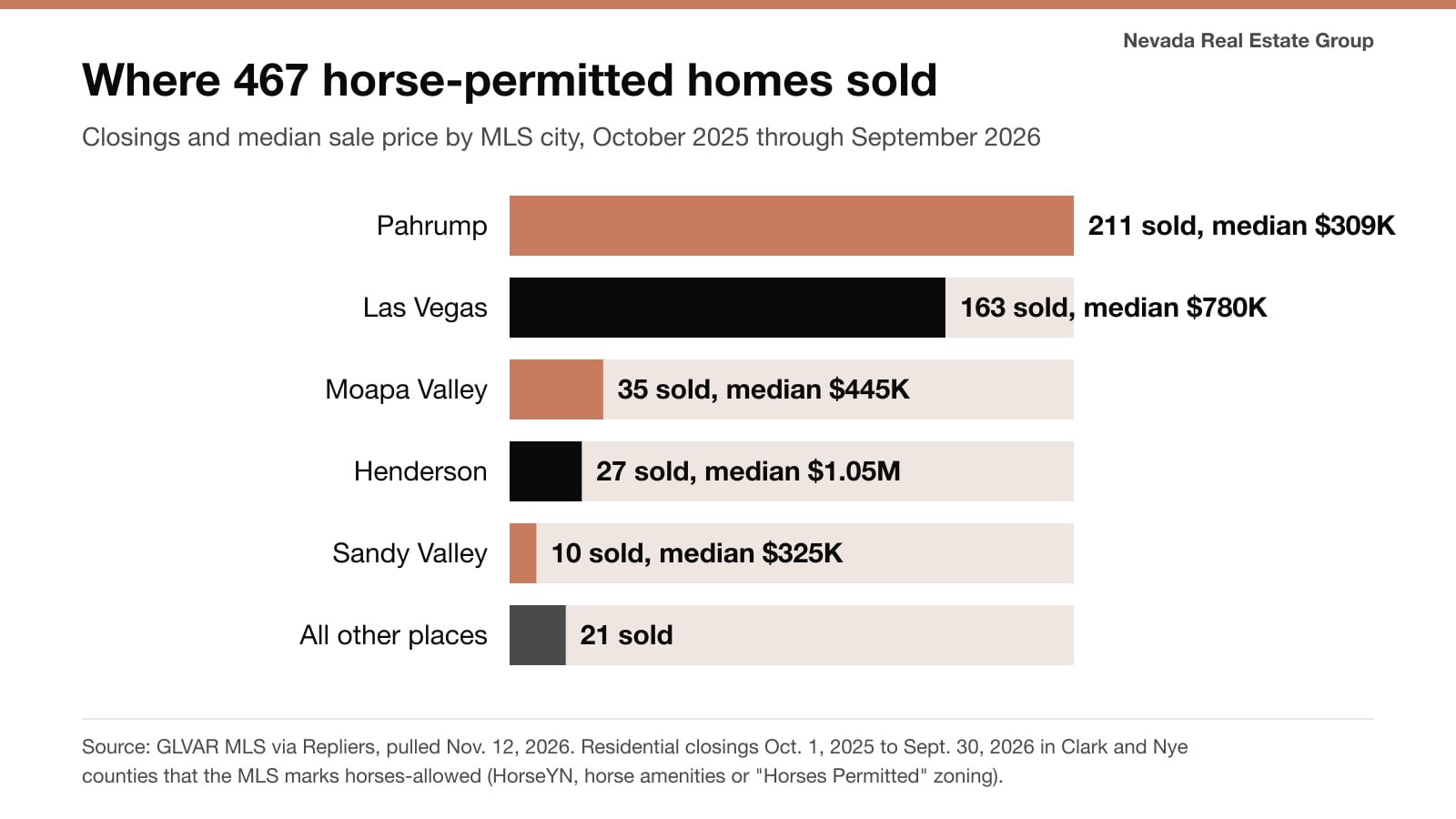
Pahrump, in Nye County, accounted for 211 of the 467 sales, or 45%, at a median of $309,000. Three in four Pahrump horse homes, 157 of 211, sold for under $400,000. They are mostly modest houses, a median 1,615 square feet, on lots of about an acre, and nearly all of them run on a well and a septic tank. The Pahrump horse properties page shows what is listed there today, and our Pahrump land and acreage guide covers lot buying in the town.
Inside the Las Vegas valley the price is far higher and the lot is smaller. The MLS city of Las Vegas recorded 163 sales at a median of $780,000 on 0.61 acre, Henderson 27 at $1,050,000 on 0.81 acre, and North Las Vegas 6 at $530,000 on 0.41 acre. Together those 196 valley sales had a median of $800,000. Only 46 of them closed under $600,000, while 64 closed at $1 million or more. The Moapa Valley towns of Logandale, Overton and Moapa sat between the two at a $445,000 median, and the median Moapa Valley lot was larger than either at 2.07 acres. Sandy Valley, southwest of the Las Vegas valley, recorded 10 sales at a $325,000 median on two-acre lots.
Prices also behaved differently once a home was listed. In Pahrump the median sale reached 97.1% of the original asking price and 43.6% of homes sold at or above the final list price. In the MLS city of Las Vegas the median sale reached 94.6% of the original ask and only 31.3% sold at or above list. In other words, the typical Las Vegas horse home sold for about 5% less than its first asking price.
Which Las Vegas valley ZIP codes have the most horse-property sales?
Valley horse property clusters in a few parts of the valley, and the ZIP code tells you a lot about the house you will get. Of the 196 valley sales, 79 were in northwest ZIP codes, 48 in southwest and south ZIP codes, 30 in the east and southeast, 27 in Henderson, 6 in North Las Vegas and 6 in older central ZIP codes. The table lists every valley ZIP with eight or more sales.
| ZIP | Closings | Median price | Median lot | Median year built | Median days on market | Median sale vs original list |
|---|---|---|---|---|---|---|
| 89108 | 18 | $588,750 | 0.46 acre | 1976 | 38 | 96.4% |
| 89131 | 18 | $877,500 | 1.05 acres | 1993 | 73 | 86.5% |
| 89149 | 17 | $1,000,000 | 0.56 acre | 1994 | 13 | 96.5% |
| 89015 | 14 | $937,500 | 0.73 acre | 2016 | 31 | 95.7% |
| 89130 | 14 | $750,000 | 0.62 acre | 1983 | 21 | 99.0% |
| 89002 | 13 | $1,225,000 | 0.95 acre | 1993 | 58 | 95.2% |
| 89120 | 11 | $825,000 | 0.67 acre | 1974 | 57 | 88.9% |
| 89110 | 10 | $628,500 | 0.66 acre | 1981 | 11 | 95.1% |
| 89123 | 10 | $982,500 | 0.74 acre | 1981 | 63 | 92.9% |
| 89146 | 9 | $710,000 | 0.57 acre | 1977 | 55 | 95.9% |
| 89139 | 8 | $1,135,000 | 0.96 acre | 1989 | 27 | 95.5% |
The northwest ZIPs, 89131, 89149, 89130 and 89129, are the core of the valley's horse country and the area around Lone Mountain and Centennial Hills. Those four ZIPs held 55 of the 196 valley sales, and 89131 had the largest median lot in the table, just over an acre. 89131 was also the slowest and most negotiated ZIP: a median 73 days on market and a median sale at 86.5% of the original asking price, so the typical seller there started well above the eventual price.
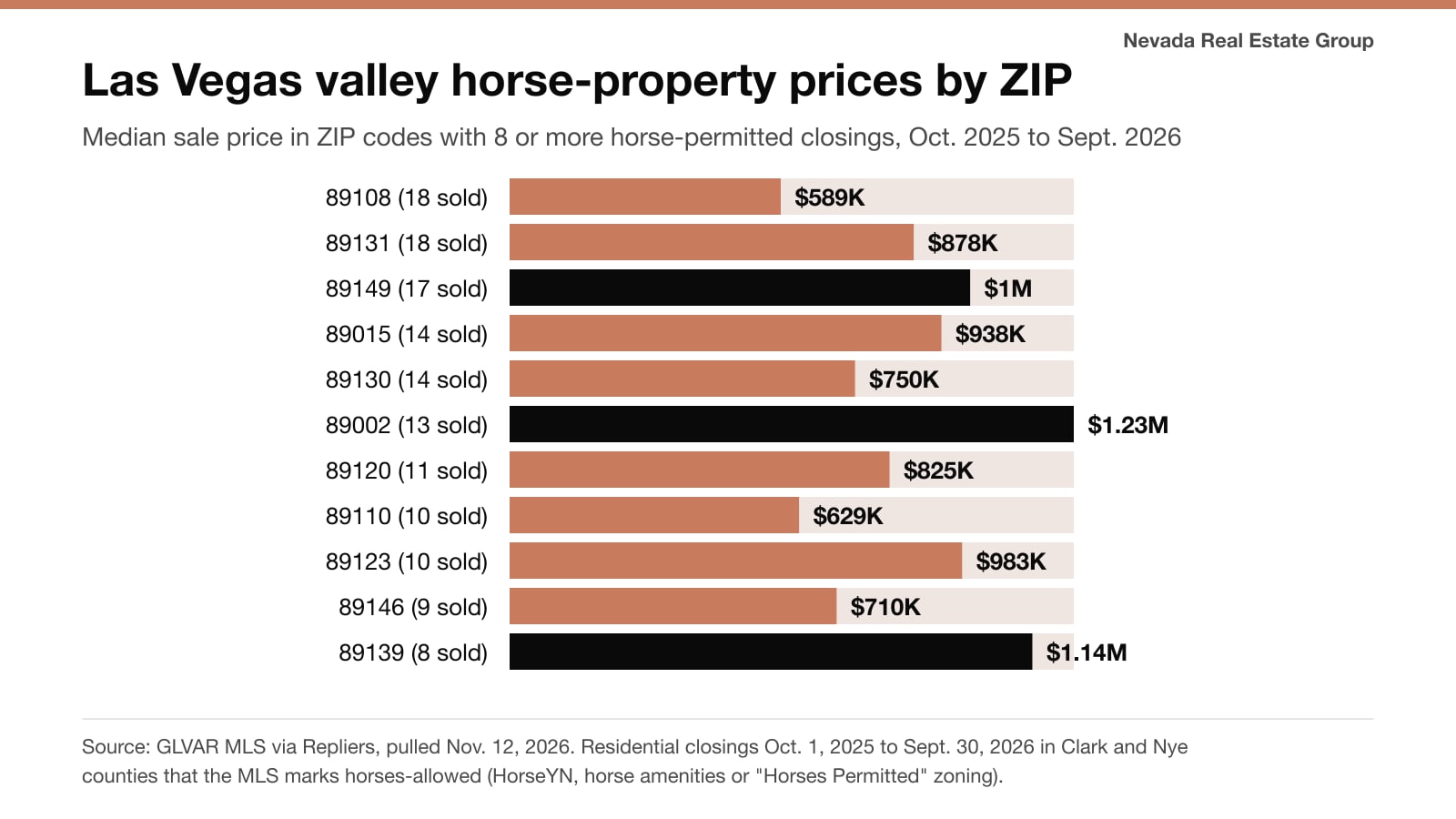
The least expensive valley option was 89108, where 18 horse homes sold at a median $588,750. These are older houses, a median 1976 build, on lots of just under half an acre. The east-side ZIP 89110 was similar at $628,500 and sold the fastest, at a median 11 days. At the top were Henderson's 89002 ($1,225,000) and 89015 ($937,500) and the south-valley ZIPs 89139 ($1,135,000) and 89123 ($982,500); 89015's horse homes had a median build year of 2016, the newest in the table. Small samples swing medians, so treat any ZIP with ten or fewer sales as a range finder rather than a price guarantee.
How much land do you get for the money?
Less than most buyers expect inside the valley. Half the valley's horse sales sat on less than two-thirds of an acre, and 58 of the 196 were on lots under half an acre. Of those 58, 45 measured between 0.44 and 0.49 acre, which is what a nominal half-acre lot of about 20,000 square feet works out to on paper (20,000 square feet is 0.46 acre). If your plan needs a full acre for pens, a round pen and trailer parking, the valley offers far fewer choices, and they cost more.
| Lot size | Valley closings | Valley median price | All-area closings | All-area median price |
|---|---|---|---|---|
| Under 0.5 acre | 58 | $627,500 | 62 | $605,000 |
| 0.5 to 0.99 acre | 86 | $800,000 | 115 | $725,000 |
| 1 to 1.99 acres | 38 | $1,180,000 | 184 | $359,000 |
| 2 to 4.99 acres | 11 | $1,340,000 | 90 | $357,500 |
| 5 acres or more | 3 | Too few to report | 16 | $472,500 |
The table shows the trade-off in one line. A valley horse home on one to two acres had a median price of $1,180,000 over the 12 months, while across both counties the same lot size had a median of $359,000, because most of those larger lots are in Pahrump, Moapa Valley and Sandy Valley. Moving out of the valley roughly triples the land per dollar, at the cost of a longer drive into the metro area and, usually, a well and septic system you will maintain yourself.
The cheapest acreage also tends to come with the smallest and oldest houses. The median one-to-two-acre home across both counties had 1,867 square feet of living space and was built in 1996, against 3,351 square feet and 1988 for the valley's one-to-two-acre sales. If you are weighing a smaller house on more land against a larger house on a half acre, decide first how many horses you plan to keep, because that number, and the zoning that allows it, drives the lot size you actually need. Our Las Vegas homes with land page shows half-acre-plus listings across the valley.
Do corrals, arenas and barns change the price?
Less than you might think, and the MLS data says most horse homes don't advertise much setup at all. Only 112 of the 467 sales, about 24%, listed any facility in the horse amenities field: 78 listed corrals, 39 an arena, 29 a tack room, 23 pasture, 17 riding-trail access and 11 a hot walker. The other 355 were marked as allowing horses with no facilities named. In most of these sales, what changed hands was the right to keep horses rather than a finished setup.
Where facilities were listed, the valley homes that had them sold for more, a median $877,500 across 64 sales against $777,500 for the 132 without, but they also sat on bigger lots (0.76 versus 0.57 acre), so the land explains much of the gap. They also negotiated harder. Valley homes with listed facilities closed at a median 92.3% of their original asking price, against 95.8% for those without, and only 23.4% sold at or above list. In Pahrump the difference nearly disappeared: 30 homes with listed facilities sold at a median $319,500 on 1.3 acres, against $308,000 on 1.1 acres for 181 without.
The practical reading is that a corral, an arena or a hot walker is something to inspect and value on its own condition, not a line that automatically adds a fixed sum to a price. Pipe-rail pens, shade covers and arena footing wear out, and an appraiser may give them little weight, a point covered in the financing section below. If the setup is the reason you want the house, have it inspected, photograph its condition before closing and confirm in writing which structures convey with the sale.
How do horse homes compare with other large-lot homes in the same ZIP codes?
To see what sets horse property apart from simply buying a big lot, we compared the 160 valley horse sales in the 14 ZIP codes that had five or more of them with the 249 other homes on half an acre or more that sold in the same ZIPs over the same 12 months without any horse flag. The horse homes were older, smaller and on slightly larger lots, and they were far less likely to sit in an HOA.
| Measure | Horses-allowed homes | Other half-acre-plus homes |
|---|---|---|
| Closings | 160 | 249 |
| Median sale price | $827,500 | $896,000 |
| Median living area | 2,868 sq ft | 3,286 sq ft |
| Median lot | 0.68 acre | 0.55 acre |
| Median year built | 1987 | 2002 |
| Median price per living sq ft | $321 | $288 |
| In an HOA | 6.3% | 40.6% |
| On septic | 68.1% | 32.5% |
| On a private or shared well | 45.6% | 16.9% |
| Sold at or above list price | 30.0% | 23.7% |
The 14 ZIP codes were 89002, 89015, 89108, 89110, 89113, 89120, 89123, 89129, 89130, 89131, 89139, 89146, 89149 and 89183. The comparison group includes many newer homes inside HOA communities, which helps explain why its median house is larger and 15 years younger. That is the point of the comparison: in the same parts of town, the large lots that allow horses are mostly older lots outside any association, while four in ten of the other large lots sit inside an HOA, where the association's recorded rules can add their own limits on animals on top of the zoning.
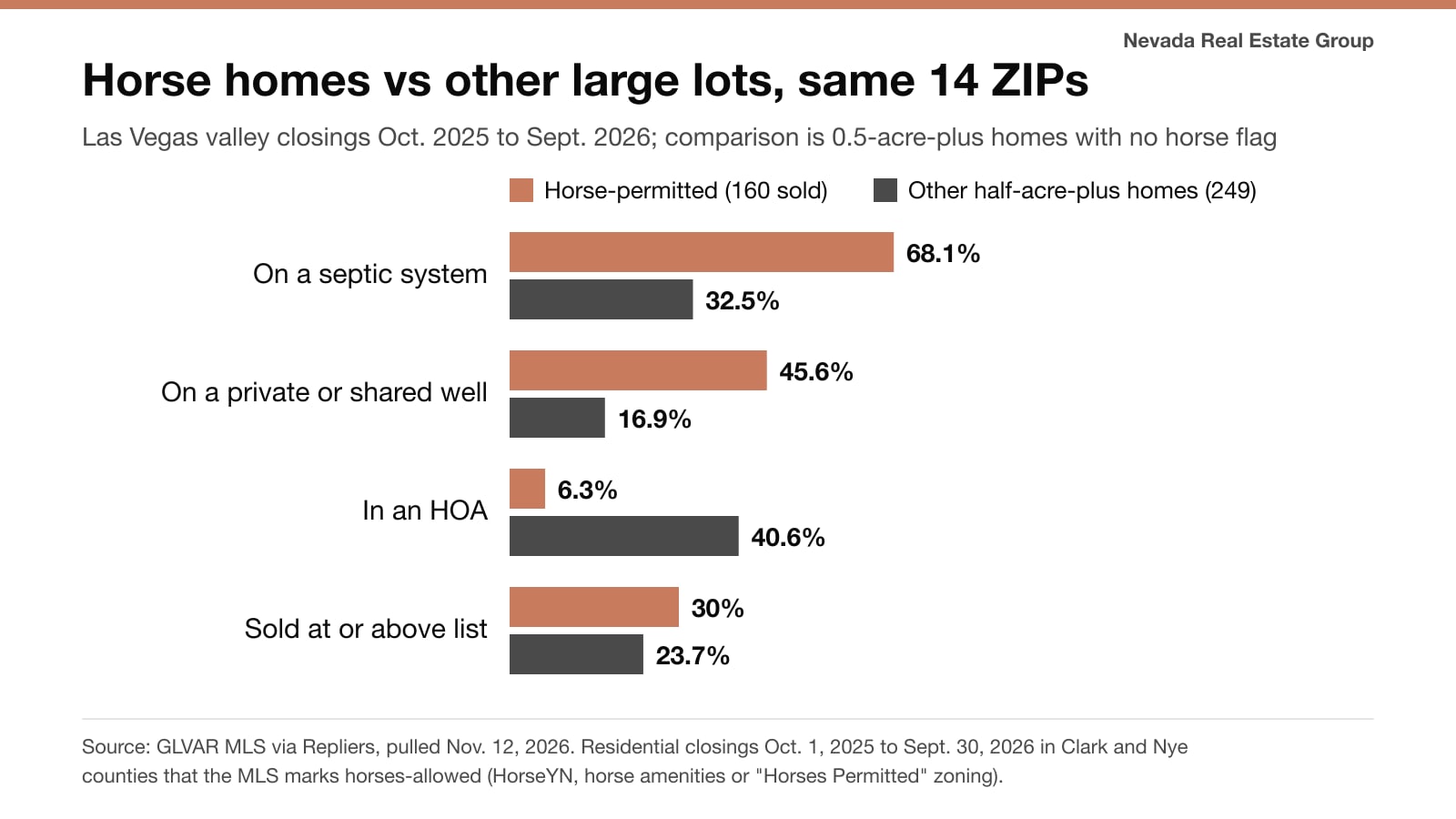
Higher price per square foot does not mean horse rights carry a premium. The horse homes had smaller houses on bigger lots, and land is part of what the price per square foot measures, so the comparison can't isolate the value of the horse rights themselves. What it does show is that if you want both a large lot and the freedom to keep animals, you are shopping almost entirely outside the HOA market. Our guide to Las Vegas neighborhoods with no HOA maps where those older non-association lots are.
How many horses can you keep on a Las Vegas valley lot?
It depends on which government's code covers the parcel, and in the Las Vegas valley that is usually either unincorporated Clark County or the City of Las Vegas. Both start from the same arithmetic: about one horse for every 7,500 square feet of lot. The difference is in which zoning districts allow horses at all and what else the code requires.
In unincorporated Clark County, the county's Title 30 development code classifies horses as large livestock and allows them only in the RS80, RS40, RS20 and AG districts inside its Urban Area, which the code defines as the land within the Las Vegas Valley Bureau of Land Management disposal boundary plus everything within 3 miles of it, and Laughlin. There, one large animal is allowed per 7,500 square feet of lot area, up to 25, and in RS20 the animals have to go with a home on the lot. The minimum lots are 20,000 square feet in RS20, 40,000 in RS40 and 80,000 in RS80. The code also sets space per animal: at least 120 square feet of stall or pen, 90 of it covered, plus at least 1,200 square feet of pasture, turnout or exercise area. Outside the Urban Area the ratio is looser, one per 4,000 square feet on lots of 80,000 square feet or less, so ask the county which rule applies before buying in Moapa Valley or Sandy Valley.
Inside the city limits, the City of Las Vegas animal-keeping rules allow no more than one horse or cow per 7,500 square feet of lot area. Animal keeping is listed as a conditional use in the U, R-E and R-D districts in the city's land-use table, while R-1 and R-MH allow only chickens. An R-D lot can stable no more than two horses and needs at least 18,000 net square feet, the same minimum lot size the R-E district standards set. In the city's horse districts, including R-E, a stable or corral has to sit at least 50 feet from any home on a neighboring residential lot, and the city bars cattle south of Cheyenne Avenue.
| Rule | Unincorporated Clark County (Urban Area) | City of Las Vegas | Nye County (Pahrump) |
|---|---|---|---|
| Districts that allow horses | RS80, RS40, RS20, AG | U, R-E, R-D (conditional use) | RE-1, RE-2 rural estates |
| Horses per lot | One per 7,500 sq ft, up to 25 | One per 7,500 sq ft; R-D capped at two | No head count found in the ordinance |
| Minimum lot | 20,000 sq ft (RS20) to 80,000 sq ft (RS80) | 18,000 sq ft (R-E; R-D net) | 1 gross acre (RE-1); 2 gross acres (RE-2) |
| Space or setback rules | 120 sq ft pen per animal, 90 covered; 1,200 sq ft turnout each | R-E stable or corral 50 ft from a neighbor's home | Ask the county planning office |
Put those numbers to work and a typical half-acre lot, about 20,000 square feet, divides into two full 7,500-square-foot allotments, so two horses, while a full acre of 43,560 square feet divides into five. Under the county code, two horses also need 240 square feet of pens and 2,400 square feet of turnout before you count the house, garage, driveway and trailer parking. Henderson and North Las Vegas write their own animal rules, which we could not verify for this guide, so confirm a Henderson or North Las Vegas parcel with that city's planning department. In Pahrump, Nye County's Ordinance 555 describes the RE-1 and RE-2 rural-estate districts as places where livestock or other large animals may be kept, on one and two gross acres respectively. The same ordinance describes a Suburban Estates (SE) district, also one gross acre, where the keeping of large animals is prohibited, so an acre in Pahrump is not automatically horse-legal.
What does a rural preservation neighborhood protect for a horse owner?
It protects the low-density, animal-friendly character of an area, but it is not by itself a permit to keep horses. Nevada law, in NRS 278.0177, defines a rural preservation neighborhood as an area of 10 or more homes, each lot within 330 feet of another, with no more than two residential dwelling units per acre, that allows residents to raise or keep animals noncommercially. Clark County implements the idea as a Rural Neighborhood Preservation overlay in Title 30, applied to land its master plan shows as Ranch Estate Neighborhood. The overlay caps density at two homes per acre, with an exception for subdivisions of 10 or fewer lots, says developments and uses must be compatible with a rural lifestyle, including the raising and keeping of animals, and bars gated communities.
The City of Las Vegas has a parallel Rural Preservation Overlay district whose stated purpose is to ensure that the rural character of each rural preservation neighborhood is preserved. For a buyer, these overlays help explain why the northwest valley still has blocks of half-acre and one-acre lots without HOAs next to newer, denser subdivisions.
Two cautions apply. First, the overlay and the zoning district are separate layers. The overlay limits density and protects rural character, while the zoning district under it sets whether and how many horses are allowed, so check both on the parcel record. Second, the arrangement between the city and county that shapes the northwest is in flux. According to Clark County's staff report for its October 20, 2026 meeting, the Las Vegas City Council approved on October 7, 2026 a 60-day notice of termination of the city-county interlocal agreement on boundaries and planning, along with an amendment extending it to February 22, 2027 if the county ratified it; without ratification, the agreement expires December 21, 2026. Our guide to what a Clark County island annexation vote means for homeowners explains what that agreement governs and what changes when it ends. If you are buying in ZIPs 89129, 89130, 89131, 89143 or 89149, read it before you rely on today's density limits for the lots around you.
What horse property is for sale right now, and how long has it been listed?
On November 12, 2026, 185 homes in Clark and Nye counties were listed as active or coming soon with a horses-allowed flag, at a median asking price of $679,900 on 1.1 acres. They had been on the market a median 83 days, counted from each listing date, and 47% had been listed for more than 90 days. That is slow inventory, and it gives a patient buyer room to negotiate.
| Area | Active listings | Median asking price | Median lot | Median days since listed | Listed over 90 days |
|---|---|---|---|---|---|
| Las Vegas (MLS city) | 72 | $1,195,000 | 0.91 acre | 78 | 45.8% |
| Pahrump | 63 | $350,000 | 1.1 acres | 84 | 47.6% |
| Henderson | 14 | $1,374,950 | 0.83 acre | 70 | 35.7% |
| Moapa Valley | 12 | $432,000 | 1.89 acres | 56 | 25.0% |
| Sandy Valley | 10 | $290,000 | 2.05 acres | 144 | 60.0% |
| All Clark and Nye | 185 | $679,900 | 1.1 acres | 83 | 47.0% |
The valley's asking prices sit well above what valley horse homes have been selling for. The 88 active valley listings (Las Vegas, Henderson and North Las Vegas) asked a median $1,200,000, half again the $800,000 median of the 196 valley sales over the prior 12 months, and 33 of the 88 asked $1.5 million or more, against 24 of the 196 sales that closed at that level. Part of that gap is mix: the expensive listings are the ones that stay on the market and pile up. But it also means a buyer looking at a $1.4 million valley horse property should study the closed sales, not the neighboring listings, before deciding what to offer.
In Pahrump the gap was smaller. The 63 active listings asked a median $350,000 against a $309,000 median sale, and the town's sales over the year closed at a median 97.1% of the original ask. Moapa Valley's 12 listings were the freshest, at a median 56 days. You can see the current valley inventory on our Las Vegas horse properties page, and search every listing on the home search with a lot-size filter.
Why do septic systems and wells matter more on horse property?
Because most Southern Nevada horse homes run on both, and the buyer inherits the maintenance and the paperwork. Of the 467 sales, 388 (83.1%) were on a septic tank, and 316 (67.7%) drew water from a private or shared well rather than a public system. The mix varies sharply by area, as the chart shows.
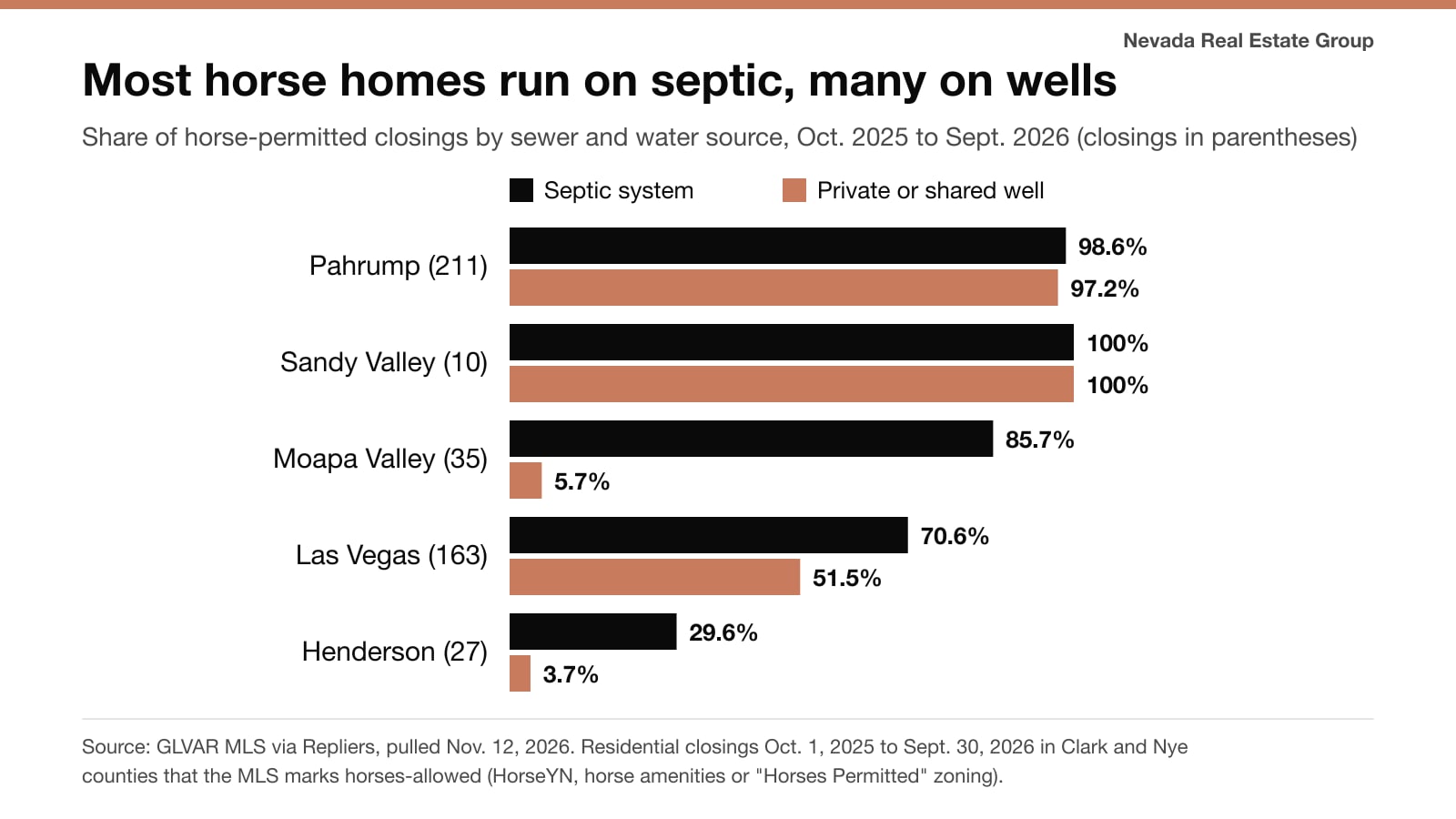
In Pahrump and Sandy Valley almost every horse home had its own well and septic system. In the MLS city of Las Vegas, 70.6% were on septic and 51.5% on a private or shared well, and in Moapa Valley most homes were on septic but listed public water. Henderson's horse homes were the most likely to have city water and sewer. Those differences change what you inspect, what you budget and what you have to file each year.
Nevada caps what a household well can pump without a water right. Under NRS 534.180, a domestic well is exempt from the permit process when its draw does not exceed 2 acre-feet a year, about 651,700 gallons. NRS 534.013 counts the watering of livestock and other domestic animals as domestic use as long as the total stays within that maximum, so your horses' water comes out of the same allowance as the house and landscaping. If the state orders a basin curtailed, NRS 534.110 lets a domestic well keep drawing 0.5 acre-foot a year, recorded by a water meter. A buyer planning several horses and irrigated turnout should check the well's history and ask whether the property comes with any additional water right.
Las Vegas valley well owners also pay into the groundwater program. According to the Las Vegas Valley Groundwater Management Program, the fee for a domestic well serving one home is $20 a year, and the Southern Nevada Water Authority manages its collection. On the septic side, horse property adds manure handling and heavy-vehicle traffic to a system that also serves the house, so locate the tank and leach field before you plan a barn, an arena or a trailer pad over them. Our Nevada well and septic buyer guide covers the inspections, testing and records to request during escrow.
Can you get a mortgage on a horse property?
Yes, and most buyers did, but expect the lender to look harder at the land and the outbuildings. Of the 467 sales, 191 closed with conventional loans, 87 with FHA loans, 41 with VA loans and 6 with seller financing, while 132, or 28.3%, closed in cash; the other 10 were recorded as other, private or assumed financing. The financing mix split by area: Pahrump buyers used FHA or VA on 97 of 211 purchases, while valley buyers used them on only 18 of 196 and leaned on conventional loans (113) and cash (57), which fits the valley's higher prices.
For conventional loans, the rules that matter come from the guidelines lenders follow when they sell loans to Fannie Mae; FHA and VA loans have their own property standards, so ask your lender how they apply. Fannie Mae's general property eligibility rules list agricultural properties, such as farms or ranches, as ineligible. Its appraisal-report guidance on improvements treats minimal outbuildings, such as small barns or stables of relatively insignificant value, as acceptable when the appraiser shows with comparable sales that they are typical for the area. Significant outbuildings, such as large barns or facilities for farm-type animals, may indicate an agricultural property, and the lender must determine whether the property is residential in nature. The site-section guidance also requires the appraisal to cover the actual size of the site, not a hypothetical portion of it.
In practice, a home on an acre with a couple of pens and a shade cover reads as a house with a large yard, while a property with a commercial-scale barn, an arena and boarding stalls can read as a ranch. Tell your lender early what the property includes and how you plan to use it, and expect the appraiser to give pens and arenas little separate value. Sellers of valley homes with listed facilities also gave up more from their first asking price, a median 92.3% against 95.8% for homes without, though bigger lots explain part of that gap, so don't assume the setup adds a fixed amount to the price.
What paperwork do you need to bring horses to Nevada?
If you are relocating with horses, the animals need their own documents, separate from the home purchase. The Nevada Department of Agriculture's equine page says horses entering the state need a certificate of veterinary inspection and a negative equine infectious anemia (Coggins) test taken within 12 months before entry. Its import requirements page says certificates are valid for 30 days from issuance and lists the other documents required. Entry rules can change, so have your veterinarian check that page within a few days of the trip.
Ownership paperwork matters too. According to the department's livestock identification FAQ, Nevada Revised Statutes Chapter 565 requires a brand inspection by a department inspector before horses are transported out of a brand district or across state lines, and whenever a change of ownership takes place. The department offers annual and lifetime horse transportation permits that it says are honored in all western states, which can save repeat inspections for owners who trailer to shows or trails out of state. If you buy horses along with the property, or the seller leaves animals behind as part of the deal, ask about the brand inspection before money changes hands.
None of this runs through escrow, so it is easy to leave until the last week. Book the veterinary visit, the Coggins test and the transport early, and line up feed, hay storage and a farrier near the new property before the horses arrive. A home with an existing covered pen and turnout lets the animals move in the day you close; a lot where you plan to build pens means boarding them somewhere first.
Should you buy in the Las Vegas valley, Pahrump or Moapa Valley?
The answer turns on three things: how many horses you plan to keep, how far you can live from work, and how much of the infrastructure you are willing to run yourself. The table sets the three main choices side by side using the 12 months of sales above.
| Question | Las Vegas valley | Pahrump | Moapa Valley |
|---|---|---|---|
| Typical price | $800,000 median | $309,000 median | $445,000 median |
| Typical land | 0.65 acre; 58 of 196 under half an acre | 1.13 acres | 2.07 acres |
| Typical house | 2,830 sq ft median | 1,615 sq ft median | 1,792 sq ft median |
| Water and sewer | 64.3% septic, 43.4% well | 98.6% septic, 97.2% well | 85.7% septic, 5.7% well |
| How buyers paid | 113 conventional, 57 cash, 10 FHA, 8 VA | 73 FHA, 56 conventional, 52 cash, 24 VA | 15 cash among 35 sales |
| Best fit | A buyer who works in the valley and needs a half acre to an acre | A buyer who wants an acre or more at the lowest price and can drive | A buyer who wants two acres of farm-town land and a public water system |
The Las Vegas valley makes sense when the commute matters more than the acreage. You give up land and pay roughly two and a half times the Pahrump price, but you stay inside the metro area where most jobs are. The valley's horse homes are also bigger houses, a median 2,830 square feet against 1,615 in Pahrump, so part of the higher price buys living space rather than land. The northwest ZIPs around Lone Mountain held the largest share of valley sales, 79 of 196, with the older 89108 and the east-side 89110 as the lower-priced entry points.
Pahrump makes sense when land and price come first. In the 12 months to September 2026, three in four Pahrump horse homes, typically about an acre with a well and septic, sold for under $400,000, and Pahrump buyers used FHA and VA loans far more than valley buyers did, 97 of 211 sales against 18 of 196. The trade-off is distance and self-reliance. Our guides to buying a home in Pahrump and the pros and cons of moving to Pahrump walk through daily life there.
Moapa Valley is the quieter middle path. It had the largest median lots of the three, about two acres, at a $445,000 median, and only 5.7% of its horse homes were on a well: the MLS listed public water for 33 of its 35 sales. It is also a small market, 35 sales in a year and 12 listings on November 12, so a buyer there needs patience and a fast response when the right property comes up.
What should you check before making an offer on horse property?
Check the things that decide whether you can keep your horses there, and the systems you will have to run, before you fall for the house. The table puts the main checks in order, with where each answer comes from.
| Check | Why it matters | Where the answer comes from |
|---|---|---|
| Zoning district and any rural overlay | Sets whether horses are allowed at all | Clark County Title 30, City of Las Vegas Title 19 or Nye County zoning for that parcel |
| Lot area and horse count | About one horse per 7,500 sq ft in the county Urban Area and the city | Parcel lot area, then the code ratio |
| Pen, turnout and setback space | County: 120 sq ft pen and 1,200 sq ft turnout per horse; city R-E: corral 50 ft from a neighbor's home | Site plan or survey measured against the code |
| HOA rules | 8.7% of valley horse homes were in an HOA | The association's recorded rules and resale package |
| Well | Domestic draw capped at 2 acre-feet a year, horses included | Well records, a water test and NRS 534 |
| Septic | 83.1% of horse homes were on septic | A septic inspection and the tank's location |
| Barns, arenas and shade covers | Unpermitted or poorly built structures become your problem | The local building department's permit history for the address |
| Financing | Large barns or animal facilities can make a lender treat the home as agricultural | Your lender and the appraiser, before you remove contingencies |
Do the zoning check first, because it can end the search for a given house in a few minutes. A listing's "Horses Permitted" note came from the agent, and the county or city record is what governs. If the parcel's district does not allow horses, a corral in the backyard does not change that, and it may simply mean the previous owner never asked.
Next, measure. A half-acre lot that allows two horses on paper may not have room for two code-size pens, two turnouts and the trailer once the house, pool and garage are counted. Walk the lot with the code's space rules in hand, and ask the seller which structures were built with permits. Our first-time buyer resources explain the inspection and contingency periods you will use to do this work inside escrow.
Finally, price the systems. A well and septic system are not reasons to walk away, since they come with most horse homes, but they are reasons to inspect, test and budget. Ask for any well records, have the water tested, have the septic tank located and inspected, and get your lender's read on the property early so the appraisal is not the first time anyone looks at the barn.
How do you start a horse-property search with Nevada Real Estate Group?
Start with your animals, not the house. Write down how many horses you will keep now and in five years, whether you need an arena or a turnout, what size trailer has to fit through the gate, and how far you can drive to work. Those answers set the minimum lot size, which sets the zoning you need, which sets the parts of the valley, Pahrump or Moapa Valley worth touring. The 12 months of sales above give you a realistic price for each choice: about $800,000 for a valley horse home on two-thirds of an acre, about $309,000 for an acre in Pahrump, and about $445,000 for two acres in Moapa Valley.
Then narrow the listings to the ones the county or city will actually let you use the way you plan to. A listing that says "horse property" is a starting point; the parcel's zoning, any HOA rules, the well and septic records and the condition of the pens decide whether it works. Our buyer services page explains how we work with buyers, and you can watch new inventory on the Las Vegas horse properties, Pahrump horse properties and Las Vegas homes with acreage pages, or set up an alert on the home search.
If you are relocating with horses, plan the move of the animals alongside the purchase, because transport paperwork and a place to put them on arrival take time to line up. When you are ready to talk through a specific property or a short list, call (702) 637-1759 or contact us online, and tell us about your horses as well as the house.
Frequently Asked Questions
How much does horse property cost in Las Vegas?
In the 12 months from October 2025 through September 2026, the 196 horses-allowed homes that sold in the Las Vegas valley had a median price of $800,000 on a median lot of 0.65 acre. The MLS city of Las Vegas alone had 163 sales at a $780,000 median, Henderson 27 at $1,050,000, and North Las Vegas 6 at $530,000. ZIP code medians ranged from $588,750 in 89108 to $1,225,000 in 89002 among ZIPs with eight or more sales.
Is Pahrump cheaper than Las Vegas for horse property?
Much cheaper, with more land. Pahrump's 211 horses-allowed sales from October 2025 to September 2026 had a median price of $309,000 on 1.13 acres, against $800,000 on 0.65 acre in the Las Vegas valley, and 157 of the Pahrump sales closed under $400,000. The trade-offs are an hour's drive to Las Vegas and a private well and septic system on nearly every Pahrump horse home.
Can you keep horses on a half-acre lot in Las Vegas?
Often yes, if the zoning allows it. Both unincorporated Clark County's Urban Area and the City of Las Vegas allow one horse per 7,500 square feet in the districts where horses are permitted, so a lot of about 20,000 square feet works out to two horses. In the county, horses are limited to the RS20, RS40, RS80 and AG districts; in the city, to the U, R-E and R-D districts, with R-D capped at two horses. Confirm the parcel's district before you offer.
Do horse properties in Las Vegas have HOAs?
Rarely. Only 17 of the 196 valley horse homes sold from October 2025 to September 2026, or 8.7%, were in an HOA. In the 14 valley ZIP codes with five or more horse sales, 6.3% of horse homes were in an HOA, against 40.6% of the other half-acre-plus homes that sold in the same ZIPs.
Can I use an FHA or VA loan to buy a horse property?
Yes. Of the 467 horses-allowed sales in Clark and Nye counties from October 2025 to September 2026, 87 closed with FHA loans and 41 with VA loans, most of them in Pahrump. Lenders still check that the property is residential rather than agricultural. For conventional loans, Fannie Mae lists farms and ranches as ineligible and says large barns or farm-animal facilities may point to agricultural use; FHA and VA apply their own property rules, so ask your lender early.
How long do horse properties take to sell in Southern Nevada?
The 467 horses-allowed homes that sold from October 2025 to September 2026 spent a median 35 days on the market and sold for a median 96.0% of their original asking price. Listings that had not sold lasted longer: on November 12, 2026, the 185 active horse listings had been on the market a median 83 days, and 47% had been listed for more than 90 days.
What water and sewer will a horse property have?
Usually a septic tank and often a private well. Of the 467 sales from October 2025 to September 2026, 83.1% were on septic and 67.7% drew water from a private or shared well. A Nevada domestic well may draw up to 2 acre-feet a year without a water right, and watering livestock counts toward that limit. Las Vegas valley domestic wells also pay a $20 annual groundwater management fee.
Which Sources Inform This Guide?
MLS study. Listing data comes from the GLVAR multiple listing service through Repliers, pulled November 12, 2026. The population is every sale listing in Clark and Nye counties with a residential property type, a raw MLS status of Closed and an MLS closing date from October 1, 2025 through September 30, 2026, the newest settled month on the run date. Three pulls were merged by MLS number: listings with the horse yes-or-no field set to yes, a keyword search for "horse," and every closing on a lot of 20,000 square feet or more. A home counted as horses-allowed only if a structured field said so: the yes-or-no field, at least one horse amenity, or a zoning description containing "Horses Permitted." That gave 467 sales (163 by the yes-or-no field, 76 by amenities alone, 228 by the zoning description alone). Before counting, three records that repeated a sale of the same address under a second MLS number were removed. GLVAR records from Lincoln and White Pine counties, Utah and other areas were excluded. The comparison group is the 249 residential closings on lots of 0.5 acre or more with no horse flag in the same 14 valley ZIP codes. Active listings are the 185 active or coming-soon horses-allowed listings on November 12, 2026, with days counted from each listing date. Medians that fall between two values are rounded to the nearest dollar, day or year.
Limits. Horse flags are entered by listing agents, so some horse-capable homes are missing and the zoning field is not a parcel record. Sales outside the MLS are invisible. Closings post to the feed weeks late, which is why the window ends with September. Small ZIP and area samples swing, and the same-ZIP comparison shows differences between groups, not the value of horse rights. The analysis script is scripts/southern-nevada-horse-property-study.ts, and its output and a 15-record spot check are kept with this post's records.
Codes and statutes. Clark County Title 30 Unified Development Code (large livestock, RS districts, Rural Neighborhood Preservation overlay); City of Las Vegas Title 19 animal-keeping rules, land-use table, R-E district standards and Rural Preservation Overlay; Nye County Ordinance 555; NRS 278.0177; and NRS 534.180, 534.013 and 534.110. All read November 12, 2026.
Water, financing and animals. The Las Vegas Valley Groundwater Management Program; Fannie Mae Selling Guide sections on general property eligibility, the improvements section of the appraisal report and the site section; and the Nevada Department of Agriculture's equine, import requirements and livestock identification pages. All read November 12, 2026.
This guide is general information, not legal advice. Zoning, animal limits and water rules apply parcel by parcel, so confirm them with the county or city and your own advisers before you buy.