

On November 5, 2026, the Treasury Department and the IRS announced the census tracts that will be Opportunity Zones for the next ten years, and 49 of them are in Nevada. The new round starts January 1, 2027 and runs through December 31, 2036, under rules rewritten by the 2025 tax law. Opportunity Zones get described loosely in real estate marketing, so this guide sticks to what the statute, the IRS notices and the final regulations actually say, and to where the Nevada tracts are.
To answer the where, we matched each of the 49 tracts on Treasury's list to its Census place and ZIP area with the Census Bureau's mapping service on November 13, 2026, and compared the new list with the 61 Nevada tracts designated in 2018. That tract-by-tract map is the part of this guide you won't find on a tax site. The rules are linked to their sources where they are used.
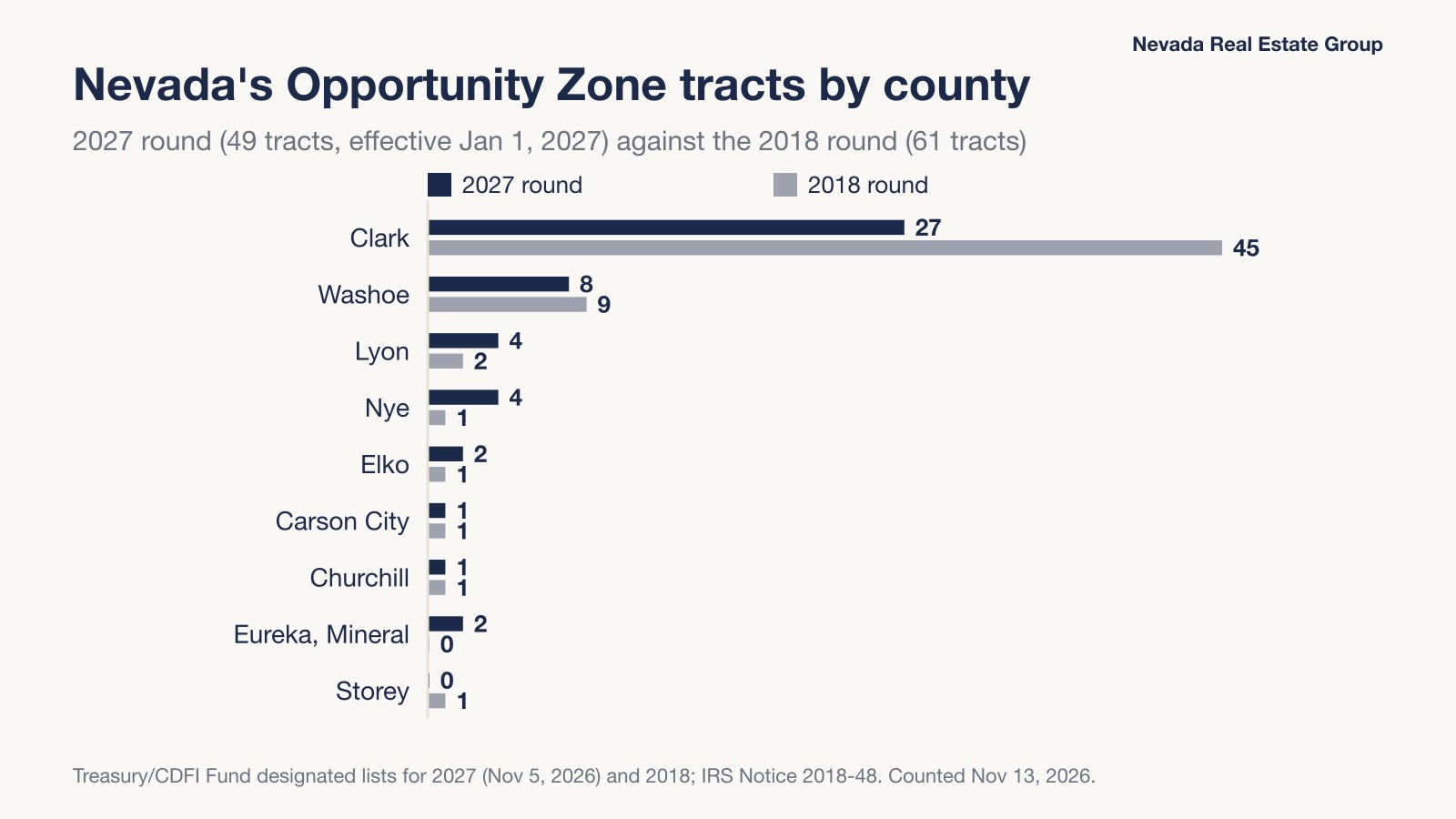
Nevada has 49 Opportunity Zone census tracts for the ten-year round that starts January 1, 2027: 27 in Clark County, 8 in Washoe, 1 in Carson City and 13 in other counties, on the list Treasury announced November 5, 2026. Buying a home to live in one brings no tax break by itself; the benefits go to capital gains invested through a Qualified Opportunity Fund.
- Treasury designated 49 Nevada tracts, effective January 1, 2027 through December 31, 2036.
- 19 of the 49 continue a 2018 zone; 41 of Nevada's 61 original zones have no overlap with a new one.
- Gains invested after 2026 get five-year deferral and a 10% basis increase, 30% in rural funds.
- Holding the fund investment ten years can exclude its appreciation, up to a 30-year limit.
- Living in a zone changes nothing on your taxes; the benefit needs a fund investment of capital gains.
What Is an Opportunity Zone, and What Changed for 2027?
An Opportunity Zone is a low-income census tract that a governor nominates and the Treasury designates. Investors who put capital gains into a Qualified Opportunity Fund, a partnership or corporation that holds property in those tracts, get federal income-tax benefits: the gain is deferred, part of it can be forgiven, and the fund investment's own growth can escape tax after a long hold. The program began in 2018 and was due to stop taking new deferrals after 2026.
The 2025 tax law, Public Law 119-21, signed July 4, 2025, made it permanent. Section 70421 repealed the 2026 sunset and replaced the single 2018 round with a new round every ten years. The first nomination window opened July 1, 2026, and under Revenue Procedure 2026-14 the first new zones run from January 1, 2027 to December 31, 2036.
The tracts that can qualify got narrower. A tract now needs a median family income no higher than 70% of its metro area's (or the statewide figure outside a metro), or a poverty rate of at least 20% together with a median family income no higher than 125%. Under the old test, a 20% poverty rate qualified on its own. The exception that let states add a non-poor tract next to a poor one is gone, and a state can still nominate no more than 25% of its eligible tracts in each round. Nationally, the IRS reported that 6,576 tracts were designated, 2,594 of them rural, all effective January 1, 2027.
Which Nevada Census Tracts Are Opportunity Zones From 2027?
| County | 2027 zones | Of which rural | Eligible for 2027 | 2018 zones |
|---|---|---|---|---|
| Clark | 27 | 1 | 141 | 45 |
| Washoe | 8 | 0 | 33 | 9 |
| Lyon | 4 | 4 | 8 | 2 |
| Nye | 4 | 4 | 6 | 1 |
| Elko | 2 | 2 | 2 | 1 |
| Carson City | 1 | 0 | 2 | 1 |
| Churchill | 1 | 1 | 1 | 1 |
| Eureka | 1 | 1 | 1 | 0 |
| Mineral | 1 | 1 | 1 | 0 |
| Storey | 0 | 0 | 0 | 1 |
| Total | 49 | 14 | 195 | 61 |
On the 2020–2024 American Community Survey data behind the Rev. Proc. 2026-14 eligibility list, Nevada had 195 tracts that met the new income test, which capped its nominations at 49, a quarter of 195 rounded up. The state used the full allowance. The Governor's Office of Economic Development says it built its list with input from local governments, regional development groups, tribal nations and business and community leaders, and put a draft out for public comment before the September 28, 2026 deadline. All 49 tracts appear on the Treasury and CDFI Fund designated list, which the CDFI Fund posted with its November 5 update, and they carry the same rural or non-rural status as in the IRS eligibility list.
Fourteen of the 49 are rural and 35 are not. Clark County has the most by far, 27, though that is 18 fewer than its 45 zones from 2018. The new round has a tighter test and a smaller cap, and the state's picks also shifted toward rural counties: Clark lost 18 zones while the statewide total fell by 12. Lyon went from two zones to four, Nye from one to four, Elko from one to two, and Eureka and Mineral counties have zones for the first time. Storey County, which had a zone in 2018 under the now-repealed rule for neighboring tracts, has none. The IRS has said it expects to publish further guidance identifying the designated zones before January 1, 2027; until then, the list Treasury published with its November 5 announcement is the one to check.
Where Are Nevada's New Opportunity Zones in the Las Vegas Valley?
| Place | Tracts | ZIP areas |
|---|---|---|
| City of Las Vegas | 9 | 89106 (4 tracts), 89101 (2), 89110 and 89101 (1), 89102 and 89104 (1), 89117 (1) |
| Paradise (unincorporated) | 7 | 89102, 89103, 89109, 89119, 89169 |
| North Las Vegas | 4 | 89030 (3), 89032 (1) |
| Henderson | 3 | 89015 (all 3) |
| Spring Valley (unincorporated) | 2 | 89146 and 89102, 89103 |
| Winchester (unincorporated) | 1 | 89109 |
| Rural southern Clark County | 1 | Mostly 89046; small parts of Boulder City, Nelson, Searchlight and Cal-Nev-Ari |
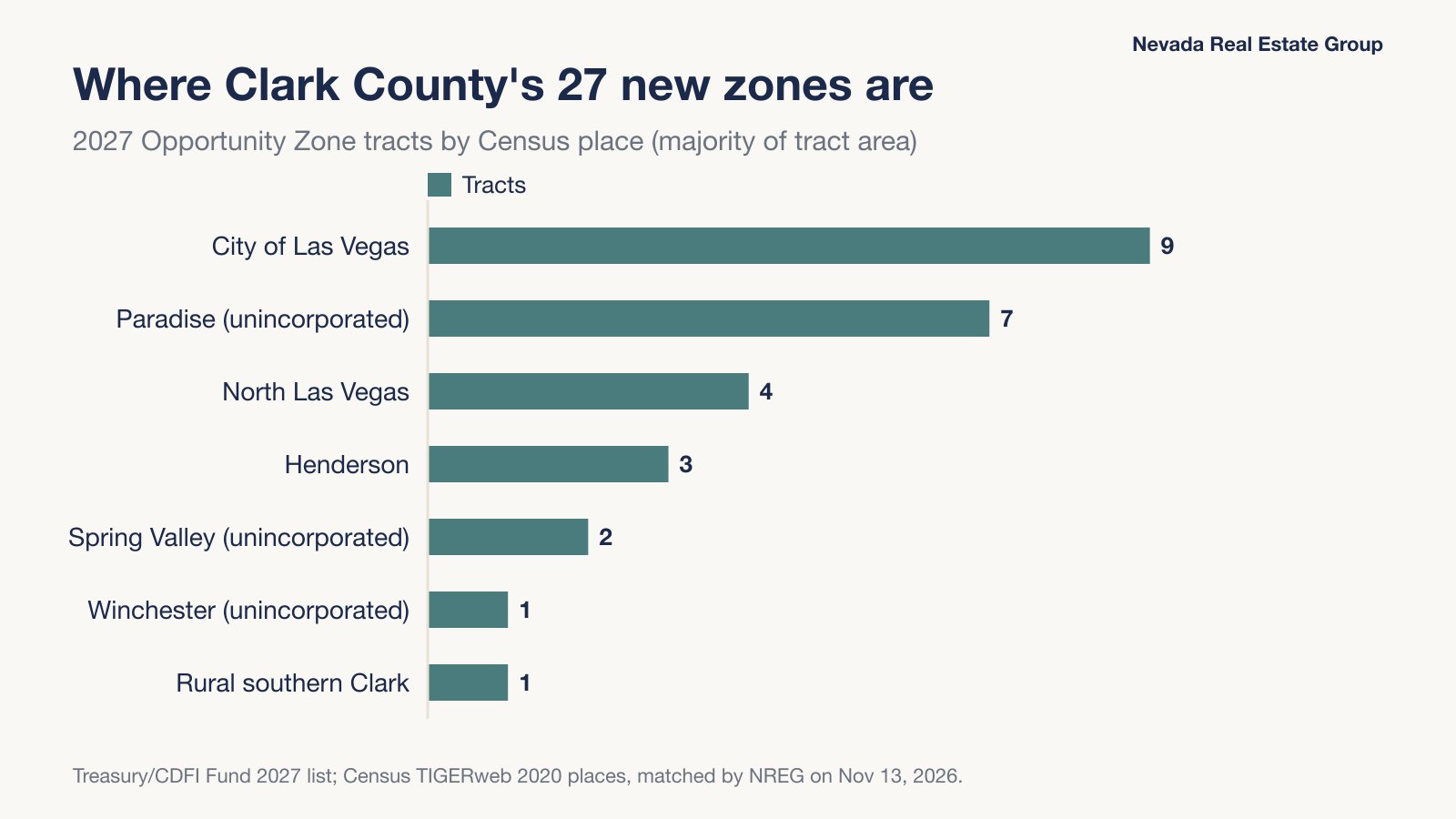
The valley's new zones cluster in a few ZIP areas rather than spreading evenly. The City of Las Vegas has nine tracts, four of them in the 89106 ZIP area and two in 89101. Unincorporated Paradise has seven, in the 89103, 89119, 89169, 89109 and 89102 areas. North Las Vegas has four, three of them in 89030, and all three Henderson tracts are in 89015. Spring Valley has two and Winchester one. The only rural tract in Clark County is a large stretch of the southern county desert, mostly in the 89046 ZIP area, that takes in small parts of Boulder City, Nelson, Searchlight and Cal-Nev-Ari.
The list also moved. The 2018 Clark County zones included two in Sunrise Manor; the 2027 list has none there, and it adds two Spring Valley tracts and a City of Las Vegas tract in the 89117 area that were not zones before.
A ZIP area is a guide, not a test. Census tracts do not follow ZIP lines, and several of these tracts straddle two ZIP areas, so a street address in 89106 or 89030 is not automatically in a zone. The only reliable check is the tract number for the parcel against Treasury's list. For how prices and supply are running in the same ZIP areas, our ZIP code market reports are the place to start.
Where Are the New Zones in Reno, Sparks, Carson City and Rural Nevada?
| Area | Tracts | ZIP areas | Rural? |
|---|---|---|---|
| Reno | 5 | 89502 (3), 89501 and 89503 (1), 89512 (1) | No |
| Sparks | 3 | 89431, 89431 and 89434 | No |
| Carson City | 1 | 89706 and 89701 | No |
| Pahrump (Nye) | 3 | 89048, 89060 | Yes |
| Amargosa Valley and Beatty area (Nye) | 1 | 89020, 89003 | Yes |
| Silver Springs, Stagecoach and part of Fernley (Lyon) | 3 | 89429, 89447, 89406 (Fernley's 89408 under 2%) | Yes |
| Yerington area (Lyon) | 1 | 89447 | Yes |
| Fallon (Churchill) | 1 | 89406 | Yes |
| Elko and northern Elko County | 2 | 89801; 89834, 89835 and nearby | Yes |
| Eureka County | 1 | 89316, 89821 | Yes |
| Mineral County | 1 | 89427, 89415, 89422 | Yes |
In the north, all eight Washoe County tracts are in the two cities; one is about 92% inside Sparks and the rest entirely or almost entirely inside a city. Reno has five: three in the 89502 ZIP area, one straddling 89501 and 89503, and one mostly in 89512. Sparks has three, in the 89431 area, one of them reaching into 89434. Carson City has a single tract, mostly in the 89706 area with a slice of 89701. None of the nine is rural, so investments there get the standard 10% basis increase, not the rural 30%.
Every zone outside those three cities and Clark County is rural. Three are in Pahrump, in the 89048 and 89060 areas, and a fourth Nye County tract covers the Amargosa Valley and Beatty area. Lyon County has four: three around Silver Springs and Stagecoach, two of which reach into parts of the City of Fernley that lie mostly outside Fernley's 89408 ZIP area, and one around Yerington. Churchill County's tract lies mostly within the City of Fallon, in the 89406 area. Elko County has one tract in the City of Elko and one very large tract across the north of the county, and Eureka and Mineral counties have one each.
Several rural tracts are mostly open land: ZIP areas, which follow where people live, cover only about a quarter of the Mineral County tract and about a third of the northern Elko County tract. So "in the zone" can mean a ranch parcel as easily as a lot in town. The same rule applies as in Las Vegas: check the parcel's tract number, not the town name.
Which Nevada Areas Lost Their Opportunity Zone Status?
Most of them. Comparing the boundaries, 19 of the 49 tracts for 2027 lie at least 98% inside a 2018 zone, and the other 30 are new. Looked at from the 2018 side, 19 of the 61 original Nevada zones contain a 2027 tract almost entirely, Churchill County's 2018 tract shares a sliver of about 3% with the new Fallon tract, and the other 41 have no overlap at all.
The 19 that carry over are concentrated in the older urban cores: six in the City of Las Vegas, three in North Las Vegas, two each in Henderson and Paradise, five in Reno and Sparks, and one in Lyon County. The 41 with no overlap include every 2018 zone in the Sunrise Manor and Winchester areas, most of the 2018 zones in the 89101 and 89107 ZIP areas of Las Vegas, the 2018 Carson City tract, the 2018 zones in Storey, Elko and Nye counties, the 2018 tract centered on Fernley, and rural Washoe County's. Some of those counties have new zones elsewhere; the old tracts themselves are not on the list.
Two cautions on the comparison. The 2018 zones use 2010 census-tract boundaries and the 2027 zones use 2020 boundaries, so a matching tract number does not guarantee an identical boundary, and some tracts were split and renumbered. We measured overlap by area, which is accurate to about one or two percentage points.
Losing zone status matters for new money, not for people who live there. Under IRS Notice 2026-40, property a fund or zone business buys after December 31, 2026 generally cannot count as zone property unless it is in a zone designated after July 4, 2025. There are two narrow exceptions: working-capital plans adopted by December 31, 2026, with at least 10% of the planned capital received and 5% spent by then, and routine replacement property. In practice, new fund purchases after 2026 in those 41 areas, and in most of the old Churchill tract, will generally not qualify.
What Happens to Investments Already Made in Nevada's 2018 Zones?
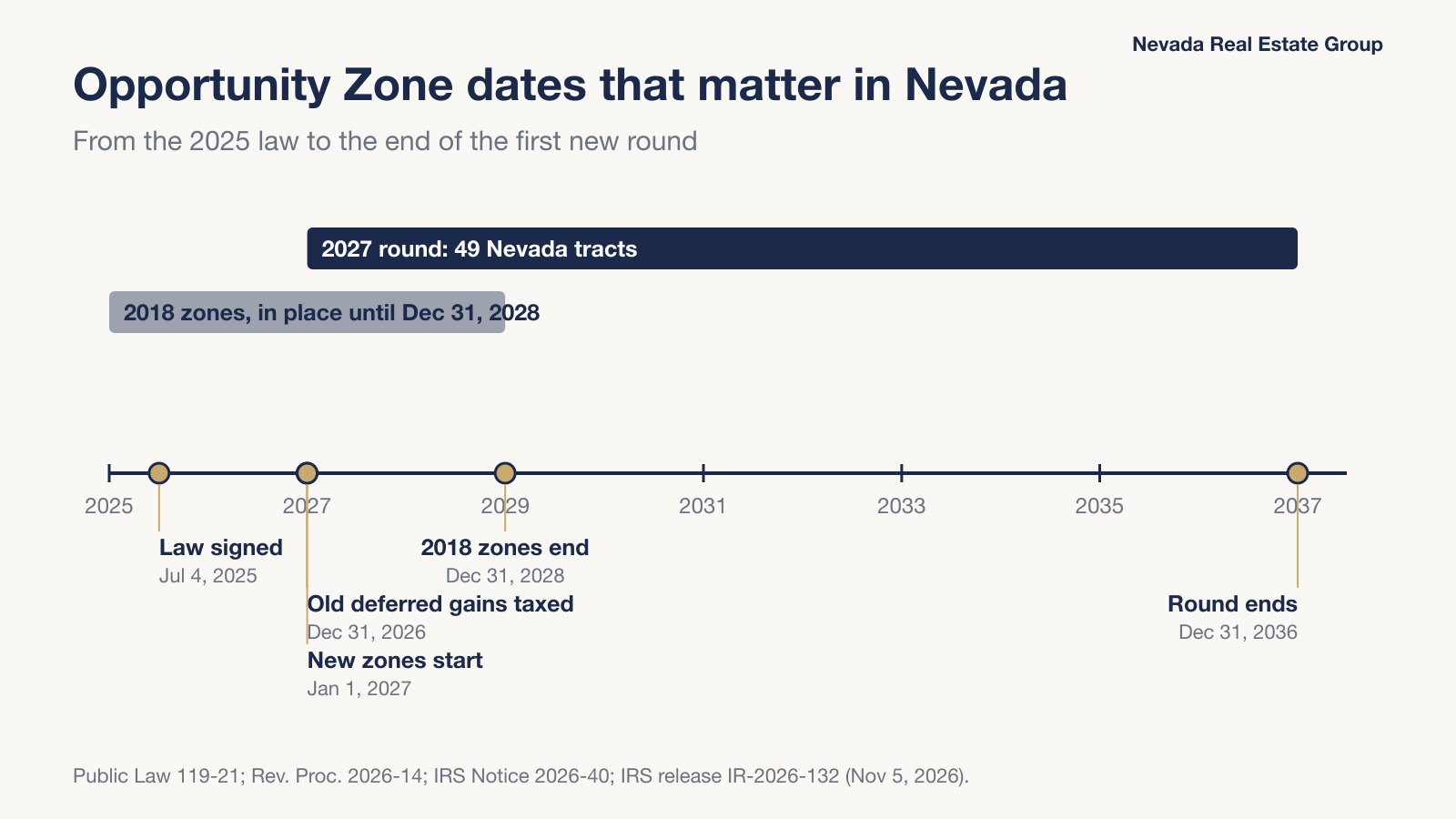
The deferral ends this year. Under the prior law's text, gains invested in a fund under the 2018 rules stay deferred only until December 31, 2026, or an earlier sale. Notice 2026-40 confirms that investors still holding on that date include the remaining deferred gain in income for the tax year that includes it, and that the amount included cannot be deferred again in a new fund.
The ten-year benefit survives. An investor who keeps the old fund interest remains potentially eligible to elect the tax-free step-up on a later sale once the ten-year hold is met, and Notice 2026-40 says that election stays available for sales before January 1, 2048. The 2018 zone designations themselves expire on December 31, 2028, per Rev. Proc. 2026-14. Nevada's economic development office describes 2027 and 2028 as a two-year overlap in which both old and new zones are valid; read that together with Notice 2026-40, which generally bars new property bought after 2026 in a 2018-only zone.
There is a bridge for this year's gains. If you sell something at a capital gain in 2026, Notice 2026-40 says you can still elect deferral under the new rules by investing in a fund on or after January 1, 2027, as long as you do it within the usual 180-day window. Someone with a gain from a sale in, say, October 2026 can therefore wait until January to invest and use the new five-year schedule instead of the old one that ends December 31. Confirm the timing with a tax adviser before relying on it, because the final regulations have not yet been updated to the 2025 law.
Do You Get a Tax Break for Buying a Home in an Opportunity Zone?
No, not by buying the home. The tax benefits attach only to an equity investment in a Qualified Opportunity Fund, which the IRS's Opportunity Zones FAQ describes as an investment vehicle that files a partnership or corporate return. The property the fund holds has to be used in a trade or business under the final regulations. A family buying a house to live in is not a fund and is not running a business in that house, so the purchase does not create a deferral, a basis increase or an exclusion, whatever the listing says about the location.
The reverse is also true: an investor does not have to live or work in a zone. The IRS FAQ says all you need to do is invest a recognized eligible gain in a fund, within the deadline.
Only certain gains qualify. The regulations limit deferral to capital gains and qualified Section 1231 gains, and the IRS FAQ says ordinary gain is not eligible. The gain also has to be one that would be recognized and subject to federal tax. Gain excluded under the home-sale exclusion is not taxed, so in our reading, which no IRS document addresses directly, it cannot be rolled into a fund; only the taxable part of a large home-sale gain might be. Have a tax professional confirm that before you plan around it.
For people who already own or rent in one of these tracts, the designation is a federal income-tax incentive aimed at fund investors. It does not by itself change a resident's income tax or property tax bill.
How Do the New Tax Benefits Work for Gains Invested After 2026?
| Feature | Invested through 2026 | Invested after December 31, 2026 |
|---|---|---|
| When the deferred gain is taxed | December 31, 2026, or an earlier sale | Five years after the investment, or an earlier sale |
| Basis increase | 10% at five years, plus 5% at seven if reached by December 31, 2026 | 10% at five years; 30% in a qualified rural fund |
| Growth on the fund investment | Excludable after a 10-year hold | Excludable after a 10-year hold; basis set at value on the sale date, or at 30 years if held longer |
| Zones | 2018 list, expiring December 31, 2028 | 2027 list, January 1, 2027 to December 31, 2036 |
| Fund reporting | New annual return for fund tax years beginning after July 4, 2025 | Same |
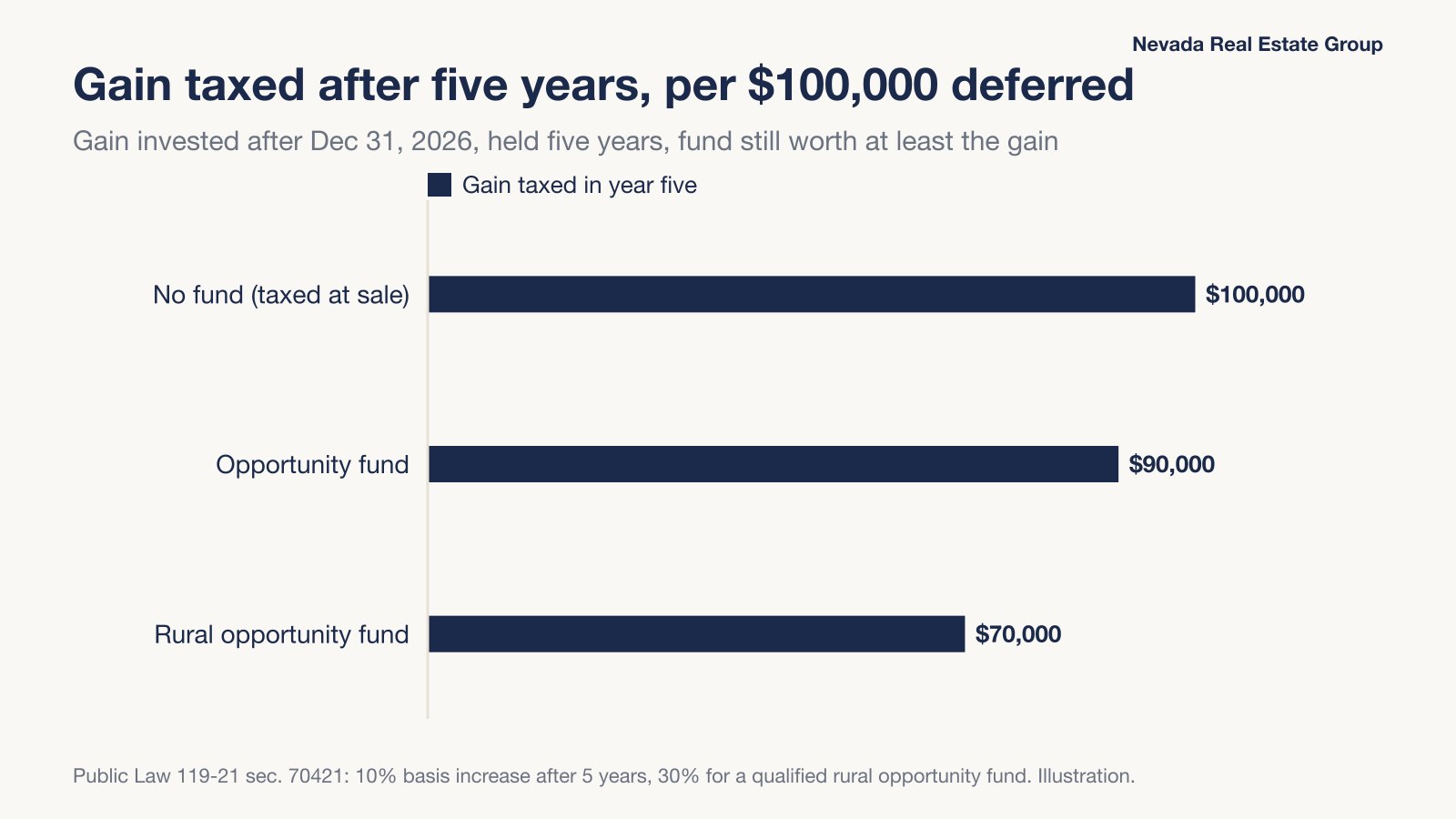
The new schedule rolls. Under Public Law 119-21, a gain invested after 2026 is taxed in the year that includes the earlier of the date you sell the fund interest or the date five years after you invested. At the five-year mark, your basis rises by 10% of the deferred gain, or 30% if the fund is a qualified rural opportunity fund. On a $100,000 gain invested in March 2027, and assuming the fund interest is still worth at least $100,000 at year five, that means tax in 2032 on $90,000, or on $70,000 through a rural fund, with the rest never taxed.
The bigger benefit is the long hold. If you keep the fund investment at least ten years, you can elect to set its basis at fair market value when you sell, so the growth on the investment itself is not taxed. The new law caps that at 30 years: sell before then and the basis is the value on the sale date; hold longer and it is the value at year 30.
Timing still starts with the sale that produced the gain. The general rule gives you 180 days from that sale to invest the gain in a fund. Every fund also faces a new annual reporting duty under Public Law 119-21 for fund tax years beginning after July 4, 2025. Penalties start at $500 a day, capped at $10,000 per return or $50,000 for funds with more than $10 million in gross assets; the amounts are adjusted for inflation and are higher for intentional disregard. Proposed regulations to implement it were published September 11, 2026.
How Does an Opportunity Fund Use Nevada Real Estate?
A fund has to keep at least 90% of its assets in zone property, measured on two dates each year, under the statute's asset test. A fund that invests through a subsidiary business instead needs at least 70% of that business's tangible property to qualify, per Notice 2026-40. For a building to count, either its original use in the zone has to begin with the fund, which covers new construction, or the fund has to substantially improve it.
Substantial improvement is a high bar for an existing house. Within any 30-month period after buying, the fund's additions to the building's basis have to exceed the building's basis, in effect doubling it. Land is excluded from the measure and does not have to be improved separately. The final regulations give the example of a $5 million hotel with $1 million allocated to land: the fund must spend $4 million improving the building. On a rental house bought for $400,000 with $100,000 of that allocated to land, the fund would have to spend more than $300,000 on the building within 30 months. In rural zones the threshold is half the building's basis.
Rentals can qualify. The regulations treat the ownership and operation of real property, including leasing it, as the active conduct of a business, and Notice 2026-40 uses an apartment building as its example of zone property. A bare triple-net lease, where the tenant handles everything, does not count on its own.
For the 2027 zones, the fund also has to buy the property after the zone's start date of January 1, 2027, under Notice 2026-40. Put together, these rules favor new construction on purchased land and heavy renovation over buying an existing house and holding it as is. For the economics of small rentals without fund rules, see our Reno and Sparks duplex returns analysis and the Las Vegas rental market for investors.
What Is Different About Nevada's 14 Rural Opportunity Zones?
Rural zones get two extra benefits, and 14 of Nevada's 49 tracts qualify. Public Law 119-21 defines a rural area as anywhere other than a city or town of more than 50,000 people and the urbanized area next to it. Treasury flags each designated tract as rural or not, and in Nevada the rural ones are three in Pahrump, one in the Amargosa Valley and Beatty area, four in Lyon County around Silver Springs, Stagecoach, part of Fernley and Yerington, one centered on Fallon, two in Elko County, one each in Eureka and Mineral counties, and the large tract in southern Clark County.
The first benefit is a bigger basis increase. A qualified rural opportunity fund, one holding at least 90% of its assets in property in zones made up entirely of rural areas, gives investors a 30% increase in basis at five years instead of 10%. On a $100,000 deferred gain, and if the investment holds its value, that cuts the amount taxed at year five from $90,000 to $70,000.
The second is a lower renovation bar. In a zone made up entirely of rural area, substantial improvement takes additions of more than 50% of the building's basis rather than 100%. That change took effect when the law was signed on July 4, 2025, so Notice 2025-50 applies it to rural 2018 zones as well; seven of Nevada's 2018 zones were on its rural list. A building with a $300,000 basis in a rural zone needs more than $150,000 of improvements within 30 months, against more than $300,000 elsewhere.
The rural benefit depends on the fund's whole portfolio, not one property. A fund needs at least 90% of its assets in property in zones made up entirely of rural areas to give the 30% increase, so an investor counting on it should check the fund's stated strategy.
How Does an Opportunity Fund Compare With a 1031 Exchange?
| Feature | Opportunity Fund | 1031 exchange |
|---|---|---|
| What has to be reinvested | Only the capital gain | The sale proceeds, into like-kind real property |
| Deadline | 180 days from the sale to invest | Identify in 45 days; receive within 180 days or by the tax-return due date, if earlier |
| What you own | An equity interest in a fund | Real property you hold for investment or business |
| The deferred gain | Taxed at five years, less a 10% or 30% basis increase | Deferred until a taxable sale |
| Growth on the new investment | Excludable after a 10-year hold | Taxed when you eventually sell outside an exchange |
The two programs solve different problems. A Section 1031 exchange lets an owner of investment real estate roll the whole position into another property and keep deferring, but the IRS describes that gain as tax-deferred, not tax-free, and the replacement has to be real property you hold. An Opportunity Fund takes only the gain, lets you keep the rest of the cash, and taxes the deferred gain on a fixed five-year clock, but it can make the growth on the new investment tax-free after ten years.
The trade-off is control against the exclusion. In a 1031 you pick and manage the replacement property yourself. In a fund you own a share of whatever the fund builds or renovates, inside a zone and under its rules. Our 1031 exchange guide for Nevada investors covers the exchange rules, intermediaries and deadlines in detail.
Nevada itself does not change the comparison. The Nevada Constitution bars a personal income tax, so for a Nevada resident both programs are about federal tax. An investor who still files in a state with an income tax should check how that state treats each one, because state treatment can differ from the federal rules.
What Should You Check Before Investing in a Nevada Opportunity Fund?
Start with the map. Confirm that the property, or every property a fund plans to buy, is in a tract on the 2027 list, not only a 2018 zone, and that the purchase will close after January 1, 2027. The CDFI Fund page links the designated list and a mapping tool, and a parcel's tract number settles the question in a way a ZIP code cannot.
Then check the clock. The 180 days to invest run from the date of the sale that produced your gain. If you are counting on the new five-year schedule, the investment has to be made after December 31, 2026. Plan for the tax bill at year five: the deferred gain, less the basis increase, comes due then whether or not the fund has sold anything, so you will need cash outside the fund to pay it.
Next, the hold. The exclusion on the fund's growth needs at least ten years, so ask how and when investors can get out, what happens if the fund sells early, and what the fees are. Ask whether the fund qualifies as a rural fund if you are counting on the 30% increase, and how it will meet the 90% asset test and the 30-month improvement deadline on each property.
Finally, expect the rules to keep moving. The final regulations still carry pre-2025 wording about gains recognized before 2027, the IRS FAQ still describes the old seven-year step-up, and Notice 2026-40 says proposed regulations are coming. In Notice 2026-55 the IRS asked for comments by November 23, 2026, including on funds that build and sell single-family homes; a home bought from such a fund still brings the buyer no Opportunity Zone benefit. A tax adviser who has read the current notices is worth more here than any summary, including this one.
Frequently Asked Questions
How many Opportunity Zones does Nevada have in 2027?
Forty-nine census tracts, announced by Treasury and the IRS on November 5, 2026 and effective January 1, 2027 through December 31, 2036. Clark County has 27, Washoe 8, Carson City 1, and 13 are in rural counties: Lyon and Nye with four each, Elko with two, and Churchill, Eureka and Mineral with one each. Fourteen of the 49 are flagged rural.
How do I know if a property is in an Opportunity Zone?
Look up the parcel's census tract and check it against Treasury's 2027 list on the CDFI Fund website, which also links a mapping tool. A ZIP code or city name is not enough, because tracts do not follow ZIP lines and several Nevada tracts straddle two ZIP areas. Also check that it is on the 2027 list, not only the 2018 list.
Can I defer tax on my home sale by investing in an Opportunity Fund?
Only a taxable capital gain can go into a fund. Eligible gain has to be recognized and subject to federal tax; gain excluded under the home-sale exclusion is not taxed, so in our reading it cannot be rolled over; only any taxable part of a large home-sale gain might be. No IRS document addresses this directly, so confirm it with a tax professional before acting.
Do Nevada's 2018 Opportunity Zones still count?
The 2018 designations last until December 31, 2028, and existing investors keep their ten-year benefit. But deferred gains from those investments come due on December 31, 2026, and under IRS Notice 2026-40, property bought after 2026 in a zone that is only on the 2018 list generally will not qualify, with narrow exceptions.
What makes a Nevada Opportunity Zone rural?
Treasury flags a tract as rural when it lies entirely outside any incorporated city or town of more than 50,000 residents and any Census-designated urban area touching such a city, as IRS Notice 2025-50 defines those terms. Nevada has 14 rural tracts for 2027. A fund holding at least 90% of its assets in rural zones gives a 30% basis increase at five years, and rural zones need only 50% substantial improvement.
When do I have to invest a capital gain in an Opportunity Fund?
Generally within 180 days of the sale that produced the gain. For the new rules, with five-year deferral and the 10% or 30% basis increase, the investment has to be made after December 31, 2026. A gain from a late-2026 sale can still qualify if it is invested in January 2027 inside its 180 days.
Does living in an Opportunity Zone change my taxes?
No. The designation is a federal income-tax incentive for investors in Qualified Opportunity Funds. Living or owning a home in a designated tract does not by itself change your income tax or your property tax bill.
What Should Nevada Buyers and Investors Do Next?
Separate the two questions. If you are buying a home to live in, the Opportunity Zone label is not a tax reason to buy or to avoid a house; judge it on price, condition and location like any other, and look at the local market data for its ZIP area. If you have a capital gain to place, the 2027 list opens a new ten-year window in 49 Nevada tracts, and the choice is between a fund investment, a 1031 exchange, or simply paying the tax and investing freely.
For investors, the most useful thing we can do is put real numbers next to the tax story. A fund's projections should match what homes and rents in the same ZIP areas actually do. Our Reno investment and rental property guide covers rentals in the north, our ZIP reports show median prices and days on market for Southern Nevada ZIP codes each quarter, and our monthly city reports track price cuts. You can also ask us for recent closings in any ZIP area a fund is targeting, to test its assumptions before you commit.
If you own property in a Nevada tract that was a zone in 2018 but is not on the 2027 list, a buyer pitching an Opportunity Zone angle on your property should be able to explain how the deal qualifies after 2026. If you own in one of the 30 new tracts, expect some investor interest, and price the property on comparable sales, not on the label.
Nevada Real Estate Group has closed more than 9,600 transactions worth over $4.85 billion. For a list of recent sales in any of these ZIP areas, call our Southern Nevada team at (702) 637-1759 or our Northern Nevada team at (775) 277-2120, or contact our team. We are real estate agents, not tax advisers: take the tax questions to a CPA or tax attorney.
Which Sources Inform This Opportunity Zone Guide?
Tract counts and locations are NREG's analysis of Treasury's designated list, run November 13, 2026: each of Nevada's 49 tracts for 2027 was matched to its 2020 Census place and ZIP Code Tabulation Area by area share using the Census Bureau's TIGERweb 2020 map service (tract, ZIP Code Tabulation Area and place layers), and overlap with the 61 tracts from 2018 (2010 boundaries) was measured by area sampling to about one or two percentage points. ZIP areas approximate postal ZIP codes. This is general information, not tax or legal advice.
The 49 tracts for 2027, by 2020 census tract number:
-
Clark County (27): 32003000201, 32003000203, 32003000301, 32003000302, 32003000402, 32003000516, 32003000700, 32003001100, 32003002000, 32003002206, 32003002505, 32003002603, 32003002605, 32003002937, 32003002946, 32003002954, 32003002995, 32003003616, 32003003800, 32003004302, 32003004601, 32003005336, 32003005421, 32003005422, 32003005703, 32003005809, 32003006800.
-
Washoe County (8): 32031000104, 32031000105, 32031000201, 32031000702, 32031000900, 32031001901, 32031003002, 32031003111.
-
Carson City (1): 32510000502.
-
Lyon County (4): 32019960204, 32019960205, 32019960206, 32019960902.
-
Nye County (4): 32023960300, 32023960407, 32023960413, 32023960414.
-
Elko County (2): 32007950900, 32007951700.
-
Churchill County (1): 32001950301. Eureka County (1): 32011000100. Mineral County (1): 32021970800.
-
Public Law 119-21, section 70421, enacted July 4, 2025.
-
Prior text of 26 U.S.C. 1400Z-2 (2024 edition).
-
Revenue Procedure 2026-14, nominations and designation periods.
-
IRS Notice 2026-40, transition rules, and Notice 2025-50, rural 2018 zones.
-
Final regulations, T.D. 9889, and the IRS Opportunity Zones FAQ (used only for rules the 2025 law left unchanged).
-
IRS release of November 5, 2026 on the designations and IRS release on the nomination guidance.
-
Treasury press release of November 5, 2026 and the CDFI Fund Opportunity Zones page with the designated list.
-
IRS Notice 2018-48, the 2018 list.
-
Nevada Governor's Office of Economic Development, Opportunity Zones.
-
IRS like-kind exchange fact sheet and the Nevada Constitution, Article 10.