

Before selling a Las Vegas home, sort projects into 3 groups: necessary repairs, modest presentation improvements, and optional renovations. Investigate condition problems first, then consider cleaning, paint, entryway, landscaping, and focused kitchen work. Spend only after comparing the completed result with similar homes and obtaining written quotes. A national remodeling return is a benchmark, not a promise of what your property will sell for.
- Repair a problem before spending money to decorate around it.
- Compare the full installed cost, disruption, and likely listing delay.
- Keep usable kitchens and bathrooms unless evidence supports a larger project.
- Check landscape-rebate eligibility before removing turf.
- Use documented condition and local competition to decide whether to repair or negotiate.
A seller does not need to hand the next owner a completely redesigned home. The better objective is a property that can be understood, inspected, and compared without avoidable distractions or unresolved surprises. Sometimes that requires a meaningful repair. Sometimes it requires less furniture, a cleaner entrance, and permission to leave a perfectly functional room alone.
This article was originally published in October 2022 and substantially updated September 24, 2026. It now separates national remodeling research from property-specific decisions in Las Vegas, Henderson, Summerlin, and North Las Vegas. The worksheets are editorial planning tools. Example budgets are invented to show the calculation, not contractor quotes, appraisals, or guarantees of resale value.
Across the 9,600-plus closings we've represented statewide as the Nevada Real Estate Group team — including 789 homes in 2025 alone — one pattern repeats: the sellers who net the most rarely spent the most on renovations. In my experience, they spent on presentation, deferred-maintenance fixes, and a handful of surgical upgrades, then let a correctly priced, move-in-ready home do the work. That is the lens for everything below.
What Does a High-ROI Improvement Actually Mean Before a Sale?
A project's resale return is the portion of its cost reflected in a sale outcome, but that outcome is difficult to isolate for one home. Condition, location, timing, presentation, and negotiation all contribute. A national estimate can suggest questions to ask; it cannot prove that your buyer will pay a particular premium for new countertops or landscaping. Start by identifying the problem the project solves.
According to NAR and NARI's 2025 Remodeling Impact Report release, homeowner satisfaction and estimated cost recovery differ across projects. Enjoying a renovation and recovering its full expense at resale are separate outcomes. If you are leaving soon, the personal enjoyment period may be short, so the selling decision deserves its own budget analysis.
Ask three questions. Is the work necessary to address a condition issue? Does it improve the home's presentation relative to direct competitors? Can it be completed properly without an unacceptable cost or delay? A project that answers the first question may be important even without a measurable premium. A project that answers none of them is usually a weak candidate for a pre-listing budget.
Also distinguish cost recovery from profit. Recovering the amount spent is not the same as creating additional net proceeds after financing, holding costs, and the disruption of construction. If an improvement extends your timeline, include that consequence. The goal is not to assemble the longest renovation list or chase a headline percentage. It is to prepare the property sensibly for the sale you intend to make.
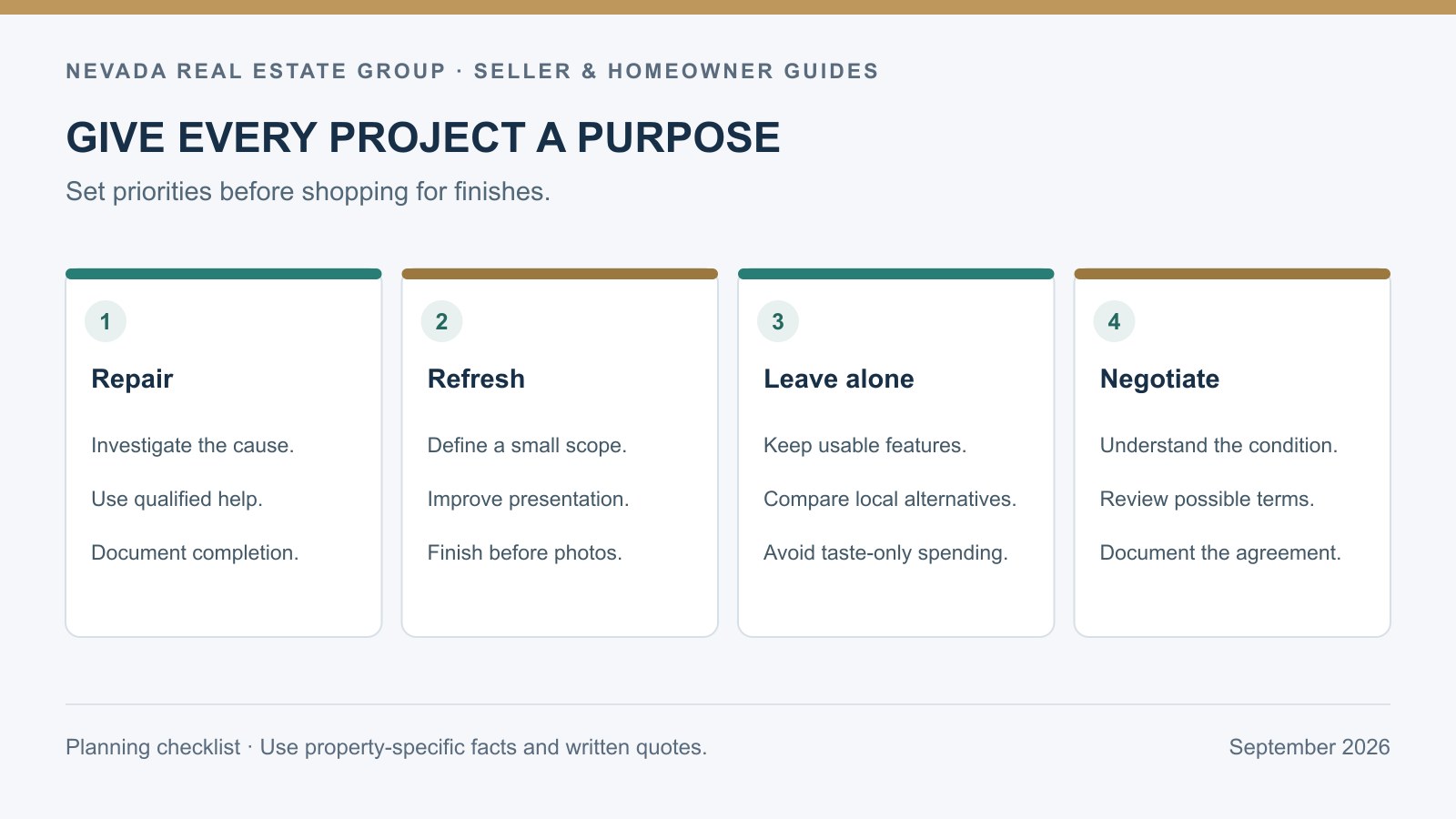
How Do You Sort Projects Into Repair, Refresh, and Leave Alone?
Walk through the property with three columns. Repairs address function, damage, or a concern that needs professional investigation. Refresh work improves presentation without changing the basic layout or scope of the home. Leave-alone items are usable features whose replacement is mainly a matter of taste. Classifying a project this way helps prevent an attractive cosmetic idea from consuming money needed for a more important problem.
| Category | Possible examples | Next action |
|---|---|---|
| Investigate or repair | Leak, unsafe feature, failed equipment, visible damage | Qualified assessment, scope, and documentation |
| Refresh | Cleaning, worn paint, entry hardware, overgrown planting | Define a limited scope and obtain a price |
| Leave alone | Functional finishes or layout that buyers may personalize | Compare with similar homes before spending |
| Consider negotiation | Known work whose timing or scope is difficult before sale | Discuss disclosure, pricing, and transaction options |
Do not diagnose a stain or crack from a photograph alone. The correct category may change after an inspection. A mark that looks cosmetic could indicate an unresolved source, while a dated but functioning fixture may not require replacement at all. Obtain the information needed to decide rather than painting over uncertainty.
Then rank the work within each column. Prioritize issues that prevent an honest, usable showing or could disrupt the sale. Compare optional projects against the same limited budget and available time. If money is tight, reduce decoration before cutting the scope required to complete a repair properly. Keep a written decision log so the plan does not expand every time someone suggests a new finish.
Which Condition Problems Should You Investigate First?
Begin with conditions that affect use of the home or create uncertainty about a larger issue. Active leaks, damaged components, unusual equipment behavior, and unsafe features deserve an appropriate assessment. A pre-listing inspection can help organize questions, but its scope and limitations should be clear. A general inspection is not a substitute for every specialist evaluation a property may need.
According to Nevada's residential disclosure statute, NRS 113.130, sellers have disclosure obligations concerning the property's condition, subject to the law's provisions and exceptions. Work with your agent and, where needed, legal counsel on the current form and circumstances. Selling without making every repair does not mean known condition information should be hidden.
Ask a qualified professional to explain the cause, proposed remedy, and any follow-up needed. Keep the report, written scope, invoice, warranty terms, and permit or inspection records where relevant. These documents help distinguish completed work from an informal statement that something was “taken care of.” They also help the next discussion if a buyer's inspector raises the same issue.
Avoid unnecessary certainty in the listing. A service visit may document that a system operated on a particular day; it does not guarantee that it will never fail. A patched surface may look better without establishing that an underlying issue is resolved. Describe work accurately and retain the supporting details.
Finally, ask how the issue affects the sale sequence. Some work may be practical before photography. Other work may require a different timetable or transaction discussion. Make that decision before ordering finishes around it. Good preparation reduces uncertainty through evidence, rather than relying on presentation to distract buyers from questions they are entitled to ask.
Should You Replace the HVAC System Before Selling in Las Vegas?
Have the system evaluated before deciding that age alone requires replacement. Buyers may ask about cooling performance, service history, equipment condition, and recurring problems. Gather what is known and let a qualified HVAC professional assess current needs. An old but functioning system and a failed system create different decisions; neither should be priced from a rule of thumb in a blog.
According to ENERGY STAR's maintenance checklist, a professional maintenance visit involves checks beyond simply changing a filter, including controls and system operation. Use a written service record to clarify what was examined and what recommendations remain. Do not describe a routine check as a full replacement or a guarantee of future performance.
If replacement is recommended, obtain an installed quote with the equipment specification, scope, permit responsibility where required, and warranty details. Ask whether ductwork, electrical changes, removal, or other related work is included. Compare appropriately specified solutions rather than choosing the lowest equipment price on its own. Avoid promising utility savings without a property-specific basis.
Then compare completing the work with negotiating a sale that acknowledges the condition. A buyer credit may be possible, but it is not automatically acceptable to every lender or suitable for every problem. The listing agent and lender should clarify the options in the actual transaction. A repair that affects safety or financing may need a different approach from elective efficiency upgrades.
For an occupied home, comfort during the marketing period also matters. Showings should reflect the home's actual condition with reasonable access to equipment. Keep the house usable and communicate accurately about what was serviced, repaired, or replaced. The purpose is an informed decision and a credible presentation, not a claim that every seller must buy a new air conditioner.
What Landscaping Work Makes Sense in the Desert?
Start by restoring order to what is already there. Remove debris, address failed irrigation components, trim appropriately, and evaluate unhealthy planting with a qualified provider when needed. A coherent, maintained yard can communicate care without a major redesign. Avoid spending on a large landscape project merely because a national article claims an automatic return.
According to the Southern Nevada Water Authority's Water Smart Landscapes program, rebate participation has application, inspection, and program conditions. Check eligibility and the required sequence before removing grass. Do not subtract an assumed rebate from a contractor proposal until you understand the program and its requirements for your property.
If you are considering a conversion, price the complete installation: removal, irrigation changes, planting, ground cover, edging, and any approvals or follow-up. Ask what the landscape will look like at installation and as it matures. A design can be water-conscious without looking unfinished, but the scope must provide that result. Keep HOA requirements and utility-program requirements separate; approval from one does not necessarily satisfy the other.
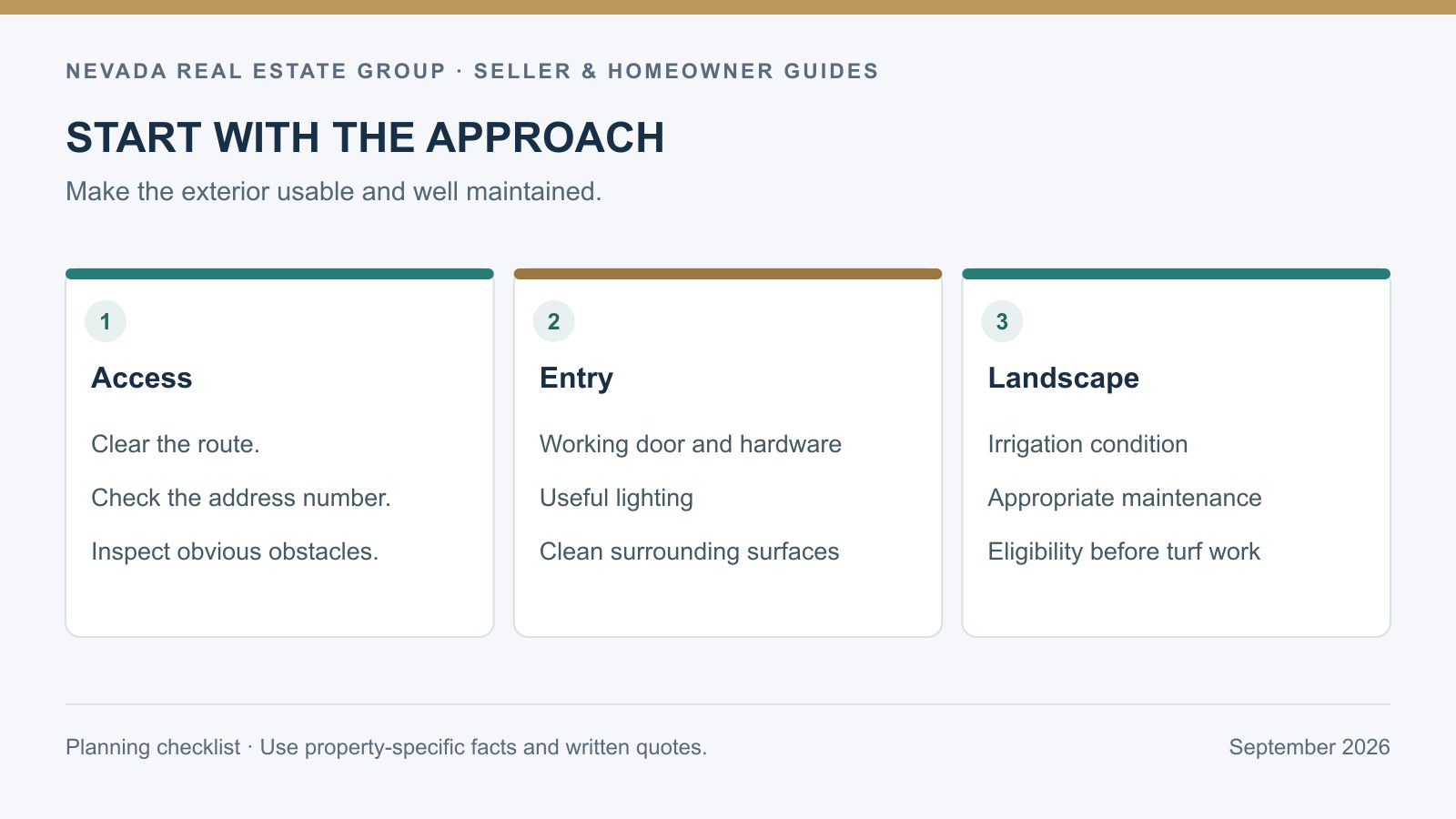
Think about the path buyers will use. Is the front entrance easy to find? Can people move comfortably from parking to the door? Are address numbers visible and lighting functional? Those basic questions are often more useful than deciding how many decorative plants to add.
For a short selling timeline, modest cleanup may be more practical than a conversion that depends on inspections, materials, and scheduling. For a longer timeline, a properly planned project may be worth considering on its own merits. Our Colorado River and Las Vegas water guide explains the broader conservation context; confirm the current rebate terms directly with SNWA. Compare actual bids and requirements, and describe any completed work and ongoing obligations accurately to prospective buyers.
Is the Front Door Worth Replacing, or Does It Need a Refresh?
The entry deserves attention because buyers use it, pause there, and examine it closely. Begin with operation and condition: the door should open and close properly, locks and hardware should function, and the surrounding area should be clean and well lit. A replacement is one possible solution, but cleaning, adjustment, refinishing, or limited hardware work may address the actual problem.
According to NAR's discussion of front-door projects, the 2025 remodeling report estimated 100% cost recovery for a steel front door nationally. That is a research estimate, not a promise that replacing your door adds its invoice amount to a Las Vegas sale. The starting condition, installation cost, and comparable homes still matter.
Get the complete installed scope before deciding. A door project can involve the frame, threshold, finish, hardware, and adjustments beyond the slab itself. Match the style and quality to the home. A costly statement entrance can be an awkward use of funds if the interior has unresolved maintenance or the neighborhood's competing homes do not support that level of finish.
For a refresh, choose materials and methods suitable for the existing surface and conditions. If an association regulates exterior appearance, confirm the process before ordering. Avoid beginning a project that cannot be completed before photography simply to satisfy an idealized launch date.
Treat the entry as a small, complete experience. Clean the approach, ensure the number is readable, check the light, and remove obstacles. Photograph it after the work is finished. Buyers should encounter a home that appears cared for and easy to enter, whether the door is new or simply functioning and presented well.
How Far Should You Go With a Kitchen Update?
Keep a functioning kitchen's useful parts unless the competitive evidence supports replacing them. Start with cleanliness, lighting, working doors and drawers, appropriate hardware, and any damaged components. A targeted refresh can make the room easier to evaluate without committing to new cabinets, appliances, countertops, plumbing, and flooring as one expanding project.
Ask what a buyer will actually compare. In an established neighborhood, a clean original kitchen may occupy a different price position from a recently remodeled home, but that does not prove a full remodel will pay for itself. Your agent should examine relevant sales and current alternatives, with attention to the whole property. Browse Las Vegas homes for sale to understand the visible competition, while remembering that asking prices are not closed-sale evidence. A renovated kitchen does not make the rest of the home identical to a higher-priced comparable.
If you are considering painting or refacing cabinets, have the substrate and condition assessed. A finish that looks good briefly but fails under ordinary use is poor preparation. Include hardware compatibility, surfaces, cleanup, and the work schedule in the proposal. Confirm how the kitchen remains usable during the project and whether a delay affects your planned move.
For appliances, replace a failed unit when the sale plan calls for it, but avoid assuming every working appliance needs a coordinated upgrade. Identify what will be included in the sale and what documentation is available. Energy efficiency, appearance, and functionality are different considerations; none creates a universal resale premium.
Be especially cautious about changing the layout close to listing. Moving plumbing, opening walls, or adding an island can introduce design, permitting, and scheduling questions beyond a cosmetic refresh. Get the complete scope before committing. If the only justification is that a future buyer might prefer your chosen style, leaving the kitchen functional and pricing the home accordingly may be the more disciplined decision.
Which Paint, Flooring, and Cleaning Projects Deserve the Budget?
Focus on coherent condition rather than making every surface look newly installed. A thorough cleaning can establish what actually needs attention. Worn or heavily personalized paint may deserve a refresh, while intact neutral finishes may not. Flooring should be evaluated for damage, odor, trip concerns, and overall condition rather than replaced automatically because the seller dislikes its style.
According to the EPA's lead-safe renovation guidance, homes built before 1978 may contain lead-based paint, and renovation can require special precautions. Check the home's age and consult appropriately qualified help before disturbing suspect surfaces. A pre-listing deadline is not a reason to improvise sanding, demolition, or paint removal in an older property.
For painting, price preparation, repairs, coating, trim, and cleanup together. Compare bids using the same rooms and finish expectations. For flooring, confirm removal, disposal, subfloor work, transitions, and baseboards where applicable. A low material price is not the total project cost. If a contractor discovers an underlying problem, pause and evaluate it before covering the area.
Cleaning should also have a defined scope. A general housekeeping visit differs from a move-out clean, window service, carpet treatment, or specialized remediation. Ask what is included and what the provider cannot resolve. Do not use fragrance or staging to conceal an unresolved condition.
Once the work is complete, inspect it under normal lighting and take test photographs. Look for unfinished edges, inconsistent colors, and visible debris. A modest job done carefully is more useful than several partially finished upgrades. Keep enough time for corrections before photography and showings, and avoid starting another project simply because the first one makes an adjacent room look less new.
How Do Permits and Contractor Checks Affect Your Timeline?
Confirm the correct jurisdiction and scope before signing. A Las Vegas mailing address does not automatically mean the City of Las Vegas issues the permit. The property may fall within another city or unincorporated Clark County. Electrical, plumbing, structural, mechanical, and other work can raise different approval requirements; ask the responsible building department about the specific project.
According to Clark County's permit guidance, permit requirements and exemptions are addressed through the county's building rules. Use the official department's process for an unincorporated-county property, and the appropriate city process elsewhere. An HOA's approval of appearance does not establish building-code compliance. For properties in Green Valley or guard-gated communities, obtain the rules for the exact association; the area label does not identify the approval process.
According to the Nevada State Contractors Board, homeowners should verify licensing and compare written bids. Check that the contracting business matches the license and proposed work. Ask who obtains permits, schedules inspections, and supplies final records. Keep the written agreement, changes, and receipts together.
The schedule should include more than the worker's days on site. Material availability, approvals, inspections, cleanup, and correction time can all affect when the house is ready to market. Ask what happens if the proposed completion date is missed and avoid assuming an oral promise is a dependable launch plan.
If earlier work lacks documentation, raise that question before listing rather than hoping it will not be noticed. The agent and relevant professionals can help determine what records exist and what further steps are appropriate. Good preparation does not require pretending a property has no history. It requires understanding that history well enough to make accurate representations and sensible transaction decisions.
When Might a Buyer Credit Be Better Than Doing the Work?
A credit may be worth discussing when the work is elective, the buyer will reasonably prefer their own finishes, or the seller cannot complete a suitable project before closing. It can also be part of a negotiated response to inspection findings. It is not a universal substitute for repairs, and its usefulness depends on the contract, financing, property condition, and the parties' agreement.
According to the Consumer Financial Protection Bureau's Closing Disclosure guide, buyers should check that the seller-credit entry reflects what was agreed. That reinforces a practical point: an informal offer to “help with repairs” needs to become clear written terms and an accurately documented transaction. Ask the lender and escrow or title team how a proposed credit can be handled.
Compare repair and credit options on a net basis. A completed repair may reduce uncertainty, but it requires cash, scheduling, and proper execution. A credit can leave choices with the buyer, but some buyers may not want the work or may face financing limitations. A lower price and a closing-cost credit also affect a buyer differently, so they are not interchangeable just because the dollar amounts match.
| Choice | Potential advantage | What must be confirmed |
|---|---|---|
| Repair before listing | Completed work can be documented and shown | Scope, cost, approvals, and completion date |
| Negotiate a credit | Buyer may retain choice over permitted uses | Lender rules, agreement, and closing documentation |
| Adjust asking price | Positions condition within the market comparison | Comparable evidence and seller net proceeds |
Work through the options with your agent before making a promise in the listing. Keep known condition disclosures separate from the negotiation. The purpose is to choose a workable transaction structure, not to make a defect disappear through a different accounting label.
How Do You Set a Budget Without Assuming a Resale Windfall?
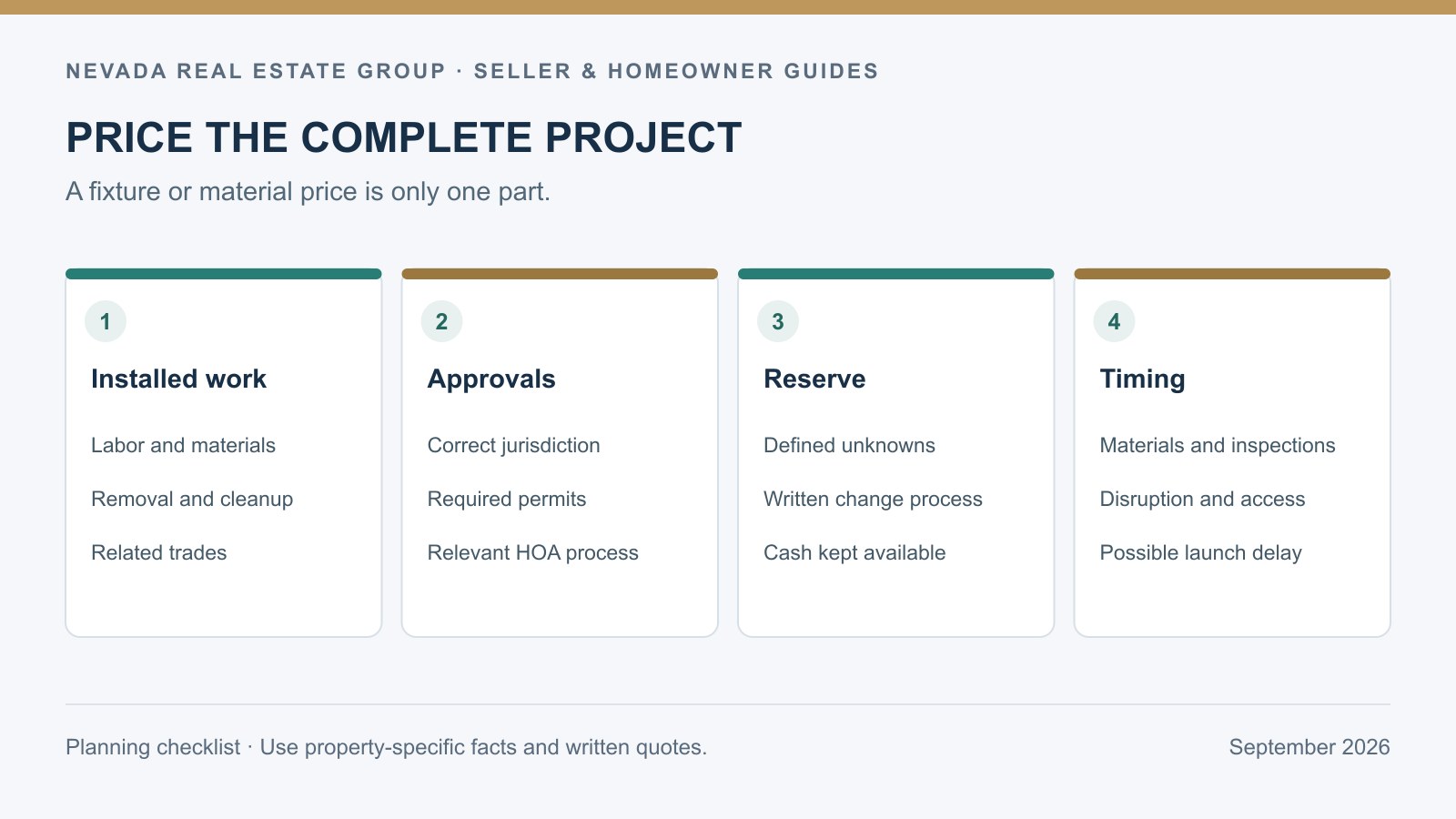
Start with an amount you can afford without depending on an unproven sale-price increase. Separate necessary work from optional presentation spending, then reserve money for uncertainty. Use actual quotes and identify what each excludes. A budget is incomplete if every line assumes the cheapest scope and there is nothing available for a discovered problem or a small delay.
Here is an invented planning example, prepared September 2026. Suppose a seller approves $6,000 for preparation: $2,500 of identified repair work, $1,500 of paint and cleaning, $1,000 of exterior refresh, and $1,000 held in reserve. Those allocations demonstrate prioritization only. They are not typical Las Vegas prices, and the correct split for another home could be entirely different.
| Category | Invented allocation | Approval condition |
|---|---|---|
| Identified repairs | $2,500 | Qualified scope and completion plan |
| Paint and cleaning | $1,500 | Specific surfaces, rooms, and services |
| Exterior refresh | $1,000 | Limited maintenance and presentation scope |
| Reserve | $1,000 | Held for a defined change, not automatically spent |
If a new proposal exceeds the budget, compare alternatives rather than adding it automatically. Could the scope be narrowed? Is the project necessary before sale, or could the condition be addressed through pricing and negotiation? Would the work delay the listing enough to add meaningful carrying costs? Document the answer and the person approving a change.
Our home value estimator can start the value discussion, but an automated estimate cannot assess your proposed construction scope. Ask your agent for a proceeds estimate that includes the preparation expense separately from sale-related costs. Do not add the renovation invoice to an asking price simply to recover it. Buyers compare the finished home with alternatives; they do not reimburse a seller's project ledger. A disciplined budget protects your flexibility even when the eventual negotiation differs from the initial plan. Across the 9,600+ closings we've represented, preparation and pricing remain connected decisions.
What Should Your Final Pre-Listing Walkthrough Accomplish?
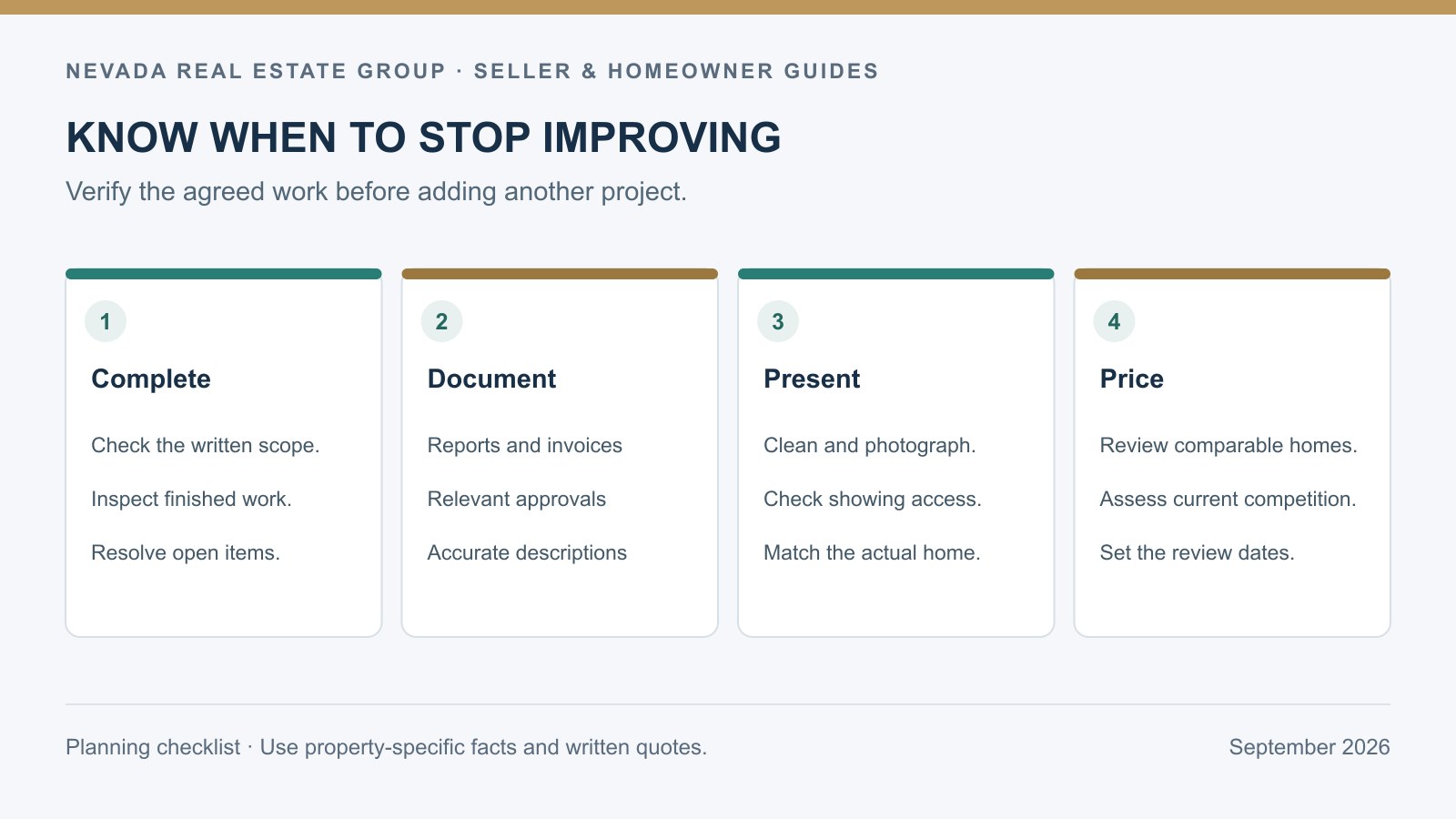
Use the final walkthrough to verify completed work, not to invent a new renovation program. Bring the agreed scope and check each item. Confirm that the house is clean, utilities and necessary systems are available for showing, access is workable, and records are organized. If something is incomplete, decide whether it must be resolved before photography or accurately handled in the sale plan.
Photograph the property as it will be offered. Do not use an old exterior image to hide current condition or digitally remove a permanent problem. Review room descriptions, included items, and claims about improvements. “New” should refer to documented work, and a general refresh should not be marketed as a full renovation. Make sure photographs, copy, and the in-person experience tell the same story.
Then connect preparation with pricing. Our Las Vegas seller pricing playbook explains how to compare active competition and review early showing feedback. A finished project may improve presentation without changing the supported price range by its entire cost. Keep those two judgments separate.
The best stopping point is when the home is ready to show honestly and competitively, not when every possible improvement has been completed. Sellers can spend indefinitely chasing the next room, surface, or fixture. Agree on a stopping rule before the work begins and use the final walkthrough to apply it.
For help setting priorities, call Nevada Real Estate Group at (702) 637-1759 or contact us. Bring the address, preferred timing, known condition questions, and an approximate preparation budget. We can discuss the property's competitive position and the sequence of decisions, while licensed specialists evaluate and perform work in their respective fields. A clear plan helps you spend where the property needs it and leave the rest for its next owner.
Frequently Asked Questions
Which home improvements have the best return before selling in Las Vegas?
There is no universal ranking for every property. Investigate condition problems first, then evaluate modest presentation work such as cleaning, paint, the entry, landscaping, and focused kitchen improvements. Compare the full installed cost with the property's condition and direct competition. National cost-recovery estimates can inform the discussion, but they do not guarantee your resale outcome.
Should I remodel the entire kitchen before listing?
Not automatically. A clean, functioning kitchen may need only limited work, while a substantial renovation can add cost, disruption, and delay. Review relevant comparable homes and get a complete scope before deciding. Replacing usable finishes solely to match a future buyer's imagined taste is different from addressing damage or a functional problem.
Do I need to replace an older air conditioner before selling?
Age alone does not settle the decision. Have a qualified professional assess operation and condition, obtain written recommendations, and compare repair or replacement options. Discuss the sale implications with your agent. A service record helps document what was checked; it does not guarantee the system's future performance or eliminate disclosure responsibilities.
Can I count a landscape rebate in my preparation budget?
Only after checking the current program, eligibility, application sequence, and requirements for your property. SNWA's Water Smart Landscapes program has conditions and inspections. Do not remove turf first and assume reimbursement will follow. Confirm relevant HOA requirements separately, and use an actual complete installation quote when comparing the project's cost and timeline.
Is selling as-is a way to avoid disclosing problems?
No. A decision not to perform every repair does not mean known condition information should be concealed. Nevada's residential disclosure rules and the transaction's circumstances matter. Work with your agent and, if needed, legal counsel on the current form and obligations. Keep records of assessments and completed work available for the sale discussion.
Should I offer a repair credit instead of doing the work?
Sometimes, but confirm that it fits the contract, lender requirements, and property condition. A credit, a lower price, and a completed repair affect the transaction differently. Compare costs, timing, and seller proceeds with your agent, and obtain clear written terms. Do not assume a credit can substitute for every repair a lender or buyer may require.
How do I avoid overspending before I sell?
Set a budget and stopping rule before starting. Separate necessary repairs, focused presentation work, and optional renovations. Obtain comparable written scopes and retain a reserve. Evaluate new suggestions against the same priorities rather than expanding the project room by room. Price the finished home from market evidence, not by adding every improvement invoice to the asking price.
Which Sources Inform This Home-Improvement Guide?
Sources reviewed September 24, 2026. National remodeling estimates are identified by publication year. Worksheets and budgets are illustrative, with no property-specific return or contractor pricing represented.
- NAR and NARI: 2025 Remodeling Impact Report release
- NAR: front-door cost-recovery discussion
- SNWA: Water Smart Landscapes
- ENERGY STAR: HVAC maintenance checklist
- Nevada Legislature: NRS Chapter 113
- Nevada State Contractors Board: working with contractors
- Clark County: permit requirements
- EPA: lead-safe renovation
- CFPB: Closing Disclosure guide
Chris Nevada · Nevada Real Estate License S.181401 · Nevada Real Estate Group · LPT Realty · (702) 637-1759.