

Clark County School District assigns each Las Vegas-area address a zoned school, and its on-time magnet and Open Enrollment applications for 2027–28 close January 12, 2027 at 3 p.m. Magnets and Open Enrollment need an application, public charters run their own admissions, and private schools set their own tuition. A nearby home guarantees none of those seats, so confirm the address in CCSD's zoning search and keep a fallback.
- CCSD's zoning search gives each address its assigned schools; a neighborhood name is not a boundary.
- Magnet and Open Enrollment applications for 2027–28 share a January 12, 2027, 3 p.m. deadline.
- Open Enrollment needs open seats, uses a lottery when oversubscribed, and comes with no CCSD bus.
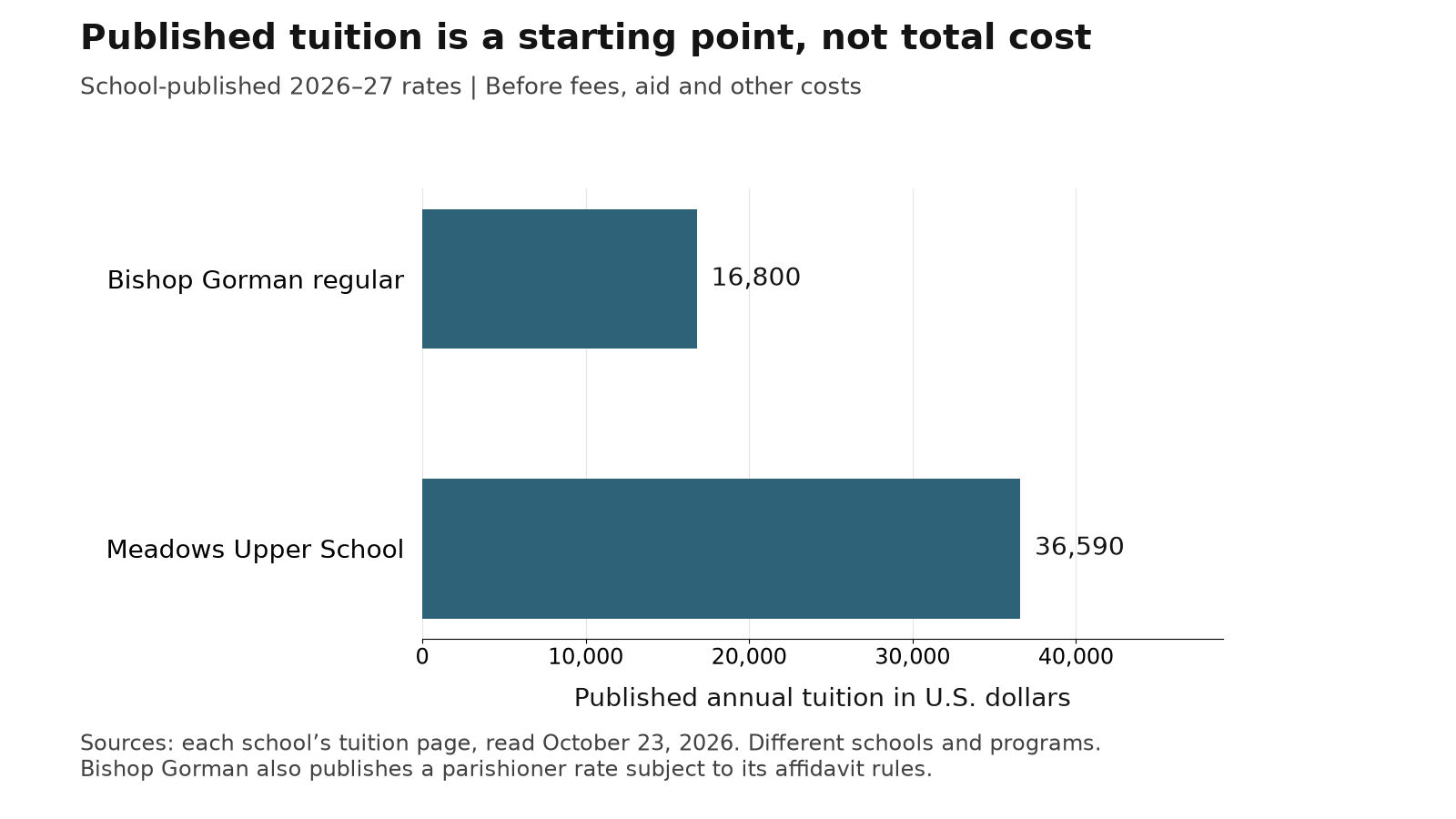
- Published 2026–27 tuition runs from $16,800 at Bishop Gorman to $36,590 for Meadows Upper School.
- Test the school run, get admission terms in writing, and keep a fallback before committing.
This guide connects the housing decision to the evidence you can check. School, financing and MLS figures were reviewed on November 1, 2026. Use the Las Vegas home search to identify candidate properties, then investigate the address and school path separately. No campus ranking can make that decision for your household.
How do Las Vegas school options connect to a home purchase?
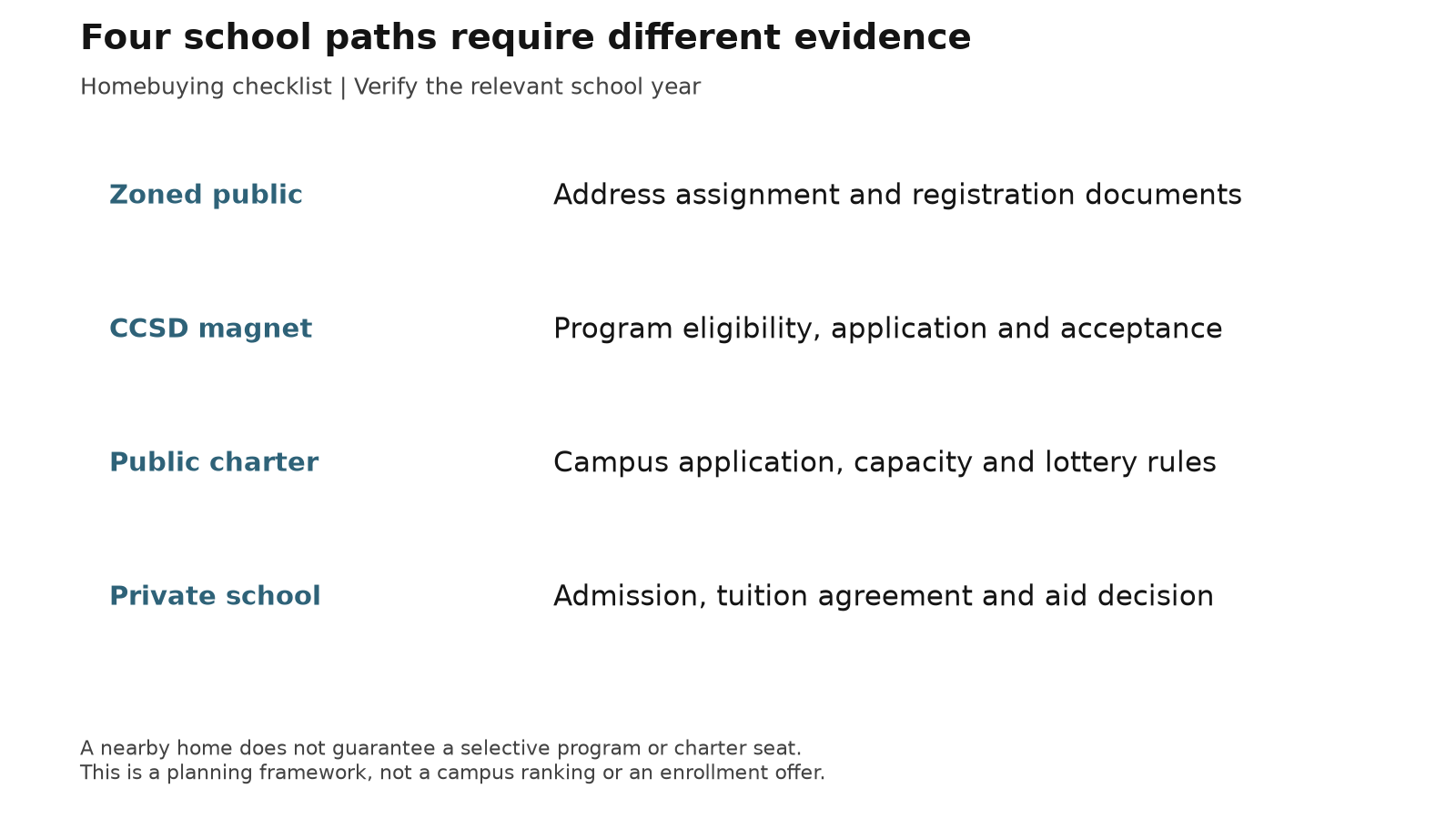
A zoned school comes with the address, and every other public option takes an application. A CCSD magnet is a program you apply to; CCSD says entry is criteria-based, interest-based or audition-based, and a random computerized lottery decides it. A public charter is a separately run public school with its own application and, when oversubscribed, its own lottery. Open Enrollment is a CCSD application for a seat at another district school with open capacity, also decided by lottery when applications exceed seats, and CCSD provides no bus. The limits matter: none of these seats comes with the house, and only the zoned school is tied to the address.
CCSD does not operate every school a buyer might consider, so treat school names in a listing as leads to verify, not enrollment commitments.
According to the CCSD zoning page, buyers can use its zoning search and zoning maps. Begin with the address and intended year. Then establish whether the desired education is at the assigned campus or requires a separate application. For example, a child interested in a specialized arts program needs the program's entry rules, while a sibling may attend a different campus with another schedule. Both journeys belong in the housing decision.
Write down a primary school plan and a fallback that your household can actually use. Record what is confirmed, what is conditional and the date each answer was received. An application submission or waitlist position should remain in the conditional column. If the preferred offer does not arrive, the purchase still needs to work financially and practically.
Our Summerlin relocation guide covers the broader move, while the school-specific checks here apply across the valley. Compare homes only after identifying your essential educational needs, such as a particular grade, support service or program. That sequence makes the shortlist more useful than simply sorting properties by a rating beside the listing.
| Path | What to verify | What a nearby home does not establish |
|---|---|---|
| Zoned CCSD school | Address, grade, school year and registration requirements | A permanent boundary or every specialized service at that campus |
| CCSD magnet | Program criteria, application cycle, acceptance and transportation | Admission merely because the campus is close |
| CCSD Open Enrollment | School on the current eligibility list, grade, open seats, lottery result and your own transportation | A seat at a non-zoned campus, or a CCSD bus |
| Public charter | Campus application, capacity, preferences and lottery rules | A reserved seat based on a neighborhood name |
| Private school | Admission, tuition agreement, fees and any aid decision | Acceptance or a particular financial-aid award |
How should you verify a property's school assignment?
Use the current district resource with the full address and the school year you need. Save the result and ask the district or school to resolve anything unclear. A map for this year may not answer a move planned for next year. A nearby school, the seller's child's attendance or an older listing can reflect a different situation. None replaces your own address-specific check.
CCSD's zoning page links the zoning search, zoning maps and suggested routes to school. Those resources serve different purposes: a zoning map concerns assignment, while a suggested route concerns travel. A property can be close to a campus yet lie outside its zone.
Ask about new construction and addresses the tool does not recognize. Provide the parcel or development information to the district through its normal channels and request clarification. Do not invent an address, borrow a relative's address or assume the nearest established subdivision supplies the correct answer. If a boundary change is being discussed, distinguish a proposal from a final decision and ask which school year it affects.
If Open Enrollment is your alternative, treat it as a backup. According to CCSD's Open Enrollment page, the on-time window for 2027–28 runs October 5, 2026 to January 12, 2027 at 3 p.m., and the late window runs March 22 to August 20, 2027 at 3 p.m. Not all schools have open seats, so check the 2027–28 eligibility list. When applications exceed seats, a lottery decides, and alternates can receive seats through the tenth day of school. You may apply to up to five schools or programs across Magnet, Open Enrollment and Central Technical Training Academy, with no more than three in one category, and accepting one seat declines the others.
CCSD's FAQ adds the terms a buyer should weigh. CCSD provides no transportation, the family must commit to at least one year, the placement lasts through the school's highest grade, and moving to the next school level takes a new application. Sibling preference applies only to a first-choice, on-time application. Keep the option conditional until the district confirms a seat.
For Henderson homes or Summerlin homes, the community page is a property-search starting point. It is not a school assignment certificate. Keep the actual school response in your home comparison file, alongside the inspection and ownership-cost information. If the assignment is central to your purchase, resolve the question before your decision deadlines and ask your own transaction advisers how that concern fits the contract.
What do the latest Nevada school results tell a buyer?
Use official results to frame questions about a specific campus, not to label an entire neighborhood. According to the Nevada Department of Education's September 15, 2026 release, the published results concern 2025–26 student and school performance. It also introduced a district performance framework. School results, district measures and a commercial rating are separate products; their scales and reference periods should not be treated as interchangeable.
The release said Class of 2026 graduation results would be released in November. Until they appear, no page can cite them. The same caution applies to claims that a campus is currently the highest ranked or that an entire ZIP has the strongest schools. We don't rank or rate campuses in this guide.
Instead, review the actual school report for the grade level involved. Note the reporting year and measures included, then ask how the campus explains its results. Your questions might concern course access, student support, growth, attendance or a specific program. A single composite score cannot describe every child's needs, and a different score does not establish a matching difference in home value.
Use the focused Summerlin schools guide and North Las Vegas schools guide for additional local starting points. Confirm their campus details against the current official record before relying on them. Retain the source date with your notes so you can distinguish a new result from a page that merely has a recent headline.
How much do home prices vary across Las Vegas ZIP codes?
Median closing prices in these 11 ZIPs ran from $447,000 in 89179 to $850,000 in 89135 over the 12 months through September 2026, based on our pull of GLVAR MLS closings by closing date. The table counts houses, townhomes and condos together. It describes ZIPs, not attendance areas, and a ZIP can hold more than one zone.
That spread is a reminder to look at more than one housing option, but it doesn't isolate the price of a school. For example, the difference between $850,000 in 89135 and $552,500 in 89144 is $297,500. That arithmetic describes two ZIP medians. It doesn't measure how much a school adds to an otherwise identical home, because size, age, condition and location all differ.
Use the Las Vegas price guide for dated market context, then request a current set of comparable properties for the actual address under consideration. Separate asking prices from completed sales and match the time window. If school assignment matters to that comparison, verify the boundaries first rather than assuming a ZIP is a single school zone.
| ZIP | Median closing price | Closings | Median days on market | Active listings |
|---|---|---|---|---|
| 89135 | $850,000 | 665 | 35 | 334 |
| 89138 | $769,000 | 745 | 39 | 344 |
| 89052 | $635,000 | 918 | 34 | 418 |
| 89144 | $552,500 | 308 | 30 | 144 |
| 89012 | $549,450 | 558 | 29 | 295 |
| 89131 | $535,000 | 648 | 30 | 233 |
| 89166 | $510,000 | 721 | 33 | 325 |
| 89011 | $480,000 | 1,262 | 38 | 705 |
| 89178 | $471,500 | 660 | 39 | 239 |
| 89074 | $454,500 | 626 | 30 | 246 |
| 89179 | $447,000 | 124 | 27 | 59 |
How should you compare Summerlin, Henderson and the northwest?
Compare actual properties against the same household requirements. Start with the grades and services needed, then add the confirmed school path, daily schedule, housing budget and work destinations. This method lets you compare a home in Green Valley with one in Centennial Hills without claiming that a city name or higher price proves a better education.
You may hear campus names such as Palo Verde, Coronado, Green Valley, Liberty, Centennial, Shadow Ridge, Arbor View, Sierra Vista and Durango in a listing or a conversation. Those names should prompt individual research, not a promise that every home in the surrounding area feeds a particular school. Verify both the assignment and the programs currently offered for the child's grade. A high school name also does not answer the elementary or middle-school question for younger siblings.
For Summerlin South and newer western neighborhoods, include the actual home-to-school and school-to-work journeys. In Green Valley Ranch, do not substitute a general Green Valley label or a ZIP for an address result. In the northwest, compare the household's routine with its actual work locations rather than assuming every trip follows the same freeway route.
The southwest deserves the same property-level review. A newer house can still create a difficult school run or require a separate admission process. Use the Summerlin versus Henderson comparison for broader ownership differences, then give each candidate a written school and travel plan. Base the comparison on your stated needs and reliable education and property records.
How does the 2027–28 CCSD magnet cycle work?
According to the CCSD magnet application information page, the cycle opened October 5, 2026, with a deadline of January 12, 2027 at 3 p.m. for the 2027–28 school year. These dates describe that magnet cycle. They are not a universal deadline for charter enrollment, private admission, a district transfer or a child entering a zoned school during the current year.
Read the requirements for the specific program and entry grade before treating an application as a viable option. CCSD says entry is determined by a random, computerized lottery, and that criteria-based high school programs and audition-based arts programs require applicants to meet those standards before the lottery. Availability is not identical across grades. A well-known name such as Advanced Technologies Academy, West Career & Technical Academy or Las Vegas Academy should lead you to the current program instructions, not an assumption that all applicants have the same eligibility or selection process.
Keep submission, eligibility, selection and acceptance as distinct steps in your planning notes. The housing budget should still work if the child is not selected. If the school choice depends on a successful audition or an uncertain seat, consider how you would use the assigned school or another confirmed option. Ask about the actual response deadlines and paperwork rather than assuming an application automatically completes registration.
Transportation also needs a separate answer. According to the magnet page, a student must live inside the designated transportation zone and more than two miles from the school; proximity alone is insufficient. Review the bus plan and the plan for days when a parent must drive. For a relocation, put the application milestones beside the closing and moving dates so that one administrative timetable does not silently depend on another being finished early.
What should you check before relying on a charter school?
Public charter admission is separate from a home's CCSD assignment. Under Nevada's charter enrollment statute, NRS 388A.453, families apply to the charter school, and an oversubscribed eligible applicant pool generally requires a lottery subject to the statute's preferences and exceptions. A neighboring home does not itself reserve a place. Confirm the particular campus, grade, application period and available capacity.
NRS 388A.366 also bars charter tuition and fees, except those a school district board may charge. That supports describing public charters as a public-school option, but it does not justify promising that every possible activity, meal or related expense is free. Obtain the school's actual cost information, transportation arrangements and calendar. A network with several campuses may have different grade ranges and practical arrangements at each location.
Ask what an offer covers and what must happen to keep it. A waitlist position is different from accepted enrollment, and a sibling's admission should not be assumed to settle another child's application. Keep the official communication and the school-year reference together. Avoid paying a housing premium based on an informal statement that a space will probably become available.
The strongest comparison is between confirmed options your household can use. Record travel time, after-school arrangements and the child's needs alongside any academic information. A charter could expand the places where a home search makes sense, but only if admission and daily access work. If the school's current rules cannot be confirmed, retain that uncertainty in the decision instead of converting it into a guaranteed benefit of the property.
When does CCSD provide school transportation?
Check the transportation rule that applies to the student's actual enrollment. According to the CCSD Transportation Department's published guidance, the two-mile walking zone uses a defined street-based measurement. The page also explains individualized services and says some buses serve magnets. The magnet application page describes the separate transportation zones and the two-mile rule.
For a magnet choice, use both the program's current transport map and the district's eligibility information. Ask how the distance is measured, where the assigned stop would be and whether a proposed address falls within the applicable service area. An online driving distance is not automatically the district's walking-distance calculation. Likewise, a nearby bus stop does not prove that your child may use that route.
Build a practical plan for the days the normal arrangement does not work. School activities, appointments, different sibling dismissal times or a parent's work schedule can require another trip. Check before-school and after-school arrangements directly with the provider, including capacity and fees. Students on a zone variance aren't eligible for transportation, according to the transportation page, and CCSD's FAQ says the same for Open Enrollment.
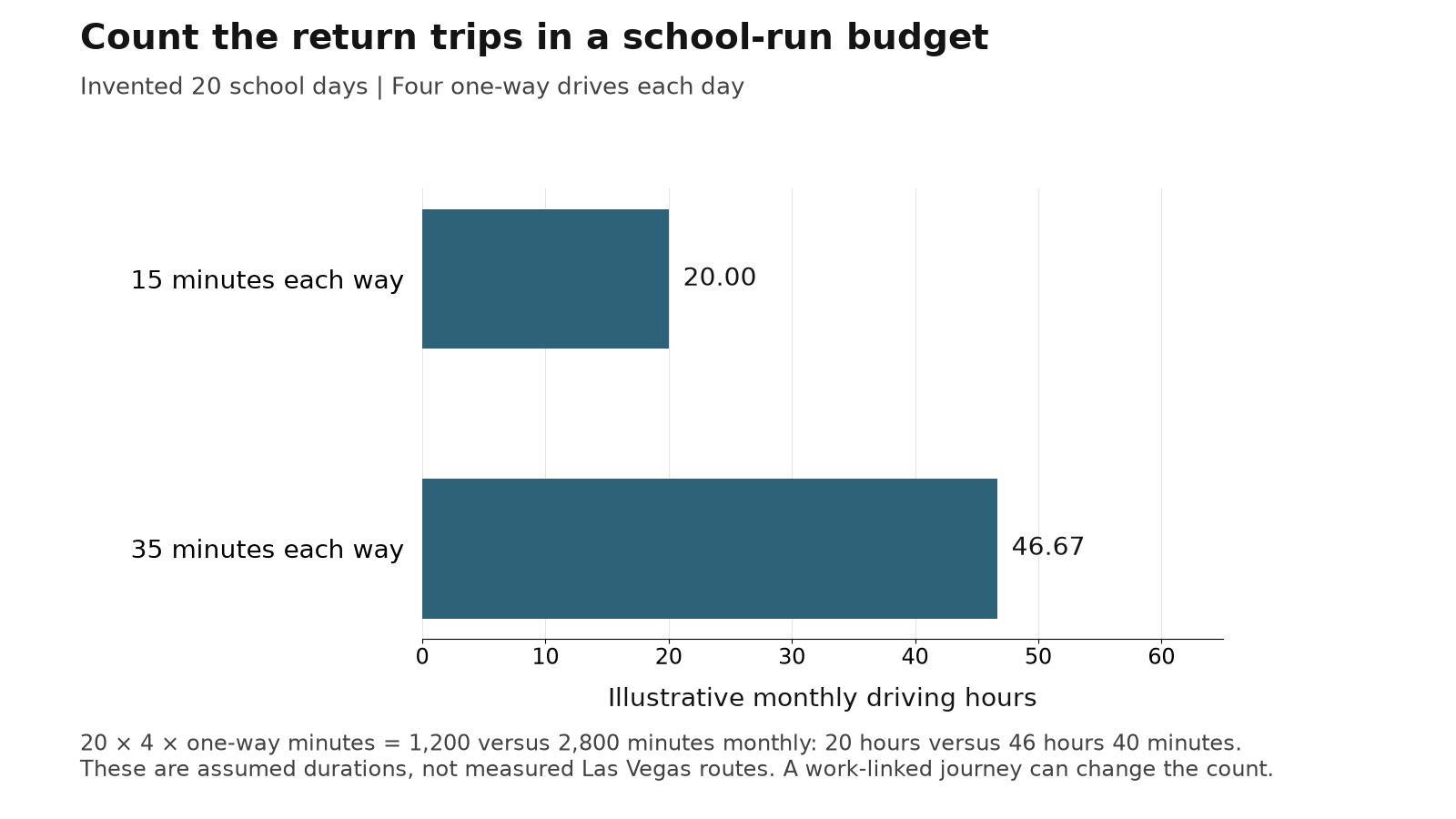
As an illustration, assume 20 school days and four one-way drives daily: drop-off, return, pickup and return. At 15 minutes each way, the total is 20 hours monthly. At 35 minutes, it becomes 46 hours 40 minutes, a difference of 26 hours 40 minutes. These are invented durations, not measured local routes. If a trip connects directly to work, change the trip count. Use the Las Vegas relocation guide to integrate school travel with the rest of the move.
What do selected private schools publish for 2026–27 tuition?
Use the school's own rate schedule for the child's grade and intended year. According to The Meadows School's 2026–27 tuition schedule, tuition is $24,350 for Beginning School, $28,210 for Lower School, $31,030 for Middle School and $36,590 for Upper School. Its page also identifies additional cost considerations and payment-plan conditions.
According to Bishop Gorman's 2026–27 schedule, regular tuition is $16,800, with a $15,400 parishioner rate subject to its affidavit requirements. It separately lists application, enrollment, annual registration, book and other applicable fees. The regular rate is therefore not an all-in annual household budget. Use the school agreement to determine which charges apply to the particular student and payment plan.
These examples are not a ranking, a complete directory or a claim that the programs are equivalent. They show why a dated, grade-specific fee schedule is more useful than a valley-wide tuition estimate.
Admission and financial assistance need separate confirmation. An aid application does not establish an award, and owning a nearby home does not establish admission. Ask about payment timing, withdrawal terms, required insurance and whether aid must be renewed. For a household considering Las Vegas luxury homes, a larger housing budget does not remove the need to preserve cash for these school-specific obligations.
| School / level | Published tuition | Scope to retain |
|---|---|---|
| Meadows Beginning School | $24,350 | School's stated level; not a K–12 average |
| Meadows Lower School | $28,210 | Grade-specific published amount |
| Meadows Middle School | $31,030 | Grade-specific published amount |
| Meadows Upper School | $36,590 | Published tuition, not total attendance cost |
| Bishop Gorman regular | $16,800 | Separate fees apply |
| Bishop Gorman parishioner | $15,400 | Subject to the school's affidavit and timing requirements |
How should tuition fit into a household housing budget?
Separate annual cost from the date cash must leave your account. Dividing a tuition figure by twelve can help compare recurring commitments, but the school may collect it on another schedule. For example, $16,800 divided by twelve is $1,400, and $36,590 divided by twelve is about $3,049.17. These are budgeting equivalents of the two published tuition amounts, not the schools' actual monthly payment quotes.
Meadows describes one-, two- and ten-payment options, with conditions that vary by plan. A household using an annual savings allowance still needs cash available on the required dates. Compare those dates with a down payment, moving costs and any period when you carry two homes. Avoid counting the same reserve as both money available for closing and money already committed to tuition.
Build separate lines for tuition, required fees, transportation, uniforms, meals, activities and after-school care where applicable. Replace each allowance with the school's or provider's current figures before deciding what home payment is comfortable. For more than one child, use each child's grade and confirmed cost; do not assume one published rate or an unconfirmed sibling discount covers the household.
Stress-test the plan with no unawarded aid and with a reasonable household cushion. That is a planning choice, not an admission forecast or a recommendation that every household needs the same reserve. Consider whether the arrangement remains workable if one parent changes work hours or a child's program changes. The cost-of-living comparison can help organize other expenses, but a generic city budget cannot substitute for the actual school agreement and property costs.
How much more mortgage payment would a higher home price add?
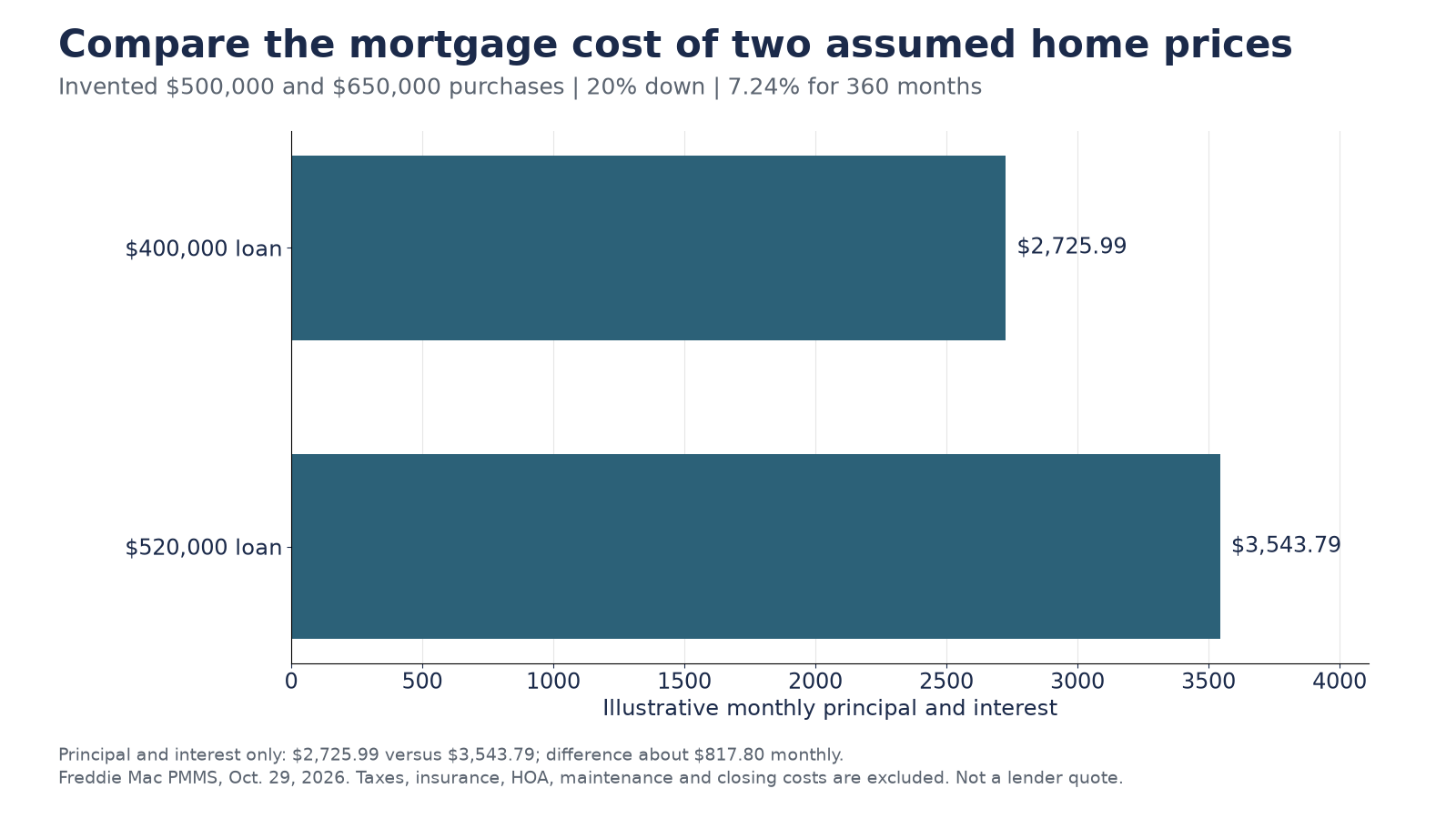
Calculate the financing difference with explicit assumptions. Consider invented homes priced at $500,000 and $650,000, each purchased with 20% down and a 30-year fixed loan at 7.24%. The loans would be $400,000 and $520,000. Standard monthly amortization gives principal and interest of $2,725.99 and $3,543.79, respectively, a difference of about $817.80. The down-payment difference is $30,000, separate from the monthly payment.
The rate is an assumption informed by Freddie Mac's October 29, 2026 PMMS, which reported a 7.24% national conventional 30-year average. It is not a local offer, a lock or a promise that either buyer qualifies. The calculation uses the loan balance multiplied by the monthly rate, divided by one minus the reciprocal of the monthly growth factor raised to 360. Taxes, insurance, HOA charges, maintenance and transaction costs are excluded.
This example also shows why tuition cannot simply be translated into a fixed extra home price. A mortgage has a term, interest rate, down payment and principal repayment; school costs have grade levels, years of attendance, fees and possible changes.
According to the CFPB's explanation of interest rate and APR, APR includes additional borrowing charges. Compare actual loan terms alongside the full household budget. A higher-priced home with a workable assigned school and a lower-priced home with private tuition are different choices; neither can be declared cheaper from one number alone.
| Assumed home price | Down payment | Loan | Monthly principal + interest |
|---|---|---|---|
| $500,000 | $100,000 | $400,000 | $2,725.99 |
| $650,000 | $130,000 | $520,000 | $3,543.79 |
What registration documents should a relocating household prepare?
Read the district's current instructions before scheduling the move around enrollment. According to CCSD's enrollment page, the process distinguishes existing students from students new to the district and lists parent or guardian identification, the child's identification, immunization requirements and proof of address. It also explains grade-entry requirements. A completed home purchase does not automatically complete these separate administrative steps.
The page lists a recent utility bill, rent receipt, residence lease or sales contract as address evidence. For a future-dated lease or sales contract used as the only proof, CCSD describes conditional registration with an additional acceptable proof required within 30 days. It says a driver's license, telephone bill or cable bill is not acceptable as address proof. That is different from the use of identification to establish the parent's identity.
Ask the school how to handle a closing date that changes or a temporary living arrangement. Do not assume the contract date, possession date and actual residence date are identical. If the household is sharing housing or lacks normal documents, seek the district's applicable process rather than substituting an address that is not the child's residence. Keep sensitive student and medical records within the school's approved channels.
Plan the transfer of academic records and discuss any existing support plan with the receiving school. Ask which documents must be originals and which may be provided electronically. The point is to identify missing items early enough to resolve them, not to promise same-day completion. Keep enrollment dates beside the moving schedule and confirm the actual first attendance arrangements directly with the school after the necessary steps are complete.
How can you compare school fit without relying on neighborhood labels?
Begin with observable needs and questions you can ask consistently. List the child's grade, courses, activities, support requirements and daily schedule. Then use the same list for each school. A campus name, test score or reputation may identify a question worth exploring, but it cannot tell you whether a particular service is available to your child or how the school day fits your household.
Request details about the actual program rather than broad assurances. For advanced coursework, ask about prerequisites and course availability. For a support need, ask the appropriate school personnel how the relevant process works. For an activity, ask about practice times, participation requirements and transportation after the normal day. The information should come from the responsible school staff and current program material, not assumptions attached to a listing photograph.
When a visit is possible, use it to test your practical questions. This guide does not claim classroom visits or interviews. You can ask how families receive updates, how concerns are addressed and where written policies are available. Record the date and distinguish a general description from a confirmed arrangement for your own child. A pleasant tour is helpful context, but it is not a substitute for admission or service documentation.
Apply the same objective housing criteria across the shortlist. Avoid treating neighborhood demographics, a higher price or marketing phrases as evidence of suitability. Your priorities may change the answer even when two schools have similar headline results. A written comparison of confirmed educational needs, costs and travel makes the final home decision more transparent and gives you specific questions to resolve before committing funds.
What should be resolved before you commit to a home?
Create one comparison sheet for each serious property. Include the confirmed assigned schools for the intended year, any separate application status, the school-run plan and the full ownership budget. Add a fallback if admission or transportation remains uncertain. Keep the date and source beside each answer so that you know which facts need another check before your transaction deadlines.
The purchase also needs to stand on its own property merits. Compare condition, inspection findings, association obligations and the household's expected length of ownership. A school-related preference does not make a roof problem, unsuitable floor plan or unaffordable payment disappear. Conversely, a home that fits well may remain viable through a different confirmed educational option. Evaluate the combination rather than buying a school label without evaluating the house.
Discuss unresolved conditions with your own transaction and financing advisers while there is time to act. Do not assume a listing's school field creates a contractual promise or that an admission delay automatically extends a purchase deadline. Separate the documents and decisions that belong to the school from those that belong to the property transaction. Confirm what is actually in writing for each.
Before possession, recheck the practical arrangements that depend on the final address: enrollment evidence, transportation eligibility, moving dates and access. After the move, keep future-year applications and boundary notices on the household calendar. The goal is a home and education plan that you can carry out with the facts available, with visible contingencies where something remains undecided. That is more useful than paying a presumed school premium that the underlying data never established.
Frequently asked questions about Las Vegas schools
Does every Las Vegas school belong to CCSD?
No. CCSD operates district public schools, while public charter and private schools have separate governance and admission processes. Verify the particular campus and school path. A home's assigned CCSD school does not establish admission to a nearby charter, private school or selective magnet program.
What is the deadline for 2027–28 CCSD magnet applications?
CCSD's published magnet page lists January 12, 2027 at 3 p.m., following an October 5, 2026 opening. Open Enrollment shares that on-time deadline and adds a late window of March 22 to August 20, 2027. Check the specific program's grade and entry requirements. Charter and private schools set their own dates.
Do magnet students receive CCSD bus transportation?
Some do, subject to the district's eligibility rules and the applicable magnet transportation boundary. Confirm the actual address, distance calculation and program. Do not rely on a general promise that all magnet students are bused.
Are Nevada public charter schools tuition-free?
NRS 388A.366 bars charter tuition and fees, except those a school district board may charge. Confirm any particular program expenses directly. Admission is separate from housing location and can involve capacity limits, preferences and a lottery; a nearby home does not guarantee a seat.
How is Open Enrollment different from a zoned school?
Your zoned school comes with the address. Open Enrollment is an application for a seat at another CCSD school with open capacity. A lottery decides when applications exceed seats, CCSD provides no bus, and the student must commit to at least one year. Not every school takes applicants, so check the current eligibility list.
Do these ZIP medians measure a school-zone premium?
No. They describe all residential closings in a ZIP over 12 months. They do not isolate school boundaries or compare otherwise identical homes, so they can't show what a school adds to a house's price.
Can a future-dated sales contract be used for CCSD registration?
CCSD's current enrollment page describes conditional registration when a future-dated lease or sales contract is the only address proof, with another acceptable proof due within 30 days. Confirm the child's circumstances and required documents directly with the school; the home contract does not complete enrollment by itself.
Which Las Vegas school area should a homebuyer choose?
Compare actual addresses against the child's needs, confirmed school options, transportation and the household budget. Summerlin, Henderson, the northwest and the southwest each require property-level checks. There is no single neighborhood label or school score that determines the right home for every household.
Which evidence supports this guide, and what remains to check?
This November 1, 2026 review uses CCSD's zoning, enrollment, transportation, magnet and Open Enrollment pages; Nevada's school-results release and charter statutes; the schools' published tuition schedules; Freddie Mac's dated rate survey; and CFPB borrowing-cost guidance. The linked pages support specific statements rather than a blanket certification of every school or property.
The ZIP table comes from our own pull of GLVAR MLS closings by closing date, run November 1, 2026. The mortgage and travel charts are original calculations using stated assumptions. They do not represent lender offers, observed traffic, school visits, client interviews or a study measuring the effect of school quality on prices. The tuition examples come from the schools and do not establish independent educational superiority.
Refresh the relevant evidence when the decision changes: a different school year, a new application cycle, a confirmed boundary decision, an updated fee schedule or a different property. Check financing again when obtaining a real offer. A current source date helps, but a source still needs to cover the exact address, grade or cost at issue. Keep conditional information visible until the responsible organization confirms it.
Chris Nevada and the Nevada Real Estate Group are licensed Nevada real estate professionals (License S.181401); we are not affiliated with CCSD or any school. For help comparing the housing side of your shortlist, contact Nevada Real Estate Group or call (702) 637-1759. Bring your confirmed school requirements, budget and travel priorities so the property comparison reflects the decisions you actually need to make.