

Las Vegas HOA fees in 2026 cover a range that surprises almost every out-of-state buyer Nevada Real Estate Group works with — from $40/month in a basic neighborhood association in Spring Valley up to $850/month in a guard-gated luxury community in Macdonald Highlands or The Ridges, and, in a master plan with an active improvement district such as Inspirada's LID T-18, a separate SID/LID assessment bill on top; Cadence and Inspirada differ here, because Cadence's developer says it has none. Across the 9,600+ closings NREG has represented and the 789 transactions we closed in 2025, the HOA conversation is the single most under-prepared part of most buyer due diligence. The fee number on the listing is rarely the whole picture — the reserve study, the special assessment history, the master HOA versus sub-association split, and the architectural review responsiveness all matter far more than whether the monthly fee is $145 or $185. This 2026 guide walks through normal ranges by community type, the four reserve study red flags I check on every transaction, special assessment dynamics, and the specific questions every buyer should ask during the five-day resale package cancellation window under NRS 116.4109.
Normal Las Vegas HOA fees in 2026 run $40-$80/month for basic neighborhood associations (no amenities), $100-$200/month for amenity-light master plans (pool, gym, parks), $200-$400/month for amenity-rich master plans like Summerlin sub-associations, $400-$600/month for 55+ communities with full clubhouses, and $500-$850/month for guard-gated luxury communities with 24-hour gate staffing.
- Basic Las Vegas HOAs run $40-$80/month while guard-gated luxury can hit $850/month plus master assessments.
- Reserve funding below 70 percent is the single most important red flag in any NRS 116 resale package.
- Master plans like Summerlin layer sub-association fees on top of community-wide master HOA assessments.
- Inspirada's LID T-18 is billed separately from HOA dues until June 1, 2035; Cadence has no SID or LID.
- The association furnishes the NRS 116.4109 package within 10 calendar days; buyers then get five days to cancel.
What's the Honest Normal Range for Las Vegas HOA Fees in 2026?
The honest 2026 normal range for Las Vegas HOA fees breaks into five tiers by amenity level and community structure. Drawing on the 789 transactions NREG closed in 2025, the distribution looks like this:
| Tier | Typical Monthly Range | Example Communities | What's Included |
|---|---|---|---|
| Basic neighborhood | $40-$80 | Spring Valley, Sunrise Manor, parts of Centennial Hills | Streets, common areas, sometimes a small park |
| Amenity-light master | $100-$200 | Mountains Edge, Skye Canyon, parts of Aliante | Pool, gym, parks, landscaping |
| Amenity-rich master | $200-$400 | Summerlin sub-associations, Inspirada, Cadence sub-associations | Multiple pools, trails, clubhouses, events |
| 55+ community | $400-$600 | Sun City Summerlin, Sun City Anthem, Trilogy | Golf-included or club access, lifestyle programming |
| Guard-gated luxury | $500-$850 | Macdonald Highlands, The Ridges, Anthem Country Club | 24-hour staffed gate, private streets, premium amenities |
Las Vegas HOA fees vary enormously, even at the same price point — the same buyer comparing a $475K Spring Valley home and a $475K Skye Canyon home can be choosing between a $55/month HOA and a $245/month HOA, a $190/month differential that adds $2,280/year or $34,200 over a 15-year hold. That difference is real money and it should factor directly into the offer math.
How Do Master-Plan Master HOAs Stack on Top of Sub-Association Fees?
In large master-planned communities like Summerlin, Cadence, Inspirada, and Skye Canyon, the HOA structure is two-tiered: a master association covers community-wide infrastructure, parks, trails, and marketing, while a sub-association at the village or neighborhood level covers landscaping, sub-area pools, and the architectural review specific to that village. Chapter 116 applies to master associations under NRS 116.212, and according to the Nevada Real Estate Division Ombudsman's training on resales, a seller in a sub-association must provide a resale package for both the master and the sub-association.
The dollar implications matter. A typical Summerlin village like Mesa or Reverence runs roughly $60-$80/month for the master Summerlin Council plus $130-$250/month for the sub-association, producing total monthly carrying cost of $190-$330/month. In Cadence Henderson, the master plus sub structure produces similar stacking. Across the 789 NREG closings in 2025, master-plus-sub communities averaged $235/month total HOA, roughly 48% higher than single-tier HOA communities at the same price point.
The strategic implication for buyers: when the listing says "HOA $150/month," ask whether that is the sub-association only or includes the master. In our experience, listings frequently show only the sub-association fee, leaving the master fee for buyers to discover during the resale package review. See the Henderson buyer guide walkthrough for community-by-community fee structures.
Why Do Summerlin and Henderson HOAs Vary So Widely?
Across Summerlin's 30+ villages and Henderson's master plans like Cadence, Inspirada, Lake Las Vegas, and Green Valley Ranch, HOA fees range from $60/month to $850/month within communities that share the same broader brand. In our experience, the variation reflects three factors: amenity intensity at the sub-association level, the age of infrastructure and its corresponding reserve study posture, and whether the community is guard-gated.
| Community Type | Summerlin Example | Henderson Example | Typical Monthly |
|---|---|---|---|
| Older established village | The Trails, The Crossing | Green Valley Ranch | $90-$165 |
| Mid-amenity village | Reverence, Stonebridge | Inspirada main, Tuscany | $180-$260 |
| Guard-gated standard | The Vistas (limited) | Anthem Country Club | $280-$420 |
| Guard-gated luxury | The Ridges, Red Rock Country Club | Macdonald Highlands, Lake Las Vegas (gated) | $500-$850 |
| 55+ guard-gated | Sun City Summerlin (parts) | Sun City Anthem | $250-$400 |
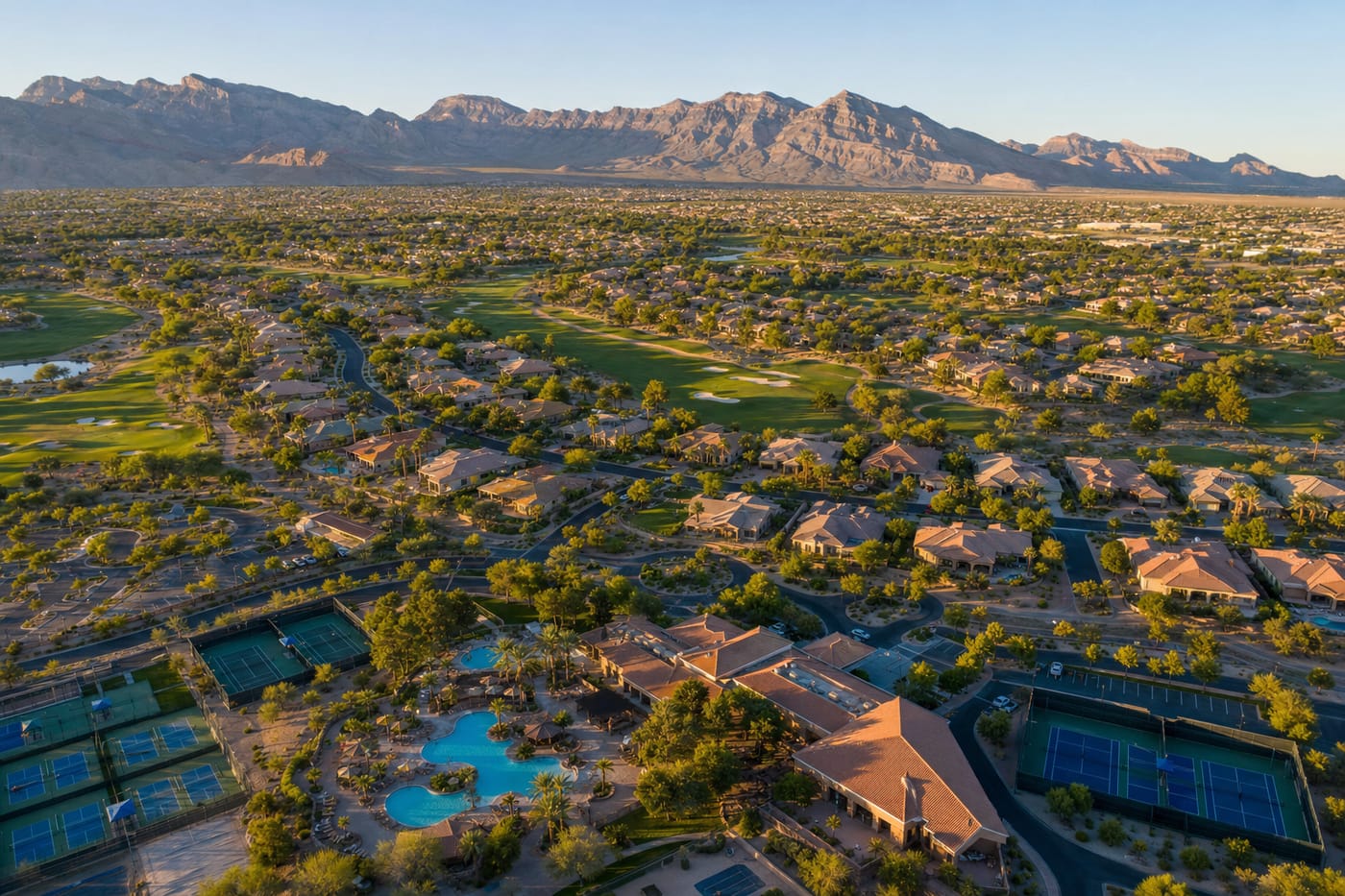
The guard-gated premium runs roughly $300-$500/month above non-gated equivalents because the staffing model requires 24/7 guard coverage, which alone costs $180,000-$300,000 annually for a 400-home community — directly funded by member dues. According to the Consumer Financial Protection Bureau, buyers should evaluate guard-gated premiums against the resale and appreciation premium the gating typically delivers, which in Summerlin and Henderson luxury communities has historically been 8%-15% over comparable non-gated product.
How High Should Guard-Gated Luxury HOA Fees Reasonably Climb?
Guard-gated luxury HOAs in Las Vegas reasonably top out around $650-$850/month for communities with 24/7 staffed gates, private streets, and full amenity packages. Drawing on NREG's 789 closings in 2025, three pricing tiers describe most luxury guard-gated communities:
- $500-$600/month: Mid-tier guard-gated like Anthem Country Club, Red Rock Country Club and the Lake Las Vegas gated parcels. Includes gate staffing, common-area landscaping and association amenities. It does not include the golf club at any of the three — Anthem Country Club, Red Rock Country Club and SouthShore are all separate entities from their homeowners associations, with optional memberships priced on inquiry.
- $600-$750/month: Premium guard-gated like The Ridges in Summerlin (some pods), Seven Hills (parts), Spanish Trail. Adds private street maintenance, enhanced security, premium amenity programming.
- $750-$850/month: Top-tier like Macdonald Highlands, The Cliffs at Eagle Hills, Summit Club access tiers. Adds concierge services, valet parking events, full-perimeter security walls.
Above $850/month, the fee structure typically reflects either an under-funded reserve catching up (red flag) or a true ultra-luxury concierge community with a genuinely large service package. One thing to watch when you are comparing those quotes: in the Las Vegas valley, a country club membership is essentially never bundled into an HOA assessment. At Anthem Country Club, Red Rock Country Club, MacDonald Highlands and Lake Las Vegas alike, the club is a separate legal entity, membership is optional, and initiation is a one-time cost that no association bills monthly. If a listing tells you the HOA fee covers the club, ask for that in writing.
What's a Red Flag in the HOA Reserve Study?
The single most important number in any Las Vegas HOA disclosure package is the percent funded figure in the reserve study. Under NRS 116.31152, Nevada HOAs must have a reserve study conducted at least once every five years. The NRS 116.4109 resale package includes only a summary of the reserves; the full study must be made reasonably available on request under NRS 116.4109(6). The percent funded figure compares actual reserve cash against the funding level the study recommends for the community's age and infrastructure replacement schedule.
The honest 2026 benchmarks I use across NREG transactions:
| Percent Funded | Reserve Health Status | Buyer Implication |
|---|---|---|
| 100%+ | Fully funded | No assessment risk, gold standard |
| 70-99% | Adequately funded | Acceptable, monitor major upcoming projects |
| 40-69% | Underfunded | Real special assessment risk within 5 years |
| Under 40% | Critically underfunded | High likelihood of special assessment, walk away or steeply discount |
According to the Consumer Financial Protection Bureau, HOA reserve underfunding is the single most common cause of homeowner financial surprise in years three to seven of ownership, because that is when major capital projects (roof replacement, repaving, pool resurfacing, fitness equipment) typically come due. Treat reserve funding below 50% as a red flag: a gap that large usually has to be closed through higher dues or a special assessment.
See our deeper HOA dispute rules walkthrough for the full reserve study read-out methodology.
How Should Buyers Read the HOA Financials in the Resale Package?
The NRS 116.4109 resale package includes the current operating budget and the current year-to-date financial statement with a reserve summary (NRS 116.4109(1)(c)), and the four diagnostic lines I check every time are: operating budget versus actuals, reserve fund contributions, delinquency rate, and legal/professional fee line items. For a multi-year trend, ask the seller to request prior years' budgets; material discrepancies signal management or governance issues.
Operating budget versus actuals: A well-run HOA finishes the year within 5% of budgeted operating expenses. Variances above 10% suggest either bad budgeting (forecast mistakes) or runaway costs (often legal, insurance, or repair surprises). Three consecutive years of 10%+ overruns is a red flag.
Reserve fund contributions: The monthly assessment should fund reserves at a rate that aligns with the reserve study recommendation. If the study recommends $35,000/year of reserve funding and the budget only allocates $18,000/year, the community is structurally underfunding reserves and a special assessment or fee increase is likely within five years.
Delinquency rate: According to NRS 116.31162, HOAs can lien properties for unpaid dues. A delinquency rate above 8%-10% suggests members are struggling, which can cascade into broader collection actions and disclosed legal expense.
Legal/professional fees: An HOA spending more than $15,000-$25,000/year on legal in a 200-400 home community typically has ongoing disputes — board governance, vendor disputes, or member litigation. Three consecutive years of elevated legal spend is a meaningful red flag worth investigating before close.
When Should a Special Assessment Make You Walk Away?
A pending or recent special assessment is not automatically a deal breaker, but the structure matters enormously. According to NRS 116.3115, HOAs can impose special assessments to fund capital projects or shortfalls, and the assessment becomes a lien on each property in the community.
| Assessment Type | Typical Range | Buyer Response |
|---|---|---|
| One-time pool resurfacing | $400-$1,200/home | Acceptable, often baked into seller credit at closing |
| Roof replacement (condo/TH) | $3,000-$15,000/home | Investigate scope, negotiate seller credit |
| Litigation defense | $1,000-$8,000/home | Investigate underlying claim, often walk-away worthy |
| Construction defect | $5,000-$50,000/home | Walk away unless fully disclosed and remediated |
Across the 789 NREG closings in 2025, special assessments came up in roughly 9% of resale transactions. The pattern that consistently produces buyer pain is condo/townhome roof or stucco assessments that exceed $8,000/home — these typically indicate a community that under-funded reserves for a decade and is now catching up. Single-family detached communities rarely run into assessments above $2,000/home unless infrastructure (perimeter walls, private streets) is involved.
For a comprehensive special assessment evaluation framework, see the NRS 116 fines and assessments walkthrough. If you are weighing a condo against a detached house in the first place, our condo vs house comparison for Las Vegas sets 12 months of MLS medians for price, HOA dues and days on market side by side.
How Do SID and LID Assessments Stack With HOA Fees in Inspirada and Cadence?
Inspirada and Cadence sit a few miles apart in Henderson and are often shopped together, but their carrying-cost stacks differ in one line. Inspirada is inside the City of Henderson's Local Improvement District T-18, which financed the master plan's infrastructure and makes its final payment on June 1, 2035, according to Assessment Management Group's district schedule. That assessment is not part of the property tax bill: according to the Clark County Treasurer, special assessments are billed separately from real property taxes, typically semi-annually, and each one stays a lien on the property until it is paid. Cadence has no such line. Its developer's FAQ says there are no SID or LID fees, though some Cadence neighborhoods, such as those with townhomes or condos, may have non-HOA assessment fees.
Here is how the published pieces compare as of October 7, 2026, using two Inspirada parcels I looked up in AMG's parcel database that day as the assessment example:
| Layer | Inspirada | Cadence |
|---|---|---|
| Master association | $255 per quarter in 2026, per the Inspirada Community Association | $225 per quarter in 2026, per the Cadence Community Association |
| Extra association charges | Additional quarterly assessments for gated neighborhoods, service areas or Toll Brothers clubhouse access | $141 per quarter insurance assessment for some attached homes; service-area assessments from $45 to $144 per quarter in four neighborhoods |
| SID/LID | LID T-18: next installments of $172.57 and $181.68 on the two parcels, due December 1, 2026; final payment June 1, 2035 | None, per the developer's FAQ |
| Property tax | Parcel-specific, billed by the Clark County Treasurer | Parcel-specific, billed by the Clark County Treasurer |
The practical gap between the two is the T-18 line, and on those two parcels it works out to about $29 to $30 a month for less than nine more years. The bigger variables are the sub-association or service-area charges and the tax bill on the specific home, so get the resale package and the parcel's AMG record before you compare. See our SID/LID fees deep dive for the district details.


How Do 55+ Community HOA Fees Justify Their Higher Numbers?
55+ community HOA fees in Las Vegas run $250-$600/month, materially higher than equivalent non-age-restricted communities, and the math actually justifies the premium in most cases. According to the National Association of Realtors and verified across NREG's 55+ closings, the higher fee funds lifestyle programming, full-time activity directors, multiple resort-style pools, fitness centers, pickleball/tennis facility maintenance, and clubhouse staffing that doesn't exist in standard family-oriented HOAs.
The three large Las Vegas 55+ communities — Sun City Summerlin, Sun City Anthem, and Trilogy at Sunstone — illustrate the range:
| Community | Monthly HOA | What's Included |
|---|---|---|
| Sun City Summerlin (some sections) | $90-$165 | Pools, fitness, golf access fee separate |
| Sun City Anthem | $185-$240 | Pools, fitness, pickleball, clubhouse, programming |
| Trilogy at Sunstone | $320-$420 | Premium pools, full lifestyle director, restaurant-grade clubhouse |
For retirees relocating from California, where Prop 13-protected long-term homes carry near-zero discretionary HOA spend, the $300-$500/month transition can feel jarring. The honest framing across our 55+ closings is that the fee replaces the cost of separate gym, club, golf, and activity memberships that retirees in non-restricted communities pay piecemeal. Across the 789 NREG closings in 2025, 18% were in 55+ communities and resident satisfaction with HOA fee value scored consistently above 8.0/10 on our follow-up surveys.
What Should the Resale Package Contain Before You Close?
Under NRS 116.4109(3), the association must furnish the documents within 10 calendar days of the seller's written request, and under NRS 116.4109(2) the buyer then has until midnight of the fifth calendar day after receipt to cancel without penalty. According to NRS 116.4109(1), the package must include:
- The declaration (CC&Rs), bylaws, and rules and regulations
- The "Before You Purchase" information statement (NRS 116.41095)
- The current operating budget and current year-to-date financial statement, including a reserve summary
- A statement of the monthly assessment and any unpaid obligation on the subject property
- A statement of unsatisfied judgments and pending legal actions
- A statement of transfer and other resale fees, and of all current and expected fees
- Proof of the association's required insurance
The full reserve study is available on request under NRS 116.4109(6).
Across the 9,600+ NREG closings, the most consistently missing or late documents are the reserve study summary and the pending litigation disclosure (often understated). NRS 116.31152(1) requires the executive board to have a reserve study conducted at least once every 5 years and to review it at least annually, so check the date on the summary. The 5-day rescission window is the buyer's protection, and it is the tool to use when the package reveals previously undisclosed issues. Call (702) 637-1759 if you want to walk through a specific community's resale package before writing your offer.
How Should You Negotiate When an HOA Issue Surfaces in Diligence?
When an HOA issue surfaces during the 5-day NRS 116.4109 rescission window, three negotiation paths exist: price reduction, seller credit at closing, or walk away. According to the Consumer Financial Protection Bureau, the optimal path depends on the severity and certainty of the underlying issue.
For a confirmed pending special assessment of known dollar amount (say, $2,800/home for parking lot resurfacing), the cleanest play is a seller credit at closing equal to the assessment plus a 10%-15% buffer. Across the 789 NREG closings in 2025, seller credits for assessment exposure averaged $3,200-$5,800 and were almost always paid willingly by sellers who preferred closing on time over re-listing.
For ambiguous issues — low reserve funding without a specific announced assessment, ongoing litigation without disclosed exposure — the better play is a price reduction of 1.5%-3.0% of purchase price to reflect risk uncertainty. On a $600K home, that translates to $9,000-$18,000 of price relief, which compensates for unknown future cost.
For severe issues — sub-30% reserve funding plus active construction defect litigation plus multiple recent special assessments — walking away is the right call. The deposit returns under the rescission window, and the time saved versus litigating problems for years post-close is worth the lost earnest money even when forfeiture is at risk.
What Are the Three HOA Mistakes Las Vegas Buyers Make Most Often?
After 9,600+ NREG closings, three HOA mistakes show up consistently enough to be predictable. First, buyers fixate on the monthly fee number and ignore the reserve study — a $145/month HOA with 35% reserve funding is far more expensive over 10 years than a $235/month HOA with 95% reserve funding. Second, buyers don't read the architectural guidelines before close, then discover they can't install their planned pool, RV gate, or solar array because of HOA approval restrictions in the HOA landscape rules. Third, buyers in master plans miss the master-plus-sub fee stacking and budget only one tier, understating monthly carrying cost by $80-$160.
According to the National Association of Realtors, HOA-driven buyer surprises are the third-most-cited cause of post-close regret after property tax surprises and maintenance cost underestimation. The fix is straightforward: read the reserve study first, read the architectural guidelines second, and confirm master-plus-sub fee structure before submitting an offer. NREG buyer onboarding catches all three of these in our pre-offer checklist — call (702) 637-1759 to walk through the checklist for your specific community.
What Else Belongs Beside HOA Dues in Your Las Vegas Carrying-Cost Budget?
According to RealTrends, which ranks teams on verified 2025 production, Nevada Real Estate Group recorded 789 closings and approximately $361.5M in volume in 2025. That work spans the HOA structures this guide covers: the Summerlin master plan and its Cliffs / Kestrel / Stonebridge villages; Henderson ZIPs 89002 through 89077 (Anthem, Green Valley, Inspirada, Cadence, MacDonald Highlands, Seven Hills, Lake Las Vegas); and Las Vegas Southwest, North Valley (Skye Canyon, Valley Vista, Tule Springs), Mountain's Edge, Centennial Hills, and the resort-corridor luxury condo inventory, in both first-time buyer and luxury price bands.
HOA dues and property tax land in the same monthly budget, and the tax side has a cap worth claiming. According to NRS 361.4723, a single-family home that is the owner's primary residence qualifies for a partial abatement that limits the yearly increase in its tax bill to 3%, but the owner has to claim it, on the county assessor's form or on the declaration of value filed at purchase. Other property, including second homes, falls under the general abatement in NRS 361.4722, which caps the yearly increase at up to 8%, and that higher cap also applies to a newly bought primary residence until the new owner files the claim. A sale does not reset the tax base. If the community carries a SID or LID assessment, that is a separate charge from both the HOA dues and the property tax, so read the seller's latest assessment bill and the parcel's record in Assessment Management Group's database as well as the resale package.
For readers using this article as a decision input, the practical next step is to review the relevant community money page for current inventory and pricing context. If you want to map this against your own timeline, budget and tradeoffs, call NREG at (702) 637-1759; we can do that before you sign a builder reservation or set a list price. According to Freddie Mac, the 30-year fixed-rate mortgage averaged 7.28% for the week of October 1, 2026, up from 7.03% a week earlier, so model carrying costs, HOA dues included, at the current week's rate for both new-build homes in Las Vegas and resale acquisitions.
Frequently Asked Questions
Are HOA fees tax-deductible in Las Vegas?
HOA fees on your primary residence are generally not tax-deductible on your federal return. According to the Internal Revenue Service Publication 530, HOA dues on a primary residence are personal expenses and do not qualify for itemized deduction. HOA fees on a rental property, however, are fully deductible as a business expense on Schedule E. For homeowners who use part of their home as a qualified home office, a proportional share of HOA fees may be deductible under the home office rules in IRS Publication 587. Across the 789 NREG closings in 2025, the most common situation where HOA fees became tax-relevant was investor purchases where the dues offset rental income directly.
Can an HOA force me to install a specific landscaping plan?
Yes, within the limits of NRS 116. HOAs in Nevada can enforce landscaping requirements that are documented in the CC&Rs and rules. However, NRS 116.330 bars an association from prohibiting drought tolerant landscaping, including decorative rock and artificial turf, in a yard the owner uses exclusively; the owner must first submit plans for architectural review, the design must be compatible with the community's style to the maximum extent practicable, and the board may not unreasonably deny approval. For new construction in Henderson and Las Vegas in 2026, most master plans require xeriscape in front yards consistent with the Southern Nevada Water Authority drought ordinances. See our deeper HOA landscape rules walkthrough for specific community standards.
How long does a Nevada HOA resale package take to receive?
Under NRS 116.4109(3), the association must furnish the documents within 10 calendar days of the seller's written request. According to NRS 116.4109(2), the buyer then has until midnight of the fifth calendar day after receipt to cancel without penalty. In practice across the 789 NREG closings in 2025, resale packages averaged 6-8 days from request to delivery for well-run HOAs, while some smaller or self-managed associations have taken 9-12 days, occasionally triggering escrow extensions. The Nevada Real Estate Division's Form 910 caps the resale certificate at $213.84 per association effective January 2026 (plus $100 to expedite), and the seller pays for the package by statute (NRS 116.4109(1)).
What recourse do I have if my HOA imposes an illegal fine?
Nevada provides multiple recourse mechanisms for unfair HOA fines. Under NRS 116.31031, a board must give notice and a hearing opportunity before fining, so homeowners can contest a fine at a hearing before the HOA board, file a complaint with the Nevada Real Estate Division Ombudsman, pursue ADR (alternative dispute resolution) under NRS 38, or file in district court. Across the 9,600+ closings NREG has represented, the most effective first step is the formal hearing request, which forces the HOA to document its rule basis and often resolves disputes without escalation. See our HOA dispute rules walkthrough and the NRS 116 fines playbook for the full procedural detail.
Do HOA fees factor into mortgage qualification?
Yes, HOA fees are included in your monthly housing expense for debt-to-income (DTI) calculation under conventional, FHA, VA, and USDA underwriting. At the 7.28% 30-year average that Freddie Mac PMMS reported for the week of October 1, 2026, a $300/month HOA reduces your qualifying loan amount by about $44,000, all else equal. For buyers maximizing their qualification, switching from a $300/month HOA community to a $100/month HOA community frees up about $29,000 of loan capacity at that rate. Run that math before you choose between a lower-HOA neighborhood such as Spring Valley or Centennial Hills and an amenity-heavy master plan.
Do HOA fees count toward my total cost of ownership the same as property tax?
Functionally yes — both are non-negotiable monthly carrying costs that survive after the mortgage is paid off. In our experience, out-of-state buyers underweight the HOA line and overweight the rate. A $300/month HOA over a 15-year hold is $54,000, comparable in magnitude to many buyers' first-year Las Vegas property tax bills compounded across the same window. We coach relocating clients through the full carrying-cost stack in our moving to Las Vegas guide, because the HOA, any SID/LID assessment and the tax bill together can change the monthly picture noticeably from one address to the next. Treat the HOA number, the reserve study, and the property tax base as one combined affordability question rather than three separate line items.
Which Sources Inform This Analysis?
This analysis draws on NRS Chapter 116, which the Nevada Real Estate Division administers under NRS 116.615(1), for common-interest community rules including resale package requirements (NRS 116.4109), reserve study mandates (NRS 116.31152), assessment rules (NRS 116.3115), and architectural review constraints, plus Assessment Management Group's district schedule and parcel records (October 7, 2026), the Clark County Treasurer's SID page, Cadence's FAQ and the Inspirada and Cadence associations' 2026 assessment pages for the Inspirada and Cadence examples.
Market data and pricing benchmarks come from the April 2026 Las Vegas REALTORS report as covered by VEGAS INC on May 6, 2026 ($473,875 median single-family, $290,000 median condo/townhome) and the National Association of Realtors for national HOA fee distribution context.
Federal regulatory and consumer protection inputs come from the Consumer Financial Protection Bureau for HOA disclosure guidance and buyer financial decision frameworks, the Federal Housing Finance Agency for the 2026 Clark County conforming loan limit of $832,750 referenced in qualifying ratio math, and Freddie Mac PMMS week of October 1, 2026 (30-year fixed at 7.28%) for the DTI calculation walkthrough.
Tax treatment and federal guidance come from the Internal Revenue Service Publication 530 (HOA fee deductibility on primary residence) and Schedule E rental property guidance. The Mortgage Bankers Association and HUD FHA underwriting guidelines inform the qualifying ratio examples. Company figures for Nevada Real Estate Group are 9,600+ career closings, 789 closings and $361.5M+ in volume in 2025 (per RealTrends), and 9,061+ five-star reviews across Google, Zillow and FastExpert. For a personalized HOA review on a specific community, call (702) 637-1759 before writing an offer.