

The Foundry is a newly announced housing project with a compelling question for buyers: could a new downtown home fit your budget and moving plans better than today's resale options? The answer starts with separating an announcement from a home that can be reserved, financed and occupied.
This is an early-project quick-take, reviewed October 21, 2026. It is deliberately shorter than our complete community guides because floor plans, actual lot pricing, association budgets and occupancy dates were not supplied in the announcement reviewed. We have not toured completed homes or independently audited construction progress. The practical contribution is a milestone checklist and transparent budget comparison—not a prediction about future value.
The Foundry is Lennar's planned downtown Las Vegas community near Las Vegas Boulevard and East Washington Avenue. Its October 15, 2026 announcement describes more than 1,000 homes and expects vertical construction in October 2027. That is not an occupancy date. Buyers should confirm actual homes, final prices, HOA charges and delivery terms before changing a lease or committing purchase funds.
- A groundbreaking, vertical construction and move-in are different milestones.
- Announced starting prices are not quotes for an available home.
- No project-specific HOA budget or occupancy date was established in the release reviewed.
- Compare total payments, closing cash and waiting costs with available alternatives.
- Keep written evidence for every reservation, incentive and delivery promise.
What Has Lennar Actually Announced About The Foundry?
According to Lennar's October 15 announcement, the project would bring townhomes and detached single-family homes to approximately 70 acres at the former Grant Sawyer Building and Cashman Center sites. The builder describes planned starting prices in the $300,000s and an amenity program including pools, outdoor recreation and gathering spaces. Those are developer statements about a planned community, not evidence that a particular finished property is available at that price.
| Item | Evidence available | Still needed for a purchase |
|---|---|---|
| Community concept | Builder announcement | Released phase and lot plan |
| Starting price | Broad advertised price range | Written price for a specific home |
| Construction schedule | Expected vertical-start target | Contract delivery terms and progress |
| Amenities | Planned features | Phasing, access rules and operating budget |
Keep the evidence categories separate as more information arrives. A floor-plan release can answer layout questions without establishing delivery. A reservation invitation can establish a sales process without guaranteeing mortgage approval. A photograph of site work can show activity without proving the home you want is in the first phase. This is especially important if an announcement is summarized on social media with words such as “open” or “ready.”
Save the dated builder material that applies to your exact home. When a salesperson supplies a number, ask whether it is a base price, an all-in contract price or a payment illustration with lender assumptions. Our new-construction overview explains the broader shopping process; this page keeps the distinction between the Foundry announcement and transaction-ready details explicit.
When Could Buyers Actually Move Into The Foundry?
The published vertical-construction target is a point in the building process, not a promise that homes will be ready that month. The announcement does not provide the sequence needed to calculate a reliable move-in date for a specific buyer: sales release, contract signing, individual building start, inspections, completion and closing. Adding a generic construction duration to the target would produce a guess, so this guide does not do that.
A useful personal timeline works backward from your nonnegotiable date. Write down when your lease expires, when a current home must sell, when a lender approval needs refreshing and how long you could tolerate temporary housing. Then mark which dates the builder has actually committed to in writing. If the community cannot yet provide a delivery window compatible with your situation, continue shopping available homes while following the project.
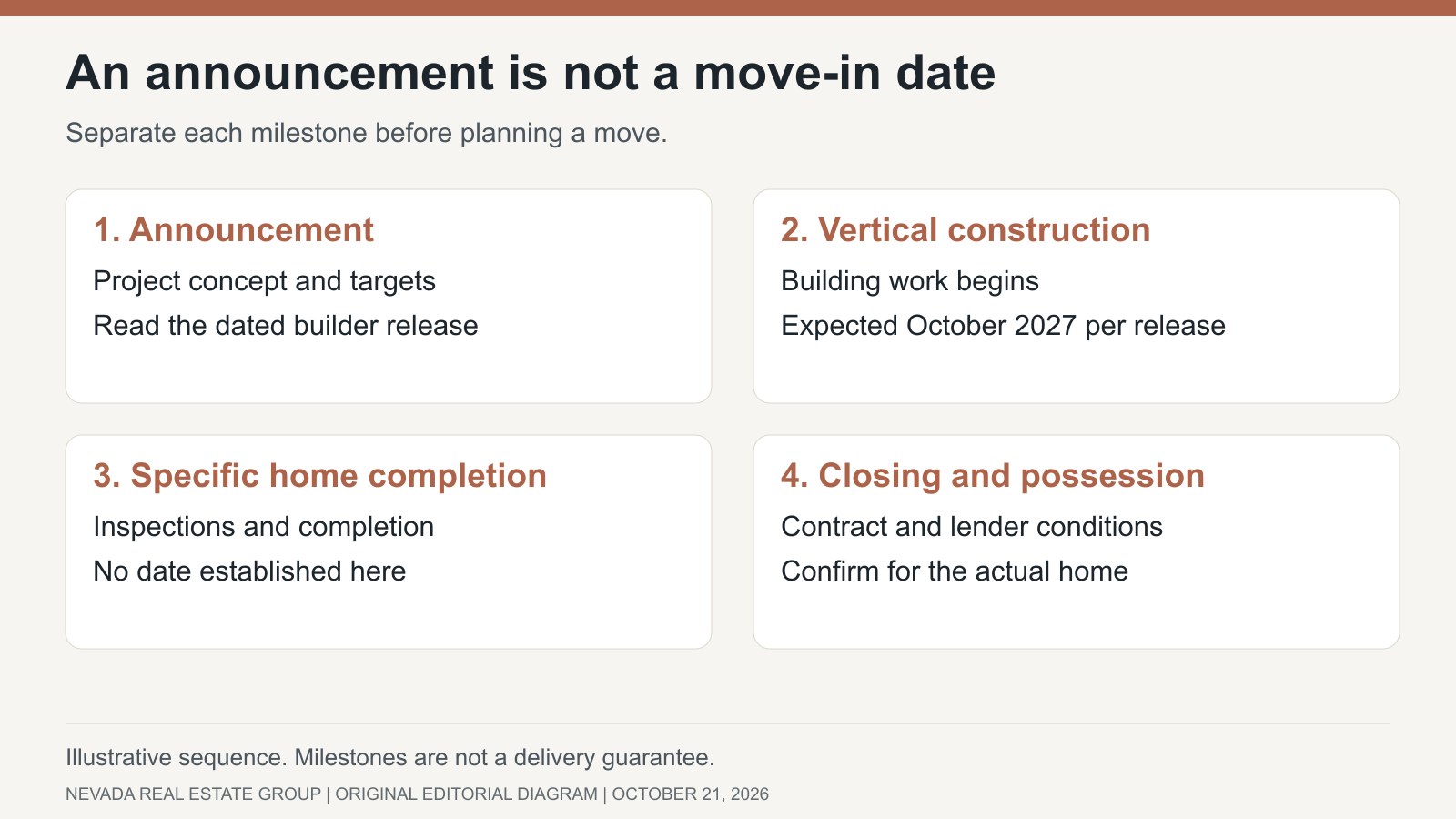
Ask how delivery estimates change, how notice is given and what the agreement says about delays. Do not assume a lease extension, storage bill or second move will be reimbursed. Keep a contingency budget for the version of the timeline that is less convenient than the sales presentation. This is a practical planning exercise, not a claim that delays will occur here. Buyers with a fixed deadline can compare Las Vegas homes for sale and documented quick-move-in offerings on the same calendar before choosing to wait.
Where Is the Project, and How Should You Check the Location?
The location identified by the builder is in downtown Las Vegas, near Las Vegas Boulevard and East Washington Avenue. Use that description to orient yourself, then use a specific released lot or parcel to evaluate a purchase. A community name is not a parcel identifier, and similarly named developments should not be treated as the same project. This guide concerns Lennar's Foundry announcement, not a different project with “Foundry” in its name.
According to the Clark County Assessor's real-property search page, records can be searched by address, parcel number or subdivision. Once the relevant identifiers are available, use them to reconcile the sales materials with public records. A current parcel record can help identify land, but it does not independently certify future amenities, a final tax bill or the completion date of a proposed house.
Evaluate the actual route from the proposed home to places you use. A downtown address may be convenient for one work destination and inconvenient for another. Walk or drive the public streets you can legally access, observe crossings and parking, and repeat the trip at your normal travel time. Do not enter a construction site to conduct this check. If your needs include transit, confirm the stop, walking path and schedule for your specific trip instead of accepting a broad “transit-friendly” label.
The downtown Las Vegas neighborhood guide supplies wider context. Keep that area-level information separate from what a future Foundry resident would actually receive. Access, orientation and daily routes are address-level questions even within a compact project.
What Does a Starting Price Tell You About the Real Budget?
An advertised starting price answers a narrow question: the builder's stated entry point at the time of the announcement. It does not identify the number of homes offered there, their layout, lot premiums, required options, financing conditions or final fees. Until a specific home and price sheet exist, an exact Foundry monthly payment would be speculative. We therefore use a clearly hypothetical $350,000 purchase below to demonstrate the calculation, not to advertise availability.
At 20% down, that example has a $70,000 down payment and a $280,000 loan. At a 7.40% fixed rate over 30 years, principal and interest would be about $1,939 per month. Taxes, insurance, assessments, maintenance and any applicable mortgage insurance are additional. According to Freddie Mac's PMMS, 7.40% was the national 30-year average on October 15, 2026. It is a dated calculation input, not a Foundry mortgage offer or a prediction of rates when the project delivers.
According to the CFPB Loan Estimate explainer, buyers should distinguish principal and interest, total estimated payment and cash to close. Apply that distinction before deciding a starting price is affordable. A low headline payment can depend on substantial cash, a temporary subsidy or charges paid separately.
Create separate columns for known amounts, written estimates and unknowns. Leave unknown fees blank with an action to obtain them; entering zero would falsely make the budget look complete. Our mortgage calculator lets you test other loan sizes, while the rate-strategy guide explains temporary subsidies and permanent points.
How Should You Compare a Townhome With a Detached Home?
Start with the way you need the property to function. Shared walls, outdoor space, stairs, parking, storage and responsibility for exterior maintenance can matter more than the model's marketing label. The announcement alone does not establish how these details will work in each Foundry product. A townhome floor plan and a detached floor plan should be compared using their actual documents, dimensions and ownership arrangements once released.
For a buyer who wants less exterior work, the relevant evidence is the maintenance allocation: what the association covers, what the owner maintains and what the budget funds. For a buyer who needs equipment storage, the evidence is usable garage dimensions and permitted storage rules. For someone prioritizing outdoor space, it is the actual lot or exclusive-use area and its restrictions. None of these preferences needs to be inferred from age, family status or any other personal characteristic.
| Your requirement | Evidence to obtain | Tradeoff to test |
|---|---|---|
| Less exterior maintenance | Maintenance chart and association budget | Recurring fees and owner exclusions |
| Usable parking | Garage dimensions and parking rules | Vehicle fit, guest parking and storage |
| Private outdoor space | Lot plan and use restrictions | Upkeep, setbacks and usable area |
| Convenient daily route | Actual trip at your travel time | Distance is not travel-time reliability |
Visit a comparable completed product only as an illustration of scale; do not assume its finishes, acoustics or documents apply here. A model may contain upgrades that are excluded from a base price. Ask for a marked standard-features list and price every difference you consider essential. Our new construction versus resale comparison can help organize the alternatives without declaring either property type universally better.
Which Fees and Ownership Documents Should You Request?
Request a complete ownership-cost package before treating any price as an all-in budget. That means association assessments, any additional association layer, special assessments, transfer or setup charges, estimated property taxes, insurance requirements and owner maintenance obligations. The announcement reviewed does not establish these costs for The Foundry. An amenity list cannot substitute for an operating budget, and an estimated budget cannot substitute for the final documents governing the purchase.
According to the CFPB Loan Estimate explainer, some taxes, insurance and assessments can be paid outside the lender's escrow account. Ask your loan officer to identify which charges are in the quoted monthly payment and which are separate. Otherwise you can accidentally compare one home's full payment with another home's principal and interest alone.
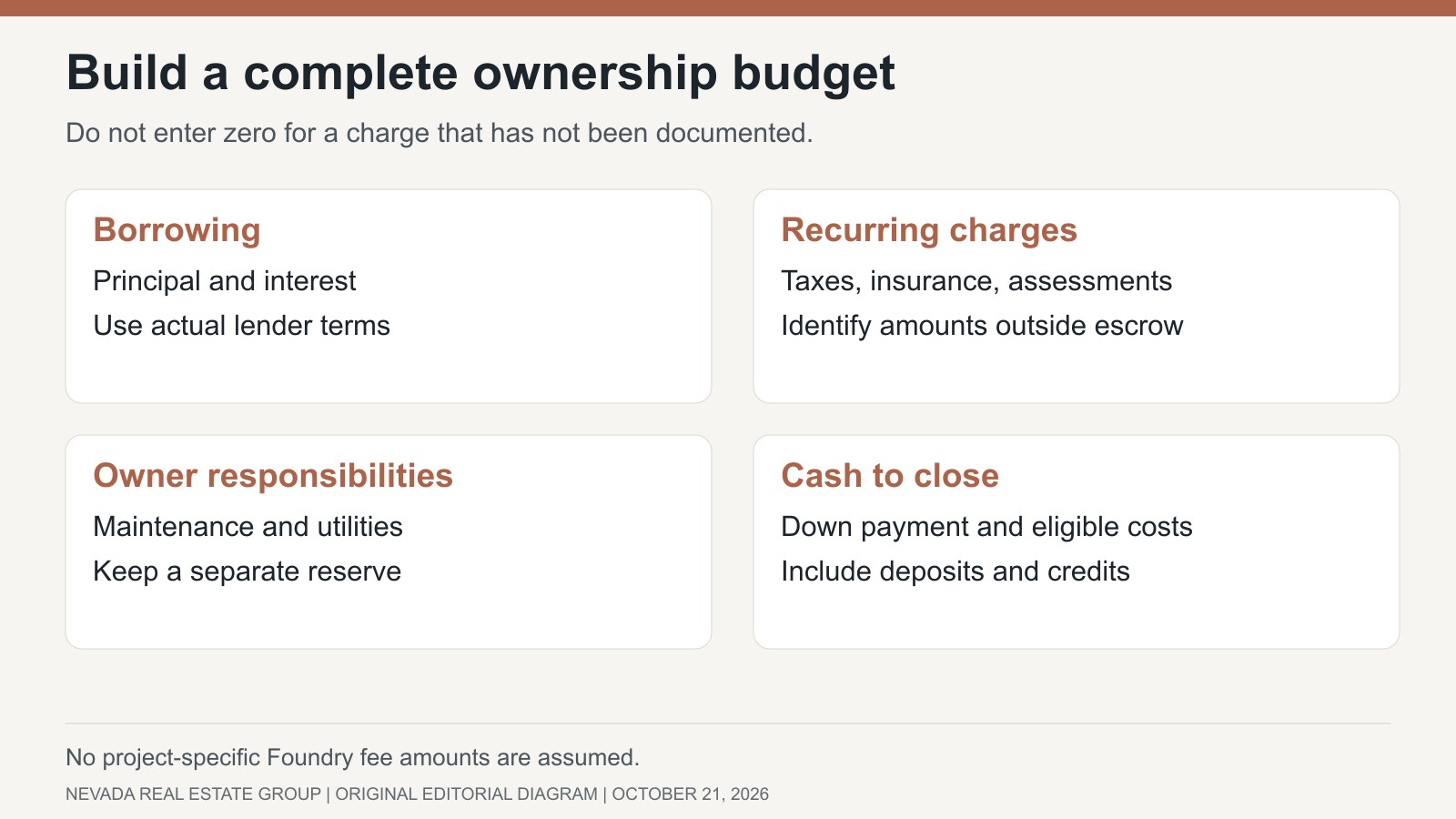
Read the rules that affect your intended use: rentals, parking, exterior changes, pets and use of common areas. Obtain the governing documents rather than relying on a verbal summary. If an amenity is phased, ask who may use it, when access begins and whether assessments change as phases open. Our Las Vegas HOA guide and SID/LID buyer guide explain the categories to investigate. They do not establish that a particular charge exists at this project.
How Should You Evaluate a Builder Mortgage Incentive?
A future incentive should be evaluated when its written terms exist. Do not price today's purchase decision around an assumed Foundry rate, closing credit or lender subsidy that has not been offered for your home. Ask whether an incentive requires a particular lender, title provider, contract date or closing deadline, and whether the price changes if you choose an independent financing source. Keep the house price and the loan price visible separately.
According to Fannie Mae's temporary-buydown requirements, qualifying borrowers must be evaluated at the note rate without relying on the temporary reduced payment. A subsidy changes who funds part of early payments; it does not permanently change that note rate. This distinction matters if a model-home sign emphasizes the first year's payment much more prominently than the eventual full payment.
According to the CFPB rate-lock explanation, protection depends on the specified period and conditions. A lock quoted far ahead of delivery needs explicit terms for expiration, extensions, fees and application changes. A construction target is not itself a rate lock. Ask who bears an extension charge if the actual closing date shifts.
Compare written Loan Estimates for the same purchase, down payment and loan term on the same day. Examine upfront costs, the full payment and the balance remaining at your expected sale or refinance date. Our builder 2-1 buydown guide contains worked examples, while mortgage pre-approval resources explain what to prepare before a specific home is selected. Future refinancing should remain an optional possibility, not the condition that makes a purchase affordable.
What Should You Know Before Paying a Reservation or Deposit?
First establish what the payment actually purchases. A place on an interest list, a reservation of a lot, a purchase contract and an option-selection deposit are different commitments. The Foundry announcement does not supply the terms for any of them. Ask for the agreement, payee, due date, refund conditions and how the money will be credited at closing. Keep a copy before transferring funds.
A practical document review starts with exit conditions. What happens if financing is unavailable, the appraisal is low, the selected home changes, construction takes longer or the buyer's circumstances change? Which promises are in the signed agreement, and which appear only in a brochure or conversation? Get answers in the contract rather than assuming a familiar resale form applies to a builder sale. Our Nevada contingency guide explains why the document and its notice requirements matter.
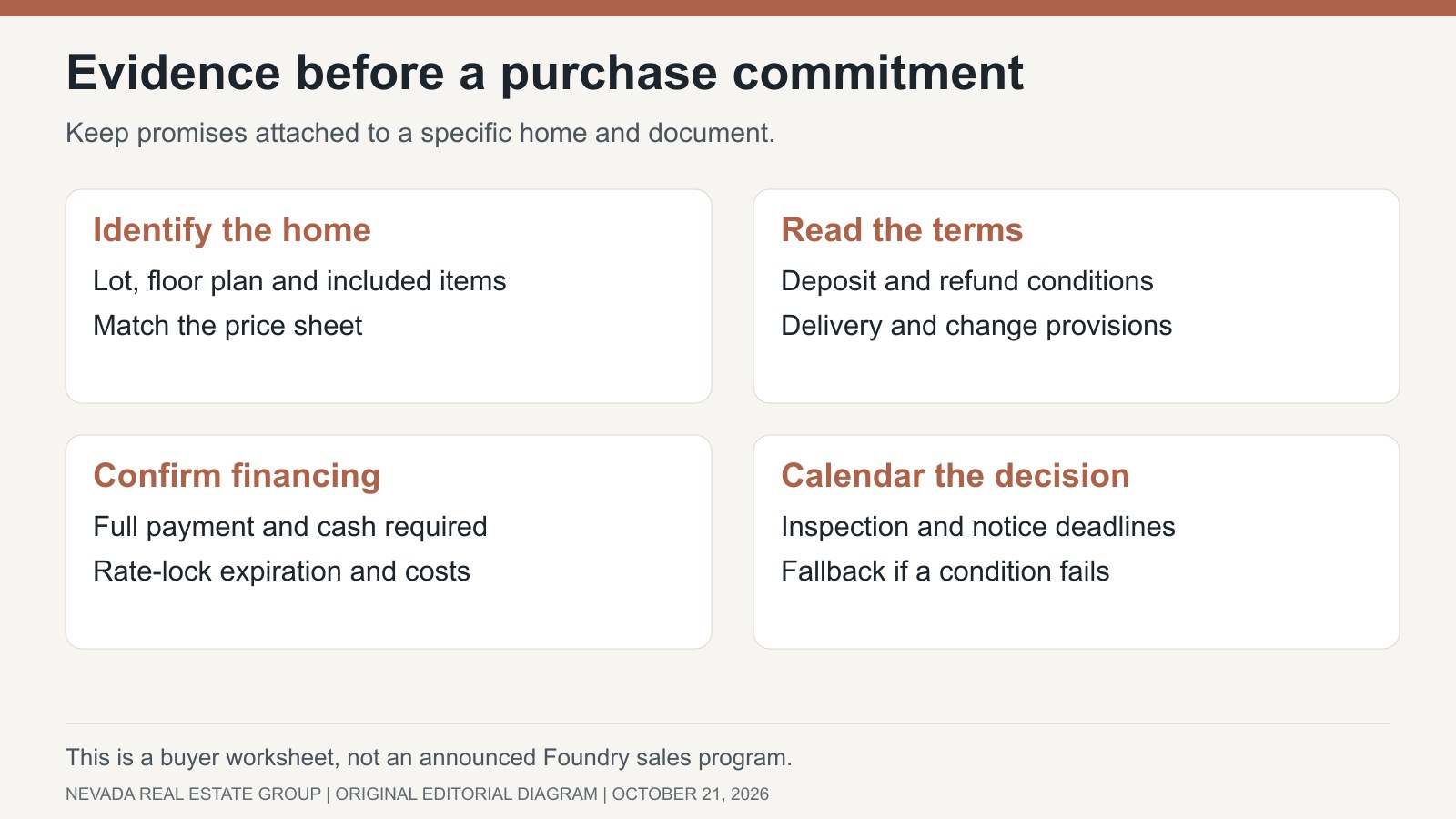
Also establish representation before starting a sales process. Ask about registration and accompaniment rules before a visit, and review any buyer-representation agreement separately from the builder paperwork. Do not assume the builder pays your representative or that a verbal offer of compensation is binding. A licensed professional can help compare the documents; legal questions about unusual terms belong with an attorney. The useful outcome is a clear decision about the actual agreement, not pressure to act because an announced community sounds scarce.
Should You Wait for The Foundry or Buy an Available Home?
Wait only if the potential property fits your requirements and the uncertainty fits your calendar and finances. An available resale offers a different kind of evidence: an address, current condition, written asking price and a negotiable closing date. A future build may offer a layout or product you prefer, but until it is released you cannot make a complete like-for-like comparison. Keep both options visible rather than treating waiting as free.
For a transparent illustration, suppose temporary housing costs $2,000 monthly and moving or storage adds $3,000. Six additional months would mean $15,000 of cash outlay before utilities. That is not automatically a $15,000 financial loss: ownership would also carry interest, taxes, insurance, maintenance and transaction costs. Compare the incremental costs of both choices, including where you would live otherwise. These are scenario inputs, not a Las Vegas rent survey or a forecast about the project.
| Question | Available property | Future Foundry home |
|---|---|---|
| Can the move date work? | Negotiate using current status | Need a specific delivery agreement |
| Is the full cost known? | Obtain current quotes and records | Await home, fee and financing details |
| Can you inspect the product? | Inspect the actual property | Confirm staged inspection rights |
| What changes the choice? | Condition, price and negotiated terms | Release terms and schedule evidence |
Our Las Vegas market resources provide dated context, not a promise about prices when a future phase opens. Compare actual homes you would accept, not a premium resale against an unspecified entry-level advertisement. If neither option meets your full-payment budget and cash-reserve requirement, waiting can be a budgeting decision without any prediction that rates or prices will fall.
What Should Your Next-Step Checklist Include?
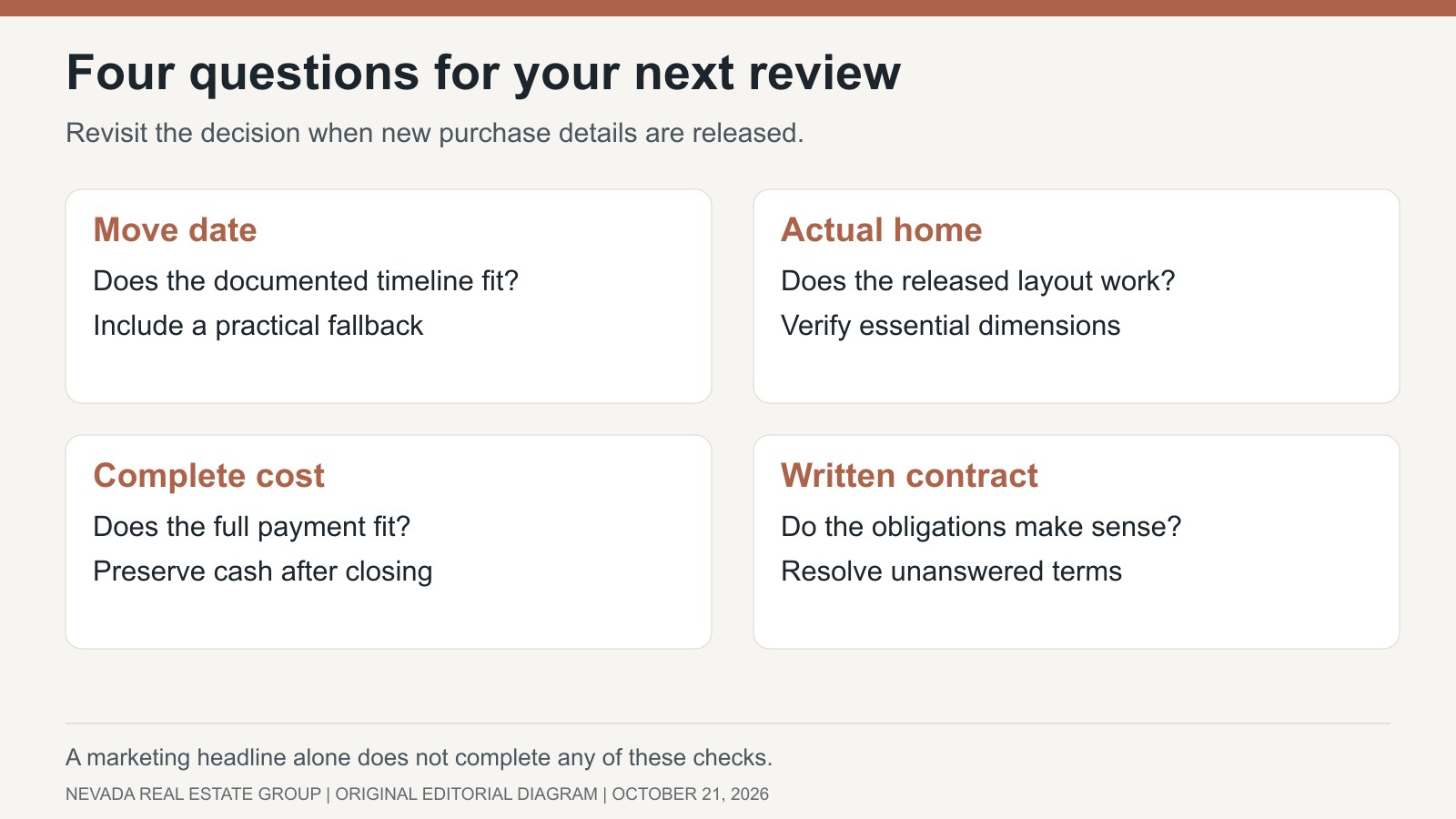
Use a short evidence file that can be updated as the project moves forward. Start with your required move date, maximum full monthly cost, cash available after closing and nonnegotiable property features. Then attach only documents that answer those requirements. A longer collection of marketing material is not necessarily a better decision file; a dated price sheet, clear floor plan and complete cost estimate usually answer more important questions.
The next review should be triggered by a meaningful event: a sales release, published home plans, association documents, a specific financing offer or a contractual delivery window. Repeating the groundbreaking announcement does not establish progress on any of those items. Check that a later source refers to the same phase and product you are considering before carrying its numbers into your worksheet.
For school assignment, use an actual address and the applicable school year. According to CCSD's zoning page, its zoning search is the district's address-level resource. A nearby school is not proof of assignment, and a future home should be checked again when its address is established. For daily travel, retain your own route observations rather than a generic neighborhood commute estimate.
If you want help organizing the comparison, contact Nevada Real Estate Group with your budget, move date and property requirements. We can compare documented Foundry information with current alternatives and identify the missing items. We will not present an unannounced release, fee or delivery date as confirmed.
Frequently Asked Questions
Is The Foundry in Las Vegas ready for move-in?
The October 15, 2026 release reviewed does not announce ready-to-occupy homes. It gives a future vertical-construction target. A buyer needs a specific home's delivery and closing information before arranging a move.
Does October 2027 mean the homes will be finished?
No. The announcement describes expected vertical construction in October 2027, not completion or occupancy. This guide does not infer an opening date by adding a generic building duration.
Can I buy a Foundry home for $350,000?
The $350,000 example here is a calculation input, not an available home or quote. Obtain a released home's price, lot premium, included features and fees directly in writing before making a budget decision.
What are The Foundry's HOA fees?
The announcement reviewed does not establish a project-specific HOA budget or assessment amount. Request the governing documents, fee schedule and maintenance allocation once available; do not enter zero for an unknown charge.
Will a builder incentive guarantee a lower permanent rate?
Only the written loan terms can answer that. A temporary buydown subsidizes payments while the note rate remains unchanged. Compare full payments, points, fees, contribution limits and lock expiration with another lender's offer.
Should I stop looking at resale homes while I wait?
Continue comparing options that meet your actual requirements until the future home has enough documented detail to evaluate. A fixed move deadline, financing cost or unavailable layout can change the choice independently of the broader market.
Which Sources and Methods Support This Guide?
Project facts come from Lennar's October 15, 2026 release. We reviewed the announcement on October 21; no private reservation list, permit audit, completed-home tour or HOA budget was used. Payment calculations use a standard 360-payment amortization formula and the dated Freddie Mac benchmark. They exclude taxes, insurance and fees.
The CFPB Loan Estimate guide, rate-lock explanation and Fannie Mae buydown requirements support financing distinctions. Clark County property records and CCSD zoning are verification tools, not evidence of a particular future parcel's fees or school assignment. Diagrams and cost scenarios are original editorial work. The cover is conceptual AI artwork, not a project rendering.