

On January 1, 2027, the power bill for most Las Vegas Valley homes changes shape. NV Energy will add a daily demand charge for residential customers in Southern Nevada, priced on each day's busiest 15 minutes, and lower the price of every kilowatt-hour to pay for it. The utility designed the change to collect the same total revenue, so its average bill barely moves. Individual bills do move: two homes that use the same electricity in a month can land on opposite sides, depending on how much of it runs at the same time.
This guide works from the published rates. It covers how the charge is measured, what else on the bill changes, the break-even point for any home, what an electric-vehicle charger and rooftop solar do to the numbers, and what buyers, sellers and landlords should ask. Every rate carries its source and the date we read it. The bill calculations are our own, built from NV Energy's October 1, 2026 residential rates, and the method is listed at the end.
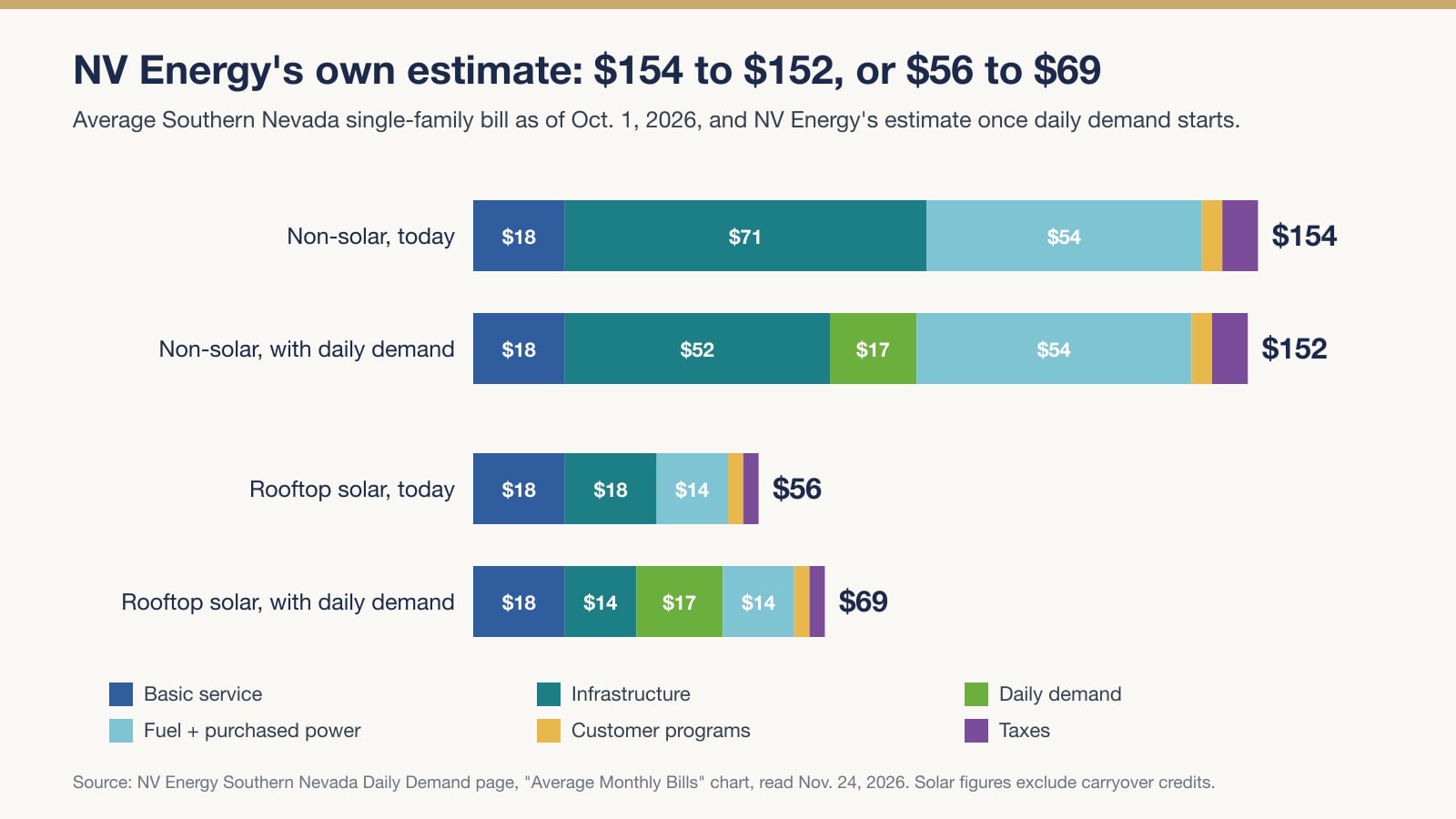
From January 1, 2027, NV Energy charges Southern Nevada single-family homes $0.14 per kilowatt of each day's highest 15-minute use and cuts the energy rate about 1.675 cents per kWh. NV Energy expects its average non-solar bill to fall from $154 to $152 and its average solar bill to rise from $56 to $69. By our calculation, a home saves when its monthly kWh exceeds about 251 times its average daily peak in kilowatts.
- Single-family homes pay $0.14 per kW of daily peak; multifamily units pay $0.10, per NV Energy.
- At NV Energy's 3.5 kW average peak, a 30-day bill breaks even at about 878 kWh.
- A 7.2 kW car charger running in the house's busiest 15 minutes adds $30.24 a month.
- Rooftop solar homes lose most: NV Energy's own average rises $13, from $56 to $69.
- Spacing out big appliances, not using less in total, is what lowers the new charge.
Published November 24, 2026. NV Energy's rate pages, fact sheet and daily demand FAQ were read that day. The bill math holds fuel prices at their October 1, 2026 level so it isolates the restructuring; actual January bills will also reflect NV Energy's next quarterly fuel adjustment.
What Is NV Energy's Daily Demand Charge, and When Does It Start?
Daily demand is a new line on the bill that recovers the fixed cost of the poles, wires and transformers that deliver power to a home. NV Energy's daily demand FAQ describes those costs as recovered today through the basic service charge and the energy price you pay per kilowatt-hour. From January 1, 2027, part of that cost moves into its own charge, measured by how much power a home pulls at once rather than how much it uses over the month.
According to NV Energy's June 2026 Daily Demand fact sheet, the restructured bills start in Southern Nevada on January 1, 2027, for residential and small commercial customers. Small businesses get a monthly version based on their highest 15 minutes of the month, according to NV Energy's Southern Nevada daily demand page. This guide covers homes.
The charge has been coming for almost two years. Nevada Power, which does business as NV Energy in the south, proposed it in its February 18, 2025 rate application, Docket No. 25-02016, according to the Public Utilities Commission of Nevada's notice of consumer sessions. The commission approved it in a final order issued September 16, 2025, according to an October 2025 issue brief by EQ Research. The start date then moved twice. It was set for April 1, 2026; NV Energy moved it to October 1, as FOX5 reported on March 11, 2026, and on March 31, 2026 the commission approved January 2027, according to FOX5's report that day.
NV Energy's position is that this is not a rate increase. Its daily demand page says plainly that it is "not a new cost," and its FAQ says the structure is designed to be revenue neutral, with no added revenue for the utility. That is true of the total. It is not a promise about any single home, which is the subject of the rest of this guide.
A version of this pricing already exists as an option. The Statement of Rates lists an Optional Residential Service – Daily Demand Pricing schedule, ORS-DDP, and EQ Research's brief notes that the 2025 order makes daily demand mandatory for all residential customers. The same brief reports finding no other investor-owned U.S. utility that imposes a distribution demand charge as a mandatory rate on most residential customers.
How Does NV Energy Measure a Home's Daily Demand?
NV Energy's FAQ walks through the arithmetic, and it is simple once you see it. The smart meter records your use in 15-minute intervals. Each day, NV Energy takes the single highest interval, multiplies the kilowatt-hours in it by four to convert it to kilowatts, and multiplies that by the daily demand price. The FAQ's example is a single-family home whose busiest 15 minutes used 0.875 kWh: times four is 3.5 kW, and 3.5 kW times $0.14 is $0.49 for that day. The process repeats every day of the billing cycle, and the daily amounts are added together.
The price is $0.14 per kW for single-family residential customers and $0.10 per kW for multifamily residential customers, per the same FAQ. NV Energy says the average Southern Nevada customer reaches about 3.5 kW at its daily peak, which is where the widely quoted $0.49 a day comes from, and it expects the average monthly impact of the line itself to fall between $15 and $20. Those figures are rounded: 3.5 kW for 30 days is $14.70, while NV Energy's average-bill chart, in the next section, shows $17 of daily demand, which works out to about 4 kW over a 30-day bill. Both sit inside NV Energy's $15 to $20 range.
Two details matter more than they first appear. First, the peak resets every day, according to the fact sheet. One bad afternoon costs you that day's charge, not a month of it. Second, it is not a time-of-use rate. NV Energy's FAQ says the price per kilowatt and per kilowatt-hour stays the same at every hour, whether your busiest 15 minutes fall at 2 a.m. or 6 p.m. What counts is how many things run at once, not when.
Over a 30-day bill, each kilowatt of average daily peak costs $4.20, and over a full year about $51.10. The table below applies NV Energy's method to five sample peaks so you can see the scale.
| Highest 15 minutes of the day | Converted to kW (× 4) | Charge for that day | 30 days at that peak |
|---|---|---|---|
| 0.5 kWh | 2.0 kW | $0.28 | $8.40 |
| 0.875 kWh (NV Energy's example) | 3.5 kW | $0.49 | $14.70 |
| 1.25 kWh | 5.0 kW | $0.70 | $21.00 |
| 1.75 kWh | 7.0 kW | $0.98 | $29.40 |
| 2.5 kWh | 10.0 kW | $1.40 | $42.00 |
That last column is not the whole story, because the daily demand line arrives with a cut elsewhere on the bill. The next section covers that cut.
What Else on the Bill Changes When Daily Demand Begins?
The price of energy falls. When daily demand starts, the per-kilowatt-hour rate drops by 1.675 cents, according to The Nevada Independent's explainer, last updated May 7, 2026. The Public Utilities Commission describes the same cut as "approximately two cents per kWh" in a statement quoted by FOX5 on July 23, 2026, with an example of $24 saved on 1,200 kWh. We use the more precise 1.675 cents throughout.
Today's bill, for comparison, comes from NV Energy's Southern Nevada residential rate schedule effective October 1, 2026. A single-family home on Schedule RS pays an $18.00 basic service charge and a total effective rate of $0.11514 per kWh, which already includes the state's Universal Energy Charge. A local government fee is added on top; the schedule gives Clark County's as 5 percent. NV Energy's tariff Statement of Rates, effective the same day, prints a slightly lower total of $0.11441, because it lists different amounts for a few small program riders. We use the bill-insert figure, which is what customers are shown. The difference is $0.00073 per kWh, or 88 cents on a 1,200 kWh bill, and it changes none of the before-and-after differences below, which depend only on the rate cut and the demand price. The basic service charge itself was trimmed on October 1, 2025, per the fact sheet, and The Nevada Independent puts that cut at 50 cents.
NV Energy has published what it expects the average bill to look like. Its daily demand page breaks the average Southern Nevada single-family bill as of October 1, 2026 into parts and shows the estimate once daily demand begins:
| Bill component | Non-solar today | Non-solar with daily demand | Solar today | Solar with daily demand |
|---|---|---|---|---|
| Basic service | $18 | $18 | $18 | $18 |
| Infrastructure (energy rate) | $71 | $52 | $18 | $14 |
| Daily demand | none | $17 | none | $17 |
| Fuel and purchased power | $54 | $54 | $14 | $14 |
| Customer programs and taxes | $11 | $11 | $6 | $6 |
| Total | $154 | $152 | $56 | $69 |
We checked that chart against the tariff. NV Energy's Statement of Rates, effective October 1, 2026, splits the Schedule RS energy price into a general rate of $0.06287 and a fuel rate of $0.05092 per kWh, less a $0.00250 deferred energy credit. At those prices, the chart's $71 and $54 imply a home using roughly 1,115 to 1,130 kWh a month, and 1.675 cents off 1,120 kWh is $18.76, which matches the $19 drop in the infrastructure line. The pieces agree.
Fuel prices keep moving underneath all of this. NV Energy adjusts its fuel and purchased-power rates quarterly, filing on February 15, May 15, August 15 and November 15, with each change effective 45 days later, according to its October 2026 adjustment notice. That October 1 change cut the average single-family bill by 3.63 percent, or $5.01 a month. A fuel swing of that size can hide or exaggerate what daily demand alone does in January.
Will a Las Vegas Home's Bill Go Up or Down?
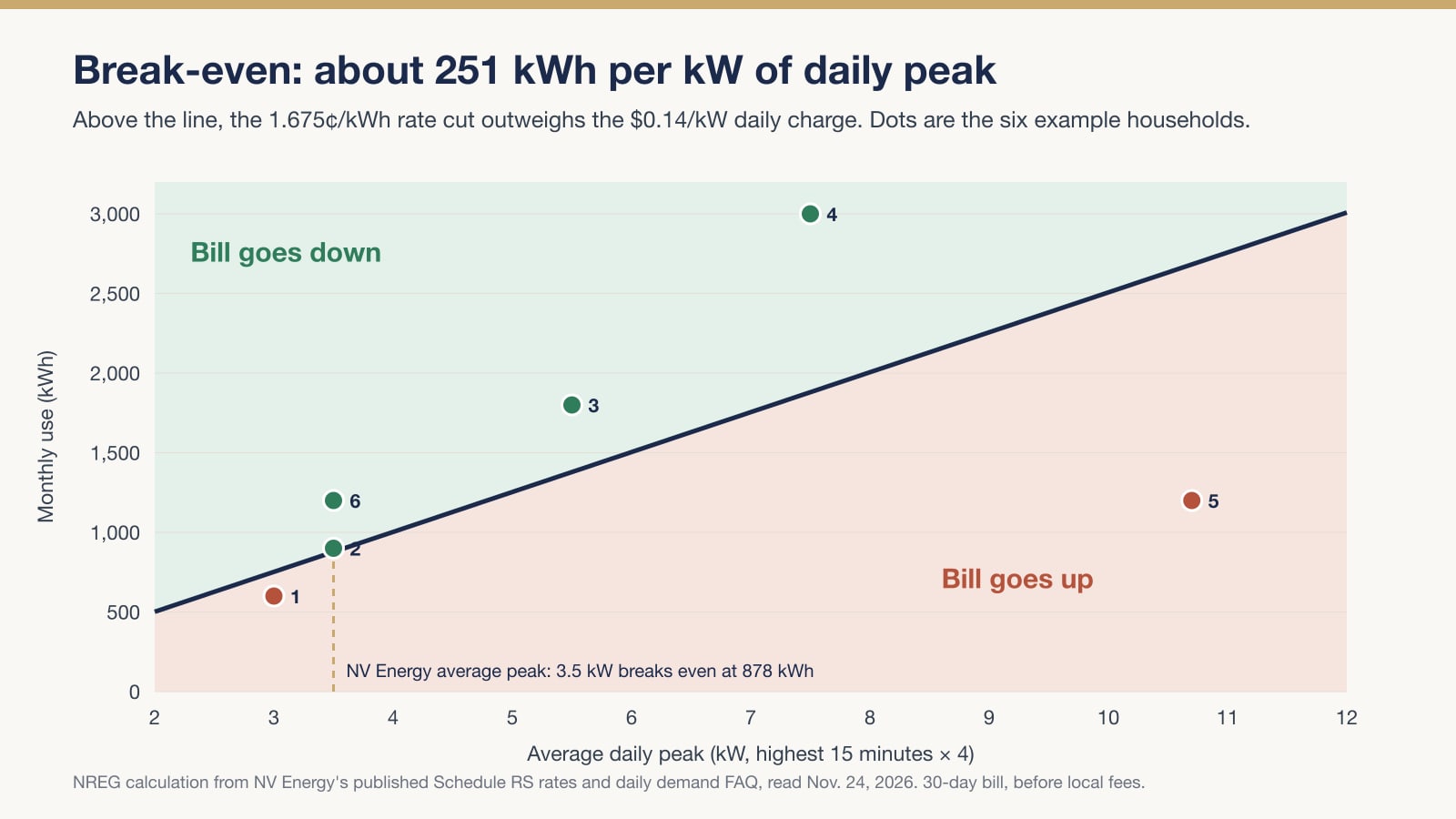
Two numbers decide it: how many kilowatt-hours the home uses in a month, and how high its daily peak runs on average. Every kilowatt-hour earns the 1.675-cent cut. Every kilowatt of average daily peak costs $4.20 over a 30-day bill. Before fuel changes and fees, the change in a 30-day bill is $4.20 times the average daily peak, minus $0.01675 times the monthly kWh.
Set those equal and you get the break-even rule: a home comes out ahead when its monthly kilowatt-hours exceed about 251 times its average daily peak in kilowatts. At NV Energy's 3.5 kW average peak, that is 878 kWh a month. At 5 kW it is 1,254 kWh, and at 8 kW it is 2,006 kWh. Put another way, the home's average hourly use has to be at least about 35 percent of its daily peak. Homes that run steadily, like a house cooling all day in July, tend to clear that bar. Homes that sit quiet most of the day and then run everything at once tend to miss it.
The table applies the rule across a range of homes. Read across from your monthly use on a recent bill to the peak column closest to yours. Negative numbers are savings.
| Monthly use | Bill today | 3 kW peak | 4 kW peak | 5 kW peak | 6 kW peak | 8 kW peak | 10 kW peak |
|---|---|---|---|---|---|---|---|
| 600 kWh | $87.08 | +$2.55 | +$6.75 | +$10.95 | +$15.15 | +$23.55 | +$31.95 |
| 900 kWh | $121.63 | −$2.48 | +$1.72 | +$5.92 | +$10.12 | +$18.52 | +$26.92 |
| 1,200 kWh | $156.17 | −$7.50 | −$3.30 | +$0.90 | +$5.10 | +$13.50 | +$21.90 |
| 1,500 kWh | $190.71 | −$12.52 | −$8.32 | −$4.12 | +$0.08 | +$8.48 | +$16.88 |
| 2,000 kWh | $248.28 | −$20.90 | −$16.70 | −$12.50 | −$8.30 | +$0.10 | +$8.50 |
| 2,500 kWh | $305.85 | −$29.27 | −$25.07 | −$20.87 | −$16.67 | −$8.27 | +$0.13 |
| 3,000 kWh | $363.42 | −$37.65 | −$33.45 | −$29.25 | −$25.05 | −$16.65 | −$8.25 |
Two patterns stand out. Big summer bills tend to shrink, because a home running its air conditioner through a Las Vegas July can pile up kilowatt-hours faster than it raises its peak. Small bills with a sharp evening spike tend to grow a little: a 600 kWh month with a 4 kW peak pays $6.75 more. The same home can sit on both sides in one year, saving in July and paying a few dollars more in a mild April, because its kilowatt-hours swing more than its peak does.
None of these amounts is large next to the summer bill itself. They are the difference the restructuring makes, before fuel adjustments and the local fee, which scales any change by about 5 percent in Clark County.
What Do Different Households Pay Under the New Structure?
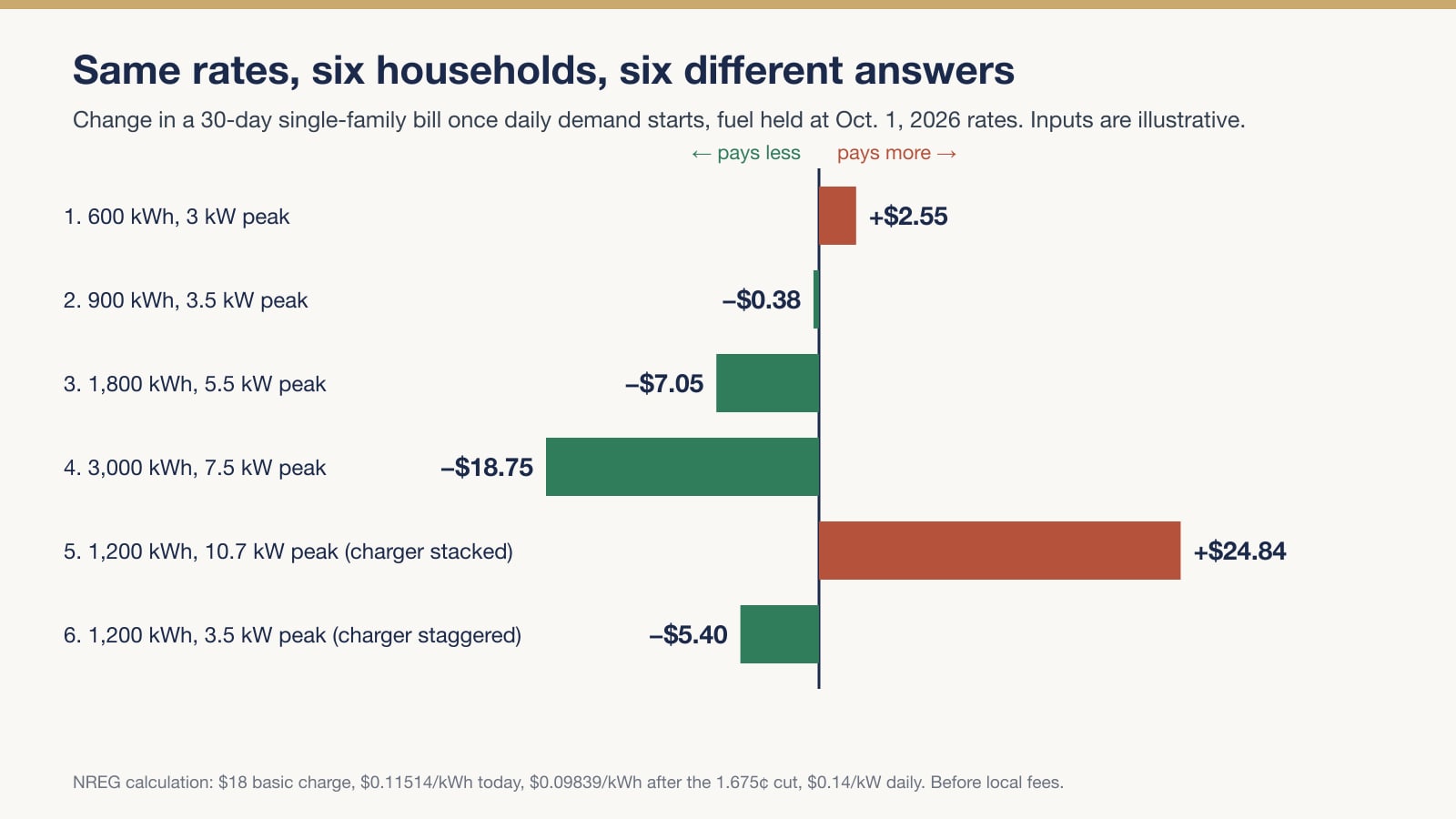
The grid is useful, but households are easier to picture. The six below are illustrative: the monthly use and peak for each are inputs we chose to show a range, not measurements of a real home. Row two uses NV Energy's own 3.5 kW average peak. The bill figures are 30-day Schedule RS bills before local fees, with fuel held at October 1, 2026 prices.
| Household | Monthly use | Average daily peak | Bill today | With daily demand | Change |
|---|---|---|---|---|---|
| 1. Small home, mild month | 600 kWh | 3 kW | $87.08 | $89.63 | +$2.55 |
| 2. Average peak, mild month | 900 kWh | 3.5 kW | $121.63 | $121.25 | −$0.38 |
| 3. Same home, summer month | 1,800 kWh | 5.5 kW | $225.25 | $218.20 | −$7.05 |
| 4. Heavy summer use | 3,000 kWh | 7.5 kW | $363.42 | $344.67 | −$18.75 |
| 5. Home 2 plus an EV charger stacked on its peak | 1,200 kWh | 10.7 kW | $156.17 | $181.01 | +$24.84 |
| 6. Home 2 plus an EV charger kept off its peak | 1,200 kWh | 3.5 kW | $156.17 | $150.77 | −$5.40 |
The first four rows show the volume effect. A small home in a mild month pays $2.55 more; the same structure saves a heavy summer user $18.75. Rows five and six show the timing effect, and it is the bigger one. Both homes add the same 300 kWh of car charging to household two's 900 kWh. In row five the 7.2 kW charger runs during the house's busiest 15 minutes every day, pushing the average peak from 3.5 kW to 10.7 kW, and the bill rises $24.84. In row six the car charges while the rest of the house is quiet, the peak stays at 3.5 kW, and the bill falls $5.40 because the extra kilowatt-hours all earn the rate cut. Same car, same kilowatt-hours, a $30.24 difference a month.
That is the core of the new structure. It does not reward using less electricity so much as using it at a steadier pace. A household that already runs its pool pump overnight and its dryer in the morning may never notice daily demand. A household that comes home at 6 p.m., starts dinner, a load of laundry and the car charger while the air conditioner catches up will.
Your own numbers are the ones that count. NV Energy's FAQ says Southern Nevada residential customers with at least a year of billing data on the same rate schedule can open "energy insights" in MyAccount, from the Daily Demand Annual Comparison tile, to see their peak demand days and an estimated before-and-after comparison.
Which Appliances Push a Home's Daily Peak Highest?
Your daily peak is the sum of everything running in the same 15 minutes, so the appliances that matter are the ones that draw a lot of power at once. NV Energy's FAQ groups common appliances into four demand levels. It doesn't publish wattages, and you don't need them to use the list: anything in the top row is worth spacing out.
| Demand level | Appliances NV Energy lists | What it means for your peak |
|---|---|---|
| High | Electric range, clothes dryer, central air conditioner or heat pump, EV charger, space heater, pool pump, arc welder | Two of these together can set the day's peak; stagger them |
| Moderate | Washing machine, dishwasher, microwave, toaster oven or air fryer, vacuum, hair dryer, iron | Adds to a peak already set by a high-demand appliance |
| Low | Coffee maker, blender, desktop computer, electric kettle, TV, portable fan, humidifier | Rarely changes the peak on its own |
| Very low | Phone charger, Wi-Fi router, LED bulb, radio, laptop, smart speaker | Not worth managing for daily demand |
The air conditioner is the one you can't avoid in a Las Vegas summer, which is why the rest of the list matters. It sets a floor under your peak from June to September, and everything else stacks on top of it. Starting the dryer while the air conditioner is running adds the dryer's draw to that day's peak; starting it in the morning, before the house heats up, may add nothing at all. The same logic applies to an electric oven at dinner time and to a pool pump left on a midday schedule.
Fuel type changes the picture. A gas range, gas dryer or gas water heater takes its heat from the gas line, not the electric meter, so a home with gas appliances starts with fewer high-demand loads to juggle. When you compare two houses, the appliance list is worth as much attention as the square footage. Our guide to the cost of owning a pool in Las Vegas covers pump schedules and equipment in more detail, and our first desert summer guide covers how air conditioning drives summer bills.
Bigger homes are not automatically worse off. A large house may run a higher summer peak, but it also tends to use more kilowatt-hours, and every one of them earns the cut. Household four in the table above, at 3,000 kWh and a 7.5 kW peak, saves $18.75. Our breakdown of the cost of owning a large home in Las Vegas puts power bills alongside the other carrying costs that scale with size.
How Much Can an Electric Vehicle Charger Add to the Bill?
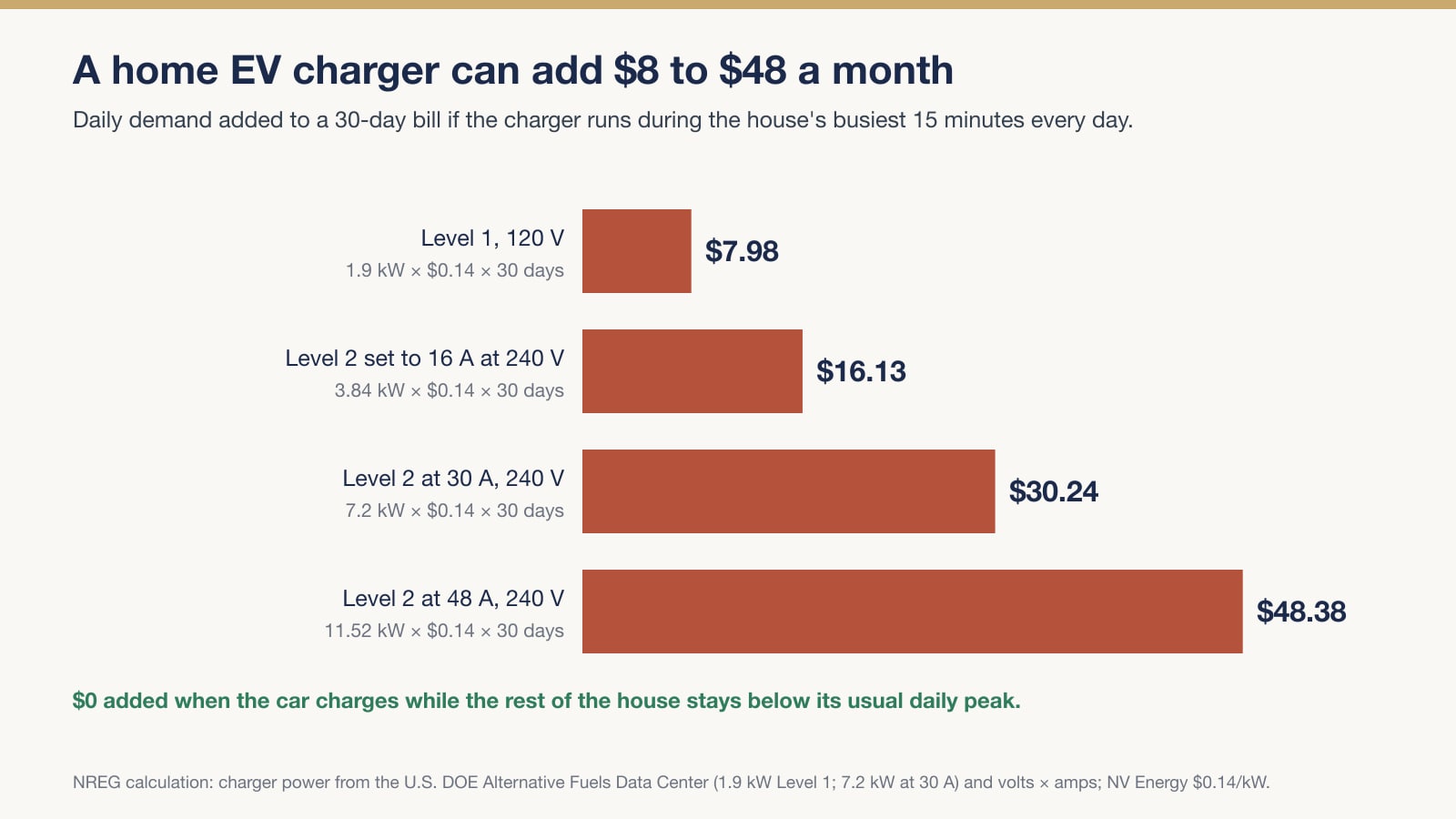
More than any other single appliance, because it draws a lot of power for hours at a time. The U.S. Department of Energy's Alternative Fuels Data Center says most residential Level 2 chargers operate at up to 30 amps, delivering 7.2 kW, and that a Level 2 unit can range from 2.9 to 19.2 kW. Its Level 1 figures assume a 120-volt plug charging at 1.9 kW.
If the charger runs during the busiest 15 minutes of the house every day, its full draw lands on top of the daily peak. The table shows what that adds to a 30-day bill at $0.14 per kW. The 16-amp and 48-amp rows use volts times amps at 240 volts.
| Charger setting | Power | Added per day | Added per 30-day bill | Added per year |
|---|---|---|---|---|
| Level 1, 120 V | 1.9 kW | $0.27 | $7.98 | $97.09 |
| Level 2, 16 A at 240 V | 3.84 kW | $0.54 | $16.13 | $196.22 |
| Level 2, 30 A at 240 V | 7.2 kW | $1.01 | $30.24 | $367.92 |
| Level 2, 48 A at 240 V | 11.52 kW | $1.61 | $48.38 | $588.67 |
Those are worst cases. The charger adds nothing to daily demand on a day when it runs while the rest of the house stays below its usual peak, and the kilowatt-hours it uses still earn the 1.675-cent cut. That is the $30.24 swing between households five and six. For most drivers, the fix is a schedule: set the car or the charger to start after dinner and laundry are done, or overnight once the air conditioner settles down.
Lowering the charging current is the other lever. Power is volts times amps, so halving the current halves what the charger can add to the peak, and a car plugged in overnight has many hours to fill. If your charger or car allows a lower current setting, it is worth trying before the first January bill.
NV Energy also offers time-of-use plans with an electric vehicle recharge price from 12:01 a.m. to 8 a.m., according to its October 2026 optional residential rate schedule. Its daily demand page says customers on time-of-use rates will continue to save by shifting use to off-peak hours. Whether a time-of-use plan beats the standard rate for your household is a separate calculation; NV Energy's daily demand page links to a rate comparison in MyAccount for it.
For buyers, a home charger is a feature with a setting. If a listing advertises a 48-amp charger, the question is not whether it is good to have, but how the current owner schedules it. If you are shopping new construction, ask the builder whether the garage is wired for a Level 2 charger and at what amperage; our comparison of new construction against resale in Las Vegas covers the other questions to put to a builder.
What Happens to Homes With Rooftop Solar?
They are the clear losers on average, and NV Energy says so. Its fact sheet says rooftop solar customers in Southern Nevada "may see a modest bill increase due to more accurate cost allocation," and its average-bill chart shows the typical solar home going from $56 to $69 a month, a $13 increase. Those solar figures do not take carryover excess energy credits into account, the chart notes.
The reason is mechanical. A solar home buys fewer kilowatt-hours from the grid, so the 1.675-cent cut saves it little: in NV Energy's chart, the solar home's infrastructure line falls only $4, from $18 to $14. But the home's peak can still land in the evening, after the panels stop producing, when the air conditioner, oven and lights run on grid power. NV Energy's chart charges the average solar home the same $17 of daily demand as the average non-solar home. NV Energy's FAQ makes the policy argument: solar homes use the same poles, wires and transformers whether power flows to them or from them.
That argument is what the courts have weighed. On May 26, 2026, the day she let the charge proceed, Clark County District Judge Mary Kay Holthus spoke of "ninety percent of the people paying for 10% of the people," as NV Energy's fact sheet quotes her. The Attorney General's office and solar advocates argue that the commission lacked the legal authority to adopt it; the legal fight is covered in a later section.
For anyone buying or selling a solar home, three things follow. First, the savings a seller quotes from the last 12 months of bills will shrink by roughly the amount in NV Energy's chart, all else equal. Second, any lease or power-purchase payment for the panels is separate from the NV Energy bill and doesn't change with daily demand. Third, a home battery that powers the house during the evening could, in principle, keep the meter's peak lower, because the charge is measured at the meter; ask the installer how the system is programmed before assuming it does. Our guide to buying or selling a Las Vegas home with solar panels covers leases, transfers and net-metering paperwork.
Do Condos, Apartments and Townhomes Pay the Same Rate?
No. Multifamily homes are on a separate rate schedule with a lower daily demand price. NV Energy's October 1, 2026 residential rate schedule defines Residential Multi-Family service, Schedule RM, as for separately metered homes "in a multi-unit complex (like an apartment)," and single-family service, Schedule RS, as for separately metered, permanent single-family dwellings. NV Energy's FAQ sets the daily demand price at $0.10 per kW for multifamily customers, against $0.14 for single-family.
| Item | Single-family (Schedule RS) | Multifamily (Schedule RM) |
|---|---|---|
| Who it covers | Separately metered, permanent single-family dwellings | Separately metered homes in a multi-unit complex |
| Basic service charge | $18.00 a month | $8.20 a month |
| Total effective energy rate today (bill insert) | $0.11514 per kWh | $0.10611 per kWh |
| Daily demand from January 1, 2027 | $0.14 per kW per day | $0.10 per kW per day |
| Energy-rate cut when daily demand starts | 1.675¢ per kWh, as reported | Not stated in the sources we read |
Because we could not find the multifamily energy-rate cut in a source we could read, this guide does not calculate break-even figures for condos and apartments. The direction is the same: units with steady use do better than units that run everything at once, and the lower $0.10 price means each kilowatt of peak costs $3.00 over a 30-day bill rather than $4.20.
Townhomes and condos fall into whichever schedule the account is actually on, and the attached-versus-detached label in a listing doesn't settle it. The rate code printed on an NV Energy bill does. The multifamily tariff adds a wrinkle: it applies "unless the dwelling received a Schedule RS class allowance" under the utility's Rule 9, according to the Schedule RM tariff sheet. If you are buying an attached home, ask the seller for a bill and look for RS or RM. Our comparison of condos and houses in Las Vegas covers the other cost differences between the two.
A casita or guest suite on the main house's meter adds its own air conditioner and appliances to the same 15-minute peak. That doesn't make one a bad idea, but it is worth knowing when a second household shares a meter. Our guide to casitas and mother-in-law suites in Las Vegas covers how those units are built and permitted.
Does the Change Reach Henderson, North Las Vegas, Boulder City and Pahrump?
It reaches every home on NV Energy's Southern Nevada system. The fact sheet and the daily demand page describe the change for "Southern Nevada customers" without carving out any city, so if NV Energy's name is on your bill and your service is in Southern Nevada, the January 1, 2027 date applies. That includes homes on NV Energy service in Las Vegas, Henderson, North Las Vegas and Summerlin.
Not every Southern Nevada home buys power from NV Energy, though. Boulder City publishes its own residential electric rates and bills its residents for electric service, according to the city's residential rates page. A Boulder City home is not on Nevada Power's Schedule RS, so NV Energy's daily demand charge does not apply to it; the city's own electric rates do.
In Pahrump, power comes from an electric cooperative. According to Valley Electric Association's about page, read November 24, 2026, the co-op is based in Pahrump and serves more than 45,000 people across a 6,800-square-mile area along the Nevada-California border. Its rates are set separately from NV Energy's, so this change does not apply there either.
For buyers, the first question about any home outside the core valley is simply which utility serves it. A home just past a city line, or in a rural part of Clark County, can sit with a different provider and a different rate structure. The answer is on the seller's bill, and it is worth asking before you compare utility costs between towns.
Northern Nevada is a separate question. NV Energy also serves the Reno area through its northern utility, but the daily demand rules described here come from Nevada Power's 2025 rate case, and NV Energy's daily demand materials describe them only for Southern Nevada. Homeowners in the north should not assume the same structure or the same January date.
Renters are covered too. Daily demand applies to the residential account, so a tenant who pays NV Energy directly on Schedule RS or RM will see it on their own bill. The owner sees it only if the utilities are in the owner's name.
How Should Buyers Weigh Daily Demand When Comparing Homes?
As one more line in the carrying cost, alongside property tax, insurance and HOA dues. For most homes the restructuring itself moves a monthly bill by a few dollars either way, which won't decide a purchase. What it does is reward some features and penalize others, and those features are visible before you buy.
| Ask for | Why it matters | Where to find it |
|---|---|---|
| Twelve months of NV Energy bills | Monthly kWh by season is half of the break-even calculation | The seller's account or printed bills |
| The rate schedule on the bill | RS, RM or a time-of-use plan changes both the demand price and the energy rate | The rate code on the bill |
| Daily peak history | The other half of the calculation, and the clearest sign of how the house runs | MyAccount energy insights, for accounts with a year on the same schedule |
| Rooftop solar ownership and terms | NV Energy's average solar bill rises $13 a month; lease payments are separate | Seller's solar contract and net-metering paperwork |
| EV charger amperage and schedule | A 30-amp charger at the house's peak adds $30.24 a month | Charger label, panel breaker, owner's app settings |
| Gas or electric range, dryer and water heater | Electric ranges and dryers are on NV Energy's high-demand list | Listing details and the inspection report |
| Pool pump type and schedule | Pool pumps are on NV Energy's high-demand list | Pool equipment pad and timer |
Ahead of January, Southern Nevada customers will receive materials comparing a recent bill with what it would have been under the new structure, according to NV Energy's fact sheet. A seller who has received that comparison has the single most useful document for this question; ask for it alongside the bills.
Remember that the household matters as much as the house. A seller's bills reflect the seller's habits: when they cooked, whether they charged a car, how they set the thermostat. Your own schedule can land the same house on the other side of the break-even line. Treat the seller's history as a range, not a quote.
Power is also one line among many in the cost of a move. Our cost of living in Las Vegas guide puts utilities next to housing, taxes and transportation, and our Las Vegas move-in playbook covers starting NV Energy service when you close.
What Should Sellers and Landlords Tell Buyers and Tenants?
Sellers who share real numbers make a buyer's job easier and pre-empt the question. The most useful package is 12 months of bills, the rate code, and, if NV Energy has sent it, the bill comparison showing what a recent bill would have cost under daily demand. If the home has solar, include the contract and the net-metering documents, because the solar savings a buyer sees in your bills are the figure most affected by the change.
A home with features on NV Energy's high-demand list should say how they run. An EV charger set to 32 amps on an overnight schedule is a different proposition from one that starts whenever the car is plugged in. A pool pump on a variable-speed motor with an overnight timer answers a question before a buyer asks it. This is practical information rather than a disclosure form, and it is what buyers in 2027 will look for.
Sellers should also avoid promising a bill. Saying "our bills averaged $180 last year" is a fact a buyer can check. Saying "the new owner will pay about $180" is a forecast that depends on their household, their fuel prices and now their daily peak. Our seller services team can help you assemble the documents that answer these questions.
Landlords face a narrower question. Where tenants hold the NV Energy account, the charge shows up on the tenant's bill, and the landlord's main exposure is a tenant asking why the bill changed. Where the landlord pays the utilities, the landlord carries the effect directly, and a unit with an EV charger or an evening-heavy tenant could cost more under the new structure. Leases that include utilities may be worth reviewing before renewal. Our guide to how much a landlord can raise rent in Las Vegas covers the notice rules that apply if utility costs change the math on a renewal.
For condo and apartment owners, the multifamily rate and the lower $0.10 demand price apply, as covered above. The same advice holds: share the bill, the rate code and the timing of the heavy loads.
Could Courts or Lawmakers Still Stop the Charge?
They could, but as of November 24, 2026 the charge has survived every challenge decided so far and remains scheduled for January 1, 2027. The commission reaffirmed its decision after the state's Bureau of Consumer Protection and clean-energy groups asked it to reconsider, according to The Nevada Independent's November 18, 2025 report.
The courts followed. On May 26, 2026, Clark County District Judge Mary Kay Holthus ruled that NV Energy can move forward over the opposition of the Attorney General's office and solar advocates, according to FOX5's report that day. Attorney General Aaron Ford said he would appeal to the Nevada Supreme Court, and the next day, in FOX5's May 27 report, said he was also disappointed with a decision in Carson City, where Vote Solar and Earthjustice had filed a separate suit in district court, according to The Nevada Independent. Vote Solar, which brought a separate suit, wrote on September 1, 2026 that its lawsuit was dismissed and that it has appealed to the Nevada Supreme Court. NV Energy's fact sheet says the rate structure has been affirmed by two courts as reasonable and supported by substantial evidence.
Lawmakers have so far declined to step in. On August 18, 2026, the Legislature's interim committee on growth and infrastructure did not advance its chair's request for a bill to ban residential demand charges, according to KTNV. Any bill in the 2027 legislative session would arrive with daily demand already on bills.
| Date | Event |
|---|---|
| February 18, 2025 | Nevada Power files its rate case, proposing a daily demand charge for residential customers |
| September 16, 2025 | Commission issues its final order approving the charge |
| November 18, 2025 | Commission reaffirms the decision after reconsideration requests, as reported |
| March 31, 2026 | Commission approves moving the start to January 2027 |
| May 26, 2026 | Clark County District Court lets the charge proceed; the Attorney General says he will appeal |
| August 18, 2026 | Interim legislative committee declines to advance a ban |
| January 1, 2027 | Daily demand takes effect for Southern Nevada residential customers |
The practical advice is to plan for January 1 and watch for a ruling. If the Nevada Supreme Court were to block the charge, the energy-rate cut that pays for it would presumably go with it, and bills would return to the current structure; the break-even math in this guide would simply stop applying.
How Can a Household Keep Its Daily Peak Down?
By running fewer big things at once. That is a different job from using less electricity, and it helps to keep the two apart. Using less lowers the kilowatt-hour part of the bill, which shrinks under daily demand anyway. Spreading use out lowers the peak, which is the new part.
NV Energy's daily demand page gives the core advice: when daily demand takes effect, spread out the use of large appliances, because running several at the same time creates a higher peak. In practice that means a few habits:
- Run the dryer, dishwasher and washing machine in the morning or late evening, not while dinner is cooking and the air conditioner is working hardest.
- Schedule the EV charger to start after the evening's cooking and laundry, or overnight, and lower its current if the car has hours to fill.
- Set the pool pump timer for hours when the rest of the house is quiet.
- Avoid starting the oven, dryer and charger within the same 15 minutes.
NV Energy's energy-saving tips on the same page lower total use: set the thermostat to 78 degrees when home and 5 to 10 degrees warmer when away in warm months, and to 68 degrees when home and 55 to 68 when away in cold months; run full loads in the washer and dryer; use the dishwasher's energy-saver setting and let dishes air dry; and set the water heater to 120 degrees.
The utility's PowerShift program offers help with both, according to that page: free smart thermostats with professional installation, free in-home energy assessments, a qualified appliance replacement program, incentives for air-conditioning tune-ups, and no-cost calibration of variable-speed pool pumps. A smart thermostat that pre-cools the house earlier in the afternoon can also keep the air conditioner from running flat-out at the same moment as the oven.
Then check whether it worked. Energy insights in MyAccount shows peak days by billing cycle, so a household can see which days set the highest peaks and what was running. For many households, the evening routine is the place to start.
Frequently Asked Questions
Is the daily demand charge a new fee on top of my current bill?
Not in NV Energy's design. The utility says daily demand is "not a new cost" and that the structure is revenue neutral: part of the cost now recovered through the energy rate moves into the new line, and the energy rate drops by about 1.675 cents per kWh to make room. NV Energy's own average non-solar bill, as of October 1, 2026, goes from $154 to $152. Individual homes can pay more or less, depending on their monthly use and daily peak.
Does it matter what time of day my peak happens?
No. NV Energy's FAQ says daily demand is not a time-of-use rate: the price per kilowatt is the same whether your busiest 15 minutes fall at 2 a.m. or 6 p.m. What matters is how much runs at the same time. Time of day matters only if you are separately enrolled in one of NV Energy's optional time-of-use plans.
How do I find my own daily peak?
Log in to NV Energy's MyAccount and open energy insights from the Daily Demand Annual Comparison tile. NV Energy says it shows peak demand days by billing cycle and an estimated comparison of your bill before and after daily demand. The annual comparison needs at least a year of billing data on the same rate schedule, so a recent move or a switch to time-of-use may leave gaps in it.
What is the break-even point for my home?
By our calculation from NV Energy's rates, a 30-day single-family bill breaks even when monthly kilowatt-hours equal about 251 times the average daily peak in kilowatts. Above that, the home saves; below it, the home pays more. At NV Energy's 3.5 kW average peak, the break-even is 878 kWh a month. Fuel price changes and the local government fee are not included.
Will I still pay daily demand on a house that sits empty?
Yes, though usually a small amount. The charge applies to each day's highest 15 minutes, and an empty house still has a refrigerator, a water heater or pool pump if they are electric, and an air conditioner holding a summer setting. With little running at once, the daily peak stays low, so the charge is modest. The $18 basic service charge applies regardless.
Does daily demand apply to my condo or apartment?
Yes, if your unit is separately metered on NV Energy's multifamily schedule, RM. The price is $0.10 per kW per day, against $0.14 for single-family homes, according to NV Energy's FAQ. Check the rate code on your bill: some attached homes are on the single-family schedule.
Is the 1.675-cent rate cut final?
It is the figure The Nevada Independent reports, and the Public Utilities Commission describes the cut as approximately two cents per kWh. When we checked on November 24, 2026, the Statement of Rates on NV Energy's website was the version effective October 1, 2026, without the January rates. The January rate sheets are the place to confirm the exact figure once NV Energy posts them.
How Can Nevada Real Estate Group Help You Weigh a Home's Power Costs?
Daily demand won't decide most home purchases, but it is now part of comparing them. When you are choosing between two houses, the right questions are about the home and about your household: how much power the house uses through the year, what sets its daily peak, whether it has solar or a car charger, and whether your own routine runs steady or spiky.
If you are buying, ask for the bills, the rate code and NV Energy's bill comparison before your inspection period ends, and look at the appliance list alongside the floor plan. If you are selling, gather those same documents before you list, so a buyer's questions have answers. If you rent out a home, check who holds the NV Energy account and whether your lease includes utilities.
I am happy to go through a specific property's utility history with you and talk through how its features fit your household. Start with our buyer services or seller services, or call me at (702) 637-1759. We work with buyers and sellers across Las Vegas, Henderson, North Las Vegas and Summerlin. For the wider budget picture, our guide to the income you need to live in Las Vegas puts power alongside every other monthly cost.
Which Sources Inform This Daily Demand Guide?
Every rate, date and program term comes from the publishing body's own page, read November 24, 2026, except where a news report is named. The 1.675-cent energy-rate cut is reported by The Nevada Independent; the Public Utilities Commission's own description, quoted by FOX5, rounds it to approximately two cents. The Las Vegas Weekly and Las Vegas Sun reports on the charge refused our read, and the Review-Journal's report on solar customers refused it as well, so this guide states nothing from them.
The bill calculations are ours. They use NV Energy's October 1, 2026 Schedule RS rates, the $18.00 basic service charge and the $0.11514 total effective rate per kWh from its residential rate schedule; the $0.14 per kW single-family daily demand price from its FAQ; and the 1.675-cent cut. Fuel is held at October 1, 2026 prices, totals are for a 30-day bill before the local government fee, and household inputs are illustrative. Charger power comes from the Alternative Fuels Data Center, with the 16-amp and 48-amp rows calculated as volts times amps. The calculation script and the chart generator are kept with our records.
- NV Energy: Southern Nevada daily demand page, including the "Average Monthly Bills" chart and ways to save
- NV Energy: daily demand frequently asked questions, including the $0.14 and $0.10 per kW prices, the calculation example and appliance demand levels
- NV Energy: Daily Demand fact sheet, June 2026 (PDF)
- NV Energy: Southern Nevada residential electric rate schedules effective October 1, 2026 (PDF)
- NV Energy: Southern Nevada optional residential rate schedules effective October 1, 2026 (PDF)
- NV Energy: Nevada Power Statement of Rates, effective October 1, 2026 (PDF)
- NV Energy: Schedule RM residential multi-family tariff sheet (PDF)
- NV Energy: quarterly fuel and deferred energy adjustment effective October 1, 2026 (PDF)
- Public Utilities Commission of Nevada: notice of consumer sessions, Docket No. 25-02016 (PDF)
- EQ Research: issue brief on Nevada Power's residential demand charge, October 2025 (PDF)
- The Nevada Independent: what the daily demand charge is and how it will affect customers, updated May 7, 2026
- The Nevada Independent: regulators uphold the billing change after solar group pushback, November 18, 2025
- FOX5: NV Energy delays the daily demand charge to October, March 11, 2026
- FOX5: commission approves a January 2027 start, March 31, 2026
- FOX5: judge allows the demand charge to proceed, May 26, 2026
- FOX5: Attorney General vows appeal, May 27, 2026
- FOX5: what the daily demand charge does to your bill, July 23, 2026
- KTNV: Nevada lawmakers decline to take on the daily demand charge, August 18, 2026
- The Nevada Independent: judge denies the Attorney General's petition to stop the daily demand charge, updated May 27, 2026
- Vote Solar: the fight isn't over, September 1, 2026
- U.S. Department of Energy, Alternative Fuels Data Center: charging station types and power levels
- City of Boulder City: residential utility rates
- Valley Electric Association: who we are
Chris Nevada · Nevada Real Estate License S.181401 · Nevada Real Estate Group · LPT Realty. This guide explains published utility rates and our own calculations from them; it is not legal or financial advice. Confirm current rates on your NV Energy bill and at nvenergy.com before relying on any figure.