

The question sounds simple: should you buy a condo or a house in Las Vegas? The honest answer depends on numbers most comparisons never show you. A condo and a house at the same address range do not cost the same per month, do not get the same loan approval, do not carry the same insurance, and do not sell at the same speed. So instead of repeating general pros and cons, I pulled the sales themselves and lined up the two home types against each other, city by city.
Everything market-related below comes from our own pull of Las Vegas MLS data through Repliers on October 4, 2026, covering every condominium, townhouse and single-family sale with a sold date from September 1, 2025 through August 31, 2026 in Las Vegas, Henderson and North Las Vegas, plus a matching prior-year window. These are our own tabulations, not official Las Vegas REALTORS statistics. The financing, insurance and legal sections come from HUD, Fannie Mae, the NAIC and the Nevada Revised Statutes, each linked where it is used.
For the 12 months ending August 31, 2026, condos and townhomes in Las Vegas, Henderson and North Las Vegas sold at a $289,838 median versus $483,062 for houses, per our MLS pull. At Freddie Mac's October 1, 2026 rate of 7.28% with 20% down, that is about $1,838 a month in principal, interest and HOA dues for the condo and $2,728 for the house, before property tax and insurance. Compare loan approval and resale speed before choosing.
- Condos and townhomes sold at a $289,838 median versus $483,062 for houses through August 2026.
- At 7.28% with 20% down, the median condo costs about $890 less monthly, HOA included.
- Condos took a median 38 days to reach contract versus 28 days, and 61% sold below list.
- Condo loans depend on the building passing FHA or Fannie Mae project review; most houses skip it.
- Request the NRS 116.31152 reserve study and leasing rules before writing an offer on any condo.
How Did We Compare Condos and Houses in the Las Vegas MLS?
The comparison uses three MLS cities: Las Vegas, Henderson and North Las Vegas. The MLS city field follows the mailing address, so "Las Vegas" also includes unincorporated Clark County neighborhoods that use a Las Vegas address. Home type comes from the MLS dwelling style. "Condo" in this article means listings styled Condominium or Townhouse, and "house" means listings styled Single Family Residence. That leaves out manufactured homes, duplexes and land. The style describes the building's form, not its legal structure, which matters later: some townhouses are legally lots in a planned community, and some detached homes are legally condominium units.
The closed-sale window is every sale with a sold date from September 1, 2025 through August 31, 2026. The comparison window is September 1, 2024 through August 31, 2025. In a check of 400 individual records, the MLS sold date matched the purchase contract date on 364 of them and the closing date on 16, so these windows mostly capture contracts written in each period that later closed. August 2026 is provisional; late closings still posting will add to it. Days on market is the MLS count, which matched list-to-contract time within a week on 321 of the 400 records. Those 400 records are also the 200-sale samples of each type used later for HOA tiers, size and year built; they are drawn from sales dated February 16 to 20 and August 6 to 13, 2026, so treat them as a check on the full-population figures, not a replacement for them.
Two feed problems shape what I report. September 2025 is under-reported: 148 condo sales and 463 house sales against 391 and 1,442 in October. January 2026 is inflated: 739 condo and 2,752 house sales against 429 and 1,716 in December. The prior window has its own spike, in March 2025. Because both windows contain these artifacts, I do not compare 12-month sale counts year over year. Medians, price per square foot and days on market are far less sensitive to a missing or doubled month, so those are the year-over-year figures I use. One caveat on days on market: the inflated months also ran slow, January 2026 at a 48-day condo median and March 2025 at 26 days, so they stretch the gap between windows. Leaving both out, condos run roughly 35 days against 30, judging from the monthly medians; the direction holds.
What Do Condos and Houses Sell for, and How Did Prices Change?
For the 12 months ending August 31, 2026, condos and townhomes across the three cities sold at a median of $289,838 on 5,323 sales (August provisional; late closings still posting). Houses sold at a median of $483,062 on 20,937 sales. The house median is $193,224 higher, about 1.67 times the condo median. For the matching window a year earlier, the condo median was $298,244 and the house median was $483,506, so the condo median fell 2.8% while the house median was essentially flat, down 0.1%.
| Measure | Condo and townhouse | Single-family house |
|---|---|---|
| Sales, Sept 2025 to Aug 2026 (August provisional) | 5,323 | 20,937 |
| Median sold price, Sept 2025 to Aug 2026 | $289,838 | $483,062 |
| Median sold price, Sept 2024 to Aug 2025 | $298,244 | $483,506 |
| Change in median sold price | -2.8% | -0.1% |
| Median price per square foot, latest 12 months | $230 | $258 |
| Median price per square foot, prior 12 months | $243 | $262 |
| Median days on market, latest vs prior 12 months | 38 vs 29 | 28 vs 25 |
| Sold below final list price, latest 12 months | 61% | 56% |
| Sold above final list price, latest 12 months | 13% | 19% |
| Median size, 200-sale sample | 1,204 sq ft | 1,992 sq ft |
| Median year built, 200-sale sample | 1998 | 2003 |
Price per square foot tells you where most of that gap comes from. Houses sold at a median $258 per square foot against $230 for condos, a difference of about 12%. The rest of the $193,224 gap is size and land: in a 200-sale sample of each type, the median condo had 1,204 square feet and the median house 1,992. So the condo discount is mostly a discount for buying less space and no private lot, not a dramatically cheaper price for the same space.
The direction of change also differs. Condo price per square foot fell from $243 to $230, about 5.3%, while houses slipped from $262 to $258, about 1.5%. Those are historical figures for two fixed windows, not a prediction of what either type will do next. They are consistent with the monthly benchmark Las Vegas REALTORS publishes: according to Las Vegas REALTORS' market statistics page, July 2026 single-family sales closed at a $480,000 median on 2,046 sales, and condo and townhome sales at $290,000 on 541. Their figures cover the association's whole territory for a single month, so they will not match a three-city, 12-month median exactly, but they land in the same place. For the tower slice of the condo market specifically, our high-rise condo market review breaks out building-by-building sales.
How Do Las Vegas, Henderson and North Las Vegas Compare by Home Type?
Splitting the same 12 months by city shows that the condo-to-house gap is not one number. It ranges from about $104,000 in North Las Vegas to about $218,000 in the Las Vegas mailing area, and the condo stock itself looks different in each city.
| City and home type | Sales | Median sold price | Median $ per sq ft | Median days on market | Sold below list |
|---|---|---|---|---|---|
| Las Vegas condo and townhouse | 3,875 | $265,943 | $225 | 39 | 63% |
| Las Vegas house | 13,749 | $484,191 | $259 | 28 | 58% |
| Henderson condo and townhouse | 1,074 | $340,000 | $243 | 38 | 59% |
| Henderson house | 4,489 | $528,878 | $272 | 31 | 61% |
| North Las Vegas condo and townhouse | 374 | $325,000 | $229 | 21 | 36% |
| North Las Vegas house | 2,699 | $429,470 | $235 | 23 | 40% |
The Las Vegas mailing area holds most of the attached sales, 3,875 of the 5,323 condo and townhouse sales, and it has the lowest condo median at $265,943. That reflects the mix: older garden-style complexes, mid-rises and resort-corridor towers all sit inside that one MLS city. The house median there, $484,191, is almost identical to the three-city figure, so the widest gap in the valley, $218,248, is mostly a story about how affordable the Las Vegas condo stock is. Our Las Vegas condos for sale page shows what is listed in that pool now.
Henderson runs higher on both sides. Its condos and townhomes sold at a $340,000 median and its houses at $528,878, a gap of $188,878, and Henderson attached homes had the highest price per square foot of the three, $243. Henderson-specific buildings, fees and financing quirks are covered in our Henderson condos and townhomes guide.
North Las Vegas is the outlier. Its attached sales were few, 374, but they moved fastest: a median of 21 days to contract, and only 36% sold below list price, against 63% in the Las Vegas mailing area. The condo median there, $325,000, sits only $104,470 below the house median of $429,470, which is the narrowest gap in the valley. A small, newer pool of townhomes behaves differently from an older condo pool, so compare inside the city you are actually shopping, and see the North Las Vegas page for the current mix.
How Many Condos and Houses Are for Sale, and How Fast Are They Selling?
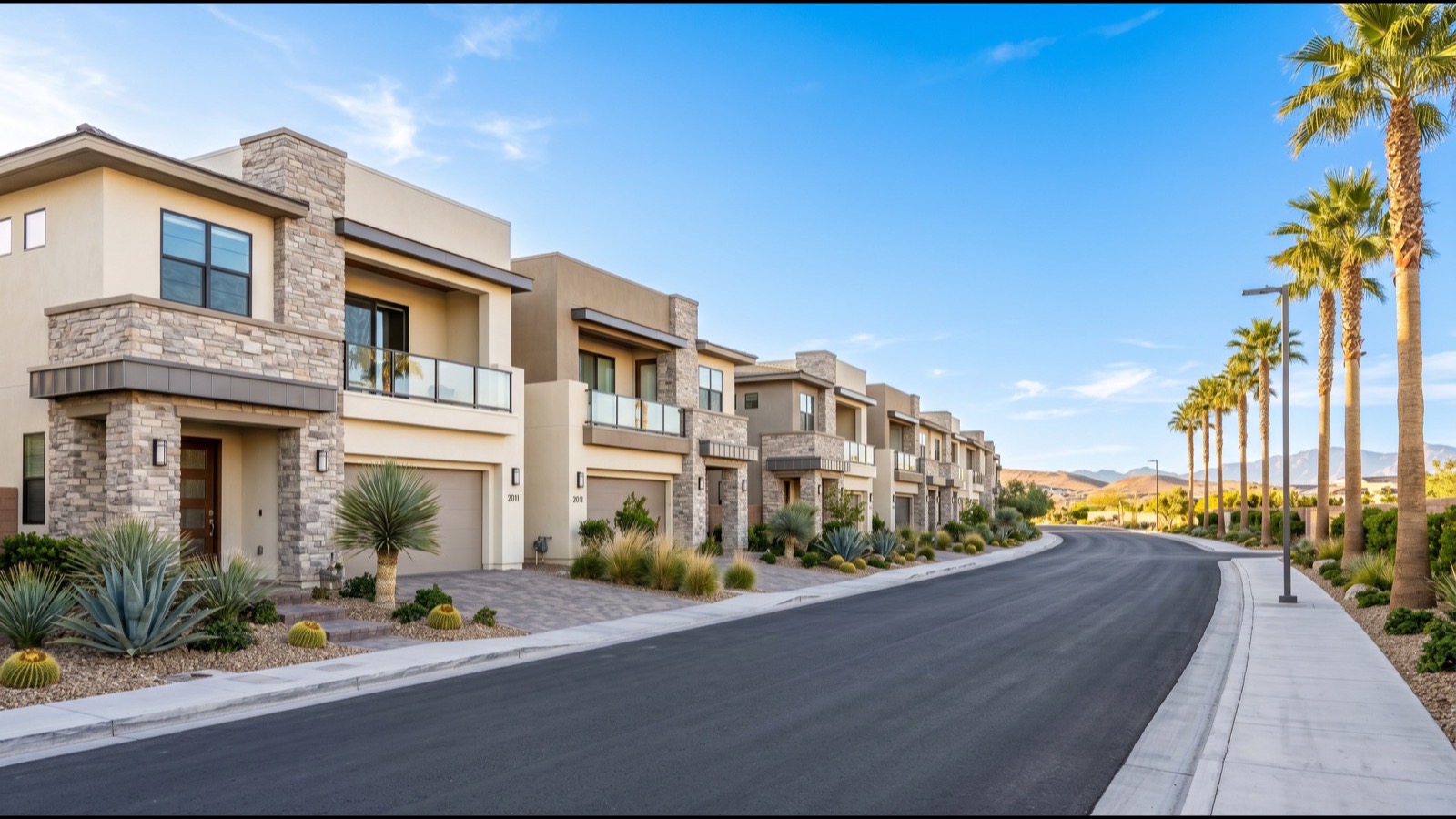
As of October 4, 2026, the three cities had 2,709 condos and townhomes available, meaning active with a New status: 2,106 in the Las Vegas mailing area, 479 in Henderson and 124 in North Las Vegas. Their median asking price was $277,545. Houses numbered 7,671 available, 5,120 in Las Vegas, 1,754 in Henderson and 797 in North Las Vegas, at a $542,512 median asking price. A further 579 condos and townhomes were under contract (337 pending and 242 active under contract) at a $297,000 median list price, along with 2,207 houses (1,233 pending and 974 active under contract) at $496,660.
Those inventory counts translate into different selling conditions. Dividing available listings by the average monthly sales for June and July 2026, the most recent months whose closings have fully posted, gives about 5.9 months of condo supply against about 4.4 months for houses, the same figures and window as our October 2026 buyer's-market analysis, which also shows the higher June–August figures, 4.6 months for houses and 6.4 for condos, because some August contracts are still closing. Under-contract listings were 18% of condo and townhouse inventory, available plus under contract, and 22% for houses. Every one of those measures points the same direction: buyers currently have more condo choices relative to demand than house choices.
Days on market say the same thing. Condos needed a median 38 days to reach a contract in the latest 12 months, up from 29 a year earlier; houses needed 28 days, up from 25. Condos were also more likely to sell below their final list price, 61% against 56% for houses, and less likely to sell above it, 13% against 19%. None of that makes a condo a poor purchase. It means a condo seller usually has less pricing power, and a condo buyer usually has more room to negotiate, at least in this window.
That is also the resale-speed point most comparisons skip. When you buy, you are also choosing the market you will eventually sell into. A condo sells to a buyer pool that needs the building to pass a lender's project review, which I cover below, and it competes with identical units in the same building. A house sells to every financing type and competes with a less uniform set of homes. Our guide to selling a home with an HOA in Las Vegas covers the resale paperwork that applies to both.
What Does a Condo Cost Per Month Compared With a House at 7.28%?
According to Freddie Mac's Primary Mortgage Market Survey, the 30-year fixed rate averaged 7.28% as of October 1, 2026, up from 7.03% a week earlier. The table below applies that rate to each type's 12-month median sold price with 20% down, then adds the median HOA fee and the average Nevada insurance premium for the matching policy form. Property tax is left out because it is set by each parcel's assessed value, not by its price, so look it up on the parcel record or our Las Vegas property tax page.
| Line item | Median condo or townhouse | Median house |
|---|---|---|
| Price (12-month median sold price) | $289,838 | $483,062 |
| Down payment at 20% | $57,968 | $96,612 |
| Loan amount | $231,870 | $386,450 |
| Principal and interest at 7.28% | $1,586 | $2,644 |
| HOA dues (median of all fee tiers, 200-sale sample) | $252 | $84 (72% of sampled sales had a fee) |
| Principal, interest and HOA | $1,838 | $2,728 |
| Insurance (NAIC 2023 Nevada average, per month) | $44 (HO-6) | $84 (HO-3) |
| Monthly total before property tax | $1,882 | $2,812 |
At these medians, the condo costs about $890 a month less than the house once HOA dues are counted, and about $930 less with insurance. It also takes $38,645 less cash to put 20% down. Over a full 30-year term, the condo loan's scheduled payments total about $571,135 and the house loan's about $951,889. That is the real affordability argument for a condo, and it is a large one.
The HOA line narrows the gap more than the raw prices suggest. The house loan payment is $1,058 higher than the condo's, but the condo's dues claw back $168 of that difference, since the median fee-paying house in the sample paid $84 and 28% of sampled houses had no fee recorded. On an income basis, lenders count those dues the same way they count the payment, so a $252 fee reduces how much you can borrow. Run your own numbers on the mortgage calculator, and note that the 7.28% rate here is a weekly national average; your quote depends on credit, down payment and points.
If 20% down is out of reach, both types work with smaller down payments, and Nevada's assistance programs apply to condos and houses alike; our down payment assistance guide lists them. Less down means a larger loan and, on most loans, mortgage insurance on top of the figures above.
How Much Are HOA Dues on Las Vegas Condos Versus Houses?
The MLS records a fee on most sales, so I measured dues two ways. The first covers the full population: across all 12-month sales that carried a fee, the median first association fee as entered was $229 for condos and townhomes and $83 for houses. That field does not convert quarterly or annual billing to a monthly amount, which matters more for houses; in the samples below, 30 of 200 house records billed the first fee quarterly, semiannually or annually, against 4 of 200 condo records. A year earlier the same medians were $212 and $77, a mix of fee changes and a different set of homes, and as of October 4, 2026, available listings showed $243 and $90.
The first fee is not always the whole bill. Many master-planned communities charge a master association fee plus a sub-association fee, and the MLS stores them as separate tiers. The second measure fixes both problems. In a 200-sale sample of each type, I used the MLS's own total, which adds every tier and states it as a monthly amount. On that basis, 184 of 200 condo and townhouse sales (92%) carried a fee, 43 listed a second tier, and the median total was $252, with the middle half between $193 and $338. Among houses, 144 of 200 (72%) carried a fee, 36 listed a second tier, and the median total among fee-paying houses was $84, with the middle half between $51 and $147.
So the typical condo pays roughly three times the dues of a typical HOA house, and 28% of sampled house sales had no association fee recorded at all. Those numbers are medians by home type from MLS sale records, which is why they differ from the community-type ranges in our HOA fee guide and our breakdown of what is normal and what is a red flag in Las Vegas HOA fees. If avoiding an association matters to you, the no-HOA homes search starts there.
What the condo fee buys is the other half of the comparison. Depending on the declaration, condo dues can cover the building exterior, roof, common areas, a master insurance policy and reserves for future replacements, items a house owner pays for directly and irregularly. A higher fee is not automatically worse; an artificially low fee that underfunds reserves is often the more expensive choice, which the reserves section below explains. What does matter is that the dues are a fixed monthly cost that never pays down and can rise, so read the budget and the fee history in the resale package. Our explainer on what you actually own when you buy a Las Vegas condo walks through which parts of the building are yours and which belong to everyone.
Why Can Financing a Condo Be Harder Than Financing a House?
When you finance a house, the lender underwrites you and the property. When you finance a condo, it also underwrites the building. According to Fannie Mae's Selling Guide section B4-2.1-01, dated August 5, 2026, project review is waived for planned unit developments and for detached condominium units, apart from some basic requirements, while most attached condo units need a Full Review or a Fannie Mae review through its PERS process; for an established attached condo project, the same section also accepts a valid FHA project approval made through HUD's Review and Approval Process (HRAP). That is why the legal structure behind a "townhouse" listing matters: a townhouse that is a lot in a planned community generally skips the building exam, while a townhouse recorded as a condo unit does not.
A building that meets these standards is what lenders call warrantable; one that fails is non-warrantable, and Fannie Mae and Freddie Mac financing is not available there. According to Fannie Mae's ineligible-projects rules, a project is ineligible if one entity owns more than 20% of the units in a project of 21 or more units, if more than 35% of the project is commercial space, if it needs unfunded repairs costing more than $10,000 per unit within 12 months, or if it faces litigation over safety, structural soundness or habitability. Projects run like hotels, with daily or short-term rentals, rental pools or front-desk registration, are ineligible too, which affects a slice of the Strip-corridor towers. Our page on Las Vegas condo-hotels covers those buildings.
The budget test is getting stricter. According to Fannie Mae's Full Review requirements, the association's budget must fund replacement reserves of at least 10% of the budget, and no more than 15% of units can be 60 or more days behind on dues. According to Fannie Mae Lender Letter LL-2026-03, issued March 18, 2026, the reserve minimum rises to 15% of budgeted assessment income for loan applications dated on or after January 4, 2027, and the lighter Limited Review was retired for loan applications dated on or after August 3, 2026. Our HOA reserve rules and condo financing post works through what that change costs an association.
A non-warrantable condo can still be bought, with cash or with a loan the lender keeps on its own books, and pricing on those loans varies by lender, so get a quote before you count on one. The resale effect is the bigger issue: a building that fails review shrinks the pool of buyers who can finance your unit later. Houses avoid all of this unless they sit in a condominium regime. Our condo warrantability guide lists the documents to request before an offer, and at the top of the tower market, where dues and loan options differ again, our penthouse condo buying guide covers the extra checks.
How Does FHA Condo Approval Work in Clark County?
FHA has its own building exam. According to HUD's FHA condominium page, FHA insures condo loans in FHA-approved projects, and a unit in a project that is not approved can still qualify through Single-Unit Approval if the project has at least five units and meets a subset of the approval standards. You can check a building's status yourself in HUD's FHA-approved condominium search.
The details are in HUD Handbook 4000.1, last revised August 12, 2026. For Single-Unit Approval, the project's FHA-insured loans may not exceed 10% of the units in a project of 20 or more units, or two loans in a smaller project; at least 50% of the units must be owner-occupied; the unit's certificate of occupancy must be at least a year old or the unit must have been occupied; and the loan needs an Accept from FHA's automated scorecard or, if manually underwritten, a loan-to-value of no more than 90%. For full project approval, existing projects generally need at least 50% owner occupancy, FHA may suspend eligibility once FHA-insured loans exceed 50% of the units, the reserve account must be funded with at least 10% of 12 months of assessments unless a reserve study supports less, and no more than 15% of units may be in arrears.
Those rules matter twice: once when you buy, and again when you sell to a buyer who wants FHA. In practice, the first question on any condo with a low-down-payment buyer is whether the building is on HUD's list, and if not, whether the 10% concentration limit is already used up. Houses face none of this; they are eligible as long as the house and the borrower qualify.
Loan size is not a constraint at these medians. According to HUD's announcement of the 2026 FHA limits, the one-unit floor for low-cost areas is $541,287 for case numbers assigned on or after January 1, 2026, and HUD's FHA mortgage limits lookup shows that floor as the Clark County limit, and according to the Federal Housing Finance Agency, the 2026 conforming limit for a one-unit home is $832,750. Both the $289,838 condo median and the $483,062 house median fit under each. Our guide to FHA loans in Las Vegas covers credit, mortgage insurance and loan limits, and our first-time home buyer guide and first-time buyers page cover the rest of the process.
What Insurance Does a Condo Owner Need Compared With a Homeowner?
A house owner usually buys an HO-3 policy, which insures the dwelling itself plus belongings and liability. A condo owner buys an HO-6, which, according to the NAIC's homeowners insurance report, provides broad named-perils coverage for the unit owner's personal property and for "certain building items in which the unit owner may have an insurable interest." The building itself is insured by the association's master policy and paid for through dues.
That split explains the price difference. In the same NAIC report, which covers the 2023 data year, Nevada's average HO-3 premium was $1,013 a year and its average HO-6 premium was $531. The HO-6 is cheaper because it insures less; the rest of the building's insurance cost sits inside the HOA budget. Comparing a condo's HO-6 premium to a house's HO-3 premium without adding the insurance share of the dues will flatter the condo.
The master policy's deductible is the part condo buyers most often miss. According to Fannie Mae Lender Letter LL-2026-03, the maximum per-unit deductible on a master policy is $50,000 per unit for Fannie Mae loans; when the master policy has a per-unit deductible, the borrower must carry a unit-owner policy; and the deductible on that unit-owner policy may not exceed the greater of 5% of the coverage amount or $2,500. If the building has a claim, your share of the master deductible can arrive as an assessment, so ask your agent about loss-assessment coverage and read the insurance summary in the resale package.
Townhomes sit in between. Some associations insure the structures, in which case the owner buys an HO-6-style policy; others leave the roof and walls to the owner, who then needs dwelling coverage much like a house. The CC&Rs say which, and the answer changes both your premium and your dues. Our Las Vegas homeowners insurance cost guide covers how carriers price homes here and what affects a quote.

What Do HOA Reserves and Special Assessments Mean for Condo Owners?
Reserves are the association's savings for roofs, paving, pools, elevators and other components that wear out on a schedule. According to NRS 116.3115, a Nevada association must establish adequate reserves, funded on a reasonable basis, for the repair, replacement and restoration of the major components it maintains, and those reserves may not be spent on daily maintenance. Nevada law does not set a percentage. The lender rules above do.
According to NRS 116.31152, the executive board must have a reserve study done at least once every five years, review it at least annually, and adjust the funding plan as needed. The study must identify the major components with a remaining useful life under 30 years, estimate each one's remaining life and cost, and estimate the annual assessment needed to cover them. For a condo buyer, that study is the closest thing to a published maintenance schedule for the building you are buying into.
When reserves fall short of a real repair, the money still has to come from owners, through higher dues or a special assessment. That is the main financial risk a condo owner carries that a house owner does not: a house owner decides when to replace a roof, while a condo owner is bound by the board's decision and its timing. A house in an HOA carries the same exposure for common areas, though usually for a smaller set of components such as walls, gates and landscaping.
Nevada gives buyers a tool to check all of this. According to NRS 116.4109, the seller must provide a resale package that includes the budget and a summary of reserves, any unsatisfied judgments or pending legal actions against the association, all current and expected fees, and proof of the association's insurance. The buyer may cancel by written notice until midnight of the fifth calendar day after receiving it. The association has 10 calendar days to furnish its documents and may charge the owner up to $185 for the certificate, adjusted for inflation by no more than 3% a year, and a buyer can ask to see the entire reserve study. Read the package before that five-day window closes, not after.
Can You Rent Out a Las Vegas Condo or House, Including as a Short-Term Rental?
Long-term leasing rules start with the declaration. According to NRS 116.335, if the declaration authorizes it, an association can adopt rules restricting the renting or leasing of units, including caps on how many units may be rented, to the extent the restriction is reasonably related to meeting the underwriting requirements of lenders or insurers. An owner blocked by a rental cap can ask the board for a hardship waiver, and units the developer still owns do not count toward the cap. Some associations also set minimum lease terms in their rules, so a condo's rental math starts with its CC&Rs.
Short-term rentals are far tighter, and the rule is written into state law. According to NRS 244.353545, the county's ordinance must prohibit a short-term rental authorization in a common-interest community unless the governing documents expressly authorize transient lodging, must prohibit one that would put more than 10% of the units in a multifamily dwelling into transient lodging, and must prohibit rentals in apartment buildings. NRS 268.09795 imposes the same common-interest and 10% limits on city ordinances, with an exception that lets the original holder of a city authorization issued before July 1, 2022 keep operating; it does not transfer to a buyer. Under NRS 244.35351 and NRS 268.09791, these rules cover Clark County and its cities of 25,000 or more people, which includes Las Vegas, Henderson and North Las Vegas, and they do not apply to units in a building on land not zoned exclusively residential that a nonrestricted gaming licensee or its affiliate owns or operates. Separately, under NRS 116.340, an owner in a planned community may use a unit for transient commercial use only if the governing documents do not prohibit it, the board approves, and the unit is properly zoned and licensed.
So silence in the documents is a no for most condos and most HOA houses. A house with no association avoids the HOA layer but not the local one, and each jurisdiction adds its own licensing, owner-occupancy, distance and fee rules. Our Las Vegas short-term rental rules post covers Clark County, the City of Las Vegas and North Las Vegas, and the Henderson short-term rental rules post covers Henderson.
Short-term renting in a condo has a second cost that falls on your neighbors and on you at resale. Fannie Mae treats daily or short-term rentals offered through hotel-type services as a mark of an ineligible, hotel-like project, so a building where nightly rentals spread can lose Fannie Mae and Freddie Mac financing for every unit. Check both the documents and the building's approval status before you buy anything with a rental plan, whichever type it is.
Who Handles Maintenance and Repairs in a Condo Versus a House?
In a condo, the declaration divides the building. The association generally maintains the common elements, such as the roof, exterior walls, grounds and shared systems, and pays for them through dues and reserves. The owner maintains what is inside the unit and any components the declaration assigns to the unit. In a house, everything on the lot is the owner's job, whether or not there is an HOA for the neighborhood's common areas. That is the trade in one sentence: a condo owner pays a predictable share of building upkeep every month, while a house owner pays for upkeep directly, often in irregular lumps when something wears out.
I could not find a published Las Vegas figure for annual maintenance costs by home type that I could verify, so I am not going to quote one. What the data does show is age. In the 200-sale samples, the median condo or townhouse was built in 1998 and the median house in 2003, and 55.5% of sampled condo sales were built before 2000, against 39% of sampled houses. Older buildings mean more components near the end of their lives, which is exactly what the reserve study is for.
For a condo, the reserve study and the last two or three years of board minutes show what is coming and whether it is funded; Fannie Mae's $10,000-per-unit test for critical repairs due within 12 months is a useful red line to ask about. For a house, the inspection is the reserve study. Ask the inspector to note the age and condition of the roof, water heater and HVAC, and use those notes to build your own replacement budget. Our guide to the pre-listing home inspection in Las Vegas explains what an inspection covers from the seller's side.
Time is part of maintenance too. A condo or townhouse with association-maintained exteriors and landscaping asks less of an owner's weekends than a house with a yard and pool. That is a factual difference in responsibility, not a judgment about who should buy which, and it carries a cost on both sides of the ledger: the condo owner pays for that service through dues, and the house owner pays in time or in contractor bills.
How Should You Decide Between a Condo and a House in Las Vegas?
Put the two home types side by side on the facts this article measured, then check each fact for the specific property, because medians describe thousands of sales and you are buying one.
| Decision factor | Condo or townhouse | House | What to verify |
|---|---|---|---|
| Entry price (12 months ending Aug 31, 2026) | $289,838 median | $483,062 median | Recent sales in the same building or subdivision |
| Cash for 20% down | $57,968 | $96,612 | Assistance programs and lender minimums |
| Principal, interest and HOA at 7.28% | $1,838 a month | $2,728 a month | Your rate quote and the HOA statement |
| Price per square foot | $230 | $258 | Size, lot and garage, not just price |
| HOA dues (200-sale sample) | 92% had a fee; median $252 | 72% had a fee; median $84 | Every tier, fee history and reserves |
| Loan approval | Building must pass Fannie Mae or FHA review, unless a PUD or detached unit | No project review in most cases | Lender project status and HUD's condo search |
| Insurance (NAIC 2023 Nevada average) | HO-6, $531 a year, plus master policy in dues | HO-3, $1,013 a year | Master policy deductible and coverage |
| Resale speed | 38 median days; 61% below list; about 5.9 months of supply | 28 median days; 56% below list; about 4.4 months | Competing listings in the same building |
| Renting it out | CC&R lease rules; short-term only if documents expressly allow | HOA rules if any, plus the local ordinance | Declaration, rules and local code |
| Maintenance | Association handles common elements, funded by reserves | Owner handles everything on the lot | Reserve study or home inspection |
Read across the rows and a pattern appears. The condo wins clearly on entry cost and monthly payment, by about $890 at the medians, and on cash to close. The house wins on resale speed, pricing power, freedom from a building's financing status, and control over repairs and rentals. Neither type is a better investment in the abstract; over the windows I measured, condo medians fell 2.8% while house medians were flat, and that is a statement about the past 24 months, not a forecast.
The useful exercise is to decide which row you cannot compromise on. If the monthly payment is the binding limit, the condo's advantage is real, and the work becomes finding a building whose reserves, insurance and approval status will still hold up when you sell. If a future rental, a garage workshop or full control over repairs is the binding limit, a house, ideally one without HOA restrictions on the use you plan, is the more direct route, and the work becomes budgeting for maintenance the association would otherwise handle. Townhouses that are legally planned-community lots sit between the two, with a house's simpler financing and a condo's shared upkeep.
Whichever way the rows fall for you, run the comparison on two real listings, not two medians. A specific condo's dues, reserve balance and FHA status, set next to a specific house's age, roof and HOA, will tell you more than any citywide figure.
Frequently Asked Questions
Is a condo cheaper than a house in Las Vegas?
Yes, at the median. For the 12 months ending August 31, 2026, condos and townhomes in Las Vegas, Henderson and North Las Vegas sold at a $289,838 median against $483,062 for houses, per our own pull of Las Vegas MLS data through Repliers on October 4, 2026. At Freddie Mac's October 1, 2026 rate of 7.28% with 20% down, the condo's principal, interest and HOA dues come to about $1,838 a month against $2,728 for the house. Per square foot the gap is smaller, $230 against $258, because houses are larger and include land.
Are HOA fees higher for condos than houses in Las Vegas?
Usually, yes. In a 200-sale sample of each type from the 12 months ending August 31, 2026, 92% of condo and townhouse sales carried an association fee, with a median total of $252 a month across all fee tiers. Among houses, 72% carried a fee, and the median among those was $84. Condo dues often cover the building exterior, master insurance and reserves, which house owners pay for separately, so compare the fee against what it covers, and check the reserve study in the NRS 116.4109 resale package.
Can I use an FHA loan to buy a condo in Las Vegas?
Yes, if the building is FHA-approved or the unit qualifies for Single-Unit Approval. HUD's search tool shows approved projects. Under HUD Handbook 4000.1, Single-Unit Approval requires a project of at least five units, at least 50% owner occupancy, and FHA-insured loans on no more than 10% of units in a project of 20 or more, or two loans in a smaller one. The 2026 Clark County FHA limit for a one-unit home is $541,287, well above the $289,838 condo median.
What is the difference between a condo and a townhouse in Las Vegas?
The MLS uses "townhouse" for an attached home's form, usually multi-level with its own entry, while "condominium" is a legal form of ownership in which you own your unit plus a share of common elements. A Las Vegas townhouse can be legally either a condo unit or a lot in a planned community, and the recorded declaration says which. The difference matters for financing: according to Fannie Mae's Selling Guide, project review is waived for planned unit developments and detached condo units but applies to attached condo units.
Do condos take longer to sell than houses in Las Vegas?
In the 12 months ending August 31, 2026, yes. Condos and townhomes took a median 38 days to reach a contract, up from 29 a year earlier, while houses took 28 days, up from 25. Condos were also more likely to sell below their final list price, 61% against 56%. As of October 4, 2026, there were about 5.9 months of condo supply against 4.4 months for houses, using June and July 2026 sales. North Las Vegas was the exception, with condos at a 21-day median.
Can I rent my Las Vegas condo as a short-term rental?
Only if the community's governing documents expressly authorize transient lodging and the local jurisdiction licenses it. Nevada law requires Clark County and the cities of Las Vegas, Henderson and North Las Vegas to deny short-term rental authorizations in common-interest communities without that express permission, and to cap short-term rentals at 10% of the units in a multifamily dwelling, under NRS 244.353545 and NRS 268.09795. Nightly rentals can also make a building look hotel-like to Fannie Mae, which can cost every unit its Fannie Mae and Freddie Mac financing, so check the documents and the building's approval status first.
Does Nevada's 3% property tax cap apply to condos?
Yes. Under NRS 361.4723, the 3% partial abatement applies to a single-family residence that is the owner's primary residence, and the statute's definition of a unit of real property includes a taxable unit of a condominium or planned unit development. A sale does not reset the tax base; the new owner must claim the 3% primary-residence cap, and the general cap of up to 8% under NRS 361.4722 applies until then. Check the parcel record and file the claim after you close.
What insurance do I need for a Las Vegas townhouse?
It depends on who insures the structure. If the association's master policy covers the roof and walls, you need a unit-owner policy, the HO-6 form, which averaged $531 a year in Nevada in the NAIC's 2023 data. If the CC&Rs leave the structure to you, you need dwelling coverage much like a house, where the HO-3 form averaged $1,013. For Fannie Mae loans, a unit-owner policy deductible may not exceed the greater of 5% of coverage or $2,500. Read the insurance section of the resale package before you bind a policy.
How Can We Help You Compare a Specific Condo and House?
Medians are where this decision starts, not where it ends. The useful comparison is one condo and one house you would actually buy, with the building's reserve study, insurance summary and approval status next to the house's age, roof, inspection and HOA documents. That is the work our team does every day. Nevada Real Estate Group is the #1 real estate team in Nevada, with 9,600+ closings represented, and in our experience the purchases that go wrong rarely fail on the property itself; they fail on a document nobody read in time, such as a reserve study with an unfunded roof, a master policy with a large deductible, or a declaration that never allowed the rental the buyer planned.
On a condo, the steps that matter most are checking the building's FHA status in HUD's search, asking the lender for its project review early, and ordering the resale package the day escrow opens so the five-day review window under NRS 116.4109 is used well. On a house, the same care goes to the inspection, the parcel's property tax record and any HOA documents. On either, price the offer from recent sales in the same building or subdivision, not from a citywide median, and remember that Nevada's real property transfer tax under NRS 375.020 is computed on the value conveyed by the deed, so it applies at the same rate to a condo and a house, as our Nevada real property transfer tax guide explains.
If you are weighing a condo against a house anywhere in Las Vegas, Henderson or North Las Vegas, call Nevada Real Estate Group at (702) 637-1759 or start with our Las Vegas townhomes and Las Vegas homes for sale searches. Bring the two properties you are considering, and we will put their real monthly costs, financing paths and resale prospects side by side before you write an offer.
Which Sources Inform This Condo vs House Guide?
Market figures come from our own pull of Las Vegas MLS data through Repliers on October 4, 2026: closed sales with sold dates from September 1, 2025 through August 31, 2026 and the matching prior 12 months, listings available and under contract as of October 4, 2026, and 200-sale samples of each home type for HOA tiers, size and year built. They are not official Las Vegas REALTORS statistics. Other sources:
- Freddie Mac Primary Mortgage Market Survey: 30-year fixed average of 7.28% as of October 1, 2026.
- Las Vegas REALTORS housing market statistics: July 2026 single-family and condo and townhome sold medians.
- HUD FHA condominiums page: FHA project approval and Single-Unit Approval overview.
- HUD Handbook 4000.1, last revised August 12, 2026: Single-Unit Approval and project approval standards.
- HUD FHA-approved condominium search: building-level FHA approval status.
- HUD announcement of 2026 FHA loan limits: $541,287 one-unit floor.
- HUD FHA mortgage limits lookup: Clark County 2026 FHA one-family limit of $541,287.
- FHFA 2026 conforming loan limits: $832,750 one-unit limit.
- Fannie Mae Selling Guide B4-2.1-01: project review types and waivers for planned unit developments and detached condos.
- Fannie Mae Selling Guide B4-2.1-03: ineligible project characteristics.
- Fannie Mae Selling Guide B4-2.2-02: Full Review reserve and delinquency standards.
- Fannie Mae Lender Letter LL-2026-03: 15% reserve requirement, Limited Review retirement and deductible limits.
- NAIC homeowners insurance report, data for 2023: HO-3 and HO-6 definitions and Nevada average premiums.
- NRS 116.3115, NRS 116.31152, NRS 116.4109, NRS 116.335 and NRS 116.340: reserves, reserve studies, resale packages, leasing restrictions and transient use.
- NRS 244.353545 and NRS 268.09795: required limits in county and city short-term rental ordinances; NRS 244.35351 and NRS 268.09791: which county, cities and buildings those rules cover.
- NRS 375.020: real property transfer tax basis.
- NRS 361.4723 and NRS 361.4722: Nevada property tax abatement caps.