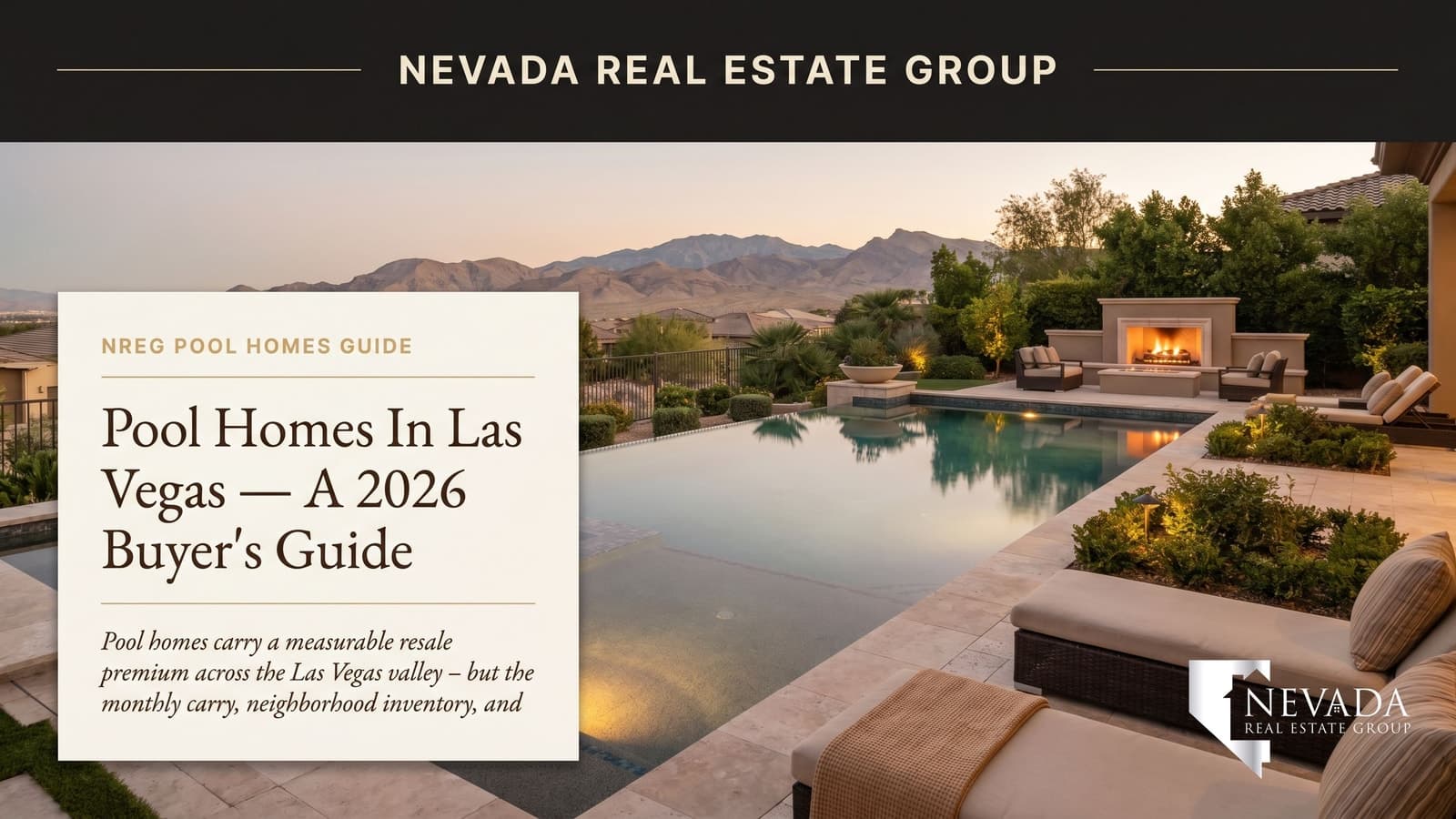

A pool in Las Vegas is not a luxury add-on — it is an expected feature in the mid-to-upper price tiers, and in our desert climate it gets used seven to eight months a year compared with three to four months in most of the country. Across our 9,600+ closings at Nevada Real Estate Group — spanning every price tier from first-time buyer entry homes under $350,000 to luxury community estates above $3 million — we have tracked pool-equipped homes and pool-less homes side by side for over a decade, and the pattern is consistent: a pool at the right price point accelerates days-on-market and draws more competitive offers, but it does not return dollar-for-dollar at resale, and the ongoing water, energy, and maintenance costs are higher than most buyers model before they close.
The numbers in 2026 look like this: building a basic gunite pool runs $45,000–$65,000 before decking, landscaping, or a spa. A mid-range custom build with water features and upgraded finish lands $65,000–$100,000. A luxury package with spa, fire features, covered pergola, and resort-style decking can reach $100,000–$200,000+. Annual maintenance adds $1,200–$2,400 for professional service, and an uncovered Las Vegas pool loses four to six feet of water depth over the summer through evaporation alone. Insurance premiums rise because a pool is legally an "attractive nuisance" under Nevada law, and Clark County code mandates a barrier fence with a self-latching gate before a certificate of occupancy is issued on any new pool.
This is the complete 2026 guide for Las Vegas and Southern Nevada communities buyers evaluating whether to buy a home with a pool, build one after closing, or pass entirely — and for current owners managing the full cost of pool ownership in the desert. Every figure cited is sourced from Clark County permit data, Southern Nevada Water Authority evaporation studies, Las Vegas REALTORS closing records, and NV Energy rate data. Our direct line is (702) 637-1759 if you want us to pull comparable sold data on pool vs. no-pool homes in a specific neighborhood before you make an offer.
A Las Vegas pool costs $45,000–$65,000 for a basic gunite build, $65,000–$100,000 mid-range, and $100,000–$200,000+ for a luxury package with spa and water features. Annual ownership runs $3,000–$5,500 including water, energy, and maintenance. Pools recover 50–70% of build cost at resale. In the $600,000-plus tier a pool is expected and accelerates the sale; below $500,000 weigh the full carrying cost first.
- Building a gunite pool in Las Vegas runs $45,000–$200,000+ in 2026 — basic shell plus decking often lands $80,000–$120,000 all-in.
- Annual pool ownership costs $3,000–$5,500 including professional service ($1,200–$2,400), water, and energy — model this before you buy.
- An uncovered Las Vegas pool loses 4–6 feet of water depth each summer to evaporation — a pool cover cuts loss 50%+ and earns SNWA rebates.
- Pools are an "attractive nuisance" under Nevada law — Clark County barrier fencing is required, and homeowners insurance liability premiums rise.
- Always get a dedicated pool inspection ($150–$350) before removing contingencies on a pool home — deferred maintenance often runs $8,000–$20,000.
Across our 789 closings in 2025 — $440M+ in production as the #1-ranked real estate team in Nevada — pools came up in the inspection, negotiation, or appraisal on a significant share of our mid-to-upper-tier transactions. Whether you are buying in Henderson, Summerlin, or anywhere across Las Vegas, the patterns below are what we have learned from that pipeline, layered against the public cost data from Clark County, SNWA, and LVR.
How Much Does It Cost to Build a Pool in Las Vegas in 2026?
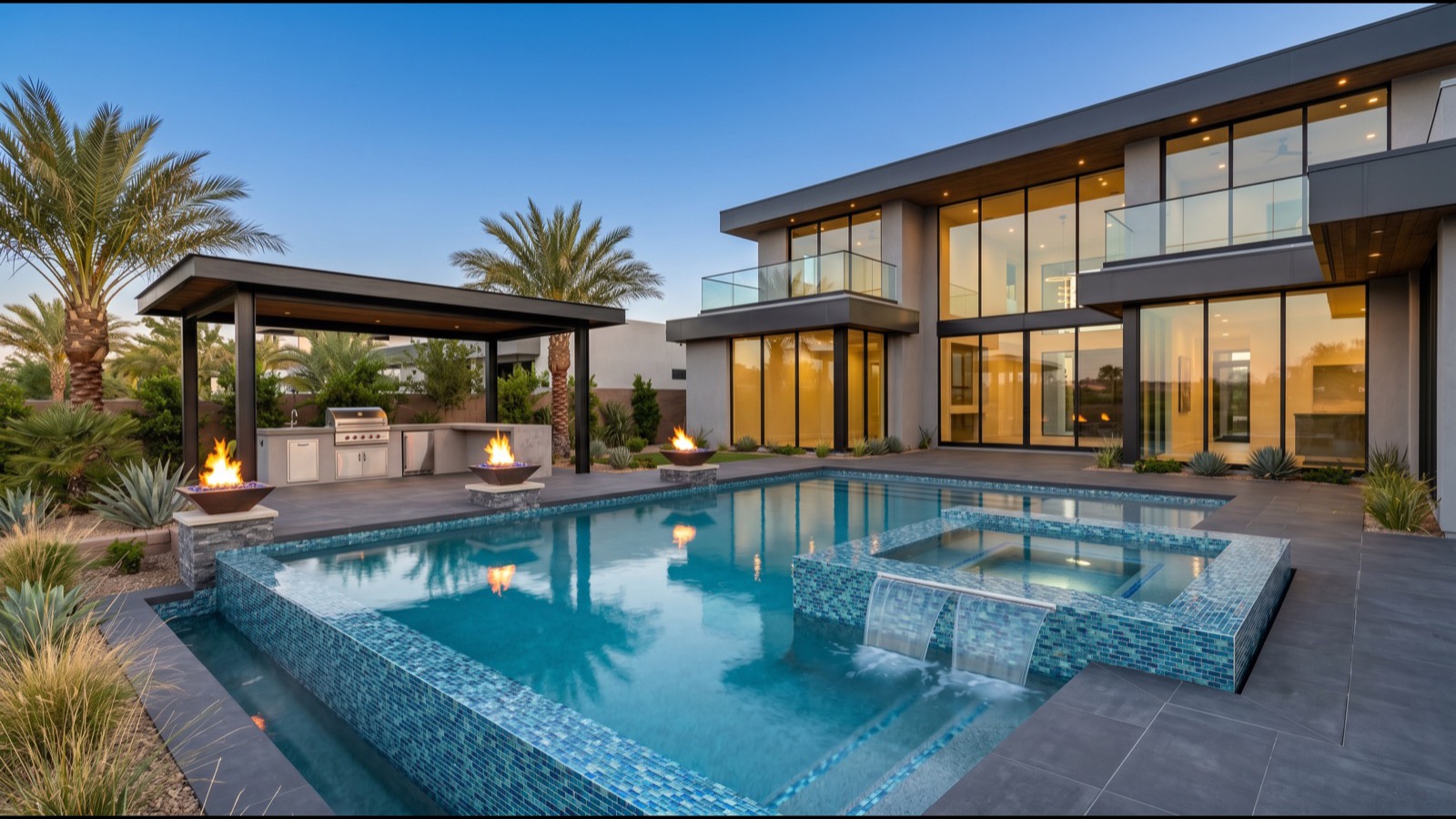
Building a gunite or shotcrete in-ground pool in Las Vegas in 2026 costs $45,000–$65,000 for the basic shell — structure, plaster or pebble finish, basic equipment (pump, filter, basic heater), and a simple concrete deck. Mid-range custom pools with upgraded finishes, water features, LED lighting, and expanded decking land at $65,000–$100,000. Luxury builds with a spa, fire-and-water features, full outdoor kitchen integration, resort-style decking in travertine or flagstone, and premium landscaping reach $100,000–$200,000+.
Those ranges are for the pool package in isolation. Most buyers who build post-close find that the full backyard transformation — pool, decking, landscaping, fencing, shade structure, and electrical upgrades for the equipment — lands $30,000–$60,000 above the pool contract price. A buyer who budgets $65,000 for a pool often ends up at $110,000 once the backyard is fully finished. According to Clark County Department of Building permit data, average pool permit values in Clark County have risen approximately 18–22% since 2021 as material costs (gunite, rebar, concrete) and contractor labor have increased alongside broader construction inflation.
The build timeline also matters in Las Vegas: most licensed pool contractors are running 8–14 week lead times from permit approval to water. Clark County pool permits require structural drawings, contractor licensing verification, and barrier/fence compliance documentation before issuance. Buyers considering new construction homes in Las Vegas homes should ask about pool permits at the design-center stage, since locking the permit before framing is complete saves weeks. According to Clark County Department of Building, residential pool permits are in the top-ten permit categories by volume in the county — reflecting Las Vegas's position as one of the highest-residential-pool-density metros in the United States.
What Is the True Annual Cost of Pool Ownership in Las Vegas?
The true annual cost of a Las Vegas pool is $3,000–$5,500/year when you add professional maintenance, water, energy, and minor repairs — not the $1,200–$2,400 pro-service figure that pool contractors typically quote. That service figure covers chemical balancing, brushing, skimming, and equipment checks. It does not cover the water you lose to evaporation, the electricity your pump and heater consume, or the repair calls you will eventually need.
Professional pool service in Las Vegas runs $100–$200 per month ($1,200–$2,400/year) for weekly visits. This is the baseline. DIY chemical maintenance runs $50–$80/month in materials if you are willing to test and balance yourself — feasible but most Las Vegas owners with jobs and families outsource it. Variable-speed pumps (now required by Clark County energy code on new pools) reduce electricity consumption meaningfully compared with single-speed models, but running a pool pump and heater in Las Vegas still adds approximately $60–$120/month to your NV Energy bill depending on heater use and pump schedule. According to NV Energy, Southern Nevada residential rates as of 2026 sit at approximately $0.11–$0.14/kWh depending on tier, and a variable-speed pump running 8 hours/day uses approximately 1–3 kWh/hour on low-medium speeds.
Water cost is the sleeper expense — a surprise to many buyers moving from wetter climates to Las Vegas. An uncovered Las Vegas pool loses 4–6 feet of water depth over the summer — roughly 20,000–40,000 gallons per season depending on pool size — almost entirely to evaporation in the desert heat and wind. According to the Southern Nevada Water Authority, a 400-square-foot pool surface loses approximately 1 inch of water per day in July at average valley temperatures and wind speed. At current SNWA tiered rates, adding 20,000–40,000 gallons in makeup water adds $150–$600/year to the water bill on top of normal household usage. SNWA offers pool cover rebates for qualifying covers that document 50%+ evaporation reduction — worth claiming at snwa.com if you own or are buying a pool home.
What Are the Long-Term Maintenance and Replacement Costs?
Long-term pool ownership follows a predictable cycle: resurfacing every 10–15 years ($5,000–$15,000 depending on finish — basic plaster at the low end, pebble or quartz aggregate at the high end), plus equipment replacement cycles that average $1,500–$5,000 per event. Planning for these in your ownership budget matters.
Equipment lifespans in Las Vegas's mineral-rich water and heat environment run shorter than national averages. Across the pool homes we have closed in Henderson and throughout Las Vegas, pool pumps typically last 8–12 years. Heaters last 7–10 years depending on usage. Salt chlorinators (now common on Las Vegas pools) last 4–7 years before the cell needs replacement ($600–$1,200 for the cell alone). Filters last 10–15 years before media replacement is needed. Automation systems and LED light fixtures add another replacement category. A pool that is 12–15 years old when you buy it is likely within 1–3 years of a resurfacing and may be within 2–5 years of one or more equipment replacements — factors to negotiate into the purchase price or budget for post-close.
According to Las Vegas REALTORS, pool condition is one of the top-three negotiation points on pool-home transactions in the mid-price tier ($450,000–$750,000), frequently resulting in either seller price reductions or repair credits when the inspection reveals aging plaster or failing equipment. In our experience at NREG, buyers who skip the dedicated pool inspection (a separate $150–$350 call from the general home inspection) often discover $8,000–$20,000 in deferred pool maintenance that was not visible in listing photos.
| Cost Category | Basic Pool (Basic Shell) | Mid-Range Custom | Luxury/Spa Package |
|---|---|---|---|
| Professional maintenance | $1,200–$1,500/yr | $1,500–$2,000/yr | $2,000–$2,400/yr |
| Electricity (pump + heater) | $600–$900/yr | $900–$1,400/yr | $1,400–$2,200/yr |
| Water (evaporation makeup) | $150–$250/yr | $250–$400/yr | $400–$600/yr |
| Chemicals (if DIY) | $600–$960/yr | $700–$1,100/yr | $900–$1,400/yr |
| Annualized resurfacing reserve | $333–$500/yr | $500–$700/yr | $700–$1,000/yr |
| Annualized equipment reserve | $200–$350/yr | $350–$600/yr | $600–$1,000/yr |
| Total estimated annual cost | $3,083–$4,460 | $4,300–$6,200 | $6,100–$8,600 |
How Does a Pool Affect Homeowners Insurance in Las Vegas?
A pool raises your homeowners insurance liability premium because it qualifies as an "attractive nuisance" under Nevada common law — a structure that foreseeably attracts children who cannot appreciate its danger. According to insurance industry data, adding a pool increases homeowners liability premiums by $50–$300/year on a standard policy, though the actual increase depends on the carrier, policy limits, and whether you carry umbrella liability coverage.
Most Las Vegas homeowners with pools should carry $300,000–$500,000 in liability on the base policy and a separate umbrella policy of at least $1,000,000 — something our sellers team routinely flags when preparing a pool home for market — a combination that adds roughly $150–$350/year in total premium above a non-pool home profile. According to Nevada Revised Statutes and Clark County code, a homeowner is legally responsible for injuries occurring in or around the pool regardless of whether the injured party had permission to be on the property — the attractive nuisance doctrine removes the normal trespasser defense for children. This is not an abstract risk: Las Vegas sees a disproportionate number of residential drowning incidents relative to cold-climate metros simply because pools are more numerous and more frequently used.
Clark County requires a barrier fence with a minimum height of 5 feet, self-latching and self-closing gates that open outward and latch at least 54 inches above the ground, and no direct access from the home to the pool area through a gate (meaning a door directly from the house to the pool deck without a separate self-closing barrier does not satisfy the code). Failure to maintain code-compliant barriers can void insurance coverage on pool-related claims. Many carriers also require a pool alarm that triggers if the water surface is broken — a requirement worth confirming with your agent before closing on a pool home.
Does a Pool Add Value at Resale in Las Vegas?
A pool adds meaningful but not dollar-for-dollar value at resale in Las Vegas — the typical recovery is 50–70% of build cost capitalized into appraised value. That means a $70,000 pool adds approximately $35,000–$49,000 in appraised value in most mid-tier Las Vegas neighborhoods. The recovery percentage is higher in the upper-tier market and lower in the entry-tier market.
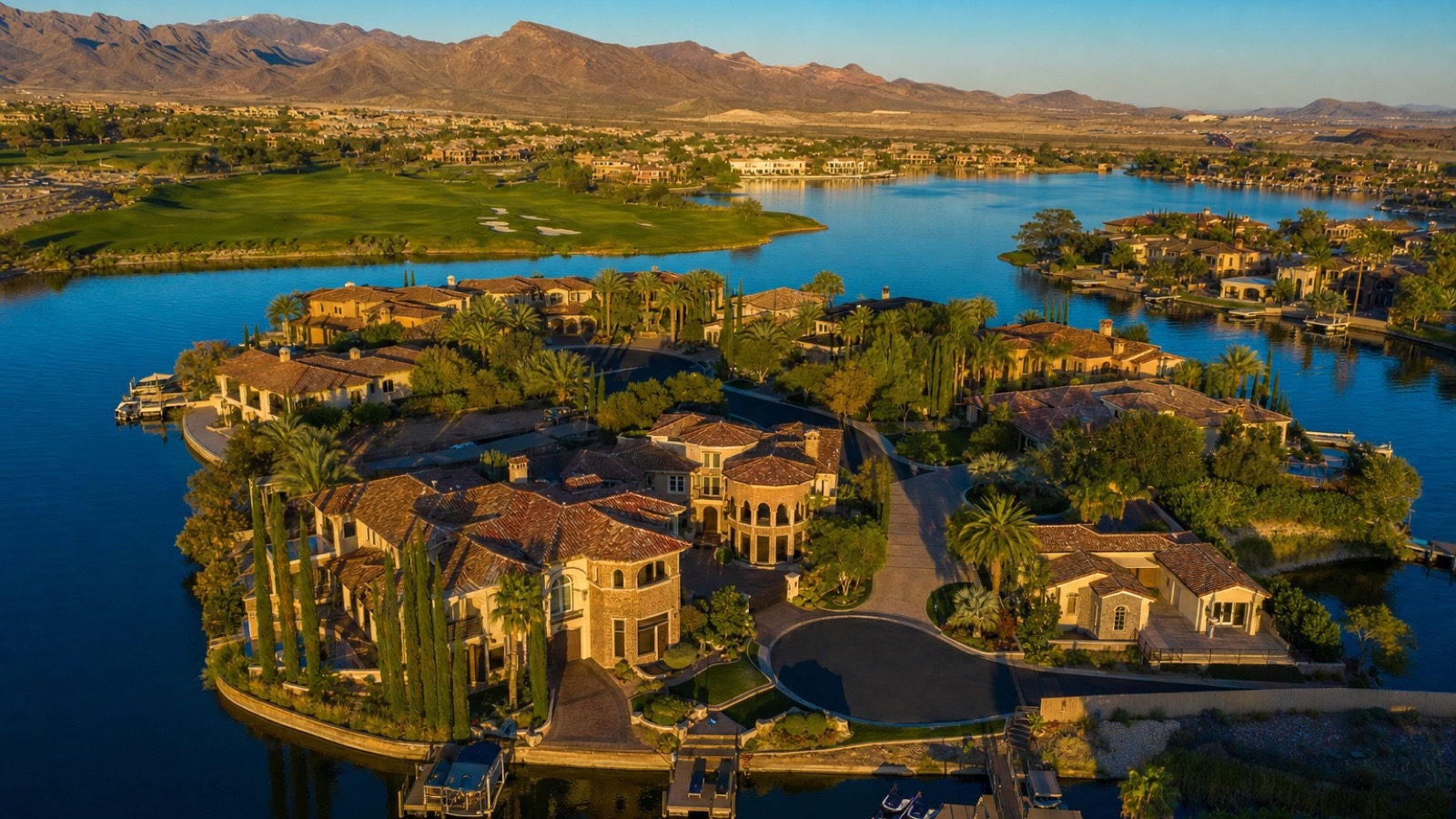
The marketability impact is more significant than the appraisal impact. According to Las Vegas REALTORS market data, pool-equipped homes in the $600,000–$1,000,000 price range sell approximately 10–18 days faster on average than comparable pool-less homes in the same neighborhoods and price brackets. In the $1,000,000+ tier — particularly in luxury communities like MacDonald Highlands, Anthem Country Club, and Summerlin guard-gated villages — a pool is essentially mandatory for marketability: pool-less luxury listings sit 30–60+ days longer and frequently require price reductions to compensate. In our experience closing luxury communities and guard-gated transactions across the valley, a luxury home listed without a pool in a neighborhood where 85%+ of comparable listings have pools will sit regardless of how well the interior is finished.
The calculus is different below $500,000. At the entry-to-mid tier — neighborhoods like North Las Vegas or established Henderson east-side communities — a pool adds some marketability but also narrows your buyer pool (some buyers with young children specifically want a pool-free yard) and adds carrying cost that is proportionally heavier relative to home value. A $30,000 annual pool carrying cost on a $450,000 home is a meaningfully larger percentage burden than the same cost on a $900,000 home. According to Clark County Assessor appraisal methodology, pool value is depreciated over a 15–20 year useful life for assessment purposes, meaning a 15-year-old pool adds significantly less to assessed value than a newly-built pool — a nuance that affects your property tax base but is separate from market appraisal.
Should You Buy a Home With a Pool or Build One After Closing?
Buying a home with an existing pool is almost always more cost-efficient than building post-close, provided the existing pool is in good condition — which is why the dedicated pool inspection is non-negotiable before you remove contingencies. A comparable home with a functioning 5-to-8-year-old pool typically sells for $25,000–$45,000 more than the same home without a pool, while building that same pool yourself post-close would cost $60,000–$90,000 all-in. The math favors buying with a pool if you want one.
The decision shifts if the existing pool needs significant work. An aging plaster resurfacing ($8,000–$15,000), a heater replacement ($2,500–$5,000), and a pump/filter upgrade ($1,500–$3,500) can add $12,000–$23,500 in near-term capital requirements on top of the purchase price premium. In these cases, buying the pool-less comp at $25,000–$45,000 less and building a new pool with exactly the layout and features you want — on your timeline, to your spec — can be the better outcome. It requires bridge capital and patience (8–14 weeks for pool construction), but you get a zero-deferred-maintenance pool with full warranty coverage and your choice of finish.
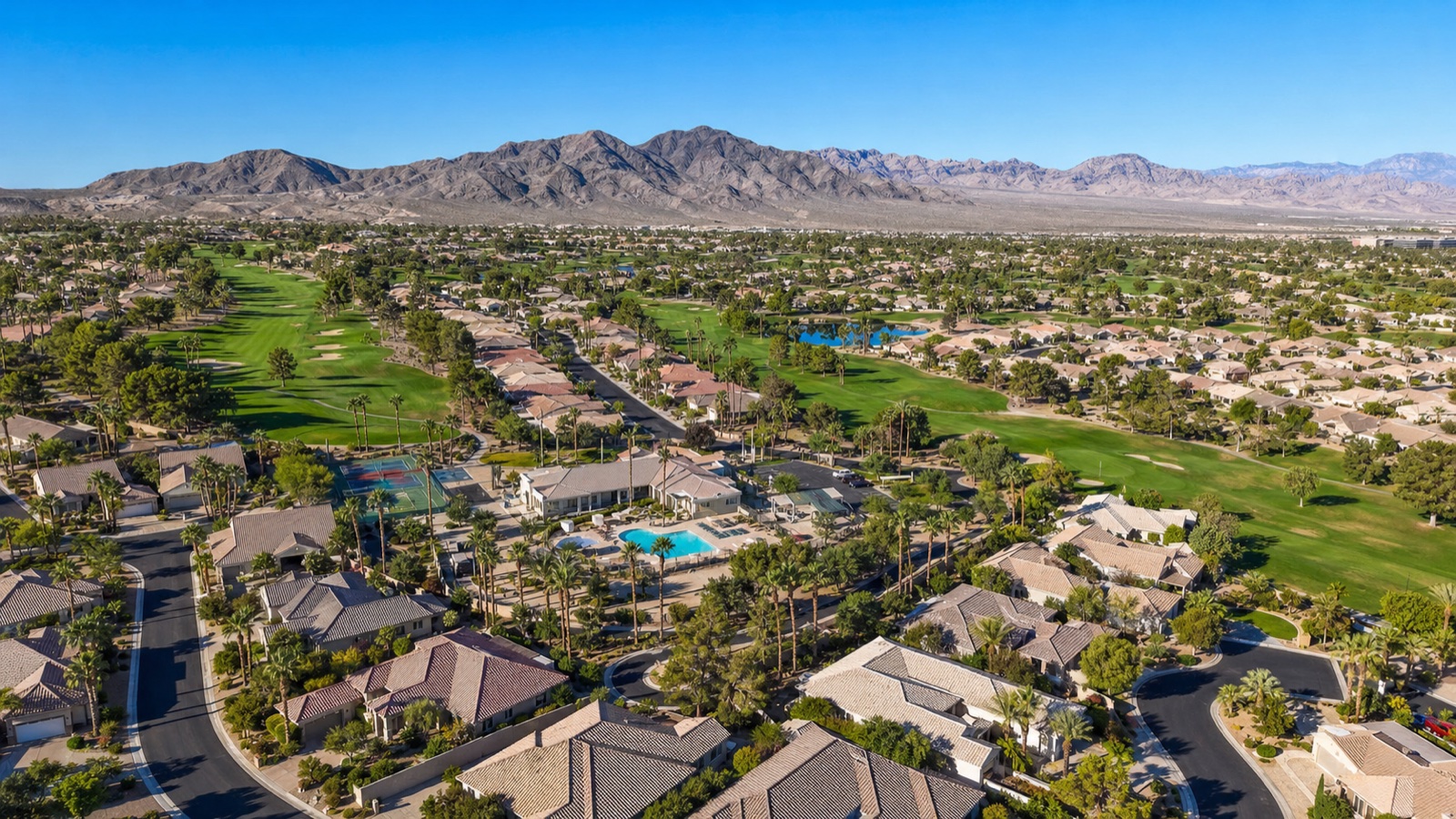
According to U.S. Census Bureau American Housing Survey data, approximately 30–35% of Southern Nevada single-family homes have an in-ground pool — among the highest rates in the country, comparable only to parts of Florida and Arizona. This density means there is always a healthy selection of pool homes in every price tier in the Las Vegas market, making it realistic to be selective about pool condition before buying. If you are relocating to Las Vegas from a non-pool-climate state, see our moving to Las Vegas guide for broader context on what first-year desert living costs look like.
If you are buying in Summerlin master-planned community villages or in one of the new construction communities currently active in the valley (Skye Canyon, Inspirada, Cadence Henderson), many production builders offer pools as a design center upgrade packaged with the original build — frequently $55,000–$80,000 added to the purchase price. This is typically the least expensive way to get a new pool since the builder's contractor pricing (volume discount) is better than what a retail consumer pays on an individual build contract. The trade-off is that builder pool specs are basic — rectangular or kidney-shaped with standard equipment — versus a custom post-close build where you control every design element.
What Does SNWA's Water Policy Mean for Pool Owners?
The Southern Nevada Water Authority manages water use across the seven-member Las Vegas valley water agencies under a strict Colorado River allocation framework, and pool owners sit at the intersection of two water-policy pressures: mandatory restrictions in drought years and tiered pricing that escalates cost for high-usage households. Understanding both before buying or building a pool matters more in Las Vegas than in any other major metro in the country.
SNWA's current tiered rate structure escalates sharply after the base tier — a pool home that regularly exceeds the household baseline allocation by 40%+ to compensate for evaporation can land in Tier 3 pricing, where marginal water costs approximately 3× the base rate. This is the reason evaporation management matters: according to SNWA, a standard pool cover rated for evaporation control reduces water loss by 50–80%, turning a $400–$600 annual evaporation makeup cost into a $80–$200 annual cost. SNWA offers a Pool Cover Rebate of up to $200 for qualifying purchases — details at snwa.com. In drought years, SNWA can mandate watering schedule restrictions and even require pool covers on outdoor features — a risk that pool owners should understand as part of the long-term ownership profile in the Colorado River basin.
SNWA also restricts new grass installation in the Southern Nevada service area, and the 2021 legislation that took effect in 2023 removed decorative grass from commercial and HOA common areas. Residential pools are not currently restricted as a category — but they are monitored, and SNWA's long-term water policy direction continues to reward efficiency and penalize high-use outliers. A pool cover is not just a financial smart move; in the current policy environment, it is a water stewardship baseline. New construction homes built since 2021 in Las Vegas are required to include water-efficient landscaping plans as part of permit approval — pool permits are reviewed in the same submission package.
What Should Buyers Check When Buying a Home With a Pool?
Buying a pool home requires a dedicated pool inspection separate from your general home inspection — the two are different disciplines, and a general home inspector is not trained or equipped to evaluate pool equipment, plumbing, plaster condition, or shell integrity. A licensed pool inspector typically charges $150–$350 and provides a written report covering every component.
According to Las Vegas REALTORS data on pool-home transaction concessions, the most common defects discovered at inspection in our market are: aging plaster or pebble finish (resurfacing due within 2–3 years, $5,000–$15,000); heater failure or age (replacement $2,500–$5,000); variable-speed pump not installed (Clark County energy code requires variable-speed on new pool equipment installations — sellers of older pools may have non-compliant single-speed pumps that need upgrading if replaced, $600–$1,500); deck cracks or settling ($1,000–$8,000 depending on severity); leak in the shell or plumbing (shell cracks can be minor cosmetic issues or significant structural concerns — pool leak detection costs $200–$500 and is worth adding if the inspector notes any moisture concerns near the pool deck); and non-compliant barrier fencing (missing self-latching mechanisms, incorrect gate height, direct-access entries from the house).
All of these are negotiable in the purchase contract, and most experienced Las Vegas buyer's agents (including our NREG team at (702) 637-1759) will incorporate pool inspection findings into either a repair request or a price reduction request during the inspection period. First-time buyers and relocators should review our buyers guide for how inspection periods and repair requests work under Nevada purchase contracts — and our first-time buyer resources page for step-by-step Nevada closing guidance. The key is that you need the dedicated inspection to have any leverage — without a professional pool report, you cannot quantify the condition defects and you cannot negotiate effectively. In our experience, buyers who invest $150–$350 in a proper pool inspection and then use those findings to negotiate frequently recover $5,000–$20,000 in concessions that more than offset the inspection cost.
| Component | What to Check | Typical Replacement Cost |
|---|---|---|
| Plaster/pebble finish | Age, roughness, staining, delamination | $5,000–$15,000 to resurface |
| Pump | Variable-speed (code), noise, age, flow rate | $600–$1,500 to replace |
| Filter | Condition, media age, pressure | $400–$1,200 to replace |
| Heater | Age, BTU output, gas vs heat pump | $2,500–$5,000 to replace |
| Salt chlorinator cell | Cell age, reading, salt level | $600–$1,200 for cell replacement |
| Shell integrity | Cracks, leaks, settling | $500–$15,000+ depending on severity |
| Deck/coping | Cracks, settling, loose coping | $1,000–$8,000 to repair/replace |
| Barrier fencing | Height, self-latching gate, no direct house access | $500–$3,000 to bring into compliance |
| Automation system | Function, app connectivity, age | $800–$3,000 to replace/upgrade |
| LED/fiber lighting | Function, leaks around fixtures | $200–$800 per fixture |
How Do Pool Costs Compare: Building vs. Buying With One vs. Skipping?
The financial comparison across the three paths is nuanced and depends on your price tier, timeline, and carrying-cost tolerance. According to our NREG transaction data and current contractor pricing, the rough cost framework looks like this: buying a home with a good existing pool typically costs $25,000–$45,000 more than the pool-less equivalent and delivers a pool with some remaining useful life. Building post-close costs $60,000–$150,000+ all-in (pool, decking, landscaping, fencing, electrical) and takes 3–6 months from contract signing. Skipping entirely saves all capital and carrying cost but can hurt marketability at resale in the mid-to-upper price tiers.
For sellers, the equation is clear: in Las Vegas homes priced above $600,000, listing without a pool puts you at a structural disadvantage versus pool-equipped comps. Our sellers team at NREG routinely advises clients in this tier to either install a pool before listing (if timeline permits) or price proactively to compensate for the disadvantage — typically $20,000–$40,000 below what a pool-equipped equivalent would command. Review our 7-day listing guarantee page for how pool condition factors into our pricing strategy conversation. Below $500,000, the impact is smaller and the decision is more case-by-case.
| Dimension | Buy Home With Pool | Build Post-Close | Skip the Pool |
|---|---|---|---|
| Upfront premium/cost | $25K–$45K added to purchase price | $60K–$150K+ all-in build cost | $0 — lowest price tier |
| Timeline to swim | Day of close | 3–6 months post-close | N/A |
| Customization | Limited to existing layout | Full custom spec | N/A |
| Deferred maintenance risk | Moderate-high (depends on age) | Zero (all new) | None |
| Annual carrying cost | $3,000–$5,500/yr | $3,000–$5,500/yr (after build) | $0 |
| Resale value impact | Positive — pool already captured in price | 50–70% of build cost recovers | Negative at $600K+ tier |
| Clark County barrier required | Verify compliance before close | Required before CO issuance | N/A |
| Insurance impact | Increase $50–$300/yr liability | Increase $50–$300/yr liability | No impact |
What Are the Clark County Code Requirements for a Pool?
Clark County's residential pool code under the Nevada Revised Statutes framework and Clark County municipal code requires barrier compliance before a pool can be filled and before a final certificate of occupancy is issued on a new pool permit. The requirements are:
Barrier fence: minimum 5 feet in height, no handholds or footholds that a child could use to climb, maximum 2-inch gap at the bottom. Gates must be self-closing and self-latching, with the latch on the inside of the gate at least 54 inches above grade or placed where a child cannot reach it. Gates must open outward (away from the pool) and latch automatically without manual engagement. Direct access from the home to the pool area — a door from the house that opens directly onto the pool deck without a compliant barrier gate — is not permitted; an intervening barrier gate or door with a compliant auto-latch is required. Pool alarms are required in some jurisdictions; Clark County strongly encourages them and some HOAs mandate them.
According to Clark County, all new pool construction requires a building permit, a pre-gunite inspection (structural), a pre-plaster inspection, and a final inspection before water can be added. Unpermitted pools — pools that were built without the required permit chain — are a documented risk on older Las Vegas resale homes (particularly those built in the 1990s and early 2000s when enforcement was less consistent). An unpermitted pool can cause insurance coverage problems, appraisal challenges, and seller disclosure liability. Always verify that pool permits and final inspections are on record at Clark County for any pool home you are considering.
Frequently Asked Questions
Is a pool worth it in Las Vegas from a resale perspective?
A pool is worth it at resale in the $600,000-plus price tier, where it is an expected feature and its absence can add 30–60+ days to market time and require a price discount of $20,000–$40,000 versus comparable pool-equipped listings. Below $500,000, the resale premium is smaller (roughly $15,000–$25,000) and recovery on a new build is typically 50–70% — meaning a $70,000 pool adds roughly $35,000–$49,000 in appraised value. The marketability benefit often matters more than the appraisal math.
How much does pool evaporation cost in Las Vegas per year?
An uncovered Las Vegas pool loses approximately 4–6 feet of water depth over the summer, equivalent to 20,000–40,000 gallons of makeup water per season depending on pool surface area. At current SNWA tiered rates, this adds approximately $150–$600 per year to your water bill. A qualifying pool cover cuts evaporation by 50–80% and SNWA offers a rebate of up to $200 for qualifying cover purchases — details at snwa.com.
What does Clark County require for a pool barrier fence?
According to Clark County residential code, a pool barrier must be at least 5 feet tall with a self-closing, self-latching gate that opens outward. The latch must be on the pool side at least 54 inches above grade. No direct-access entry from the house to the pool deck without a compliant gate is permitted. Pool alarms are strongly encouraged. All new pool construction requires a permit and three inspections before water can be added.
How much does a pool inspection cost in Las Vegas and what does it cover?
A dedicated pool inspection from a licensed pool inspector costs $150–$350 in Las Vegas. It covers plaster/pebble finish condition, pump and filter age and performance, heater function, salt chlorinator cell status, shell integrity for cracks or leaks, decking condition, barrier fence compliance, automation system function, and lighting. This is separate from a general home inspection. In our experience at NREG, buyers who get a pool inspection frequently recover $5,000–$20,000 in negotiated concessions based on the findings.
Do new construction builders in Las Vegas offer pool packages?
Yes — many production builders in active Las Vegas master plans including Summerlin villages, Skye Canyon, Inspirada, and Cadence Henderson offer pool packages through their design centers, typically at $55,000–$80,000 added to the base purchase price. Builder pool pricing benefits from volume contractor discounts and is often $10,000–$25,000 below what you would pay building the same pool post-close through a retail contractor. The trade-off is limited customization — builder pools are typically simple rectangular or freeform shapes with standard equipment.
Does a pool affect my homeowners insurance in Nevada?
Yes — a pool raises your liability exposure because it qualifies as an "attractive nuisance" under Nevada common law. Most carriers increase liability premiums by $50–$300 per year and recommend raising liability limits to $300,000–$500,000 on the base policy plus a separate $1,000,000 umbrella policy. The total premium impact is typically $150–$350/year above a non-pool home profile. Failure to maintain code-compliant barriers can void coverage on pool-related claims, so fence and gate compliance is both a legal and an insurance requirement.
Which Sources Inform This Las Vegas Pool Cost Guide?
This guide draws on Clark County permit data, SNWA evaporation and rebate documentation, NV Energy residential rate schedules, Las Vegas REALTORS market transaction data, Nevada Revised Statutes, U.S. Census American Housing Survey residential pool ownership data, and NREG's internal transaction pipeline from 789 closings in 2025 and 9,600+ career closings. External sources cited:
Las Vegas REALTORS — Southern Nevada market transaction data and median pricing. Southern Nevada Water Authority — evaporation rates, tiered water pricing, pool cover rebate program. Clark County Department of Building — residential pool permit requirements, barrier code, inspection process. NV Energy — residential electricity rate tiers for Southern Nevada. U.S. Census Bureau American Housing Survey — residential pool ownership rates by metro. Nevada Revised Statutes — attractive nuisance doctrine and residential property law. Clark County Assessor — pool depreciation methodology and assessed value methodology for residential improvements. Nevada Department of Taxation — property tax assessment context for home improvements. Bureau of Reclamation — Colorado River water allocation framework affecting SNWA policy. U.S. Department of Housing and Urban Development — FHA appraisal guidelines for pool valuation in residential transactions. Freddie Mac Primary Mortgage Market Survey — rate context for purchase financing on pool homes. Federal Housing Finance Agency — home price appreciation data for Southern Nevada. Howard Hughes Corporation / Summerlin — new construction pool package pricing in Summerlin master plan villages. City of Henderson — Henderson-jurisdiction pool code and permit process (Henderson properties in Henderson city limits follow Henderson code, not Clark County unincorporated code).
For a personalized analysis of whether a specific pool home or pool-build opportunity makes financial sense for your situation, contact the Nevada Real Estate Group at (702) 637-1759, visit our about page to learn more about Chris Nevada and the NREG team, or visit nevadarealestategroup.com. We pull comparable sold data on pool vs. no-pool homes in any Las Vegas neighborhood on request — it takes about ten minutes and will tell you exactly what the pool premium (or discount) is in the specific market you are targeting.