

NACA offers qualifying Las Vegas owner-occupants a mortgage with no down payment, no mortgage insurance and fixed-rate terms of 15, 20 or 30 years. Buyers still need documented financial readiness, purchase funds and an eligible property. Start with NACA's workshop and qualification process before committing to a home; program approval and a property's closing are separate milestones.
- No down payment does not mean every purchase expense disappears.
- NACA reviews payment history and affordability rather than relying on a credit-score cutoff.
- Qualification comes before a properly coordinated offer and mortgage application.
- Property condition, insurance and association costs still affect the purchase.
- Compare complete loan terms and cash remaining after closing.
A NACA mortgage can change the cash equation for a household that is ready to own a home but does not want a large down payment to consume its savings. The process also asks for preparation, documentation and ongoing participation. Understanding both sides makes it easier to decide whether the program fits your Las Vegas purchase.
This independent guide was researched in September 2026 using NACA's current materials. NACA and the lender determine eligibility and loan approval. The budget examples below are original illustrations, not loan offers, rate quotes or promises of approval.
How Does a NACA Home Loan Work in Las Vegas?
NACA combines homebuyer preparation with access to its mortgage program. The borrower works through qualification, then connects that approval to a particular property and the lender's closing process. It is useful to think of the program as a sequence of decisions: whether the household is ready, what payment is affordable, whether the home works and whether the final loan conditions are satisfied.
According to NACA's mortgage-product FAQ, the mortgage offers no down payment, no lender closing costs, no mortgage insurance and fixed-rate terms. Those features are meaningful, but the payment and funds needed for a particular purchase still require an individualized review. Do not use a headline benefit as a complete household budget.
The real estate search should follow the qualified payment and purchase parameters. A listing price that looks affordable can produce a different result once property taxes, insurance, association dues and any required repairs are included. Two homes at the same price may therefore be different fits for the same buyer.
Create a simple status sheet from the beginning. Record the current stage, the person handling it, the documents requested and the next decision. This prevents an early workshop registration or counselor appointment from being described to a seller as final financing approval. It also makes it easier for your agent to know when it is appropriate to discuss offers.
The program is particularly worth evaluating when retaining cash matters to your household. That could mean maintaining a moving fund, avoiding an overly thin emergency reserve or preserving money for ordinary ownership costs. Those are budget priorities you can discuss without assuming the program is automatically the best choice for every borrower.
Compare NACA with any other financing you are eligible to obtain. Use the same property, same intended occupancy and same purchase date assumptions. The strongest decision is based on the complete financial and practical fit, including the work required to reach closing, rather than on one feature considered in isolation.
Who Can Qualify for NACA in the Las Vegas Area?
Begin with intended occupancy and your household's actual financial circumstances. NACA is a homeownership program, so an investor looking for a property they will not occupy is asking for a different kind of financing. Explain any existing real estate ownership and your intended living arrangement early rather than discovering an eligibility issue after choosing a home.
According to NACA's general eligibility FAQ, the purchased home must be the member's only home at closing and remain the member's primary residence while the NACA mortgage continues. Its priority-member categories consider household income relative to area median family income. Confirm your classification and permitted purchase area with NACA; an old online income figure is not an approval.
Eligibility should not be reduced to a guess based on occupation, age or neighborhood preference. Prepare the facts the counselor requests and let the program evaluate them. If you are changing jobs, have variable earnings, own another property or expect a family gift, raise those issues specifically. The answer may affect documents, timing or the way the purchase is structured.
Ask about membership and participation obligations alongside mortgage eligibility. NACA's eligibility FAQ lists annual membership dues of $36 per household, prorated at $3 per month, and a credit-report charge refunded by the lender at closing. Confirm the current charges and ongoing commitments in your own program documents. These are separate from the down payment and lender closing-cost benefits.
For location questions, give NACA the actual property address when one becomes relevant. Broad labels such as “Henderson” or “North Las Vegas” may not provide the information needed for a program determination. A property search should stay within the parameters confirmed for your household and the specific transaction.
Keep a written list of unanswered eligibility questions and resolve them before making expensive commitments. You do not need to solve the underwriting yourself. You do need to make sure the people evaluating the file have complete information. That approach is usually more productive than trying to fit a personal situation into a generic success story from another city or another year.
What Does NACA Review Instead of Your Credit Score?
The absence of a credit-score cutoff should not be confused with the absence of financial review. A buyer still needs to demonstrate a pattern that supports taking on the proposed housing payment. The useful preparation is accurate records and a realistic budget, not an assumption that unfavorable information will be ignored.
According to NACA's mortgage-underwriting FAQ, the program examines credit-report information, payment history and the household's circumstances without using the credit score as its eligibility measure. It also evaluates whether the borrower can support the proposed payment. NACA's published discussion of payment shock connects a higher housing expense with a demonstrated savings pattern.
Build a record that tells a coherent story. If rent is paid electronically, preserve the statements or records that show the payments. If an account contains an unusual deposit or a transfer between your own accounts, keep the documentation that explains it. A clear file reduces the need for someone to reconstruct events from disconnected screenshots.
Discuss problems honestly. An incorrect credit-report entry, a late payment and an expense outside your control are different situations. Provide the facts and supporting records requested by the counselor. Avoid paying a third party to make a sweeping promise about eligibility or deleting information merely because you fear it will raise a question.
Consider your own comfort level separately from the maximum payment a program may permit. A household can technically qualify for a payment and still prefer a lower one because of childcare, variable work hours, travel or savings goals. A useful budget reflects those choices rather than treating approval as an instruction to spend the maximum.
Keep the preparation routine manageable: organize incoming records, follow the action plan and check that requested items were accepted. If a document is unclear or incomplete, ask what would resolve it. The objective is a dependable demonstration of readiness, with a payment that continues to work after the excitement of buying a home has passed.
What Documents Should You Prepare Before Your Counseling Appointment?
Start with the current checklist NACA provides, then organize the requested documents by subject and date. Requirements can differ with employment type and personal circumstances. A salaried employee, a self-employed buyer and a household with multiple income sources should not assume they will submit identical files.
According to NACA's qualification-process FAQ, preparation includes income, tax and bank records, with additional documentation for self-employment. The process begins with a homebuyer workshop and continues through the member's file and counseling. Use the checklist assigned to your situation for the exact periods and forms required.
| File group | Examples to discuss with NACA | Preparation habit |
|---|---|---|
| Identity and household | Requested identification and applicant information | Use consistent legal names |
| Income and employment | Pay records, tax documents and self-employment evidence | Include the full requested period |
| Banking and savings | Complete account statements and deposit explanations | Keep all statement pages together |
| Housing and debts | Rent-payment evidence and requested account records | Connect amounts to the household budget |
| Open questions | Job changes, gifts, existing property or unusual transactions | Resolve issues before making an offer |
Use clear filenames, such as the document type, account label and statement month. Keep originals and avoid editing financial documents to make them easier to read. If a page is missing, obtain a complete copy instead of assuming the reviewer will not need it. A file that is easy to follow saves work for both you and the person reviewing it.
Upload sensitive documents through the program's designated secure process. Your real estate agent generally needs to understand your qualification status and purchase parameters; that does not require sending your entire banking and tax file to everyone involved in a home search.
Track whether an item is requested, submitted or accepted. Those are separate statuses. An upload confirmation shows delivery, while acceptance means the reviewer has what is needed. Ask for clarification when a repeated request appears rather than resubmitting the same incomplete material without understanding the problem.
Finally, allow time to maintain the file. Financial documents age while you search, and life changes can require updates. A short recurring review is easier than rebuilding the entire package after a seller has accepted an offer and deadlines are approaching.
What Do Buyers Still Pay If There Is No Down Payment?
Separate the benefits of the mortgage from the money required to complete a purchase and begin ownership. A down payment, a prepaid insurance premium, an inspection bill and cash held in reserve are different categories. Combining them under the phrase “closing costs” can leave buyers unsure which amounts are actually covered.
According to NACA's qualification workbook, members need purchase funds appropriate to their circumstances, including items such as inspection expenses, prepaids and reserves. The current workbook should be used with the individualized counselor review. Optional spending and any proposed rate buydown also need to be considered separately.
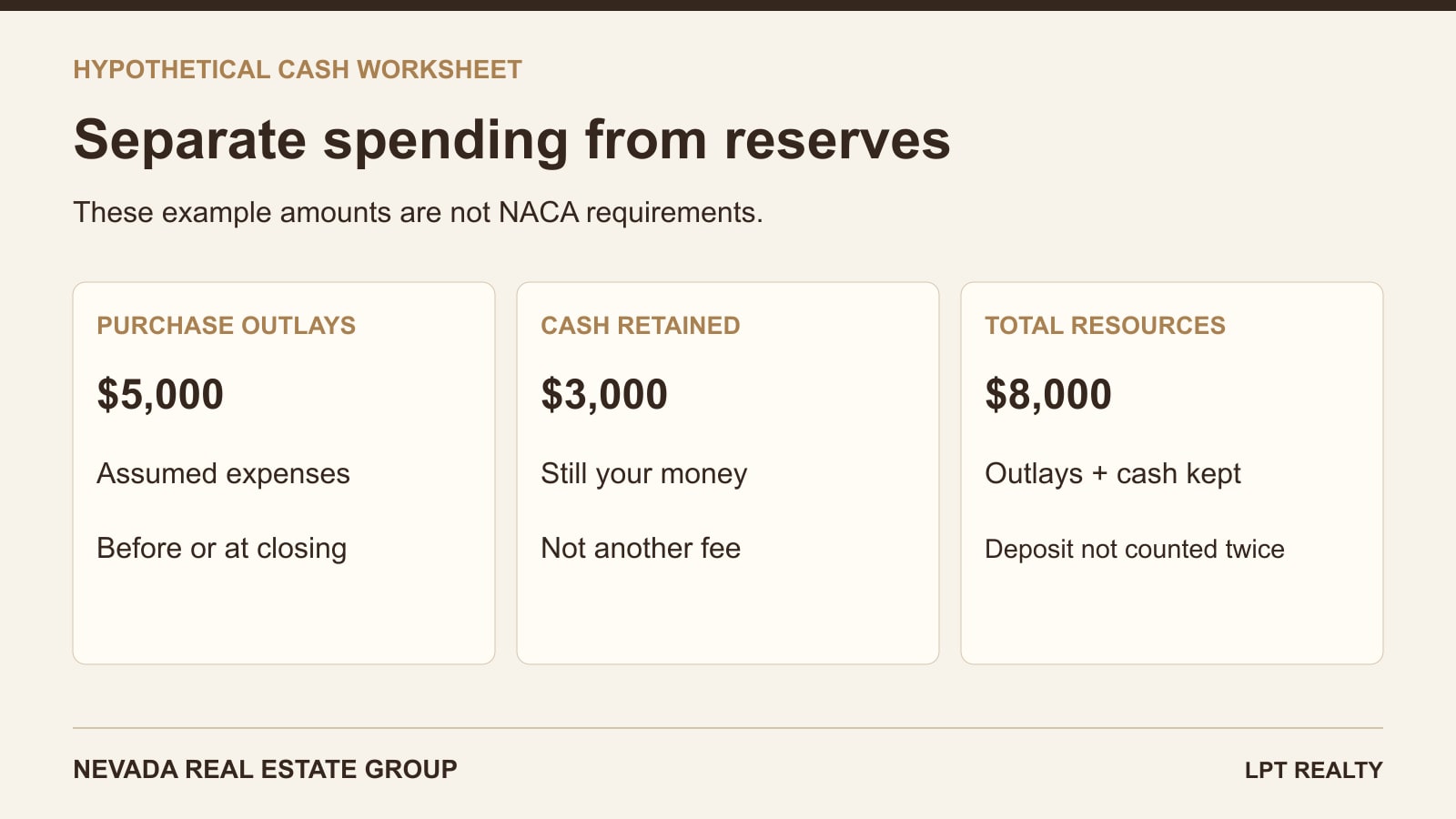
The following September 2026 illustration uses invented round amounts solely to explain the cash categories. It does not predict what NACA will require for your household or what a Las Vegas closing will cost.
| Category | Assumed amount | Treatment in this example |
|---|---|---|
| Purchase-related outlays | $5,000 | Combined assumed expenses paid before or at closing |
| Cash retained after purchase | $3,000 | Reserve balance, not a fee paid to someone |
| Total resources planned | $8,000 | Outlays plus retained cash |
| Earnest deposit already paid | $1,500 | Assumed credited toward the $5,000 outlay total |
| Outlays remaining after that deposit | $3,500 | Before accounting for any other expenses already paid |
The example shows two common accounting mistakes. First, the reserve is money retained, not another transaction expense. Second, an earnest deposit credited in the settlement is not added again as a separate permanent cost. The actual closing statement determines how deposits and credits are applied; this worksheet is not a substitute for that statement.
Ask for a schedule showing when each payment is due. An inspection may require payment well before closing. Insurance or other items may also need attention while the loan is being processed. A household can have enough total resources and still face a timing problem if it expects every dollar to be due on the final day.
Budget the move and early ownership expenses outside the mortgage transaction. Utility deposits, moving services, essential furniture and an unexpected repair can matter even when the program eliminates major loan charges. Preserve a margin that fits your circumstances instead of spending every available dollar because the loan does not require a down payment.
How Can You Practice a Higher Housing Payment Before Buying?
Use your current spending as the starting point for an ownership budget. The proposed housing payment should include the recurring items that will actually apply to the home. Then examine whether the difference can be supported consistently without using credit to cover ordinary living expenses.
For example, suppose current rent is $1,900 and a hypothetical complete monthly housing payment is $2,500. The difference is $600. Saving that difference for four months would accumulate $2,400. These September 2026 example amounts demonstrate arithmetic only; four months is not a promised qualification period, and the payment is not a quote for a particular property.
The exercise is more informative when you track what changed. Did you reduce a discretionary expense comfortably, or did you postpone a bill that will return later? Did overtime temporarily make the budget look stronger? Did a large annual expense happen to fall outside the observation period? Look for a pattern that can continue through an ordinary year.
Add homeownership expenses that are not included in the lender's monthly payment. Maintenance, utility differences and replacement of aging equipment may affect your actual cash flow. The amount will vary by property, but omitting the category entirely makes the budget less useful.
Keep an emergency fund distinct from money you plan to spend on the purchase. Otherwise the same dollars can appear to solve two different needs. If a payment only works after every account is emptied, consider a lower housing target or more preparation time rather than assuming approval will make the budget comfortable.
Bring the results to your counselor. Discuss the proposed payment, the savings record and any expense that the standard application does not explain clearly. The goal is to connect documented affordability with a household plan you understand.
You can also use the exercise to compare properties. A home with higher association dues may require a lower purchase price to fit the same payment ceiling. A home needing immediate equipment replacement may require more cash after closing. Keeping the complete monthly and cash picture visible makes those differences easier to evaluate before an offer.
How Long Does the NACA Process Take in Las Vegas?
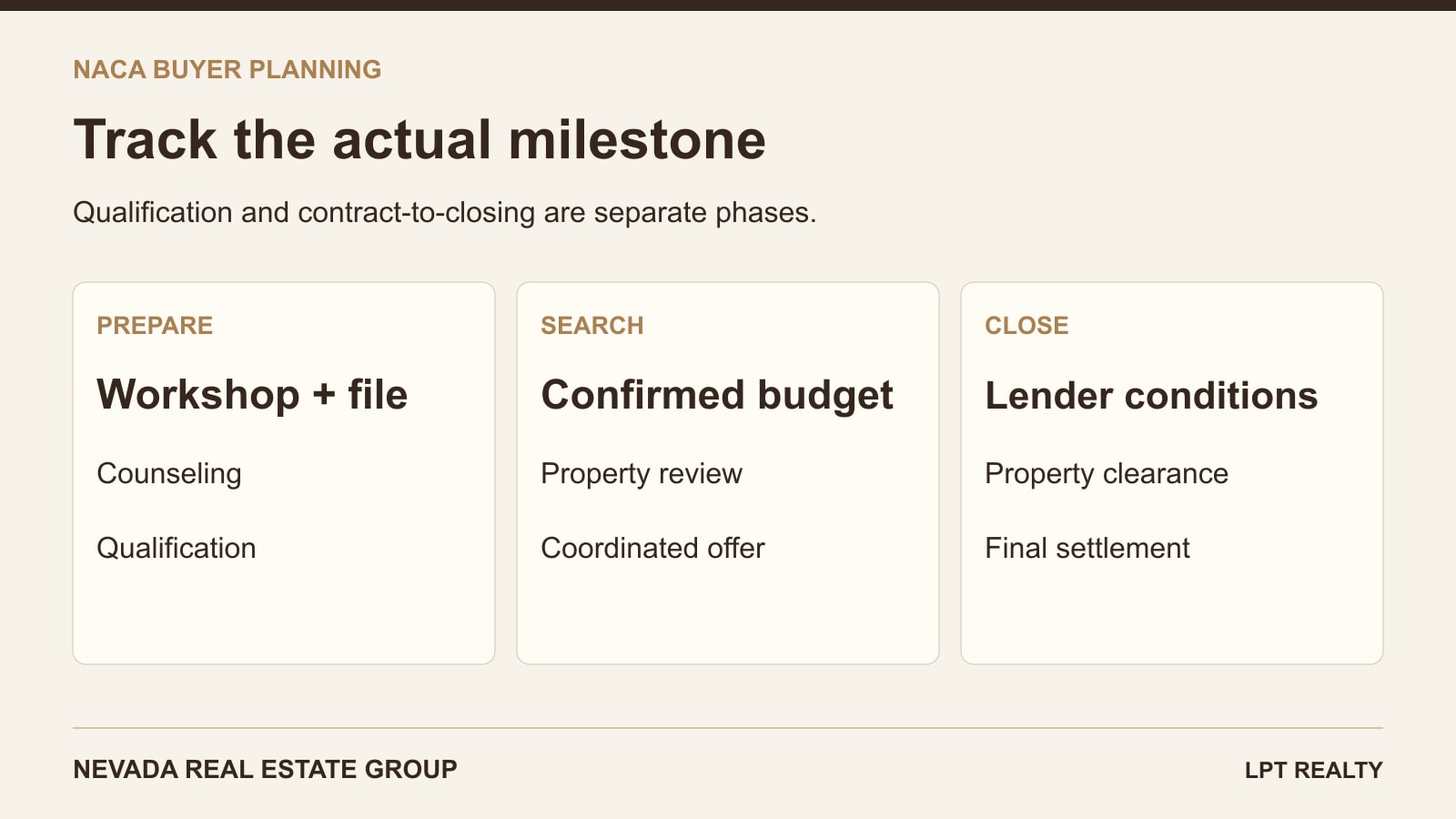
Separate preparation and qualification from the period after a purchase contract is accepted. A buyer who has just registered for a workshop is at a different stage from a qualified member with a complete file and an eligible property. A closing target published for the latter should not be advertised as the entire journey for the former.
According to NACA's mortgage-process FAQ, the program describes a 28-day contract-to-closing target that depends on prompt coordination and completion of required steps. It is not a guarantee for every transaction. Your own schedule also includes whatever time is needed for readiness, qualification and finding a suitable home.
| Stage | Useful evidence of progress | What can affect timing |
|---|---|---|
| Preparation | Workshop completed and requested file assembled | Document availability and household circumstances |
| Qualification | Program determination and purchase parameters | Outstanding action-plan items |
| Home search | Suitable property and coordinated offer | Inventory, budget and property eligibility |
| Under contract | Inspections, lender conditions and property review | Repairs, documents, appraisal and coordination |
| Closing preparation | Final approvals and confirmed settlement instructions | Unresolved conditions and transaction details |
Plan personal commitments around the actual stage. A moving truck reservation, lease termination or nonrefundable storage arrangement can become expensive if made before key conditions are resolved. Ask your agent and closing contacts which milestones support a firmer move date and which uncertainties remain.
If a deadline matters, explain why at the beginning. A job start, school calendar or lease end is useful planning information, but it does not remove the need for qualification or property review. You may need a temporary housing option that reduces pressure to accept an unsuitable purchase just to meet a date.
During the transaction, keep one shared list of open items with responsible people and due dates. Update it when an issue is resolved. If the same question circulates repeatedly, identify who can make the actual decision rather than relying on increasingly confident estimates from people who do not control that step.
The most dependable schedule is built from completed milestones and current information. Treat a target as a planning tool, then confirm the real status before making the next commitment that depends on closing.
Which Las Vegas Homes Should You Consider With a NACA Mortgage?
Begin with the purchase parameters NACA has confirmed for you, then evaluate the actual property. Price, intended occupancy, condition and recurring costs all belong in the decision. A beautiful listing that falls outside the approved search parameters is not made suitable by an attractive monthly-payment estimate from another source.
According to NACA's home-purchase program information, the program supports qualifying owner-occupied home purchases. Property eligibility and the borrower's affordability need to be connected in the actual file. For a condo, multi-unit property, new construction or a home needing work, ask for the relevant requirements before assuming the same process applies in every case.
Tour with a practical checklist. In Las Vegas, look at cooling equipment, roof condition, windows, plumbing, water-heating equipment and visible signs of deferred maintenance. A home does not need to be cosmetically perfect to deserve consideration, but you need to distinguish improvements you would enjoy from problems that may affect the purchase or immediate ownership budget.
For an association property, obtain the current dues and review the relevant documents. Determine what the dues cover and whether there are additional charges or obligations to investigate. A low advertised price can be misleading when recurring costs have not been included in the payment discussion.
Consider location using your own daily requirements: worksite, transportation, shopping, services and the places you visit regularly. Compare Las Vegas, Henderson and North Las Vegas properties through those practical needs and your confirmed eligibility. The community name alone should not determine whether a home makes the shortlist.
Keep a written reason for accepting or rejecting each serious candidate. Over time, that record reveals whether the search is being constrained by price, condition, layout or something else. You can then adjust the right variable instead of raising the budget simply because several unsuitable homes appeared in a row.
The best shortlist contains properties that are plausible financially and operationally, with questions identified early enough to investigate. It should make the eventual offer more informed, not just produce a larger list of houses to tour.
What Happens if the Home Needs Repairs?
Find out which issues must be addressed and how they will be handled before treating the property as ready to close. An inspection is a source of information for several decisions: what the buyer is comfortable owning, what the program requires and what the parties can agree to do under the contract.
According to NACA's property-condition FAQ, its Home and Neighborhood Development department, known as HAND, reviews required property repairs. Existing homes require an inspection through the specified process. Property clearance may involve seller-completed work or an approved repair arrangement; ask HAND what applies to the actual home.
Distinguish three lists: required repairs, recommended maintenance and your desired upgrades. A dated but functional finish is different from a safety or structural concern. Keeping the lists separate helps you negotiate sensibly and prevents an optional remodel from obscuring the items that determine whether the transaction can proceed.
Obtain written estimates when the scope is meaningful. A vague allowance does not tell you whether the necessary work is affordable, whether the contractor can perform it on the required schedule or whether related work has been omitted. Share the relevant information with the people reviewing the property and financing.
Do not begin repairing a seller's home before you own it merely to keep the transaction moving. NACA's property guidance specifically warns members against doing their own pre-closing repairs. If the deal needs a repair solution, coordinate it through the contract and the program's accepted process.
Consider how post-closing work would affect occupancy. Even an approved repair plan can require time, access and coordination after ownership changes. Ask where you would live during disruptive work, whether those costs fit the household budget and who will handle scheduling.
Finally, preserve your ability to make a clear decision. If the inspection reveals a project beyond your budget or comfort level, discuss the available contractual choices with your agent. A favorable mortgage does not eliminate the importance of buying a home whose condition and repair obligations you can realistically manage.
Can You Use Your Own Real Estate Agent With NACA?
Confirm the representation arrangement before beginning the offer process. You want an agent who understands the program's requirements, communicates clearly with the relevant contacts and describes your financing status accurately. A general familiarity with home loans is helpful, but it should not replace checking the actual NACA process.
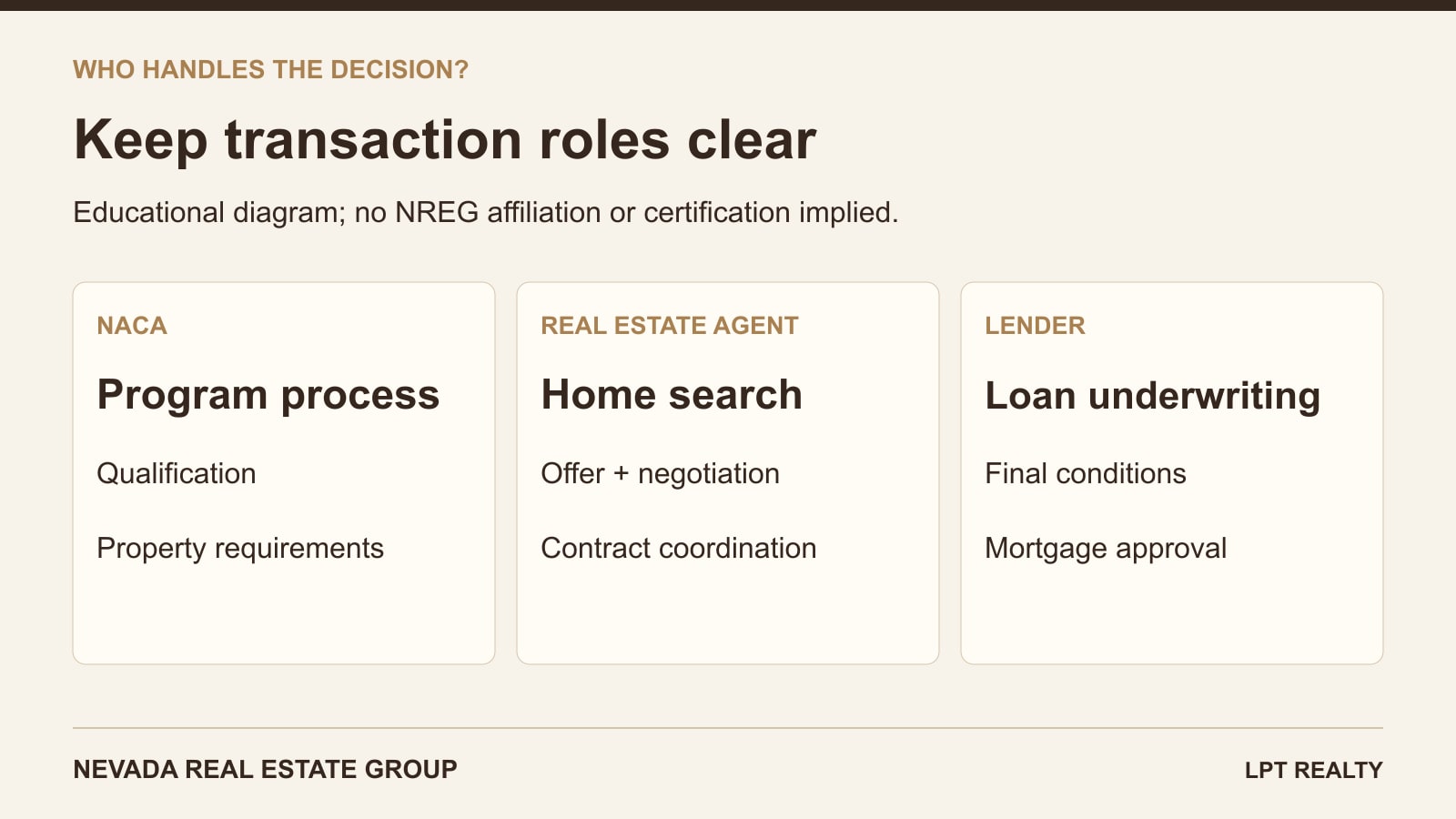
According to NACA's housing-search FAQ, members can work with outside agents subject to NACA's policies. Compensation and participation requirements need to be handled within those policies. This guide does not represent Nevada Real Estate Group as a NACA-certified agent, approved partner or program affiliate.
Ask the agent to explain how they would coordinate the file. Who checks that an offer fits your purchase parameters? How will the signed contract and property information reach the appropriate program contacts? Who tracks inspection and repair deadlines? Clear answers are more useful than a broad promise that the agent has “done loans like this.”
Discuss representation and compensation documents before signing. Make sure you understand the services, obligations and payment arrangements, and confirm that they are compatible with current NACA requirements. If a question arises, resolve it with the appropriate NACA contact before treating the arrangement as settled.
The agent's role also includes helping you evaluate the home beyond financing eligibility. Review the property information, negotiate the purchase terms, coordinate inspections and keep the transaction's deadlines visible. Program approval does not replace that real estate work, just as an agent's enthusiasm does not replace underwriting.
Maintain appropriate privacy boundaries. The agent needs the confirmed budget, status and relevant transaction conditions. Detailed financial records should continue through the secure channels used by the people responsible for qualification and lending. Share what is needed for each role without distributing the whole application unnecessarily.
Choose communication habits that fit your schedule. Decide how urgent questions will be handled and where current documents will be stored. A coordinated team helps you make decisions from the same facts, which becomes especially valuable when a repair, deadline or seller request requires a quick but informed response.
How Should You Compare NACA With Other Homebuyer Programs?
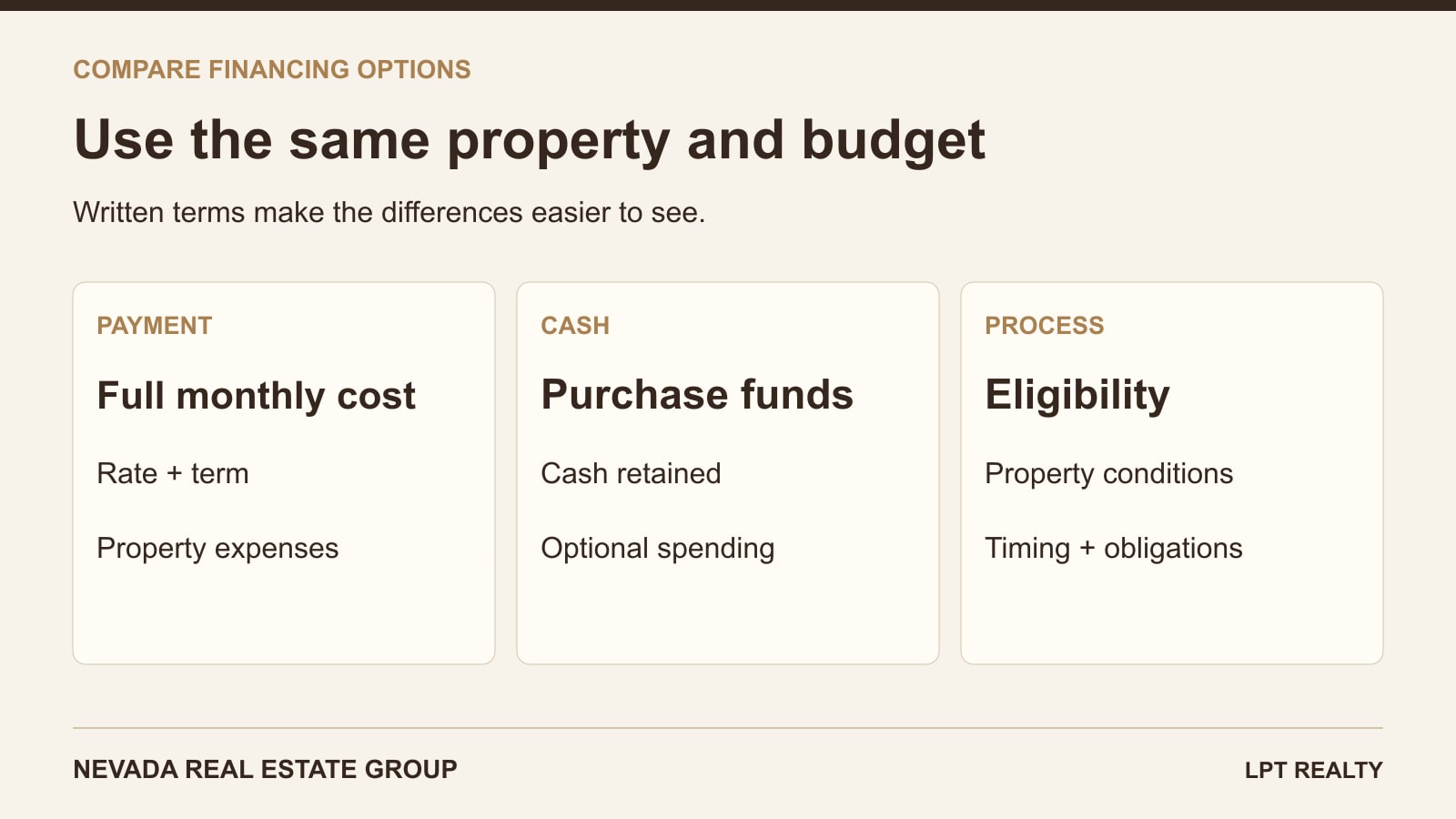
Compare the full purchase outcome using written terms. Start with the amount of cash required, the complete monthly payment, total borrowing costs, property restrictions and the time needed to complete the process. An offer that is stronger on one dimension may require a tradeoff on another.
Use the same home in each comparison when possible. Otherwise a lower payment may simply reflect a cheaper property, different taxes or omitted association dues. Identify whether the rate is fixed or adjustable, whether any buydown is temporary or permanent and how much money must be paid to obtain the quoted terms.
For assistance programs, ask whether the benefit is a grant, a repayable loan or an obligation with forgiveness conditions. Find out what happens if you sell, refinance or stop occupying the home. Do not compare a conditional benefit with an unconditional gift just because both reduce the cash needed on the first day.
Our guides to Nevada down-payment assistance and Las Vegas homebuyer programs can help organize the alternatives. Program availability and individual eligibility need current confirmation with the relevant provider. Combining benefits should also be confirmed explicitly rather than assumed.
Consider the value of cash retained after closing. Money used to reduce a rate or principal is no longer available for an emergency or an immediate home expense. That does not make the payment reduction a poor choice; it means the decision should include the household's remaining liquidity and expected length of ownership.
Keep the comparison understandable. A one-page worksheet with the same categories for each option is better than several unrelated payment screenshots. Write down any uncertain amount and who will confirm it. If a quote changes, record the date and the reason so you can tell whether the change came from market pricing, a different property or an updated application.
Choose the program that supports a sustainable purchase with obligations you understand. The objective is a home and payment that work for your household after closing, not winning a comparison based on the lowest advertised rate or the smallest initial cash figure alone.
What Should a Las Vegas Buyer Do First to Get Started?
Begin through NACA's official website, review the current materials and register for the appropriate introductory step. Keep your login and private records within the program's designated channels. A third-party blog can explain the process, but it cannot qualify you or replace the instructions in your file.
According to NACA's office directory, the Las Vegas office is at 3030 S Jones Blvd, Suite 103, Las Vegas, NV 89146. Confirm the current appointment or workshop arrangements through NACA before visiting. The program office is separate from Nevada Real Estate Group's real estate office.
Set aside time for a household budget discussion before collecting listings. Decide what payment feels comfortable, how much cash you want to retain and which features of a home are essential. Identify any personal deadline and a fallback plan if the purchase takes longer than hoped. Those decisions give the financial preparation a practical purpose.
Then assemble the requested records and build an open-items list for the counselor. Include unusual circumstances rather than waiting for someone to discover them. As the file progresses, update the list with the current status and the next action you control. This keeps the process moving without pretending you can schedule an approval that belongs to another party.
Once your purchase parameters are confirmed, coordinate the property search and representation requirements. Focus on homes that match the budget, intended occupancy and condition expectations. A clear shortlist and a complete file make it easier to respond when a suitable property appears.
For help planning a Southern Nevada home search, contact Chris Nevada, Nevada Real Estate Group at LPT Realty, at (702) 637-1759. Our office is 8945 W Russell Rd, Suite 170, Las Vegas, NV 89148; Nevada license S.181401. We can discuss the real estate search and the questions to coordinate with your program contacts. NACA and the lender remain responsible for program determinations and mortgage approval.
Frequently Asked Questions
Is NACA available to homebuyers in Las Vegas?
NACA maintains a Las Vegas office and a home-purchase program. Start through its official materials and qualification process. Availability does not establish that every applicant or property qualifies. Your household's circumstances, the proposed home and the lender's requirements must be evaluated for the actual transaction.
Do I need a particular credit score for a NACA mortgage?
NACA says it evaluates payment history and financial circumstances rather than using a credit-score cutoff. It still reviews credit information and affordability. Prepare accurate records and discuss any issues with your counselor. A low score does not automatically resolve the question either way, and this guide cannot determine eligibility.
Does no down payment mean I can buy with no savings?
No. Plan for the purchase funds determined for your situation, which can include expenses and money retained in reserve. The amount depends on the actual file and property. Ask for an itemized funds review and distinguish payments you will spend from balances you need to keep after the purchase.
Can I finish the entire NACA process in 28 days?
Do not interpret a contract-to-closing target as the time from your first workshop registration to ownership. Preparation, qualification and the home search come before that phase. The actual transaction also depends on completed conditions and coordination. Make personal moving commitments based on current milestones, not a general advertised target.
Can I use NACA for an investment property I will not occupy?
NACA's purchase program is for owner-occupants. A property you will not occupy requires a different financing discussion. If you are considering a multi-unit home where you would live in one unit, ask NACA about the specific property, occupancy, training and financing requirements before making an offer.
Can my real estate agent guarantee that a home will work with NACA?
No. An agent can help identify issues, coordinate the search and manage the real estate transaction. Program qualification, property clearance and lender approval belong to the responsible reviewers. Confirm an outside agent's participation and representation arrangements under current NACA policies rather than assuming a professional title establishes approval.
Should I stop looking at other mortgage options after contacting NACA?
You can compare alternatives using written terms and consistent assumptions. Review the complete payment, purchase funds, remaining cash, conditions and timing. Keep your program contacts informed about decisions that affect the transaction, and avoid making multiple commitments you do not understand. The best fit depends on the household and property.
Is Nevada Real Estate Group affiliated with NACA?
This is an independent educational guide and does not claim NACA affiliation, endorsement or certification. NREG can discuss a Las Vegas real estate search. Any representation for a NACA purchase must meet current program requirements, while qualification and mortgage approval remain with NACA and the lender.
Which Sources Support This Guide?
- NACA: mortgage-product terms and home-purchase program.
- NACA: general eligibility and mortgage-underwriting criteria.
- NACA: qualification process and current qualification workbook.
- NACA: mortgage process and closing coordination.
- NACA: property-condition review and housing-search policies.
- NACA: official office directory.
Source review: September 11, 2026. Official pages may contain older examples or schedules; this article does not reuse dated loan limits or quote a current interest rate. Confirm the applicable terms, required funds and appointments directly with NACA. All numerical household examples and planning graphics are original illustrations.