

Moving to Carson Valley means choosing a specific property and a workable routine across Gardnerville, Minden, Genoa and nearby Douglas County communities. A mountain view does not tell you who supplies the water, whether a barn is permitted, which school serves the address or how often you will travel to a specialist. Those questions can change the choice more than the town name.
This October 23, 2026 review preserves the original July housing snapshot and replaces unsupported tax, service and travel assumptions with checked sources and transparent planning examples. The comparison is about housing features and practical requirements. It does not rank places by the types of people who live there or promise a particular lifestyle outcome. Readers focused on retirement can also use the separate guide to retiring in Carson Valley.
Carson Valley buyers should compare Gardnerville, Minden and Genoa by the home's complete cost, actual service providers and recurring journeys. Nevada has no individual state income tax, but California obligations can continue after a move. The original July 13, 2026 housing snapshot is historical. For an illustrative $600,000 purchase with 20% down, a 30-year loan at 7.32% produces about $3,297 monthly principal and interest.
- Choose the parcel and routine before treating a town label as a recommendation.
- Prices and counts here date from July 2026; asking and sold figures cover different homes.
- Gardnerville Ranchos has district water and sewer services; verify each address.
- Carson Valley Health's hospital is in Gardnerville, not Minden.
- Use filing-status-specific tax calculations, address-specific school checks and actual insurance quotes.
Where Is Carson Valley, and How Does It Differ From Carson City?
Carson Valley and Carson City are different destinations. For the Gardnerville, Minden and Genoa properties discussed here, start with Douglas County records. A listing's mailing city, subdivision name and service district are different pieces of information; none should substitute for the parcel's actual location and jurisdiction.
According to Douglas County's new-resident guide, the county includes Genoa, Gardnerville and Minden, and an address may receive services from a town, the county or a general improvement district. That is a useful starting point for a relocation folder: record the parcel number, local government, water supplier, sewer arrangement and road-maintenance contact separately. Do not assume all services come from the entity printed on the postal address.
According to Douglas County's geography page, Minden is the county seat, Carson City borders the county to the north, and the county includes parts of Lake Tahoe and the Sierra Nevada. A countywide fact therefore may describe the lake, the valley or another area. Ask which geography a statistic covers before applying it to a particular house.
Use the Carson City community guide as a separate location comparison, especially if your workplace or frequent appointments are there. The Northern Nevada community directory helps broaden that search without confusing neighboring markets. A useful first map includes the candidate home, work entrance, grocery stop, school and medical office. Draw the routine around real destinations before deciding whether the desired property features justify the travel.
How Should You Compare Gardnerville, Minden and Genoa?
Compare the same requirements across all three areas. An in-town address, a golf-community home and a larger parcel can have very different upkeep obligations even when they share a mailing town. The useful distinction is the property package: access, lot, building condition, services, restrictions and total cost.
Start with Gardnerville listings if that location fits your destinations and budget, then compare similar properties in Minden and Genoa. Keep bedroom count, usable space, condition and required features consistent. Otherwise, a town comparison can become an accidental comparison between a smaller older home and a larger renovated estate. July's different medians do not establish the premium for an equivalent house.
| Search area | Requirement to investigate | Evidence needed | What could change the choice? |
|---|---|---|---|
| Gardnerville | Access to selected services and a suitable house/lot combination | Exact service providers, property condition and measured routine | Repair costs or a different utility arrangement |
| Minden | Convenient access to particular county-seat destinations | Walking route or actual drive to those destinations | Distance from the specific home, traffic or missing sidewalks |
| Genoa | Desired setting, property features or golf-community location | Comparable sales, restrictions, dues and actual amenity terms | Maintenance, insurance or membership costs |
If walkability matters, inspect the entire route, including crossings, lighting and winter conditions. A listing near a town center is not automatically convenient on foot. If golf access matters, distinguish owning a nearby home from receiving club membership. The Genoa Lakes guide can orient a search, but current governing documents and membership terms should settle the purchase-specific questions.
Make a short list of nonnegotiable requirements before touring. A garage that fits equipment, a manageable driveway or a reliable trip to work is observable. Labels such as prestigious, polished or best for a particular household type are too vague to resolve the decision.
What Do Homes Cost in Gardnerville, Minden and Genoa?
The figures below preserve the article's July 13, 2026 record. The original text attributed them to NREG's NNRMLS feed, grouped by town designation, with active residential listings and year-to-date closed residential transactions. The underlying property-level export was not available in this refresh, so these figures have not been independently reconstructed or replaced with an October count.
| Town | Active listings | Median asking price | 2026 YTD closed | YTD median sold price |
|---|---|---|---|---|
| Gardnerville | 131 | $745,750 | 126 | $562,450 |
| Minden | 49 | $849,900 | 67 | $699,950 |
| Genoa | 7 | $1,850,000 | 2 | $1,919,250 |
| Original valley summary | ~187 | $775,000, originally called blended | ~195 | $585,000, originally called blended |
The counts add to 187 active listings and 195 closings. The combined medians cannot be derived by averaging the three town medians; reconstructing a pooled median requires the underlying observations. The original valley summary remains a historical statement with that limitation. Genoa's two reported closings also make its median especially sensitive to the particular homes sold.
The original July discussion reported 68–75 days on market for Gardnerville and Minden and more than 90 days for Genoa. Those are historical descriptions, not a current deadline or a prediction of how long your house will take to sell. The asking and sold medians represent different groups and observation periods. Their gap does not measure an individual seller's discount or prove a price trend.
For today's purchase, use current available listings plus recent comparable closed sales selected for the property's features. Ask for the search date, geographic boundaries, property types, sample size and exclusions. A smaller, well-matched comparison can be more useful than a broad valley average, provided its limitations remain clear.
How Can You Turn a Budget Into a Useful Property Search?
Begin with the maximum ongoing cost and the cash you need after closing, then work backward to a purchase range. Asking prices alone leave out financing, repairs, insurance, district bills and the work involved in maintaining land. A lower-priced home with expensive immediate needs may leave less flexibility than a more expensive home requiring little initial work.
The July article described search bands under $500,000, $550,000–$750,000, $750,000–$1,100,000 and $1,200,000 and up. Those were historical editorial groupings, not proof that a particular home type is currently available in each band. Retain them as context for the original article, then rebuild the search using today's actual listings and your requirements. Do not assume a price band guarantees acreage, a barn, a particular floor plan or a specific town.
Create separate columns for purchase price, required work, optional improvements and continuing costs. A roof repair needed to obtain coverage belongs in the immediate plan; a future patio usually belongs in a different category. Ask inspectors and contractors to distinguish urgent defects from maintenance and discretionary upgrades. That separation helps you negotiate and preserves a realistic move-in schedule.
Use the Gardnerville Ranchos guide to investigate that specific area without assuming every property is agricultural or suitable for horses. For a broader location decision, the Carson City versus Reno comparison provides another set of questions. Compare complete options that meet the same needs, and be willing to revise the map when the required condition, services or cash reserve cannot be achieved within the original search area.
What Would Financing a Carson Valley Purchase Cost?
Financing depends on the amount borrowed, loan program, rate, term and borrower qualifications. According to Freddie Mac's Primary Mortgage Market Survey, the national 30-year fixed average was 7.32% on October 22, 2026. This is dated national context, not a Carson Valley lender quote or a promise that a particular borrower qualifies.
For a transparent comparison, assume invented purchase prices of $600,000 and $800,000, a 20% down payment, a fixed 7.32% note rate and 360 monthly payments. The resulting loans are $480,000 and $640,000. Using principal × monthly rate divided by one minus the discounted payment factor gives monthly principal and interest of $3,297.27 and $4,396.36. Their difference is $1,099.09 per month after rounding.
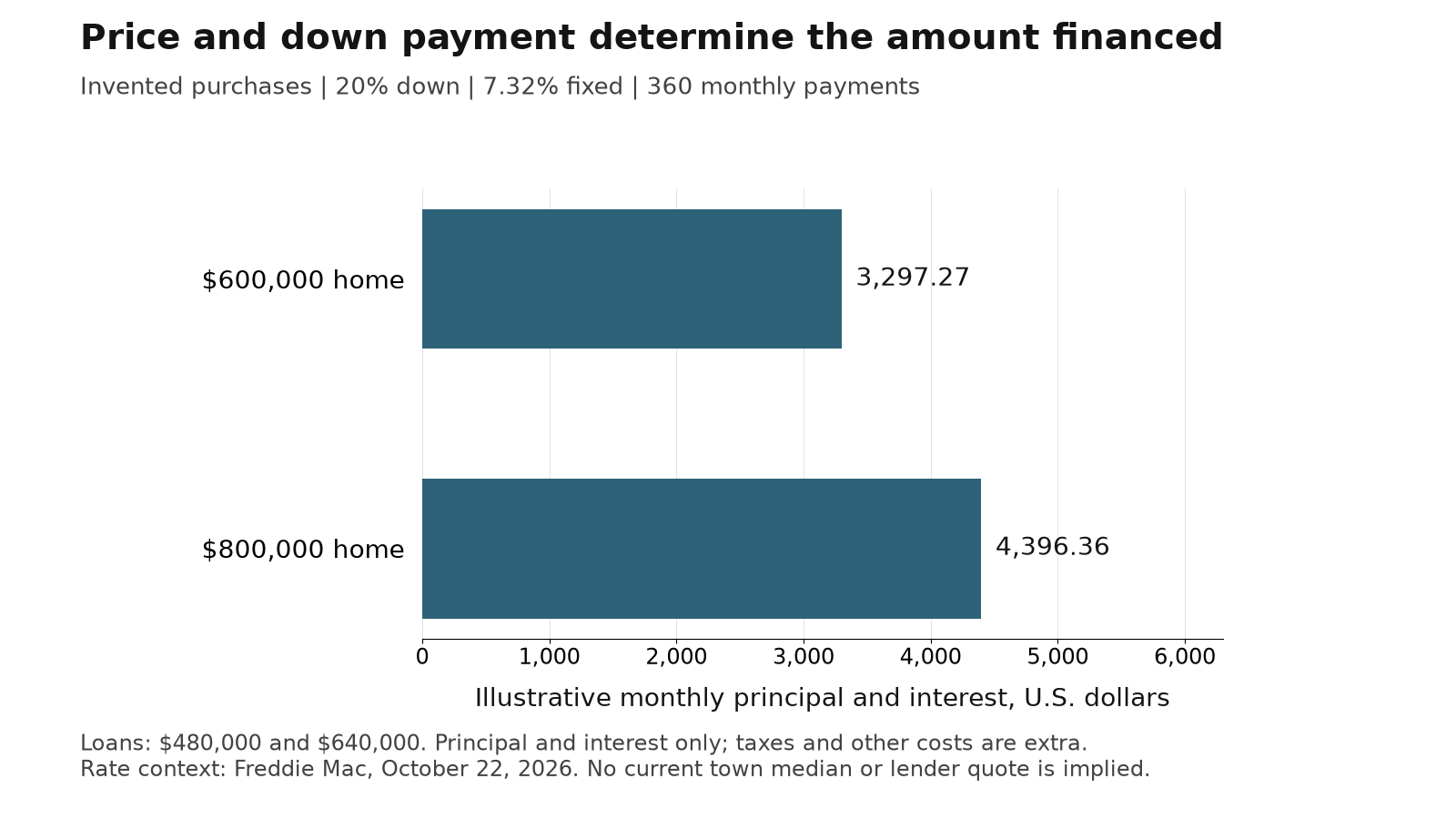
These payments exclude property taxes, homeowners insurance, any mortgage insurance, association dues, district charges and repairs. They also do not include lender fees or discount points. Compare actual Loan Estimates on a consistent date and loan structure, including cash to close and whether a quoted rate requires upfront charges. A lower advertised payment can reflect a larger down payment or a different product rather than cheaper financing.
Before using sale proceeds from another home, confirm the expected net cash after that mortgage, transaction costs and any taxes. Keep a reserve outside the down payment. The buyer resources can help organize the purchase sequence, but your lender's written terms determine the loan you can actually obtain.
How Much California Income Tax Might a Move Affect?
According to the Nevada Department of Taxation, Nevada does not impose an individual state income tax. Federal taxes and other state obligations are separate. To compare the California side, identify the tax year, filing status and taxable income instead of multiplying all earnings by a marginal bracket.
According to the California Franchise Tax Board's October 2026 Tax News, the 2026 Schedule Y for married/RDP joint filers uses graduated brackets. The examples below treat the input as Form 540 taxable income after applicable deductions, for a full-year California resident return, before credits. They are not gross-income estimates, retirement-distribution estimates or individualized savings forecasts.
| State taxable income | Applicable calculation | Tax before credits |
|---|---|---|
| $90,000 | $2,113.48 + 6% of the amount over $85,722 | $2,370.16 |
| $150,000 | $4,109.92 + 8% of the amount over $118,996 | $6,590.24 |
| $250,000 | $6,621.76 + 9.3% of the amount over $150,394 | $15,885.12 |
For example, the $150,000 calculation taxes only the $31,004 above that bracket's threshold at 8%, then adds the tax carried from lower brackets. It does not apply 8% to the entire $150,000. Single filers use a different schedule, and credits can change the final liability. These examples correct the original article's unspecified household estimates without suggesting every relocating buyer realizes the same reduction.
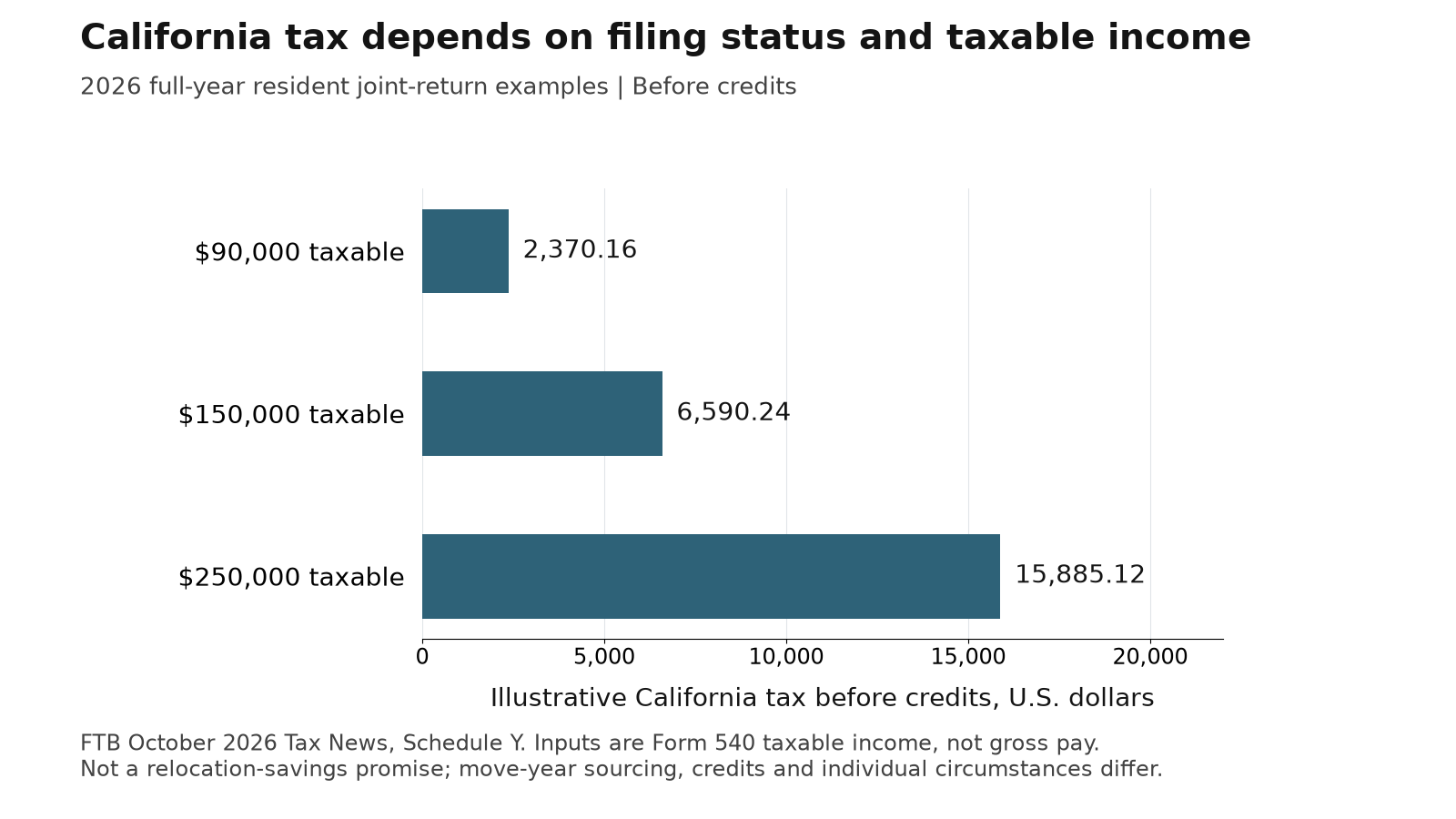
Ask a tax professional to compare your actual income categories and expected move date. A pension, Social Security payment, stock award, business receipt and property sale do not automatically share the same tax treatment. Use the resulting household estimate alongside housing and travel costs, rather than treating a state tax difference as a larger mortgage budget by default.
Can California Tax Obligations Continue After Moving to Nevada?
Yes. According to the Franchise Tax Board's part-year and nonresident guidance, California taxes worldwide income during California residency and California-source income during nonresidency. Buying a Nevada home does not, by itself, settle the date or validity of a residency change.
The distinction matters for someone who keeps California rental property, performs work there, sells California real estate or continues business activity tied to California. FTB also distinguishes employee work performed outside the state from some independent-contractor sourcing rules and warns that deferred or equity compensation can require separate analysis. Do not treat all remote work as having identical consequences simply because the computer is in Nevada.
Build a dated record of the move and ask your adviser what evidence matters for your circumstances. The questions may involve where you actually live, where services are performed, continuing ties and the nature of income received. Driver's licenses, vehicle registration, mailing changes and other administrative steps are useful parts of moving, but this guide does not present them as a checklist that automatically establishes tax domicile.
The calculation in the preceding section is a full-year resident illustration. It should not be prorated mechanically by the number of months after closing to estimate a part-year return. The taxable base and sourcing may change, and a property transaction can occur on a different timetable from the physical move.
Resolve these issues before committing sale proceeds or counting on a precise savings amount. If a job requires regular California travel, include that schedule in both the tax discussion and the transportation budget. A well-documented answer is more useful than a broad promise that changing your address eliminates every state income-tax obligation.
Which Property Taxes, District Bills and HOA Costs Should You Check?
Use the actual parcel's tax record and service accounts. A current owner's bill, a listing's estimated payment and an association's monthly dues answer different questions. None alone establishes your complete cost after purchase. The Douglas County Assessor provides access to property information and related tools; ask about the specific assessment and any applicable owner-occupancy paperwork rather than relying on a countywide shortcut.
Do not calculate property tax by treating the purchase price as the final taxable or assessed value without verifying the applicable method. Also distinguish limits on tax-bill growth from a cap on market value or an assurance that every charge stays fixed. New improvements and a property's particular circumstances can matter. This guide does not quote a universal effective rate or predict the next bill for a house it has not inspected.
List water, sewer, trash, district charges and association obligations individually. Some may appear on a tax statement; others may arrive separately. Verify the payee, billing frequency, current amount and whether a balance or special assessment is outstanding. Avoid adding a charge twice simply because it appears in both a seller disclosure and an estimated monthly-cost worksheet.
Association review should include recorded restrictions, the budget, reserves, insurance, meeting records and any approved or proposed special assessment. A low regular fee may exclude work the owner must fund personally. A home outside an HOA can still have recorded restrictions, public rules and service costs. Conversely, a district water or sewer bill is not proof that a property belongs to a private homeowners association. Keep those categories separate so the comparison remains understandable.
Does a Ranchos or Acreage Address Guarantee Horse-Property Use?
No. A neighborhood name, large-looking lot or existing fence does not establish the legal use of land. A buyer planning horses, a workshop, a second dwelling, irrigation or a commercial activity should describe that intended use precisely and seek property-specific confirmation before relying on it.
According to Douglas County's Community Development page, the county provides links to planning, building, engineering, code enforcement and permit-search resources. Use the parcel number to assemble the applicable zoning, permits, recorded restrictions and access documents. An existing structure is not proof that its present use was approved, and an empty area is not proof that another building can be added there.
For an equestrian property, practical suitability extends beyond permission. Evaluate the usable area, drainage, fencing, feed storage, trailer access, manure handling and ongoing care. Ask how water is supplied and whether the intended use is supported by the relevant records. A domestic water supply and irrigation rights should not be treated as interchangeable simply because both involve water on the property.
The Gardnerville Ranchos General Improvement District's mission statement identifies water, sewer, street maintenance and parks/recreation services within its district. That directly contradicts the assumption that every Ranchos home necessarily relies on a private well and septic system. Confirm the particular address's service, connection and billing arrangements.
Compare the property you can legally use and maintain with the life you want to lead. If the required use is not supported, a lower asking price or attractive barn should not close that gap. Keep unresolved approval and water questions inside the due-diligence process, with the appropriate professional advice and contractual protections.
What Should You Inspect When a Home Has a Well or Septic System?
First establish whether the home actually uses those systems. Request utility bills, connection records, permits and seller disclosures. For a private well, distinguish the physical condition and output of the well from water quality and from the legal authority for the proposed use. A clear-looking glass of water does not resolve those separate questions.
According to the EPA's private-well guidance, private wells should be tested annually for specified basic indicators, with additional testing when conditions or suspected contaminants warrant it. The agency recommends certified drinking-water laboratories. For a purchase, discuss the appropriate sampling scope with local specialists and obtain the actual report rather than a verbal statement that the water was tested previously.
For septic, ask for the installation record, system location, capacity and maintenance history. According to the EPA's homebuyer septic guidance, inspection before purchase is an important part of evaluating a home served by a septic system. Make sure the inspection scope addresses the system itself; a general home inspection may not include the necessary specialist work.
Then connect the findings to the intended occupancy and property changes. A future addition, driveway project or outbuilding could interact with the well, drainfield or required access. Keep a usable site plan and avoid assuming that a seller's existing arrangement can accommodate every proposed change.
Obtain written estimates for identified work and determine who will perform it, what approvals are needed and when it can be completed. The goal is a functional, lawful system with an understandable maintenance plan. A report that merely lists an unresolved concern should lead to follow-up before the contingency deadline, not an assumption that the issue is inexpensive.
How Should You Evaluate Trips to Carson City, Reno and Tahoe?
Evaluate travel from the exact driveway to the exact destination at the times you expect to go. A town-center estimate does not include the last portion of a trip, parking, a school drop-off or weather delays. The original guide's broad 15-minute capital commute and 25-minute Tahoe promise should not be applied to every Carson Valley home.
The county's geography page lists Minden and Reno as 46 miles apart, but that general mileage is not an address-specific route or a travel-time guarantee. Use a route planner for the actual trip and, where feasible, test it under representative conditions. Mountain travel also needs a separate weather and access check. Do not schedule a tour that requires driving through hazardous conditions just to test a possible commute.
The arithmetic makes repeated trips visible. Assume two hypothetical routes take 25 and 55 minutes each way. At 20 round trips per month, that becomes 1,000 versus 2,200 minutes: 16 hours 40 minutes versus 36 hours 40 minutes. The difference is 20 hours monthly. These are invented inputs, not measured drives between the towns named here.
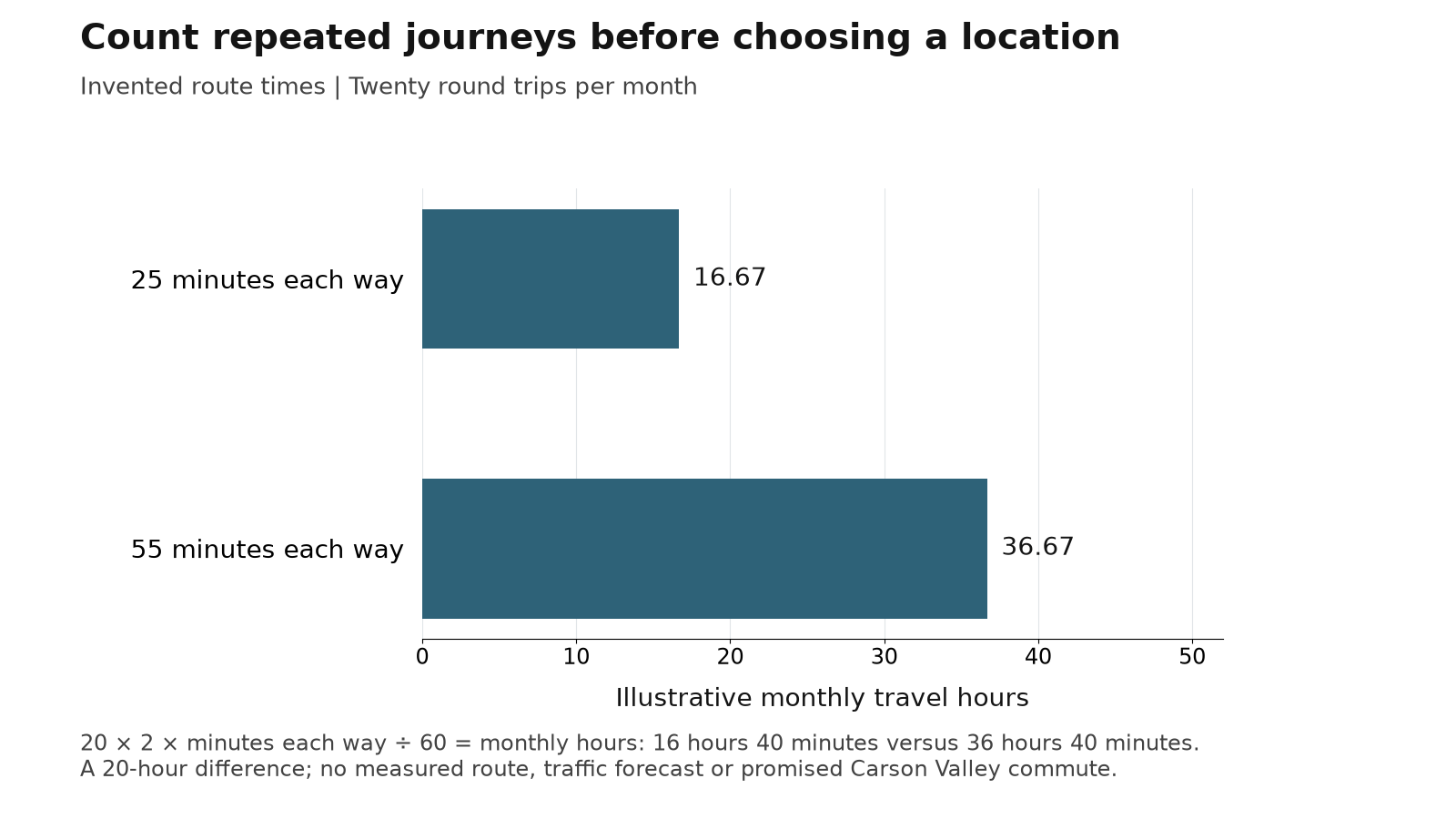
Include trips for work, medical care, groceries, recreation and airport access separately. A journey made once a month has a different impact from the same journey made every weekday. Readers comparing a broader move can use the Reno relocation guide or examine the Stateline area and Nevada Lake Tahoe communities as distinct alternatives. Keep the housing tradeoff and the recurring travel commitment in the same worksheet.
What Does the Climate Mean for Everyday Ownership?
Plan for seasonal variation and property-specific conditions instead of a promise of comfortable weather every day. According to Douglas County's geography and climate page, the county spans substantial elevation differences and generally has an arid climate with warm summers and cool evenings. Its broad description is orientation, not a guarantee about a particular address or a substitute for a weather-station record.
The original article's assertion that summers avoid triple-digit extremes and its precise sunny-day claim are not supported by a matching dataset in this review. Neither is needed to make a useful decision. Ask how the home handles heating, cooling, sun exposure, wind, drainage and access, and request actual utility history when available. An efficient building with manageable exposure can differ greatly from a nearby house with older equipment or large unshaded windows.
According to the National Weather Service's winter-safety guidance, snow, ice and blowing snow can create dangerous travel conditions. Review the current forecast for both the home and the intended route. A clear valley road does not establish conditions at a mountain destination, and a general seasonal description should not be used to decide whether a specific drive is safe.
Inspect exterior drainage, roof condition, exposed plumbing and the practical task of clearing the driveway. Find out who maintains the road and what access limitations apply. For a larger parcel, consider where equipment and supplies will be stored and how maintenance will be handled during an absence. The aim is to select an ownership workload you can sustain through the year, not to judge the property from one attractive afternoon.
How Should Wildfire, Smoke, Flooding and Insurance Affect the Choice?
Treat these as property and household questions that need separate evidence. A picturesque location does not establish a low hazard level, and a broad regional label does not tell you whether a specific insurer will offer suitable coverage. Obtain a written quote tied to the address, intended occupancy and property features before relying on an estimated premium.
According to the FEMA Flood Map Service Center, it is the official public source for flood-hazard information supporting the National Flood Insurance Program, and effective maps can change. Use the current map products for the parcel and discuss drainage, elevation information and coverage questions with the appropriate professionals. This guide has not made a flood determination for any candidate property. A map review also does not replace inspection of local drainage and the building itself.
According to AirNow's fire and health guidance, wildfire smoke contains fine particles that can affect health, and local air-quality information should guide precautions. That is a reason to consider indoor filtration, cooling and an alternate plan for smoky periods. It does not establish a predictable number of smoke days for Gardnerville, Minden or Genoa.
For insurance, compare limits, deductibles, exclusions, replacement-cost assumptions and any work required to bind coverage. Ask about outbuildings, equipment, animals or other intended uses when relevant. Put required work into the cash and timing plan. A premium estimate without the necessary underwriting details is not equivalent to confirmed coverage, and the existence of the seller's policy does not guarantee the same terms for the buyer.
How Can You Verify Schools Without Relying on a Town Reputation?
Use the exact address, relevant grade and intended enrollment year. According to the Douglas County School District enrollment page, families can use its zoning map to identify a zoned elementary school, and it provides separate resources for new students and annual updates. Confirm the applicable middle and high school arrangements with the district as well. A town name or nearby campus is not a complete assignment check.
The original article claimed consistently strong outcomes without identifying a reporting year, measure or comparison. This refresh does not repeat that broad ranking. If performance information matters to your decision, examine the current official report for the specific school and the measure you care about, then discuss programs and support directly with the school. A single aggregate score cannot answer every student's needs.
Build the school routine into the housing comparison. Check transportation eligibility, pickup and drop-off arrangements, after-school needs, calendars and what happens on delayed or closed days. Confirm that an appealing program is actually available to the student and whether a separate application or transfer process is required. Do not make a home purchase dependent on an assumed exception that has not been confirmed.
Keep housing recommendations tied to the features you request: commute, space, access, cost and documented services. Evaluate each property against the household’s stated requirements and verified location records. Two homes in the same area may serve very different routines because of their particular routes and facilities. Save the district's current answer with the rest of the property file and revisit it if the address or intended move date changes.
Where Is the Hospital, and How Should You Check Healthcare Access?
Carson Valley Health's hospital is in Gardnerville. According to its emergency-room page, the hospital address is 1107 US Highway 395 N, Gardnerville, and it operates a 24-hour emergency room. The original article incorrectly placed that hospital in Minden. A clinic in one town and a hospital in another should not be collapsed into a single location claim.
For relocation planning, list the services you actually use, their locations and the frequency of visits. Confirm insurance-network participation, referral requirements, availability for new patients and any specialist or treatment requirements directly with the provider and insurer. A facility's list of services does not establish appointment availability or suitability for an individual's care.
Map routine care and specialized care separately. If a particular service requires travel to Carson City, Reno or elsewhere, use that exact destination in the transportation analysis. Someone making frequent appointments may weigh the route differently from someone using the same facility occasionally. Include the practical question of who can provide transportation when driving yourself is not possible.
The Carson Valley retirement guide offers a related planning framework, but neither guide can determine whether a medical network is adequate for a specific person. Do not infer that emergency access guarantees every type of inpatient or specialist service stays local. For a medical emergency, follow emergency-service guidance rather than a relocation comparison. For a planned move, get the relevant care arrangements settled early enough that there is no avoidable interruption in prescriptions, records transfer or scheduled treatment.
How Should You Organize the Move and Protect Your Cash Reserve?
Here is the sequence I run with relocating clients, refined across the 9,600-plus closings Nevada Real Estate Group has represented statewide:
Define the required property features and recurring destinations first. Compare actual listings, obtain financing terms or confirm available cash, and identify any dependency on selling the current home. Then assemble the parcel, service, condition, insurance and restriction records before the relevant contract deadlines. A tour should test the short list against the requirements rather than assume every available property must be visited.
For an invented $600,000 purchase, a 20% down payment uses $120,000. Add assumed closing costs of $12,000, immediate work of $18,000 and a retained reserve of $30,000: the total allocation is $180,000. The reserve remains available after closing; it is not another fee paid at settlement. Replace every allowance with the actual loan, inspection, contractor and household figures.
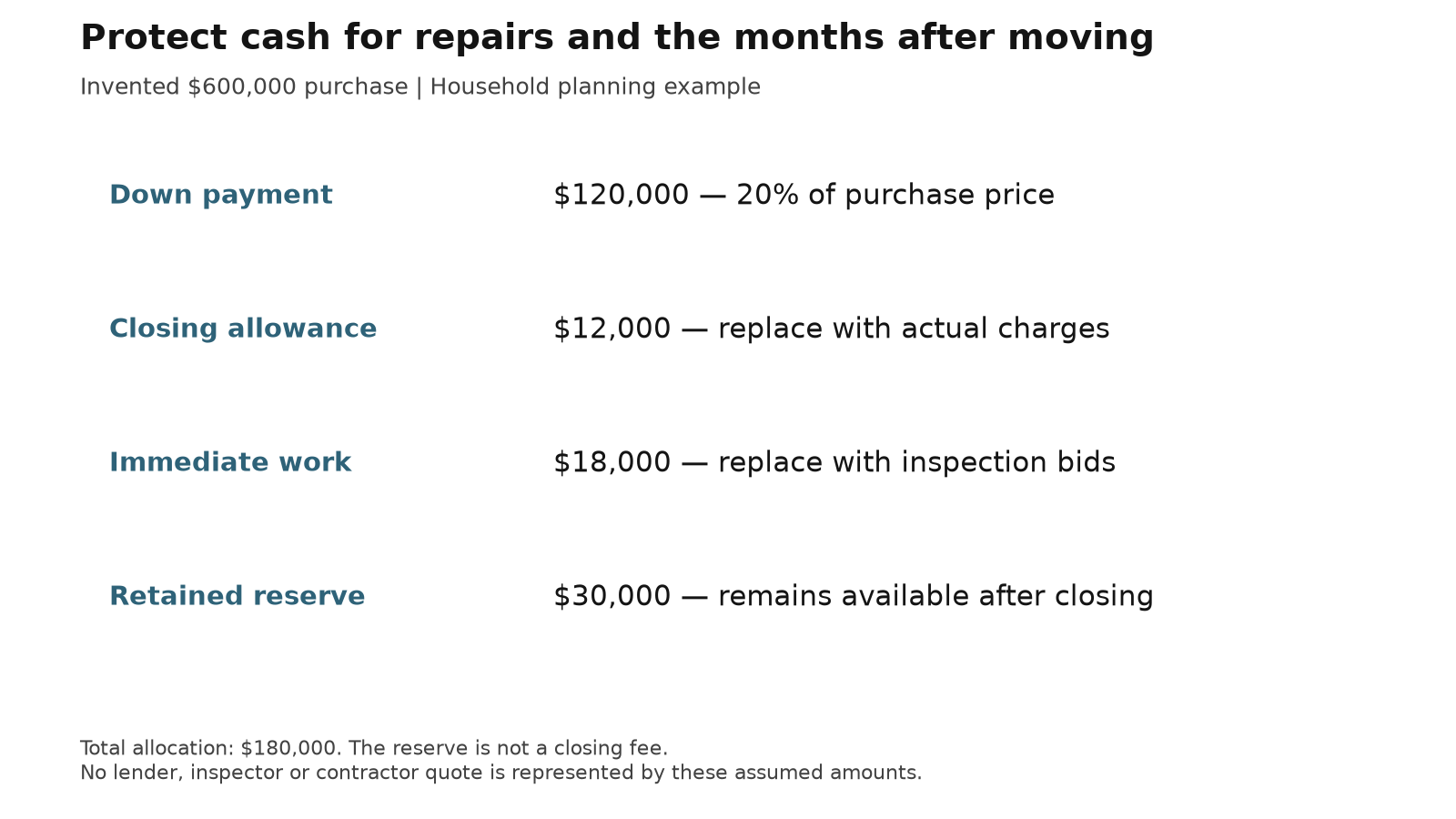
Schedule utilities, moving access, care continuity and administrative changes around the actual possession date. If timing is uncertain, compare temporary housing and storage costs with the risk of rushing the purchase. My practical recommendation, after years of watching relocating clients, is to resolve the systems and daily-routine questions before committing to a location.
Nevada Real Estate Group is the #1-ranked real estate team in Nevada with $4.85B-plus in career sales volume, 9,600-plus closings, and 150-plus agents. For help organizing a Carson Valley search, call or text (775) 277-2120, or share your timeline and property requirements. Our seller resources cover the other side of a coordinated move, and the first-time buyer resources explain the purchase process.
Frequently Asked Questions
Is Carson Valley the same place as Carson City?
No. This guide compares Gardnerville, Minden and Genoa properties in Douglas County. Carson City is a separate neighboring destination to the north. Confirm the parcel's jurisdiction, service providers and school assignment rather than relying on a mailing address or the shared Carson name.
Are the July 2026 prices current asking prices?
No. The original July 13, 2026 snapshot reported median asking prices of $745,750 for Gardnerville, $849,900 for Minden and $1,850,000 for Genoa. Those figures remain historical, with the original dataset unavailable for reconstruction. Use current listings and matched closed sales for a new purchase decision.
Does every Gardnerville Ranchos home have a well and septic system?
No. The Gardnerville Ranchos General Improvement District identifies water and sewer among its services. Confirm the specific home's connections, providers and bills. A neighborhood label does not establish private systems, horse-use permission, lot size or the absence of recorded restrictions.
How much California income tax would a $150,000 household save?
That cannot be determined from gross household income alone. As an illustration, $150,000 of California state taxable income for 2026 joint filers produces $6,590.24 before credits under the published schedule. Actual savings depend on deductions, credits, income types, residency and continuing California-source income. Nevada has no individual state income tax.
Is Carson Valley Health's hospital in Minden?
No. The hospital's emergency-room page identifies 1107 US Highway 395 N in Gardnerville and a 24-hour emergency room. Verify the exact location of each clinic or specialist separately, along with insurance participation and appointment availability.
Can every Carson Valley home reach Tahoe in 25 minutes?
No reliable universal time applies. Test the exact origin, destination, time of day and route conditions. Mountain weather, parking and the final portion of the trip can change the result. The examples in this guide demonstrate travel-frequency arithmetic and are not measured routes.
Which town is best for a buyer with school requirements?
Compare the specific address and grade through Douglas County School District's current resources, then confirm programs and transportation. Choose housing by your stated needs and documented services. This guide does not rank towns by household type or make unsupported school-quality claims.
What cash should remain after the down payment?
Plan for closing charges, immediate work, moving expenses and a reserve that remains available after closing. The guide's invented $600,000 purchase allocates $180,000 across a $120,000 down payment, $12,000 closing allowance, $18,000 work allowance and $30,000 retained reserve. Replace those assumptions with your actual costs and needs.
Sources and Methods
Primary pages were reviewed October 23, 2026. July's original NREG/NNRMLS figures are preserved as historical statements; the property-level export was unavailable, and no October inventory count is represented. The town medians describe different cohorts, and the original blended medians cannot be reconstructed from the published town summaries alone.
- Douglas County: new residents and service arrangements, geography and climate, Assessor and Community Development.
- Gardnerville Ranchos GID: services in its mission statement.
- Nevada Department of Taxation: individual income tax.
- California FTB: October 2026 Tax News and 2026 schedules and part-year/nonresident guidance.
- Freddie Mac PMMS: October 22, 2026 national rate context.
- EPA: private-well testing and homebuyer septic guidance.
- National Weather Service: winter safety, FEMA: Flood Map Service Center and AirNow: fires and health.
- Douglas County School District: enrollment and elementary zoning.
- Carson Valley Health: emergency room and hospital address.
The four graphics present original calculations or a cash-planning framework. Mortgage examples use principal × monthly rate ÷ [1 − (1 + monthly rate) to the power of −360], with no taxes or insurance included. California examples use the 2026 joint-filer schedule before credits. Travel examples multiply hypothetical one-way minutes by two and by monthly round trips. No client transaction, property inspection, lender quote, appointment availability or measured driving route is claimed. The cover is illustrative rather than a documented local property photograph.