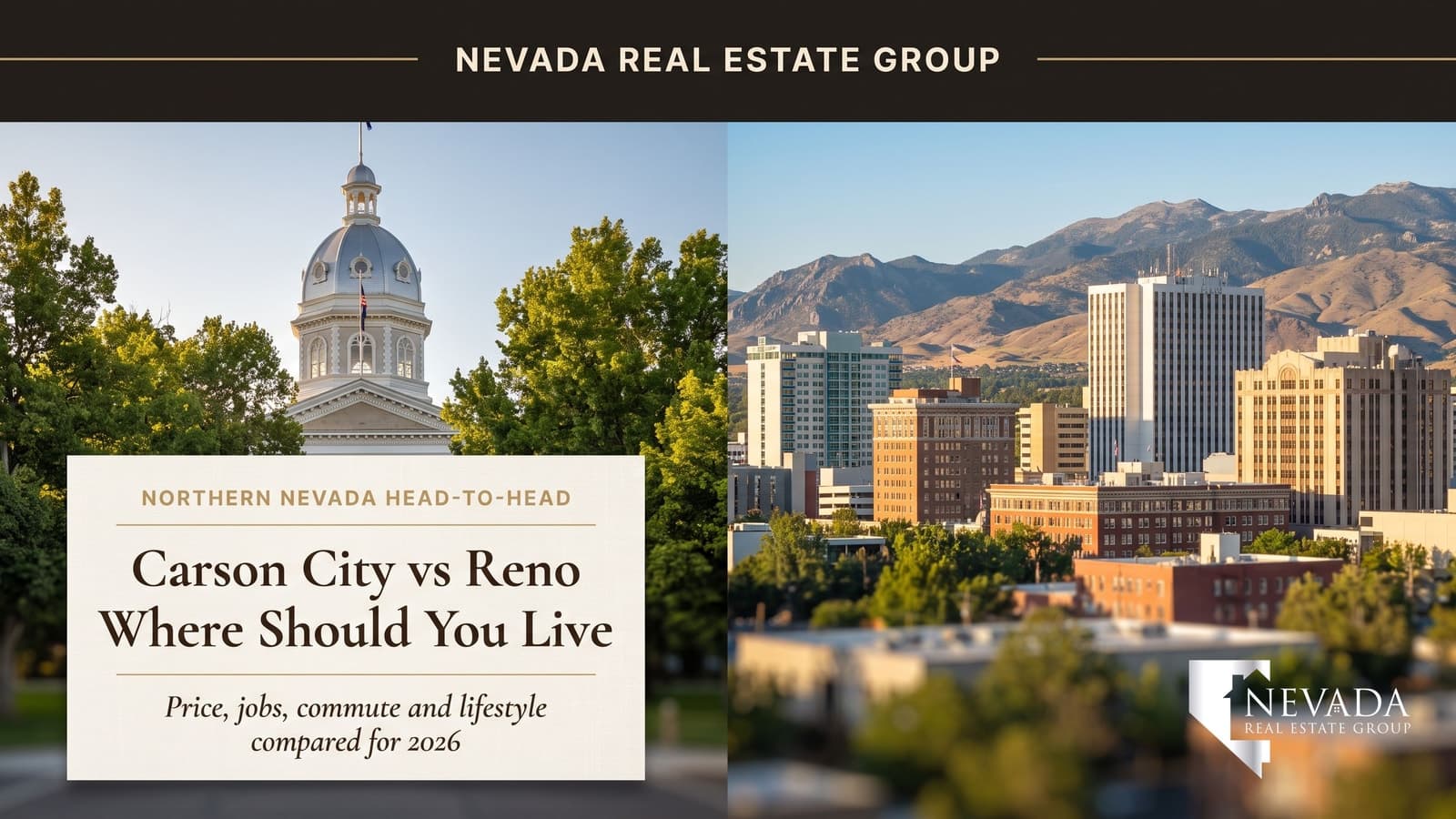

Carson City and Reno sit barely 30 miles apart on the eastern flank of the Sierra Nevada, share the same mountains, the same no-income-tax state framework, and the same weekend access to Lake Tahoe — and yet they are two genuinely different places to buy a house and build a life. One is a compact state capital of roughly 59,000 people where the largest employer is the government itself. The other is a mid-size metro of more than 275,000 that reinvented itself around Tesla, data centers, logistics, and a growing tech corridor. Choosing between them is not a coin flip; it is a lifestyle decision with real dollar consequences.
Here is the fact that surprises almost every buyer who assumes the small capital must be the cheaper one: as of July 12, 2026, Carson City and Reno post nearly identical median list prices — $610,000 versus $599,000 — but their median sold prices tell a completely different story. In my experience helping buyers decide between these two markets, the list-price similarity is a mirage, and the closed-sale data is where the real money lives.
Carson City is the more affordable, slower-paced choice: its median sold price of $545,000 sits about $61,500 below Reno's $606,500 (live NNRMLS feed, July 12, 2026). Reno offers four times the inventory, a more diversified job market, and metro amenities. Carson City offers a walkable capital, shorter Tahoe access, and lower entry costs. Both share Nevada's no-income-tax advantage. Call Nevada Real Estate Group at (775) 277-2120.
- Carson City's median sold price ($545,000) sits $61,500 below Reno's ($606,500) despite near-identical list prices.
- Reno had 1,570 active listings to Carson City's 389 — four times the choice (NNRMLS, July 12, 2026).
- Both markets move fast: 46 median days on market in Carson City, 47 in Reno.
- Reno leans Tesla, tech, and logistics; Carson City leans state government and healthcare.
- Carson City is 20–30 minutes to Tahoe; Reno about 45 minutes over Mt. Rose.
- Start with Nevada Real Estate Group: Las Vegas (702) 637-1759 · Reno (775) 277-2120.
How Do Carson City and Reno Compare on Price in 2026?
Start with the number that reframes the whole decision. When you look only at what sellers are asking, the two cities look like twins — Carson City's median list price is $610,000 and Reno's is $599,000, a gap of just $11,000. But asking prices are aspirations. What buyers actually pay is where the honest comparison lives, and there the two markets diverge hard.
According to Nevada Real Estate Group's live NNRMLS feed (pulled July 12, 2026), Carson City's median sold price over the trailing 90 days is $545,000 across 178 closed sales, while Reno's is $606,500 across 852 closed sales. That is a $61,500 spread — Carson City closes about 10% cheaper than Reno even though it lists for slightly more. The reason is skew: Carson City's active listings include a tail of high-end custom and view properties around the western foothills and toward the Clear Creek and Kings Canyon corridors that lift the list median, while its everyday closed inventory — the ranch homes, mid-century blocks near downtown, and newer subdivisions on the east side — sells for meaningfully less.
| Dimension | Carson City | Reno |
|---|---|---|
| Median sold price (90 days) | $545,000 | $606,500 |
| Median list price (active) | $610,000 | $599,000 |
| Active listings | 389 | 1,570 |
| Closed sales (90 days) | 178 | 852 |
| Median days on market | 46 | 47 |
| New-construction actives (2024+) | 75 (median $609,552) | 124 (median $688,950) |
| No-HOA active listings | 184 | 601 |
| Primary job engine | State government + healthcare | Tesla, tech, logistics, university |
| City population (approx.) | ~59,000 | ~275,000 |
The practical takeaway: if your budget tops out around $550,000, Carson City puts more move-in-ready houses inside your reach, and you will feel less bidding pressure. If you need selection, newer construction, or a specific neighborhood, Reno's larger board simply has more to show you. Run both cities live — Carson City homes for sale and Reno homes for sale — and watch how differently the two inventory pools feel.
Why Does Carson City's Sold Price Sit Below Reno's?
Three forces pull Carson City's closed prices under Reno's, and understanding them protects you from overpaying in either direction.
First, scale and demand. Reno's 852 closed sales in 90 days dwarf Carson City's 178. More buyers chasing homes — driven by the Tesla-anchored job base and California in-migration — keeps steady upward pressure on Reno's closed prices. Carson City's demand is real but thinner, so sellers meet the market rather than push it.
Second, housing stock age and type. Carson City's core is older and more horizontal — single-story ranch homes, established neighborhoods near the capital complex, and a stable stock that appeals to retirees and government workers. Reno carries a heavier mix of newer subdivisions in the south and northwest, plus a downtown high-rise and midtown revival that add price-lifting product.
Third, the list-vs-sold skew I flagged above. Carson City's active median is propped up by a handful of luxury and acreage listings on the west side and toward the Tahoe rim; those sit longer and don't dominate the closed pool. Across the 9,600+ closings our team has represented statewide, I've learned to trust the sold median over the list median every time — asking prices tell you what sellers hope, closed prices tell you what the market bears.
Which City Has the Bigger and Faster Housing Market?
Reno is by far the deeper market, but neither city is slow. The two cities post nearly identical velocity — 46 median days on market in Carson City, 47 in Reno — which tells you both markets are balanced-to-brisk in mid-2026, not frozen and not frothy. What differs is choice.
With 1,570 active listings, Reno gives a buyer roughly four times the selection Carson City's 389 actives provide. That matters most if you have specific requirements: a single-story with a casita, a particular school zone, RV parking, or new construction with a builder warranty. In Carson City, a picky buyer can exhaust the qualifying inventory in an afternoon; in Reno, the same criteria still leave dozens of candidates.
Inventory depth also changes your negotiating posture. In a thinner market like Carson City, the right house draws competition even when the overall market is calm, so when the one you want appears, you move decisively. In Reno's deeper pool, you can be more patient and let comparables work in your favor. According to Freddie Mac's Primary Mortgage Market Survey, 30-year fixed rates have hovered in the mid-6% range through mid-2026, which keeps monthly-payment math front and center in both cities — a reason the sold-price gap between them is worth real attention. If you want to see how each market is trending, our deep dives on the Carson City housing market and the Reno housing market break down the numbers month by month.
What Are the Job Markets Like in Carson City vs Reno?
This is the fault line that decides the whole comparison for most working buyers, and the two economies could hardly be more different in character.
Carson City is a government town. As Nevada's capital, its single largest employer is the State of Nevada — the legislature, agencies, courts, and the sprawling capital complex anchor a stable, recession-resistant white-collar base. Layer on Carson Tahoe Health (the region's major hospital system), the Carson City School District, and local government, and you have an economy built on steady, benefits-rich public-sector and healthcare jobs. It is not a boomtown; it is a dependable one. According to the Nevada Department of Employment, Training and Rehabilitation, Northern Nevada unemployment has stayed low through 2026, and Carson City's public-sector anchor smooths out the cycles that hit more volatile economies.
Reno is a diversified growth engine. The Tesla Gigafactory just east of the metro (in the Tahoe-Reno Industrial Center) reshaped the region's economy, and it did not come alone — Panasonic, Switch, Google, and a wave of logistics and advanced-manufacturing employers followed. Add the University of Nevada, Reno, the Renown Health system, a still-substantial gaming and tourism sector, and a startup scene downtown, and you get a labor market with far more paths for far more skill sets. According to the U.S. Bureau of Labor Statistics, the Reno metro area has posted consistent job growth this decade, and according to the Economic Development Authority of Western Nevada, employer relocations and expansions continue to feed the pipeline.
| Factor | Carson City | Reno |
|---|---|---|
| Anchor employers | State of Nevada, Carson Tahoe Health | Tesla, Panasonic, Switch, Google, UNR, Renown |
| Economic character | Stable, public-sector, recession-resistant | Diversified, growth-oriented, cyclical upside |
| Best fit for | Government, healthcare, trades, remote workers | Tech, manufacturing, logistics, professional services |
| Commute reach | Small footprint, short drives | Metro-scale, more sprawl |
| Wage ceiling | Steady, moderate | Higher upside in tech and specialized roles |
The honest read: if you work for the state or in healthcare, or you are a remote worker who values quiet, Carson City is a natural home base. If your career lives in tech, advanced manufacturing, logistics, or professional services — or you want the option to change jobs without leaving town — Reno's breadth wins.
How Long Is the Commute Between Carson City and Reno?
Short enough that plenty of Northern Nevada households split the difference. Carson City and Reno are connected by US-395 and the I-580 freeway, and the drive is roughly 30 miles — typically 35 to 45 minutes depending on traffic and where in each city you start and end. The I-580 extension over the Galena/Washoe Valley stretch turned what used to be a slower two-lane run into a genuine freeway commute.
That proximity is why the two cities function as one extended labor shed for many workers. It is common to live in Carson City for the lower housing costs and calmer pace while commuting to a Reno or Tahoe-Reno Industrial Center job — or to live in Reno and drive to a state job in the capital. According to the Nevada Department of Transportation, I-580 carries heavy daily volumes between the two cities, and the corridor is the spine of the region.
If a daily Reno commute is in your plans, weigh the tradeoff plainly: Carson City can save you real money on the house (that $61,500 sold-price gap, plus lower everyday costs), but you spend it back in windshield time and fuel. Sparks buyers face a similar calculus in reverse — see how Sparks homes for sale stack up if your job sits on the east side of the metro. For a household with one Reno job and one remote worker, Carson City often pencils out beautifully; for two Reno commuters, the math usually tips toward living closer in.
What Is the Size and Vibe Difference Between the Two Cities?
This is the intangible that buyers underweight and then feel every single day. Carson City and Reno are not just different sizes — they are different kinds of places.
Carson City is a small, self-contained capital. With about 59,000 residents in a compact, consolidated municipality, it feels like a well-kept small city where you run into people you know at the grocery store. The historic west-side district, the capitol grounds, the Carson River, and a genuinely walkable downtown give it a rooted, unhurried character. Traffic is minor. The pace is deliberate. According to the U.S. Census Bureau, Carson City's population has grown slowly and steadily, which is exactly the point — it is stable by design.
Reno is a real metro with real energy. At more than 275,000 in the city and roughly half a million in the Reno-Sparks metro, Reno offers what a small capital cannot: an international airport, a Division I university, a revitalized Riverwalk and Midtown scene, professional-grade dining and nightlife, major-event venues, and the churn of a growing city. That energy comes with metro tradeoffs — more traffic, more sprawl, more construction, and a faster tempo.
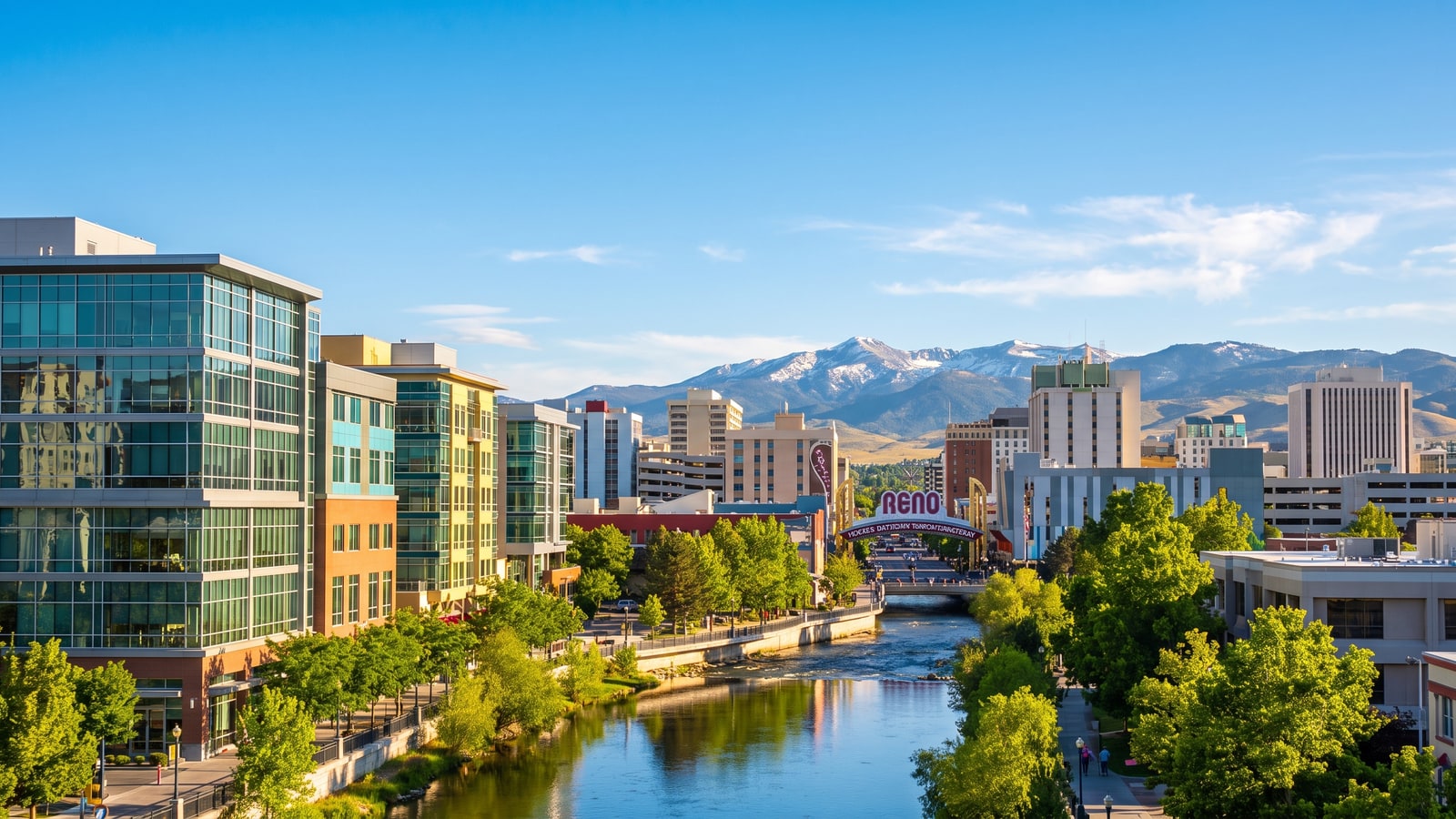
I tell every buyer to be honest about temperament here. Some people are energized by a metro and would find Carson City too quiet; others are soothed by a capital's calm and find Reno's pace draining. Neither is wrong — but this is the variable that determines whether you love your choice in year three, long after the price gap stops mattering.
How Do Schools Compare in Carson City and Reno?
Both cities sit inside solid Nevada public-school systems, but they are governed by different districts, and the size difference shows up in options.
Carson City is served by the Carson City School District, a small, contained district — a handful of elementary schools, two middle schools, and Carson High School, plus charter and magnet options. Its scale is a feature for many families: smaller administrative footprint, easier-to-navigate choices, and tight community ties. Reno and neighboring Sparks fall under the much larger Washoe County School District, one of Nevada's biggest, which brings a far wider menu — signature academies, magnet programs, International Baccalaureate tracks, and a broad range of high schools with distinct specialties.
For the education side of the location decision, review our guide to Carson City schools and verify current zoning for the particular address.
According to GreatSchools, ratings vary school-by-school in both districts, so the right move in either city is the same: identify the specific attendance zone for any home you're serious about and verify current ratings and boundaries before you write an offer, because a strong district still contains a range of individual schools. Private and parochial options exist in both markets, with more selection in the larger Reno metro. For families, I always recommend touring the actual assigned schools — a district's average tells you little about the campus your child will attend.
Do Carson City and Reno Have the Same Taxes?
Mostly yes — and this is one of Northern Nevada's biggest shared advantages — but there are small differences worth knowing.
Both cities operate under Nevada's no-state-income-tax framework, which is a meaningful annual advantage over neighboring California for wage earners, retirees drawing from investments, and remote workers alike. Both also benefit from Nevada's property-tax structure, including the owner-occupied assessment cap under NRS 361.4722, which limits how fast the taxable value of a primary residence can rise year over year — a protection that grows more valuable the longer you own.
Where they differ slightly is sales tax, which is set at the county level. According to the Nevada Department of Taxation, Washoe County (Reno and Sparks) carries a higher combined sales-tax rate than Carson City, which operates as its own consolidated jurisdiction with a somewhat lower combined rate. The gap is modest — a fraction of a percent — but on large purchases it adds up. Property-tax rates also vary by taxing district within each city, so the effective bill on two similarly priced homes can differ; confirm the exact rate for any specific parcel with the county or city assessor before you budget.
| Tax or cost | Carson City | Reno |
|---|---|---|
| State income tax | None | None |
| Owner-occupied property cap | Yes — NRS 361.4722 (3% cap) | Yes — NRS 361.4722 (3% cap) |
| Combined sales tax | Lower (consolidated municipality) | Higher (Washoe County) |
| Est. 20% down at median sold | about $109,000 (on $545,000) | about $121,300 (on $606,500) |
| Est. monthly P&I at median sold | about $2,815 (6.7%, 30-yr) | about $3,130 (6.7%, 30-yr) |
The payment math above is illustrative — it assumes 20% down and a roughly 6.7% 30-year fixed rate per Freddie Mac's mid-2026 survey — but it makes the affordability gap concrete: Carson City's lower median sold price saves you roughly $12,300 up front and about $315 a month in principal and interest versus Reno. Over a five-year hold, that is close to $19,000 in payments before you count the smaller down payment. Want your own numbers? Start with a free home value estimate — and if you need to sell before you buy, our seller team can run the same comparison from the listing side for either city.
Which City Offers Better Access to Lake Tahoe and the Outdoors?
Both cities are strong choices for outdoor lovers, but Carson City has a genuine geographic edge on Tahoe access — and that surprises people who assume Reno, being bigger and better known, must be closer.
From Carson City, the drive to the east and south shores of Lake Tahoe over US-50 and Spooner Summit is roughly 20 to 30 minutes — you can be at the water on a summer evening or the ski slopes on a winter morning without committing your whole day. From Reno, Tahoe is about 45 minutes over the NV-431 Mt. Rose Highway to Incline Village and the north shore, a scenic drive but a longer one, and one that weather can complicate in winter. Both cities put the Sierra backcountry, the Carson River, renowned mountain biking, and dozens of trailheads within easy reach.

For a household that organizes weekends around the lake and the mountains, Carson City's shorter Tahoe access is a legitimate daily-life advantage. For a household that wants outdoor access plus metro amenities the rest of the week — the airport, the restaurants, the events — Reno's slightly longer Tahoe drive is an easy trade for everything else the city delivers.
What Does New Construction Look Like in Each City?
If you want a builder warranty and never-lived-in finishes, both cities offer new construction, but Reno has more of it and it costs more.
According to Nevada Real Estate Group's live NNRMLS feed (July 12, 2026), Reno had 124 active new-construction listings (built 2024 or later) at a median of $688,950, while Carson City had 75 at a median of $609,552. Two things jump out. First, Reno's new-build median runs nearly $80,000 above Carson City's — the metro's land costs, demand, and product mix push new construction higher. Second, and quietly important, new construction makes up a larger share of Carson City's smaller market: 75 of 389 actives (about 19%) versus 124 of 1,570 (about 8%) in Reno. For a buyer who specifically wants new, Carson City punches above its weight.
New construction also intersects with the HOA question. Carson City had 184 no-HOA active listings and Reno had 601 — reflecting Reno's larger overall pool, but both cities offer meaningful no-HOA choice, which is harder to find in master-planned Southern Nevada. Many of Carson City's older, HOA-free neighborhoods sit close to downtown and the capital complex, while Reno's no-HOA stock skews toward its established core and older subdivisions. If a builder warranty and modern floor plan top your list, we can filter either market to new-only on our live Northern Nevada search and walk you through the tradeoffs against resale.
Who Is a Better Fit for Carson City Than Reno?
After hundreds of Northern Nevada conversations, the fit usually sorts cleanly. Here is how I frame it for buyers weighing the two.
| Buyer profile | Better pick | Why |
|---|---|---|
| State/government worker | Carson City | Job is in town; short commute; stable base |
| Tesla, tech, or logistics worker | Reno | Employers cluster east and north of the metro |
| Budget under $550K | Carson City | Lower median sold; more homes in reach |
| Wants maximum selection | Reno | Four times the active inventory |
| Retiree / quiet lifestyle | Carson City | Walkable capital; calm pace; fast Tahoe access |
| Young professional / nightlife | Reno | Midtown, Riverwalk, university, airport, events |
| Remote worker | Either — lean Carson City | Lower costs, quiet, Tahoe proximity if job is portable |
| Family wanting school options | Reno | Larger Washoe district; more program variety |
Choose Carson City if you value a lower cost of entry, a small-town capital feel, the shortest Tahoe access, and a stable government-and-healthcare economy — and you either work in town or work remotely. Choose Reno if you want a diversified job market, deep housing selection, metro amenities, an airport, and a growth trajectory — and you can absorb the higher price and faster pace. Plenty of my clients tour both before deciding, and I encourage it; the two cities feel different the moment you spend a day in each. When you're ready, tell us what matters most and we'll build a side-by-side plan.

Which City Appreciates Faster Over Time?
Reno has been the faster appreciator over the past decade, and the reasons are structural — but Carson City offers a quieter, steadier ride that some buyers prefer.
Reno's appreciation has been powered by the Tesla-anchored job boom, sustained California in-migration, and constrained land supply against strong demand. That combination has driven above-average price growth and, at times, real volatility on the way up. According to the Federal Housing Finance Agency house price index, the Reno metro has posted strong long-run gains, reflecting exactly that demand pressure. When a market rises fast, though, it can also correct faster when rates or the economy shift.
Carson City tends to be the tortoise to Reno's hare: steadier, less volatile, with appreciation tied to its stable employment base rather than a boom cycle. For a buyer who prioritizes predictability and a lower entry price — and who plans to stay put for years — that stability is a feature, not a bug. Across the closings our team has represented, I've watched Carson City hold value gracefully through cycles that whipsawed hotter markets. Neither approach is universally "better"; it depends on whether you're optimizing for maximum upside (Reno's historical edge) or lower-variance ownership (Carson City's). If long-term appreciation is your driver, the broader Reno vs Las Vegas comparison puts Northern Nevada's growth story in statewide context.
Why Do Buyers Comparing Carson City and Reno Call Nevada Real Estate Group?
Because a 30-mile decision with a $61,500 price gap, two different job economies, and two different daily lives deserves more than a Saturday of open houses. It deserves data, local judgment, and someone who works both markets every week.
Nevada Real Estate Group is the #1-ranked real estate team in Nevada, with more than $4.85 billion in career sales volume, 9,600+ closed transactions, 150+ agents, and 9,061+ verified five-star reviews — and our Northern Nevada team lives inside the Carson City, Reno, and Sparks markets daily. We pull the live NNRMLS numbers (like the 178-vs-852 closed-sale and $545,000-vs-$606,500 median figures in this guide), map them against your budget and commute, and tour both cities with you so the choice is informed rather than emotional. Whether you're a state worker eyeing the capital, a Tesla hire heading to the metro, or a remote worker deciding where the money goes furthest, we build the side-by-side that fits your life. If you're still vetting representation, our guide to the best real estate agent in Reno lays out exactly what to look for.
Ready to compare in person? Browse Carson City homes for sale and Reno homes for sale, start a free home value estimate, or reach our buyer team directly. Call or text us — Las Vegas (702) 637-1759 · Reno (775) 277-2120 — and let's find the Northern Nevada city that actually fits you.
Frequently Asked Questions
Is Carson City cheaper than Reno?
On what buyers actually pay, yes. According to Nevada Real Estate Group's live NNRMLS feed (July 12, 2026), Carson City's median sold price is $545,000 versus Reno's $606,500 — a $61,500 gap — even though the two cities post nearly identical median list prices ($610,000 vs $599,000). Carson City also generally carries a lower combined sales-tax rate. If your budget tops out near $550,000, Carson City puts more move-in-ready homes within reach.
Which city has better job opportunities, Carson City or Reno?
It depends on your field. Carson City's economy centers on state government (it's Nevada's capital) plus healthcare and local government — stable, benefits-rich, recession-resistant work. Reno offers a far more diversified market anchored by the Tesla Gigafactory, Panasonic, Switch, Google, the University of Nevada, Reno, Renown Health, logistics, and tourism. For breadth and higher tech-and-manufacturing wage ceilings, Reno wins; for public-sector stability, Carson City does.
How far apart are Carson City and Reno, and how long is the commute?
About 30 miles, connected by US-395 and the I-580 freeway — typically a 35-to-45-minute drive depending on traffic and your start and end points. The proximity is why many households live in Carson City for lower housing costs while commuting to Reno or the Tahoe-Reno Industrial Center for work, or vice versa. For two Reno commuters the math usually favors living closer in; for a one-commuter household, Carson City often pencils out well.
Which city is better for families and schools?
Both sit in solid Nevada public systems. Carson City School District is small and easy to navigate with strong community ties; Washoe County School District (Reno and Sparks) is much larger and offers more program variety — magnets, academies, and IB tracks. Families wanting the widest menu of school options lean Reno; families wanting a tight, small-district feel lean Carson City. Either way, verify the specific attendance zone and current GreatSchools ratings before you offer.
Which city is better for retirees and remote workers?
Carson City is often the stronger fit for both. Retirees value its walkable capital, calm pace, lower entry price, quality healthcare via Carson Tahoe Health, and 20-to-30-minute Tahoe access. Remote workers get the same lifestyle upside plus lower housing and everyday costs — the $61,500 median-sold gap goes a long way when your job isn't tied to a Reno office. Reno still appeals to retirees and remote workers who want metro amenities and an airport nearby.
Which city appreciates faster, Carson City or Reno?
Reno has been the faster appreciator over the past decade, driven by the Tesla-anchored job boom, California in-migration, and constrained supply — with more volatility on the way up. Carson City appreciates more steadily, tied to its stable employment base. If you're optimizing for maximum long-run upside, Reno has the historical edge; if you prefer lower-variance, predictable ownership, Carson City is the calmer ride. Both benefit from Nevada's no-income-tax advantage.
Are the taxes different between Carson City and Reno?
The big framework is identical — no Nevada state income tax and the same owner-occupied property-tax cap under NRS 361.4722. The main difference is sales tax, set at the county level: Washoe County (Reno) carries a higher combined rate than Carson City's consolidated jurisdiction. The gap is a fraction of a percent but adds up on large purchases. Property-tax rates also vary by taxing district within each city, so confirm the exact rate for any specific parcel before budgeting.
Which Sources Inform This Carson City vs Reno Guide?
Live inventory, pricing, and pace figures come from Nevada Real Estate Group's NNRMLS feed, pulled July 12, 2026 (Carson City: 389 actives, $610,000 median list, 178 closed sales at $545,000 median sold, 46 median days on market, 75 new-construction actives, 184 no-HOA actives; Reno: 1,570 actives, $599,000 median list, 852 closed sales at $606,500 median sold, 47 median days on market, 124 new-construction actives, 601 no-HOA actives). Methodology: city-scoped active and 90-day-sold statistics from the same live feed that powers our site search. Supporting economic, tax, and school context draws on these authorities:
- U.S. Census Bureau — Carson City QuickFacts — population and housing baselines
- U.S. Census Bureau — Reno QuickFacts — population and housing baselines
- U.S. Bureau of Labor Statistics — Reno metro employment and job-growth data
- Nevada Department of Employment, Training and Rehabilitation — Northern Nevada unemployment and labor statistics
- Economic Development Authority of Western Nevada — Reno-Sparks employer relocation and expansion tracking
- Nevada Department of Taxation — state and county sales-tax framework
- Nevada Revised Statutes 361.4722 — owner-occupied property-tax cap
- Freddie Mac Primary Mortgage Market Survey — weekly 30-year mortgage rate benchmarks
- Federal Housing Finance Agency House Price Index — Reno metro long-run appreciation
- GreatSchools — Nevada — Carson City and Washoe County school ratings
- Nevada Department of Transportation — I-580 corridor and commute data
Ready to decide? Call or text Nevada Real Estate Group — Las Vegas (702) 637-1759 · Reno (775) 277-2120 — the Northern Nevada specialists for Carson City, Reno, and Sparks.