

Mesquite, Nevada and St. George, Utah belong on the same home-search itinerary when you want desert recreation and access to the Virgin River corridor. They are different housing markets, jurisdictions and daily routines. A lower purchase price can matter greatly, but so can the frequency of a medical appointment, the availability of a flight and the maintenance obligations attached to a particular house.
At Nevada Real Estate Group, relocations make up a large share of the 9,600+ closings our team has handled over 16+ years, and "Mesquite or St. George?" is one of the most common cross-border questions we field.
Choose between Mesquite and St. George by comparing actual homes and recurring costs. Nevada has no individual state income tax; Utah's 2026 rate is 4.45% of state taxable income before applicable credits. Mesquite's July 2026 housing figures below are historical, not a verified current discount. Medical networks, airport itineraries, HOA obligations and repeated travel can change which home works better for you.
- Utah's 2026 rate is 4.45%; gross retirement withdrawals are not automatically state taxable income.
- Nevada's qualifying 3% abatement limits tax bills, not assessed values.
- Compare matched homes; July 2026 prices cannot show whether a $150,000 gap exists today.
- Verify specialists, flight dates, school boundaries and recurring trips by address.
- Sun City Mesquite and SunRiver St. George have distinct identities and governing documents.
The factual review here is dated October 23, 2026. The Las Vegas versus St. George guide covers the larger metro alternative; this article focuses on Mesquite. Use the current tax sources linked below when making a cross-border calculation.
Which Requirements Should Decide Your Mesquite or St. George Shortlist?
Begin with the requirements that would make a home unusable or unaffordable. Those might be a step-free entrance, a recurring appointment within your travel limit, a particular workspace or a maximum monthly payment. Write them before touring. Otherwise, an appealing view can overwhelm a practical constraint that becomes expensive after closing.
Give each requirement an observable test. For a floor plan, measure the doorway, parking space or room that matters. For healthcare, verify the specific provider and insurance network. For a travel requirement, compare the complete journey to the actual terminal or entrance. A city name, advertised lifestyle or neighborhood label cannot answer those questions by itself.
| Your requirement | Evidence to collect in both cities | What could change the choice |
|---|---|---|
| Affordable recurring cost | Loan estimate, tax projection, insurance and association statements | A smaller loan can be offset by repairs, fees or frequent travel |
| Specific medical access | Provider, network, location and appointment availability | The required service is elsewhere or unavailable to new patients |
| Usable recreation | Actual facility, access rights, hours and separate charges | A nearby course or pool is not included with the home |
| Reliable travel | Address-to-destination route and dated flight itinerary | Seasonal service, connection times or road conditions alter the trip |
Use the Mesquite community hub to orient the Nevada search, then inspect individual properties. A requirement should remain the same on both sides of the comparison. Comparing a small attached home with an expansive detached house might be useful for your budget, but it does not establish that the cities charge different prices for equivalent housing.
Mark unknown items as unknown. Do not assign a favorable score because a listing omits an expense or a brochure promises convenience. You can narrow the list without declaring a universal winner, and revisit your ranking when a verified cost or service changes.
What Do Homes Cost in Mesquite?
The original article reported a Mesquite median sale price near $400,000, an average near $414,000 and about 41 days on market for its trailing-year transaction group. Those figures describe the July 13, 2026 article's historical record. The underlying export is not available for this refresh, so the sample, precise cutoff and exclusions cannot be independently reconstructed.
Its active-listing snapshot was a different population: roughly 48 available listings and a $420,000 median asking price. An asking median is not a closed-sale median. Subtracting the two does not reveal a typical negotiated discount because the properties and observation windows differ. Today's Mesquite homes for sale should be examined separately from that earlier snapshot.
| Original measure | July article's figure | Interpretation limit |
|---|---|---|
| Mesquite closed-sale median / mean | About $400,000 / $414,000 | Original trailing-year group; underlying export unavailable |
| Mesquite market time | About 41 days | Original cohort, not a present selling-time promise |
| Mesquite asking median / active count | About $420,000 / 48 | Separate active snapshot, not comparable closings |
| Original listing extremes | $49,990 lot to $1,825,000 estate | A manufactured-home lot is not a completed home |
| St. George description | Mid-$500,000s | No matched sample or exact observation window supplied |
The July article also described condos and townhomes at $200,000–$300,000, detached homes at $350,000–$550,000, golf or view homes at $600,000–$1,000,000 and a luxury tier around $1,800,000. These are retained historical bands, not current inventory guarantees. Its claimed $100,000–$200,000 tier-by-tier Utah premium lacked a documented matched comparison and should not set an offer today.
For budget categories, the Mesquite home-values guide provides another starting point. A useful current comparison requires recent, relevant closed sales and an explicit date range in each city, with land, attached housing and detached housing separated.
How Can You Compare Equivalent Homes Across the State Line?
Compare homes that solve the same practical problem before comparing the cities' medians. Start with housing type, usable area, bedroom arrangement, parking, lot, age and condition. Then examine association obligations, recreation access, energy equipment and the location of your recurring destinations. A price difference has meaning only after you understand what differs in the product.
Build a small worksheet for the actual candidates. Record asking price and status with a date, then add recent sold comparables that share the important features. Keep active competition separate from completed transactions. A seller can ask for a premium that the next buyer will not pay; a past closing may reflect repairs, concessions or circumstances missing from the public headline.
For example, a lower-priced house needing major equipment work may consume cash that a better-maintained alternative leaves available. An attached home may transfer some exterior maintenance to an association but add assessments and restrictions. A golf-front house can offer a view without including playing rights. These differences can matter more than the city's median.
Use the Mesquite neighborhood and golf-community guide to identify questions about setting and governance. If your comparison expands beyond these two cities, keep Summerlin and Henderson as separate alternatives with their own destinations and costs. Do not mix their sales into a Mesquite price claim.
Finally, ask what evidence would reverse your initial preference. A roof inspection, insurer's quote or association packet may show that the apparent bargain costs more to own. Keeping that possibility open is a better negotiation tool than committing to a fixed cross-border discount before reviewing any homes.
How Do Nevada and Utah Income Taxes Compare in 2026?
According to the Nevada Department of Taxation's individual-income-tax guidance, Nevada does not impose an individual state income tax. That is a meaningful consideration for a Mesquite purchase, but it does not eliminate federal taxes, property taxes, sales taxes or obligations that may arise in another state.
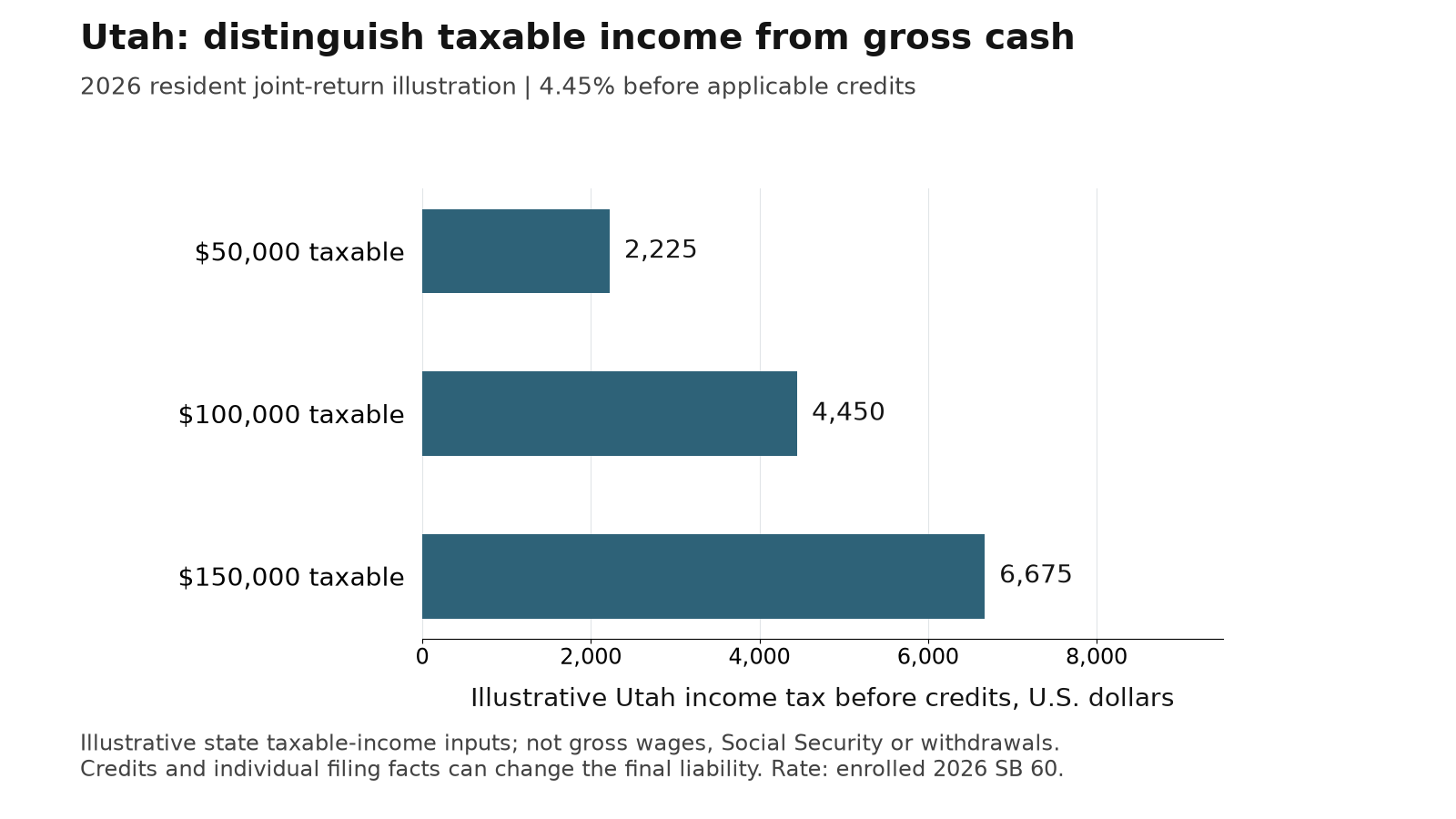
According to Utah's enrolled 2026 SB 60, the resident individual rate is 4.45%, with retrospective operation for taxable years beginning January 1, 2026. The Utah House's tax-policy record also identifies the reduction from 4.5% to 4.45%. A household calculation starts with Utah state taxable income and then accounts for applicable credits; it does not simply multiply every dollar arriving in a bank account.
Here is a deliberately limited 2026 illustration for a resident married couple filing jointly, assuming the stated amounts are already Utah state taxable income. Before any applicable credits, $50,000 × 4.45% is $2,225; $100,000 produces $4,450; and $150,000 produces $6,675. These are arithmetic examples, not estimates for all couples with those amounts in wages, benefits or withdrawals.
Have a tax professional compare the same year's expected income and filing facts under both scenarios. Keep the annual tax difference separate from the one-time down payment and from future appreciation assumptions. A known rate can inform the decision without turning a hypothetical tax result into guaranteed savings.
What Should Retirees and Remote Workers Check Before Using a Tax-Savings Estimate?
Separate income type, taxable amount and state connection. Pension payments, Social Security benefits, taxable-account proceeds and retirement-account withdrawals do not automatically produce identical state taxable income. A large transfer between accounts is not necessarily income, and the balance available for spending is not itself a tax-return line.
The Utah House's tax-policy history describes Social Security and military-retirement credits, including changes over different years. That establishes why a flat-rate multiplication can be incomplete. It does not supply every eligibility fact for your return. This guide does not carry a prior year's credit threshold forward as a verified 2026 rule or assume that every retiree qualifies.
Prepare a projection showing filing status, expected income categories, deductions, state adjustments and credits. If a move occurs during the year, ask how the timing and each income source affect the returns. If you continue working for an employer across the border, verify payroll treatment and the employer's permission for the actual work location before treating a Nevada address as the complete answer.
For a seasonal residence, distinguish owning property from establishing tax residency. The house you prefer for winter use may not become your sole primary home. Keep the property-tax occupancy rules separate from the income-tax analysis; satisfying a local exemption requirement does not by itself resolve every residency question.
This preparation also improves the housing budget. A buyer who assumes all gross withdrawals are taxed at the headline rate may overstate the savings available for a larger mortgage. A buyer who ignores cross-state income may understate obligations. Ask for a written, dated projection using your facts before converting a tax comparison into a purchase ceiling.
How Do the Property-Tax Rules Differ for the Actual Home?
According to the Clark County Assessor's tax-abatement guidance, the qualifying Nevada owner-occupied primary-residence abatement caps increases in the tax bill at 3%. It is not a 3% ceiling on assessed value. The same guidance describes an up-to-8% cap for other property and first-year exceptions for new construction or a change of use.
The county also explains that a recorded ownership document removes the owner-occupied designation and requires a new postcard to retain the qualifying abatement for the next year. Review the parcel's existing bill and classification with the assessor. Do not assume a purchase price resets the protected base, or assume the seller's occupancy paperwork completes yours.
According to the Utah State Tax Commission's primary-residential exemption guidance, qualifying property receives a 45% exemption, leaving 55% of market value taxable. The stated occupancy test is a primary domicile for at least 183 consecutive days in a calendar year, occupied by the owner or a full-time tenant. Eligibility must be checked for the intended use.
A hypothetical $550,000 qualifying Utah valuation would leave $302,500 subject to the applicable property-tax rates. That is a taxable-value calculation, not a $302,500 bill, and it does not establish the tax on a particular listing. A hypothetical qualifying $2,000 Nevada prior-year bill rising the full 3% would become $2,060, subject to applicable exceptions.
The Utah page separately announces application changes beginning January 1, 2027 after ownership changes and other triggers. Ask the county which filing procedure applies to your acquisition date. Do not apply that future procedure retroactively to a 2026 closing or assume exemption paperwork is automatic.
How Much Would a Different Purchase Price Change the Mortgage Payment?
A price difference changes the loan only after the down payment and financing terms are specified. According to Freddie Mac's PMMS, the national 30-year fixed-rate average was 7.32% on October 22, 2026. It is national context, not a Mesquite or St. George quote and not a promise that either buyer qualifies.
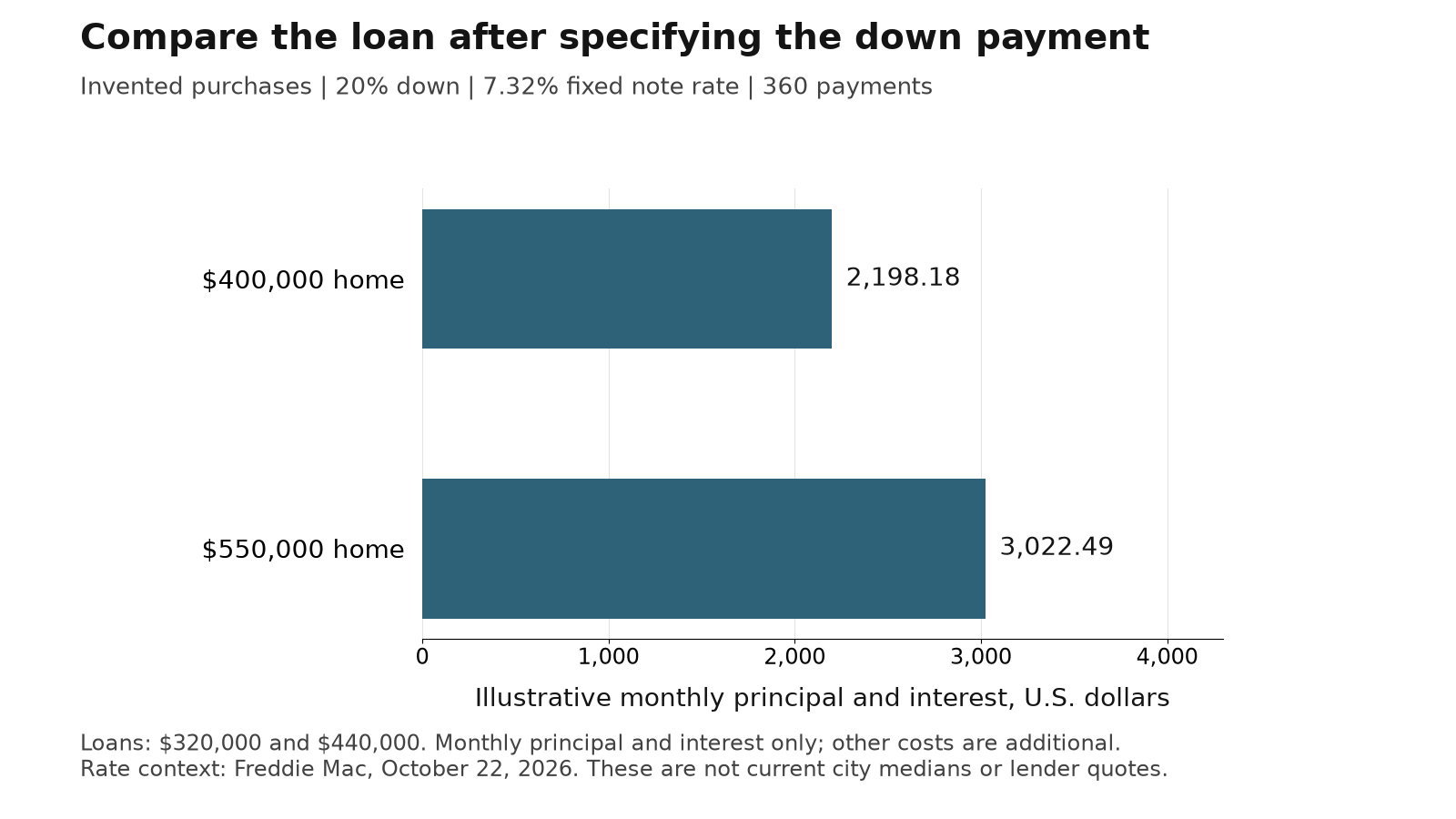
For a transparent example, compare invented $400,000 and $550,000 purchases with 20% down, a 30-year fully amortizing fixed loan and an assumed 7.32% note rate. The loans are $320,000 and $440,000. Monthly principal and interest are approximately $2,198.18 and $3,022.49. Using unrounded results, the difference rounds to $824.32 per month.
| Item | Home A | Home B |
|---|---|---|
| Assumed purchase price | $400,000 | $550,000 |
| 20% down payment | $80,000 | $110,000 |
| Loan amount | $320,000 | $440,000 |
| Principal and interest at 7.32%, 360 payments | $2,198.18/month | $3,022.49/month |
| Expenses excluded | Taxes, insurance, associations, mortgage insurance if applicable, utilities, maintenance, closing costs and points | |
Replace the example with written Loan Estimates for the actual candidates. Compare rate locks, points, lender credits, loan type and the amount of cash required, not just the monthly figure. Ask each lender to itemize any upfront charge required to obtain the quoted rate and show when that cash is due. A temporary payment reduction and a permanent note-rate change are different products. A builder's promotional payment can also depend on a specified lender, loan program or closing date.
If you are paying cash, the mortgage line disappears but the capital difference remains. The example cannot establish a universal cross-border saving because neither price represents a matched, currently available pair of homes.
How Much Cash Should Remain After Buying?
Compare cash left available after closing, not only the advertised down payment. Moving, repairs, deposits and overlapping housing costs can occur together. A house that fits the monthly budget may still strain the household if closing consumes the money needed for the transition or for known work.
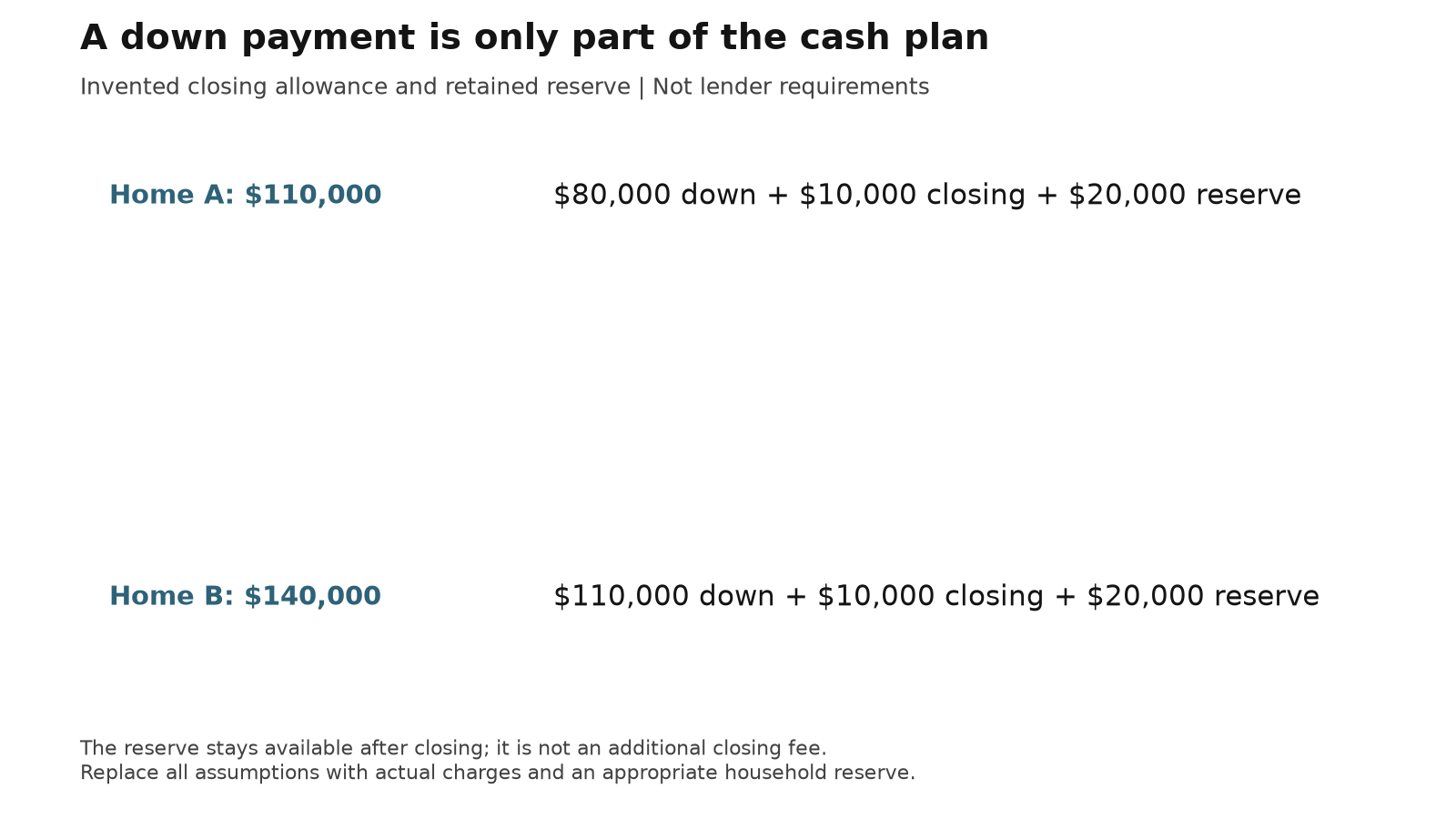
Using the invented financing example above, assume another $10,000 of closing expenses and a separately retained $20,000 reserve for each option. Home A requires $80,000 down plus $10,000 at closing and $20,000 kept available: $110,000 in planned cash. Home B requires $110,000 down plus those same two assumptions: $140,000. The reserve is not a closing fee, and neither closing-cost allowance is a quote.
Replace the shared assumptions when evidence differs. A repair allowance belongs with the property needing work. A refundable deposit should not be counted again if it is credited at closing. Proceeds from a home sale may arrive after the purchase funds are due, so timing matters as well as the eventual total.
Consider a delayed move or a month of carrying both homes when assessing the plan. The purpose is to expose a cash constraint before selecting a property, not to prescribe the same reserve for every buyer. Review your transaction dates, expected proceeds and available funds with the people handling the financing and closing.
Which Recurring Costs Can Reverse the Apparent Housing Advantage?
Build a monthly worksheet for each address, using actual documents wherever available. Include mortgage payments, property taxes, insurance, all association assessments, utilities, routine maintenance and separately purchased recreation. Keep an annual or irregular expense on the sheet by dividing it into a monthly planning allowance, while retaining its actual due date in your cash calendar.
A lower price does not prove lower insurance. Request an address-specific quote with the same coverage assumptions and deductibles for both homes. Ask which conditions or inspections affect availability and pricing. The state's income-tax structure is not evidence that an insurer will charge less for a particular Nevada property.
For utilities, compare service providers, equipment, conditioned area and actual bills when the seller can provide them. Note occupancy, thermostat settings, pool use and any long vacancy before treating an old bill as your own estimate. A house occupied only part of the year may have a low annual total that does not represent full-time use.
Association costs deserve the same discipline. An invented $100 monthly difference is $1,200 per year before increases or assessments, but a higher fee may cover an expense the other owner pays directly. Reconcile the included services rather than comparing dues in isolation. The Mesquite 55-plus inventory page can help identify candidates; it cannot replace their governing documents.
Keep the tax projection outside the property worksheet until it has been reviewed using the household's actual filing facts. Then combine the totals without counting the one-time purchase price as an annual expense. This prevents the original article's broad savings claim from becoming a budget assumption unsupported by the homes you are considering.
How Should You Compare Medical Access Without Relying on Hospital Size Alone?
Start with the services you actually use, the accepted insurance network and appointment availability. According to Mesa View Regional Hospital's emergency-care page, the Mesquite facility provides 24/7 emergency care and emergency general-surgery coverage, with additional on-call surgical support. The page also describes its Mercy Air base for transfers when a higher level of specialty care is needed.
According to Intermountain's St. George Regional Hospital description, the hospital has 284 beds and serves as a regional referral center. That corrects the earlier article's 245-bed description. Its size and role are useful context, but neither establishes that your specialist practices there, accepts your plan or can see you when needed.
Make a list of primary care, recurring specialty appointments, labs, imaging, pharmacy and any other required services. Verify each separately. An insurer's general network directory and a provider's current new-patient availability may answer different questions. For a planned course of care, confirm the actual location rather than assuming every appointment occurs at the main hospital.
Then compare the complete trip from each candidate home: road travel, parking, walking and the ability to return afterward. A casual city-to-city driving estimate is not an emergency-response standard or a guarantee about transfer destination. Emergency decisions belong with emergency services; this housing comparison does not recommend self-transport based on a price or tax calculation.
A home closer to a verified recurring provider may justify a higher total cost for one household. Another buyer may find the required services locally. Record the evidence and the tradeoff without labeling either city medically suitable for everyone with a particular condition or age.
What Should You Check About Airports and Repeated Cross-Border Trips?
According to the LVCVA's Mesquite Municipal Airport listing, Mesquite's airport serves general aviation and has no scheduled flights. That differs from saying it is impossible to fly from Mesquite. Scheduled airline travel normally requires a different airport and a complete journey calculation.
According to the Greater Zion tourism office's transportation page, St. George Regional Airport offers service through American, Delta and United, with named hubs including Salt Lake City, Denver, Los Angeles, Phoenix and Dallas–Fort Worth. Its page distinguishes seasonal service. Check the airline's actual dates, connections and return options before valuing a home for a route.
Compare SGU with Harry Reid International using the trips you expect to take. Include travel to the terminal, parking, check-in time, fares, baggage and connection risk. A wider destination list does not guarantee the lowest total price for your itinerary. Do not assume that a trip from either city center matches the drive from a particular neighborhood to a terminal.
The I-15 journey between the Nevada and Utah areas also passes through Arizona's Virgin River Gorge. Plan from the actual addresses, check current road conditions and verify the time zone shown for each appointment. This guide does not promise a uniform 40-minute drive.
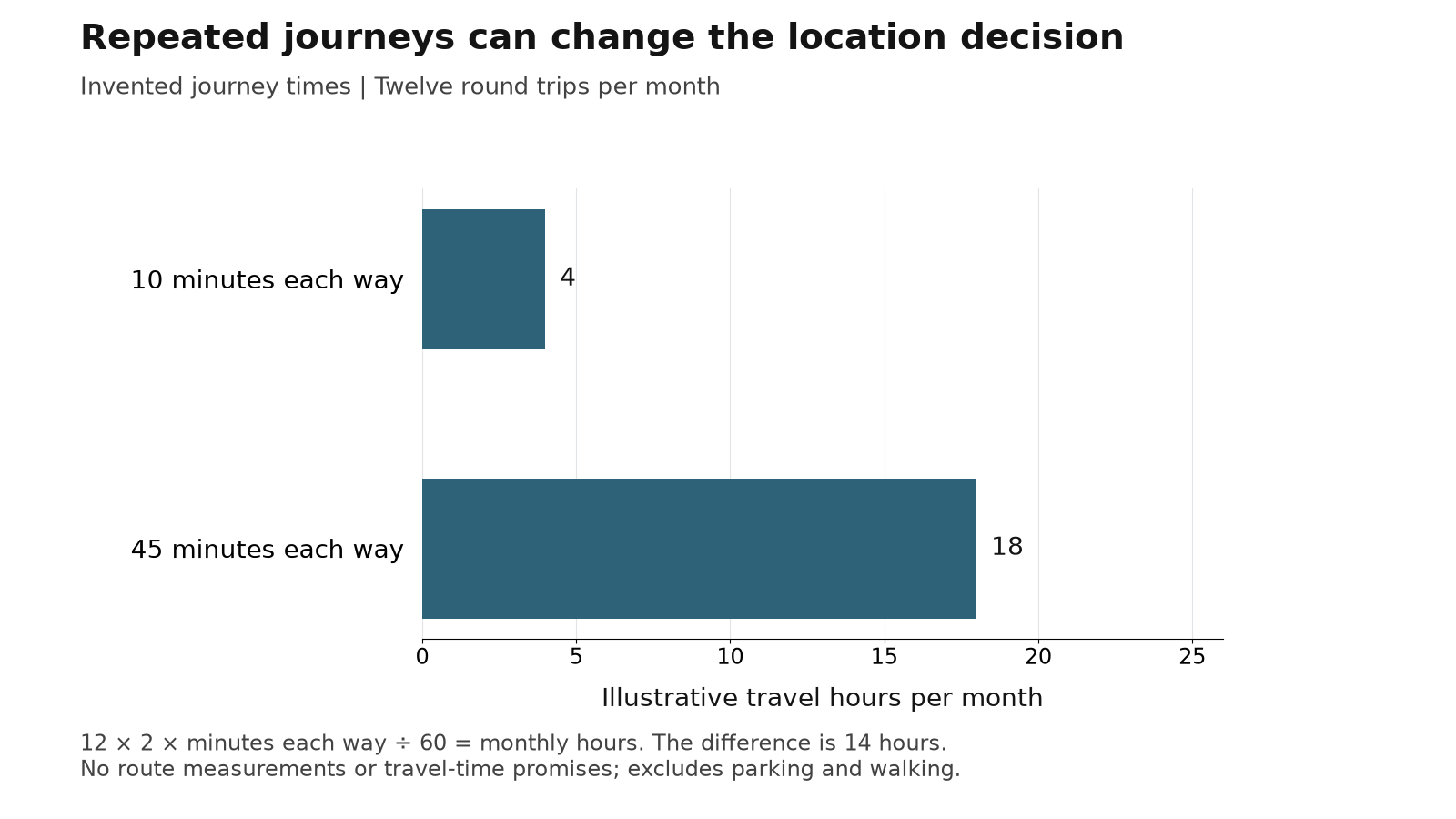
Repeated appointments and errands can matter more than an occasional flight. Record how often you will make each trip, and test the important routes during relevant conditions. A location that works for a monthly outing may feel different when the same destination is needed several times each week.
How Do Sun City Mesquite, SunRiver and Golf Amenities Differ?
Treat each development as its own community with its own documents. According to the SunRiver St. George Community Association's lifestyle page, SunRiver is a 55-plus community with resident control and facilities including indoor and outdoor pools and sports courts. It should not be relabeled as a Del Webb development called Sun City St. George.
According to Sun City Mesquite's governance page, residents belong to both Sun City Mesquite HOA and the Anthem Mesquite Master Association. The page identifies Pioneer Center facilities including pools, sports courts and a putting course. Obtain the applicable assessments and obligations for both entities rather than assuming one advertised fee tells the whole story.
For either community, verify occupancy eligibility, guest arrangements, rental restrictions, architectural rules and responsibility for private maintenance. A 55-plus label does not establish the detailed policy for every household member or visitor. Nor does a broader neighborhood name, such as Mesquite Vistas, prove that every property has the same age restriction or amenity access.
Golf adds another set of questions. Separate the course operator, residential association, membership program and any resident benefit. A putting facility at a recreation center is different from a round on an adjacent golf course. A view across a fairway does not establish playing rights, discounted fees or a guaranteed open view forever.
Tour the amenities you expect to use and ask for current operating and guest rules. Compare their actual value to you with the charges and restrictions, without assuming every buyer wants the same activities. The Mesquite golf-community guide offers more detail on course identities and neighborhood questions; obtain the current property packet before making a financial commitment.
How Should Heat, Outdoor Access and Home Maintenance Affect the Decision?
Test the home and the routine under conditions relevant to your intended occupancy. A pleasant short visit does not establish summer comfort, winter equipment performance or year-round recreation access. The earlier article's blanket promise of golf every day should not substitute for course schedules, weather or your own tolerance for outdoor conditions.
According to the National Weather Service's heat-safety guidance, heat can cause illness and worsen existing health conditions. Use current local forecasts and alerts when planning a visit or outdoor activity. This guide does not convert a broad elevation difference into a guaranteed personal comfort advantage or a precise temperature difference between candidate houses.
During a tour, look at afternoon sun exposure, shaded outdoor space, window condition and cooling equipment. Ask for equipment age and service records, then have the property's condition assessed appropriately. A large patio that is difficult to use during your intended hours may deliver less value than a smaller shaded space. An appealing pool also creates service, utility and repair obligations that belong in the budget.
For a seasonal home, write down what must happen while you are away: inspections, leak detection, landscaping, equipment servicing and access for someone responding to a problem. Clarify which tasks an association handles and which remain yours. Do not assume the phrase lock-and-leave guarantees that every maintenance or security responsibility is covered.
Outdoor access deserves an equally specific test. Check the destination, trail or facility you actually want to use, along with its access rules and current conditions. A broad promise of nearby recreation is less useful than knowing whether your normal outing fits the home's location, your schedule and the cost of ownership.
How Can You Verify Schools and Work Arrangements Without Generalizing About Either City?
Verify school assignment by address and school year. According to Clark County School District's zoning page, the district provides a zoning search and maps for identifying assigned schools. Use that process for the Mesquite property rather than inferring a complete feeder pattern from a city name or a listing description.
According to Washington County School District's boundary page, its maps are organized by grade level and allow address searches. The page documents boundary changes involving Desert Canyons, Bloomington and Little Valley for the 2026–2027 school year. That is a concrete reason to check the current assignment instead of relying on an older brochure.
Ask separately about enrollment, transportation and programs important to the student. A district's size does not prove a particular class size, available placement or quality of fit. Review the actual campus and requirements without turning broad ratings or demographic assumptions into a recommendation about where a household belongs.
Work arrangements require an address-level review too. If commuting, confirm the employer's actual site, required days and start time, then test the route. If working remotely, confirm the employer's location policy and the service available at the house. A provider operating somewhere in the city does not prove a particular plan, connection or installation date is available at the property.
Keep a contingency for a changed schedule. More office days, a different campus or an added afternoon activity can alter the travel calculation. The best comparison uses the household's stated requirements and verified services, not a general claim that one town is for retirees and the other is for families or professionals.
What Should You Check About Growth, New Construction and Resale?
Evaluate the specific project and competing homes rather than assuming growth produces appreciation. A population headline does not show how many suitable homes will compete with yours, whether infrastructure is complete or how a future buyer will value your floor plan. This refresh does not present an unverified current population or growth ranking for either city.
For a new home, separate the base plan from the actual lot, options and contract price. Verify the builder's completion description and what remains unfinished. Ask which roads, landscaping and amenities exist today, which are under construction and which are proposals. A rendering is not proof of a finished facility or a guaranteed completion date.
For a resale, compare condition, established landscaping, immediate occupancy and known association documents with any remaining repairs or older equipment. A lower price may reflect real work, while a higher price may include features that are worth little to you. Use an inspection and the actual contract terms to clarify those differences.
The new-construction overview can help organize questions about builders and inventory, but its broader regional scope should not be mistaken for a verified Mesquite or St. George availability count. Obtain current information for the specific project and property before relying on an advertised price or incentive.
Think about a future sale using the same objective criteria. A property that satisfies your unusual preference may have a narrower pool of buyers, and an amenity premium may not be recovered. There is no supported promise here that either city will appreciate faster. Choose a home you can afford and use under realistic holding-period assumptions, including the possibility of a slower resale.
How Can You Turn the Comparison Into a Practical Buying Decision?
Tour a manageable set of homes that satisfy the same essential requirements, then revisit the strongest candidates after reviewing documents. For each one, retain the dated price and status, financing estimate, projected taxes, insurance quote, association obligations, known repairs and verified access to your recurring destinations. Keep assumptions visibly separate from confirmed entries.
Use a second visit to test the routine, not only the appearance of the house. Try the relevant entrance and parking, inspect the usable outdoor areas and confirm the trip to an appointment, workplace or activity. This is a recommended buyer process; it does not claim that routes or properties were personally tested for this article.
Mesquite may deserve priority when an available home meets your needs and its verified carrying costs and Nevada tax treatment work well for your situation. St. George may deserve priority when a specific provider, workplace or travel itinerary materially reduces recurring friction. Either choice can change when the actual house, financing or services differ from the first impression.
Before an offer, identify the unresolved items that could change your willingness to proceed. Put appropriate investigation periods, document requests and financing conditions into the discussion with your licensed representatives. Do not assume a general online comparison establishes the rights or deadlines in either state's contract.
For the Nevada side, Mesquite real estate assistance, our buyer resources and the Nevada property search can help move from a city comparison to actual addresses. If you must sell first, review seller resources and Mesquite sale planning. To discuss the evidence needed for your shortlist, contact Nevada Real Estate Group at (702) 637-1759. Confirm the appropriate Utah-licensed representation for any Utah transaction.
Frequently Asked Questions
Is Mesquite cheaper than St. George in 2026?
The original July 2026 article reported about $400,000 for its Mesquite sale median and described St. George in the mid-$500,000s, but it did not provide matched cohorts. Those historical figures do not prove today's price difference for equivalent homes. Compare current candidates, recent relevant sales and all recurring costs before choosing on price.
What is Utah's 2026 individual income-tax rate?
Utah's enacted 2026 SB 60 sets the resident individual rate at 4.45%, with retrospective operation for taxable years beginning January 1, 2026. Apply it to state taxable income and account for applicable credits. Gross wages, benefits or retirement withdrawals are not automatically the final taxable amount. Nevada does not impose an individual state income tax.
Does Nevada's 3% property-tax cap limit a home's assessed value?
No. Clark County describes a qualifying primary-residence cap on increases in the tax bill, with exceptions and separate rules for other property. It is not an assessment-growth ceiling. Review the property's prior bill, occupancy classification and required owner paperwork with the assessor, especially following a purchase or recorded ownership change.
Does Utah's 45% primary-residence exemption apply to every second home?
No. Utah's Tax Commission limits the exemption to qualifying primary residential use and describes a 183-consecutive-day occupancy test. A vacation-home label does not establish eligibility. Confirm the property's intended use and the application rules for the relevant year; the Commission separately announces procedural changes beginning January 1, 2027.
Is SunRiver St. George the same as Sun City Mesquite?
No. They are distinct communities in different states with separate governance and documents. SunRiver's association identifies its St. George 55-plus community. Sun City Mesquite's governance page identifies both its local HOA and Anthem Mesquite Master Association. Verify occupancy, fees, maintenance and recreation rights for the specific home instead of transferring assumptions between them.
Does living near a regional hospital guarantee access to my specialist?
No. Verify the provider's actual practice location, insurance participation and appointment availability. Mesa View describes local emergency services and transfer support; Intermountain describes St. George Regional's referral role. Those institutional descriptions do not establish your personal care arrangements, emergency travel time or the destination of a future transfer.
Can I take a scheduled airline flight from Mesquite Municipal Airport?
The LVCVA's airport listing describes general aviation with no scheduled flights. Compare actual SGU and Las Vegas itineraries for your travel dates, including the trip to the terminal, parking and connections. St. George's published route list includes seasonal distinctions, so an airport's presence does not guarantee the flight you want on a particular day.
How should I compare a $400,000 home with a $550,000 home?
First confirm they satisfy the same requirements. In this article's invented example, 20% down and a 7.32% fixed rate over 30 years produce about $2,198.18 versus $3,022.49 in monthly principal and interest. Taxes, insurance, associations and other costs are additional. These prices are calculation inputs, not verified current city medians or lender offers.
Sources and Calculation Notes
Primary materials were reviewed October 23, 2026. Historical housing figures retain the original July period; the missing underlying export and unmatched Utah cohort limit conclusions. No current median, measured commute, insurance quote, client interview or property walkthrough is invented. The four charts show transparent scenarios, not observed local outcomes.
- Nevada Department of Taxation: individual income tax.
- Utah Legislature: enrolled 2026 SB 60 and Utah House: dated tax-policy changes.
- Clark County Assessor: tax abatement and Utah Tax Commission: primary-residential exemption.
- Freddie Mac: October 22, 2026 PMMS. Payment formula: principal × monthly rate ÷ (1 − (1 + monthly rate) raised to −360); monthly rate is 7.32% ÷ 12.
- Mesa View: emergency services and Intermountain: St. George Regional Hospital, each describing its own institution.
- LVCVA: Mesquite airport and Greater Zion tourism office: transportation, destination organizations rather than independent fare comparisons.
- Sun City Mesquite HOA: governance and SunRiver St. George association: lifestyle, each describing its own community.
- CCSD: zoning, Washington County School District: boundaries and National Weather Service: heat safety.
Chris Nevada is the founder of Nevada Real Estate Group, brokered by LPT Realty (NV License S.181401). Our team has closed 9,600+ transactions and $4.85B+ in career volume across Nevada, ranking #1 in the state and #44 nationally, with 9,097+ five-star reviews at 4.9 stars.