
Published June 4, 2026 · Updated June 4, 2026 · By Chris Nevada, Nevada Real Estate Group · NV License S.181401
Reno has gone from "the place you drive through to get to Tahoe" to one of the most-requested relocation destinations in the West — and the questions I field have changed with it. A decade ago people asked whether Reno was a real option. Now they ask how to do the move right: what their housing budget actually buys, which neighborhood fits their commute, how Nevada's no-income-tax residency rules work, and what order to do everything in so nothing falls through the cracks.
Across the 9,600-plus closings and 16-plus years our team at Nevada Real Estate Group — the #1 real estate team in the state — has handled across Nevada, we've walked hundreds of out-of-state buyers through exactly this move. This guide is the playbook I give them: the real 2026 numbers on cost and housing, a neighborhood-by-neighborhood map, the Nevada DMV and residency steps that trip people up, and a relocation timeline you can actually follow. Whether you're coming from the Bay Area, Sacramento, Seattle, or somewhere snowier, here's how to land in Reno with confidence.
Moving to Reno in 2026 means a median home price around $660,000, no state income tax, four real seasons at 4,505 feet, and Lake Tahoe 45 minutes away. New residents must get a Nevada driver license and register a vehicle within 30 days, and the metro's 4%-range unemployment reflects a job market anchored by Tesla and the Tahoe-Reno Industrial Center. Plan a 60-to-90-day timeline and line up financing before you tour.
- The City of Reno median home was about $660,000 in spring 2026; the metro median sits near $611,000.
- Nevada has no state income tax — but you must establish genuine residency (NV license + vehicle within 30 days).
- Reno spans urban Midtown to master-planned Northwest and South Reno; budgets from the $500,000s to $2 million-plus.
- The job engine is the Tahoe-Reno Industrial Center east of town — Tesla, Switch, Google, Redwood Materials.
- Plan 60–90 days: finance + agent first, tour, offer, then NV residency, utilities, and the DMV after you land.
If you're still weighing the region itself, our 10 reasons to live in Reno guide makes the case; this one assumes you're moving and focuses on how.
Shopping the area? Browse live Reno homes for sale — every active MLS listing with prices, photos, and instant filters.
What Should You Know Before Moving to Reno?
Here's the whole relocation picture in one view before we go deep:
| Factor | Reno / Washoe County |
|---|---|
| State income tax | None (constitutionally banned) |
| Median home price (city) | $660,000 (metro $611,000) |
| Metro population | 575,000 (Reno city 287,000) |
| Elevation | 4,505 ft (high desert, four seasons) |
| Unemployment (early 2026) | 4.3% |
| Distance to Lake Tahoe | 45 minutes |
| Distance to San Francisco | 218 miles (3.5 hrs); Sacramento 2 hrs |
| New-resident DMV deadline | 30 days (license + vehicle) |
Source: U.S. Census Bureau, Nevada DMV, Northern Nevada Regional MLS, and Nevada Real Estate Group analysis, 2026.
Why Are So Many People Relocating to Reno?
The short answer is value — financial and lifestyle. Reno delivers a four-season Western city with mountain-and-lake recreation at a price far below coastal California, wrapped in Nevada's tax structure. According to the U.S. Census Bureau, the city has grown to roughly 287,000 people (from about 264,000 at the 2020 Census), and the broader Reno-Sparks metro now holds around 575,000 — growth driven largely by Californians and remote workers moving east over the Sierra.
The pull factors are consistent across the buyers I work with. There's no state income tax — a structural advantage that compounds every year. Homes cost roughly half of Bay Area prices. Lake Tahoe and a dozen ski resorts sit within an hour. And unlike the southern Nevada desert, Reno gets genuine seasons without the snow-belt brutality of the Midwest or Northeast. In my experience, the people happiest after the move are the ones who came for all of those reasons at once, not just one — Reno rewards buyers who want the whole package of taxes, cost, climate, and outdoor access.
It's also no longer a one-industry town. The economy has diversified from gaming into advanced manufacturing, clean energy, logistics, and tech, which means relocating professionals increasingly arrive with a job already in hand rather than hoping to find one. That combination — lifestyle plus a real job market plus the tax win — is why Reno keeps landing on relocation shortlists.
How Much Does It Cost to Live in Reno?
Reno sits near or modestly above the U.S. average on overall cost of living, with housing as the main driver and most other categories reasonable. Day-to-day costs — groceries, utilities, transportation — track close to national norms and well below California. The two numbers that matter most to a relocating household are housing and taxes, and the tax side is unusually friendly (more on that below).
On the rental side, if you're testing the market before buying, expect a one-bedroom to run around $1,460 a month and a two-bedroom in the $1,700 to $1,775 range, a fraction of comparable coastal-California rents. Utilities are straightforward: a single regulated provider for power and gas and a single regional water authority, which I'll cover in the utilities section. The honest framing I give clients: your Reno paycheck stretches further than a same-salary California paycheck for two compounding reasons — the home costs less and Nevada doesn't tax your income — and that gap widens every year you stay.
The cost trade-off versus California is stark enough that it drives the whole migration. A household selling a modest coastal-California home can often buy a comparable or larger Reno home outright or with a small mortgage, then keep more of every future paycheck. That's the math that gets people off the fence.
What Will a Home Cost in the Reno Market Right Now?
Let's put real 2026 numbers on it. According to Northern Nevada Regional MLS data, the City of Reno median single-family price was about $660,000 in spring 2026 (up roughly 3% year over year), while the broader Reno-Sparks metro median sat near $611,000 and neighboring Sparks ran about $564,000. Reno's median price per square foot was around $345.
Just as important for a relocating buyer is how fast the market moves. According to the same NNRMLS data, inventory was tight at roughly 1.6 months of supply in spring 2026, well-priced homes went under contract in about 11 days, and sellers were receiving close to 99% of list price. According to the Reno/Sparks Association of REALTORS, it remained a seller's market — rising prices, shrinking inventory, quick sales. The practical implication for an out-of-state buyer is simple but critical: you cannot show up cold and shop slowly. You need financing lined up and an agent ready so you can move on the right home within days, not weeks.
That speed is the single biggest mistake I see relocators make — flying in to "look around" with no pre-approval and watching the home they liked sell before they've finished touring. We handle a lot of this remotely: virtual tours, neighborhood matching, and remote offers, so out-of-state buyers can compete without living here yet.
Which Reno Neighborhoods Should Relocators Consider?
Reno is really a collection of distinct submarkets, and matching your priorities to the right one is where the right local agent earns their keep. Here's the map I draw for relocating buyers, from urban to master-planned.
Old Southwest and Midtown are the metro's walkable, character-driven core. The Old Southwest holds historic tree-lined homes near downtown and the university; Midtown is the restaurant-brewery-arts district drawing younger buyers. Both tend to price near or above the city median, with Old Southwest historic homes commanding premiums for location and charm.
Northwest Reno is the master-planned and luxury belt: Caughlin Ranch, Somersett (with guard-gated sections), ArrowCreek, and Montrêux. This is where the metro's higher-end inventory clusters — many homes run from the $700,000s into $2 million-plus for view and golf-course lots, with ArrowCreek and Montrêux anchoring the top of the market. It's the choice for move-up buyers who want newer construction, amenities, and Sierra views.
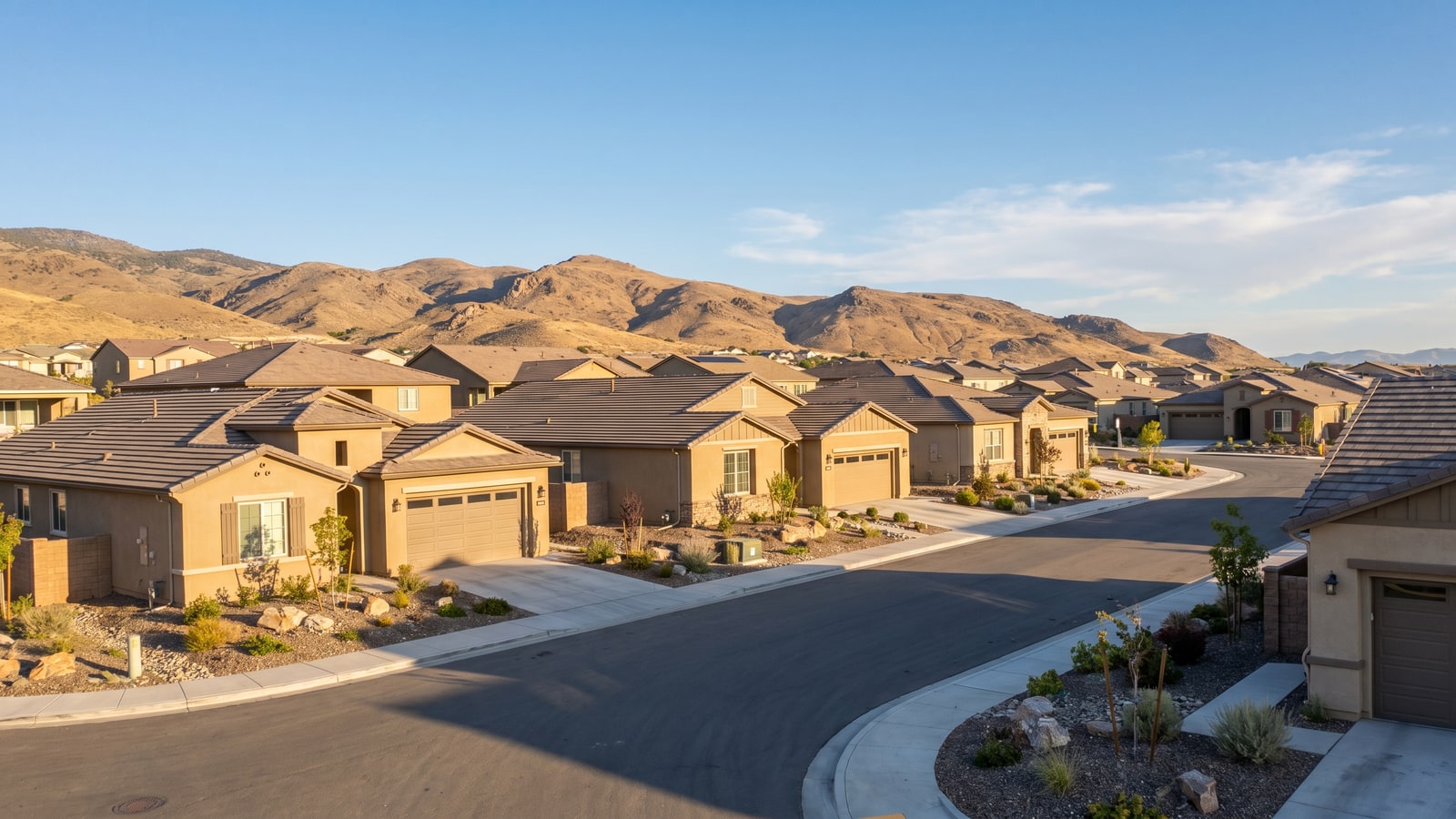
South Reno — anchored by Damonte Ranch and Double Diamond along the Steamboat corridor — is the family-suburban sweet spot, with newer homes, parks, schools, and an adjacent town center. Double Diamond often runs in the $500,000s to $650,000s; Damonte Ranch and the Galena foothills above it climb higher into the move-up tier.
Sparks and Spanish Springs, just east, hold the deepest supply of newer, moderately priced family homes — master plans like Kiley Ranch, Wingfield Springs, D'Andrea, and the Sparks Marina area. For a relocating family on a fixed budget, this corridor frequently delivers the most home for the money. We compare the two cities in depth in our Reno vs Sparks guide.
| Area | Vibe | Typical range |
|---|---|---|
| Old Southwest / Midtown | Walkable, historic, urban | Near/above city median |
| Northwest (Somersett, ArrowCreek) | Master-planned, luxury, views | $700,000s–$2M+ |
| South Reno (Damonte, Double Diamond) | Family suburban, newer | $500,000s–$900,000s |
| Sparks / Spanish Springs | Newer family value | $500,000s–$700,000s+ |
Source: Northern Nevada Regional MLS and Nevada Real Estate Group neighborhood analysis, 2026. Ranges are typical, not absolute.
When I tour relocating buyers, I usually start with two questions: how far are you willing to commute, and do you want walkable-and-established or newer-and-quiet? Those two answers narrow four submarkets to one fast. A remote worker who wants character and nightlife lands in the Old Southwest or Midtown; a Gigafactory or logistics employee wants the eastern Sparks–Spanish Springs corridor for the short I-80 run; a move-up family chasing space and Sierra views leans Northwest into Somersett or ArrowCreek; and a value-focused family with school-age kids usually finds the most home for the money in South Reno's Damonte Ranch and Double Diamond or across the line in Sparks. The state capital, Carson City, a half-hour south on I-580, is also worth a look for buyers who want a smaller-town feel with the same Lake Tahoe access — see our Carson City area page. I've watched buyers burn a whole trip touring randomly across the valley; an hour of this triage up front usually saves days and a lot of second-guessing.
How Do Nevada's Taxes Change Your Take-Home Pay?
This is the structural reason the move pays off. According to the Tax Foundation, Nevada is one of only a handful of states with no individual income tax, and according to the Nevada Department of Taxation, the state funds itself through sales and gaming taxes rather than taxing wages, capital gains, or retirement income. That status isn't just a statute — it's written into Article 10 of the Nevada Constitution, which makes it extraordinarily durable.
For a relocating household, the effect compounds. A family earning $150,000 that would owe several thousand dollars a year in a progressive-income-tax state keeps that money in Nevada — and the gap widens for high earners and anyone realizing capital gains. There's no tax on Social Security, pensions, military retirement, or 401(k) and IRA distributions either, which is why Reno is increasingly popular with retirees. Property taxes are reasonable too: the effective residential rate in Washoe County runs well below the national average, and Nevada caps annual property-tax increases at 3% on owner-occupied primary residences, so your bill stays predictable even as values climb.
The one cost to be aware of is sales tax — Washoe County's combined rate is 8.265% — and the vehicle registration tax covered below. But for almost every relocating household, the no-income-tax math overwhelms those. We walk through the mechanics in our Nevada state income tax guide and our Nevada tax advantages guide. One caveat I always add: the tax win is only real if you genuinely become a Nevada resident, which brings us to the part of the move people most often get wrong.
How Do You Establish Nevada Residency After You Move?
This is the most under-planned part of a Reno relocation, and the deadlines are real. According to the Nevada DMV, new residents must obtain a Nevada driver license and register their vehicle within 30 days of establishing residency. You're considered a resident — starting that 30-day clock — once your legal residence is in Nevada or you take a job here.
For your first Nevada driver license, the DMV requires one proof of identity, two proofs of your Nevada residential address (a lease, utility bill, and similar), proof of your Social Security number, and your existing out-of-state license. If you're 21 or older and currently licensed, you generally only need to pass a vision test — no written exam. To register an out-of-state vehicle, you'll need Nevada insurance, your current plates and registration, an emissions inspection where required, an odometer reading, and a VIN inspection, which the Reno DMV office can perform on the spot.
Nevada vehicle registration includes a Governmental Services Tax of about four cents per dollar of the vehicle's depreciated DMV valuation (with a minimum), authorized under NRS Chapter 371 — and a useful detail for Reno specifically: Washoe County is not subject to the supplemental registration tax that Clark County (Las Vegas) and Churchill County add, so registration here costs a touch less. To formalize your residency for tax purposes, you can also file a sworn Declaration of Domicile with the district court clerk under NRS 41.191, and you should register to vote with the Nevada Secretary of State. I tell clients to treat these as a checklist for week one after closing, not an afterthought.
What Should California Movers Know About Residency Audits?
If you're leaving California, this section matters — and I'll say upfront that we're real estate professionals, not tax advisors, so this is general information and you should work with a qualified CPA or tax attorney on your specific situation. That caveat is important because California's Franchise Tax Board actively audits departing high earners who move to no-income-tax states, with taxpayers earning $200,000 or more (and especially those over $1 million) the most common targets.
California doesn't use a simple day-count rule. It applies a subjective "closest connections" test — weighing where your home, family, doctors, banks, vehicles, and social life are — and under California Revenue & Taxation Code §17016, spending more than nine months in California in a tax year creates a presumption of residency. The single most common fact that defeats a clean break is keeping a California home available for your personal use. The practical defense, which your CPA will help you document, is to make Nevada unambiguously your "predominant and principal home": move your driver license and vehicle registration here, register to vote here, spend the majority of the year physically in Nevada, file the Declaration of Domicile, and shift your professional and financial relationships north. Done deliberately, the transition is clean; done carelessly, it can invite a multi-year audit — which is exactly why I encourage California buyers to loop in a tax professional before they move, not after.
What Is the Reno Job Market Like for Newcomers?
Strong and diversifying. According to the U.S. Bureau of Labor Statistics, the Reno-Sparks metro added roughly 6,200 jobs over the year ending in early 2026, and metro unemployment sat in the low-4% range — healthier than the statewide figure. The growth engine is the Tahoe-Reno Industrial Center (TRIC), the enormous industrial park just east of the metro that, according to the Economic Development Authority of Western Nevada, hosts more than 100 companies including Tesla, Switch, Google, Walmart, and Redwood Materials.
Tesla's Gigafactory Nevada anchors it — one of the largest buildings in the world by footprint, employing thousands, with a multibillion-dollar expansion underway adding roughly 3,000 more jobs. Redwood Materials committed around $1.1 billion to a battery-materials campus there as well. Beyond TRIC, the region has deep employment in healthcare (anchored by Renown Health), logistics and distribution (the I-80/I-580 crossroads make Reno a national shipping hub), the University of Nevada, and a growing professional-services and tech base. According to EDAWN, recent business relocations have been bringing jobs at average salaries above $76,000. For relocating professionals in manufacturing, clean energy, logistics, healthcare, tech, and the trades, Reno is a genuine opportunity market, not a gamble — but as with any move, I tell clients to confirm the job first and let the employer's location guide the neighborhood search.
How Are Reno's Schools and University?
Families relocating with kids land in the Washoe County School District, which according to the district serves the entire metro — Reno, Sparks, and beyond — with roughly 64,000 students, making it Nevada's second-largest. There's one district for the whole valley, so your specific zoned schools depend on your home's address and attendance zone rather than the city on your mailing label. Newer Sparks and South Reno subdivisions often pair with newer school facilities, but strong zoned options exist across the metro; matching budget to the right neighborhood-and-school combination is part of what we do on relocation tours.
Higher education and the broader "college town" energy come from the University of Nevada, Reno. According to UNR, it's a top-tier R1 research university with around 21,000 students, a medical school, Division I athletics, and a research-and-talent pipeline that feeds the region's tech and healthcare growth. For families, that means cultural amenities, continuing-education options, and a city that skews a bit younger and more dynamic than its size would suggest.
What Is Reno's Climate Like Through the Year?
This surprises people who assume Nevada means relentless heat. Reno sits at 4,505 feet in the Truckee Meadows on the western edge of the Great Basin, and according to the Western Regional Climate Center, it has a high-desert, four-season climate — hot, dry summers with cool evenings, and crisp winters with real snow but not the months-long lockdown of the snow belt. The valley averages around 21 inches of snow a year, with far more piling up in the surrounding Sierra and at Tahoe for skiing.
Crucially, Reno stays sunny through all of it — roughly 82% of possible sunshine annually, marketed locally as more than 300 days of sun. For buyers fleeing both California wildfire-smoke summers and Pacific Northwest gray, the combination of four genuine seasons, low humidity, and abundant sunshine is a major draw. The honest version I give clients: if you want to ski in winter, hike in summer, and still see blue sky most days, Reno's climate is hard to beat — just budget for a few snow days and a good set of all-weather tires.
What Will You Do Outdoors After You Move?
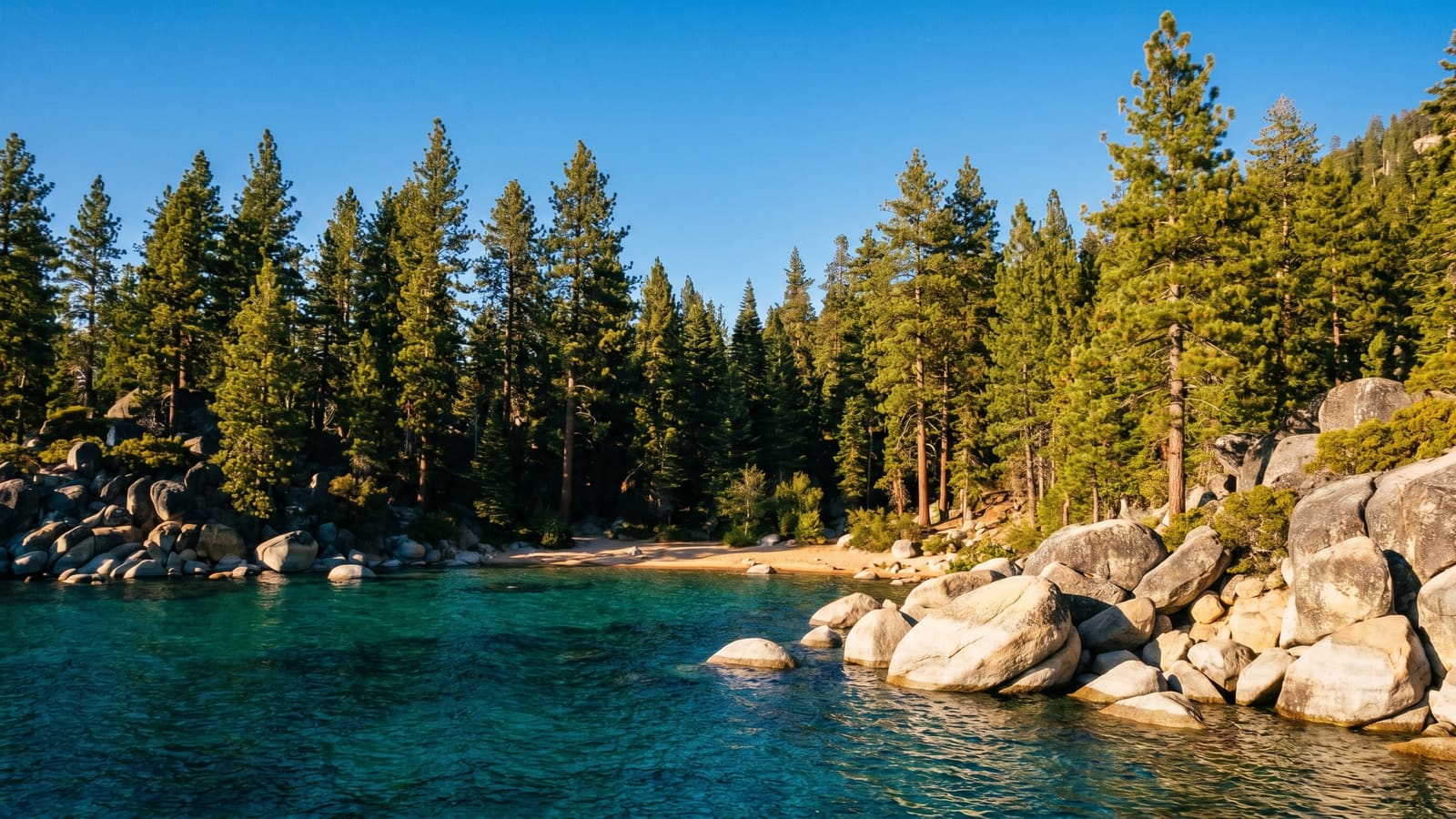
For most relocators, the outdoor access seals it. Lake Tahoe — one of the largest, clearest alpine lakes in North America — is about 45 minutes away, close enough to be a Saturday trip rather than an annual vacation, and the closest ski resort, Mt. Rose, is roughly 25 minutes from town with a long, reliable season. A dozen-plus Tahoe-area resorts sit within about an hour, giving Reno one of the highest concentrations of skiing in the country.
In town, the Truckee River runs straight through downtown, including a free whitewater park you'll see locals kayaking on at lunch. The high desert and Sierra foothills deliver hundreds of miles of hiking and mountain-biking trails climbing right out of the neighborhoods, plus Galena Creek, the Mt. Rose Wilderness, and Pyramid Lake to the north. According to Visit Reno Tahoe, the region is built for a four-season outdoor life. The practical relocation angle: this isn't weekend-warrior access requiring hours in the car — it's woven into ordinary days, which is exactly the lifestyle most of our transplants say they came for.
How Do You Get Around Reno and Beyond?
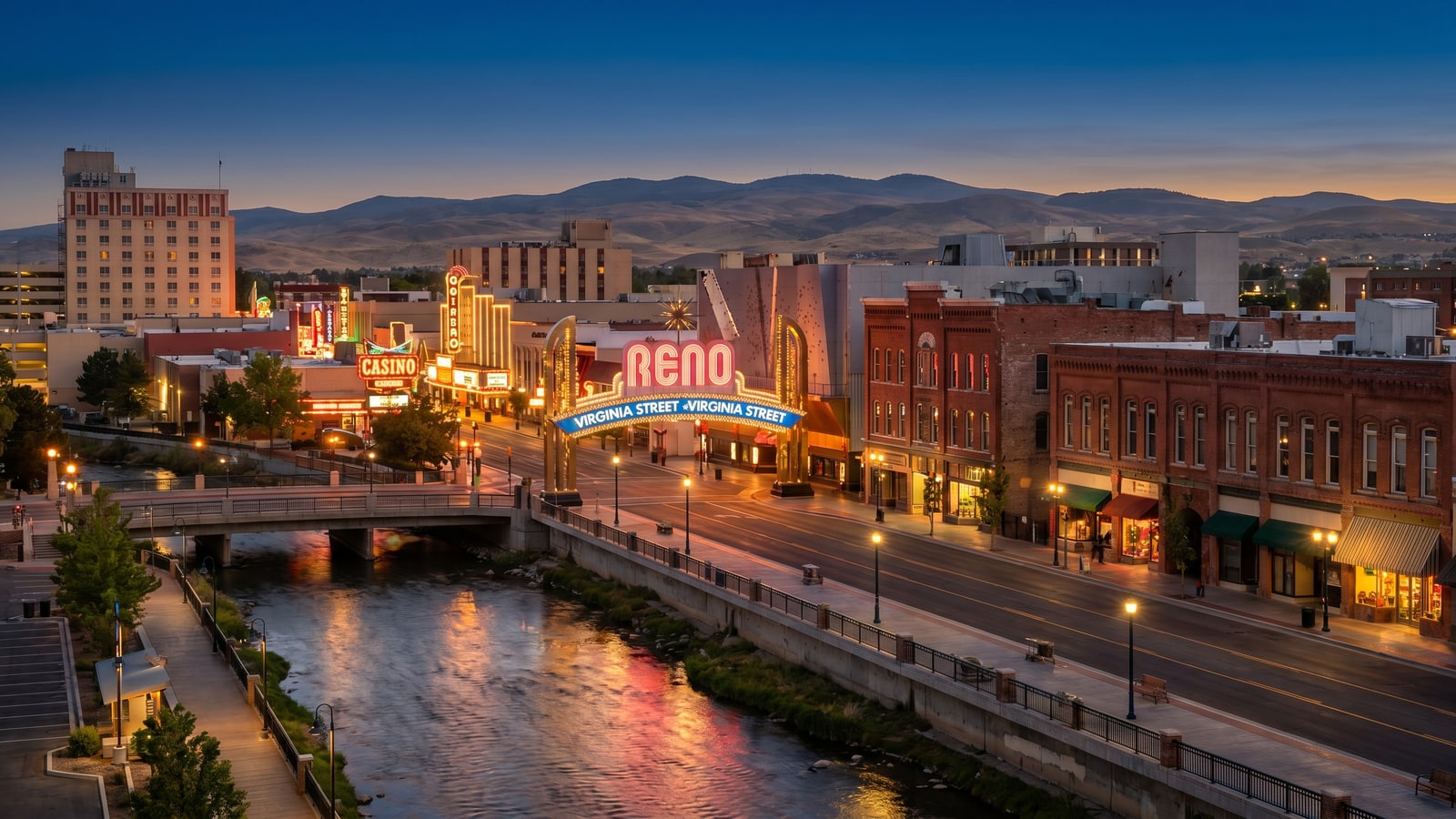
Getting around is easy, and staying connected to California is part of the appeal. According to area highway references, Reno is served by Interstate 80 running east-west through the Sierra and Sacramento, and I-580 / US-395 running north-south through Reno, Sparks, and Carson City. According to Visit Reno Tahoe, the San Francisco Bay Area is about 218 miles (roughly 3.5 hours) via I-80, and Sacramento is about 132 miles (roughly 2 hours) — close enough to keep California ties, see family, or run a hybrid work arrangement while living somewhere far more affordable.
Air travel is genuinely convenient. According to Reno-Tahoe International Airport, RNO served a record 4.8 million passengers in 2024 and offers 20-plus nonstop destinations on about ten airlines with 120-plus daily flights, including direct service to major West Coast and hub cities — all from a compact airport ten minutes from downtown. For day-to-day transit, according to RTC Washoe, the regional RTC RIDE bus system covers the metro with two bus-rapid-transit lines along Virginia Street and the 4th Street/Prater corridor. Most households are car-centric, but the I-80/I-580 grid is uncongested by big-city standards, and a typical cross-town commute is a fraction of what newcomers left behind.
What About Utilities and Healthcare in Reno?
Setting up a household is refreshingly simple. According to NV Energy, a single regulated utility provides both electricity and natural gas across the Reno-Sparks metro, and according to the Truckee Meadows Water Authority, one regional authority handles water — so there's no patchwork of providers to chase. Set both up about a week before move-in, alongside internet (cable and fiber options serve most of the metro).
Healthcare is a genuine strength for a metro this size. According to Renown Health, Renown Regional Medical Center is the region's largest hospital and has been ranked the #1 hospital in Nevada — a major academic medical center anchoring care for all of northern Nevada. According to Northern Nevada Health System, Sierra Medical Center serves the south-Reno/Sparks side, and the University of Nevada, Reno School of Medicine adds academic depth, residencies, and specialty care. Carson Tahoe to the south and a VA Sierra Nevada facility round out the options. For retirees and families weighing the move, that combination — a top-ranked flagship hospital plus a medical school plus competing systems — is reassuring, and it's a notch above what most cities of Reno's size offer.
A practical budgeting note from the moves we run: beyond the down payment and closing costs, new arrivals should set aside for Nevada vehicle registration, two or three months of overlapping rent-or-mortgage during the transition, and the deposits utilities sometimes ask of new accounts. Movers from California should budget time, not just money, for the residency steps — the DMV visit, voter registration, and updating banks, brokerages, and your employer's payroll to your new Nevada address. In our experience, the households that build a simple two-column checklist — "before the move" and "first 30 days here" — are the ones who avoid the last-minute scramble. None of it is difficult; it just rewards doing things in the right order, which is exactly the sequence our relocation team runs with out-of-state buyers every week.
What Does a Smart Reno Relocation Timeline Look Like?
The relocations that go smoothly almost always follow the same sequence. Here's the timeline I give out-of-state buyers:
| When | What to do |
|---|---|
| 90 days out | Get mortgage pre-approval; pick a local agent; set budget + neighborhood shortlist |
| 60 days out | Virtual + in-person tours; make offers (move fast — homes sell in 11 days); line up movers |
| 30 days out | Under contract: inspection, appraisal, lock financing; schedule NV Energy + TMWA + internet |
| Move week | Close, take possession, transfer utilities, change address with USPS |
| First 30 days here | Nevada driver license + vehicle registration (DMV), register to vote, Declaration of Domicile |
Source: Nevada Real Estate Group relocation workflow and Nevada DMV deadlines, 2026.
The two non-negotiables: line up financing and an agent before you tour (so you can compete in a fast market), and treat the 30-day DMV clock as a hard deadline once you land. Everything else — utilities, address changes, voter registration — slots in around closing. Because we handle out-of-state moves constantly, we coordinate the whole sequence for relocating buyers, from remote tours and offers to a closing checklist and the residency to-dos for week one. Call our Northern Nevada team at (775) 277-2120 and we'll map your specific timeline.
How Does Reno Compare to Las Vegas or Staying in California?
Two comparisons come up constantly. Versus Las Vegas — Nevada's other metro, roughly 2.3 million people — Reno is smaller, cooler, four-season, and built around mountains and a lake rather than the Strip, while sharing the identical statewide no-income-tax advantage. Versus staying in California, the contrast is starker: dramatically lower home prices, no income tax, and a shorter-than-you-think drive back over the Sierra.
| Dimension | Reno | Las Vegas | Coastal California |
|---|---|---|---|
| State income tax | None | None | Up to 13.3% |
| Median home price | $660,000 | Mid-$400,000s | $1M+ (Bay Area) |
| Climate | Four seasons | Hot desert | Mild coastal |
| Signature lifestyle | Tahoe, skiing, university | Strip, dining, sports | Coast, big cities |
Source: U.S. Census Bureau, Tax Foundation, Las Vegas REALTORS, Northern Nevada Regional MLS, and Nevada Real Estate Group analysis, 2026.
The takeaway: if you want a four-season, outdoor-oriented, university-town lifestyle with California access and no income tax, Reno is hard to beat — and because Nevada Real Estate Group works statewide, we can also show you the southern side if Las Vegas is on your list. Browse every market on our community directory if the south is also on your shortlist.
Frequently Asked Questions
Is it worth moving to Reno in 2026?
For many relocating buyers, yes. Reno offers no state income tax, a median home price around $660,000 (roughly half the Bay Area), four real seasons at 4,505 feet, Lake Tahoe 45 minutes away, and a diversified job market with low-4% unemployment. The trade-offs are a competitive seller's market and real winter snow, but for buyers who want a four-season Western city with California access at a far lower cost, the move pencils out well.
How much money do you need to move to Reno?
Plan for a down payment on a median home around $660,000 (so roughly $33,000 at 5% down up to $132,000 at 20%), plus closing costs, moving expenses, and Nevada vehicle-registration fees. Renters should budget first-and-last on a one-bedroom near $1,460 or a two-bedroom near $1,750 a month. The good news after you arrive: no state income tax means more of every paycheck stays with you, which offsets the upfront move cost over time.
How long do you have to register your car and get a license in Nevada?
Thirty days. New Nevada residents must obtain a Nevada driver license and register their vehicle within 30 days of establishing residency, per the Nevada DMV. For the license, drivers 21 and older who are currently licensed generally only need a vision test plus proof of identity, two proofs of Nevada address, and a Social Security number. Vehicle registration requires Nevada insurance, an odometer reading, and a VIN inspection, which the Reno DMV office can perform.
Does Reno have four seasons and snow?
Yes. At 4,505 feet, Reno has a high-desert, four-season climate — hot, dry summers, crisp winters, and about 21 inches of snow a year in the valley (far more in the nearby Sierra for skiing). Snow in town usually melts within days while the mountains stay loaded into spring, and Reno still gets roughly 82% of possible sunshine. It's a genuine four-season climate without the months-long lockdown of the snow belt.
What's the best area of Reno to live in?
It depends on your priorities. Old Southwest and Midtown offer walkable, historic, urban living; Northwest Reno (Caughlin Ranch, Somersett, ArrowCreek) is the master-planned luxury belt; South Reno (Damonte Ranch, Double Diamond) is family-suburban and newer; and Sparks/Spanish Springs offers the most newer home for the money. Match the area to your commute and budget — a local agent can tour you through two or three on each end of the spectrum in a day.
Is moving from California to Reno worth it for taxes?
Often, yes — Nevada has no state income tax versus California's top rate above 13%, plus no tax on retirement income and a 3% property-tax cap. But the savings are only real if you establish genuine Nevada residency, and California audits departing high earners aggressively using a "closest connections" test. Work with a CPA to document the move properly — Nevada license, vehicle, voter registration, majority of the year here, and a Declaration of Domicile.
How far is Reno from San Francisco and Lake Tahoe?
Reno is about 218 miles (roughly 3.5 hours) from the San Francisco Bay Area via I-80, and about 132 miles (around 2 hours) from Sacramento. Lake Tahoe is much closer — about 45 minutes to an hour depending on which shore, with the nearest ski resort (Mt. Rose) around 25 minutes from town. That proximity lets you keep California ties while living somewhere far more affordable.
Which Sources Inform This Reno Relocation Guide?
This guide combines Nevada Real Estate Group's Northern Nevada relocation experience — drawn from 9,600-plus closings statewide — with primary public sources. Population data comes from the U.S. Census Bureau; jobs and unemployment from the U.S. Bureau of Labor Statistics and EDAWN; tax structure from the Tax Foundation and the Nevada Department of Taxation; residency, licensing, and vehicle rules from the Nevada DMV, NRS Chapter 371, NRS 41.191, and the Nevada Secretary of State; California residency rules from California R&TC §17016; housing data from Northern Nevada Regional MLS and the Reno/Sparks Association of REALTORS; utilities from NV Energy and the Truckee Meadows Water Authority; healthcare from Renown Health and the UNR School of Medicine; climate from the Western Regional Climate Center; and transit and connectivity from RTC Washoe and Reno-Tahoe International Airport. Ready to plan your move? Call our Northern Nevada team at (775) 277-2120 or start on our Reno community page. Prices, taxes, and rules change — verify current figures and consult licensed tax and legal professionals before relocating.
Information deemed reliable but not guaranteed. This article is educational and is not financial, tax, or legal advice — tax rules, residency requirements, and market conditions change and vary by individual situation. Confirm current details with a qualified professional before relocating. Nevada Real Estate Group · (775) 277-2120 · NV License S.181401.