
Published July 13, 2026 · Updated July 13, 2026 · By Chris Nevada, Nevada Real Estate Group · NV License S.181401
Every few weeks a Las Vegas buyer sits across from one of our agents, priced out of the neighborhood they wanted, and asks the same question: what if I just move to Pahrump? Sixty miles west over State Route 160 and the Mountain Springs pass, the same money buys a bigger house on a bigger lot — often with a well, an RV garage, and room for horses. The price gap is real and large. The commute is also real, and it climbs a 5,493-foot summit twice a day. The decision is a genuine arbitrage: you are trading dollars saved on the mortgage against dollars — and hours — spent on the road.
At Nevada Real Estate Group, relocations and cross-valley moves make up a large share of the 9,600+ closings our team has handled over 16+ years, and Pahrump-versus-Vegas is one of the most common trade-off questions we field. Below is the same honest breakdown we give those clients: the actual price gap pulled from the live GLVAR feed, the true commute cost in gas and time, who the trade fits, who it burns, and the exact point where the math flips from smart to sentimental.
Pahrump is meaningfully cheaper: its median home sold for $266,000 in early 2026 versus $438,823 in Las Vegas — a $172,823 (39%) gap, per the GLVAR feed our team tracks. But the 60-mile NV-160 commute over Mountain Springs adds 2 to 2.5 hours and $17 to $84 a day. The trade pencils for remote workers, retirees, and land buyers; it rarely pencils for a daily Strip commuter.
- Pahrump's $266,000 median sale price runs about $173,000 under the Las Vegas median ($438,823).
- The NV-160 commute is 60 miles and 60–90 minutes each way over the 5,493-foot Mountain Springs Summit.
- A daily round-trip costs about $4,400/year in fuel — up to $21,000 fully loaded at the IRS rate.
- Remote workers, retirees, horse buyers, and land buyers win; daily on-site commuters usually don't.
- Pahrump sits in Nye County — separate schools, hospital, and a rural well-and-septic lifestyle.
How Much Cheaper Is Pahrump Than Las Vegas in 2026?
The short answer is a lot — but how much depends on whether you compare closed sales, active asking prices, or the raw all-listings median that vacant land distorts. Here is the whole comparison in one view before the deep dive. Pahrump sits in Nye County at about 2,700 feet in a broad desert valley; Las Vegas sits in Clark County at about 2,000 feet, 60 miles east over the Spring Mountains.
| Dimension | Pahrump (Nye County) | Las Vegas (Clark County) |
|---|---|---|
| Median sale price (2026 YTD) | $266,000 | $438,823 |
| Median active list price (homes) | $344,950 | $383,236 |
| Median days on market | 52 days | 30 days |
| Commute to opposite city | ~60 mi / 60–90 min via NV-160 | ~60 mi / 60–90 min via NV-160 |
| State income tax | None (0%) | None (0%) |
| School district | Nye County SD | Clark County SD (CCSD) |
| Signature lifestyle | Acreage, wells, horses, wineries, quiet | Strip, airport, jobs, master plans |
| Major hospital | Desert View (25 beds) | Multiple full-service systems |
Source: Las Vegas REALTORS / GLVAR feed, U.S. Census Bureau, Nevada Department of Transportation, and Nevada Real Estate Group analysis, 2026.
What Is the Real Price Gap Between Pahrump and Las Vegas Homes?
This is the number that starts the whole conversation, and it lands squarely in Pahrump's favor. Based on the closed transactions our team tracks through the GLVAR feed, Pahrump's median sale price sat at $266,000 through the first half of 2026, with the average around $241,000 and homes moving in roughly 52 days. Las Vegas, by contrast, posted a median sale price of $438,823 and an average near $561,800, with homes going pending in about 30 days. According to Las Vegas REALTORS, that puts the closed-sale gap at $172,823 — a 39% discount for choosing Pahrump.
Asking prices tell a similar but narrower story. Pahrump's active homes list at a median $344,950 (screening out the roughly 1,046 vacant-land and sub-$100,000 parcels that pull the raw all-listings median down to about $65,000). Las Vegas actives sit at a median $383,236 across a much deeper pool of 11,633 listings. So on move-in-ready homes, the asking-price gap is closer to $38,000 to $95,000 depending on how you slice it — still meaningful, just not the eye-popping 39%. The honest framing: Pahrump saves you roughly $100,000 to $170,000 on the purchase, and every dollar of that either lowers your mortgage or buys you more square footage and land.
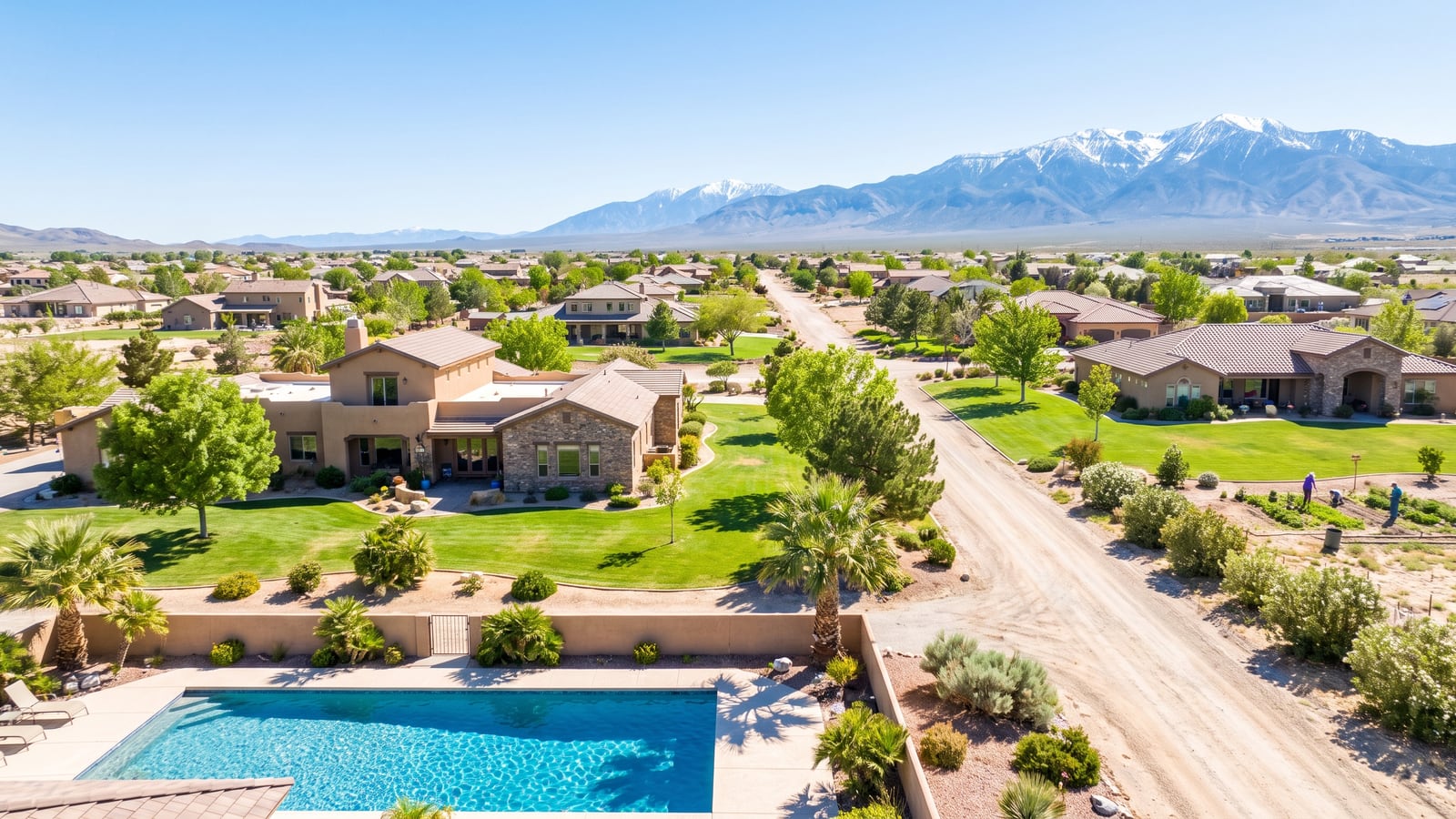
In practice, the Pahrump price bands look like this next to Las Vegas. A buyer with a $300,000 budget who finds a dated condo or a small older home in the valley can land a newer three-bedroom single-family home on a quarter-acre in Pahrump. At $450,000, Las Vegas gets you a standard tract home in a mid-tier master plan; Pahrump gets you a larger custom home on an acre-plus with a well and an RV garage. Buyers chasing a trophy address instead of acreage can compare the valley's luxury communities rather than making the drive. Buyers who want to compare the big-metro master-plan option can browse live valley inventory on our Las Vegas homes for sale page, then weigh it against Pahrump homes for sale.
| Budget | Pahrump (Nye County) | Las Vegas (Clark County) |
|---|---|---|
| $250,000 | Older 3-bed home or manufactured home on owned land | 1-bed condo or dated small townhome |
| $350,000 | Newer 3–4 bed on 0.25–0.5 acre | Older single-family home, tight lot |
| $450,000 | Custom home on 1+ acre, well + RV garage | Standard tract home, mid-tier master plan |
| $600,000 | Semi-custom estate on 2–5 acres, horse-ready | Upgraded home in a nicer master plan |
| $900,000+ | Large custom acreage estate, shop + pool | Entry luxury / guard-gated tract |
Source: Las Vegas REALTORS / GLVAR active + sold data and Nevada Real Estate Group analysis, 2026. Individual homes vary — verify current inventory.
How Long Is the Pahrump-to-Las-Vegas Commute Over NV-160?
The commute is the other half of the arbitrage, and it is not a casual drive. Pahrump connects to Las Vegas almost exclusively via State Route 160 (Blue Diamond Road), a two-to-four-lane highway that climbs over Mountain Springs Summit at 5,493 feet in the Spring Mountains before dropping into the southwest valley. According to the Nevada Department of Transportation, it is roughly 60 miles from central Pahrump to the western edge of the Las Vegas valley (Blue Diamond and the 215 Beltway).
Timing depends entirely on where you are actually going. To the southwest valley — Enterprise, Spring Valley, or Southern Highlands — plan on about 60 minutes in normal conditions. To the Strip or downtown, add another 20 to 30 minutes of surface and freeway traffic, putting the realistic door-to-door time at 75 to 90 minutes each way. That is before weather: NV-160 over Mountain Springs sees occasional winter snow and ice at the summit, high-wind advisories, and periodic closures after crashes on the two-lane sections. There is no alternate route that does not add an hour, so a single bad accident on the pass can strand the entire corridor. Buyers eyeing this trade should test-drive it at their real commute times before committing — the Tuesday-8am reality differs sharply from the Sunday-noon scouting trip.
What Does the Pahrump Commute Actually Cost in Gas and Time?
Here is where a lot of price-refugee math quietly falls apart. A daily round-trip is 120 miles. At a realistic 26 miles per gallon and $3.75 a gallon, that is about $17.30 a day in fuel — roughly $363 a month and $4,360 a year if you commute 21 workdays a month. But fuel is the small number. According to the Internal Revenue Service, the 2026 standard mileage rate — which bundles fuel, maintenance, tires, depreciation, and wear — runs about $0.70 per mile. Apply that to 120 miles a day and the fully loaded cost is roughly $84 a day, $1,764 a month, and $21,000 a year.
Then there is time, which most buyers undervalue. Two-plus hours of daily driving is roughly 44 to 52 hours a month — the equivalent of five to six full workdays behind the wheel every month, or 26-plus days a year. If you value your time at even $25 an hour, that is another $15,000 a year in opportunity cost. The house is cheaper; the commute is not free.
| Cost basis | Per day | Per month (21 days) | Per year |
|---|---|---|---|
| Fuel only (26 mpg, $3.75/gal) | $17.30 | $363 | $4,360 |
| IRS full ownership ($0.70/mi) | $84 | $1,764 | $21,000 |
| Time (2.2 hrs/day @ $25/hr) | $55 | $1,155 | $13,860 |
| Hours behind the wheel | 2.2 hrs | ~46 hrs | ~555 hrs |
Source: Internal Revenue Service 2026 standard mileage rate, U.S. Energy Information Administration fuel-price data, and Nevada Real Estate Group analysis. Individual costs vary with vehicle and driving pattern.
When Does the Pahrump Price Arbitrage Actually Pencil Out?
Now put the two numbers side by side, because that is the entire decision. Buying in Pahrump saves you roughly $100,000 to $173,000 on the purchase — call it a monthly mortgage savings of about $600 to $1,000 at 2026 rates on that price gap. A daily commuter's fully loaded driving cost is $1,764 a month at the IRS rate, or $363 a month if you count only fuel. So the honest verdict is stark: if you drive to a Las Vegas job site five days a week, the full ownership cost of the commute can erase most or all of the mortgage savings — and the time cost erases the rest.
The arbitrage flips decisively in your favor when you remove the daily drive. A remote worker who commutes zero days keeps the entire mortgage savings and pays only for occasional trips. A hybrid worker in the office two days a week pays roughly $145 a month in fuel — a rounding error against a $700-plus monthly mortgage savings. A retiree who drives to Vegas twice a month for shopping or medical appointments comes out thousands ahead every year. According to the U.S. Census Bureau, remote and hybrid work now covers a large and durable share of the workforce — which is exactly why Pahrump's commuter math looks nothing like it did a decade ago.
| Buyer | Days driven/week | Monthly commute cost | Net verdict |
|---|---|---|---|
| Fully remote | 0 | about $50–$150 | Strong win — keep full savings |
| Hybrid (2 days) | 2 | about $145–$700 | Wins for most buyers |
| Retiree | ~0.5 | about $40–$180 | Strong win — lifestyle + savings |
| Daily on-site (5 days) | 5 | about $360–$1,760 | Usually a wash or loss |
Source: Nevada Real Estate Group analysis using IRS mileage and GLVAR price data, 2026. Estimates — run your own numbers before deciding.
Who Makes the Pahrump-for-Las-Vegas Trade?
Across the Pahrump and southwest-valley closings our team has represented, the buyers who move west and stay happy fall into four clear groups. Remote and hybrid workers top the list — they capture the full price gap without paying the commute tax, and Pahrump's lower cost of living stretches a Vegas or California salary dramatically. Retirees are second: on a fixed income, a $266,000 home with no state income tax and a slower pace is a powerful combination, and the occasional Vegas drive for a specialist or a show is a feature, not a burden.
Third are land and acreage buyers — people who want horses, a shop, an RV garage, off-grid solar, or simply elbow room that Clark County zoning and lot sizes cannot deliver at any reasonable price. Fourth are Las Vegas price-refugees who were quoted out of the neighborhood they wanted and would rather own more for less than rent forever in the valley — many first weigh the buyers path in the valley before deciding the pass is worth it. If you want to see what the acreage lifestyle actually looks like, our Pahrump horse properties page tracks the current rural inventory, and our Pahrump housing market guide breaks down the neighborhoods in detail.
What Do You Give Up Living in Pahrump vs Las Vegas?
Honesty matters here, because the trade is not free of downside. Las Vegas gives you a full-service metro: Harry Reid International Airport, multiple major hospital systems, professional sports, a deep job market, endless dining, and master-planned communities like Summerlin and Henderson with resort amenities baked in. Pahrump gives you a small town of roughly 44,000 people with a Walmart, a handful of casinos, two respected wineries, and a genuinely quiet, dark-sky, elbow-room lifestyle — but not the metro's depth.

The everyday trade-offs are concrete. Dining and shopping variety are thin; serious retail or a nice dinner often means the drive to Vegas. Air travel means driving to Harry Reid, about 75 minutes away. Rural infrastructure is a learning curve: many Pahrump homes run on private wells and septic systems rather than municipal water and sewer, which means testing, maintenance, and occasional repair costs that valley buyers never think about. Internet options, while improved, can still be spottier than the valley's. And the social pace is small-town — a plus for some buyers, a deal-breaker for others. None of these are hidden; they are simply the other side of the price and space you gain.
How Do Property Taxes and Cost of Living Compare?
On taxes, the two towns are closer than the home prices suggest, because they share the same state. Nevada has no state income tax anywhere — Pahrump and Las Vegas both benefit — and, according to the Nevada Department of Taxation, the state funds itself through sales and gaming taxes rather than taxing wages, pensions, or retirement withdrawals. Both counties also fall under Nevada's 3% annual cap on how fast a primary residence's taxable value can rise, per Nevada Revised Statutes, which protects long-term owners from runaway assessments.
Effective property-tax rates run in a similar band — roughly 0.5% to 0.7% of value in both Nye and Clark counties, according to Clark County Assessor and Nye County figures — so a cheaper Pahrump home simply produces a smaller tax bill in raw dollars. Where Pahrump pulls ahead is the broader cost of living: lower home prices mean lower insurance premiums, and everyday costs outside of that big drive tend to run at or below the valley. The one line item that can erase the savings, as covered above, is fuel and vehicle wear if you commute daily. According to the Bureau of Labor Statistics, housing is the single largest household expense at 30% to 35% of budget, so a six-figure lower purchase price gives Pahrump a real head start that the commute either preserves or spends.
What Can You Buy in Pahrump That Las Vegas Can't Offer?
This is Pahrump's trump card, and it has nothing to do with the price gap on comparable tract homes — it is about product Las Vegas simply does not have. Clark County is dense, largely built out, and zoned in tight lots; genuine acreage inside the valley is rare and expensive. Pahrump, sitting on a broad open desert valley, offers one-, two-, and five-acre-plus parcels at prices that would buy a condo in the valley. Of Pahrump's roughly 1,860 active listings in mid-2026, more than 1,000 are vacant land — a land inventory the valley cannot approach.
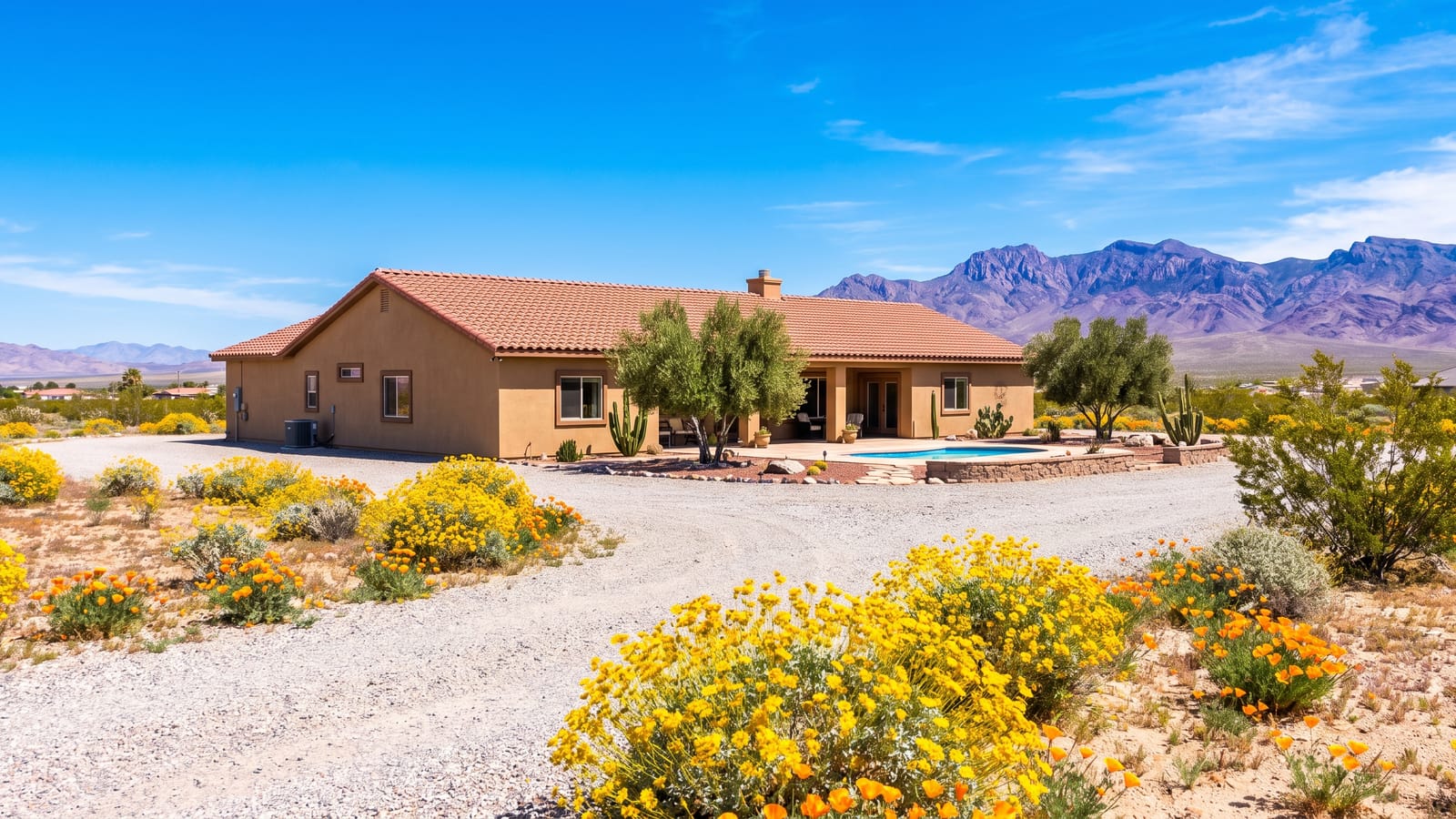
That opens doors Las Vegas closes. You can buy a buildable acre with a well and septic already in place, park a manufactured home on owned land (a genuinely affordable path to ownership), keep horses, build a detached shop or oversized RV garage, or set up off-grid solar on a rural homesite. According to the U.S. Census Bureau, Nye County's low density and large average parcel size are precisely what make this possible. Buyers who want a from-scratch build or new inventory can start on our new construction hub and our Pahrump new-construction homes page; buyers who need extra parking for a boat or toys should check Pahrump RV-parking homes, and land-and-lifestyle shoppers should read our moving to Pahrump guide for the full rural checklist.
How Do Schools and Healthcare Compare Between Pahrump and Las Vegas?
These two categories are where Las Vegas holds a clear edge, and families should weigh them carefully. Pahrump students attend the Nye County School District, a small rural district anchored by Pahrump Valley High School and a handful of elementary and middle schools. Las Vegas students attend the Clark County School District (CCSD) — one of the largest districts in the nation — which offers far more magnet programs, specialized academies, private-school options, and extracurricular depth simply by scale. According to GreatSchools, families prioritizing a specific magnet or specialized program will find more choices in the valley; families prioritizing small class sizes and a tight community may prefer Nye County.
Healthcare follows the same pattern. Pahrump is served by Desert View Hospital, a small facility of roughly 25 beds that handles emergencies and routine care but refers complex or specialized cases to Las Vegas, about 60 miles east. Las Vegas offers multiple full-service hospital systems, specialists, and trauma care within the metro. For a healthy household, Desert View plus an hour's drive to Vegas specialists is workable; for a buyer managing a serious ongoing condition, the valley's medical depth is a legitimate, decision-changing advantage — the same trade-off retirees weigh against the price and quiet.
Is Pahrump Part of Las Vegas or Clark County?
No — and this trips up a lot of relocating buyers, so it is worth stating plainly. Pahrump is not part of Las Vegas and not in Clark County. It sits in Nye County, a separate county whose seat is Tonopah, roughly 60 miles west of the Las Vegas valley over the Spring Mountains. Pahrump is an unincorporated town — it has no city government of its own and is governed by the Nye County Commission and a local town board, according to Nye County.
That distinction has real consequences. It means a different school district (Nye County SD, not CCSD), different county services, different building and permitting departments, and a different assessor setting your property-tax bill. It also means Pahrump's rural zoning allows the acreage, wells, and outbuildings the valley's Clark County zoning restricts. When people casually call Pahrump "a Vegas suburb," they are describing the commute, not the jurisdiction — legally and administratively, it is its own place in its own county. That independence is a large part of what makes the lifestyle, and the prices, different.
What Are the Risks of Buying in Pahrump as a Commuter?
Beyond the commute cost already covered, three risks deserve a clear-eyed look before you sign. First, resale liquidity: Pahrump homes sit a median 52 days on market versus 30 in Las Vegas, and the buyer pool is thinner. In a soft market, a rural or acreage home can take considerably longer to sell than a valley tract home, so this is a hold-for-several-years decision, not a flip. Second, the well-and-septic learning curve: private water and waste systems carry inspection, maintenance, and occasional replacement costs — a failed septic or a well that needs deepening can run into five figures — that municipal-service buyers never face. Always order well-flow and septic inspections during escrow.
Third, route dependency: your entire connection to Las Vegas jobs, airport, and hospitals runs through one highway over one mountain pass. A major crash, a snow closure, or high-wind advisory on NV-160 can add an hour or shut the corridor entirely, and there is no quick detour. According to the Nevada Department of Transportation, winter conditions at Mountain Springs Summit occasionally require chains or trigger closures. None of these risks is disqualifying — thousands of people commute the corridor happily — but each is a real cost you should price in before you fall in love with the acre and the shop. Our team can walk you through the full due-diligence checklist; start a conversation on our contact page or run your current home's number on our home value estimator.
Which Choice Is Right for You in 2026?
Strip away the emotion and the decision comes down to one variable: how often you actually have to be in Las Vegas. If your work, your family, and your life keep you tied to the valley five days a week, the honest math says stay closer in — the commute's full cost tends to erase the price savings, and a mid-tier valley home or a lower-cost outer suburb may serve you better. If you are remote, hybrid, retired, or chasing land and quiet, Pahrump is one of the best price-per-square-foot and price-per-acre plays in Southern Nevada, and the savings are real and durable.
The best move is to run both scenarios with real numbers before you commit — your specific commute pattern, your budget, and your resale timeline. Our team closes on both sides of the pass every month, so we can model the Pahrump-versus-valley trade for your exact situation without a sales pitch. If you want the deeper agent-selection framework first, read who is the best real estate agent in Las Vegas, then reach out. You can browse both markets today on Pahrump homes for sale and Las Vegas homes for sale, start your own search, or talk to a buyer's agent through our buyers page. Call Nevada Real Estate Group at (702) 637-1759 when you are ready to run the numbers.
Frequently Asked Questions
Is Pahrump cheaper than Las Vegas?
Yes, meaningfully. Pahrump's median closed home sold for about $266,000 through the first half of 2026 versus $438,823 in Las Vegas — a roughly $172,823 (39%) gap, based on the GLVAR data our team tracks. On move-in-ready active listings the gap narrows to roughly $38,000 to $95,000, but Pahrump is cheaper across every price band, and you generally get more house and more land for the money.
How long is the commute from Pahrump to Las Vegas?
The drive is about 60 miles via State Route 160 over Mountain Springs Summit (5,493 feet). Plan on about 60 minutes to the southwest valley and 75 to 90 minutes to the Strip or downtown in normal conditions. Winter weather, high winds, or a crash on the two-lane pass can add an hour, and there is no fast alternate route.
Is Pahrump part of Clark County or Las Vegas?
No. Pahrump is in Nye County, a separate county from Clark County, and it is an unincorporated town with no city government of its own. That means a different school district (Nye County SD), different county services, and rural zoning that permits acreage, wells, and outbuildings the Las Vegas valley restricts.
Does the money you save in Pahrump beat the commute cost?
It depends entirely on your commute. Buying in Pahrump saves roughly $600 to $1,000 a month on the mortgage versus a comparable Las Vegas home. A daily on-site commuter's fully loaded driving cost runs up to $1,764 a month at the IRS mileage rate, which can erase the savings. For remote, hybrid, or retired buyers who rarely drive, the savings are almost entirely preserved.
What kind of homes can you buy in Pahrump that Las Vegas doesn't have?
Acreage. Pahrump offers one-, two-, and five-acre-plus parcels, buildable land with wells and septic, horse properties, oversized RV garages and detached shops, and the option to place a manufactured home on owned land — all at prices the built-out, tightly zoned Las Vegas valley cannot match. Over 1,000 of Pahrump's active listings in 2026 were vacant land.
What are the downsides of moving from Las Vegas to Pahrump?
Thinner dining, shopping, and job markets; a small 25-bed hospital that refers complex cases to Las Vegas; a smaller Nye County school district; private well-and-septic maintenance; and total dependence on one highway over a mountain pass. Resale is also slower — a median 52 days versus 30 in the valley — so it is a hold-for-years decision.
Do Pahrump and Las Vegas pay the same Nevada taxes?
Largely, yes. Both are in Nevada, which has no state income tax, and both fall under Nevada's 3% annual cap on primary-residence assessment increases. Effective property-tax rates are similar (roughly 0.5% to 0.7%), so a cheaper Pahrump home simply produces a smaller tax bill in dollars. The main cost difference is the commute, not the tax code.
Which Sources Inform This Pahrump vs Las Vegas Guide?
Every figure in this guide is drawn from live MLS data our team tracks or from the public authorities below. Market numbers reflect Southern Nevada conditions in mid-2026 and change constantly — verify current figures before making a decision, and call Nevada Real Estate Group at (702) 637-1759 for a market-specific analysis. Our sellers can start on the sellers page and our acreage shoppers on Pahrump horse properties or Pahrump sell-my-house.
- Las Vegas REALTORS (GLVAR) — active and closed sale prices, days on market
- U.S. Census Bureau — population, county density, and workforce data
- Nevada Department of Transportation — NV-160 distances and Mountain Springs conditions
- Nevada Department of Taxation — no state income tax; sales and gaming tax structure
- Nevada Revised Statutes — 3% primary-residence assessment cap
- Clark County Assessor — Clark County effective property-tax rates
- Nye County — Pahrump jurisdiction, governance, and county services
- Internal Revenue Service — 2026 standard mileage rate for vehicle cost
- U.S. Energy Information Administration — regional fuel-price data
- Bureau of Labor Statistics — household budget and cost-of-living shares
- GreatSchools — Nye County SD and CCSD school data
This article is educational and not financial, tax, or legal advice. Real estate values, mortgage rates, and tax rules change; consult a licensed professional for your situation. Nevada Real Estate Group, brokered by LPT Realty · NV License S.181401 · (702) 637-1759.