

A reverse mortgage can help a Nevada homeowner use equity while remaining in a suitable home. It can also reduce the money available for a later move, leave a surviving spouse without expected loan advances, or become due after an obligation is missed. The decision starts with the household's housing plan and monthly budget, followed by the loan terms. A large home value alone does not establish that borrowing is the right choice.
This guide compares a federally insured Home Equity Conversion Mortgage, or HECM, with staying without new debt and selling to buy a less expensive home. It draws on the roughly 9,600 transactions our team has closed statewide, many with retirees on both sides of this exact decision. Federal program rules and the clearly labeled calculations below serve different purposes: the rules define the product, while the calculations help organize questions for a lender and independent counselor. They are not lender offers, property valuations or a personal retirement recommendation.
A Nevada HECM lets eligible homeowners age 62 or older borrow against a principal residence without scheduled monthly principal-and-interest payments. Taxes, insurance, upkeep and other property charges continue. For 2026 FHA case numbers, the maximum claim amount is $1,249,125, which is not the amount you can withdraw. Compare net proceeds, growing debt, spouse protections and a possible move before choosing a loan.
- The principal limit and spendable proceeds are different from the home's value or FHA insurance limit.
- Loan insurance does not replace homeowners insurance or eliminate default risk.
- A younger non-borrowing spouse needs specific protection; future advances may stop.
- Heirs need a written payoff and response timetable, not a blanket 95% assumption.
- Compare a complete move budget with the cost of staying; no option wins automatically.
What does a reverse mortgage change about owning your Nevada home?
A HECM places debt against the home while allowing eligible borrowers to receive loan advances. The homeowner retains title. Unlike an ordinary amortizing mortgage, scheduled monthly principal-and-interest payments are generally not required while the loan remains in good standing. Interest, insurance charges and applicable fees increase what must eventually be repaid. That distinction is central: removing a payment from the monthly budget does not remove the cost of borrowing.
According to the Consumer Financial Protection Bureau's explanation, reviewed August 28, 2026, the borrower must continue occupying the property as a principal residence, maintaining it, and paying taxes and homeowners insurance. The loan is secured by the property and ultimately has to be resolved, commonly through a sale. A HECM can become due for reasons other than a death or voluntary move, including failure to meet loan obligations.
Think about three separate balances. The mortgage balance is what you owe. Home equity is the home's value less secured debt, before sale costs. Available credit is the amount a loan agreement currently permits you to draw. They move differently. A larger unused credit line is permission to borrow more; it is not earned investment income or an increase in the property's market value.
For a homeowner comparing Las Vegas housing with Reno housing, the city does not change that basic structure. The property, household, loan documents and future living arrangement determine the practical fit. Keep a written record of why staying in the current home works, including access, stairs, maintenance, family support and room for changing care needs.
Who can qualify, and why does counseling matter?
Under HUD's HECM handbook, borrowers must be at least 62 at closing. A non-borrowing spouse does not have to be 62, so saying every owner or spouse must meet the borrower age threshold is inaccurate. Eligibility, title and spouse status need review together. A second home or investment property does not qualify as the borrower's principal residence simply because the owner spends some time there.
The loan also requires sufficient equity and an eligible property. An existing mortgage is not automatically disqualifying, but the financing must resolve the required liens and obligations. Ask the lender to identify any money you must contribute if proceeds are insufficient. Property condition, title, federal debt and the lender's financial assessment can affect approval. There is no responsible shortcut from an estimated home value to a guaranteed loan amount.
According to the CFPB's counseling and cost guidance, HECM borrowers must receive counseling through a HUD-approved reverse-mortgage counseling agency. Fees vary, and inability to afford a counseling fee should not prevent access. Ask about the charge and waiver process before the appointment instead of treating an advertised price range as universal.
Bring your proposed loan estimate, current mortgage statement, tax and insurance bills, household budget and spouse information. Include someone you trust if that helps you understand the discussion, but retain control over the decision. The counselor should help you examine alternatives and consequences. Counseling is not a promise of loan approval, a property appraisal or a substitute for independent legal advice about title and inheritance. Use HUD's HECM consumer page to locate the official counselor and lender search resources.
How much can you borrow, and what is actually available to spend?
According to HUD's December 11, 2025 announcement, the HECM maximum claim amount is $1,249,125 for FHA case numbers assigned on or after January 1, 2026, across all areas. This is an insurance calculation limit. It is neither a statewide home price nor a check every borrower can receive. Do not apply a forward-mortgage county limit to a HECM or assume a high-value house releases its entire appraised value.
The lender calculates a principal limit using the applicable value or maximum claim amount, expected interest rate and age of the youngest borrower or eligible non-borrowing spouse. HUD describes those inputs here. Younger ages and different rates can materially change the result. Obtain the actual calculation instead of relying on an age-based dollar estimate copied from another household's example.
Then reconcile the deductions. In an illustrative October 23, 2026 worksheet, suppose the lender has calculated a $240,000 principal limit. Subtract a $60,000 existing mortgage payoff, $20,000 in financed closing costs and $20,000 reserved for specified future property charges. That leaves $140,000 before other adjustments. The $240,000 input is deliberately assumed, not a HECM quote or an estimate of what a particular age qualifies to receive.
The $140,000 remainder is also not automatically available as cash at closing. HUD imposes initial disbursement rules, and set-asides affect available funds. Have the lender show the amount available on closing day, during the first 12 months and afterward, with each deduction named. Keep these columns separate from the total credit line. Our Nevada real estate glossary can help distinguish principal, equity, payoff and closing costs while you review the documents.
Which payout arrangement matches the actual need?
There is no universally best payout plan. A household paying off an existing mortgage has a different cash need from one seeking an occasional repair reserve. According to the CFPB's payment-options guidance, a fixed-rate HECM generally provides a single lump sum, while adjustable-rate arrangements offer a line of credit, monthly payouts or combinations. Compare both the rate structure and the distribution pattern.
| Choice | Basic use | Question to resolve |
|---|---|---|
| Fixed-rate lump sum | Single advance at closing, subject to limits | Do you need this much debt immediately? |
| Adjustable-rate credit line | Draw available amounts when needed | How do rates, growth, fees and access conditions work? |
| Term payments | Monthly advances for a chosen period | What pays the bills after that period ends? |
| Tenure payments | Monthly advances while applicable loan conditions and limits are met | What happens after a move, default or borrower death? |
| Modified term or tenure | Monthly advances combined with a credit line | How much capacity remains in each part? |
HUD's handbook distinguishes six payment plans when modified term and modified tenure are counted separately. A term payment period ending does not itself mean an otherwise compliant HECM has reached a fixed maturity date. Conversely, describing tenure payments simply as income for life hides the loan's occupancy, due-and-payable and maximum-amount conditions.
Unused adjustable-rate credit capacity may grow under the agreement. That feature is not a savings-account yield, and it does not make future draws costless. Once money is advanced, interest and applicable charges accrue on debt. Taking less initially can reduce borrowing costs, but leaving funds undrawn also needs to fit the household's actual plan. Ask for side-by-side schedules using the same starting assumptions. A useful schedule shows available credit, cumulative advances, projected balance and the conditions under which advances stop.
What upfront costs should appear in a HECM comparison?
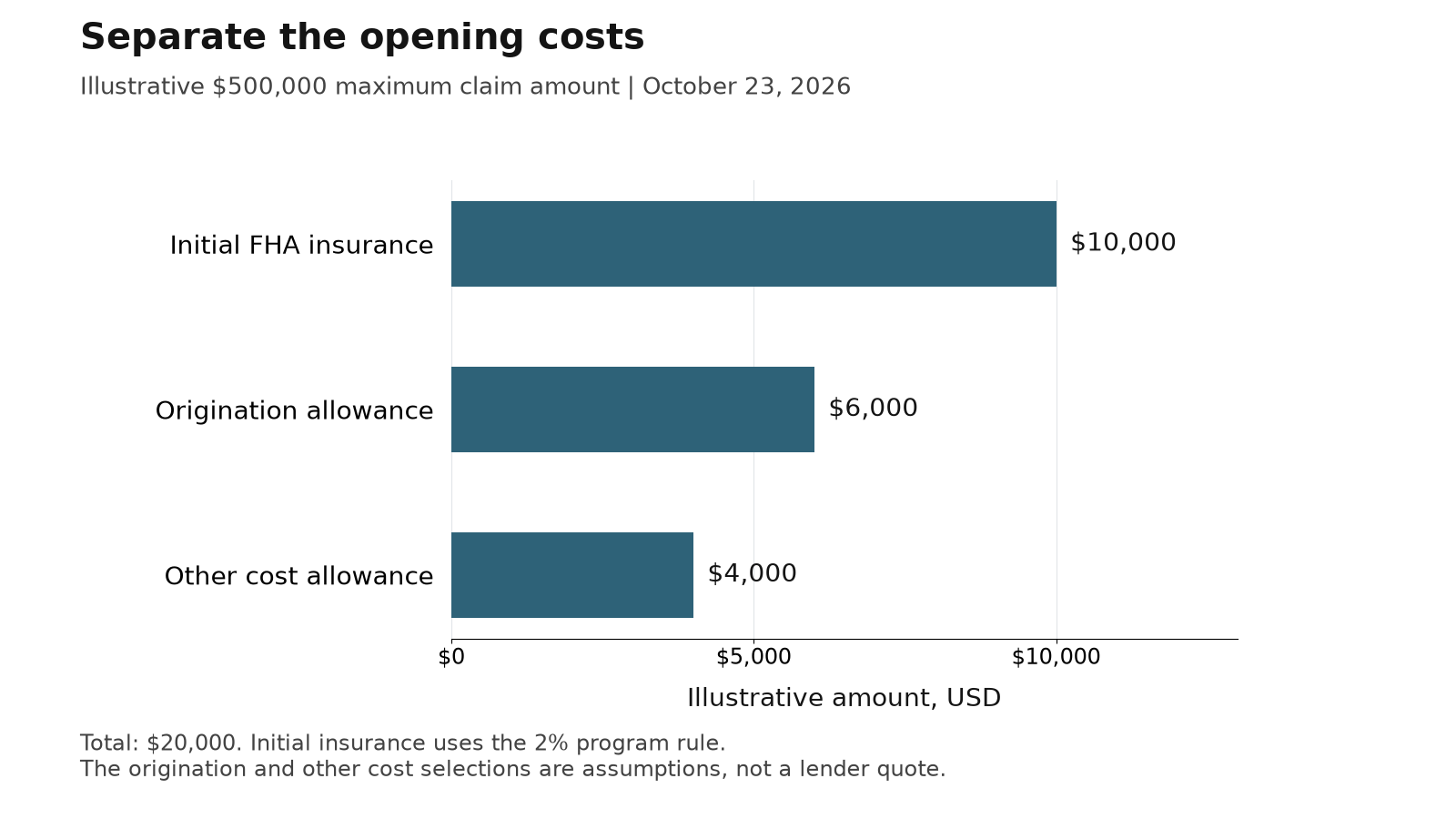
As reviewed October 23, 2026, HUD Handbook 4000.1, reverse-mortgage sections II.B.3.i and II.B.6, specifies an initial mortgage insurance premium of 2% of the maximum claim amount and annual MIP of 0.50% of the outstanding mortgage balance, collected monthly. These percentages use different bases. Applying the annual percentage to the full home value would misstate the calculation.
The origination-fee formula has a $6,000 ceiling. A lender may charge less; the ceiling is not a compulsory fee. Third-party charges depend on the transaction. Obtain an itemized proposal showing appraisal, title, recording and other costs, along with any lender credits. Confirm whether counseling is separate and whether cash-paid expenses have also been included in the financed balance.
| Item | Calculation or assumption | Amount |
|---|---|---|
| Initial FHA mortgage insurance | $500,000 × 2% | $10,000 |
| Origination fee | Assume the permitted $6,000 ceiling | $6,000 |
| Other opening costs | Chosen planning allowance; replace with quotes | $4,000 |
| Total opening-cost allowance | Sum of the three items | $20,000 |
Financing these costs avoids paying that portion from cash at closing, but it still uses borrowing capacity and adds debt. A lender credit also needs examination alongside the interest rate and other terms; it does not necessarily make the entire arrangement cheaper. Compare the total package using a common time horizon.
The same $20,000 illustrative opening cost represents $6,666.67 per year spread over three years, versus $2,000 per year over ten years, before interest or ongoing charges. That simple allocation is not an APR or a projected total loan cost. It shows why an early move can change the economics. Request the formal Total Annual Loan Cost disclosures and several holding-period examples before choosing.
How can the balance grow when you are not making loan payments?
The debt can grow through new advances, interest, annual mortgage insurance and applicable servicing or other charges. The rate, timing of withdrawals and time in the loan all matter. Quoting a universal doubling period obscures those inputs. A borrower taking regular advances will have a different path from one who stops borrowing after closing, even if both initially borrowed the same amount.
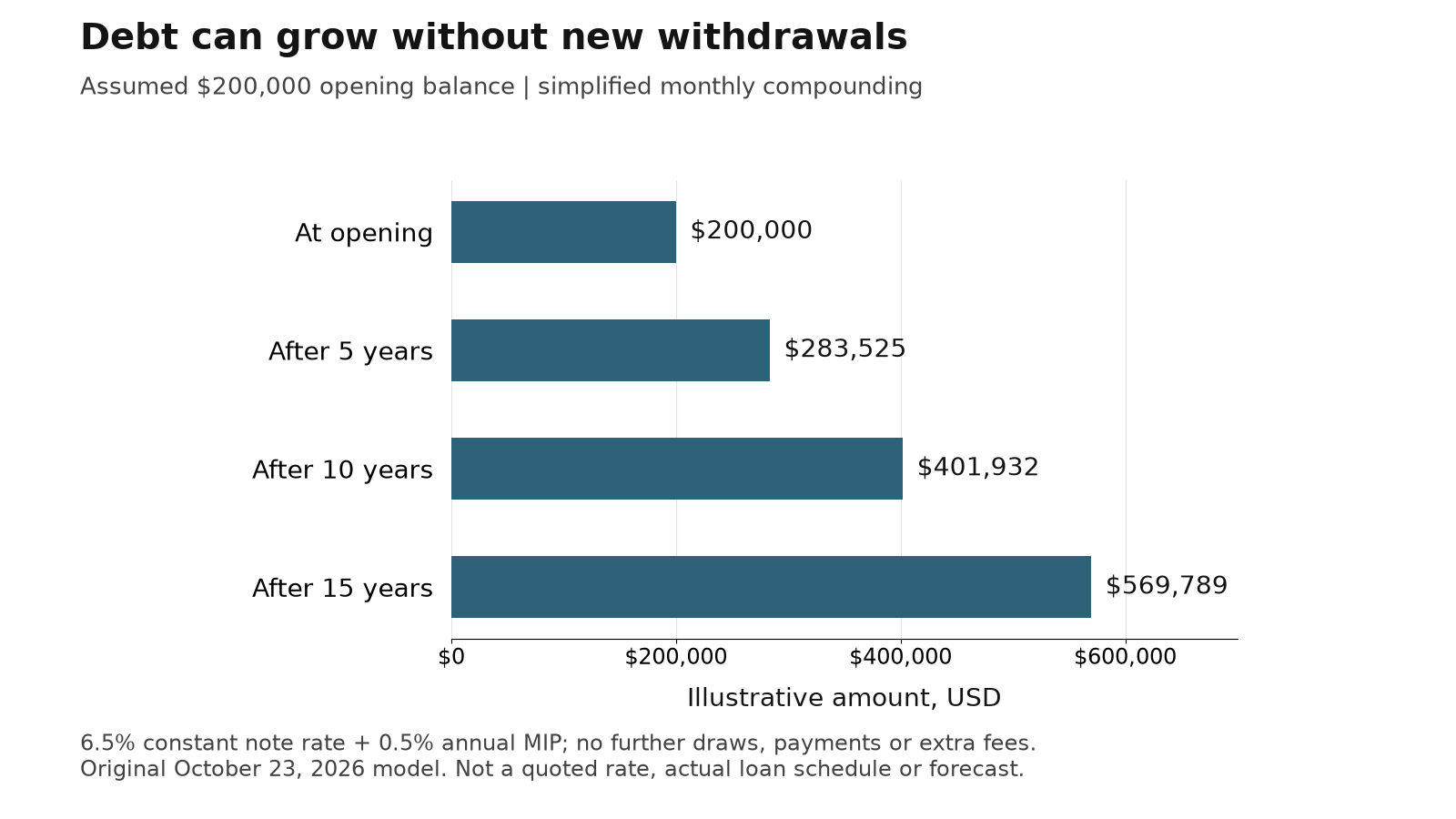
Consider a separate October 23, 2026 illustration with a $200,000 opening debt balance, a constant 6.5% note rate, 0.5% annual MIP and simplified monthly compounding at 7% divided by 12. Assume no further draws, payments or additional fees. The balance becomes approximately $283,525.05 after five years, $401,932.28 after ten years and $569,789.35 after fifteen years. These are calculations, not current rates, a lender amortization schedule or a prediction of a home's future value.
With the same assumptions but a combined annual accrual input of 6%, the ten-year balance is $363,879.35; at 8%, it is $443,928.05. This sensitivity shows why the rate structure matters. An adjustable rate would not remain constant, and actual servicing calculations and charges can differ from this simplified model. Ask the lender for the contract-specific projection.
Do not subtract the illustrated balance from an assumed future sales price and call the remainder a guaranteed inheritance. Future market value and selling costs are unknown. Instead, compare the projected debt with several possible move dates and housing costs. A later move to Northern Nevada communities needs funding for the destination, not just a comfortable current monthly budget.
Which housing bills remain after the mortgage payment disappears?
Build the stay-put budget from the property's actual records. Include taxes, homeowners and applicable flood insurance, association dues and assessments, maintenance, utilities and the work needed to keep the home suitable. Do not substitute a citywide tax estimate for the parcel's bill or assume an association pays for an owner's roof. A HECM changes financing; it does not change every responsibility attached to the home.
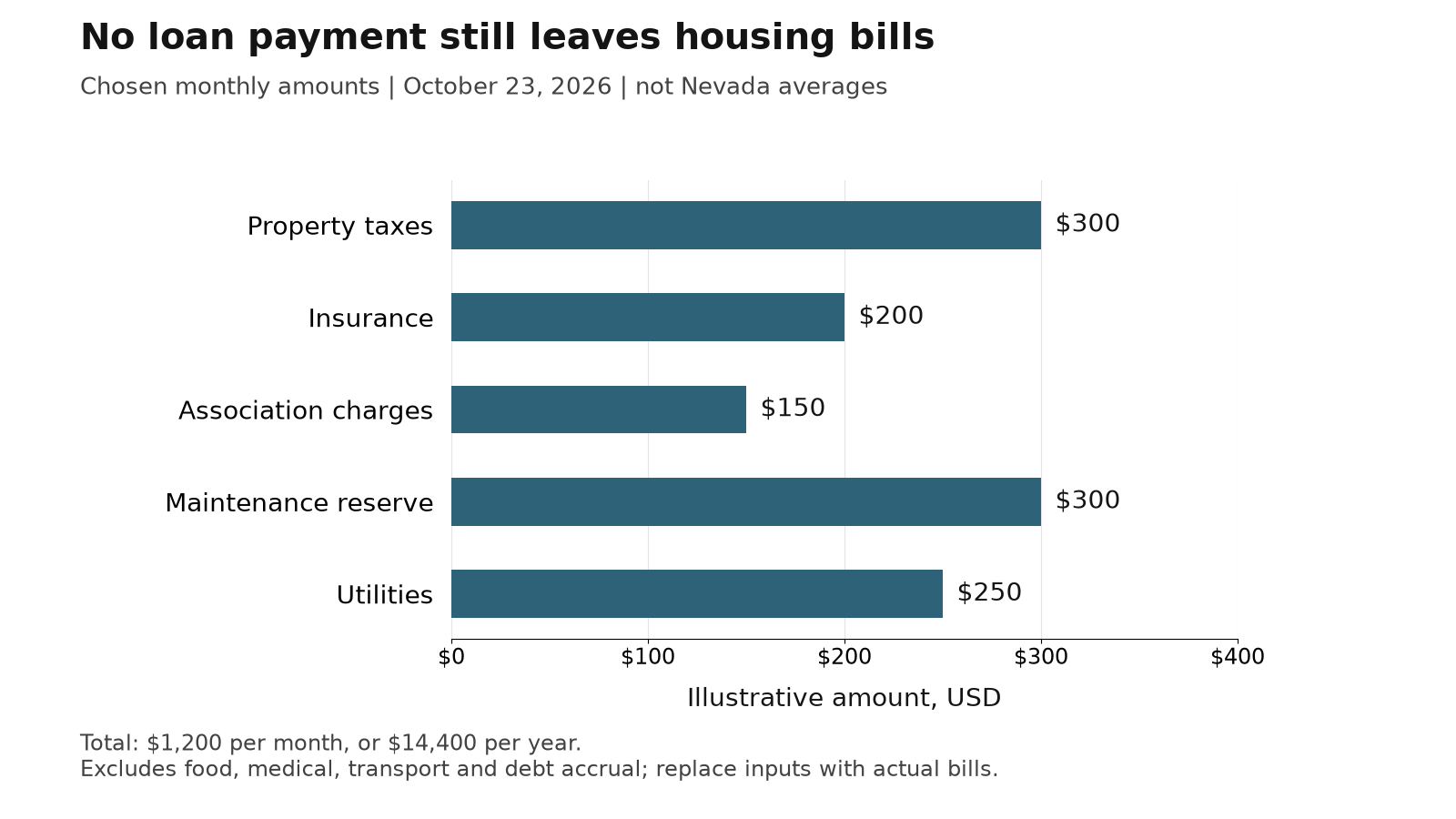
For an illustrative October 23, 2026 household, use annual amounts of $3,600 for property taxes, $2,400 for insurance, $1,800 for association charges, $3,600 for maintenance reserves and $3,000 for utilities. The total is $14,400 a year, or $1,200 a month, before food, transportation, medical costs or any loan-related charges added to debt. These selected figures are not a Nevada average or a quote. Replace all five with household-specific inputs.
HUD's handbook describes fully and partially funded life expectancy set-asides, or LESAs. A fully funded arrangement pays specified charges directly; a partially funded arrangement can require the borrower to make up the remaining amount and pay the bills. The reserve is not a guarantee that every cost will be paid forever. HUD requires notice that funds may prove insufficient, and a non-borrowing spouse's deferral period does not continue those available advances.
Ask who pays each bill, what is included, how disbursements appear on the statement and what happens if the reserve runs out. Keep an independent reminder system even when a servicer pays a charge. The aging-in-place and downsizing comparison for Reno and Sparks helps frame the housing decision; the specific household budget should decide whether staying is sustainable.
How do a move, extended care or a missed obligation affect the loan?
The frequently repeated twelve-month rule needs its context. According to the CFPB's guidance on moving out, a move away from the principal residence can make repayment necessary. The special discussion of more than twelve consecutive months concerns an absence in a healthcare facility. It is not a general permission to move elsewhere for almost a year while treating the old home as a qualifying residence.
A remaining co-borrower may keep the loan and continue receiving advances while meeting its obligations. An eligible non-borrowing spouse may qualify for a deferral under particular rules, which differs from being a borrower. Adult children, roommates and other relatives do not automatically obtain either status by living in the property. Obtain a written explanation based on the actual names and classifications in the loan file.
Create a contact plan before a medical event forces a rushed decision. Identify the servicer, account information, documents a representative needs, occupancy certifications and the person authorized to communicate. An estate planning or elder-law attorney can address authority and title questions. A real estate agent cannot grant a loan extension or decide whether the servicer must recognize a deferral.
Missing taxes, insurance or required maintenance can also create default risk. Contact the servicer and a HUD-approved counselor promptly if a problem develops, and request the available resolution options and deadlines in writing. Do not assume foreclosure is either automatic after one problem or impossible while someone remains in the house. The CFPB's reverse-mortgage terms distinguish default, foreclosure and possible loss-mitigation steps.
What protection does a younger or non-borrowing spouse have?
Start by confirming whether each spouse is a borrower, an eligible non-borrowing spouse, or neither. These labels are not interchangeable. A co-borrower generally continues the loan's benefits and responsibilities after another borrower dies, subject to ongoing requirements. An eligible non-borrowing spouse may receive a deferral of repayment, but does not receive continuing loan advances during that deferral. A budget that depends on those advances therefore needs a separate survivor scenario.
According to the CFPB's spouse guidance, rules depend in part on whether the FHA case number was assigned before or on/after August 4, 2014. For newer HECMs, relevant conditions include identification in the documents, marriage requirements and exceptions, continued principal residence and compliance with other loan obligations. The older-loan Mortgage Optional Election process has different conditions and involves the servicer's election. Neither should be summarized as an unconditional lifetime guarantee.
Ask for a written description of what happens after the borrower's death and after a qualifying extended healthcare absence. Have the explanation address property charges, remaining set-asides, available income, certification requirements and what ends a deferral. Keep that explanation with the signed loan documents and share its location with the appropriate family member or representative.
Do not remove a spouse from title simply because someone says it will increase proceeds. Title rights, eligibility and survivor protection require independent review. When comparing a move to Henderson or another community, evaluate the survivor's ability to manage the home as well as the initial loan amount. A financially workable arrangement for two people can become difficult when one person must handle every bill, repair and administrative task alone.
What should heirs do when the last borrower dies?
Heirs need the loan documents, current balance, servicer contact and legal authority to act. The first task is to determine whether a co-borrower or eligible non-borrowing spouse has continuing rights. Then obtain the due-and-payable notice, payoff instructions, appraisal process and response deadlines in writing. Do not wait for a remembered six-month period before contacting the servicer.
The CFPB's heirs page, reviewed August 28, 2026, distinguishes repaying the balance to keep a home from selling an underwater property under the applicable 95%-of-appraised-value rule. HUD Handbook 4000.1, section III.B.2.b.iii–iv, likewise distinguishes full payoff, a qualifying sale, spouse-related circumstances and other resolution options. Do not assume every heir can simply retain title by paying 95% of value. Post-death transfers and particular deferral situations can require a more specific analysis.
For a limited illustration, 95% of a $380,000 appraisal is $361,000. That multiplication does not establish a particular heir's payoff amount, sale approval, net proceeds or right to remain. If the debt were $400,000, the family would still need the servicer's approved resolution and the attorney's advice about ownership and transfer. This distinction is especially important when one heir wants the house and others want a sale.
HECM non-recourse protection limits collection against the borrower or estate under the program; it does not erase administrative duties, property bills or the need to resolve title. Ask about extensions immediately rather than treating them as guaranteed. Preserve every notice and response. The Nevada probate sale guide explains the separate estate-sale process. Loan servicing deadlines and probate authority must be managed together; completing one does not automatically satisfy the other.
How can you recognize pressure or misleading reverse-mortgage advertising?
Pause when a pitch presents borrowing as a government benefit, promises permanent payment-free living, or focuses on available cash while omitting the debt and future housing decision. According to the FTC's guidance on deceptive reverse-mortgage claims, pressure to buy investments, insurance, travel or repairs with the proceeds deserves scrutiny. It is inaccurate to say every proposal to invest loan proceeds is automatically a felony; the actual conduct and applicable law matter.
Separate the decisions. Obtain an independent repair scope before choosing repair financing. Evaluate an investment with an independent adviser before borrowing against a home to fund it. Ask every participant how they are paid and whether compensation depends on the loan, sale or another product. A confident recommendation is not a substitute for disclosure of incentives.
The CFPB's August 2026 explanation explicitly states that VA does not offer reverse-mortgage loans. A veteran can still consider a HECM under the applicable FHA rules, but military-themed advertising does not create a VA benefit or approval. Verify the product and institution through official resources, not through the phone number or badge in an unsolicited advertisement.
Use the Nevada Division of Mortgage Lending's license and registration lookup guidance to locate the appropriate official search. Confirm the company and individual, relevant status and contact information; a name match alone does not authenticate a caller. If a family member is pressuring the homeowner to release money, give the homeowner private time with the counselor and independent legal help. Consent and understanding matter even when the proposed recipient is a relative.
How does a complete downsizing comparison change the decision?
Selling can release equity, but the sale price is not the cash available afterward. Deduct existing debt, selling costs, replacement housing, purchase costs, moving expenses and any applicable taxes. A smaller property may carry a larger association charge or need modifications, so lower square footage does not guarantee lower total spending. Compare a real destination with the current home, not an idealized retirement lifestyle.
| Item | Assumption | Effect on cash |
|---|---|---|
| Current home sale | Hypothetical price | +$500,000 |
| Selling costs | Chosen aggregate allowance of 7% | −$35,000 |
| Existing mortgage payoff | Assumed balance | −$60,000 |
| Replacement home | Hypothetical cash purchase | −$330,000 |
| Purchase costs | Selected allowance | −$9,000 |
| Moving and setup | Selected allowance | −$6,000 |
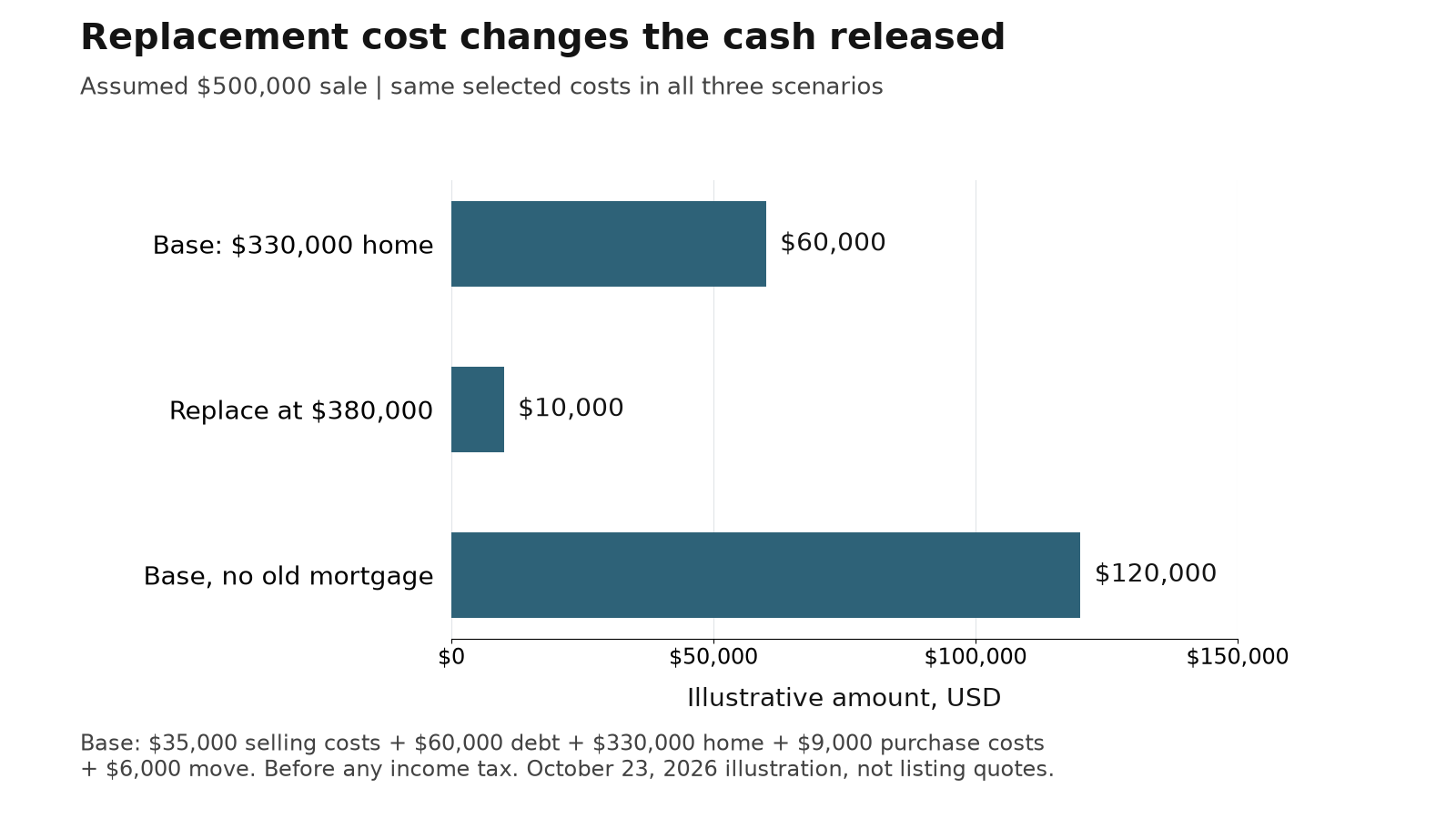
| Cash remaining | Before any applicable income tax or extra reserve | $60,000 |
Without the assumed $60,000 mortgage payoff, this same worksheet would leave $120,000. With a replacement home costing $380,000 instead of $330,000, the original version leaves only $10,000. Those differences show why a broad claim about how much downsizing frees is unreliable. Actual selling compensation and other costs are negotiated or transaction-specific; the 7% entry is a planning input, not an industry standard.
Compare the move with a written HECM proposal on equal terms: cash available, future debt, monthly expenses, housing suitability and a later care or relocation scenario. If staying already requires a large renovation, include that cost. If moving requires a temporary rental or overlapping ownership, include that too. Browse Las Vegas 55+ communities, Mesquite options and North Las Vegas options to identify properties for a real comparison, then verify each property's restrictions, costs and condition.
Which alternatives deserve a place beside the HECM proposal?
Consider the size and duration of the need before comparing products. A one-time repair, a recurring monthly shortfall and a planned relocation are different problems. Borrowing can fund each temporarily, but it cannot make an unsuitable home or an unsustainable budget disappear. Start with an expense review, available liquid assets and any relevant assistance for which the household actually qualifies; do not assume a broadly described senior program is currently available locally.
A home equity loan or HELOC can provide funds while retaining the property, but repayment terms, qualification, variable rates and fees need scrutiny. A cash-out refinance replaces the existing mortgage with a different obligation. A family loan needs clear written terms, legal and tax review, and consideration of how other relatives are affected. Selling and renting shifts the comparison toward rent, moving costs and the management of released equity. None is automatically cheaper or safer for every household.
According to the IRS's reverse-mortgage tax answer, proceeds are loan advances rather than taxable income. That does not establish eligibility for every means-tested program or make accrued interest automatically deductible. Ask the relevant benefits administrator about retained funds, and a tax adviser about the household's actual use of proceeds and later repayment.
HUD also permits HECM for Purchase arrangements, subject to their separate requirements and the cash needed to complete the purchase. That combines moving and borrowing rather than making them mutually exclusive. Request a distinct comparison if it is relevant. Use the pre-purchase checklist to investigate the replacement property while an appropriately qualified lender and counselor evaluate the financing. The property decision deserves the same attention even when the loan structure changes.
What documents and questions should you take to the final comparison?
Create one household worksheet that all proposals use. Record the current property value assumption, existing payoff, liquid reserves, recurring income, expenses, expected repairs and possible move dates. Separate guaranteed income from assumptions, and identify which costs continue after one spouse dies. Record the source and date of every estimate. When a figure changes, ask for an updated comparison instead of comparing proposals produced from different inputs.
Request the principal-limit calculation, net proceeds, initial-disbursement schedule, rate and adjustment terms, origination and third-party fees, set-asides, servicing charges and Total Annual Loan Cost disclosures. Ask what happens after an ordinary move, a healthcare absence, death, failure to pay a charge, or a request to sell. Get the answers in writing and have the counselor explain any term you cannot restate in your own words.
According to the FTC's shopping guidance, comparing offers and alternatives is part of evaluating the product, and most reverse mortgages have a limited cancellation right. Ask the lender and attorney which cancellation rules apply to your specific transaction, particularly a purchase, and follow the required written procedure and deadlines. Do not treat the existence of a possible cancellation right as a reason to sign documents you have not understood.
Keep an accessible family file containing signed documents, contact details and instructions for locating statements. Decide who may receive information and who has legal authority to act. Review the plan after a major health, household or housing change. A careful initial comparison is useful, but it does not replace ongoing attention to insurance, occupancy certifications, property bills and the loan balance.
How can Nevada Real Estate Group help compare staying with moving?
Nevada Real Estate Group is the #1 real estate team in Nevada by RealTrends Verified, with roughly 9,600 closings statewide — including years of helping retirees decide between staying, borrowing, and moving. The real estate side of this decision is estimating a supportable sale range, identifying replacement homes and preparing a transaction-specific cost comparison. A sale estimate is not an appraisal, and a housing comparison is not a HECM approval or a legal determination about heirs' rights.
One last piece of perspective from the closings we handle: the retirees happiest with their decision five years later are rarely the ones who found the cleverest financial product — they are the ones whose housing matches their life. Put that housing question on paper: can the home accommodate daily routines, visitors, changing mobility and the work needed to maintain it? Then compare the financial options against that requirement.
A brokerage can earn compensation from a sale or purchase, so include that incentive when evaluating advice about moving. Keep an independent counselor in the borrowing discussion and appropriate legal or financial professionals in their areas of expertise. Ask for an itemized, dated estimate rather than relying on a broad promise that either moving or borrowing will release a particular amount.
Explore the statewide home search to identify a realistic replacement, or contact Nevada Real Estate Group to discuss the property comparison. The Las Vegas team can be reached at (702) 637-1759 and the Northern Nevada team at (775) 277-2120. Bring the lender's written proposal and your housing budget so the comparison starts with the same assumptions. The useful outcome is a documented choice that the homeowner understands and can sustain.
What questions do Nevada families ask about reverse mortgages?
Do I have to be 62 to get a Nevada HECM?
Every HECM borrower must be at least 62 at closing. An eligible non-borrowing spouse can be younger, but has a different legal and financial position from a co-borrower. The lender must review occupancy, title, property and other eligibility requirements. Do not remove a spouse from title or assume survivor protection simply to increase the calculated proceeds; obtain independent advice on the actual documents.
Is the 2026 HECM limit the amount I can borrow?
No. The $1,249,125 maximum claim amount applies to FHA case numbers assigned on or after January 1, 2026. The principal limit uses additional inputs, including age and interest rate. Existing mortgage payoff, fees, set-asides and initial-disbursement rules then affect what is available to use. Ask for a line-by-line reconciliation from value to principal limit to spendable proceeds.
Can a reverse mortgage cause foreclosure while I still live there?
Yes. Occupancy alone does not satisfy all loan requirements. Taxes, required insurance, property condition and other obligations must remain in order. A failure can lead to due-and-payable status and potentially foreclosure if unresolved. Contact the servicer and a HUD-approved counselor promptly when a problem arises. Ask for the specific reason, possible remedies and deadlines in writing.
Does an unused HECM credit line earn investment interest?
No. Growth in available credit is an increase in borrowing capacity under the loan, not investment earnings deposited into a savings account. Future withdrawals create debt and associated charges. A credit line may suit intermittent needs, but its rate, access conditions, growth rules and effect on future housing options require the same scrutiny as other payout plans.
Can heirs always keep the home by paying 95% of its value?
Do not assume that. Current CFPB guidance distinguishes keeping the home through payoff from a qualifying sale when the debt exceeds value. HUD also addresses specific transfers and spouse-deferral situations. The family needs a current appraisal, written servicer instructions and advice about title and the chosen transaction. A 95% calculation alone does not establish a universal payoff entitlement.
Will a younger spouse keep receiving the reverse-mortgage payments?
A co-borrower and an eligible non-borrowing spouse have different rights. A qualifying non-borrowing spouse may receive a deferral of repayment while meeting the requirements, but does not continue receiving loan advances during that deferral. Build a survivor budget without assuming those payments or set-aside disbursements continue. Confirm the FHA case date and spouse classification in the actual loan file.
Are reverse-mortgage proceeds taxable income?
The IRS treats the advances as loan proceeds, not taxable income. That does not mean all uses of the money have the same tax or benefits consequences. Accrued interest is not automatically deductible, and any allowable deduction depends on the applicable rules and payment. Consult the relevant benefits administrator and a tax adviser about the household's circumstances rather than assuming a general tax answer resolves every issue.
Is downsizing always better than a HECM?
No. Moving has transaction, replacement-housing and practical costs, while a HECM adds debt and continuing obligations. Compare actual proposals using the same home value, payoff, time horizon and household budget. A home that already meets long-term needs may support a different choice from one requiring major adaptation. Include a survivor scenario and a possible later move before deciding.
Which sources and methods support this guide?
Program guidance was reviewed October 23, 2026. The principal federal references are HUD's 2026 limit announcement, HUD's HECM overview, and the relevant reverse-mortgage sections of Handbook 4000.1, Update 18. The handbook sections used cover borrower and spouse eligibility, payment plans, disbursements, insurance, closing fees, set-asides and due-and-payable procedures. Future-effective property provisions are not treated as already in force.
The CFPB pages linked beside each claim explain costs, payment choices, moving, spouses and heirs. Its heirs page reviewed August 28, 2026 distinguishes a sale from keeping the home; broad older summaries of the 95% rule should not substitute for the actual transaction analysis. The FTC informs the shopping and pressure checks, the IRS supports the loan-proceeds tax distinction, and Nevada's mortgage regulator supplies the official route to licensing information.
All dollar worksheets and charts are original, hypothetical calculations. They do not describe a client transaction, lender quote, available listing, current market median or guaranteed result. The balance model uses a constant combined annual input divided by twelve, compounded monthly; actual loan accounting can differ. The downsizing example excludes any applicable income tax and changes only the specifically named assumptions between scenarios.
The roughly 9,600 transactions Nevada Real Estate Group has closed statewide are part of the company experience described above; the examples are not a statistical study of those transactions. Use dated, property-specific and lender-specific records to replace the assumptions before making a decision. Independent counseling, written loan terms and the household's own housing needs remain essential to the comparison.