

A physician moving to Nevada can have a strong career outlook and a complicated mortgage file at the same time. A new employment contract, substantial student debt, a change from training to practice and a limited window to move can all affect how the purchase should be organized. A professional-loan label does not resolve those details by itself.
I would start by comparing the financing paths while building a home-search plan around the actual work location and schedule. The goal is a home and payment that remain workable after the move, with enough cash left for the transition. The largest loan available is not necessarily the best target for the search.
Physician home loans in Nevada are lender-specific mortgage programs for eligible medical professionals. Compare at least 2 financing paths—a physician program and a suitable conventional option—using the same property, down payment and date. Confirm student-debt treatment, employment-contract requirements, cash reserves and property eligibility before tying a Las Vegas or Reno purchase to your job's start date.
- A medical credential alone does not guarantee approval; each lender sets its own physician-program eligibility.
- Compare both loans on identical inputs: the $600,000, 6.5% example runs $3,603 monthly at 5% down and $3,034 at 20%.
- Under Fannie Mae's rule a deferred $200,000 student loan can count as $2,000 a month; verify treatment early.
- Fannie Mae's employment-contract path can close a conventional loan before your start date; confirm the conditions with the lender.
- Test the commute from the real worksite, UMC in Las Vegas or Renown in Reno, on your actual shift.
Program sources were reviewed September 7, 2026. This guide is home-purchase education, not a lender commitment or an assessment of your personal borrowing eligibility. The financial examples are hypothetical. No lender partnership, hospital affiliation or professional review of this article is implied.
What Makes a Physician Mortgage Different From Other Home Loans?
A physician mortgage is a lender's program for a defined set of professionals, with its own approach to matters such as down payment, employment history and student debt. The name does not establish a uniform national rulebook. Two lenders using similar labels can have different eligible degrees, property restrictions, loan limits and documentation requirements.
According to Greater Nevada Mortgage's doctor-loan page, its program is intended for qualifying physicians and other specified medical professionals beginning their careers, with a lower-down-payment option. The published description provides a real Nevada option to investigate. It does not establish a zero-down offer, a mortgage-insurance waiver or a particular rate for your application.
Ask the lender to identify the exact program and give you a written summary of the terms relevant to your situation. The useful answer connects the program to your employment arrangement, debt documentation, cash and intended property. A general statement that “we work with doctors” is less helpful than a clear explanation of what the underwriter will need.
Keep the loan comparison separate from the home search at first, then bring them together once the likely parameters are known. A property can fail a lender's requirements even if the borrower otherwise qualifies. A borrower can also be approved for a payment that leaves too little room for the practical costs of the move.
For that reason, begin with your preferred monthly housing budget and the cash you want remaining after closing. Then ask which loan structures support those limits. That approach makes the program serve the purchase plan, rather than letting a marketing label determine how much house to pursue.
Which Medical Professionals Should Check Program Eligibility?
Use the lender's actual eligibility list and confirm how it applies to your credential and employment stage. Do not assume all health-care occupations qualify, or that every lender limits the program to the same degrees. Residents, fellows, employed physicians and practice owners may also present different documentation questions even when their credentials are accepted.
According to Greater Nevada Mortgage, eligible credentials include MD, DDS, DMD, OD, DPM and DO categories, with specified training and specialty provisions. Credit-union membership is also required. Check the provider's complete list for your circumstances; these September 2026 observations do not establish approval.
Prepare a concise description of your situation before contacting a lender: credential, training or practice stage, employed or self-employed status, intended state of residence and approximate purchase timing. Ask whether any recent graduation, residency or licensing conditions affect the program. If the public page does not answer a question, have the lender resolve it rather than guessing.
An applicant whose occupation is outside a program's list may still have other mortgage options. Conversely, being on the list does not eliminate ordinary underwriting or property requirements. Keep the distinction between professional eligibility and complete loan approval clear throughout the process.
Avoid making an offer contingent on an assumed professional exception. Get a written explanation of the program's treatment of your application first, with outstanding conditions identified. That gives the agent a realistic financing framework and helps prevent a last-minute discovery that a different loan or larger down payment is needed.
Should You Compare a Physician Loan With Conventional Financing?
Yes. Request a physician-program scenario and a suitable conventional scenario using matching property and timing assumptions. Conventional financing should not be dismissed merely because student loans or a future employment start date are involved. Those issues have documented underwriting rules, and the lender needs to determine how they apply to your file.
According to Fannie Mae's employment-offer guidance, some loans can use qualifying future employment offers or contracts under specified conditions. This does not mean every conventional lender will approve your proposed closing date. It means an employment contract is a question to evaluate under the actual rules, not automatic proof that only a physician product can work.
| Decision | Physician program | Conventional option |
|---|---|---|
| Professional eligibility | Confirm the lender's accepted credentials | Review standard borrower eligibility |
| Student debt | Request the exact qualifying-payment treatment | Request the applicable agency and lender treatment |
| Future employment | Confirm contract and start-date requirements | Check the applicable employment-offer rules |
| Down payment and insurance | Obtain a written property-specific offer | Obtain a written property-specific offer |
| Total cost | Include rate, points, fees and cash remaining | Use the same comparison assumptions |
If one scenario uses a different down payment, show the effect on both monthly payment and remaining cash. A comparison that presents only the lower payment can hide how much additional money was required to obtain it. Similarly, a program without a separately charged mortgage-insurance premium, if actually offered, is not automatically the lowest-cost loan after interest and fees.
Ask each lender to explain why its proposed structure fits your circumstances. Keep the written conditions with the comparison so that an attractive preliminary quote does not become detached from its requirements. The final choice should reflect verified terms and your purchase plan, not an assumption that professional branding makes a product inherently superior.
How Can Student Loans Affect Your Mortgage Application?
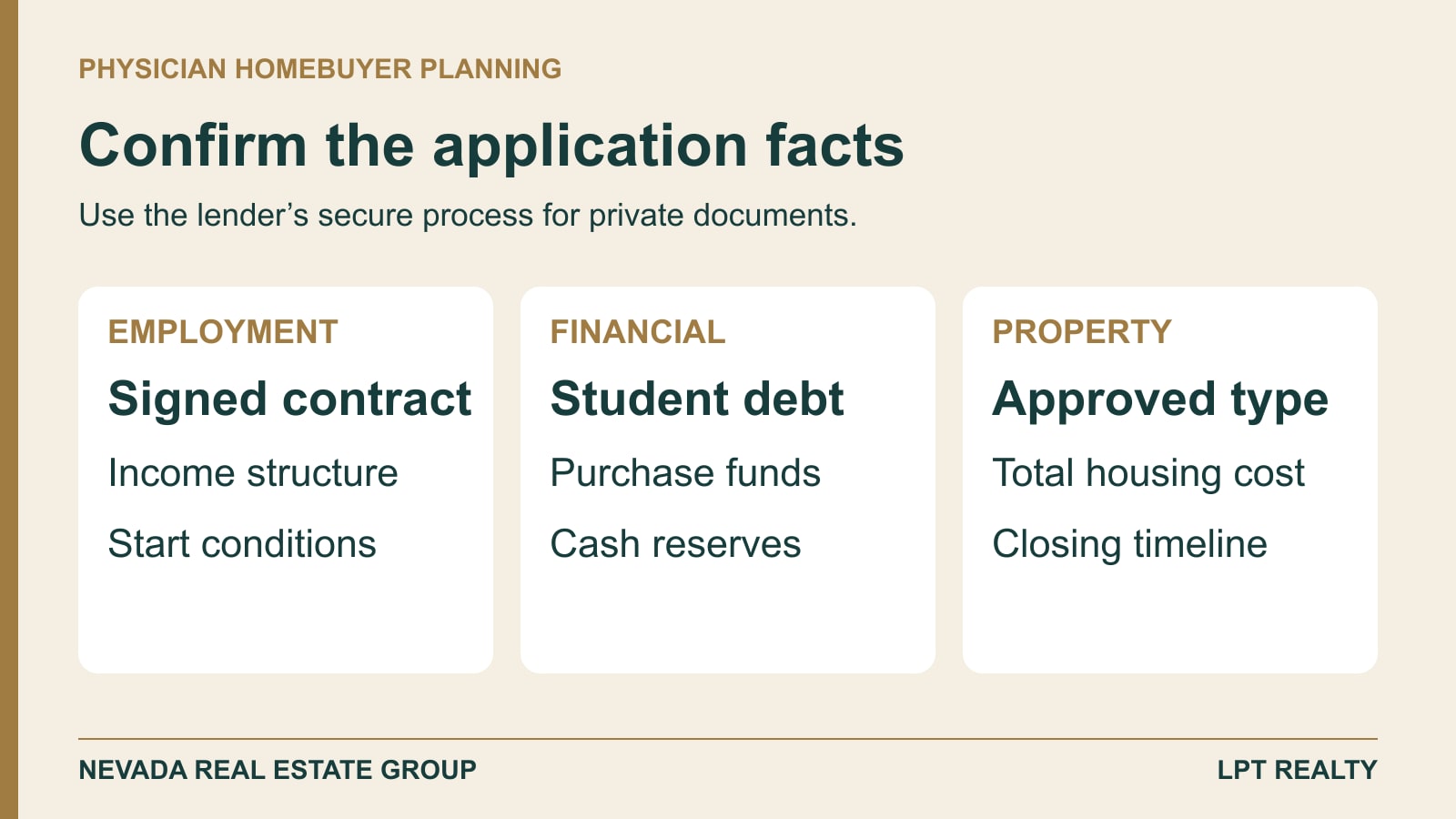
The monthly obligation used for mortgage qualification can differ from the balance you see on a student-loan statement. The lender needs to determine the applicable payment treatment using current documentation and the mortgage program's rules. A large outstanding balance does not provide enough information by itself to calculate the effect on eligibility.
According to Fannie Mae's monthly-debt guidance, documented student-loan payments can be used in specified circumstances, including a documented zero payment under an income-driven plan. For deferred loans or loans in forbearance, its stated alternatives include 1% of the outstanding balance or a fully amortizing payment using documented terms. The actual applicable treatment needs lender review.
Those distinctions matter. In a purely arithmetic example, 1% of a $200,000 balance is $2,000 per month. That is not a statement that your lender will assign that payment, nor a recommendation to change repayment plans. It demonstrates why you should ask what figure the underwriter is using and what documentation supports it.
Gather current statements and any applicable repayment-plan documentation through the lender's secure process. Identify when a temporary arrangement is expected to change. If the credit report and the current statement show different payments, ask the lender how it will reconcile them rather than assuming the smaller figure controls.
Do not pay down, consolidate or refinance student debt solely because you expect it to help the mortgage application. Such a change can affect available cash and other loan features. Ask the mortgage lender to show the qualifying impact, and review the student-loan consequences with the appropriate adviser or servicer before acting. The home-purchase budget should also reflect the payment you expect to make in real life, not only the number used for qualification.
Can You Close Before Starting a New Nevada Job?
Possibly, but the answer depends on the loan's specific rules and the employment documentation. Do not set a binding closing date based only on the date printed in an offer letter. Ask the lender which conditions must be satisfied before closing, which income it will recognize and how the period before the first paycheck is funded.
Fannie Mae's employment-offer guidance includes an option with defined limits, including a one-unit principal-residence purchase, fixed-base income, contract requirements and a start date no later than 90 days after the note date. Additional conditions and reserves apply. A physician program may use different rules; obtain its requirements independently rather than transferring the conventional rule to it.
Separate guaranteed base compensation from bonuses, production incentives, extra shifts and other variable income. A job's total possible compensation is not automatically the income available for underwriting. Similarly, licensing, credentialing, background checks or other employment conditions can matter to whether an offer is considered ready for use.
Build the calendar around several milestones: contract execution, satisfaction of employment conditions, lender review, proposed closing, physical move, work start and first paycheck. These are separate dates. A start date moving by a few weeks can affect both underwriting and the amount of cash the household needs during the transition.
Discuss a backup housing plan before it becomes urgent. Temporary accommodation may be useful if the employment or closing schedule is uncertain, but its costs should be included in the budget. Do not waive a necessary financing protection simply because a move feels inconvenient to postpone. A dependable closing requires the employment, loan and property conditions to line up; an attractive house does not remove those dependencies.
How Do You Set a Housing Budget That Works After the Move?
Start with the payment you can comfortably support from dependable income, then add the costs of owning and using the property. Mortgage principal and interest are only part of the monthly outlay. Include property taxes, insurance, association charges, utilities, maintenance and any services you expect to use.
For a hypothetical September 2026 comparison, assume a $600,000 purchase, a 30-year fixed loan and a 6.5% annual interest rate. With 5% down, the assumed loan is $570,000 and principal and interest are approximately $3,603 per month. With 20% down, the assumed loan is $480,000 and principal and interest are approximately $3,034. This is payment arithmetic using invented financing assumptions, not a currently offered rate or APR.
| Input or result | 5% down illustration | 20% down illustration |
|---|---|---|
| Assumed purchase price | $600,000 | $600,000 |
| Down payment | $30,000 | $120,000 |
| Loan amount | $570,000 | $480,000 |
| Assumed annual interest rate and term | 6.5%; 30 years | 6.5%; 30 years |
| Approximate monthly principal and interest | $3,603 | $3,034 |
The larger down payment reduces the illustrated principal-and-interest payment by approximately $569 while committing another $90,000 upfront. That tradeoff deserves its own review. Neither illustration establishes which down payment is available or advisable for your circumstances, and a lender may price the two scenarios differently.
Next, prepare an actual monthly household budget after the move. Include the expected student-loan payment, transportation, insurance and other recurring commitments that matter to you. If the purchase only works with uncertain bonus income or a future refinance, make that dependency explicit. A sensible housing target should remain understandable without relying on every optimistic career and interest-rate assumption occurring together.
How Much Cash Should Remain Available After Closing?
Keep the down payment, closing costs, moving expenses and remaining reserves in separate lines. A low-down-payment option can preserve cash, but preservation only helps if the resulting loan payment and total cost are workable. Conversely, a large down payment can reduce borrowing while leaving too little flexibility during a job transition.
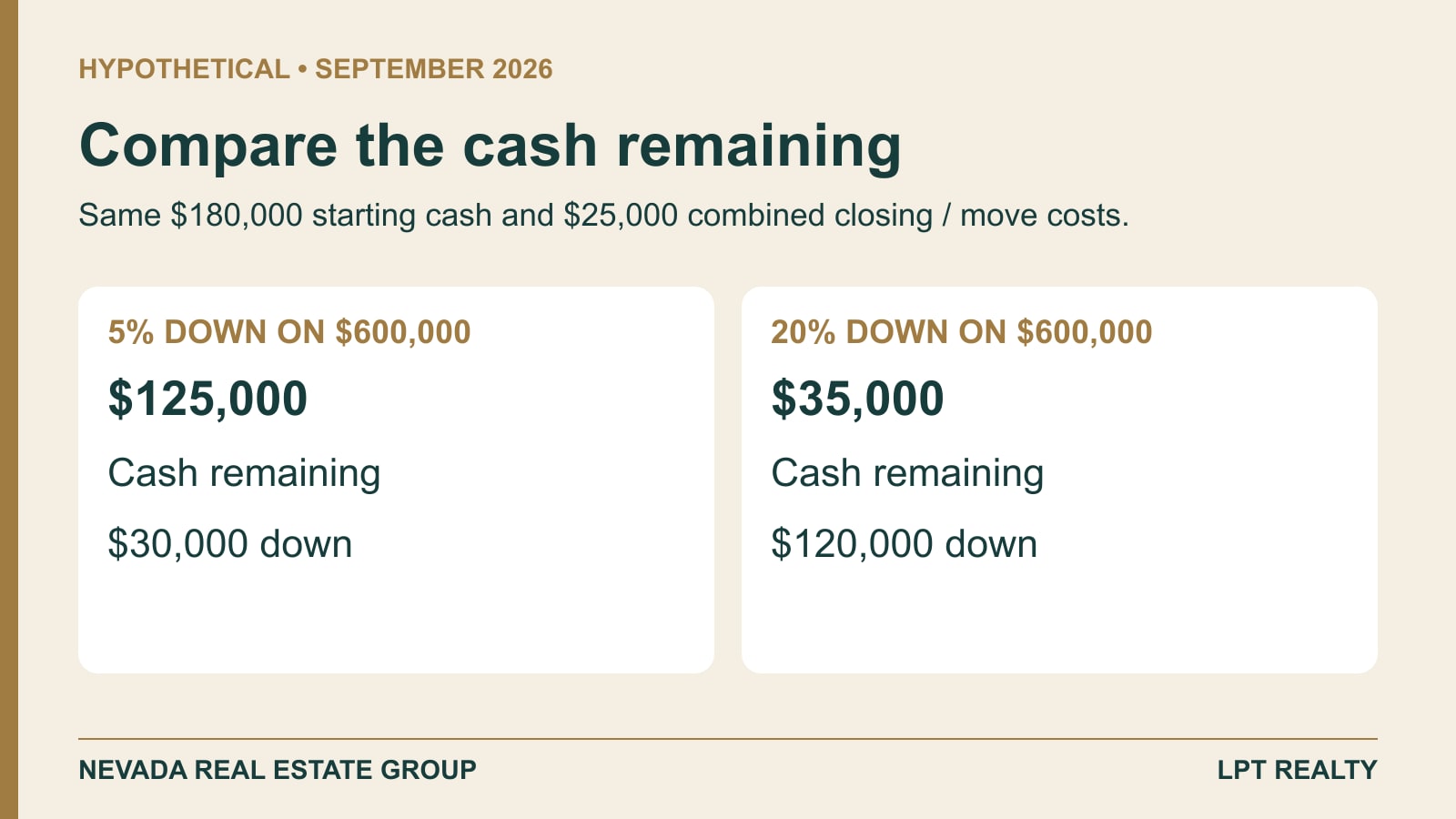
Use another hypothetical September 2026 illustration. Start with $180,000 of available cash. Assume $15,000 for closing costs and prepaid items and $10,000 for moving and initial setup. A $30,000 down payment would leave $125,000; a $120,000 down payment would leave $35,000. These are invented budget inputs, not lender-required reserve amounts, a moving quote or an estimate for a particular home.
| Cash item | 5% down illustration | 20% down illustration |
|---|---|---|
| Starting available cash | $180,000 | $180,000 |
| Down payment | −$30,000 | −$120,000 |
| Assumed closing and prepaid costs | −$15,000 | −$15,000 |
| Assumed move and setup | −$10,000 | −$10,000 |
| Cash remaining | $125,000 | $35,000 |
Now compare what that remaining cash must do. It may support a gap before the first paycheck, unexpected repairs, overlapping housing payments or other commitments. Some assets may also need to meet a lender's definition of eligible reserves. Money that is restricted, unvested or needed for another obligation should not be counted as freely available without checking the facts.
Keep a distinction between what the lender requires and what you choose for comfort. Ask for both numbers in the planning worksheet. If additional cash will come from selling a current home, timing and contingencies matter as well. The existing buying-and-selling-at-the-same-time guide addresses that separate coordination problem. A proceeds assumption is not cash already available for the Nevada closing.
What Property Requirements Should You Check Before Touring Homes?
Ask the lender which property types, occupancy arrangements and condition standards fit the program. A prequalification for a borrower does not approve every detached home, condominium or new construction purchase. Identifying restrictions early makes the home search more efficient and reduces the chance of pursuing a property that cannot use the chosen financing.
Greater Nevada Mortgage's published doctor-loan description identifies single-family residences and warrantable condominiums as eligible property categories. That is a starting point for questions, not an approval of any specific condominium project. The lender must evaluate the actual property and applicable project requirements.
For a condominium, ask who reviews association finances, insurance, litigation and other project conditions, and when that review will occur. Do not infer warrantability from a listing description or a seller's statement that previous buyers used conventional loans. Project circumstances and lender requirements can differ.
For a detached home, connect condition and maintenance with the demands of the move. An extensive renovation may be a poor match for a tight work-start schedule even when the property is otherwise appealing. Obtain an inspection appropriate to the home and understand which repairs the loan may require before closing versus those you would choose to handle afterward.
For new construction, verify the realistic completion date, deposit terms, included features and financing conditions. A model home's presentation does not establish the delivery date or specifications of the selected home. If a builder offers an incentive tied to a lender, compare the full written offer with the physician and conventional options already obtained. The relevant comparison is the complete purchase and financing package, with the conditions attached to each benefit made visible.
How Should a Las Vegas Physician Organize the Home Search?
Begin with the exact work address, expected shift and any secondary locations. A hospital name alone may not identify where you will park, enter the building or report on a particular day. Ask the employer to confirm the location and schedule before filtering homes around a general impression of the city.
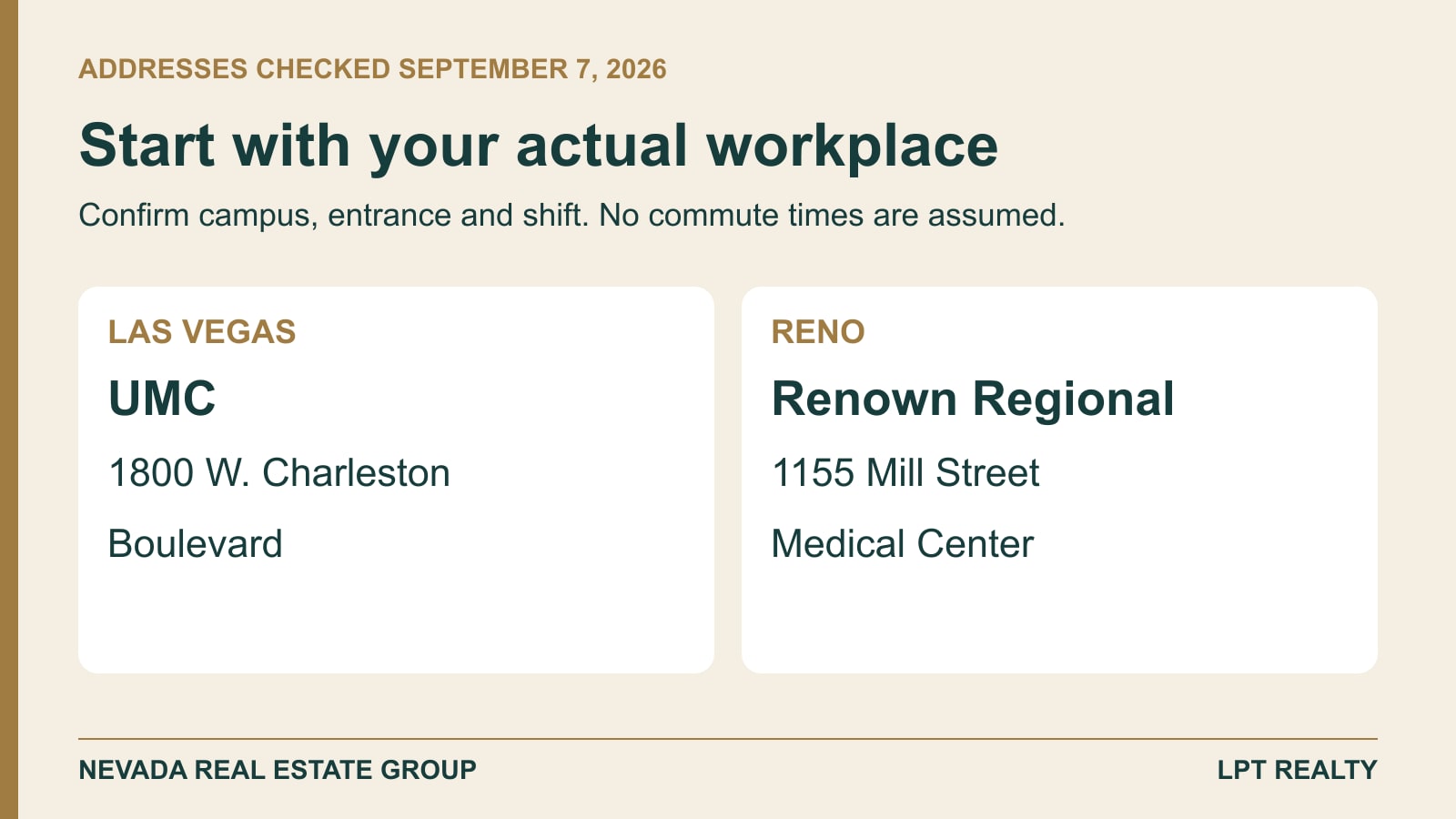
According to University Medical Center's contact page, UMC's listed physical address is 1800 W. Charleston Boulevard, Las Vegas. That is a verified reference point, not a promise that every physician affiliated with UMC works at that address or uses the same entrance. Use your own employment information to identify the correct destination.
Build a shortlist in Las Vegas or Henderson based on your budget, desired property features and actual route needs. A larger valley search can be useful if you have multiple workplaces, but it should not assume that all addresses offer interchangeable travel times. Test candidate routes during the hours you expect to travel and account for parking and the walk to the department.
At each home, evaluate practical details that matter to your schedule: light control in a room used for daytime sleep, noise you observe during the visit, maintenance responsibilities and the layout for the way you use the space. Those are property-specific observations and personal preferences, not claims about which neighborhood is suitable for a profession or household type.
Keep the location scorecard separate from mortgage eligibility. A lender can approve the financial file without knowing whether the daily routine will work well. Your home-search decision should combine the two. For broader questions about local facilities and care access, the Las Vegas healthcare guide provides context without replacing the employer-specific commute research needed for your move.
Our guide to moving to Las Vegas for healthcare work connects employer locations and work routines with the home search.
How Should a Reno Physician Compare Locations and Ownership Costs?
Use the same workplace-first method in Reno, with the actual destination and schedule driving route tests. Do not choose a home based on a generalized claim that a whole side of the city is convenient. A particular access point, parking arrangement or secondary clinical location can matter more than a neighborhood's marketing description.
According to Renown Health's Regional Medical Center location page, that facility is at 1155 Mill Street, Reno. Confirm whether it is your actual work location, then test travel from the homes under consideration. This article does not assign fixed commute times or claim that another Renown location is interchangeable with that campus.
Compare current homes in Reno and Sparks against your requested budget, features and access needs. Include the property's maintenance obligations and insurance quote in the financial comparison. If a home's features or location raise questions about seasonal access or coverage, obtain property-specific information instead of applying a citywide assumption.
According to the Washoe County Assessor's tax-cap guidance, qualifying primary residences receive a 3% cap on annual tax-bill increases, with a higher cap applying to other categories and rules for qualifying rentals. This is not a 3% tax on the purchase price. Confirm the parcel's applicable treatment and filing requirements when building the ownership budget.
Keep the financial and lifestyle comparisons consistent between Northern and Southern Nevada. A lower advertised payment is not necessarily a lower total housing cost if taxes, insurance, assessments or maintenance assumptions differ. Use actual property records and quotes for each finalist. The statewide choice should come from your job and preferences; the article's two-city coverage is a planning comparison, not a recommendation to buy in one region because of your occupation.
Compare the Reno relocation sequence with the job start date and financing timeline.
How Do You Compare Loan Estimates Without Missing Important Costs?
Compare written offers for the same purchase assumptions and request clarification of differences. Look beyond the headline interest rate to loan amount, points, lender charges, mortgage insurance if applicable, estimated cash to close and the payment structure. A useful comparison also identifies the rate-lock status and expiration.
According to the CFPB's Loan Estimate request guidance, a lender generally must provide a Loan Estimate within three business days after receiving the application information required for a covered mortgage. A casual discussion or incomplete inquiry is not necessarily the same milestone. Ask the lender where your application stands and which conditions remain.
According to the CFPB's comparison guidance, a lower estimate for taxes or insurance does not make the loan itself a better deal. Standardize those property-cost assumptions when assessing offers. Otherwise one quote can appear cheaper simply because it included a smaller placeholder for an expense the lender does not control.
Pay attention to the expected holding period without assuming it is certain. A resident or fellow may anticipate another move, while a newly employed attending may expect to stay longer. Compare upfront cost with the payment over a realistic period, then examine what happens if the move occurs earlier or later. Do not promise yourself that refinancing will solve an unaffordable payment.
Keep the lender's written responses attached to the comparison. If a fee is unclear, ask what it pays for, whether it can change and whether it is refundable. Verify any credit or incentive in the documents rather than relying on a conversation. The cleanest choice is the one whose costs, conditions and risks you can explain—not necessarily the offer with the most attractive single number.
For the categories to check in the settlement budget, use our Nevada closing-cost guide alongside the lender's actual disclosures.
What Timeline Connects the Job, Mortgage and Home Purchase?
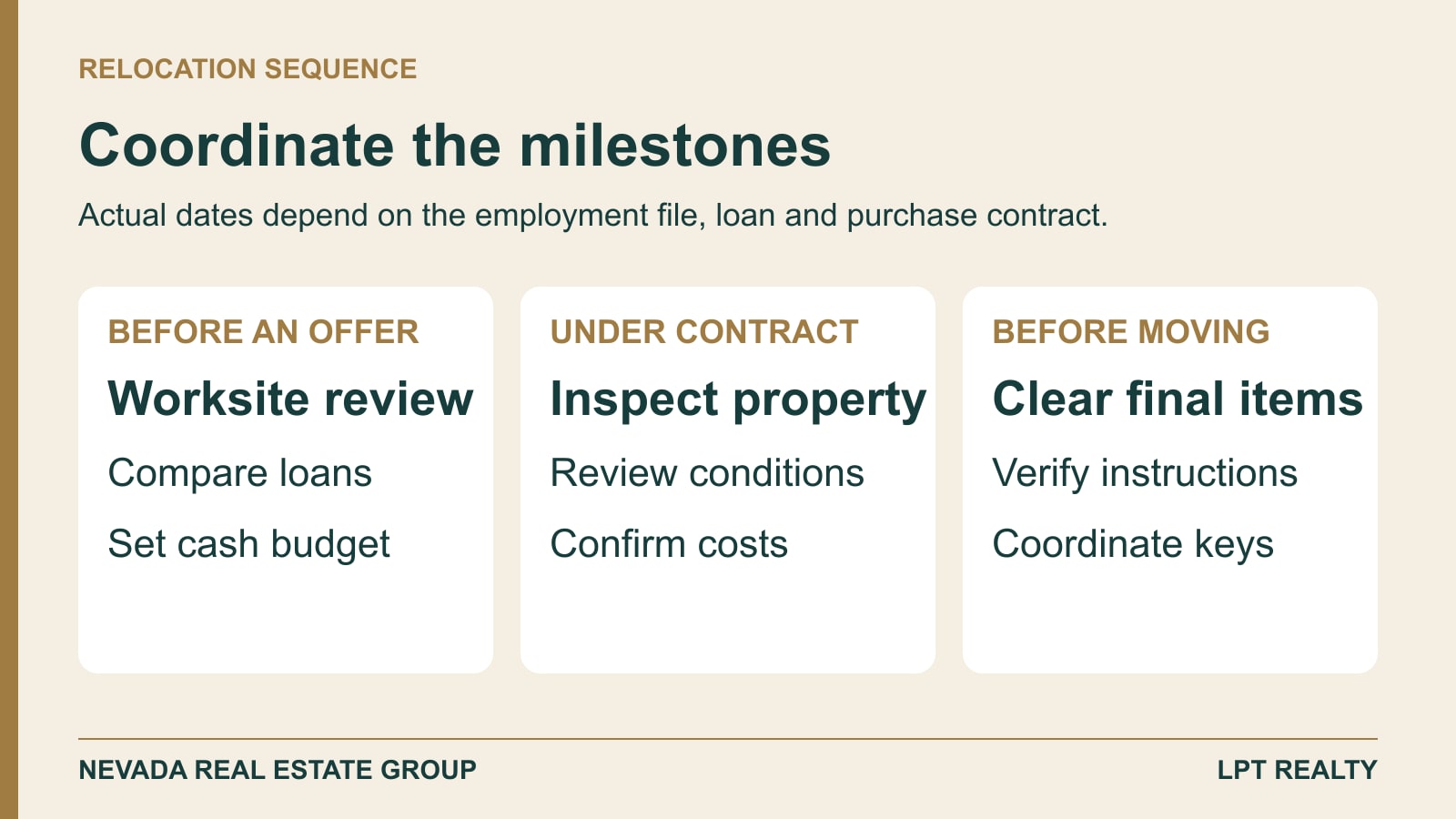
Use a milestone plan with dependencies rather than a promise that every physician purchase closes within a fixed number of days. The actual timing depends on the employment file, lender, property, appraisal, inspections, title and the negotiated purchase agreement. A hospital start date is an important planning input, but it does not control those independent processes.
Before touring seriously, confirm the work location, gather financial documentation and compare financing paths. Identify any employment conditions or expected changes in debt payments. Set the preferred housing budget and the amount of cash you want to retain after the move. This phase can prevent a rushed offer on a home that does not fit the eventual loan.
Once under contract, maintain a calendar for the actual contingency and document deadlines. Assign who obtains the insurance quote, reviews the association package, confirms loan conditions and coordinates any repair agreement. Keep a list of decisions that depend on something not yet received. If a date changes, update the moving plan rather than leaving two incompatible calendars in circulation.
| Milestone | Evidence needed | Decision it supports |
|---|---|---|
| Financing comparison | Employment, debt and cash information | Budget and likely program |
| Property selection | Location, condition and ownership costs | Whether to make an offer |
| Contract review period | Inspections, appraisal and lender conditions | Proceed, renegotiate or exercise applicable rights |
| Closing preparation | Final documents and verified funds instructions | Readiness to close and move |
Use secure channels for financial documents and verify wiring instructions through a trusted contact method. Do not send sensitive employment or account records through a general website inquiry form. The practical objective is a coordinated move with understood obligations and a backup plan if a key dependency changes. Keeping those decisions visible helps the purchase support the new job instead of adding avoidable uncertainty to it.
How Can You Start a Physician Home Search With a Clear Plan?
Prepare a short brief containing the city, actual workplace, desired move window, preferred property features and a comfortable total monthly housing budget. Add your lender's preliminary program requirements and the amount of cash you intend to preserve. You do not need to share private medical, student-loan or bank documents with an agent to explain the home-search criteria.
For each property considered, keep three assessments together: financing fit, total ownership cost and day-to-day suitability. A home can be appealing on one measure and weak on another. Write down the specific unresolved questions before deciding whether it belongs on the shortlist. That makes touring more productive than comparing homes by appearance and asking price alone.
If the employer, worksite or start date remains uncertain, use a search plan flexible enough to reflect that uncertainty. It may be sensible to explore available homes while postponing a binding purchase decision until key facts are known. The appropriate sequence depends on your own circumstances; neither buying immediately nor waiting is a universal rule for physicians moving to Nevada.
Nevada Real Estate Group can help organize the property search and purchase process while your chosen lender evaluates the loan. For Southern Nevada, call (702) 637-1759. For Reno and Northern Nevada, call (775) 277-2120. You can also request a home-buying consultation with your city, work location and target timeline.
Nevada Real Estate Group is brokered by LPT Realty; Chris Nevada's license is S.181401. The next useful step is a shortlist connected to verified financing and the way you intend to live. A physician-loan program can be part of that plan, but the complete purchase should make sense even after the excitement of the move and the first day of the new job have passed.
Frequently Asked Questions
Are physician home loans available in Nevada?
Yes. Greater Nevada Mortgage publishes a doctor-loan program for specified eligible professionals, reviewed September 7, 2026. Availability of a program is not approval for an individual borrower or property. Request current written terms and compare a suitable conventional option before choosing financing.
Does a physician loan automatically mean no down payment or no mortgage insurance?
No. Those features depend on the lender and actual program. The verified Nevada provider's public page describes a lower down payment but does not establish either feature for your application. Ask for the down payment, insurance treatment, rate, fees and eligibility conditions in a written offer.
Can student debt prevent me from getting a mortgage?
It can affect qualification, but the balance alone does not determine the outcome. The lender must evaluate the applicable payment and the rest of the financial file. Provide current documentation and ask how the qualifying payment is calculated. Your real post-move budget should also reflect the payments you expect to make.
Can a conventional loan use a future employment contract?
Some can, under specified conditions. Fannie Mae's employment-offer guidance describes qualifying paths, including limits on property, income, timing and reserves. Ask the lender whether your actual contract and proposed closing meet the applicable rules; do not assume only a physician program can consider future employment.
Should I buy near the hospital before I know my exact worksite?
Confirm the campus, entrance, schedule and any secondary work locations before making a location-dependent purchase. A health system can operate multiple sites. Test travel from candidate homes during the hours you expect to use the route, including parking and the final walk, rather than relying on a general neighborhood commute claim.
Is the 6.5% interest rate in this guide a current loan offer?
No. It is an invented assumption for the September 2026 payment illustration, using a 30-year fixed amortization. The example excludes taxes, insurance, HOA charges and any mortgage insurance. It is neither an advertised rate nor an APR quote; actual pricing and eligibility require a lender's written offer.
Does a physician program approve every condominium?
No. Borrower eligibility and property eligibility are separate. The verified provider lists warrantable condominiums, but the actual project still needs review under the applicable lender requirements. Obtain confirmation for the specific building or association before relying on that financing to complete a purchase.
What information should I send to begin the home search?
Share the city, workplace, preferred move window, housing budget and desired property features. Include the lender's preliminary property and financing parameters if available. Send sensitive employment, identification and financial records through the lender's secure process rather than a general inquiry form. An agent can begin organizing the search without those private documents.
Which Sources Inform This Nevada Physician-Homebuyer Guide?
Sources reviewed September 7, 2026. The program comparison distinguishes lender-specific information from conventional agency guidance and original planning examples. No lender, hospital or tax adviser is represented as endorsing or reviewing this article.
- Greater Nevada Mortgage, doctor/physician home loan: published eligibility categories, membership condition and property types; no unsupported zero-down or mortgage-insurance promise is inferred.
- Fannie Mae, employment offers or contracts: conventional future-employment underwriting paths and conditions.
- Fannie Mae, monthly debt obligations: student-loan payment treatment; the lender must determine the applicable rule.
- CFPB, requesting Loan Estimates: covered mortgage application and disclosure timing.
- CFPB, comparing loan offers: comparing complete offers and consistent assumptions.
- UMC, contact information: Las Vegas facility address, not an individualized worksite or commute determination.
- Renown Regional Medical Center: Reno facility address, not an individualized worksite or commute determination.
- Washoe County Assessor, tax-cap information: tax-bill cap explanation and property-specific confirmation.
The payment examples use a standard fully amortizing mortgage formula, monthly interest equal to the stated annual interest rate divided by 12, and 360 payments. Cash-allocation examples use only the expressly stated hypothetical inputs. No actual client finances, live loan pricing, neighborhood suitability claims or guaranteed approval outcomes are included.