
If you are reading this, chances are you have lost someone — and now, on top of the grief, you have been handed a job: settling their estate, including the house. First, take a breath. What feels overwhelming from the outside is actually a knowable, step-by-step legal process. Probate is simply the court-supervised way an estate's assets are gathered, debts are paid, and what remains passes to the people who should receive it. When a house is part of that estate, the court's rules decide who can sell it and how.
This guide walks the entire path in plain language: whether the estate even needs probate (many smaller Nevada estates do not), how you get legally appointed to act, the two very different ways a probate home sale can run, what the court confirmation hearing actually looks like, the legal clocks and costs, and the mistakes that cost estates money. It is general information, not legal advice. Nevada probate runs through the district courts, no attorney reviewed this guide, and a licensed probate attorney should guide your specific case. If you are earlier in the journey — you inherited a house and are weighing what to do with it — our inherited-house guide is the companion to this one; this post is for the person who has to run the probate sale itself.
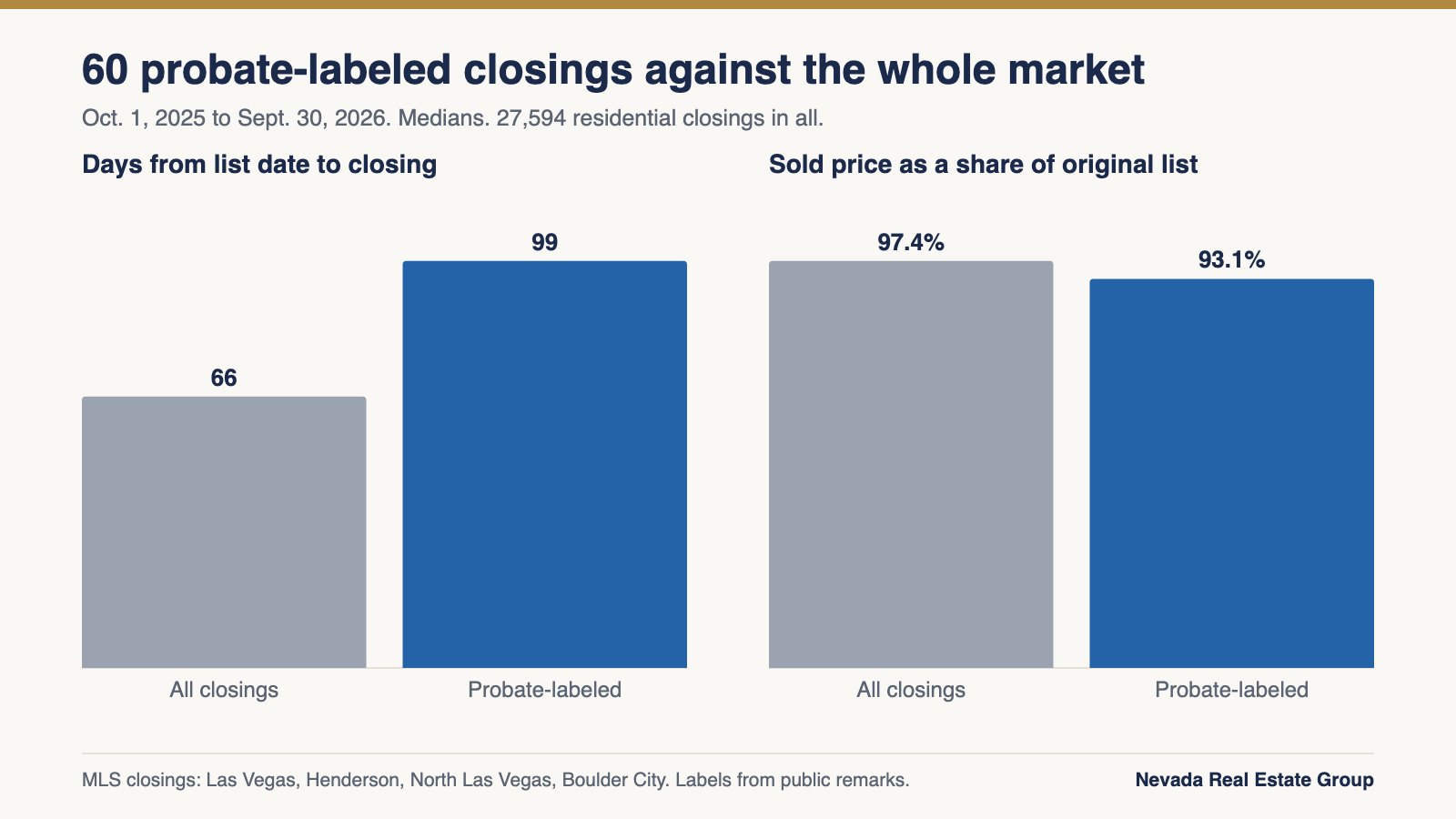
Here is what the local record shows. We read the public remarks on all 27,594 residential closings in Las Vegas, Henderson, North Las Vegas and Boulder City from October 1, 2025 to September 30, 2026, the first 12 months under Nevada's new probate limits. Sixty were labeled probate sales. Those 60 closed at a median $365,000 and 96.9% of the final list price, against $445,000 and 98.9% for all closings, and they took a median 99 days from list date to closing, against 66. The label depends on what each listing agent wrote, so the real number of probate sales is higher, and these homes differ from the market in price and condition. Treat it as a description of what happened, not a discount to expect.
Selling a house in Nevada probate starts with a court appointing a personal representative, who then sells by 15-day notice to heirs under full independent authority (NRS 143) or with court confirmation and possible overbids (NRS 148). Since October 1, 2025, estates worth up to $500,000 after liens can seek summary administration. In 60 Las Vegas-area closings labeled probate through September 2026, the median sale took 99 days from listing to closing.
- SB 404 raised summary administration to $500,000 after liens on October 1, 2025, and set-aside to $150,000.
- Nobody can sell the house for the estate until the court appoints a representative and letters issue.
- Full independent authority avoids a hearing if no heir objects and the price holds 90% of appraised value.
- At a confirmation hearing, the first overbid on a $100,000-plus sale must beat the bid by at least $5,000.
- Probate-labeled Las Vegas-area closings sold at a median 96.9% of list, against 98.9% for all sales.
Do You Even Need Probate to Sell the House in Nevada?
Start here, because the answer shapes everything — and sometimes the answer is no. Whether a Nevada estate needs probate, and which kind, depends mostly on how the home was titled and the estate's value after liens. If the house was held in a living trust, the Civil Law Self-Help Center lists trust property among assets that don't need probate, and the successor trustee can sell it directly. If it was owned in joint tenancy, it passes to the surviving owner. If it was titled with a deed upon death (NRS 111.655 to 111.699), it passes to the named beneficiary, and a Death of Grantor Affidavit must be recorded. Those new owners then sell it as their own; our Nevada title guide covers these forms in depth.
When the house was in the deceased person's name alone with no trust or deed upon death, probate is generally required, and Nevada sorts estates by value after liens. NRS 145.040 says the gross value of the estate after deducting any encumbrances, and NRS 146.070 says fair market value reduced by enforceable liens and encumbrances, measured at the date of death. So a mortgage counts down. The Civil Law Self-Help Center words it as assets minus debts and mortgages; the statutes say encumbrances, so ask counsel how an unsecured debt is treated.
| Estate value after liens | Track | What it means |
|---|---|---|
| $150,000 or less | Set-aside without administration (NRS 146.070) | Court order, with no petition until 30 days after death; with a surviving spouse or minor child, the court must set the estate aside for them, subject to limited reductions |
| Over $150,000, up to $500,000 | Summary administration (NRS 145.040) | The court may order it if advisable; creditors get 60 days instead of 90, and many regular proceedings and notices are waived |
| Over $500,000 | General administration | Full process; the Nevada court self-help page says to expect at least 120 to 180 days |
Those numbers changed on October 1, 2025, and the change is the most useful thing on this page. Senate Bill 404, approved June 5, 2025, raised the set-aside limit under NRS 146.070 from $100,000 to $150,000 and the summary-administration ceiling under NRS 145.040 from $300,000 to $500,000. NRS 145.110 requires the representative to ask the court to revoke summary administration if the estate turns out to exceed $500,000 as of the date of death.
For a house, that reset the default answer, and the test is equity rather than price. A paid-off home at the $470,000 Las Vegas REALTORS median for September 2026 now fits under the ceiling if the rest of the estate stays inside it; under the old $300,000 limit it did not. A $620,000 home carrying a $250,000 mortgage counts as $370,000. Summary administration is still discretionary: the court may order it if advisable, given the estate's nature, character and obligations. It cuts the creditor claim period from 90 days to 60 (NRS 147.040) and waives many regular proceedings and notices (NRS 145.010).
One thing to confirm rather than assume: a case opened before October 1, 2025 may still be running under the prior rules, so ask your attorney which version governs your file. Some Nevada probate guidance still circulating in 2026 quotes the superseded figures.
SB 404 changed who can be appointed, too. According to KNPR's April 10, 2025 interview with Sen. Melanie Scheible and Review-Journal reporter Eli Segall, the bill followed a Review-Journal investigation into private administrators who took over estates and sold homes to a small circle of repeat buyers. NRS 139.040 now lists family members first, then the public administrator, creditors and more distant kin, and reaches any other legally qualified person only on a finding of good cause, backed by an affidavit of due diligence to find heirs and a statement of qualifications. NRS 143.340 also limits independent authority to a representative named in the will or a spouse or relative in the first seven priority classes. If someone outside your family has petitioned to administer an estate you are an heir to, raise those sections with counsel.
What Does a Personal Representative Actually Do?
The personal representative (Nevada's term covering both an executor named in a will and an administrator appointed without one) is the person legally empowered to act for the estate — and if you are reading this, it is probably you. The role is real work, but it is a defined job, not an endless one: locate and secure the assets, notify the people and creditors entitled to notice, pay the estate's legitimate debts, sell property when needed, and distribute what remains to the heirs, with a fiduciary duty to act in the estate's best interest, never your own.
That fiduciary duty is the compass for every decision in this guide. When you sell the house, you must seek a fair price, not a quick nod to a family friend at a discount. A sale to you or your attorney, or one that indirectly benefits your relative, needs court approval even with independent authority (NRS 143.370). When you spend estate money, it must benefit the estate. Nevada law compensates you for this work: under NRS 150.020, unless the will sets compensation, the fee runs 4% of the first $15,000, 3% of the next $85,000 and 2% above $100,000, on the estate accounted for less liens. Keep receipts for anything you front, because the court approves compensation and accounts before distribution. You do not have to be a legal expert; you have to be honest, organized and willing to ask for help. Our seller resources cover the house side of that job.
Step by Step: How Does a Nevada Probate Home Sale Work?
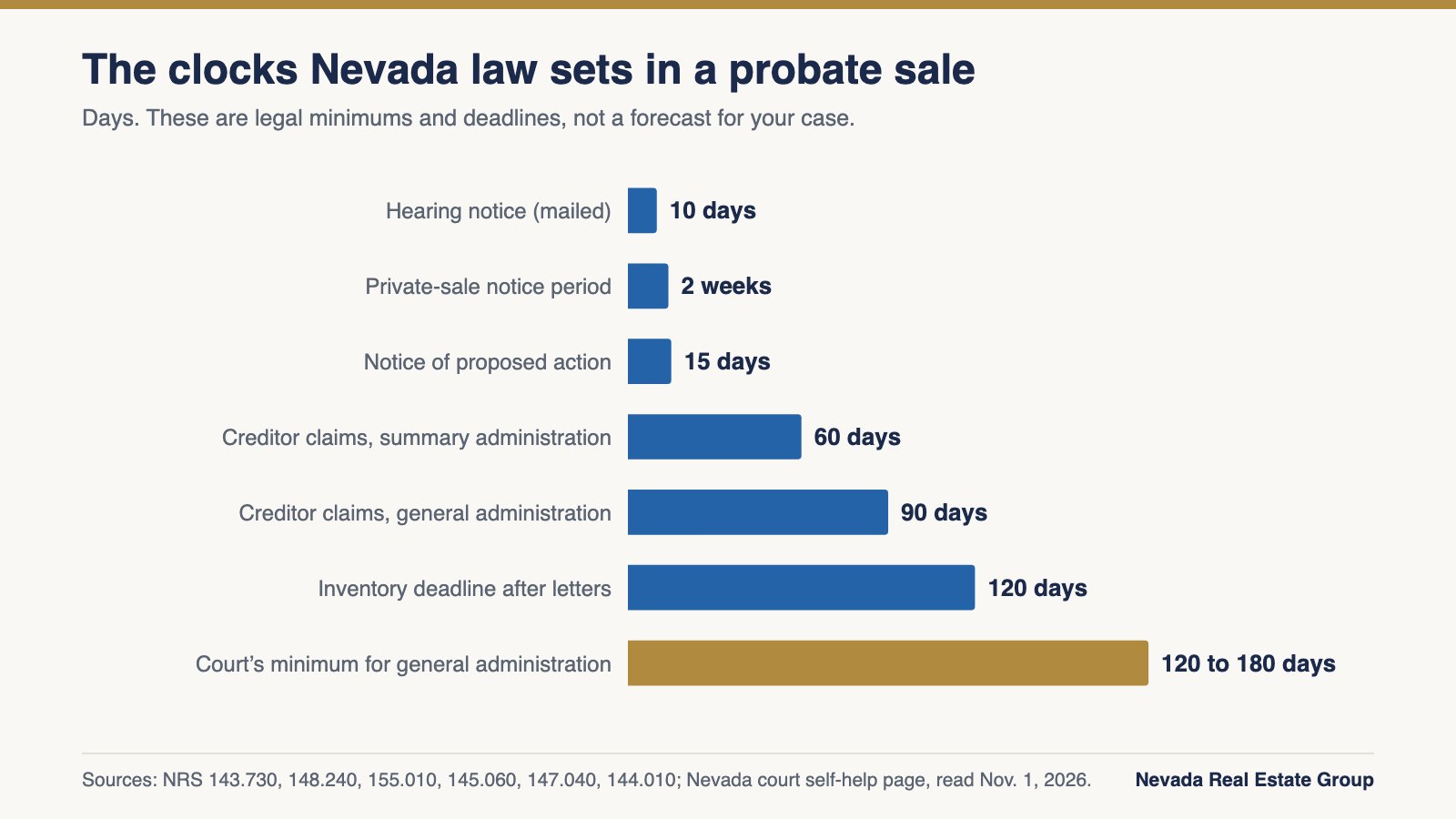
To sell an inherited house in Las Vegas, first find out how title passed, because that decides who can sign. If the home was in a trust, a deed upon death or survivorship title, the trustee or new owner sells it without a probate sale, and our inherited-house guide covers that path and remote heirs. If it was in the deceased owner's name alone, a court must act first. It usually appoints a personal representative, who then lists the home, signs the contract and signs the deed; an estate of $150,000 or less after liens can instead go by a set-aside order that names who receives the home. This table is the probate route, from filing to the final check. Times are legal clocks and court statements, not forecasts.
| Step | What happens | Clock the law or court sets |
|---|---|---|
| 1. File the petition | Petition filed in district court (Clark County in Las Vegas; Washoe in Reno) | Clark County hearings are generally set 24 to 60 days after filing |
| 2. Appointment and letters | Court appoints you; letters testamentary or of administration issue | Mailed hearing notice at least 10 days before |
| 3. Notice to creditors | Notice published and mailed; creditors file claims | 60 days in summary administration, 90 in general |
| 4. Inventory and appraisal | Estate assets listed and valued, including the home | Inventory within 120 days after letters; appraisal within 1 year before a confirmed private sale, unless waived |
| 5. Secure and prepare the home | Insurance, utilities, maintenance, light prep | Ongoing duty to preserve estate property |
| 6. List and accept an offer | Agent markets the home | Exclusive listing limited to 90 days per grant under independent authority |
| 7. Approve the sale | Notice of proposed action, or court confirmation under NRS 148 | 15 days' notice, or a petition within 30 days after the sale, notice and a hearing |
| 8. Close escrow | Representative signs the deed; a confirmed sale's order is recorded | Contract terms control |
| 9. Pay debts and distribute | Creditors paid, account approved, heirs receive their shares | Court approval required |
Two things make this list less intimidating in practice. First, you are not doing it alone — the attorney drives the court filings, the agent drives the sale, and escrow drives the closing. The Nevada court self-help page says there are no self-help forms to probate a large estate and strongly recommends an attorney. Second, several steps run in parallel: the creditor period ticks while you prepare and market the home. The broader mechanics of a Nevada sale are the same as any listing — our how to sell a house in Nevada guide covers those fundamentals — probate just adds the court's rules on top.
How Do You Get Appointed and Receive Letters?
The personal representative named in the court's letters signs for a Las Vegas home sold through probate: the listing, the purchase contract and, under NRS 148.280, the deed. Heirs do not sign unless they hold that appointment, although they may receive notice and can object. With two representatives, both generally sign unless one is absent from the state or has a legal disability or conflict; with more than two, a majority is enough (NRS 143.010). A home outside probate has a different signer: the successor trustee, the surviving owner, the deed-upon-death beneficiary or the person a set-aside order names. Your title company will confirm what it needs before closing.
Nothing can be sold until the court gives someone legal authority over the estate, so appointment is always step one. Your probate attorney files a petition with the district court: in Southern Nevada that is the Eighth Judicial District Court in Clark County, where two probate commissioners hear matters and make recommendations to the probate judge; in the Reno area it is the Second Judicial District Court in Washoe County. The petition asks the court to admit the will (if there is one) and appoint you as personal representative.
After notice to interested parties and a hearing, the court signs the order and the clerk issues your letters testamentary (with a will) or letters of administration (without one). Those letters are your proof of authority for banks, title companies and buyers. Clark County's Probate Department says hearings are generally set 24 to 60 days after filing. Order certified copies for the title company and keep them current: under NRS 143.372, a holder of estate property can refuse a certification more than 180 days old. From this moment forward you act for the estate, with the duties that come with it.
What Are the Two Ways to Sell — and Which Should You Use?
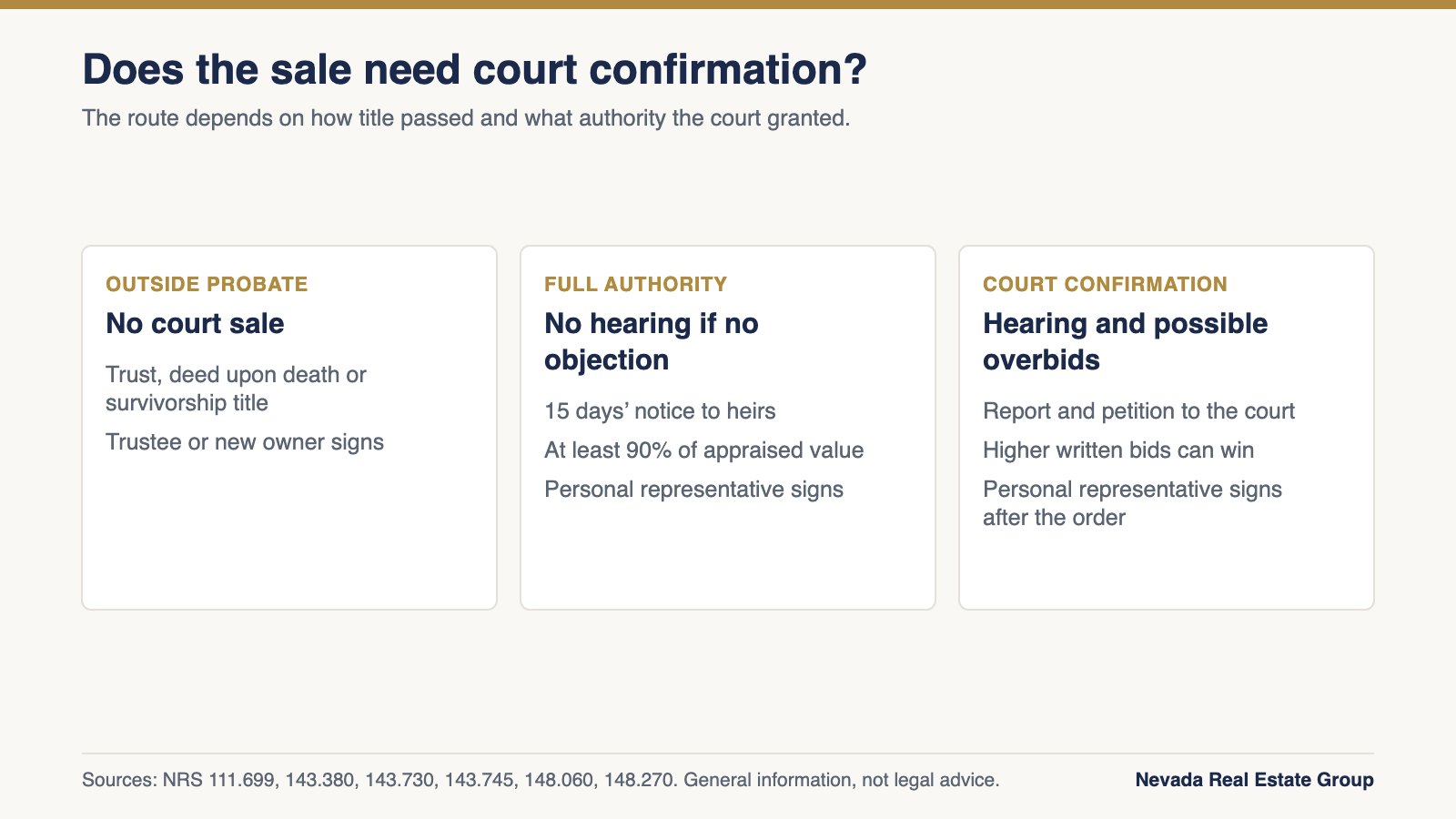
No, an inherited Nevada home sale does not always require court confirmation. Confirmation applies when a personal representative sells without full independent authority: NRS 148.060 requires those sales to be reported and confirmed before title passes, and NRS 148.080 keeps that rule even when the will gives a power of sale. It does not apply to a home that passes outside probate, or to a full-authority sale at 90% or more of appraised value with no objection (NRS 143.380).
Summary administration is the gray area. NRS 148.060 excepts it from the report-and-confirm rule, while NRS 145.070 still requires real-property sales to follow chapter 148's notice and manner, and Clark County's Probate Department says sales of real property have to be approved by the court before transfer. Ask your attorney how your case will run. In our 60 labeled closings, 35 remarks said court approval, confirmation or overbids applied, and 3 said the sale needed none.
That leaves two routes for a personal representative selling estate real property, and knowing which one you are on shapes the entire sale.
| Factor | Independent administration | Court confirmation (NRS 148) |
|---|---|---|
| Court hearing to sell? | No, unless someone objects — notice of proposed action to affected heirs and devisees | Yes — confirmed at a hearing |
| Can buyers overbid? | No | Yes — higher written offers can win |
| Minimum price | 90% of appraised value, or all interested persons consent and the court confirms | Court must find fair market value; appraisal within 1 year unless waived |
| Commission | Stated in the notice; no court approval required | Fixed by the court; capped at 7% on improved property |
| Buyer certainty | Higher — contract holds unless an objection arrives | Lower — buyer can be outbid at the hearing |
| When it applies | Court grants full authority to a representative named in the will or a relative in NRS 139.040(1)(a)-(g) | Default without full authority, or after an objection |
Independent administration, under NRS 143.300 to 143.815, is the streamlined route, but it takes full authority. Limited authority still needs court supervision to sell real estate (NRS 143.370). With full authority, you mail or deliver a notice of proposed action to affected heirs and devisees at least 15 days before the sale date, stating the price and commission (NRS 143.725 and 143.730). If no one objects, escrow closes without a hearing. If someone objects in writing, you must petition the court before going ahead (NRS 143.745). A sale under 90% of appraised value needs every interested person's written consent and court confirmation. Court confirmation under NRS 148 is the traditional route: the accepted offer is reported to the court, notice is given, and the sale is confirmed at a hearing where other buyers may bid higher. Ask your attorney at the very first meeting which authority you will have, because your agent needs to market the home accordingly and every buyer needs to know which rules apply.
What Happens at a Court Confirmation Hearing?
If your sale runs through NRS 148 confirmation, the hearing is where everything converges. After you accept an offer, your attorney files the report and petition within 30 days and notice goes out. At the hearing the court considers whether the sale is necessary or benefits the estate, whether it was fairly conducted, and whether the price is disproportionate to value. A private sale needs a finding that the sum offered represents fair market value and, unless waived, an appraisal within one year before the sale (NRS 148.260). In Clark County, the Probate Department lists a sales calendar on Wednesday and Friday mornings, treats sales hearings as presumptively in person, and marks a sale set for bidding as "Bids" on its approved list.
The part that surprises people is overbidding. Under NRS 148.270, the court confirms the sale only if it does not appear that a bid at least 5% higher (on a bid of up to $100,000) or at least $5,000 higher (on a bid of $100,000 or more) could be obtained. On a $400,000 accepted offer, a responsible written offer of $405,000 lets the court accept it, order a new sale or hold a public auction in open court. If the court accepts a higher bid, its order substitutes the new price and purchaser into the original contract, and that order is enough for escrow to close. NRS 148.120 divides the commission when a different agent's buyer wins. For the estate, overbidding is protection. For buyers it means an accepted offer is not final until the order is signed, which is why probate listings need an agent who can explain the process, and why buyers hunting probate homes should know the overbid rules too. After confirmation, the representative signs a deed that refers to the order, and a certified copy of the order is recorded (NRS 148.280).
How Long Does It Take to Sell a House Through Nevada Probate?
The honest answer: the law sets some clocks, and we found no Nevada court that publishes an average for a whole probate case or a probate home sale. We searched the Clark County Probate Department, Clerk and Civil Law Self-Help Center pages and Washoe's probate statistics page on November 1, 2026. The one published average we found covers only the first step, and only in Washoe County: the Second Judicial District Court's December 2025 status report, the newest on its page, puts the 2025 average from filing the initial petition to ruling on it at about 42 days for general administration and 43 for summary administration. The closest statewide statement is the Nevada court self-help page, which says to expect a minimum of 120 to 180 days for general administration. Our own MLS count shows what the sale stage looked like in practice:
| Measure | Probate-labeled | All closings |
|---|---|---|
| Closings | 60 | 27,594 |
| Sold price | $365,000 | $445,000 |
| Sold price against final list | 96.9% | 98.9% |
| Sold price against original list | 93.1% | 97.4% |
| List date to closing | 99 days | 66 days |
| Contract to closing, closings from March 2026 | 51.5 days (36 homes) | 30 days (17,419 homes) |
Part of that gap is mix, so here is a closer match: among single-family homes that sold for $250,000 to $500,000, the 36 labeled probate took 91 days from list date to closing and sold at 98.3% of final list, against 60 days and 100.0% for all 11,520. The 20 sales with court language and a usable contract date took a median 59 days from contract to closing. Remarks undercount probate sales, and 60 homes is a small sample, so use these as planning context.
What stretches cases is everything around the sale: waiting for letters, the creditor period, court calendars and family disagreement, which can add a long delay when heirs contest the will or the sale. The practical advice is simple: file promptly, ask about full independent authority, keep heirs informed so nobody feels blindsided, and let the professionals run their lanes in parallel. Every month the estate carries the home costs it taxes, insurance and upkeep.
What Does Probate Cost — and Who Pays It?
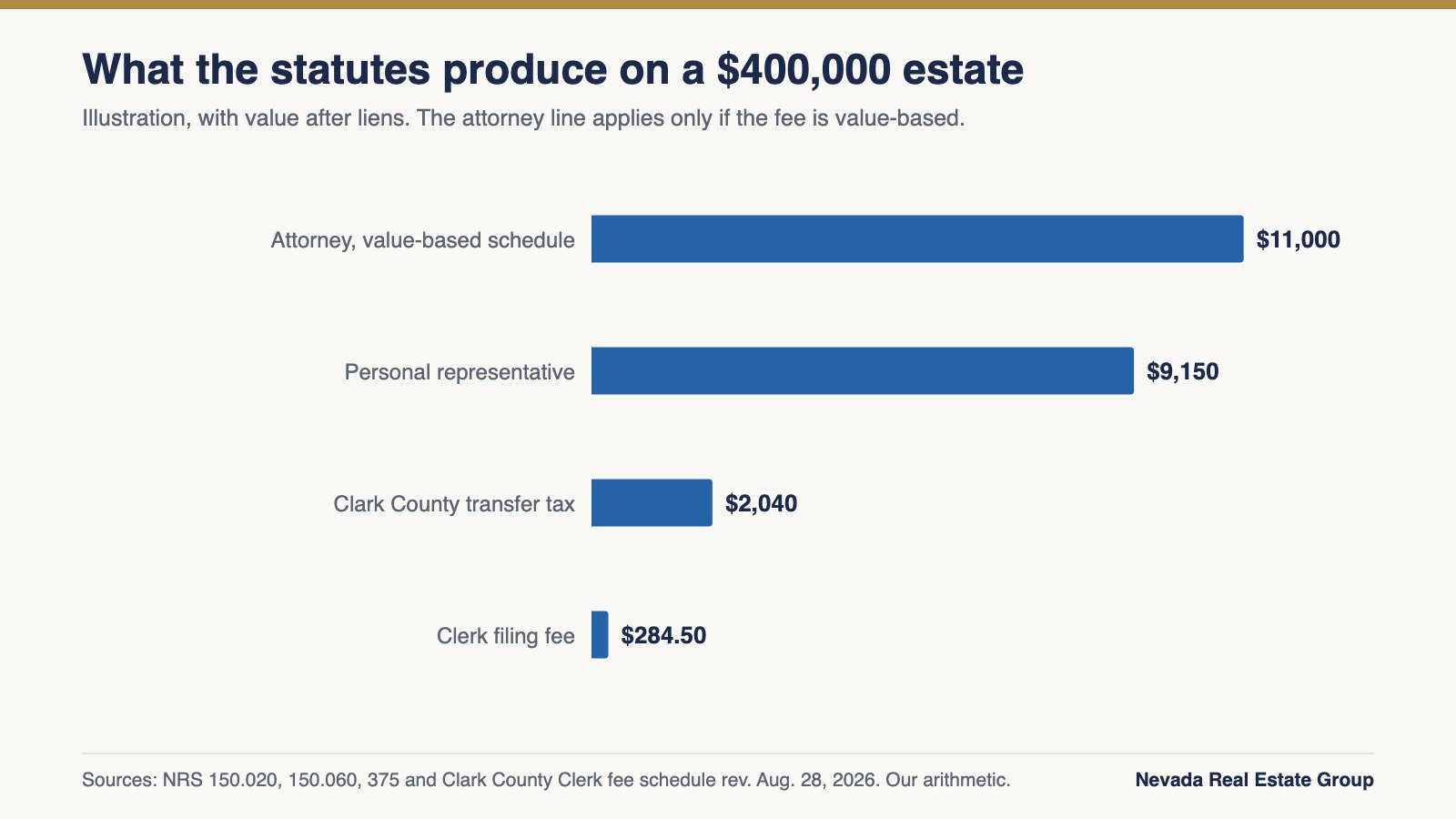
Here is the reassurance families need most: in the normal case, the estate pays, not you. Probate costs come out of estate assets, usually funded by the house sale itself, and the court approves fees and accounts before distribution. These are the figures set by statute or the Clerk's schedule. Everything else needs a written quote.
| Cost | Published figure | On a $400,000 estate or sale |
|---|---|---|
| Clark County petition filing fee | $284.50 for a stated value of $20,000 up to $500,000; $537.50 above | $284.50 |
| Personal representative (NRS 150.020) | 4% of first $15,000, 3% of next $85,000, 2% above $100,000 | $9,150 |
| Attorney, if value-based (NRS 150.060) | 4% of first $100,000, 3% of next $100,000, 2% of next $800,000 | $11,000 |
| Commission in a court-confirmed sale (NRS 148.110) | Fixed by the court; maximum 7% on improved property, 10% on unimproved | Negotiate it; no set rate |
| Clark County transfer tax | $2.55 per $500 | $2,040 |
Sources: the Clerk's fee schedule, revised August 28, 2026, NRS 150, NRS 148 and the Nevada Department of Taxation. The attorney line applies only to a value-based agreement; NRS 150.060 also allows hourly compensation, and the fee arrangement must be in writing and approved by the court. Transfer tax is a joint liability of buyer and seller, and a contract can assign it (NRS 375.030). The four dollar amounts total $22,474.50 on this illustration, before any commission, title and escrow charges, appraisal, publication or repairs. Those vary by provider and property, so get written quotes.
Listing commissions are not set by law. The NAR settlement changes that took effect August 17, 2024 ended compensation offers on the MLS, and they did not set a rate; the fee is negotiable, and it must fit the cap above when a court fixes it.
How Should You Prepare and Price a Probate Home?
While the legal machinery runs, the house itself needs stewardship. First, protect the asset: NRS 143.020 requires a reasonable effort to preserve estate property. Keep insurance in force and tell the insurer the home is vacant, then ask what that changes. Keep utilities on, maintain the yard and secure the property.
Second, prepare deliberately. Of our 60 labeled closings, 15 remarks said as-is, against 390 of all 27,594. Remarks can't show how much a clean-out adds, so we won't give you a percentage. Get quotes, ask your agent for comparable sales in similar condition, and spend estate money only where that evidence supports it. Paperwork can differ too: NRS 113.130 exempts a fiduciary, including a personal representative who takes temporary control solely to facilitate the sale, from the seller disclosure form. Your agent still has to disclose known material facts under NRS 645.252.
Third, price from the appraisal and real comps, not sentiment. The sale needs that fair-value support, and independent authority has the 90% floor. As of November 1, 2026, 10 active listings in Las Vegas, Henderson, North Las Vegas and Boulder City carried probate language in public remarks, at a median list price of $447,250, so buyers see few of them. Comparable homes in Las Vegas, Henderson, North Las Vegas or Reno are in the full statewide search.
What Are the Tax Consequences of a Probate Sale?
Here is genuinely good news inside a hard season. According to IRS Publication 551, inherited property generally takes a basis equal to its fair market value at the date of death, or the alternate valuation date if the representative elects it. If your mother bought the house for $120,000 decades ago and it was worth $450,000 when she passed, the basis is $450,000, and selling near that value produces little or no capital gain. When the estate sells, IRS Publication 559 treats gain or loss on a home held for sale as capital and long-term, and the estate files Form 1041 if its gross income reaches $600.
Nevada adds nothing on top. The Nevada Constitution bars an inheritance tax and a personal income tax, and the Nevada Department of Taxation says no estate tax filing is required for deaths on or after January 1, 2005. The IRS puts the federal estate tax filing threshold at $15,000,000 for 2026 deaths. The estate may still owe ordinary costs: prorated property taxes through closing and the real property transfer tax on the sale. If the home is held for years after death and appreciates, gain builds above that basis; our inherited-house guide covers that timing. No CPA reviewed this guide, so have one confirm the specifics.
What Mistakes Cost Estates the Most Money?
These errors are avoidable, and each one maps to a rule above. Selling before you have authority tops the list: a contract signed before letters issue, or outside your granted powers, can unwind. Letting the house sit unprotected invites loss. Underselling to "just be done", often to an off-market cash buyer at a steep discount, can breach your duty to the heirs, and a full-authority sale under 90% of appraised value needs everyone's written consent and the court. Skipping heir communication breeds the objections that send a sale to a hearing. Using an agent who has never done a probate sale risks missed notice periods and confused buyers. And paying estate expenses carelessly from personal funds without documentation makes reimbursement harder. The pattern behind all six: probate punishes improvisation and rewards process.
How Do You Choose the Right Team for a Probate Sale?
Three professionals carry a probate sale. The probate attorney drives the court process — hire one who practices probate regularly in your county, ask whether your case qualifies for summary or independent administration, and get the fee structure in writing. The real estate agent must actually know probate: how letters work, what a notice of proposed action is, how to explain an NRS 148 confirmation listing, and how to keep a buyer informed through a hearing where they might be overbid. Ask any agent directly: how many probate or estate sales have you closed, and how does confirmation work? A blank look is your answer. The escrow/title officer closes on certified letters and court orders — our Nevada escrow guide explains that final leg.
The team also has to work together: the agent times the listing to the attorney's authority, the attorney calendars the confirmation to the escrow timeline, and everyone keeps you, the decision-maker, informed in plain English. On our side, that means running the sale lane and coordinating with your attorney, from Las Vegas to Sparks and Carson City. Review any listing agreement with your attorney first, because an exclusive listing under independent authority is limited to 90 days at a time (NRS 143.540). Our seller programs explain the rest.
Why Work With Nevada Real Estate Group on a Probate Sale?
Because a probate sale is two jobs at once — a real estate sale and a court process. Nevada Real Estate Group is the #1 real estate team in Nevada by RealTrends Verified, with 9,600+ closed transactions statewide. We coordinate with your probate attorney, market the home for fair value, explain confirmation and overbidding to buyers, and communicate with the family in plain language at every step. This is not just a transaction; it is the last piece of business you are doing for someone you loved, and it should be done right.
If you have been named to handle an estate — or you expect to be — call our Las Vegas team at (702) 637-1759 or our Northern Nevada team at (775) 277-2120, or contact us here for a no-pressure conversation. We will explain where the house fits in the process, show you comparable sales, and coordinate with your attorney so the sale supports the estate instead of complicating it.
Frequently Asked Questions
How long does it take to sell a house in probate in Nevada?
We found no Nevada court average for a whole case; Washoe County's 2025 figure of about 42 days for general administration covers only petition to first ruling. The fixed clocks are 60 days for creditor claims in summary administration, 90 days in general administration, and 15 days' notice for a full-authority sale. The state court self-help page says to expect at least 120 to 180 days for general administration. In 60 Las Vegas-area closings labeled probate through September 2026, the median home took 99 days from list date to closing, against 66 for all sales.
Can you sell a house before probate is complete in Nevada?
Yes — the sale does not wait for the whole case to finish. Once the court appoints you and issues letters, the home can be listed and sold during the administration, by notice of proposed action under full independent authority or by court confirmation under NRS 148. What you cannot do is sell before you are appointed. The proceeds go to the estate and are distributed when the court approves.
What is a court confirmation hearing and what is overbidding?
When a probate sale requires confirmation under NRS 148, the accepted offer is reported to the court, which reviews the price and process. A responsible bidder can offer at least 5% more on a bid of up to $100,000, or at least $5,000 more on a bid of $100,000 or more. The court may accept that offer, order a new sale or hold a public auction in open court. For buyers, a probate offer is not final until the confirmation order is signed.
Do all heirs have to agree to sell the house?
Not necessarily. The personal representative, not the heirs collectively, holds the authority to sell. Under full independent authority, affected heirs and devisees get at least 15 days' notice and can object in writing; an objection sends the sale to court. In a confirmation case, an interested person can file objections and be heard. Keeping heirs informed early heads off many objections.
Who pays the costs of probate — and what do they total?
In the normal case the estate pays, not you personally. Clark County's petition fee is $284.50 for a stated value of $20,000 up to $500,000. The representative's statutory fee is $9,150 on a $400,000 estate, and a value-based attorney fee is $11,000 on the same amount, though attorneys may also bill hourly. Commission, title, appraisal, publication and repairs need written quotes. Court approval applies to representative and attorney compensation.
Do you pay capital gains tax when selling a house in probate?
Usually little or none. According to IRS Publication 551, inherited property generally takes a basis equal to its fair market value at death, so selling near that value produces minimal taxable gain. Nevada has no inheritance tax or personal income tax, and requires no estate tax filing for deaths since January 1, 2005. The estate still pays prorated property taxes and any agreed transfer tax at closing. Have a CPA confirm your numbers.
Can I sell a Nevada probate house as-is, or should the estate fix it up?
Many do: 15 of our 60 labeled closings said as-is in their remarks. Light work such as a clean-out and minor repairs can make sense, but the MLS can't show what it adds, so get quotes and ask for comparable sales in similar condition first. A personal representative who takes temporary control solely to facilitate the sale is exempt from the seller disclosure form under NRS 113.130, though your agent must still disclose known material facts.
Which Sources Inform This Nevada Probate Sale Guide?
Market figures come from our November 1, 2026 read of the Repliers MLS feed for Las Vegas, Henderson, North Las Vegas and Boulder City: 27,594 residential closings by closing date from October 1, 2025 to September 30, 2026, plus active listings that day. We read each closing's public remarks for the word probate and excluded two that said no probate was needed. Contract dates come from the MLS sold-date field, used only for closings from March 2026 on. Statutes were read on the Nevada Legislature's site the same day. This is general information, not legal or tax advice; no attorney or CPA reviewed it, so retain a Nevada probate attorney and CPA for your case.
- Nevada Revised Statutes Chapter 148 — Sales of Estate Property — court confirmation, commissions and overbid rules
- Nevada Revised Statutes Chapter 143 — Powers and Duties of Personal Representatives — independent administration and notice of proposed action
- Nevada Revised Statutes Chapter 145 — Summary Administration — the $500,000 limit after encumbrances
- Nevada Revised Statutes Chapter 146 — Estates Not Exceeding Certain Amounts — the $150,000 set-aside
- Nevada Revised Statutes Chapter 147 and Chapter 155 — creditor claims and notices
- Nevada Revised Statutes Chapter 139 — priority for appointment
- Nevada Revised Statutes Chapter 150 — Compensation and Accounting — representative and attorney fees
- Statutes of Nevada 2025, Chapter 339 (SB 404) and the bill's NELIS page — the threshold increases
- KNPR State of Nevada, April 10, 2025 — background on the bill
- Clark County Probate Department and Clerk's fee schedule, revised August 28, 2026
- Nevada court self-help, large estates and Civil Law Self-Help Center, administration of estates
- Second Judicial District Court, Probate Case Status Report, December 2025 — Washoe County time from petition to first ruling
- IRS Publication 551, IRS Publication 559 and IRS estate tax page
- Nevada Department of Taxation estate tax FAQ, transfer tax page and Nevada Constitution
- Las Vegas REALTORS September 2026 statistics, as published by FOX5
- NAR settlement FAQ