

Aging in place makes sense when your Reno or Sparks home can support your daily routine, maintenance, and help needs at a manageable cost. Downsizing deserves a closer look when the layout, location, or upkeep remains difficult even after realistic improvements. Compare 3 options—stay, modify, and move—using actual quotes, a five-year budget, and a plan for transportation and support.
- A smaller house does not automatically mean a smaller monthly bill.
- Test the entire daily route, including the garage, bathroom, and laundry.
- Include snow, yard work, transportation, and paid help in both budgets.
- Confirm what an HOA handles before treating maintenance as solved.
- Make the decision around your preferences and needs, with qualified help where appropriate.
You can love your home and still question whether it fits the next stage of life. A familiar kitchen, nearby friends, and an established routine have real value. So do a manageable yard, fewer stairs, and a location that keeps the places you use within reach. The decision is personal; a birthday or an empty bedroom does not settle it.
This Reno–Sparks guide helps you compare the choices before committing to a renovation or a sale. It is a housing planning worksheet, not an assessment of anyone's health or ability to live independently. Cost examples are deliberately illustrative, not contractor bids or forecasts of local home values. Resource links were reviewed September 24, 2026; confirm availability and eligibility directly.
How Do You Decide Whether to Stay, Modify, or Move?
Start with the problem you want to solve. “The house is too much” can mean too many rooms to clean, a steep driveway, an upstairs bedroom, isolation, or an expensive roof. Those problems lead to different answers. Write each concern in plain language and mark whether it is a building issue, a location issue, a service need, or a preference. Remodeling can address some building issues. It cannot move a neighborhood closer to the people you see every week.
According to the National Institute on Aging, planning ahead for aging at home includes thinking about future assistance and available support. Use that principle before comparing listings. Ask what already works, what is difficult today, and what would make the home harder to use if circumstances changed. Include the homeowner's priorities directly rather than letting family members assume them.
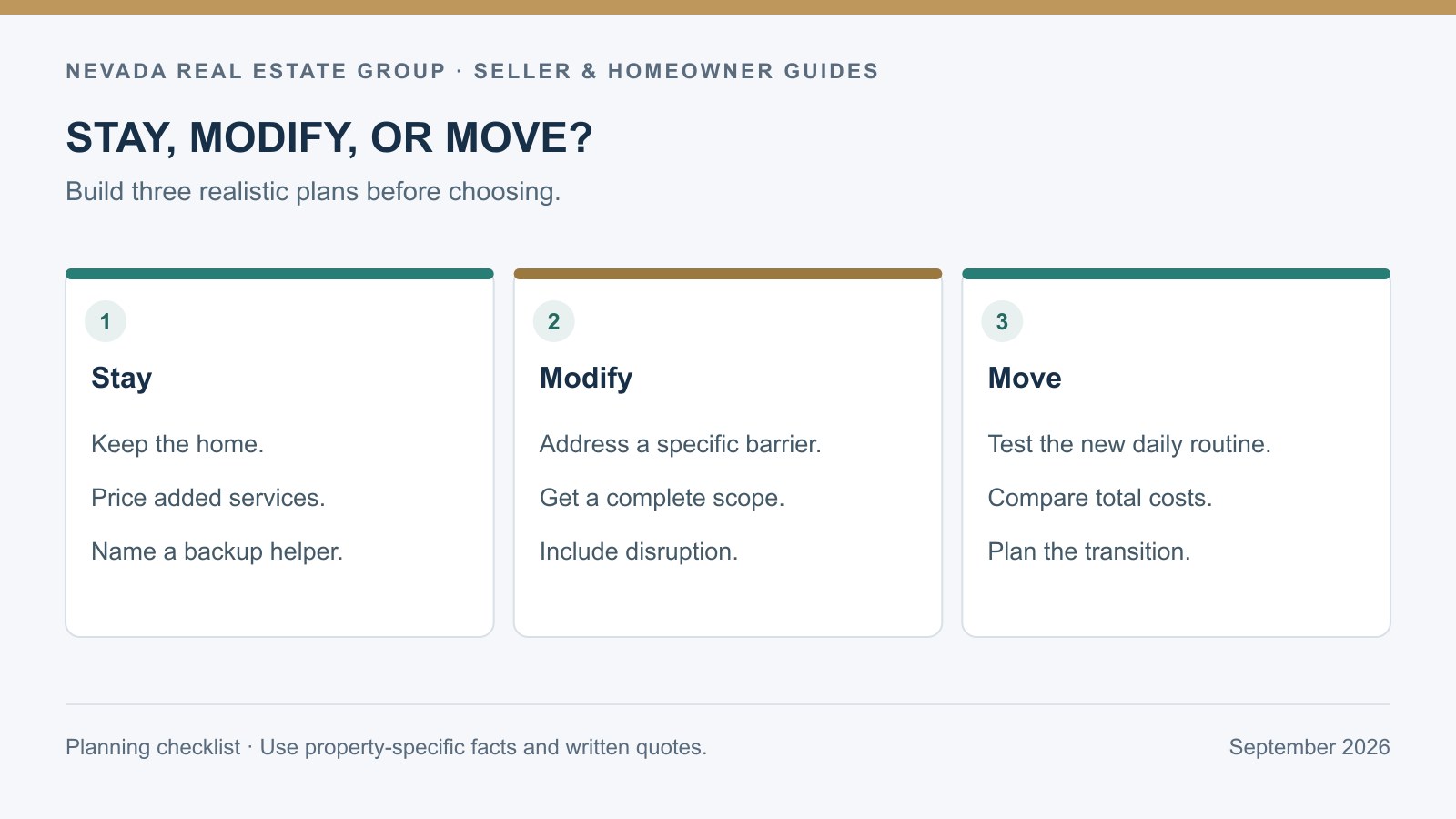
Give each option a realistic description. Staying may include hiring a cleaner or arranging rides. Modifying may include a bathroom project and a temporary living arrangement during construction. Moving may mean a smaller detached home, an accessible condominium, a rental, or housing with services. “Stay for free” versus “buy an expensive house” is not a fair comparison if staying requires significant work.
Then identify the decision that cannot wait. An immediate safety or care concern belongs with an appropriate professional now, even if the real estate decision takes months. For the remaining concerns, set a review date and gather evidence. A written choice with a few open questions is more useful than repeatedly browsing homes without agreed criteria.
What Should You Check Along Your Everyday Route Through the Home?
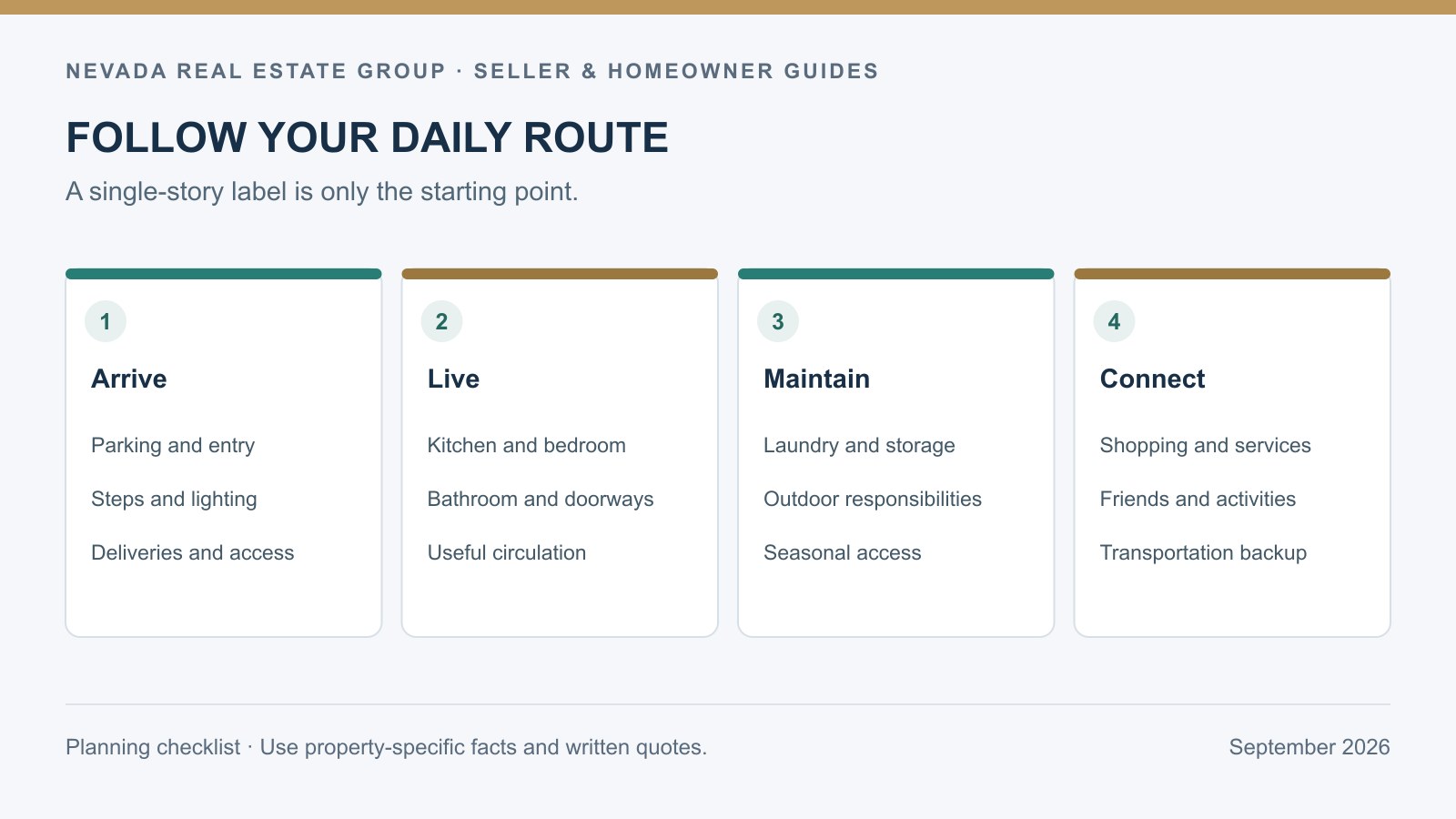
Walk the route you actually use: parking to entry, entry to kitchen, bedroom to bathroom, and laundry to storage. Do this with normal lighting and the furniture in its usual position. A listing described as single-story can still have entry steps, a sunken room, a high shower threshold, or an awkward garage transition. A bedroom on the main floor helps only if the rest of the routine is workable.
Record the obstacles without deciding immediately how to fix them. Note narrow passages, heavy doors, hard-to-reach storage, slippery surfaces, poor lighting, and places where carrying something makes movement difficult. If mobility equipment is relevant, bring its actual dimensions to a qualified home assessment. Do not assume that a photograph or a generic doorway measurement proves accessibility for a particular person.
Consider the whole household. One person may handle stairs comfortably while another would benefit from avoiding them. Pets, visitors, a caregiver, and the possibility of a temporary recovery period can change how rooms need to function. A home office might be a future bedroom, but only if access, privacy, bathroom use, and any necessary work make that conversion practical.
Use the same checklist when touring alternatives in Reno and Sparks. A move should solve the problems that prompted it. Write the measurements and unanswered questions next to each address; memory tends to preserve the attractive kitchen and forget the difficult entrance. Ask an occupational therapist or another suitably qualified professional to assess personal accessibility needs, and a licensed contractor to evaluate proposed building changes. Their roles complement the real estate comparison.
Which Home Modifications Deserve a Quote Before You List?
Quote the smallest complete project that addresses the actual barrier. Better lighting, usable hardware, professionally installed supports, an improved entry, or a bathroom modification may be worth evaluating before a larger renovation. Do not choose a project solely because a product is marketed for older adults. The installation, underlying structure, household needs, and ability to use the space afterward matter more than the label.
According to the Nevada State Contractors Board, consumers should obtain at least three written bids before hiring a contractor. Make those bids comparable by providing the same scope. Ask what demolition, structural work, plumbing, electrical work, finishes, permits, cleanup, and final inspection are included. A cheap fixture price says little about the installed cost of a functioning room.
According to the City of Reno's building permit guidance, permit applications and status tracking use the regional permitting system. Confirm the correct jurisdiction for your address; Reno, Sparks, and unincorporated Washoe County are not interchangeable. Ask the appropriate department and contractor which approvals your specific project requires. HOA approval, where applicable, is a separate check.
Finally, price the disruption. Will the only bathroom be unavailable? Is there somewhere comfortable to stay? Who will coordinate deliveries and inspect the finished work? A modification that looks economical on paper may be burdensome if it requires a long displacement. Conversely, a focused project that preserves an established support network may be more useful than moving to a smaller house with a similar obstacle. Compare the completed outcome, not just the construction invoice.
How Do Snow, Outdoor Work, and Seasonal Maintenance Change the Choice?
Maintenance is a combination of money, physical effort, scheduling, and responsibility. In Reno and Sparks, compare the actual property rather than assuming every valley address has the same seasonal demands. Driveway slope, shade, exposure, landscaping, and the route between parking and the front door can matter as much as interior square footage. A smaller home with a demanding exterior may not reduce the work you want to avoid.
List a normal year's tasks: filters, gutters, irrigation checks, yard cleanup, pest service, roof attention, exterior repairs, and any snow or ice removal. Put the person or company responsible next to each one. If the answer is “my son usually handles it,” discuss whether that is a dependable arrangement or an occasional favor. If you plan to hire help, obtain actual service terms and ask about backup coverage.
For a condominium or an HOA community, request the governing documents and a written explanation of maintenance boundaries. Common-area service does not necessarily include the private driveway, entry steps, roof, windows, patio, or landscaping beside your unit. Ask who handles urgent problems, what owners must arrange themselves, and how the association funds larger repairs. Dues buy the services stated in the documents, not every service you might expect.
If a property is attractive in summer, examine the winter routine before deciding. Ask where snow is stored, who clears the pedestrian route, and how deliveries reach the door. When an in-person seasonal visit is impossible, request relevant records and specific answers rather than relying on reassurance. A manageable home is one whose difficult days you can plan for, not merely one that is easy to enjoy during a sunny tour.
How Do You Compare the Cost of Staying With the Cost of Moving?
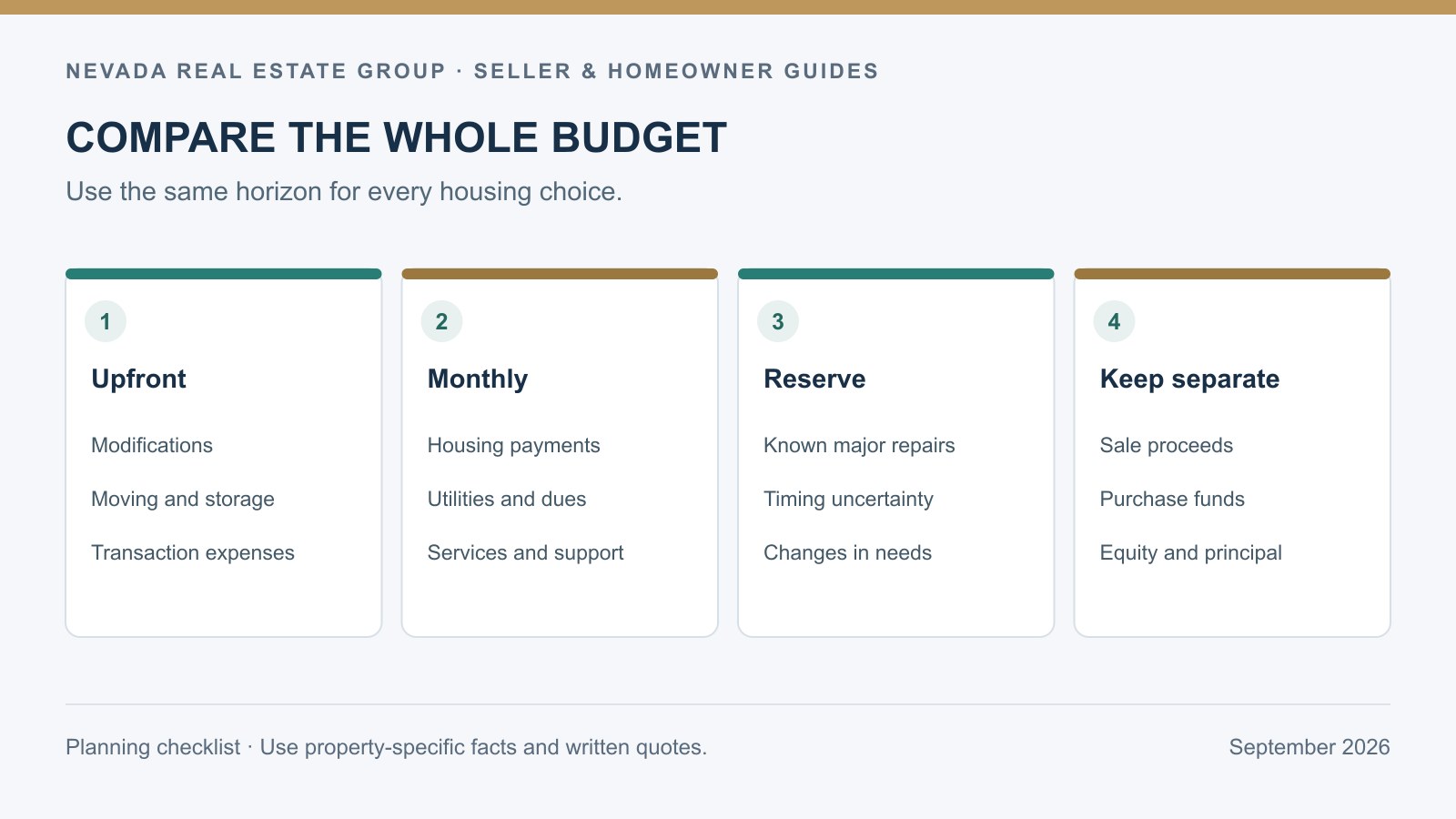
Use the same time horizon and the same categories for both choices. Five years is a useful worksheet period, not a prediction of how long anyone will stay. Show upfront costs separately from monthly spending. Then keep an additional line for major known repairs and help needs. Avoid treating principal payments, interest, sale proceeds, and ongoing expenses as if they were identical types of cost.
The table below uses invented round numbers to demonstrate the arithmetic. It is not a Reno quote, property valuation, or estimate of care costs. Replace every number with your own evidence. It assumes the monthly totals have already been calculated consistently for each option; it does not assume equal equity, appreciation, financing, or investment returns.
| Option | Upfront expense | Monthly outlay | 60-month calculation |
|---|---|---|---|
| Stay with added services | $3,000 | $2,000 | $123,000 |
| Modify the current home | $30,000 | $1,800 | $138,000 |
| Move to a different home | $20,000 | $1,600 | $116,000 |
That example shows why a large one-time bill and a smaller monthly bill must be considered together. It does not show which option is best. Add purchase funds and sale proceeds as a separate cash-and-equity analysis, then ask a financial or tax professional about consequences specific to your situation. Include temporary housing, storage, repairs needed to sell, moving labor, and the costs of selling and buying. Do not use a generic commission percentage as a fixed fee; compensation and other transaction expenses need actual quotes and agreements.
Run a second version with one inconvenient event: a delayed sale, a major repair, or higher ongoing service costs. If an option works only under the most favorable assumptions, it needs more reserve or a different plan.
Why Might a Smaller Reno Home Still Cost More Each Month?
The purchase price and room count do not determine the full monthly bill. Financing terms, insurance, taxes, association dues, utilities, and services can offset savings from less space. Use the mortgage calculator for the financing portion, then add the other expenses separately. Someone moving from a long-owned house into a newer condominium may gain convenience while spending more each month. That can still be a reasonable choice, but it should be a deliberate trade.
According to the Washoe County Assessor's tax-cap guidance, qualifying owner-occupied primary residences can receive a 3% cap on increases in the property-tax bill, subject to the program's rules and exceptions. That is not a 3% property-tax rate, and it does not tell you the bill for a home you might buy. Check the parcel's current records, ownership-use requirements, and any relevant changes with the assessor rather than copying the tax amount from your present home.
Request an insurance quote for the exact address and intended occupancy. For a condominium, ask what the association's policy covers and what coverage you need separately. Read the dues schedule, reserve information, and disclosed assessments. A lower mortgage payment will not feel like a saving if an expected association expense was omitted from the comparison.
Compare the services you will actually buy. If you value yard care, exterior maintenance, or shared amenities, assign those benefits a realistic household value. If you will rarely use them, do not treat their presence as automatic savings. Build a monthly total from documented bills and quotes, then keep a separate reserve for irregular expenses. The objective is a home whose cost and responsibilities you understand before signing, whether it is smaller, newer, rented, or simply easier to use.
How Important Are Transportation and Nearby Support?
Location remains important even when commuting no longer drives the search. Write down the destinations you use repeatedly: grocery store, pharmacy, medical offices, friends, family, classes, worship, recreation, or volunteering. Check the actual journey from each candidate address. A short distance on a map can still involve a difficult crossing, an inconvenient transfer, or a route you do not enjoy using.
According to RTC Washoe, RTC ACCESS is a prescheduled paratransit service for people who meet ADA eligibility criteria, with trips limited to its service area. Age alone does not establish eligibility. Before relying on it, confirm the application process and whether both the home and your destinations qualify. Ask about other transportation options if a route falls outside those boundaries.
According to Washoe County Senior Services, the county offers support programs and connections for older adults and caregivers, including nutrition and homemaker resources. Contact the program directly about eligibility, availability, and how services are arranged. Listing a resource in a plan does not mean that service has been approved or will be available immediately.
For informal support, discuss specifics. “We are nearby” is different from “we can drive on Tuesday mornings and have a backup for cancellations.” Ask the homeowner which relationships and activities they most want to preserve. Moving closer to one family member while leaving all existing social connections may solve one problem and create another. A strong plan describes both the normal week and what happens when a driver, helper, or household member is unavailable. Transportation and support should influence the shortlist before an attractive property becomes the default choice.
Is a 55-Plus Community the Same as Housing With Care?
No. Age-restricted ownership housing, independent living, assisted living, and other care arrangements are different choices with different contracts and services. A community can have activities and attractive shared spaces without providing help with medication, bathing, meals, or overnight needs. Ask for the actual service agreement rather than interpreting a brochure or the term “active adult” as a care commitment.
According to HUD's senior housing resources, older adults can explore different housing options and obtain help from a HUD-approved housing counselor. For a particular 55-plus community, confirm occupancy rules, guest policies, age verification, and any exceptions with the association or operator. Do not assume every resident must be the same age or that the rules match the community next door.
According to Medicare's long-term-care coverage guidance, Medicare generally does not pay for long-term custodial care. Do not build a housing budget around an assumption that routine ongoing assistance will be covered. Ask the appropriate benefits professional about your circumstances and distinguish any eligible skilled services from ordinary long-term help.
The Reno 55-plus housing directory provides a starting point for comparing locations. If an age-restricted community fits your preferences, our Reno and Sparks 55-plus community comparison can help organize the property search. Use it after clarifying the type of housing you need. Tour both the home and the facilities you would actually use, review the documents, and verify service availability. The correct question is not whether the community looks appealing to someone of a certain age. It is whether the property, rules, cost, and services fit the people who will live there.
What Should Your Side-by-Side Decision Worksheet Include?
A useful worksheet makes tradeoffs visible without pretending that every preference can be reduced to a score. Start with non-negotiable needs, then list preferences that can be traded against cost. A necessary entry arrangement should not lose to a scenic view simply because you gave both categories equal points. Likewise, staying close to a trusted support network can reasonably outweigh an extra bedroom or a newer kitchen.
| Question | Evidence to collect | Decision note |
|---|---|---|
| Can daily activities work here? | Route assessment and relevant measurements | Works now, needs changes, or unresolved |
| Who handles maintenance? | Service quotes and HOA responsibilities | Name the responsible party and backup |
| Can regular trips continue? | Tested routes and confirmed transport eligibility | Check important destinations individually |
| What is the full cost? | Upfront expenses, monthly bills, reserves | Compare the same time horizon |
| What makes the plan change? | Household priorities and professional input | Set a review date and decision triggers |
Add an “unknown” column. This prevents an assumption from quietly becoming a fact. An unquoted bathroom project, an unread HOA document, and an untested bus route should remain open items until someone checks them. Assign each item to a person and agree on a reasonable completion date. Keep the list short enough to use during a conversation.
Then ask each household member to explain the choice in one sentence. Differences often reveal the real issue: one person wants less maintenance, while another wants more nearby company. Those goals may be compatible, but they require a different search than “find a smaller house.” Revisit the worksheet after each serious tour or quote rather than changing priorities to fit whichever home you saw most recently.
Should You Sell First, Buy First, or Try Renting?
The sequence depends on available cash, financing, the amount of preparation your current home needs, and your tolerance for temporary housing. Selling first can clarify the proceeds available for the next step, but it can require a rental and more than one move. Buying first can simplify the physical transition while creating overlapping payments and a need to qualify for financing. Neither sequence is automatically safer for every household.
Our buyer resources outline the purchase side. Before choosing, ask your lender to evaluate the actual purchase plan and your listing agent to prepare a sale-proceeds estimate. Have the title or escrow team identify relevant closing expenses and timing. A contingent offer, negotiated possession arrangement, or temporary rental can sometimes help, but availability and terms depend on the transaction. Do not assume a seller will accept a particular arrangement.
Renting can be a way to test a different location or home format before another purchase. Check lease length, accessibility, pets, parking, storage, and the possibility of rent increases or another move. The trial works best when you define what you are trying to learn. For example, does a smaller layout feel manageable after several weeks, and do the intended transportation and social routines actually happen?
Our Reno home-selling process and costs guide covers the sale side in more detail. Keep your transition plan separate from the asking-price decision: needing a certain amount for the next home does not establish the current home's market value. Build a fallback that works if either transaction takes longer than hoped. A calm sequence is often worth more to the household than squeezing both closings into a fragile schedule.
How Can You Reduce Belongings Without Rushing the Housing Decision?
Start with the rooms and possessions you use, not an arbitrary percentage of things to discard. Measure essential furniture and identify items that support daily life. A smaller home can work beautifully if it accommodates those needs. It can feel restrictive if the move plan assumes every meaningful activity will disappear along with spare furniture. Keep space for hobbies, visiting people, and the routines that make a home comfortable.
Separate four categories: keep and use, offer to a named person, sell or donate, and decide later. Set limits on the last category so it does not become an indefinite storage bill. Ask recipients before reserving large items for them. A dining table that someone “might want someday” needs an actual decision date, collection arrangement, and backup destination before moving day.
For valuable objects, records, or emotionally difficult decisions, work in manageable sessions and use appropriate professional help when needed. Compare service scopes for organizers, movers, estate-sale providers, and storage companies. Ask who packs, transports, insures, removes packaging, and places furniture at the destination. Do not assume one quote includes the whole transition.
If you plan to sell while still living in the home, our Reno staging budget guide helps separate useful rearrangement from optional furniture rental. An inventory can also improve the property search. If a hobby requires a dedicated work area or family visits require a comfortable guest arrangement, state that before touring. The goal is a manageable home, not the smallest possible floor plan. Plan the first night after the move as carefully as the moving truck: accessible essentials, working utilities, necessary equipment, and a clear route through the rooms. A thoughtful move preserves independence and familiarity while reducing the responsibilities you chose to leave behind.
What Can You Do Over the Next 30 to 90 Days?
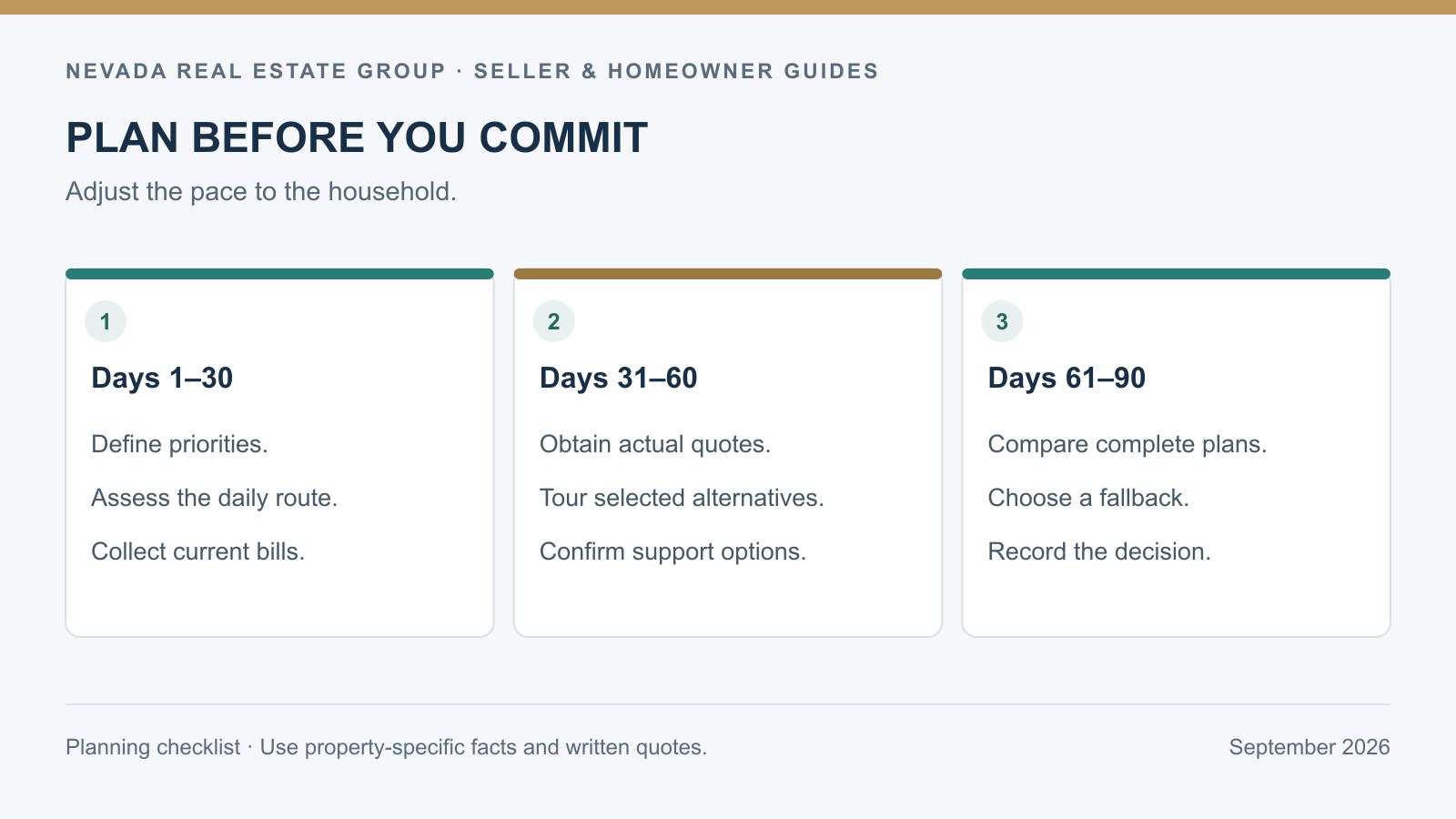
Use a staged plan with decision points. In the first month, define the concerns, complete the daily-route check, gather current bills, and identify any immediate issue that needs qualified attention. During the next phase, request modification and service quotes, inspect a small number of housing alternatives, and confirm transportation and support options. Only then compare the complete plans and decide whether to proceed, revise, or postpone.
| Phase | Work to complete | Useful result |
|---|---|---|
| Days 1–30 | Priorities, route assessment, bills, urgent needs | A short list of problems to solve |
| Days 31–60 | Quotes, selected tours, service and transport checks | Comparable stay, modify, and move plans |
| Days 61–90 | Budget review, sequencing, family discussion | A documented choice and fallback |
If you choose to stay, keep the worksheet and schedule another review. The decision can be correct now without being permanent. Identify what would prompt a new conversation, such as a recurring access problem, unavailable assistance, a repair beyond the planned reserve, or a change in personal preference. Avoid using a single arbitrary age as the trigger.
If you choose to move, turn the completed worksheet into the property-search criteria. Nevada Real Estate Group can help compare Reno homes and Sparks homes and organize the sale and purchase questions. Call (775) 277-2120 or contact us with the layout, location, and maintenance priorities you have identified. The real estate work should follow that plan, while qualified health, legal, and financial professionals address questions in their respective fields.
Frequently Asked Questions
Is downsizing always less expensive than aging in place in Reno?
No. A smaller property can carry higher financing costs, insurance, taxes, or association dues. Compare the upfront transition expenses, ongoing monthly total, and repair reserves with the cost of maintaining or modifying your present home. Keep sale proceeds and equity separate from expense calculations. Obtain actual quotes before assuming the move creates savings.
Does a single-story home mean it is accessible?
No. Check entry steps, the garage transition, bathroom arrangement, doorways, laundry, and the routes between essential rooms. Suitability depends on the person and any equipment they use. An appropriate professional assessment can identify changes that a listing description or photograph cannot establish. Apply the same checklist to the home you own and the homes you tour.
Should I remodel my bathroom before deciding whether to move?
Get a complete scope and quote first. Include permits where required, construction disruption, and temporary arrangements if the bathroom cannot be used. Compare the finished result with realistic housing alternatives. A focused modification can make staying practical, but it will not resolve a location or support problem that exists outside the home.
Can every older adult use RTC ACCESS in Reno and Sparks?
No. RTC ACCESS has ADA eligibility requirements and a defined service area. Confirm both eligibility and the proposed trip locations directly with RTC Washoe before making it part of your housing plan. If it does not fit, investigate other transportation options rather than assuming age alone qualifies you for the service.
Does Medicare pay for ongoing help at home?
Medicare generally does not pay for long-term custodial care. Some skilled services may be covered under separate requirements, but that is different from assuming routine ongoing assistance is paid for. Ask a benefits professional about your situation and budget for support using confirmed coverage and actual service availability.
Is a 55-plus community the right choice for everyone who is downsizing?
No. It is one housing option. Compare the home's layout, community rules, dues, transportation, and available services with other ownership or rental choices. Age-restricted housing does not automatically provide personal care. The best fit depends on the household's preferences and requirements, not simply eligibility to live there.
What should I bring to a downsizing consultation?
Bring your priority list, a rough monthly budget, known repair needs, essential furniture measurements, preferred destinations, and your desired timing. You do not need to have made the decision to sell. Those details help distinguish a property problem that could be fixed from a reason to change location or housing type.
Which Sources Inform This Reno and Sparks Housing Guide?
Resources reviewed September 24, 2026. Public programs, eligibility, and costs should be confirmed directly. The comparison worksheets and invented cost scenario are editorial planning tools, not reported market statistics.
- National Institute on Aging: aging in place
- Washoe County Senior Services
- RTC Washoe: ACCESS eligibility and service area
- Washoe County Assessor: tax-cap and abatement information
- Medicare: long-term-care coverage
- HUD: information for senior citizens
- Nevada State Contractors Board: working with contractors
- City of Reno: building permits
Chris Nevada · Nevada Real Estate License S.181401 · Nevada Real Estate Group · LPT Realty · (775) 277-2120.