

A seller’s mortgage can be part of a home-buying opportunity, but its interest rate is only the beginning of the comparison. You need the remaining balance and term, the buyer’s required cash, every additional loan payment and a written explanation of what happens to the seller’s liability. A home that fits those numbers still needs to fit the buyer’s location and condition requirements.
This guide uses the named public program rules and transparent calculations, reviewed November 1, 2026. Start with the Nevada VA guide or Nevada FHA guide for broader financing questions; here the decision is whether taking over a particular existing loan works for both parties.
Yes, if the loan allows it and you pass the review. As of November 2026, all FHA-insured loans are assumable with the servicer's approval, VA loans can be assumed by qualified buyers, USDA guaranteed loans need Agency approval, and ordinary fixed-rate conventional loans generally can't be assumed. You still fund the gap: an invented $450,000 home with a $300,000 balance leaves $150,000 before costs.
- Use the existing loan's remaining term; an assumption doesn't automatically start a new 30-year schedule.
- Price minus assumed balance is the equity gap, and closing costs and reserves come on top.
- A 10% second loan shrinks our invented example's monthly edge over a 7.24% loan to $228.75.
- VA release of liability and restoration of entitlement are separate outcomes, so get each in writing.
- FHA processing fees can reach $1,800 and VA's $300, before other allowed charges and any funding fee.
What does assuming a mortgage actually transfer?
An assumption concerns the debt obligation associated with a property. It is different from a new mortgage that pays off the seller’s loan, and different from an informal agreement to send payments while the seller stays responsible. According to Fannie Mae’s assumption definition, the security instrument determines assumability and the seller remains liable unless the lender or servicer releases that obligation. Government programs have their own procedures, discussed below.
Request a current statement and the relevant note, security instrument and modification documents through an authorized process. Identify the unpaid principal balance, interest rate, maturity date, scheduled principal and interest, mortgage-insurance charge and escrow amount. A payment displayed on a statement may combine categories that change after a sale. Any deferred balance, partial claim or second lien needs a separate entry; it may not appear in the headline principal balance.
For a fixed-rate loan whose terms remain unchanged, the remaining amortization schedule is central to the comparison. A mortgage originated years ago does not ordinarily regain those elapsed years merely because someone else takes it over. If a program allows changed terms, get the approved terms in writing and calculate them explicitly. Do not describe a possible modification as an existing contractual benefit.
The property transaction also needs its own agreement, title review and settlement instructions. Transferring a deed does not by itself establish that a servicer approved a new borrower or released the seller. Use the Nevada escrow guide to organize the closing milestones. The decision should rest on the actual loan file and accepted contract, rather than the assumption that “government-backed” resolves every remaining question.
Which loan types can be assumed, and where are the exceptions?
Yes, you can assume a seller's mortgage on a Las Vegas home if the loan is assumable and you clear the servicer's review. HUD Handbook 4000.1 says all FHA-insured mortgages are assumable, VA says qualified buyers can assume its loans, and USDA guaranteed loans need Agency approval. Ordinary fixed-rate conventional loans generally have due-on-sale clauses, though Fannie Mae's transfer requirements allow most adjustable-rate loans and some much older ones, with credit and mortgage-insurer conditions. These are federal program and investor rules, so they work the same way in Las Vegas as elsewhere.
They are also a small part of the market. Of 12,624 active-status residential listings in Las Vegas, Henderson, North Las Vegas and Boulder City on November 1, 2026, our read of public MLS remarks found 215, or 1.7%, advertising an assumable loan. Of those, 99 named VA and 45 named FHA, and 168 stated a rate, with a median of about 3.8% and a range from about 2.2% to 6.6%. Those are sellers' claims in listing remarks, not verified loan terms, and a listing that doesn't mention one may still have an assumable loan.
| Loan category | First question | Important distinction |
|---|---|---|
| VA | Who processes approval, and is entitlement substitution requested? | Qualified non-veterans may assume; release and entitlement are separate |
| FHA | What underwriting, occupancy and release requirements apply? | Assumable; current handbook specifies manual review and a formal seller-release document |
| USDA guaranteed | Which transfer provision and Agency approval apply? | Regulation includes continuing transferor liability and program conditions |
| Conventional | Does the instrument and investor permit this particular transfer? | Specific loan and protected-transfer exceptions exist |
USDA direct and guaranteed loans are different programs. A rural location or a familiar agency acronym is not enough to identify the correct rule. Likewise, a protected transfer involving a family member or inheritance should not be presented as the same process as an unrelated buyer’s negotiated purchase. The purpose and structure of the transfer matter.
Ask the servicer to identify the investor or guarantor, applicable assumption route, required documents and approval authority. Keep the answer with the property file. If the listing agent has only the seller’s recollection, treat assumability as unresolved. A useful initial screening result is a written list of what is confirmed and what is missing, followed by a comparison with other homes the buyer could realistically finance.
Why does the remaining term change the payment comparison?
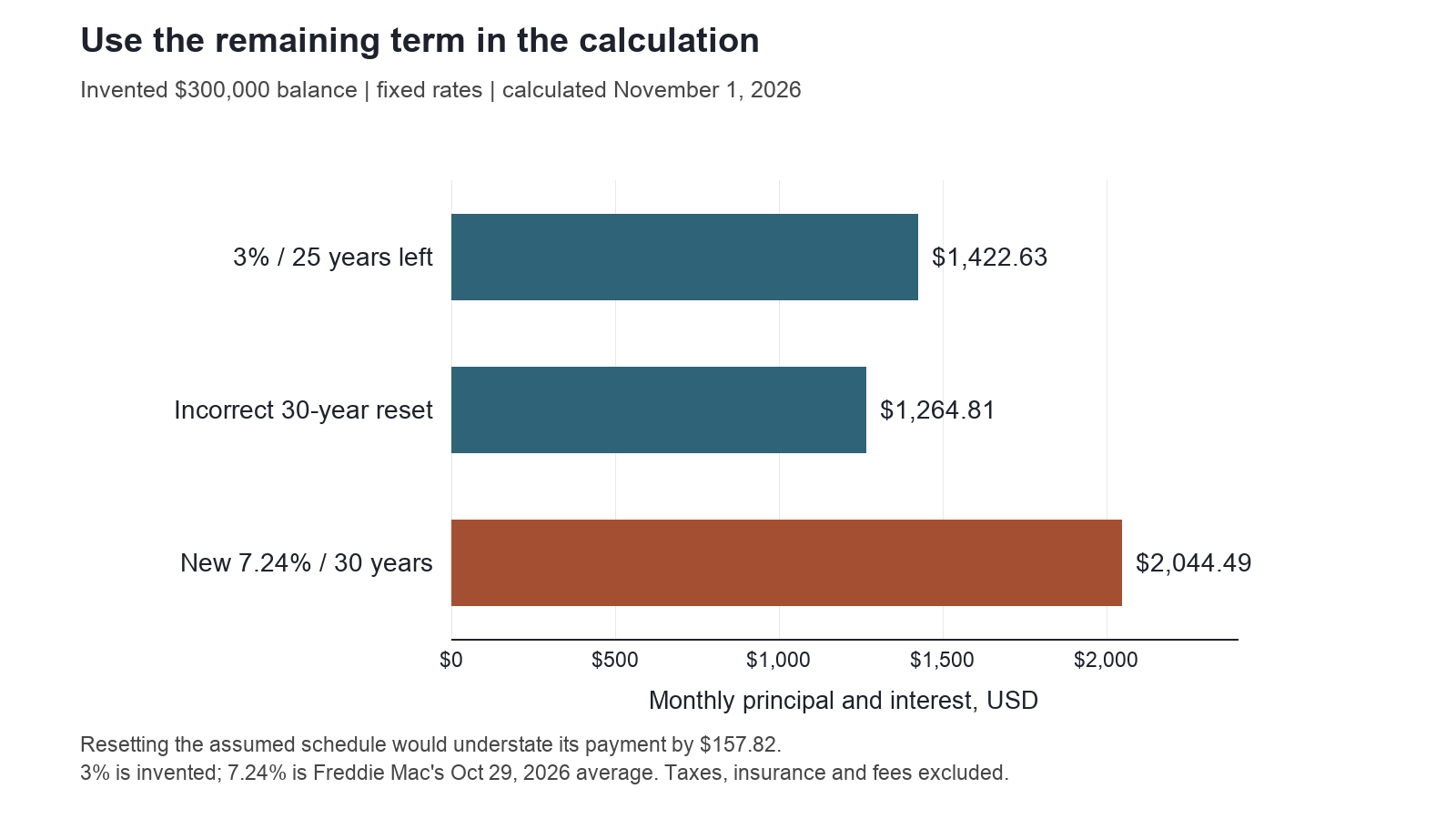
The same balance and rate can produce different payments when the repayment period changes. An invented example uses a $300,000 fixed-rate balance at 3% with 25 years remaining. Its level principal-and-interest payment is approximately $1,422.63 per month. Calculating that same balance over a fresh 30 years instead produces $1,264.81, which understates the assumed payment by about $157.82. Neither figure includes taxes, insurance or other ownership costs.
For comparison, a new $300,000 loan at 7.24%, Freddie Mac's October 29, 2026 average, over 30 years produces approximately $2,044.49 principal and interest. The difference from the 25-year assumed loan is $621.86 per month before other costs. The 3% rate and the balances are invented, and 7.24% is a national average rather than a quote, so neither figure is a claim that a particular borrower can obtain that loan. The shorter remaining term also changes how quickly principal is repaid.
| Scenario | Rate and remaining schedule | Monthly principal and interest |
|---|---|---|
| Illustrated assumption | 3%; 25 years | $1,422.63 |
| Incorrect automatic reset | 3%; newly assumed 30 years | $1,264.81 — not the stated loan’s schedule |
| Illustrated new loan | 7.24%; 30 years | $2,044.49 |
Use the servicer’s actual amortization schedule when assessing a real file, especially after modifications, principal curtailments or payment changes. For an adjustable-rate loan, include the next reset date and applicable index, margin and caps. A low initial payment does not describe all future payments. Our mortgage glossary explains the vocabulary to check; the figures for your decision must come from the actual offer and documents.
How much cash does the equity gap require?
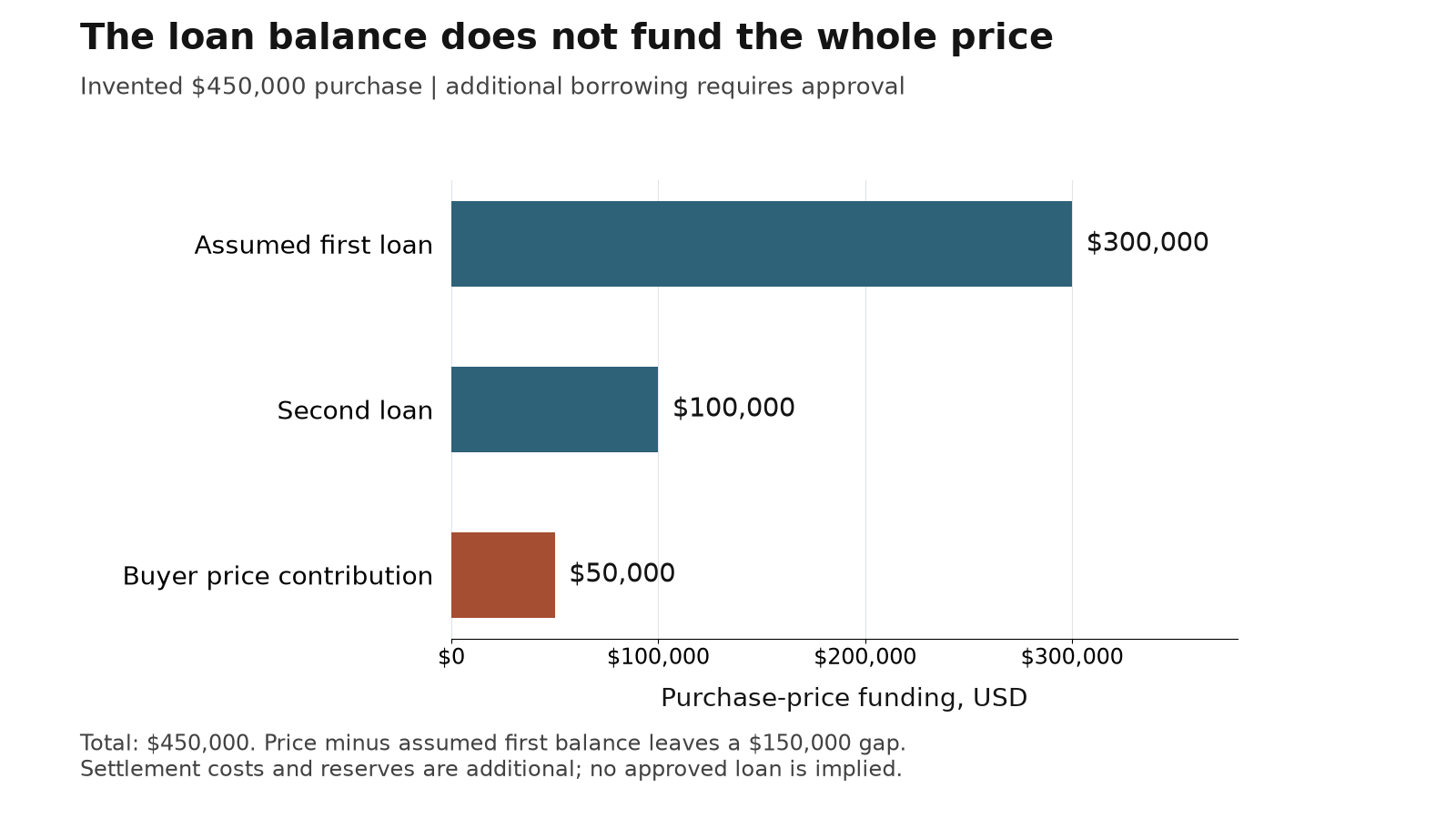
The equity gap begins with purchase price minus the principal balance being assumed. An invented $450,000 price and $300,000 assumed balance leave $150,000 to fund before closing charges and adjustments. That number does not tell you what the seller will net after paying other obligations, and it does not equal the buyer’s final cash to close. Keep those separate reconciliations visible.
With no approved additional borrowing, the buyer must have a plan for the full price difference. If the household also assumes $6,000 of settlement costs and wants $15,000 retained after closing, the selected cash-availability target is $171,000: $150,000 + $6,000 + $15,000. The $6,000 is an invented allowance, not a Nevada fee average. A previously delivered deposit would reduce the additional cash still due, rather than being charged again.
If a second loan is approved, it can change both cash requirements and monthly obligations. In a separate illustration, $300,000 of assumed first-mortgage debt, $100,000 of second-mortgage debt and $50,000 of buyer purchase-price cash total the same $450,000 price. Costs and reserves remain outside that sum. A smaller initial cash requirement therefore comes with another financing decision; it is not free equity.
Ask escrow to identify all liens, seller payoffs, prorations and buyer credits. Ask the lender to identify allowed funds and documentation. Do not count the same gift, deposit or account balance twice, and do not assume a down-payment-assistance program permits this transaction without specific confirmation. The earnest-money guide helps distinguish a deposit from the complete cash plan. A workable assumption needs funds available at the right time as well as an attractive monthly payment.
How can a second loan change an apparently large saving?
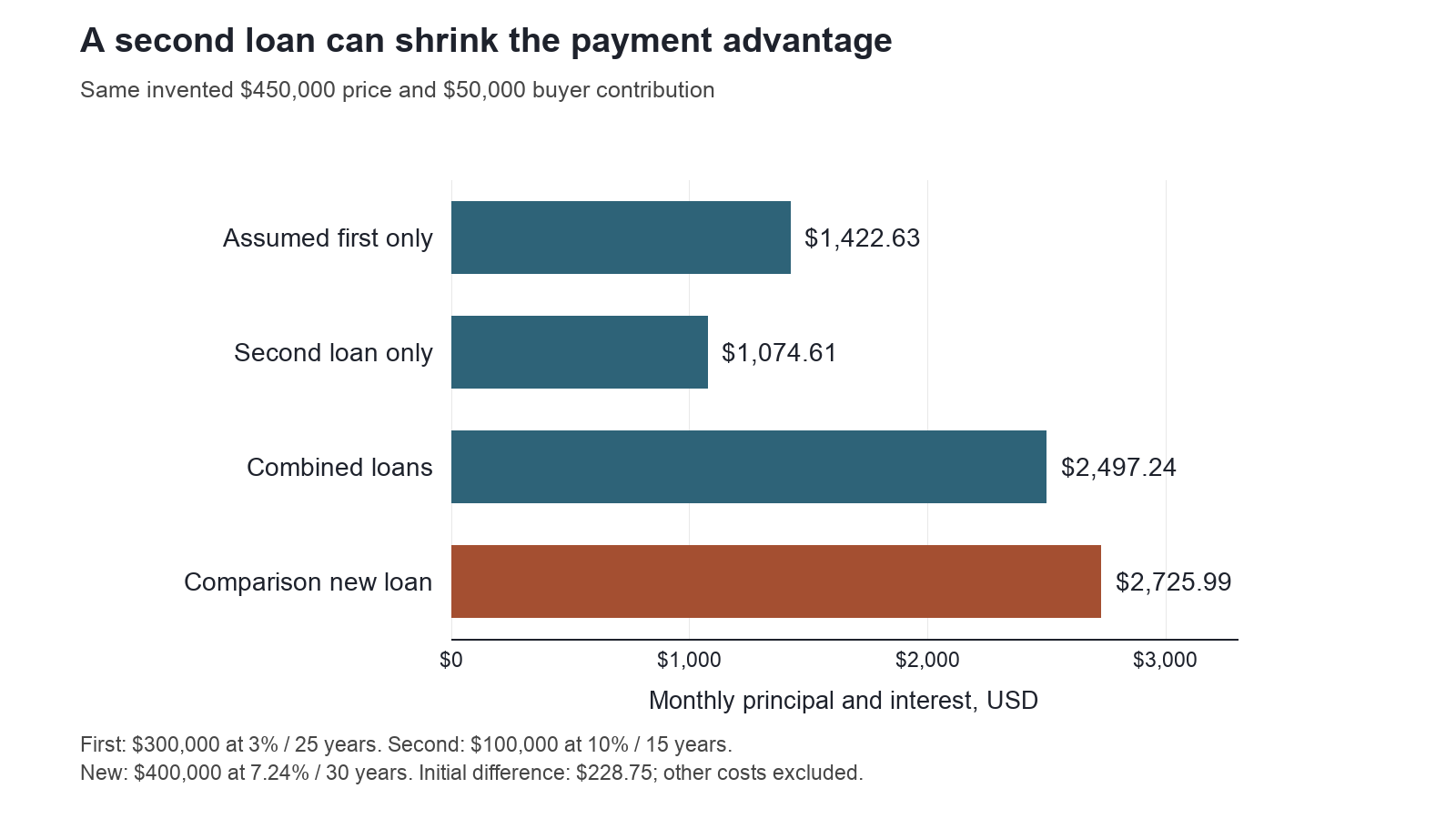
Compare combined payments with the same purchase price and buyer cash contribution. Otherwise, an assumption with substantial cash can appear cheaper simply because the buyer borrows less. An invented example keeps the $450,000 price and $50,000 purchase-price cash contribution constant. One option uses the $300,000 first loan at 3% with 25 years remaining and a $100,000 second loan at 10% over 15 years. The other uses a new $400,000 loan at 7.24% over 30 years.
The assumed first loan costs $1,422.63 in monthly principal and interest. The second costs $1,074.61, for approximately $2,497.24 combined. The new loan costs $2,725.99. The initial difference is $228.75 per month before fees, insurance, taxes and other costs, far less than the $621.86 gap on the $300,000 alone. The first mortgage’s low rate has not disappeared, but it does not describe the total borrowing arrangement.
The repayment schedules also differ. The second loan ends after 15 years if paid as scheduled; the assumed first ends after 25; the new loan lasts 30. Do not multiply the initial monthly difference by 30 years and call that lifetime savings. Compare balances, interest, fees and likely payoff dates over the household’s chosen horizon. If the buyer expects to sell, the remaining debt at that point matters alongside monthly cash flow.
A balance-weighted average of the two note rates cannot substitute for the combined payment or an APR comparison. Different terms, fees, variable rates or balloon payments can change the result substantially. Ask for a complete repayment schedule for each debt. When comparing Las Vegas homes with Reno options, use property-specific costs too; equal loan amounts do not make two homes equally expensive to own.
What does VA require when an assumption includes secondary borrowing?
According to VA Circular 26-24-17, secondary borrowing is not generally prohibited in a VA assumption, but the holder must preserve the VA loan’s first-lien position and document the additional loan and repayment terms. The second payment must be considered in underwriting. The circular also addresses permitted uses, no cash back to the assumer, grace periods and the effect of a non-assumable second loan on a later sale. It does not promise that a particular second lender will approve the buyer.
Obtain both lenders’ written requirements before treating the funding plan as complete. Identify who reviews subordination and title priority, which costs the proceeds may cover and whether the transaction can close under the proposed sequence. A seller-financed note also requires review; calling it a carryback does not make it exempt from the first loan’s rules or applicable law. A Nevada attorney can help evaluate the proposed documents and obligations.
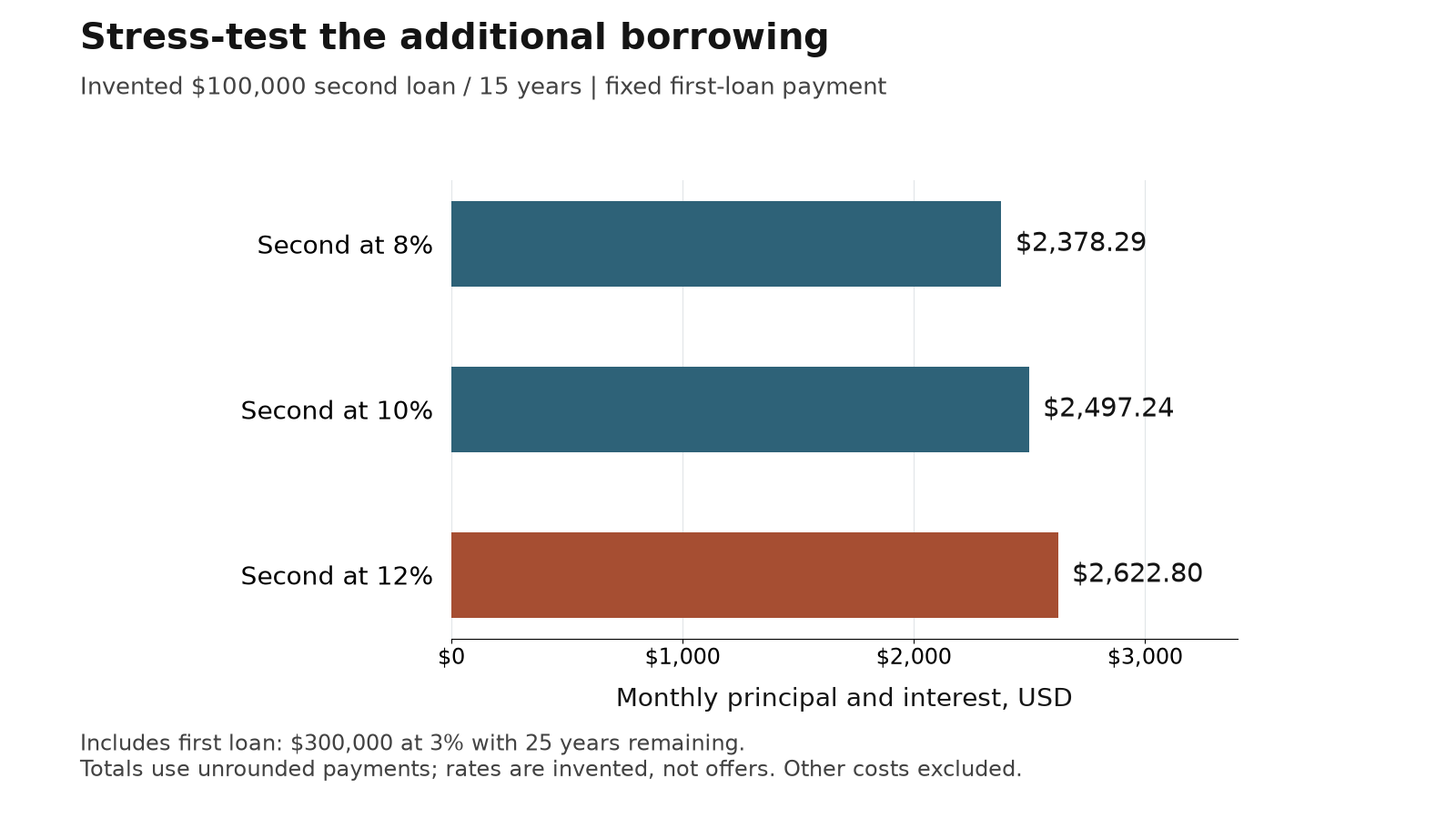
Stress-test the second-loan payment rather than relying on one preliminary quote. On an invented $100,000 balance over 15 years, fixed rates of 8%, 10% and 12% produce approximately $955.65, $1,074.61 and $1,200.17 in monthly principal and interest. Added to the illustrated $1,422.63 first payment, the totals are $2,378.29, $2,497.24 and $2,622.80, against $2,725.99 on the new loan. These are teaching scenarios, not offered rates.
For a variable-rate line, ask about the draw period, repayment period, payment changes and maximum exposure. Preserve household reserves after all required cash is committed. A lender’s qualifying decision and a household’s comfort with changing payments are related but different judgments. The point of the stress test is to reveal when the combined arrangement stops fitting, before an accepted contract makes a funding shortfall urgent.
How do VA approval, seller release and entitlement differ?
A qualified non-veteran can assume a VA loan; military service is not universally required for the assuming buyer. According to VA Circular 26-23-10, the assumption review addresses creditworthiness, a current loan and the assumer’s obligation to purchase and accept liability. The process can occur with or without substitution of entitlement. An eligible veteran assumer with sufficient entitlement who intends to occupy may agree to substitute it, allowing restoration for the seller.
Without substitution, the original veteran’s entitlement remains encumbered until the loan is paid in full. That is distinct from a documented release of personal liability. Do not describe a release as automatically restoring entitlement, or assume the seller can never use any remaining benefit. The seller needs an assessment of available entitlement and the planned next purchase, rather than a conclusion based solely on the buyer’s veteran status.
According to VA Circular 26-24-9, holders are expected to provide the selling veteran with Form 26-10291, Assumption Entitlement Acknowledgement, after receiving the application and obtain the signature no later than closing. Use that discussion to identify the actual consequence for the seller. A signature acknowledging risk is not itself a substitution of entitlement.
Before agreeing, ask for separate written answers: who will be liable after closing, what release document will be issued, whether substitution is approved, and what evidence confirms restoration. A veteran seller moving to Henderson or Sparks may be coordinating another financed purchase, so the sequence matters. Keep the next lender informed through authorized document sharing. Neither party should rely on the informal assurance that the other person “will take over everything.”
What should buyers check on an FHA assumption?
According to HUD Handbook 4000.1, sections II.A.8.n and III.A.3.b, FHA assumptions require the applicable underwriting and occupancy review. For mortgages closed on or after December 15, 1989, the stated occupancy categories are a principal residence or a HUD-approved secondary residence. The handbook specifies manual underwriting by the responsible Direct Endorsement underwriter rather than using the TOTAL Mortgage Scorecard for an assumption. Older loans and protected transfers can involve different provisions.
The existing balance, rate and mortgage-insurance arrangements must be verified from the actual file. Ask for the insurance charge and its applicable duration, rather than substituting rules for a newly originated loan. Confirm whether a modification or other servicing arrangement changed the schedule. A seller’s remembered original payment may no longer describe the obligation being transferred.
HUD’s assumption provisions do not impose a new minimum cash investment simply for assuming the outstanding principal balance. That does not eliminate the purchase-price gap, costs or the need to document permitted funds. A buyer can therefore encounter a substantial cash requirement even though the program’s assumption rule does not require a fresh percentage down payment on that balance.
The handbook identifies Form HUD-92210.1, Approval of Purchaser and Release of Seller, for the formal release. Merely notifying HUD of a borrower change is not that release. It also requires attention to a partial claim when ownership changes, including an official payoff letter. Ask the servicer and closing professional to identify any such obligation early. The first-time buyer resources can help organize general preparation, but the assumption package needs the specific loan records and current servicing instructions.
What makes USDA and protected transfers different?
According to 7 CFR 3555.256, a USDA guaranteed-loan transfer with assumption requires Agency approval and specified borrower, property and lien conditions, and the new borrower must be eligible. The regulation states that the transferor remains personally liable. It permits approved new terms within its limits, and the new rate cannot exceed the original loan’s rate. A new guarantee fee on the remaining balance applies. It also includes a property-location exception for guaranteed loans in areas that have ceased to be rural.
The same regulation separately addresses transfers that do not trigger a due-on-sale clause, including specified family, death, divorce and trust situations. Their existence does not automatically establish approval for a different transaction. A family transfer, a new obligation and a seller’s release are separate questions.
First establish whether the file is USDA guaranteed or USDA direct. This article’s regulatory discussion concerns the guaranteed program; it does not substitute those rules for a direct loan’s servicing requirements. Ask the responsible agency or servicer for the exact applicable process, any subsidy or recapture issue, approval authority and continuing liability. Put the explanation beside the proposed purchase agreement.
Conventional mortgages also have protected-transfer and specific loan exceptions, but a buyer should not use them as a shortcut around a due-on-sale provision. According to Fannie Mae’s transfer guidance, a subject-to purchase is among the situations requiring transfer review. Have a qualified attorney assess an unusual structure before signing or moving funds. A marketing label cannot eliminate the obligations in the note or security instrument.
Which assumption fees belong in the comparison?
Use an itemized statement for the actual transaction. According to the VA funding-fee table, updated October 5, 2026, an assumption generally carries a 0.5% funding fee, with applicable exemptions. On the invented $300,000 balance, that is $1,500 if payable. The assumption-specific circular requires collection at closing and does not permit adding it to the assumed loan balance. Do not apply a general new-purchase financing example to that separate rule.
According to VA Circular 26-23-10 Change 1, the assumption processing fee may be up to $300, with specified additional charges. The locality-variance circular permits an additional location-based amount when an assumption closes; its Exhibit A places Nevada in the West at $463. These are permitted categories and limits, not a complete or mandatory fee quote.
HUD’s current handbook permits a reasonable and customary FHA assumption processing fee up to $1,800, with specified separately allowable costs. Ask for the governing basis and actual amount for each charge, including any additional financing, title, recording, tax and insurance items. Do not assume every line permitted on a new loan is allowed on an assumption.
Compare fees alongside the payment difference and planned holding period. In the invented second-loan example, every upfront fee eats into a $228.75 initial monthly difference. An upfront charge does not become worthwhile merely because the first mortgage has a low rate. If an allowance already includes a funding or processing fee, do not add it again. Keep deposits, credits, financed amounts and retained reserves clearly separated.
How should the contract handle approval and timing?
Don't plan around a generic closing estimate. VA’s assumption circular distinguishes a decision within 45 calendar days after a complete package for holders or servicers with automatic authority from submission within 35 calendar days for prior approval, and a disapproval can be appealed to VA within 30 calendar days. Those are defined processing requirements, not a promise that every transaction closes within the same number of days from an offer. Missing documents, title work and additional financing can affect the sequence.
Ask the servicer to confirm when the application is considered complete, who owns the next step and which items remain outstanding. Keep dated copies of submissions and responses. If a request is denied, ask for the stated reason and applicable review or appeal procedure. Do not replace formal instructions with repeated informal assurances that the file is “almost done.”
The purchase agreement should address the intended financing structure and the consequences if approval, gap funding or seller-release conditions are not obtained. Have the agent and, where needed, an attorney explain the relevant deadlines, notices, deposit exposure and extension provisions. Our offer guide and contingency guide provide useful questions, but only the accepted terms establish the contractual protection.
Coordinate inspections and other due diligence without assuming the loan review pauses those obligations. A buyer may need to make a property-condition decision before the servicer reaches its final decision. A seller may be arranging another purchase, moving or paying carrying costs. Build a shared milestone list that states what each party needs to know before committing further funds. The best schedule is one supported by the actual file and agreement, with unresolved dependencies visible.
How do you find a candidate without trusting unverified listing claims?
Listing remarks can identify a possible assumption, but they are a starting point. The 215 listings counted above are a one-day snapshot of what sellers wrote. An advertisement of a rate does not establish the remaining balance, maturity, buyer eligibility or seller consent to the proposed structure.
For a candidate in North Las Vegas or Reno, first decide whether the home meets ordinary needs: location, condition, layout, insurance availability and complete ownership cost. Then ask the seller to authorize appropriate loan verification. Do not request private account information through unsecured channels or assume a photograph of one statement is the full file. The agent and servicer can identify the documents needed for a legitimate application.
| Question | Evidence | Unresolved issue to record |
|---|---|---|
| What loan is being transferred? | Current statement and relevant loan documents | Balance, term, rate, modifications and other liens |
| Can this buyer qualify? | Servicer requirements and completed review | Credit, funds, occupancy and program conditions |
| Can the gap be funded? | Verified cash and any approved secondary financing | Cash timing, title priority and combined payment |
| What happens to the seller? | Release and applicable entitlement documents | Continuing liability and next-purchase implications |
Compare the candidate with an ordinary resale and, where appropriate, new construction using written terms rather than slogans. A builder incentive, a price concession and an assumption affect different parts of the calculation. Include any premium in the asking price and the cost of deferred repairs. A favorable loan should support a suitable home purchase, rather than persuade the buyer to overlook a home that fails the underlying decision.
What should both parties verify before closing?
Obtain the final assumption agreement, approved repayment terms, itemized settlement figures and required release documents. Confirm the identity of the borrower responsible for each debt and the first-payment instructions. For a VA substitution, verify the entitlement documentation separately. For any second loan, confirm that its final terms match the approved underwriting and title arrangement. A preliminary approval is not evidence that every closing condition has been satisfied.
Use the property-inspection checklist to keep condition and repair decisions separate from financing approval. Review the current association statements, assessments, insurance quote and property-tax information. The seller’s old escrow payment is not a guarantee of the buyer’s future tax and insurance bill. Ask which bills will be paid by the servicer and which remain the homeowner’s responsibility.
Confirm funds through trusted closing contacts using previously established contact information. Do not treat an unexpected email instruction as sufficient authority for a wire. Keep the final settlement statement, payment schedule, release and recorded-document information together after closing. If the first statement differs from the approved terms, raise the discrepancy promptly with the servicer and retain the response.
Nevada Real Estate Group is the #1 real estate team in Nevada by RealTrends Verified, with 9,600+ closings statewide. Bring the proposed property, loan information and cash plan to our buyer team or seller team so the unresolved questions can be organized with the appropriate professionals. Call (702) 637-1759 in Southern Nevada or (775) 277-2120 in Northern Nevada. A useful next step is a documented comparison of the actual options, including any reason the assumption may not fit.
Nevada Real Estate Group · 8945 W Russell Rd, Suite 170 · Las Vegas, NV 89148 · (702) 637-1759 · NV License S.181401
Frequently Asked Questions
Can a non-veteran assume a VA loan?
Yes, subject to the applicable approval and credit requirements. That does not automatically restore the seller’s entitlement. Without an approved substitution, the original veteran’s entitlement remains encumbered until payoff. Release of personal liability is a separate matter. Both parties should obtain written confirmation of the required documents and the consequence for the seller’s next financing decision.
Does an assumption start the loan over at 30 years?
Not automatically. Use the existing loan’s remaining schedule unless approved terms explicitly change it. In the invented example, $300,000 at 3% with 25 years remaining costs about $1,422.63 in monthly principal and interest. Recalculating it over 30 years would show $1,264.81 and misrepresent that stated obligation. Actual modifications or adjustable terms require their own calculation.
Is the equity gap the same as my cash to close?
No. Price minus assumed principal balance is the starting purchase-price gap. Closing costs, deposits, credits, adjustments and any approved additional financing affect the final settlement amount. Reserves and moving costs are separate household needs. Ask escrow and the lender to reconcile the complete cash plan without counting a deposit or financed charge twice.
Can a second mortgage erase the low-rate advantage?
It can reduce the initial payment advantage, and at a high enough rate it can reverse it. In the equal-cash example, the assumed first plus an invented 10% second loan costs $2,497.24 monthly versus $2,725.99 for a new loan at 7.24%, $228.75 apart before other expenses, and a costlier second narrows that further. Compare fees, different repayment terms and future balances as well as the initial payment. No rate in that illustration is an offer.
Is a VA seller’s release the same as restored entitlement?
No. A release addresses liability, while substitution or later payoff affects restoration under the applicable VA rules. An eligible veteran buyer may substitute sufficient entitlement when the requirements are satisfied. The selling veteran should review the Assumption Entitlement Acknowledgement and obtain a separate written explanation of the available entitlement for any planned next purchase.
Are FHA assumption fees always under $1,000?
No. HUD’s current handbook permits a reasonable and customary processing fee up to $1,800, with specified additional allowable costs. The actual fee can be lower, and the cap is not a complete closing estimate. Request an itemized statement and identify any costs for a second loan, insurance, taxes or title work rather than relying on an old general range.
Are all USDA and conventional loans freely assumable?
No. Identify the specific program, instrument and transfer category. USDA guaranteed assumptions have Agency and regulatory conditions, including continuing transferor liability; direct loans use a separate framework. Conventional loans have particular loan and protected-transfer exceptions, but those do not make every ordinary purchase assumable. Get the applicable written requirements before treating a listing’s wording as approval.
Should I pay more for a house because of its assumable loan?
Only after comparing the property and complete financing alternatives. Include any price premium, gap funding, fees, repairs, insurance and remaining loan balances at your expected exit date. A low first-mortgage rate alone does not establish a fair price or a household benefit. Obtain property-specific valuation and loan information, and preserve the contract protections appropriate to the unresolved questions.
Which sources and calculations support this guide?
Program rules were reviewed November 1, 2026 against the linked VA circulars and fee page, HUD Handbook 4000.1 (revised August 12, 2026), USDA's guaranteed-loan regulation and Fannie Mae’s transfer provisions. USDA Rural Development’s own servicing guidance refused our fetch, so USDA points rest on the regulation. These sources establish their stated program rules, not an individual borrower’s approval or a universal servicer closing time.
The four charts and payment examples are original calculations. The balances, the 3% first-loan rate and the second-loan rates are invented, and 7.24% is Freddie Mac’s average for October 29, 2026. Fixed-payment math uses the monthly rate, principal and stated number of remaining monthly payments; totals use unrounded payments before being rounded to cents. The examples exclude taxes, insurance, fees and other costs except where separately identified. No current mortgage quote, property inspection or client transaction was collected for these illustrations. The listing count is our read of public remarks on 12,624 active-status residential MLS records through Repliers, pulled November 1, 2026; it excludes solar-contract assumptions and is not official LVR data.
Use current loan documents, written quotes and professional review for the actual property and parties; a favorable example does not guarantee the same result elsewhere.