

A North Las Vegas buying budget becomes useful when it explains the compromises between actual homes. One property may offer the layout you need but require work; another may have a convenient location with different monthly obligations. A newer house can still carry costs outside its advertised base price. Start with dated market context, then compare each candidate’s usable features, documented costs and the cash left after closing.
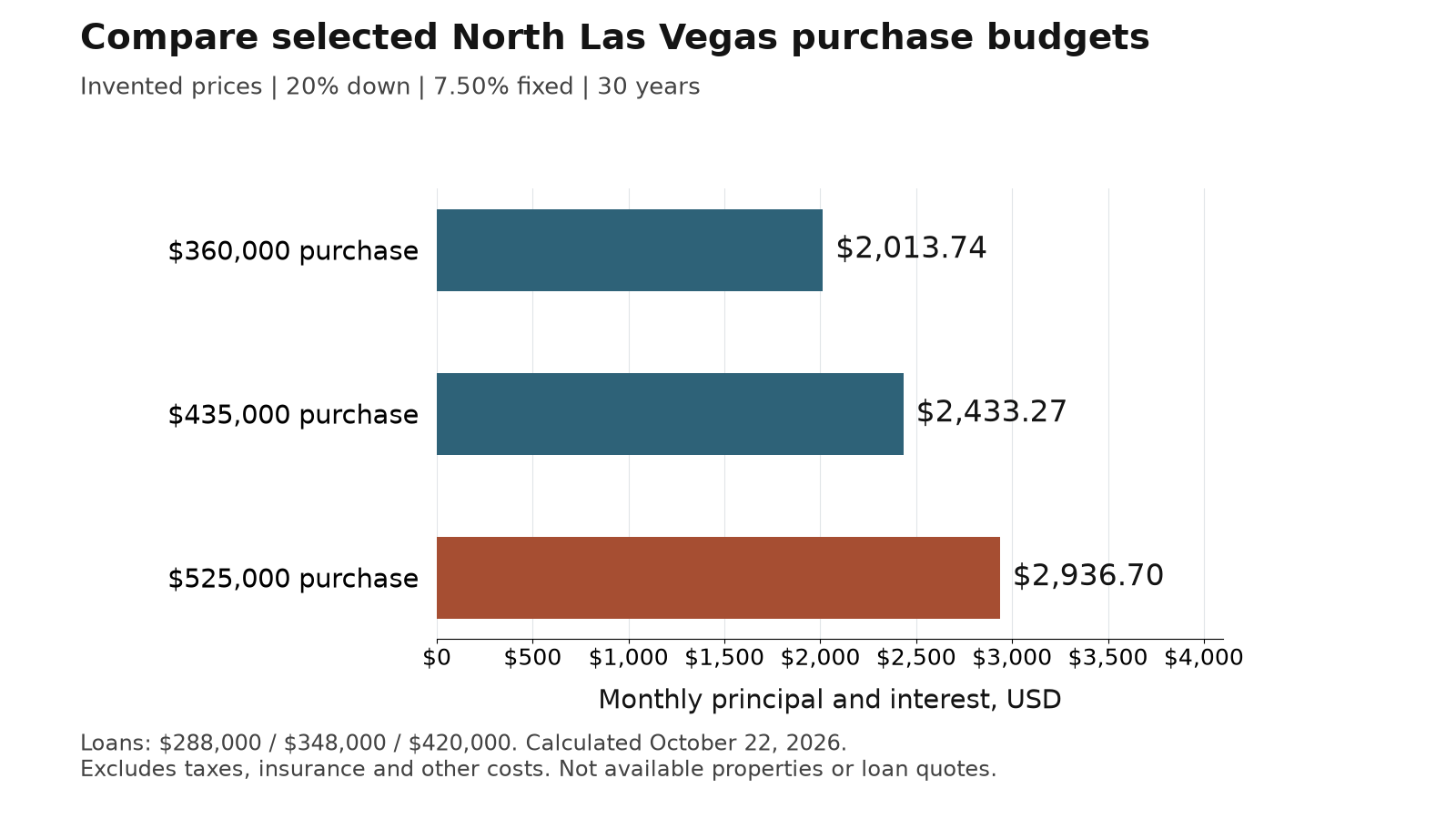
This guide compares $360,000, $435,000 and $525,000 as chosen North Las Vegas purchase budgets. None guarantees a bedroom count, size or community. At an assumed 7.50% fixed rate for 30 years with 20% down, the $435,000 example has $2,433.27 monthly principal and interest. Property charges, maintenance and utilities are additional. Compare actual homes, builder inclusions, association obligations, condition and retained cash before deciding what your budget buys.
- Use dated market measures for context and relevant comparable sales for the individual home.
- The $435,000 case is a chosen budget, not an assertion that today’s median equals that amount.
- Compare usable rooms, condition and daily destinations without assuming that one area always offers more home.
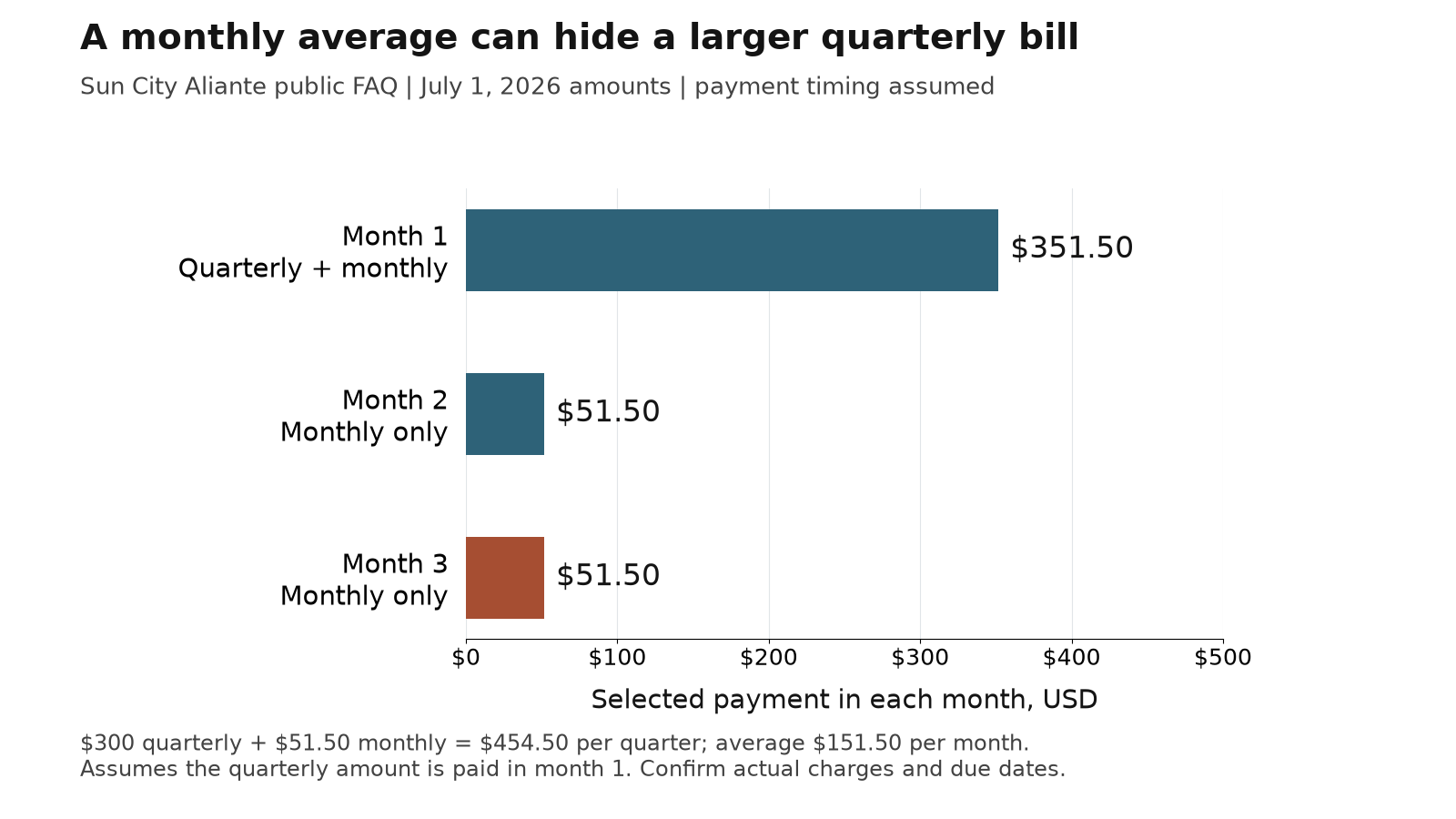
- Check every association charge and its payment frequency; a monthly equivalent can hide a larger bill in one month.
- A builder’s base price may differ from the chosen lot, options and setup total.
- Financing approval, the household’s monthly budget and cash remaining after closing are separate checks.
How we know this: Across the 9,600+ closings Nevada Real Estate Group has represented statewide — more than $4.85B in closed volume — a large share sit right around the North Las Vegas median, so we see what that budget buys every week. In my experience, buyers who decide their top priority first — newest, biggest, or lowest cost — get far more for $435,000 than buyers who try to maximize all three at once. Public summaries and hypothetical calculations below are identified separately, rather than presented as an analysis of those company transactions.
Which North Las Vegas Price Figure Should You Use?
According to NREG’s North Las Vegas city market report, the August 2026 single-family median sold price was $415,000 across 210 reported closings when reviewed as of October 22, 2026. This is an affiliated published summary using a North Las Vegas city selection in the GLVAR/Repliers feed. It is not an independently recomputed transaction dataset or a price estimate for every home in the city.
The report’s period and property type matter. A regional report, a different month or an asking-price summary can legitimately show another number. Do not combine those measures into one all-year median or assume that the difference between asking and sold medians is the discount on an individual property. The homes represented by those groups may differ.
| Figure | Amount or scope | How to use it |
|---|---|---|
| NREG city-report median | $415,000; August 2026 single-family selection | Published market context, not an individual valuation |
| Reported closed sales | 210 in that selection and month | Keep the population with the median |
| This guide’s middle budget | $435,000 | Chosen input for property and financing comparisons |
We've represented buyers at this exact price point across every corner of North Las Vegas, so treat the median as a starting budget, not a house. For an offer, request relevant recent closings and identify differences in condition, lot, layout and terms. A midpoint for a whole reported group cannot tell you whether the target home’s price is justified. It should help frame the next questions, not substitute for their answers.
How Do You Decide What the Home Must Provide?
Begin with the rooms and functions you actually need. Record sleeping arrangements, work space, storage, parking, outdoor use and any accessibility requirements. Then identify the preferences you could change later, such as certain finishes. The larger home is not automatically the more useful one if its layout does not fit the household.
Use the same requirements at all three example budgets. A $360,000 property should not be assumed to be attached; a $525,000 property should not be assumed to add a bedroom or a guaranteed amount of space. Availability and individual condition matter. A higher asking price may reflect a feature you value, a feature you do not need or an expectation that comparable evidence does not support.
Create a short candidate sheet with the address, property type, essential features, condition questions, ownership obligations, financing estimate and cash remaining. Mark unknowns explicitly. If several important expenses are missing, the comparison is still incomplete even if the asking price falls below your ceiling.
Use North Las Vegas homes for sale and the North Las Vegas hub to identify choices, then evaluate those actual properties. The broad cost-of-living guide serves a different household-expense question. This article’s narrower purpose is to explain why one home delivers more of what matters to you after its condition, costs and compromises have been counted.
What Should You Check in Newer North Las Vegas Communities?
In the Villages at Tule Springs or Valley Vista, begin with the proposal for the actual home. Obtain the lot, configuration, included features, selected options, completion terms and applicable community obligations. A community advertisement does not establish which house is available at your budget or which features are included in the quoted price.
Compare the plan with the way you intend to use it. Identify rooms that must serve more than one purpose, storage that may be missing and outdoor areas that still need work. A newer year built does not eliminate the need to inspect the property or understand warranties and maintenance responsibilities. Review the specific documents rather than relying on “new” as a complete condition description.
Test the location against your regular destinations. The relevant route depends on where and when you travel, parking and required stops. This guide does not assume that every northern address has the same commute or that every central home serves every job better. Include the actual routine in the shortlist process.
For current alternatives, the North Las Vegas new-construction page and new-construction hub provide places to investigate. Verify the current offer directly before using a price or incentive in a comparison. The decision should be supported by a written proposal for a specific property, not a promise that a fixed budget always buys more square footage at the edge of the city.
How Do You Compare Established Central and Eastern Homes?
Established properties may have a layout, lot or location that suits the household. Their condition and ongoing costs still need individual review. Separate cosmetic preferences from issues that affect function, insurability or the ability to use the home as intended. An older finish is not the same problem as an unresolved system defect, and a fresh cosmetic update does not prove that every system is sound.
I steer value-focused buyers here when they want maximum space and are comfortable trading brand-new for established, with a plan to update over time. Make that plan specific: required work, optional work, estimated cost and a realistic sequence. Ask for relevant records and qualified evaluations instead of assigning one renovation allowance to every older home.
Check additions, conversions and other features that are material to the price. Ask how they appear in the records supporting the transaction and what remains unresolved about their intended use. Obtain address-specific guidance from the appropriate jurisdiction and transaction professionals. The article does not establish that a particular alteration is permitted or that one type of room can be used for every purpose.
Finally, compare the cash needed before the house works for you with a candidate requiring less immediate work. A lower price may leave a useful reserve, or the necessary work may absorb that advantage. The answer depends on actual findings. Avoid treating “central,” “established” or “updated” as a guarantee of bargain pricing; explain what the property provides and what the buyer must still fund.
How Should Aliante’s Amenities Enter the Value Comparison?
For a home in Aliante, identify the particular association and property obligations before assigning a value to the master-plan name. The address may have different charges, amenities and responsibilities from another home marketed under the same broad label. Ask what is included, what is optional and which facilities or services the household would use.
I bring Aliante into the conversation for buyers who want amenities and a planned-community feel at a value price. That preference still needs an address-level comparison. A lower regular fee can leave more maintenance with the owner, while a higher fee can pay for services you would otherwise purchase separately. Neither is automatically better without the details.
Sun City Aliante is a specific association example, not a fee schedule for every Aliante property. According to its public FAQ, owners have separate Sun City and master-association assessments. The dated amounts are examined below to show why payment frequency matters. Obtain current written information for the actual purchase, including any additional charges and applicable occupancy or use requirements.
If you want a golf setting, determine whether any membership is included, optional or separate from ownership. If a park or other amenity is important, investigate its actual access conditions. Do not assume that a community label guarantees a view, a specific service or stronger future resale. Compare the benefits you will use with the complete obligations you are accepting.
Why Does the Frequency of Association Bills Matter?
The Sun City Aliante FAQ explicitly dates its published assessment example July 1, 2026: $300 quarterly for Sun City Aliante and $51.50 monthly for the Aliante Master Association. Reviewed as of October 22, 2026, those published amounts equal $151.50 per month on average, or $1,818 annually. They are a dated association example, not a quote for every North Las Vegas home.
The monthly equivalent helps compare expenses but may not match each month’s bill. If the $300 quarterly amount is paid in the first month of a selected quarter, the combined payments would be $351.50, $51.50 and $51.50. The three-month sum is $454.50. That timing example assumes the payment schedule; confirm actual due dates and current charges for the property.
Set aside the appropriate amount in the household plan without assuming the bill arrives evenly. Also list any transfer-related charges, known special assessments and obligations outside ordinary dues. The public FAQ is not a complete resale document, financial audit or guarantee that future fees will remain unchanged.
The comparison should account for services as well as amounts. Ask which expenses the association covers and which remain yours. Read current budgets, relevant reserve information, insurance details and planned-work disclosures with the professionals assisting the transaction. A published fee helps identify a question; the documents for the actual purchase establish what needs to be funded and investigated.
How Do the Three Budgets Compare Under the Same Loan Terms?
According to Freddie Mac’s Primary Mortgage Market Survey, the national 30-year fixed average released October 22, 2026 was 7.32%. It is context rather than a personal quote. The examples below separately assume 7.50% fixed for 30 years with 20% down so that the effect of borrowing different amounts is visible.
| Input or result | $360,000 purchase | $435,000 purchase | $525,000 purchase |
|---|---|---|---|
| 20% down payment | $72,000 | $87,000 | $105,000 |
| Loan amount | $288,000 | $348,000 | $420,000 |
| Fixed rate and term | 7.50%; 30 years | 7.50%; 30 years | 7.50%; 30 years |
| Monthly principal and interest | $2,013.74 | $2,433.27 | $2,936.70 |
No actual property or lender offer is represented. Taxes, insurance, association charges, utilities, maintenance and transaction costs remain additional. A home with the same price can have a different overall cost once those items are included. The table is a controlled calculation, not proof of affordability or approval.
For actual offers, compare the price, down payment, rate, term, points, credits and other charges together. According to the CFPB Loan Estimate guide, the loan terms, projected payments and closing costs each need attention. If negotiation changes the price or financing, update both monthly and initial-cash figures. Do not make the purchase depend on a future refinance whose eligibility, rate and cost are still unknown.
What Is Included in a Full Ownership Budget?
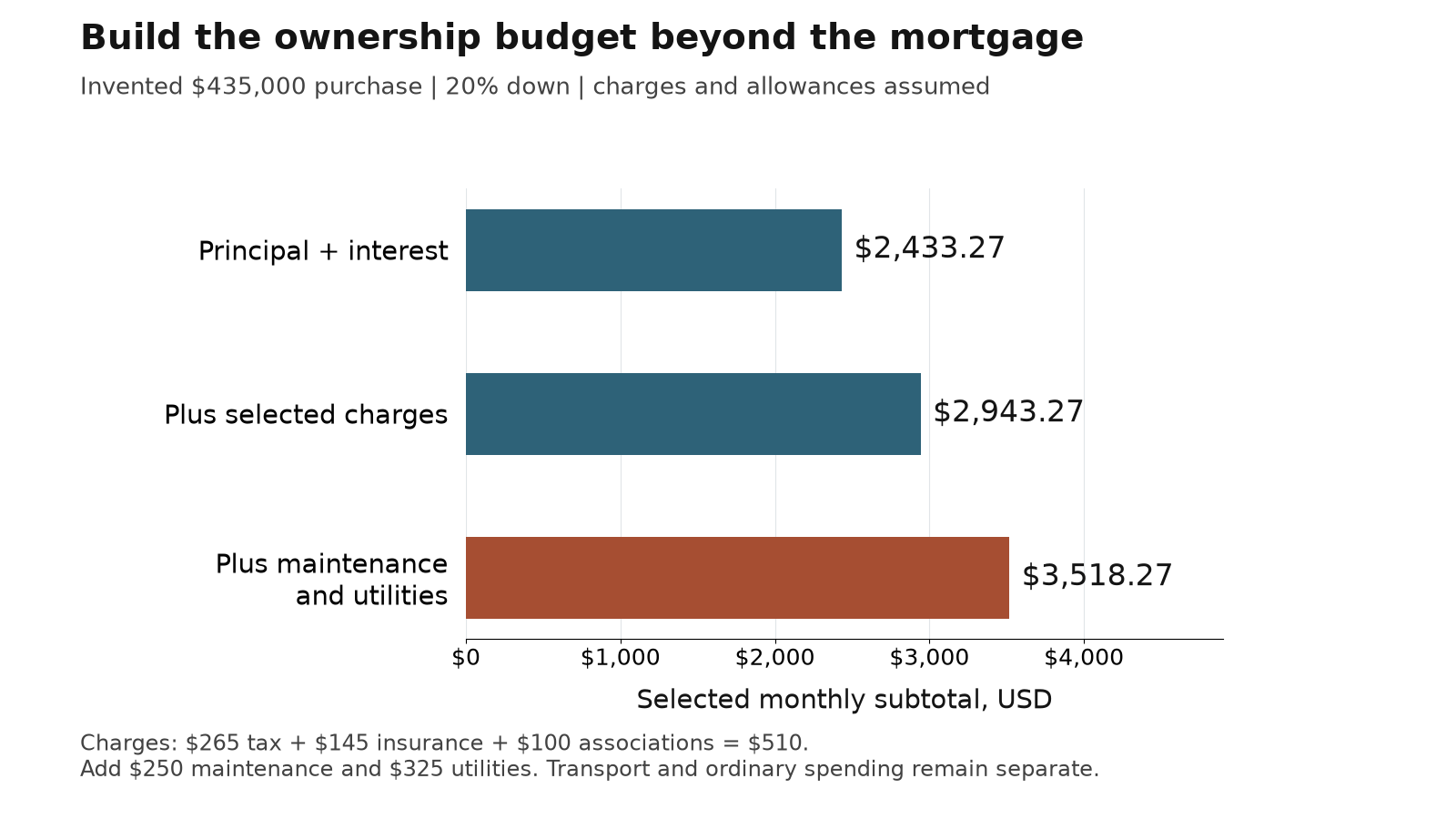
Begin with the middle example’s $2,433.27 principal and interest. Add invented monthly amounts of $265 property tax, $145 insurance and $100 association charges. Those selected payment components total $2,943.27. Add $250 maintenance savings and $325 utilities, and the selected owner budget is $3,518.27 before transport and ordinary household spending.
These inputs, calculated as of October 22, 2026, are not North Las Vegas averages or actual quotes. In particular, the invented $100 association input is separate from the dated Sun City Aliante example. Replace every allowance with evidence appropriate to the candidate. Check which expenses are collected through the mortgage account and which must be paid separately to avoid omissions and double counting.
Treat identified repairs separately from a general maintenance allocation. If an inspection raises a significant issue, obtain an estimate and timeline. A monthly savings plan does not automatically cover a known immediate obligation. Compare insurance coverage and conditions as well as premiums, and investigate utility use in light of the way you plan to occupy the home.
The most expensive mistake I see is shopping on price alone and ignoring the all-in monthly cost. The broader North Las Vegas salary guide helps frame household comparisons, while this property sheet focuses on the actual home. Reliable income, debts, healthcare, dependents’ needs and savings priorities still belong in the final household calculation. Approval for the loan and comfort with that full budget are related but different decisions.
How Do You Test the Income Needed for the Example?
If you choose a 30% gross-income screen for the selected $2,943.27 payment components, the calculation is $2,943.27 × 12 ÷ 0.30, or $117,730.80 annual gross income. This calculation, made as of October 22, 2026, uses a chosen planning rule. It is not a lender’s approval standard or an estimate of what every North Las Vegas buyer must earn.
Use take-home cash for a separate household test. Assume $7,250 monthly receipts, the $3,518.27 owner budget and $2,800 other spending. The remaining amount is $931.73. Another $550 obligation reduces it to $381.73. Missing expenses reduce it further. The example illustrates why a manageable mortgage component can still leave a tight household margin.
I always start buyers with a real pre-approval so we anchor the search to what you actually qualify for. Then compare that approval with the way the household spends and saves. Use reliable income and actual debts, and consider any variability that matters to your circumstances. A possible raise or hoped-for refinance should not be the only reason the current proposal appears workable.
A lower down payment can preserve cash while increasing the loan and potentially changing other charges. Obtain actual program comparisons from the lender rather than assuming every small-down-payment option has the same cost or eligibility. The financing, reserve and monthly household plan should agree with one another. None of the invented numbers here establishes a borrower’s qualification, insurance requirement or comfortable maximum price.
How Can a Builder’s Base Price Differ from the Completed Choice?
A base price is useful only when you know what it includes. For a specific proposal, identify the lot, structural choices, finish selections and items needed after closing. Ask which amounts become part of the purchase contract, which are paid separately and what conditions apply to credits or incentives. Do not compare an incomplete base offer with a resale that already includes the features you require.
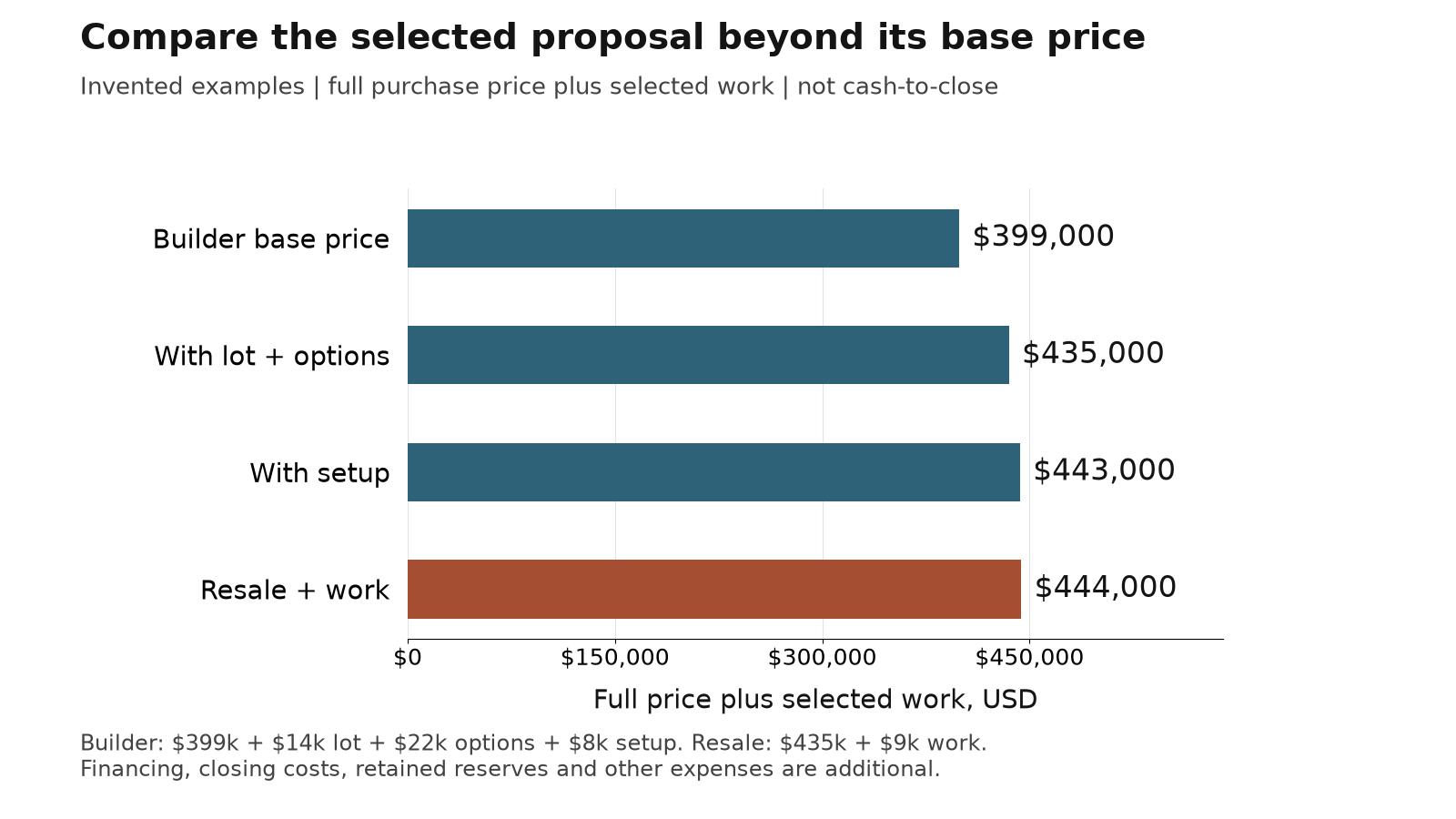
The invented comparison below, calculated as of October 22, 2026, illustrates the distinction. It is not a builder advertisement, available property or observed average. Zero entries mean no extra amount was selected for that line in this example, not that every actual proposal includes the item without charge.
| Selected component | Builder example | Resale example |
|---|---|---|
| Base home or selected resale price | $399,000 | $435,000 |
| Selected lot addition | $14,000 | $0 additional assumed |
| Selected contract options | $22,000 | $0 additional assumed |
| Resulting purchase price | $435,000 | $435,000 |
| Selected setup or necessary work | $8,000 | $9,000 |
| Purchase plus selected work | $443,000 | $444,000 |
The initially lower builder headline ends at the same assumed purchase price; selected setup leaves a $1,000 difference in the final comparison. Closing charges, financing costs, reserves and other expenses remain outside these totals. For decisions about specific selections, the design-center budget guide serves a narrower purpose; its dated rates and program details need their own current review. The current written proposal is what supports this purchase comparison.
How Much Cash Should Remain After the Purchase?
For an invented $435,000 purchase as of October 22, 2026, start with $87,000 down, then assume $12,000 closing and prepaid items, $8,000 moving and setup, and $25,000 retained reserves. Those selected amounts account for $132,000 cash. The reserve stays with the household; it is not a standard charge paid to close the transaction.
Known repairs or other requirements can add to that amount. Obtain relevant estimates before deciding that the cash plan is complete. If the property needs substantial work immediately, show it separately instead of assuming the reserve will somehow cover everything. The appropriate reserve depends on the household, property and uncertainty; the example is not a universal recommendation.
Compare the timing of deposits and other payments with the actual contract and settlement documents. Identify what is refundable, what is credited and what remains at risk, with advice from the professionals handling the purchase. This guide does not establish a universal Nevada option-deposit rule or promise that a payment will be recoverable.
If a current-home sale provides the funds, coordinate the sequence through the seller resources and transaction team. Include potential overlap in housing, storage and moving. Expected proceeds are not available funds before the sale provides them. A home that works on purchase price alone may require a different timetable or financing arrangement once the real cash flow is considered.
What Should You Check About Taxes and Separately Billed Obligations?
According to Clark County Assessor’s real-property explanation, taxable value follows prescribed methods and properties sit in different tax districts. Use the actual parcel information instead of applying a universal percentage to the asking price. Identify the tax year and property status behind the amount supplied by the seller, listing or lender.
According to the county’s abatement guidance, qualifying primary residences can receive a 3% cap on the tax bill, with other treatment and requirements for other categories and new construction. Ownership changes can require renewed occupancy documentation. That cap is not a tax rate of 3% of the home’s price. Confirm the relevant steps and parcel information with the appropriate office.
Ask whether any separate improvement-district or other property obligation applies. Obtain its current amount, payment frequency, remaining obligation and treatment in the transaction. Do not assume that every far-north house has the same charge or that an association fee includes every other assessment. Where a listing field and source record differ, reconcile the difference before choosing a budget input.
For a new property, ask what the estimate assumes about completed improvements and future billing. For an established property, investigate whether the current owner’s circumstances affect the quoted amount. This article does not calculate a parcel’s final liability or determine eligibility. The useful result is a documented reason for the figure on your comparison sheet, with unresolved questions still visible.
How Do Condition, Outdoor Work and Maintenance Change Value?
Review the house’s systems, surfaces and outdoor features as individual responsibilities. Ask for relevant service records and obtain qualified inspection or specialist advice where needed. A new cooling system does not establish the condition of the roof; attractive landscaping does not answer questions about drainage or irrigation. Record what is known and what still needs evaluation.
According to EPA’s lead-disclosure guidance, many pre-1978 housing transactions have specific disclosure requirements, with exceptions. If a candidate is older, obtain appropriate current guidance and the relevant documents. The age alone does not establish that a particular property contains a hazard, and this article is not an individual inspection or legal-clearance finding.
According to Southern Nevada Water Authority’s landscape-planning guidance, planning should consider the spending limit, timeline, association requirements and future irrigation needs. Apply those questions to a yard you intend to change. No rebate amount, pool rule, water bill or guaranteed improvement return is asserted here.
Keep necessary work, near-term preferences and later optional projects separate in the cash plan. If the house only fits after uncertain changes, obtain the relevant estimates and address-specific approval guidance before treating those changes as available features. The North Las Vegas Building Safety page was inaccessible during this review, so no current permit rule was inferred from it. Ask the city about the actual proposal rather than relying on an unverified general rule.
How Should Daily Travel and Work Needs Affect the Shortlist?
Map the places you actually use and test the route under conditions relevant to your schedule. Work location, shift, parking and required stops can matter more than a general neighborhood description. A home’s extra room may have substantial value for one household and little value for another if the routine does not work.
For remote work, verify the service options at the address and the requirements of the job. Do not assume that a community’s age or reputation establishes the connection available to an individual house. Ask about installation, equipment, charges and any other conditions before relying on a service as part of the purchase decision. No address-level broadband availability was tested for this guide.
If employment location is uncertain, make that uncertainty explicit rather than assuming an announced project will supply the job you need. The North Las Vegas jobs guide addresses employment research separately. A planned development, employer name or broad regional trend is not proof of a particular opening, offer, wage or commute.
Use the same approach for appointments, shopping and essential services. If a school assignment is material, confirm the address and applicable year with the district; a community name is not an enrollment guarantee. The shortlist should reflect the household’s actual requirements without ranking places by vague prestige or assuming that all buyers should prefer the same location. Property features and daily use need to make sense together.
How Should You Compare Offers and Negotiation Terms?
Ask for relevant comparable closings, listing history and condition information for the target. A citywide median or a general market label cannot tell you the seller’s priorities or whether another offer exists. Avoid using an old universal days-on-market figure or sale-to-list percentage as an automatic negotiation rule.
In my experience, buyers who are pre-approved and clear on their priorities can act within a day or two of the right home hitting the market, which is often the difference between winning and losing a well-priced North Las Vegas house in the busy season. That is why I front-load the preparation before we ever tour. Preparation helps you evaluate information promptly; it does not remove the need to resolve a material issue.
Compare the proposed dates, contingencies, financing and consequences with the professionals handling the transaction. A price concession, closing credit and different completion date can affect different parts of the household plan. Identify what the offer actually solves and what risk or cost remains. If new information changes the budget, revise the comparison before deciding how to respond.
I keep a live read on which area is offering the most at any given time. This article nevertheless does not present an evaluated current listing sample or recommend a specific bargain. Use the method with fresh property evidence. A preferred community, new construction or a growing employment area does not guarantee appreciation; the purchase should make sense without depending on an assured future price increase.
What Should Decide Between the Final Two Homes?
Write one clear explanation of each home’s strongest advantage and most important compromise. Then compare the essentials: usable layout, property condition, current proposal, ongoing charges, daily routine and cash remaining. If the advantage is a feature you do not need, it may not justify a higher payment or a smaller reserve.
In my experience, buyers who prioritize a move-in-ready modern home lean new, while buyers who want established amenities or a more central location lean resale. Those preferences still need an actual property comparison. A newly built home can exclude necessary setup; an established home can have recently replaced systems or material unresolved work. Use the documents and findings rather than treating the category as a complete answer.
Keep unknowns on the final sheet. Specify what evidence would resolve each issue and whether the decision depends on a favorable answer. A candid incomplete comparison is more useful than a precise-looking total built from unsupported assumptions. Financing approval, monthly comfort and retained cash should all fit the same proposed purchase.
Use $435,000 here as a chosen example, then set the search to your actual budget. As the lead agent at Nevada Real Estate Group, I do this every week for buyers at exactly this price point. Call (702) 637-1759 or contact our team to compare current North Las Vegas candidates against your priorities. The next step is a documented address-level review of what the home provides and what you will remain responsible for after closing.
Frequently Asked Questions
What is the median North Las Vegas home price in 2026?
Use a dated measure with its geography and property type. The August single-family selection in NREG’s city report is shown above; it should not be treated as an all-year value or an individual appraisal. Compare relevant recent closed sales before deciding what to offer on a particular home.
What does $435,000 buy in North Las Vegas?
It depends on the actual properties available, their condition, layout, location and obligations. This guide uses $435,000 as a chosen budget without promising a certain size, bedroom count or community. Investigate the specific candidate and compare its full cost rather than relying on a generic price ladder.
Does North Las Vegas always offer more house than other areas?
No universal rule establishes that for every property or buyer. Compare equivalent current candidates, their condition, obligations and daily-use requirements. An asking price alone does not measure value, and a larger floor area may not compensate for a layout, location or cost that does not fit.
What is the loan payment on the $435,000 example?
With 20% down, the assumed loan is $348,000. At 7.50% fixed for 30 years, monthly principal and interest are $2,433.27. Property charges and other expenses are additional. The broader owner budget uses invented allowances that must be replaced with actual documents and quotes.
Why can the association bill exceed its monthly average?
Different charges can be collected on different schedules. A quarterly assessment combined with a monthly charge can produce a larger bill in one month even when the annual expense is divided evenly for budgeting. Confirm the applicable associations, actual amounts, due dates and any additional obligations for the home.
Is a builder’s base price the final purchase cost?
Not necessarily. Confirm the selected lot, configuration, options, included features, setup and incentive conditions. The invented comparison in this guide separates those items and excludes other transaction costs. Compare written proposals on equivalent terms rather than matching a base-price headline with a complete resale offering.
Can I choose a home based on the pre-approval maximum?
A pre-approval helps establish financing possibilities but does not include every household preference, expense or savings need. Compare take-home income with the full ownership budget and other obligations, and preserve appropriate cash for the household and property. The article’s gross-income screen is a chosen example, not an approval rule.
Does buying new construction guarantee better resale results?
No. Future value depends on the particular home and market conditions, among other factors. Compare current price, included features, condition, timing and ownership obligations. A warranty or financing incentive has its own terms and does not guarantee appreciation, a future refinance or an easy sale when you move.
Which Sources Inform This North Las Vegas Budget Guide?
Sources were reviewed as of October 22, 2026. NREG’s city market report provides the dated single-family selection; it is an affiliated published summary, not an independent transaction audit. Sun City Aliante’s public FAQ provides its explicitly dated assessment example. The calculated payment timing assumes when the quarterly amount is paid; actual transaction documents and due dates still need confirmation.
Freddie Mac PMMS provides national rate context and the CFPB Loan Estimate guide supports financing comparisons. Mortgage, household, builder-proposal and cash worksheets are original calculations with disclosed assumptions. They are not current lender offers, builder quotes, client results or proof of a particular home at any example price.
Clark County’s real-property explanation and abatement guidance support the tax questions. EPA lead-disclosure guidance and SNWA landscape planning support specific due-diligence questions. No parcel tax, individual hazard, association finances, broadband service, school assignment or permit outcome was verified.
The cover is conceptual and the charts illustrate the disclosed examples. Current permit rules were not inferred from an inaccessible city page, and dated companion guides are not substitutes for present transaction documents. Keep source periods, property selections and calculation assumptions attached when using the figures. The final purchase decision requires current evidence for the actual address and the household’s own financial and practical limits.
Nevada Real Estate Group · Chris Nevada · License S.181401 · (702) 637-1759.