

The salary needed for North Las Vegas depends on the household, its actual housing choice and the amount it wants left after recurring obligations. A single “comfortable income” range hides those differences. A public basic-needs model can establish context, but it cannot price a particular lease, approve a mortgage or decide how much emergency money you should retain.
This October 22, 2026 review works through those distinctions. It keeps public benchmarks separate from original hypothetical worksheets, with the inputs shown. The goal is to compare a real job and property against dependable take-home, then identify the missing information before a move. None of the examples is a current home listing, lender quote or client budget.
There is no universal comfortable salary for North Las Vegas. The Living Wage Institute’s February 2026 Clark County model lists $50,337 before tax for one adult without children, but it measures basic needs rather than a home-purchase budget. Build your target from actual take-home, housing, care, transport, debt and savings; county estimates cannot settle an individual property decision.
- Use the correct household and worker count when reading a public benchmark.
- Compare spending with take-home; mortgage debt ratios use gross income.
- Include recurring rental charges or full ownership costs, not just the advertised payment.
- Keep down payment, closing funds and retained reserves separate.
- Test actual workplaces and care schedules before ranking homes by price.
What does a reliable local income benchmark actually measure?
According to the Living Wage Institute’s Clark County calculation, published through MIT, the February 15, 2026 model gives the following annual household income before taxes. Clark County includes North Las Vegas, but these estimates are not a separate city or neighborhood price survey. They describe selected basic-needs scenarios, not mortgage approval or financial comfort.
| Household configuration | Annual income | Interpretation |
|---|---|---|
| One adult, no children | $50,337 | One full-time worker in the model |
| Two adults, one working, two children | $86,980 | One worker; different care assumption |
| Two adults, both working, two children | $121,903 | Combined household income, not each worker’s salary |
Living wage data sourced from the Living Wage Institute via the linked county page, accessed October 22, 2026. Use the published annual row rather than forcing a rounded hourly figure to reproduce it exactly. In a two-worker scenario, a per-worker hourly figure and the household annual total are different labels.
The table is most useful as a question generator. Identify which configuration resembles your household, then list the ways your circumstances differ. Your actual housing agreement, benefit deductions, work hours or care needs may require a different result. A household with the same headcount may still have a very different spending pattern and cash reserve.
Keep your own documents beside the benchmark. A current lease proposal, an employer’s pay terms and an actual care quote answer questions the model cannot. If those documents indicate a larger requirement, the published estimate does not overrule them. Our North Las Vegas rent guide explains why a dated housing benchmark and a current rental proposal should remain separate.
Why is a basic-needs estimate different from living comfortably?
According to the Living Wage Institute’s methodology, the model uses full-time work and a defined set of basic expenses. Its assumptions exclude savings, retirement investment and several discretionary activities. The calculator’s FAQ also explains that the model is not a budget for emergency expenses or leisure. A public threshold therefore cannot answer how much margin you personally want.
Define comfort in observable terms before adding a percentage to a benchmark. It might mean a recurring reserve contribution, an affordable hobby, the ability to replace a vehicle, or sufficient flexibility for unpaid time away. Write those needs into the budget rather than assuming the word “comfortable” carries the same meaning for every reader.
The distinction also matters for someone already living in a paid-off home. Their current cash expenses may differ greatly from a buyer financing a purchase, while repairs, insurance and taxes remain relevant. An identical annual income can support very different housing arrangements depending on obligations and assets. A salary target without those conditions is incomplete.
Avoid interpreting the public model as a verdict on your household. Earning above a modeled figure does not establish that a particular home fits; earning below it does not tell the whole story about your resources or circumstances. The useful comparison is between dependable money available and the obligations you actually expect to carry.
The North Las Vegas living-cost article covers related expense categories. For a commitment, replace general ranges with current evidence and your own spending records. Treat any unresolved cost as an open item, rather than allowing a broad affordability label to supply the missing number.
How do you convert a salary into a usable monthly budget?
Start with the distinction between gross earnings and spendable income. According to the Consumer Financial Protection Bureau’s debt-to-income explanation, gross monthly income is the amount before taxes and deductions. Your household spending plan needs the amount available after those deductions, with any separately paid obligations included consistently.
For an October 22, 2026 hypothetical illustration, an annual gross salary of $72,000 equals $6,000 per month before deductions. If a household independently estimates $4,500 in monthly take-home, use that assumed amount for spending. This article has not calculated the taxes or deductions that would produce it. Do not copy that relationship as a universal take-home percentage.
For hourly work, record the dependable paid hours. At an invented $25 per hour, 40 paid hours each week for 52 weeks produces $52,000 gross annually. At 32 paid hours, it produces $41,600. That difference may matter more than a small change in the rent you are considering. Neither hourly figure is an employer offer.
Keep conditional compensation separate. A bonus, overtime payment or one-time relocation allowance may have conditions that do not match a recurring mortgage obligation. Read the offer and ask how benefits, schedule changes and unpaid periods affect the normal month. If the household depends on two incomes, record both start dates and the period before both paychecks arrive.
Build the baseline from money you can reasonably rely on, then show additional possibilities in a separate scenario. The North Las Vegas employment guide covers worksite and offer questions. A budget becomes useful when its income assumptions are as explicit as its expense assumptions.
What salary would support a particular rental proposal?
Start with the complete proposal rather than a citywide rent range. Ask which recurring charges sit outside the base rent, which utilities are the tenant’s responsibility, and what changes after any concession ends. Include required insurance and the household’s actual service needs. A discounted first month does not establish the cost of the remaining lease.
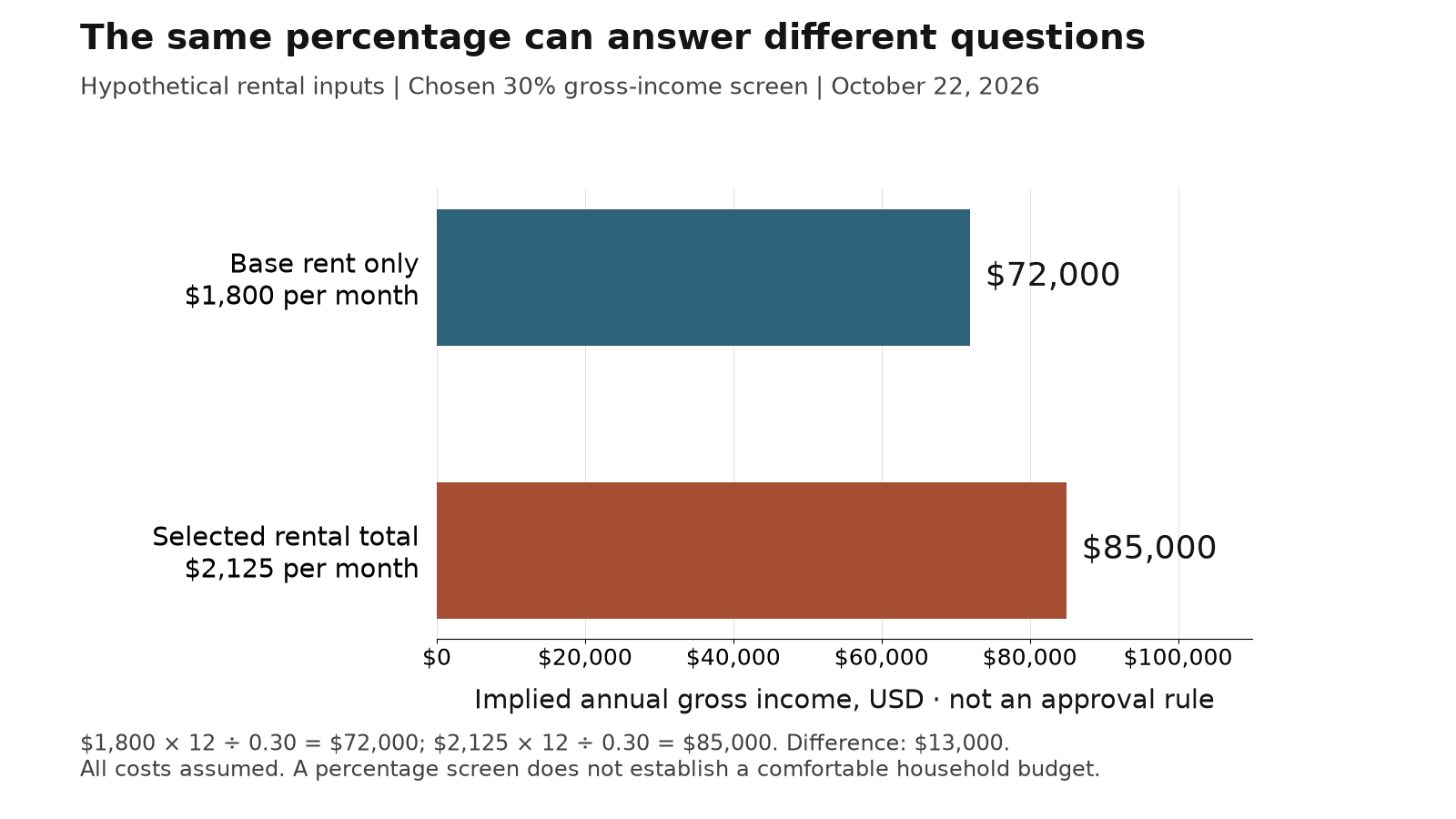
This October 22, 2026 hypothetical rental example assumes $1,800 base rent, $225 utilities and communications, $25 renters insurance and $75 in other recurring charges. The selected monthly total is $2,125. These are invented inputs for demonstrating the method, not current North Las Vegas apartment prices or standard fees.
If you choose a 30% gross-income screen, base rent alone implies $72,000 annually: $1,800 × 12 ÷ 0.30. Applying the same chosen screen to the selected $2,125 total implies $85,000. The $13,000 difference comes from changing the numerator, not a sudden change in the local rental market. This is an optional planning screen, not a universal landlord or lender requirement.
The more important test is the amount remaining after all household spending. A percentage can look acceptable while care costs, debt or transportation consume the rest. Conversely, a household may deliberately choose different priorities. Make the tradeoff visible with the actual monthly remainder rather than treating one ratio as a complete answer.
Keep initial cash separate from the recurring total. Request the deposit, application charges, first payment, concession conditions and any overlap with an existing lease. Our buyer resources can help with a later rent-or-buy comparison, while North Las Vegas housing inventory shows the ownership alternatives to investigate.
How much income would a hypothetical home purchase require?
A purchase calculation needs a specific price, down payment, rate, term and expense assumptions. According to the CFPB’s Loan Estimate explainer, principal and interest are only part of the total payment; insurance, taxes and other charges can matter, including costs paid outside escrow. Read the actual documents before choosing an income target.
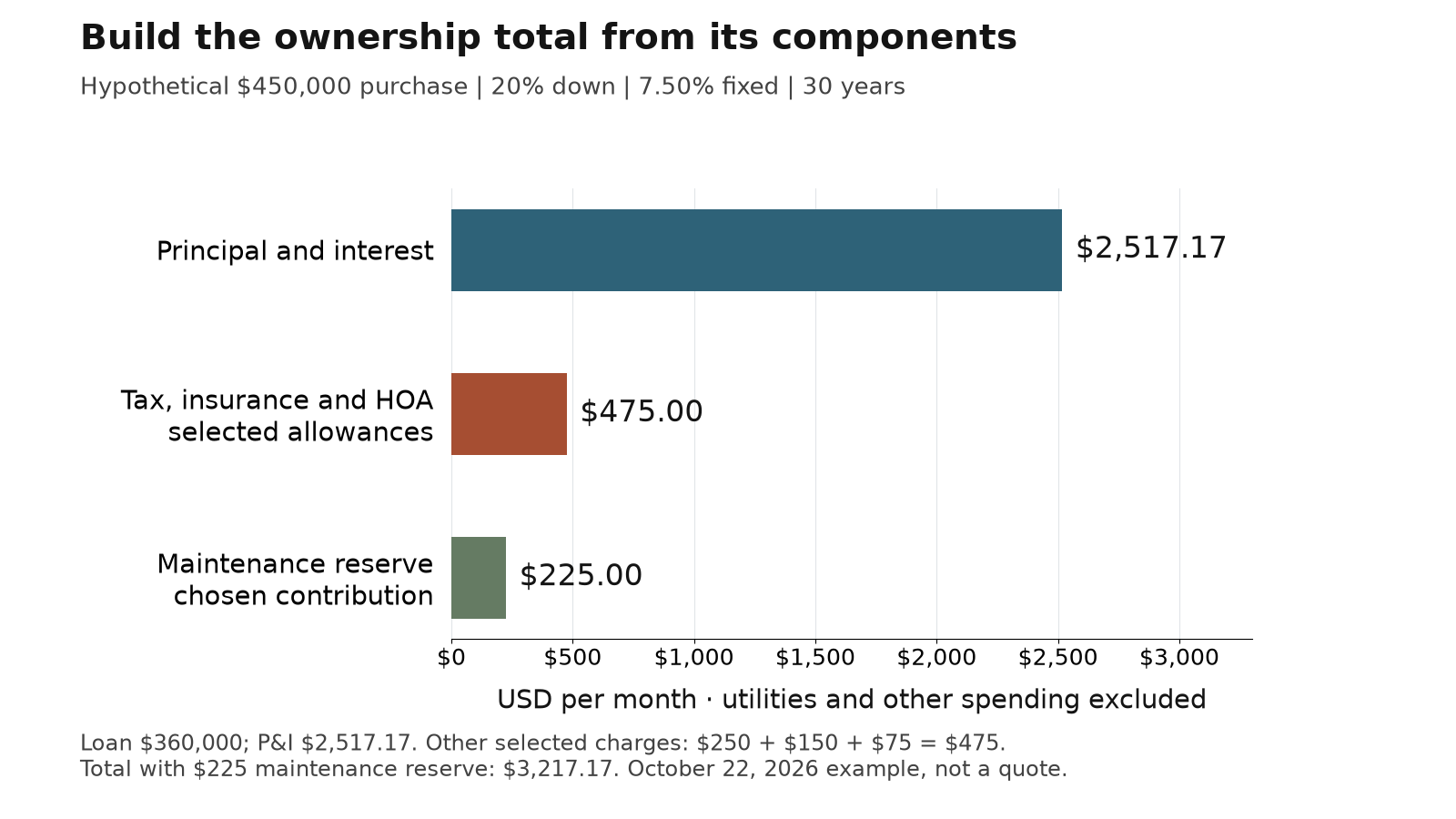
The following October 22, 2026 hypothetical example assumes a $450,000 purchase, 20% down, or $90,000, and a $360,000 loan at a 7.50% fixed annual interest rate over 30 years. It assumes level monthly payments and no mortgage insurance. The price is not a current city median, and the financing terms are not an offer or approval.
| Component | Monthly amount | Evidence needed for a real home |
|---|---|---|
| Principal and interest | $2,517.17 | Actual loan amount, interest rate and term |
| Property tax allowance | $250 | Parcel-specific bill and applicable assessment |
| Insurance allowance | $150 | Property-specific coverage quote |
| Association allowance | $75 | Actual dues and other obligations |
| Selected payment and charges | $2,992.17 | Sum above; not every household expense |
| Maintenance reserve contribution | $225 | Chosen reserve, not an escrow invoice |
| Housing plus maintenance reserve | $3,217.17 | Utilities and other household spending remain separate |
Applying a chosen 30% gross-income screen to the $2,992.17 payment-and-charges line gives $119,686.80 annually. That is arithmetic from assumptions, not a citywide salary requirement. It excludes the maintenance reserve and remaining household expenses from that ratio; those still belong in the cash budget.
A lender evaluates its own criteria and documentation. Your preferred spending margin may be more restrictive than a loan decision. Compare actual properties through North Las Vegas homes for sale only after replacing the assumed charges. A home with the same price can produce a different result because the loan, insurance or association obligations differ.
How do rates, down payment and cash reserves change the answer?
According to Freddie Mac’s Primary Mortgage Market Survey, the national 30-year fixed mortgage average was 7.32% on October 22, 2026. The series describes a defined group of conventional conforming purchase applications. It is a dated benchmark, not the rate promised to a North Las Vegas buyer. The ownership worksheet uses a separately assumed 7.50% rate so its calculation can be reproduced without implying a quote.
Compare actual Loan Estimates using consistent assumptions. A lower advertised rate may involve different points, credits, loan terms or cash at closing. Ask which terms are locked, which remain estimates and how long the offer applies. Evaluate the complete arrangement rather than selecting the lowest number in a headline.
A larger down payment reduces the amount borrowed, but it also uses cash that could otherwise remain available after closing. Neither effect should be hidden. List the proposed down payment, other purchase costs and the reserve that remains; then decide whether the tradeoff fits the household’s plans. Do not spend the emergency fund simply to make the monthly ratio look better.
For new construction, identify any incentive’s expiration and financing conditions. A temporary payment reduction is different from a permanent loan rate. Obtain the payment schedule and calculate the later obligation before treating the first period as the normal budget. Our new-construction inventory is a place to compare options, not proof that a promotion fits an individual buyer.
Finally, avoid making a future refinance the assumption that rescues the plan. Future rates, eligibility and property value are not established by today’s purchase. The current obligation should be workable under the terms you can verify. If a later refinancing opportunity appears, it can be assessed on its own costs and conditions.
What does a single adult's rental budget look like in North Las Vegas?
Build the worksheet from the rental proposal and actual spending, then show the remainder. This October 22, 2026 invented example uses the selected $2,125 rental total above and assumes $4,500 monthly take-home. It does not describe a typical North Las Vegas resident, a measured client or a tax calculation.
| Selected item | Monthly allocation | Important distinction |
|---|---|---|
| Rental total | $2,125 | Includes the stated utilities, insurance and recurring charges |
| Food | $500 | Invented household allowance |
| Transport | $450 | Replace with actual travel and vehicle needs |
| Healthcare | $200 | Costs not already deducted from take-home |
| Debt payments | $250 | Replace with actual required payments |
| Other spending | $175 | Check for omitted obligations |
| Reserve contribution | $300 | Chosen saving, not a bill from a provider |
| Selected total | $4,000 | Sum of listed allocations |
| Remaining from take-home | $500 | Before omitted or changed costs |
The selected remainder is not automatically free spending. Check whether professional costs, pets, support obligations, irregular medical needs or another category is missing. If additional recurring expenses total $350, this example’s remaining margin becomes $150. That sensitivity is a transparent calculation, not a local price estimate.
Room-sharing can change the housing allocation, but examine the actual lease responsibilities and what happens if another occupant leaves. A household should not assume every cost divides evenly or that an advertised room arrangement permits the intended occupancy. Confirm terms and build a fallback scenario before relying on a split payment.
The useful question is whether the residual amount covers your priorities with an acceptable cushion. According to the CFPB’s affordability guidance, a borrowing limit does not capture every family or financial circumstance. The same practical distinction helps renters: an approval screen and a comfortable monthly routine are separate tests.
How should households with children compare one and two incomes?
A second paycheck changes more than gross income. Compare the added take-home with care, travel, benefits and schedule effects, while keeping longer-term career preferences separate from a single month’s arithmetic. The right arrangement depends on the household; a public model cannot decide how a family should divide paid work and care.
The Living Wage Institute FAQ explains that its two-adult, one-worker scenario assumes the nonworking adult provides care. That assumption helps explain why the table’s household configurations differ. It does not mean unpaid care has no economic value or that every one-worker family has no paid-care expense.
Use a current quote for the ages, days and hours you actually need. Ask about availability, schedule limits and charges outside the standard day. School hours, holidays and work shifts may not align. Avoid substituting a broad annual average for a provider arrangement that must work on a specific weekday.
For an October 22, 2026 hypothetical comparison, suppose an additional job brings $2,800 in monthly take-home and adds $1,600 care, $350 transport and $150 other work costs. The selected additional remainder is $700. That is not a local care quote or a recommendation to accept or decline work. Benefits, training, retirement contributions and career continuity may affect the decision too.
Apply the same discipline to housing. More bedrooms or a shorter route may help, but they do not establish school assignment, service eligibility or affordability. The North Las Vegas neighborhood guide provides areas to investigate; use actual property, school and care requirements rather than demographic labels or a universal “best for families” ranking.
How do debts change the income needed for a mortgage?
According to the CFPB’s debt-to-income guidance, DTI compares monthly debt payments with gross monthly income, and limits vary by lender and loan product. It is not the same calculation as the household cash worksheet, which also includes ordinary spending and savings priorities.
An October 22, 2026 hypothetical ratio example starts with $8,000 gross monthly income, $3,000 in proposed housing obligations and $600 in other debt payments. The selected combined ratio is 45%: $3,600 ÷ $8,000. Removing an assumed $200 debt payment would reduce that arithmetic result to 42.5%. Neither result predicts approval; a lender must determine the actual eligible income, obligations and rules.
Do not confuse paying down a balance with eliminating a required monthly payment. Ask the lender how the actual account will be treated before moving money. A cash decision may improve one ratio while reducing the reserve available after closing. The useful comparison records both effects rather than pursuing a percentage in isolation.
The take-home worksheet can reveal a separate problem. A household may meet a lending rule while still finding food, transport, care or medical costs difficult to cover. Conversely, a lender may require documentation that a household’s personal budget cannot supply. Keep the lender’s decision and your own preferred margin as separate columns.
Collect the actual documents early: current earnings information, debt statements, housing terms and the source of purchase funds. The buyer planning page covers the home-search process, while a qualified lender explains the loan-specific requirements. A generic rule such as 28%, 30% or 36% should never be described as the one ratio all North Las Vegas buyers must satisfy.
What do local wages tell you about an income target?
According to the BLS May 2025 Las Vegas metro occupational wage release, the all-occupation mean hourly wage was $29.23. Selected major groups included $23.93 for transportation and material moving, $22.75 for production and $48.76 for healthcare practitioners and technical occupations. These dated metro means are not current North Las Vegas job offers or starting rates.
A wage average describes observed compensation across a group; an income target describes a household’s spending needs. Comparing the two can highlight a planning question, but it does not establish that a particular applicant can obtain the average or that the average comfortably supports a chosen home. Broad occupational categories also combine different duties and qualifications.
Look at the actual job’s base pay, dependable hours, benefits and worksite. Verify whether the shift is fixed, whether the work is seasonal or temporary, and which payments are conditional. If the role is still an application rather than an accepted offer, treat its income as uncertain when deciding what obligations to take on.
Apex development deserves the same separation. A project announcement does not establish a vacancy, its compensation or its start date. Healthcare, education and other employers also have their own application and credential requirements. The North Las Vegas jobs and employers guide addresses those details, while this article focuses on converting verified income into a housing decision.
For a remote worker, confirm the employer’s approval of the work location and any compensation or attendance changes. Keeping an existing salary after a move is an arrangement to verify, not a benefit the city automatically provides. Include required travel and service needs in the household worksheet before assuming the move improves the remaining margin.
How can a commute change which home is affordable?
Compare the exact home with the exact reporting location, shift and entrance. “Near Apex” or “full valley access” does not establish a reliable journey. A household working at the VA medical center, a north-valley facility and a Strip employer will face different practical questions even if all are using the same broad metro labor market.
Test travel at the relevant times and include parking, the trip from the entrance to the work area, and the return journey. If public transport is part of the plan, confirm both directions and service at the actual end of the shift. This review has not measured a route or certified that a particular home can support a car-free routine.
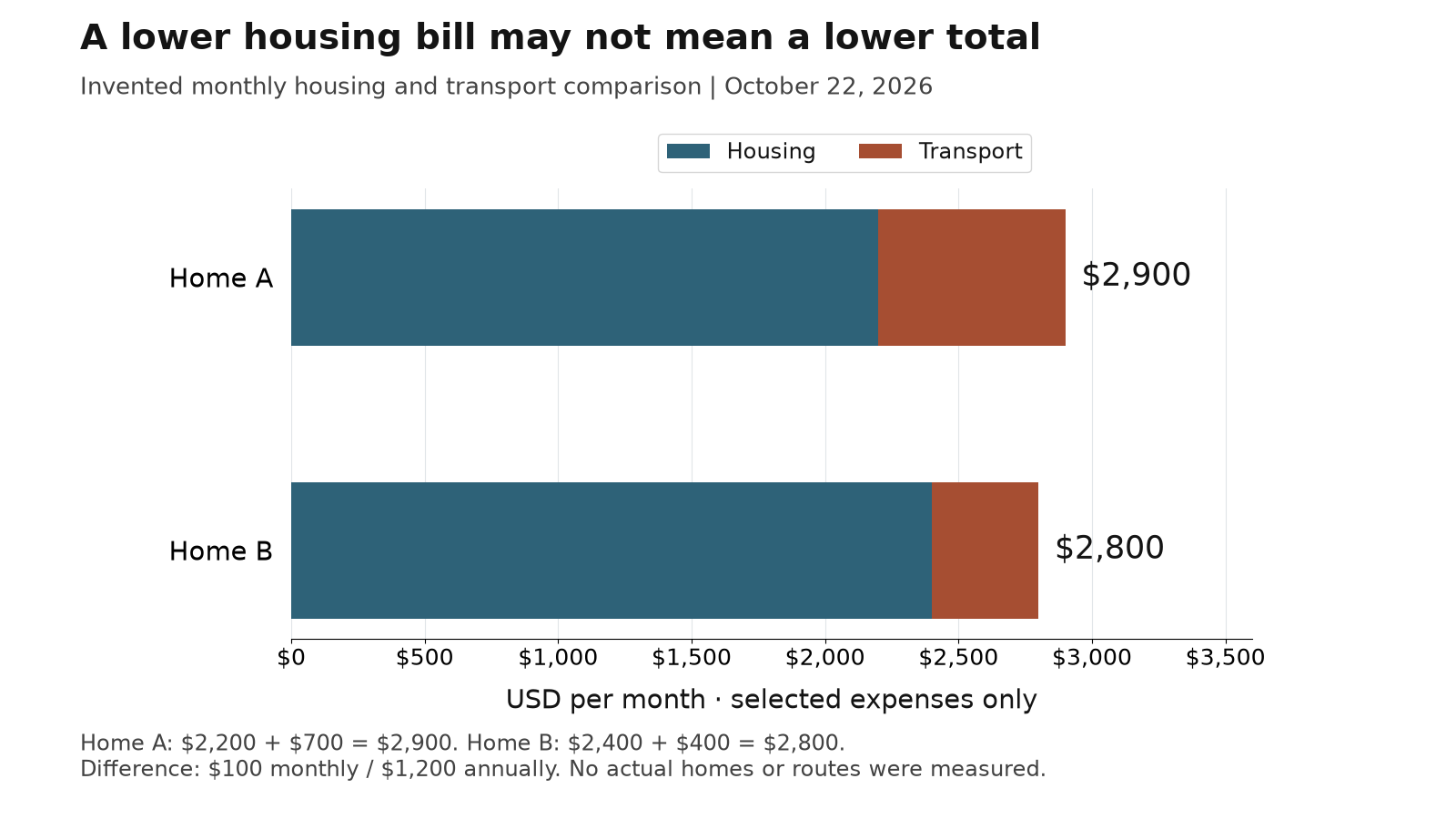
Consider an October 22, 2026 invented comparison. Home A has $2,200 in selected housing costs and $700 transport; Home B has $2,400 housing and $400 transport. The selected totals are $2,900 and $2,800, so the higher housing figure leaves the smaller combined bill by $100 monthly, or $1,200 annually. This is arithmetic, not a finding about two actual neighborhoods.
Time also belongs in the comparison, even when you do not assign it a dollar value. Record the weekly journeys and whether both workers need vehicles simultaneously. Check how a schedule change would affect care arrangements or the second person’s trip. The cheapest housing line may fail the household’s routine.
Use Aliante, Valley Vista and Villages at Tule Springs as search areas to test against those requirements. Compare Henderson or Las Vegas where the actual workplaces justify it. Do not rank entire cities by a theoretical income target when the important costs come from individual properties and schedules.
How much does Nevada’s tax position change the calculation?
According to the Nevada Department of Taxation, Nevada does not impose an individual income tax. That is relevant to a move, but it does not eliminate federal obligations, payroll deductions or other taxes. Gross salary still differs from money available for household spending.
Avoid applying another state’s top marginal rate to your entire salary. A tax projection depends on the household’s filing circumstances, deductions, income types and residency history. A table promising the same savings to everyone at a particular salary is not enough to support a purchase decision. Ask for a projection tied to your actual arrangement.
According to the California Franchise Tax Board’s part-year and nonresident guidance, residency periods and California-source income can remain relevant after a move. The guidance treats employee work locations and independent-contractor sourcing differently. A changed mailing address alone does not resolve those questions.
Keep the first relocation year separate from later years if the work and residency pattern changes. Obtain a payroll estimate with the relevant benefit selections, and identify what the tax adviser’s calculation includes. If one person continues working in California or the household retains California income sources, make that explicit rather than relying on a general Nevada comparison.
Then compare the complete household result. A possible tax reduction can coexist with a pay adjustment, a larger housing obligation or additional travel. Use the supported take-home estimate in the worksheet and leave unresolved assumptions visible. The Las Vegas relocation hub provides broader move planning; the individual tax calculation belongs with a qualified adviser who knows the facts.
Which property costs should be verified before choosing an income target?
Request the actual property-tax information, insurance terms, association documents and any recurring assessments. A city label or an old listing estimate cannot supply every obligation. Confirm what is included in the lender’s proposed payment and what will be paid directly so the same cost is neither omitted nor counted twice.
According to the CFPB’s Loan Estimate explainer, some taxes, insurance and assessments may be outside escrow. Its comparison guidance also distinguishes loan costs from the cash needed at closing. Use those sections to organize questions for the lender, insurer and the party responsible for each charge.
For insurance, obtain a quote for the actual home and coverage requirements. Compare deductible, exclusions and any additional policies rather than treating a statewide average as your bill. For maintenance, review the property’s condition and likely near-term work. A monthly reserve contribution is a planning choice; it does not guarantee that a large repair will wait until enough has accumulated.
Utilities need similar attention. Request available usage information and confirm the relevant providers and service responsibilities. Cooling needs, equipment, occupancy and the intended use of the home can affect the budget. This article does not assert a typical summer bill, a specific tariff or a guaranteed amount saved by choosing a newer home.
The new-construction page and existing-home inventory can offer different property choices, but neither category automatically produces lower total costs. A purchase incentive, extra room or appealing community amenity should be compared with the recurring obligations. The relevant evidence is the property and its documents, not a general claim that one city or master plan is always more affordable.
How much cash should be kept separate from monthly income?
Treat the move as a separate cash event. A household can have sufficient recurring income and still lack the funds for deposits, closing, relocation or immediate work. Make a timeline showing when each amount is due and which funds will actually be available at that point. Do not count the same savings as both the down payment and the reserve remaining afterward.
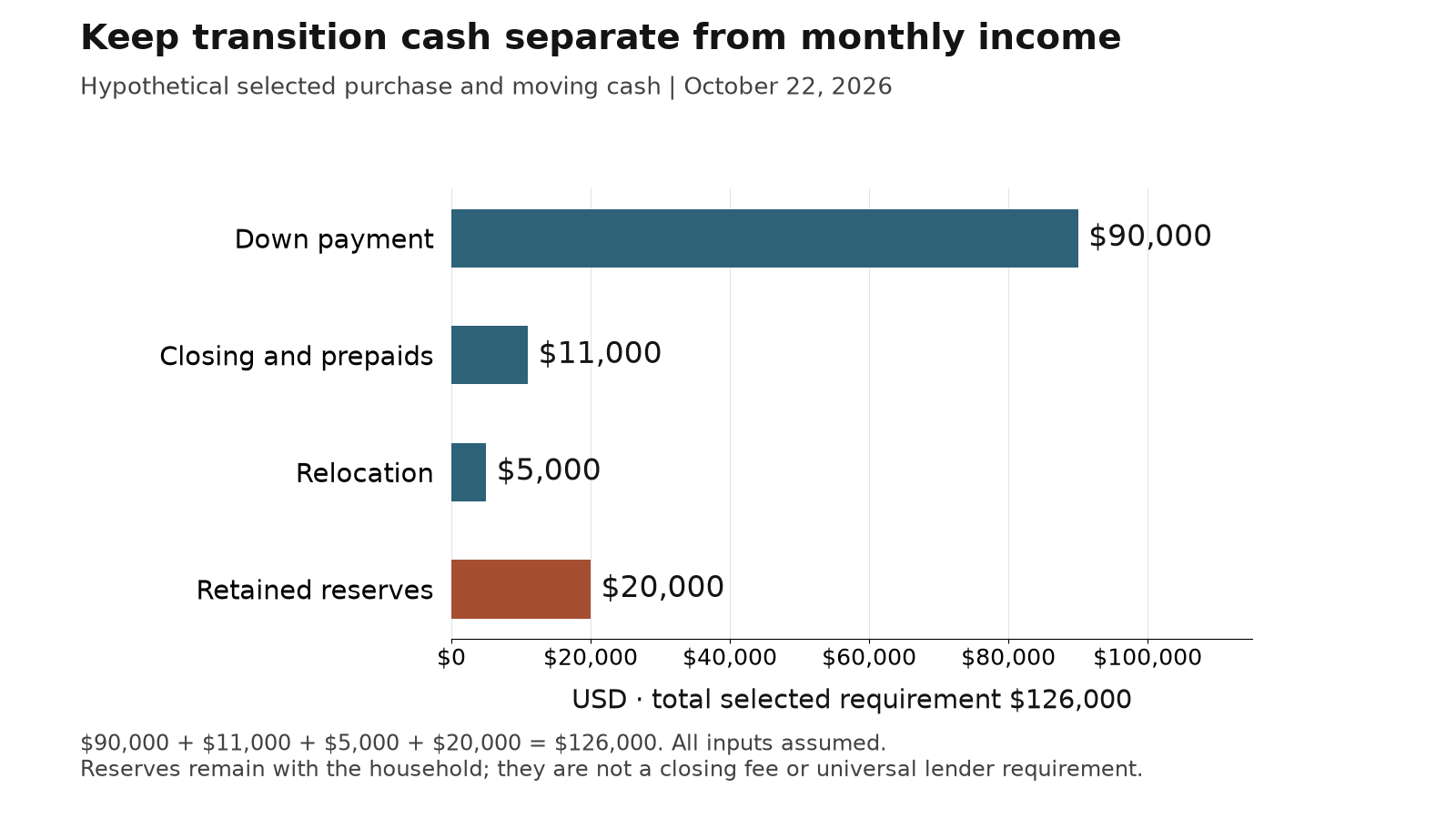
For an October 22, 2026 hypothetical purchase-cash example, start with the ownership worksheet’s $90,000 down payment, then assume $11,000 closing and prepaid costs, $5,000 relocation and $20,000 retained reserves. The selected cash requirement is $126,000. None of those added allowances is a local quote or a universal lender requirement.
Separate credits and previously paid deposits carefully when reconciling a real transaction. Use the actual closing documents and the lender’s explanation so funds are not added twice. An incentive may reduce a specific cost without becoming cash the household can freely spend. Ask where it appears in the transaction and what conditions apply.
For a rental move, list the first payment, deposit, actual fees, moving costs and any overlap between homes. Do not assume a deposit will be returned before the next one is due. If a second move is likely, include its potential cost when comparing renting first with buying immediately.
If sale proceeds fund the relocation, use the expected net after actual obligations, with the timing made explicit. Our seller resources cover that side of the process. A sale price is not the same as money available for the next purchase, and a projected completion date should not be treated as cleared funds.
How should you turn the numbers into a North Las Vegas decision?
Start with the most uncertain input. It might be the actual worksite, a care arrangement, insurance, an association charge or the dependable amount of take-home. Name the person or document that can resolve it. A useful decision file makes those missing pieces visible rather than smoothing them into a broad income range.
Across the more than 9,600 transactions Nevada Real Estate Group has closed, North Las Vegas is consistently where value-focused buyers land when the rest of the valley feels expensive.
Many of my relocating clients rent for six to twelve months first to test a neighborhood, then buy — a smart, low-risk move.
Many of my clients shop the whole valley before deciding, and value-focused families consistently land in North Las Vegas.
The honest caveat is that California salaries are often higher, so the move can mean a pay adjustment; but in my experience the lower cost of living and tax savings more than offset it for most households.
The worksheets in this review are explicitly invented planning examples. For your own move, compare a complete current lease proposal with a complete ownership proposal using the same household priorities. Include the cost of moving again, the flexibility you want and the cash retained after either choice. Neither a basic-needs model nor a citywide description settles that comparison.
Choose a property shortlist based on the requirements you can state and verify: total carrying cost, workable travel, usable space, condition and acceptable obligations. If a key assumption changes, update the worksheet before moving ahead. The North Las Vegas homes for sale page can support the search once those boundaries are clear.
For help organizing a home comparison around your budget and work requirements, contact the team through our contact page or call (702) 637-1759. Bring the actual documents and unresolved questions. The useful next step is a clearer decision about the particular home and household, not a promise that one salary is comfortable for everyone.
Frequently Asked Questions
Is there one salary that makes North Las Vegas comfortable?
No. A basic-needs benchmark, a landlord’s screening criteria and your preferred household spending margin answer different questions. Build a budget from dependable take-home and actual housing, care, transport, debt and saving needs. The examples in this guide demonstrate calculations and are not universal income requirements.
Is the living-wage figure specific to North Las Vegas?
The reviewed source is for Clark County and was updated February 15, 2026. It is not a separate North Las Vegas neighborhood or current-property survey. Use the correct household configuration and carry its assumptions into any comparison with your circumstances.
Does a two-worker living-wage figure mean each person earns the annual total?
No. The annual before-tax row used here is the household total. The calculator’s hourly figures for two working adults are per worker under its equal-earnings assumption. Keep the units and worker count attached; do not double a household total or present one worker’s hourly requirement as the entire household income.
What income would the hypothetical $450,000 purchase require?
With the stated 20% down payment, 7.50% fixed rate, 30-year term and assumed tax, insurance and association charges, the selected monthly payment is $2,992.17. A chosen 30% gross-income screen gives $119,686.80 annually. That is illustrative arithmetic, not lending approval; maintenance, utilities and other spending still require a separate budget.
Is rent at 30% of gross income always affordable?
No. The result depends on what the ratio includes and what the household must pay afterward. In the invented rental example, base rent and the selected full rental total imply different income figures under the same screen. Compare the actual remaining take-home after all obligations as well as any required application criteria.
Does moving from California guarantee a fixed tax saving?
No. Nevada has no individual income tax, but the household’s filing circumstances, residency periods, income sources and work arrangement affect the result. Obtain an appropriate projection and payroll estimate. Do not apply a top marginal rate to the whole salary or assume a new address resolves every California obligation.
Is North Las Vegas always less expensive than Henderson or Summerlin?
An individual property comparison needs actual housing, financing, service and travel costs. Broad city or community labels do not establish the total a particular household will pay. Compare real alternatives under the same assumptions and test the exact routes; this review does not rank current citywide prices.
Should a first-time buyer spend the full amount a lender approves?
Treat the approval and your preferred spending margin as separate decisions. Include ordinary household expenses, saving priorities, condition-related costs and cash remaining after closing. A smaller obligation or renting longer may fit some plans; another household may choose ownership. The actual terms and tradeoffs should be explicit.
Which sources and methods support this income guide?
Reviewed October 22, 2026. Living wage data is sourced from the Living Wage Institute via its linked Clark County page on MIT, accessed that date. The source’s February 2026 version, geography and household units remain attached. Its methodology and FAQ explain modeled assumptions; the guide does not relabel it as a current North Las Vegas property-price survey or NREG client study.
Other primary evidence comes from BLS for May 2025 metro occupational wages, Freddie Mac for the October 22 mortgage benchmark, CFPB for borrowing and Loan Estimate concepts, Nevada Taxation for the individual-income-tax distinction and California FTB for part-year and source-income questions. Relevant sources are linked beside claims. No general agency homepage is offered as proof of a specific income threshold.
All rental, property, payroll, care, debt, travel and relocation examples are hypothetical. The amortized payment uses the stated loan principal, monthly interest rate and 360 payments; charges are added separately. Gross-income screens divide the selected annual expense by the chosen proportion. Household remainders subtract listed expenses from assumed take-home. Cash requirements add separately labeled amounts without treating retained reserves as closing fees.
No current representative rental sample, neighborhood price survey, matched city comparison, employer vacancy census or firsthand commute test was performed. No individual tax, mortgage, insurance or school eligibility determination is made. The cover is a conceptual illustration. Review the worksheet again when an offer, lease, loan quote, household obligation or property document changes; dated public context does not replace current decision evidence.