

"What will my budget buy in Boulder City?" is the first question most buyers ask me, and it is the right one. The useful answer starts with a specific home and the costs of owning it. A citywide median cannot tell you whether your budget buys a permitted addition, an affordable repair project, a workable garage or a view worth paying for.
This October 22, 2026 review separates dated market observations from transparent purchase calculations. It connects the asking price to the financing, condition and cash decisions that determine whether a home fits. Use the Boulder City community guide for location context and the Boulder City cost-of-living guide to assemble the rest of your household budget. The cover is a conceptual illustration, not a photograph or an offer for a particular property.
Boulder City home budgets need property-level comparisons: Realtor.com reported a $489,000 median listing price for September 2026, while NREG's August 2026 single-family report showed a $590,000 median across 10 sales. Those different measures cannot establish what one home is worth. At an illustrative $550,000 price, 20% down and 7.50% over 30 years produce $3,076.54 monthly principal and interest, before taxes, insurance, association charges, repairs and household spending.
- Compare the same property type, location, condition and sale period.
- September asking prices and August closed sales describe different populations.
- A purchase price does not guarantee bedrooms, floor area, condition or a view.
- Historic-district alterations may need city review before construction.
- Keep repairs, closing costs and retained cash separate from the down payment.
Across the 9,600+ closings Nevada Real Estate Group has represented statewide — more than $4.85B in closed volume — we work the whole valley including Boulder City, so we see how this tight, distinctive market actually trades. In my experience, the biggest challenge in Boulder City is not price but inventory — the right home does not come along every week, so pre-approved, prepared buyers win.
The market observations below identify their own periods and sources. The invented financing and cash examples are calculations, not results from that transaction experience or quotes for available homes.
What Do the Latest Boulder City Price Figures Actually Measure?
According to Realtor.com’s Boulder City market summary, the median listing price was $489,000 for September 2026. That is an asking-price statistic for its residential coverage, not a median of detached-home closings. According to Realtor.com Economic Research’s data library, its monthly residential series combines single-family homes with condo and townhome properties; the October 1 update covered September. Historical figures can be revised. Use the period and definition together whenever you repeat a number.
The NREG Boulder City market report separately displayed an August 2026 single-family median sold price of $590,000 across 10 sales, reviewed October 22. This is our own published MLS-derived report, not independent corroboration. Its property-type filter and settled reporting period differ from the listing summary. The two medians do not measure a month's appreciation, a negotiation discount or a gap between what the same sellers asked and received.
| Observation | Period and scope | Useful question | What it cannot establish |
|---|---|---|---|
| $489,000 median listing price | Realtor.com, September 2026 residential listings | Where is the middle of this asking-price series? | One home's sale price or detached-home value |
| $590,000 median sold price; 10 sales | NREG report, August 2026 single-family sales | What was the middle closed price in this small monthly group? | A current quote or the price of all home types |
| Property-specific comparison | Comparable closed homes plus current competing listings | What supports an offer on the selected address? | A guaranteed future resale return |
We've represented buyers in Boulder City, so treat the median as a starting budget, not a house. Establish the size and features available within your budget from current matching homes, rather than attaching an assumed floor plan to a citywide statistic. Before making an offer, request the actual comparable addresses, closing dates, condition differences and relevant concessions. A small group can change substantially when a different mix of properties sells; a precise-looking city median does not remove that uncertainty.
How Should You Build a Useful Budget Range Before Touring?
Build three limits: the purchase price you can finance, the monthly spending you can sustain, and the cash you can commit without exhausting reserves. A home must pass all three. Someone with substantial equity but limited recurring income may have a different price ceiling from a buyer with strong wages and little cash. Neither situation is captured by a single citywide affordability estimate.
Begin with required features that are costly or impossible to change: the location, usable access, room arrangement, parking dimensions and outdoor space. Then list flexible preferences such as finishes, paint or a future landscaping project. Measure the vehicle and furniture that must fit instead of relying on labels such as oversized garage or spacious bedroom. A lower price is not good value if the house fails a daily requirement that no reasonable renovation can solve.
For an October 22, 2026 planning exercise, this guide uses $400,000, $550,000 and $700,000 as invented purchase prices. They are not advertised listings or statistically established market tiers. Browse Boulder City homes for sale and verify each property's current availability and details. Record what actually appears in your range instead of assuming it guarantees a certain size, age or number of bedrooms.
Our buyer resources can help organize financing and the purchase sequence. For the first tour list, keep a column for an unresolved item and another for the person or document that can resolve it. “Unknown roof condition” is more useful than automatically assigning every older home a large repair bill. This produces a shortlist that can improve with evidence, rather than a ranking built from asking prices alone.
What Should You Check When Buying in Boulder City's Historic Core?
The historic core deserves a property-level review of condition and proposed changes. According to Boulder City's Historic Preservation program, the district has a formal preservation process and resources for identifying individual properties. The program connects the neighborhood's origins to Hoover Dam construction. Architectural interest can be a reason to choose a home, but it does not answer whether a particular addition is permitted or whether your planned work is feasible.
I bring the historic core into the conversation for buyers who value walkability, character, and community over size or modern finishes. Test the actual route from a prospective address to the destinations you expect to use. Sidewalk continuity, slopes, crossings, summer exposure and the timing of your trips all matter. A location described as near downtown may still work differently for two households with different mobility needs or schedules.
For the building itself, ask for permit history, available contractor invoices and inspection findings. Distinguish cosmetic wear from an unresolved electrical, roofing, plumbing or structural concern. Document the scope of any prior conversion or addition before counting it as usable space for your needs. A pleasing remodeled room is not enough evidence that all work was approved or that its use fits your plan.
Do not assign every historic house the same maintenance premium. An older home with documented improvements can require a different near-term budget from a newer property with deferred work. Compare evidence and contractor estimates rather than age alone. If your intended purchase depends on expanding or altering the exterior, resolve that question before treating the house as an affordable route to a larger finished home.
Which Historic-Home Changes Need City Review Before You Budget Them?
According to Boulder City's current historic-property alteration guidance, most exterior changes within the historic district that need a building permit and are visible from a public street require a Certificate of Appropriateness, with an exception for ordinary maintenance. Its guidance identifies projects such as additions, certain exterior modifications and changes to window or door configurations. The property's designation and the work's scope affect the review. Check the current program, not a general assumption that all older houses can be remodeled in the same way.
The practical budgeting sequence is address, proposal, city discussion, design and contractor pricing. First establish whether the parcel is in the district and what status applies. Then describe the actual project, including materials and visible changes. Ask staff which review and permits are relevant before paying for a finished design or relying on a contractor's preliminary verbal allowance. The city's preservation resources link the map and project-review materials.
A renovation estimate should identify work included, exclusions, design costs, permit-related costs and the conditions under which the contractor can revise the price. Keep a separate schedule assumption for review and revisions. Do not translate an administrative processing target into a guaranteed move-in date; project completeness, revisions and construction are different steps.
This is especially important when the affordable-looking home needs a specific alteration to work for you. A bedroom addition, enclosed porch or changed opening may be central to your purchase decision. If feasibility remains unresolved, reflect that uncertainty in the offer and due-diligence plan with your advisers. A low purchase price does not compensate for a project that cannot deliver the layout you need.
How Do Established, Newer and View Properties Compare Within One Budget?
Compare the features that are present and verified rather than assigning automatic value to a neighborhood label. An established detached home may offer the layout you need without a planned remodel. A newer home may have useful documentation and systems, or it may still need substantial work. A view property may justify a premium to one buyer while creating access or upkeep concerns for another. None of those descriptions establishes a predictable amount of square footage for a fixed price.
| Search emphasis | Potential reason to choose it | Evidence to obtain | Budget question |
|---|---|---|---|
| Historic core | Architecture and access to downtown destinations | Condition, permits, district status and project feasibility | Can required work fit both the cash plan and approvals? |
| Established detached home | A workable layout or lot | System condition, usable space and recurring charges | Which repairs are immediate rather than optional? |
| Newer property | Preferred layout or construction features | Inspections, applicable association documents and warranties | Does the total payment justify the features you will use? |
| Hillside or view property | Setting and outdoor outlook | Access, site condition, boundaries and relevant restrictions | What maintenance and insurance does this address require? |
I bring view lots into the conversation for buyers drawn to Boulder City for the lake, the recreation, and the scenery. Walk the actual access route and inspect the spaces from which you would enjoy the outlook. Ask what is included within the parcel and what neighboring development or restrictions should be investigated. Do not assume a view is permanently protected because it appears in listing photography.
If newer design is your priority, compare Southern Nevada new-construction options as well as Boulder City resales. If you are evaluating a premium setting, the luxury-community guide provides a separate starting point. Use those comparisons to identify what you value; they do not establish that a home in another community is a comparable sale. Location, property type and conditions still need to match the valuation question.
Does Growth Control Guarantee Scarcity or Future Home Values?
According to Boulder City's Community Development department, staff administer growth-control requests within applicable limits as part of their planning work. That confirms a local development process. It does not establish that every resale listing will attract multiple offers, that prices cannot decline, or that a buyer must waive protections to compete. New construction and existing homes offered for resale are related but different sources of supply.
The relevant choice depends on which owners offer their properties and which homes meet your requirements. A useful buying decision needs evidence about that actual selection. Count properties that actually meet your requirements, check their status, and ask how often similar homes have closed over a defined period. Separate the whole town's listing count from the much smaller set that fits a particular garage, floor plan, condition or financing need.
Price a proposed purchase with comparable transactions and the competing choices available at the time of the offer. Consider what would happen if you needed to sell sooner than planned. Selling costs, repairs, changing borrowing costs and a different mix of buyers can affect the result even when the city continues its growth-control program. No ordinance substitutes for a household's capacity to hold and maintain the property.
Compare the same priorities against Henderson homes and communities or the broader Las Vegas market if those locations are realistic alternatives. The objective is not to declare one city's growth pattern universally better. It is to decide whether Boulder City's actual choices meet your needs at a total cost you can sustain, with enough flexibility if the expected next listing does not arrive.
What Mortgage Payments Do $400,000, $550,000 and $700,000 Produce?
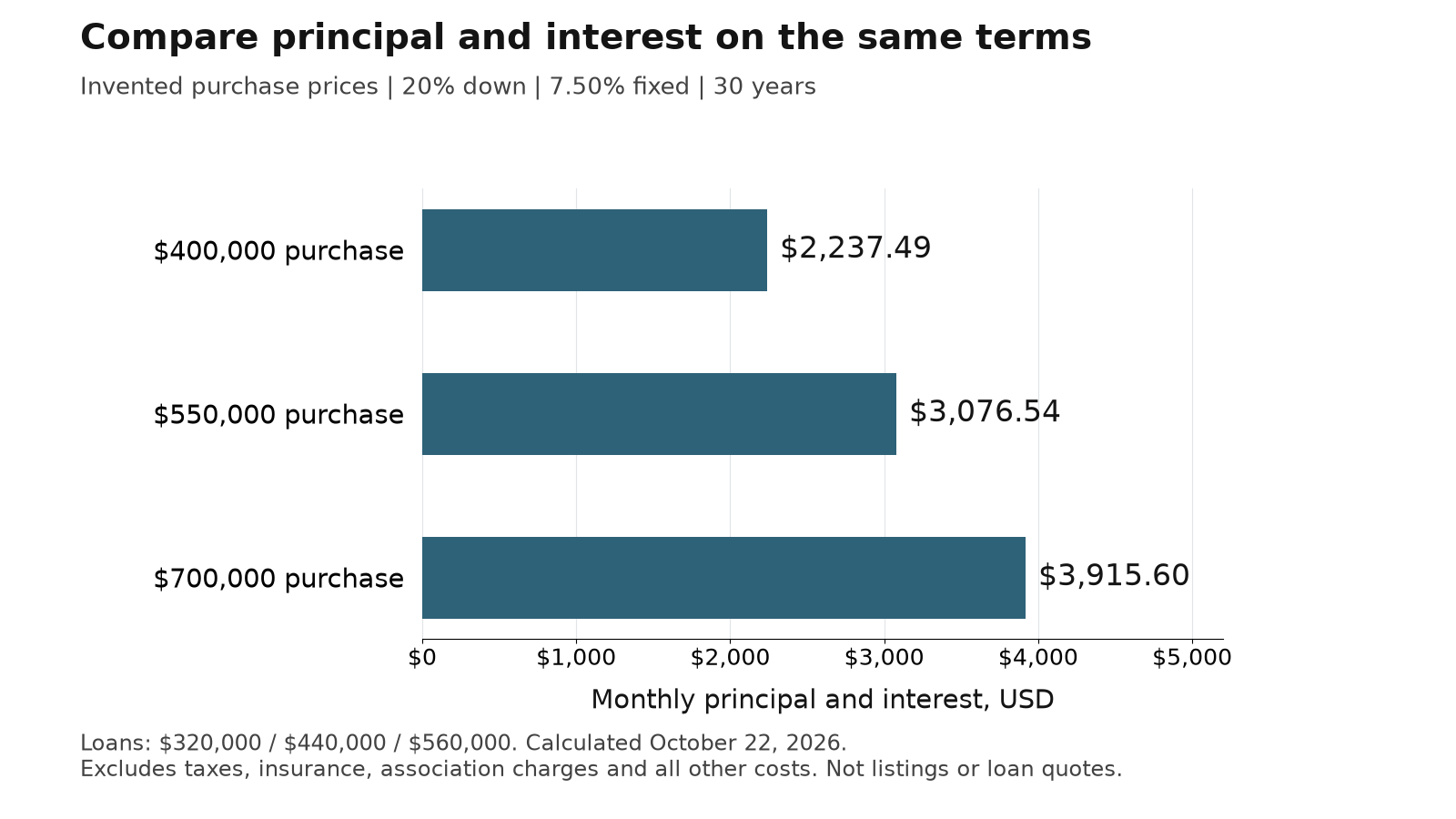
For this October 22, 2026 illustration, assume a 30-year fixed loan at 7.50% with 20% down, no financed fees and equal monthly principal-and-interest payments. The selected prices are calculation inputs, not recommendations or lender quotes. According to Freddie Mac's Primary Mortgage Market Survey, the national 30-year fixed average was 7.32% as of October 22, 2026. That national survey is context; it is not the rate offered to a particular Boulder City buyer. The model deliberately retains its separately stated 7.50% assumption.
| Assumed price | Down payment | Loan amount | Monthly principal and interest |
|---|---|---|---|
| $400,000 | $80,000 | $320,000 | $2,237.49 |
| $550,000 | $110,000 | $440,000 | $3,076.54 |
| $700,000 | $140,000 | $560,000 | $3,915.60 |
These payments exclude property tax, insurance, association charges, utilities, maintenance and other household expenses. Changing the down payment, term, rate or financed fees changes the calculation. Keep the same assumptions when comparing price points; otherwise a larger down payment or a different loan product may explain an apparent bargain.
For each real property, request a lender scenario that identifies the rate date, lock terms, points, fees and required cash. A quoted monthly figure should say which costs it includes and which you pay separately. Compare the proposed financing against your planned ownership period without assuming you can refinance later. If the home only fits with an uncertain future rate reduction, the current budget has not yet demonstrated that it works.
What Does a More Complete Monthly Ownership Budget Include?
According to the Consumer Financial Protection Bureau's Loan Estimate explainer, principal and interest are only part of the ownership payment; some taxes, insurance or assessments may be paid separately. Check the form against the actual property and confirm costs with the appropriate provider. An escrow payment does not make those expenses disappear, and an expense paid outside escrow still belongs in the budget.
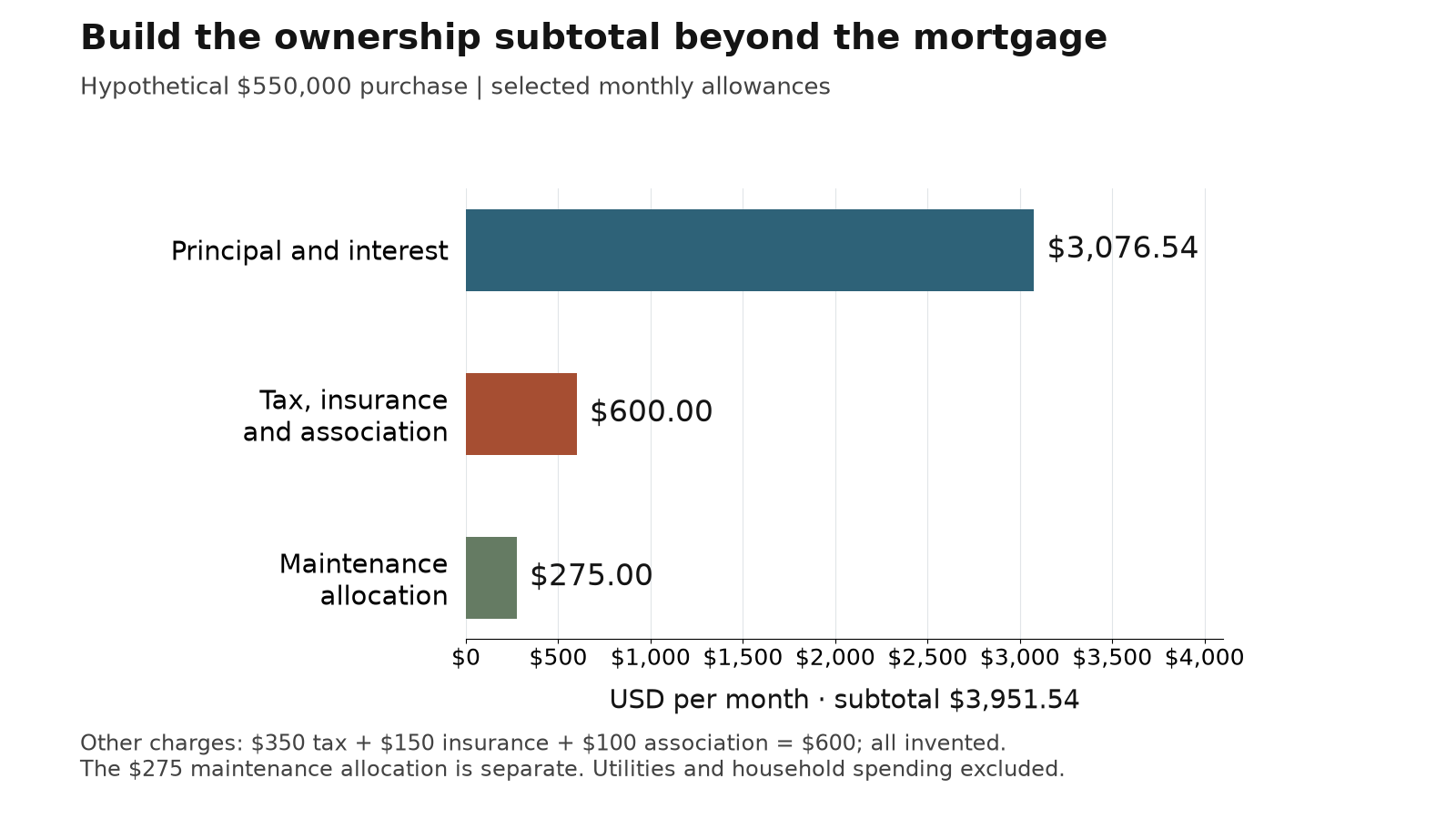
Extend the October 22, 2026 hypothetical $550,000 purchase with chosen monthly allowances of $350 for property tax, $150 for homeowners insurance and $100 for association charges. Adding them to $3,076.54 principal and interest produces $3,676.54. Set aside a separate $275 maintenance allocation and the selected ownership subtotal becomes $3,951.54. Every allowance is invented; none is a quoted Boulder City tax bill, premium, association assessment or measured repair average.
Obtain the actual parcel's tax information, a policy quote and the association documents if applicable. Ask whether there are additional assessments or costs excluded from the ordinary dues. Request available utility history and adjust for your expected occupancy, equipment and use. If a seller's household used the home differently, its bills may be a poor fit for yours.
Use a condition-based repair plan rather than assuming the monthly maintenance allocation will cover every failure. A replacement required immediately after closing needs cash on that timeline. Avoid counting the same expense twice if it already appears in a contractor's initial work budget, but do not omit it simply because it is inconvenient. The Boulder City retirement guide adds questions for buyers balancing housing with a fixed income, health access and daily routines.
How Much Income Would Make the Purchase Work for Your Household?
There is no single Boulder City salary requirement that establishes both mortgage eligibility and comfortable ownership. Your income stability, debts, household expenses, down payment and the lender's product matter. A buyer using retirement income or proceeds from another sale also needs a plan for recurring costs after moving. Treat any income screen as a calculation with assumptions, rather than as an assurance of approval.
For example, choosing to limit the preceding $3,676.54 mortgage, tax, insurance and association subtotal to 30% of gross income would imply $147,061.60 annual gross income: $3,676.54 multiplied by 12 and divided by 0.30. The percentage is a selected planning screen, not a lender standard or an observed local income requirement. It also excludes the maintenance allocation and all other spending. A different chosen share produces a different answer.
The stronger household test uses take-home income and actual expenses. Assume monthly take-home pay of $8,000, the $3,951.54 ownership subtotal including maintenance, and $3,200 in other spending. The remaining amount is $848.46. An additional $450 recurring cost would reduce it to $398.46. Those are invented inputs for testing a budget, not a recommendation that the remaining cash is sufficient for your family.
Build the expense list from statements, quotes and your expected routine. Include debt payments, food, transport, medical needs, dependents, savings and irregular bills. Then test an income interruption and the repair exposure identified during inspections. A lender's approval answers a financing question; you still need to decide whether the payment leaves enough room for the rest of your life and the risks you can reasonably absorb.
How Should You Compare a Cheaper Fixer With a More Expensive Home?
Compare cash required and recurring payments separately. A lower price can require more money before move-in if the home needs immediate work, while the higher-priced property may produce a larger loan payment. Neither direction proves which choice is better. Use inspection findings and written bids to replace the assumptions, and consider whether the lender can finance the property in its present condition.
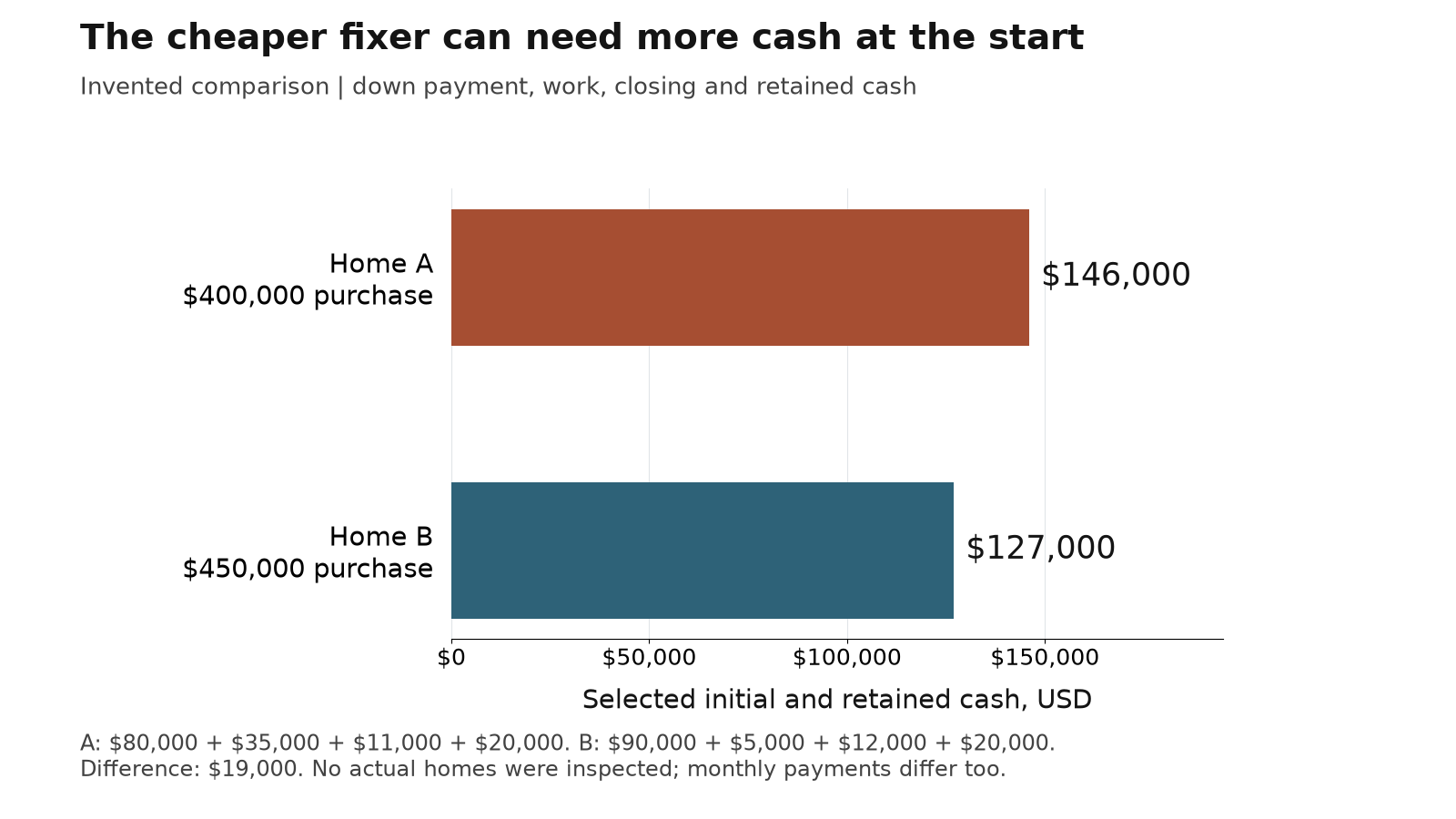
In an invented October 22, 2026 comparison, Home A costs $400,000, with $80,000 down, $35,000 of immediate work, $11,000 of closing and prepaid costs, and $20,000 retained cash. That selected cash plan totals $146,000. Home B costs $450,000, with $90,000 down, $5,000 of immediate work, $12,000 of closing and prepaids, and the same $20,000 retained. Its selected cash plan totals $127,000. Home A needs $19,000 more under these assumptions despite the lower purchase price.
With 20% down at the model's 7.50% fixed rate over 30 years, the more expensive property's principal and interest would be $279.68 higher each month. Taxes, insurance, association costs and future repairs could create additional differences. Do not select a home using only the initial-cash chart or only the mortgage comparison; they answer different parts of the decision.
For a historic property, include the feasibility and timing of the proposed work in the comparison. Consider temporary accommodation, storage and disruption if the house cannot be occupied as planned. A contractor allowance is not a completed inspection, and a contingency fund is not proof that the desired alteration will be approved. If the scope remains uncertain, price that uncertainty explicitly rather than assuming the least expensive outcome.
What Inspection Questions Matter Before You Commit to an Older Home?
Treat inspection as a way to define the property and its costs, not as a formality after choosing it. Ask what the inspector can assess, which systems need specialist review, and what conditions prevented inspection. Compare the findings with seller disclosures, permits and contractor records. A recently replaced component may still require evidence about installation, scope and any remaining defects; attractive finishes do not establish the condition of concealed systems.
According to the U.S. Environmental Protection Agency's lead-disclosure guidance, federal lead disclosure requirements generally apply to most housing built before 1978. The guidance addresses disclosure of known hazards and available records, and describes the opportunity for a purchase inspection period subject to the applicable arrangements and exceptions. Review the actual documents and inspection choices for the property. A disclosure is not a guarantee that no hazard exists.
The most expensive mistake I see is underestimating the carrying cost and maintenance of an older historic home. Translate each significant finding into a decision: investigate further, obtain a bid, negotiate a documented remedy, accept the cost within your plan, or reconsider the purchase. Keep the inspection deadlines visible and consult the relevant professionals about the contract and technical issue.
Do not assume the seller must fix every item or that a credit makes every defect manageable. Some conditions can affect financing, insurance or safe occupancy; their importance may exceed the apparent cost of repair. A buyer with limited remaining cash should be especially careful about accepting unresolved work on a promise to address it later. The useful result is a clear understanding of what you are buying and the obligations you can carry after closing.
How Much Cash Should You Keep Beyond the Down Payment?
A down payment is one component of the cash plan. Add transaction costs, prepaid items, moving and setup, required work and the reserves you intend to retain. Keep paid deposits and credits visible so you do not count them twice. Ask the lender and closing team which amounts are estimates, when funds are needed and how the final figures will be confirmed.
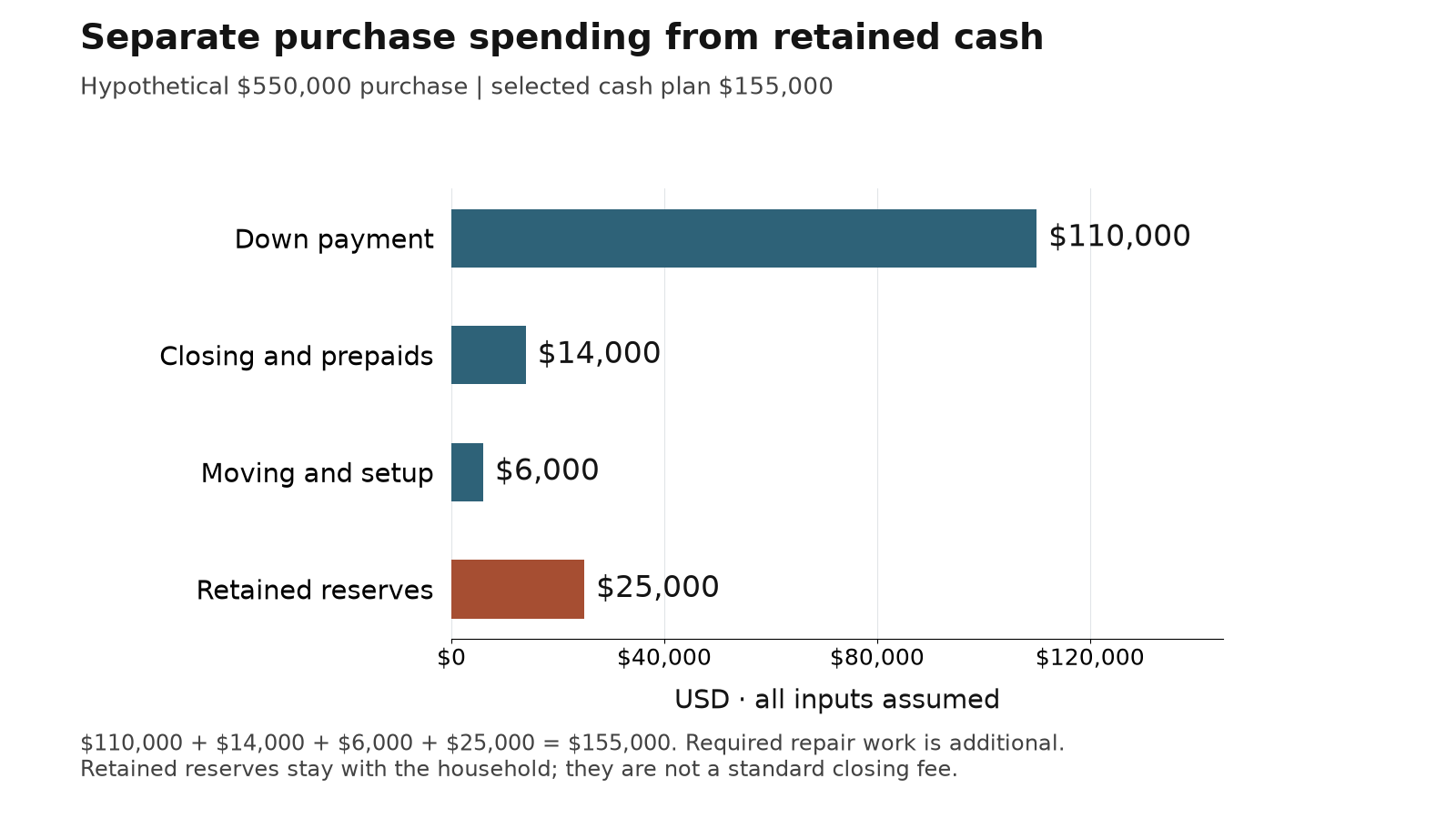
For the hypothetical October 22, 2026 $550,000 purchase, a $110,000 down payment, $14,000 for closing and prepaids, $6,000 for moving and setup, and $25,000 retained cash total $155,000. Retained cash is not a fee paid at closing. It stays available for the household under this chosen plan. None of the selected allowances is a required local percentage or a prediction of your closing statement.
If an inspection identifies a separate $40,000 immediate project, the assumed $25,000 reserve alone would fall $15,000 short of funding it, before preserving any emergency cushion. That is a reason to revisit the whole purchase plan, not to call the reserve adequate because it met the original spreadsheet. Review which costs are optional, which must happen promptly and which the proposed loan can or cannot cover.
If another home sale supplies your funds, use a realistic estimate of net proceeds, timing and any overlap in ownership expenses. The seller resources and Las Vegas pricing guide address that separate decision. Do not treat the current home's asking price as spendable equity. Confirm the amount and timing available before committing to obligations that depend on it.
How Should You Compare Loan Options Without Confusing the Trade-offs?
Start with the amount financed, monthly obligation, fees and cash required under each option. A smaller down payment can preserve liquidity while increasing the loan balance and potentially changing other charges. A larger down payment can reduce borrowing but leave less money for known repairs or an income interruption. Compare the complete plan, including any mortgage insurance and program-specific conditions, with a lender who can assess your eligibility.
On the illustrative $550,000 purchase, changing from 20% to 10% down preserves $55,000 before differences in fees and other costs. At the same assumed 7.50% fixed rate over 30 years, the $495,000 loan has $3,461.11 in monthly principal and interest, $384.57 more than the $440,000 loan. Mortgage insurance, if applicable, would be additional. This arithmetic does not promise the same quoted rate or terms for the two real loan options.
According to the CFPB's Loan Estimate review guidance, comparing estimates from different lenders helps identify differences in the proposed loan and charges. Request scenarios close enough in time to make the comparison meaningful and identify the lock status. Consider the costs over your expected ownership period instead of focusing exclusively on the lowest advertised rate.
Discuss condition-related requirements before choosing a property that needs significant work. A pre-approval for a borrower does not prove every building will qualify for that financing. If the plan depends on a renovation product, seller contribution or another special arrangement, get its requirements and feasibility confirmed before relying on it. The aim is a financeable home and a sustainable household plan, with the trade-offs visible before you commit.
How Can You Decide Whether to Offer Now or Keep Looking?
Make the decision from the fit of the property, the evidence supporting the price and your readiness. A citywide median does not tell you how long a particular seller has been negotiating, what condition the house is in or whether a competing offer exists. Ask for current status and the relevant comparison set. Confirm the property still fits the financing and cash limits after the inspection and insurance information is included.
In my experience, the buyers who succeed here are the ones who get fully pre-approved, define their target area clearly, and stay ready to tour and offer on short notice. Preparation should give you time to make an informed choice. It should not become a reason to skip investigating a problem or to accept a payment that fails your household budget. Decide in advance which unresolved issues require more information and which features are essential.
If nothing fits, identify the constraint before expanding the search. You might adjust finishes, timing, layout or location while keeping the monthly and cash limits intact. Compare Las Vegas master-planned communities only if their setting and costs work for your actual routine. The Boulder City relocation guide can help build a visit around the places you would use, rather than around listing tours alone.
Keep a dated decision sheet for each serious candidate: comparable sales, payment scenario, inspection items, renovation feasibility, cash remaining and reasons to walk away. Update it when a fact changes. A disciplined purchase can be decisive without pretending that every Boulder City home is scarce, every seller needs an immediate answer or every price premium will be recovered at resale.
How Do You Turn the Budget Into a Property-Specific Buying Plan?
Choose a small set of homes that meet your essential requirements and compare them on the same basis. For each, document the current asking price, property type, verified usable space, known condition issues and relevant association or historic-district questions. Add a dated financing scenario, a realistic initial-work allowance and the cash you expect to retain. This brings the guide's separate questions together around the actual addresses you are considering.
Ask what evidence would change your preference. A better inspection result might justify more weight for an older home; an unworkable renovation plan might remove a seemingly attractive option. A higher price can be worthwhile if it solves an important need within the complete budget, but paying more is not proof of better value. Keep asking which feature you are buying, what supports its price and whether you will use it.
The comparison should also reflect your timeline. If you must sell first, obtain financing documentation and coordinate dates before relying on proceeds. If you can wait, set a review schedule and recheck rates and expenses when a suitable property appears. Old assumptions should not silently carry into a later offer, especially when insurance, repair scope or the selected loan changes.
For help comparing current Boulder City choices with those requirements, call (702) 637-1759 or contact Nevada Real Estate Group. Bring your priorities and available property documents; avoid sharing sensitive financial records through a general inquiry. The next useful step is a specific comparison supported by current evidence, not a promise that one price buys the same house throughout the city.
Frequently Asked Questions
What is the median home price in Boulder City in 2026?
The answer depends on the measure and period. Realtor.com reported a $489,000 median listing price for September 2026 residential coverage. NREG's August 2026 single-family report displayed a $590,000 median sold price across 10 sales. These different populations cannot establish a trend between the two numbers or value a specific address. Use property-level comparable sales for an offer.
What does a $550,000 Boulder City budget buy?
It does not guarantee a specific size, age or view. Compare actual available properties, condition, layout, required work and recurring expenses. As a financing illustration only, a $550,000 purchase with 20% down at 7.50% fixed over 30 years produces $3,076.54 monthly principal and interest. Taxes, insurance, association charges, utilities and maintenance are additional.
Does growth control guarantee Boulder City home values will rise?
No. The city's development process does not guarantee resale prices, rapid sales or appreciation for an individual property. Evaluate comparable transactions, current competing homes, condition and the costs of holding and eventually selling. Your own requirements may leave few suitable choices even when broader inventory measures show more homes available.
Can I freely remodel a home in Boulder City's historic district?
Do not assume that. The city's current guidance describes Certificate of Appropriateness review for many exterior changes requiring a building permit and visible from a public street, subject to its stated exceptions. Check the property's status and proposed work with Community Development before treating a renovation as feasible or committing to its final design and budget.
Is a cheaper fixer always the better budget choice?
No. Immediate work, financing constraints, temporary accommodation and uncertainty can outweigh part of the price difference. In this guide's invented comparison, the $400,000 fixer requires $146,000 of selected initial and retained cash, while a $450,000 home with less immediate work requires $127,000. Those assumptions illustrate a method; actual inspections and bids must replace them.
How much cash is needed beyond the down payment?
Add closing and prepaid costs, moving, required work and cash retained for the household, while accounting for deposits and credits. The hypothetical $550,000 example totals $155,000 using $110,000 down, $14,000 closing and prepaids, $6,000 moving and setup, and $25,000 retained. These are selected inputs, not standard local charges or a lender requirement.
Do I have to put 20% down to buy in Boulder City?
The examples use 20% for a consistent comparison; that is not a universal requirement. Ask a lender which programs you and the property qualify for. Compare loan amount, rate, fees, possible mortgage insurance, monthly cost and cash remaining. A smaller down payment can preserve cash while increasing borrowing and other costs.
How can I compare Boulder City with Henderson or Las Vegas?
Use the same essential features, financing assumptions and ownership period, then obtain property-specific costs for each choice. Compare the actual routines you expect to follow, including work, appointments and recreation. A different community can broaden the options, but its citywide median is not a substitute for comparable sales supporting a particular home's price.
Which Sources and Assumptions Support This Budget Guide?
The source review occurred October 22, 2026. Periods and populations remain attached to the observations; the calculations use invented, fully stated inputs. They are not appraisals, lender approvals, inspected-property results or a sample of company transactions.
- Realtor.com Boulder City market summary — September 2026 median listing price; other inconsistent change fields were not used.
- Realtor.com Economic Research data library — monthly coverage, update period and definitions; not an additional independent publisher.
- NREG Boulder City market report — August 2026 single-family median and 10-sale count, as displayed during review; affiliated MLS-derived summary, not a new audit of individual closings.
- Boulder City Historic Preservation and preservation resources — current district program and property-research resources.
- Boulder City historic-property modifications — current project-review guidance; confirm applicability for the actual address and scope.
- Boulder City Community Development — planning, permitting and growth-control administration; no guarantee of resale returns.
- Freddie Mac PMMS — national 30-year fixed average as of October 22, 2026; distinct from the illustrative 7.50% rate.
- CFPB Loan Estimate explainer — comparing proposed financing, charges and cash needed.
- EPA lead-disclosure guidance — scope of federal pre-1978 housing disclosure guidance and inspection considerations.
Nevada Real Estate Group · Chris Nevada · License S.181401 · (702) 637-1759. Recheck property availability, documents, costs and loan terms when making a purchase decision.