

A Mesquite buying budget needs to answer two questions: what does the particular home provide, and what will it require after closing? A community name, golf setting or attractive floor plan cannot answer both. Use dated market evidence to orient the search, then compare actual properties on condition, obligations, financing and the amount of cash you retain. The three budgets below are chosen examples, not promises of current inventory.
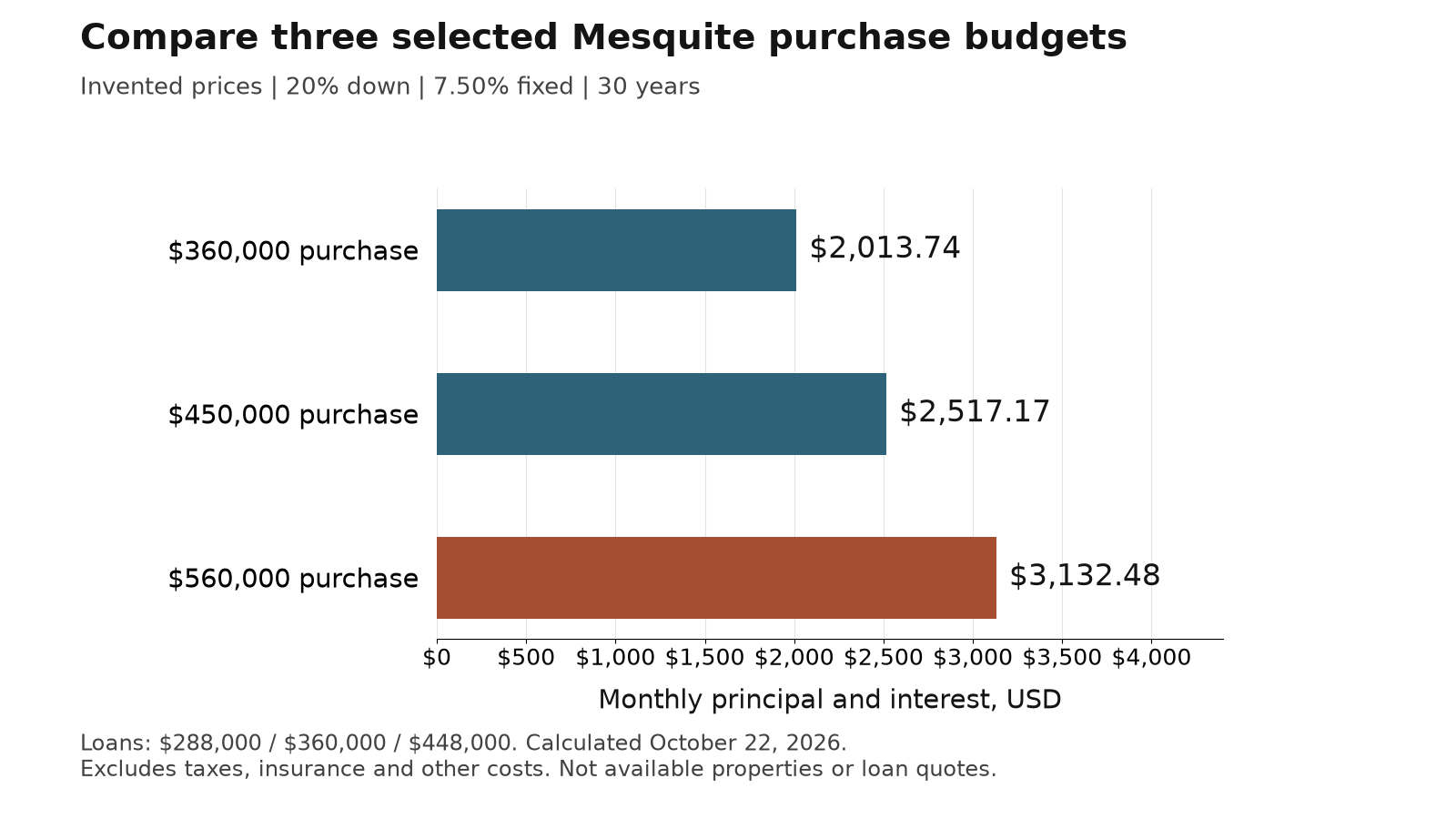
In Mesquite, compare what a selected budget buys through actual property features and full ownership costs. This guide uses $360,000, $450,000 and $560,000 as examples, without guaranteeing a home size or community. At an assumed 7.50% fixed rate for 30 years with 20% down, the middle example has $2,517.17 monthly principal and interest. Taxes, insurance, association charges, maintenance and utilities are additional; necessary work and retained cash also affect the choice.
- Keep a dated asking-price median separate from a sold-price median and an individual valuation.
- The $450,000 case is a chosen purchase budget; no fixed bedroom count, size or community is guaranteed.
- Sun City Mesquite’s governance page identifies two associations; obtain the charges and documents applicable to the actual home.
- At an assumed 7.50% fixed rate for 30 years with 20% down, the $450,000 example has $2,517.17 monthly principal and interest.
- Compare taxes, insurance, maintenance, utilities, necessary work and cash remaining before deciding which home offers better value.
How we know this: Across the 9,600+ closings Nevada Real Estate Group has represented statewide — more than $4.85B in closed volume — we work the whole Clark County market including Mesquite, so we see what this desert golf town actually trades at. In my experience, buyers who match the community to their stage of life — active-adult, golf, or family — get far more from $450,000 than buyers who shop on square footage alone. The public sources and hypothetical calculations below are identified separately; they do not claim to analyze those company transactions.
Which Mesquite Price Measure Should Guide Your Search?
According to Realtor.com’s Mesquite market summary, the September 2026 table displayed a $399,000 median listing price and $335,000 median sold price when reviewed as of October 22, 2026. These are different measures from the publisher’s Mesquite selection. The page does not establish that either figure represents detached homes alone, and the underlying sale records were not recomputed for this guide.
An asking-price median summarizes what sellers request within a reported group; a sold median summarizes another reported group’s completed prices. Subtracting those two numbers does not measure the discount on an individual home. Nor does either number guarantee a certain floor plan, view, age or condition. A property-specific valuation requires comparable evidence appropriate to the actual candidate.
| Measure | Amount | Meaning and limit |
|---|---|---|
| Realtor.com median listing price | $399,000 | September 2026 published Mesquite selection; asking prices |
| Realtor.com median sold price | $335,000 | September 2026 published selection; not a detached-only claim |
| This guide’s middle example | $450,000 | Chosen purchase budget; not an asserted current median |
We've represented buyers in Mesquite, so treat the median as a starting budget, not a house. The companion Mesquite housing-market guide addresses a broader market question with its own dated MLS selection. Do not blend its trailing-period figures with this monthly portal summary as though they measure the same population. For the current purchase, request relevant closed comparisons and explain which differences matter to the home being considered.
How Do You Translate a Budget into Property Requirements?
Start with the way you want to use the house. List essential rooms, parking, storage, outdoor space, accessibility needs and recurring destinations. Then identify the features that are preferences rather than requirements. A candidate that meets the essential functions with a manageable payment may be more useful than a larger home with an inconvenient layout or obligations you do not want.
The same process applies at $360,000, $450,000 and $560,000. Do not assume that the lower example means an attached home or that the higher example guarantees a fairway lot. Available properties vary, and a listing’s asking price needs its own support. Record what the additional money buys in the particular comparison instead of relying on a generic price ladder.
That is why I spend the most time up front helping buyers identify which Mesquite community matches how they actually want to live, before we ever look at individual listings. The practical questions are the buyer’s chosen activities, property needs, verified community rules and financial limits. Avoid assumptions about what a household should prefer based on age or family circumstances. Where occupancy restrictions apply, obtain the governing requirements for the actual property.
Use the Mesquite hub and Mesquite homes for sale to identify candidates, then make a comparison sheet for each address. Include unknowns rather than silently treating them as zero. The purpose of the first search is to build a workable shortlist, not to prove that a community label automatically delivers better value.
What Should You Verify Before Buying in Sun City Mesquite?
According to Sun City Mesquite’s community page, it is a 55+ community offering activities and ways for residents to participate. That general description is a starting point. Obtain current occupancy, guest, use and rental requirements from the applicable documents and management before deciding whether a particular purchase fits. This guide does not supply a blanket rule for every proposed resident or visitor.
According to the association’s governance page, residents belong to both Sun City Mesquite HOA and the Anthem Mesquite Master Association. The page describes dues supporting community maintenance, management and Pioneer Center facilities. Ask for both associations’ current charges, which items are included, any additional assessments and the responsibilities retained by the homeowner. A single listing field may not answer all of those questions.
Evaluate the amenities by how you intend to use them. Visit the facilities when appropriate, obtain their current access conditions and consider the relevant activity schedule. Do not assume that a golf setting includes every golf expense or that association maintenance covers the house itself. The written terms determine those obligations.
At a chosen $450,000 budget, compare actual homes and their condition rather than promising a standard size or age. A community can suit the buyer’s preferred routine while an individual house still needs work or exceeds the comfortable monthly budget. The decision should account for both. Public pages do not replace the current transaction documents, and no specific assessment amount or household eligibility was verified for this guide.
How Should You Value a Golf Setting or View Lot?
A golf or open-space view can be a meaningful preference. It can also command a price that leaves less room in the budget for the house’s condition, layout or reserve. Identify exactly what you value: the view from the rooms you use, outdoor space, proximity to an activity or access to particular facilities. Those are different benefits and may have different costs.
I bring golf communities into the conversation for buyers who value setting and amenities, whether or not they golf daily. Compare the specific property’s obligations with the benefits you will actually use. Ask what a membership includes, whether it is optional or required, and whether fees or transfer conditions apply. Do not infer those answers from an advertisement showing a fairway.
Review the setting at relevant times. Consider privacy, maintenance activity, noise, outdoor comfort and the way the lot relates to adjacent land. Ask for recorded information and appropriate professional guidance if a view or neighboring use is material to the purchase. A current open view is not a promise that surrounding conditions will never change.
Finally, compare the view premium with a non-view candidate that meets the same household needs. Would the difference preserve useful cash or fund a necessary improvement? There is no universal correct premium. The point is to make the preference explicit and support the proposed price with relevant property evidence. This guide does not claim that golf frontage guarantees appreciation, an easier resale or a particular home at any of the three example budgets.
How Do You Compare New Construction with an Established Home?
For a builder proposal, obtain the price of the actual lot and configuration, included features, selected options, completion terms, warranty documents and incentive conditions. For an established home, obtain condition evidence, relevant repair history and estimates for work you would need. A model-home image and a resale asking price are not enough for an equivalent comparison.
Separate the home you can move into from the improvements you would still need to arrange. Landscaping, window coverings, appliances or other items may be included in one proposal and excluded in another. Verify each item instead of assuming a standard package. For resale, a finished yard or updated room still deserves inspection and maintenance questions.
Compare financing incentives through actual lender documents. A lower initial payment can differ from the long-term obligation, while a credit can come with conditions that affect the overall cost. According to the CFPB Loan Estimate guide, loan terms, projected payments and closing costs need separate review. Keep the cash required and payment terms visible together.
The new-construction hub can help locate choices to investigate. It does not establish current Mesquite incentives or the completion date of a specific house. Include temporary housing, storage and moving timing in the comparison when relevant. Neither a new home nor an established home automatically gives more usable space or better value at $450,000; the written proposal and property condition determine the actual trade-offs.
When Can an Established Property Be the Better Budget Choice?
An established home may provide a layout, lot or location that suits your needs. The useful question is whether its condition and cost leave a workable ownership plan. Separate dated finishes from issues affecting basic function, safety, insurability or the ability to use the home as intended. Cosmetic preferences and necessary work should not compete for one vague renovation allowance.
Ask for the ages and service records of significant systems where available, then use qualified inspection and specialist advice to investigate material questions. A recently replaced item does not establish that every other system is sound. Likewise, an older system does not tell you the exact remaining life without relevant evaluation. Avoid giving the home an automatic condition rating from the year built alone.
For planned changes, determine whether the intended work needs association or government approval and whether the estimate accounts for that process. A converted room or enclosed patio deserves questions about how it appears in the records supporting the sale. Do not assume that a feature seen in another house can be reproduced under the same conditions.
Compare the resulting cash and timeline with a home that needs less immediate work. A lower contract price may require more cash before the household can use it comfortably. If the work can wait, decide whether you are happy living with the existing condition. The best budget choice is the one whose compromises you understand and can fund, not necessarily the house with the smallest asking price or newest finishes.
What Do the Three Purchase Budgets Mean for a Mortgage?
According to Freddie Mac’s Primary Mortgage Market Survey, the national 30-year fixed average released October 22, 2026 was 7.32%. That is context, not a Mesquite borrower’s quote. For a consistent comparison, the table uses a separate assumed 7.50% fixed rate, 30-year term and 20% down payment. No actual property or lender offer is represented.
| Input or result | $360,000 purchase | $450,000 purchase | $560,000 purchase |
|---|---|---|---|
| 20% down payment | $72,000 | $90,000 | $112,000 |
| Loan amount | $288,000 | $360,000 | $448,000 |
| Fixed rate and term | 7.50%; 30 years | 7.50%; 30 years | 7.50%; 30 years |
| Monthly principal and interest | $2,013.74 | $2,517.17 | $3,132.48 |
The same terms isolate the effect of borrowing more. Taxes, insurance, association charges, utilities, maintenance and transaction costs are additional. Those amounts can vary between two homes with the same purchase price, so the mortgage comparison is one part of the decision.
Replace the assumptions with actual lender terms before making a commitment. Ask about points, other charges, credits and rate-lock conditions, then compare equivalent scenarios. If the down payment or price changes during negotiation, update both the monthly calculation and the initial-cash plan. A financing example is useful because the inputs are visible; it is not evidence that the household qualifies or that a particular home will be affordable.
What Belongs in the Monthly Ownership Budget?
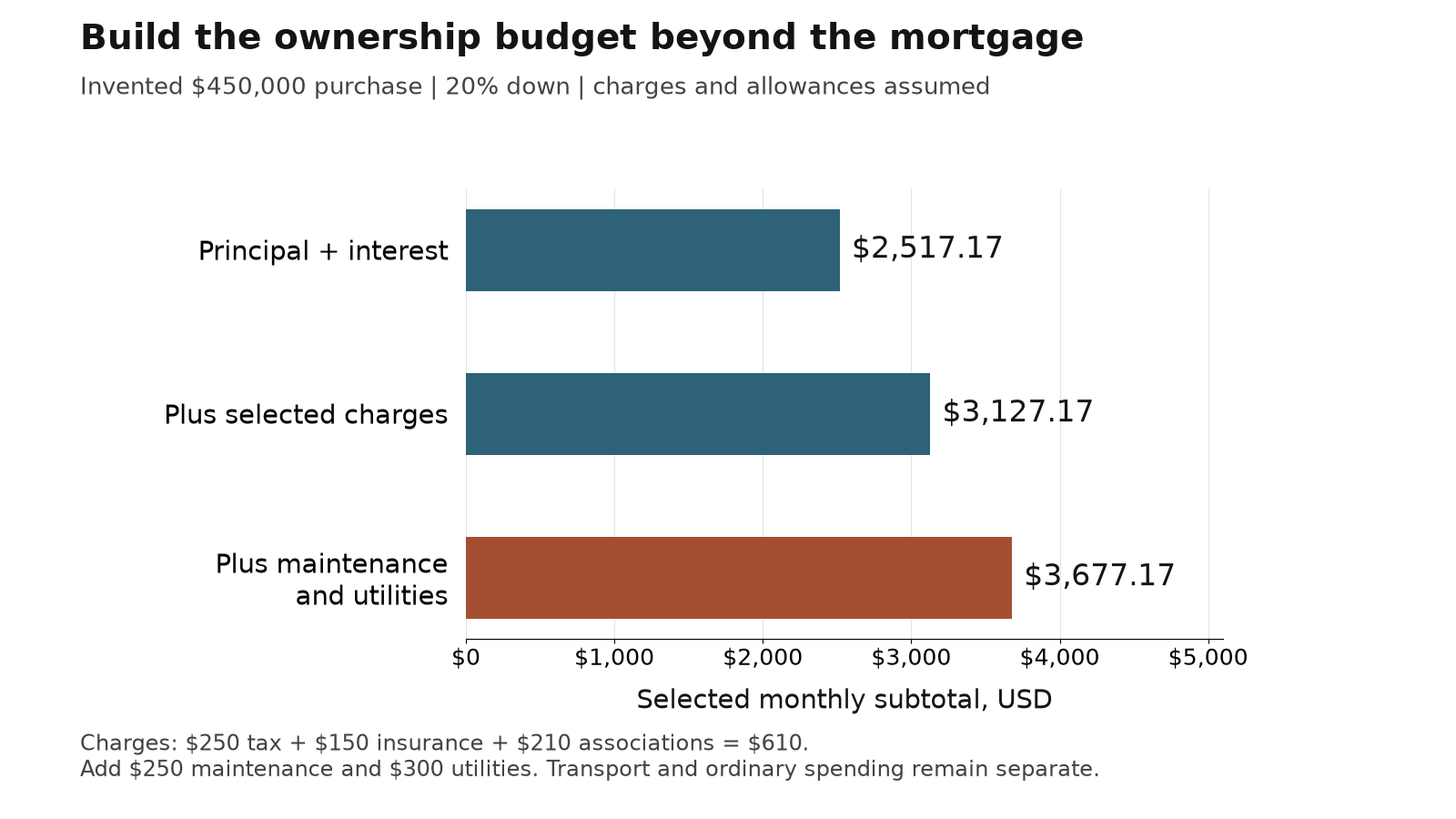
Start with the middle example’s $2,517.17 principal and interest. Add invented monthly amounts of $250 property tax, $150 insurance and $210 combined association charges. Those selected payment components total $3,127.17. Add $250 maintenance savings and $300 utilities, and the selected owner budget becomes $3,677.17 before transport and ordinary household spending.
All additional inputs are assumptions calculated as of October 22, 2026. They are not Mesquite averages, Sun City dues, insurance quotes or a parcel’s tax bill. Some expenses may be collected through an escrow account and others paid directly; check the documents to avoid counting an item twice or omitting it entirely.
Keep necessary work outside the general maintenance allowance. If an inspection identifies a material issue, obtain the relevant estimate and timeline rather than assuming that a monthly savings amount resolves it. Similarly, ask what the insurance proposal covers and excludes. A low premium with different coverage is not automatically the cheaper equivalent choice.
The buyer resources explain the broader purchase process. For this decision, make the household sheet specific: reliable take-home income, housing, transport, healthcare, debt, dependents’ needs and savings priorities. A lender’s approval does not supply every household expense. The article’s chosen figures show a structure you can replace with documented inputs; they do not establish a universal income requirement or promise that Mesquite ownership costs less than every alternative location.
How Do Multiple Associations Change the Comparison?
Where more than one association applies, list each separately. Request current regular dues, payment frequency, known assessments, transfer-related charges and what each organization maintains. Ask which documents and budgets apply to the specific address. The public statement that Sun City Mesquite has two associations is useful, but it does not establish what a particular buyer will pay at closing or afterward.
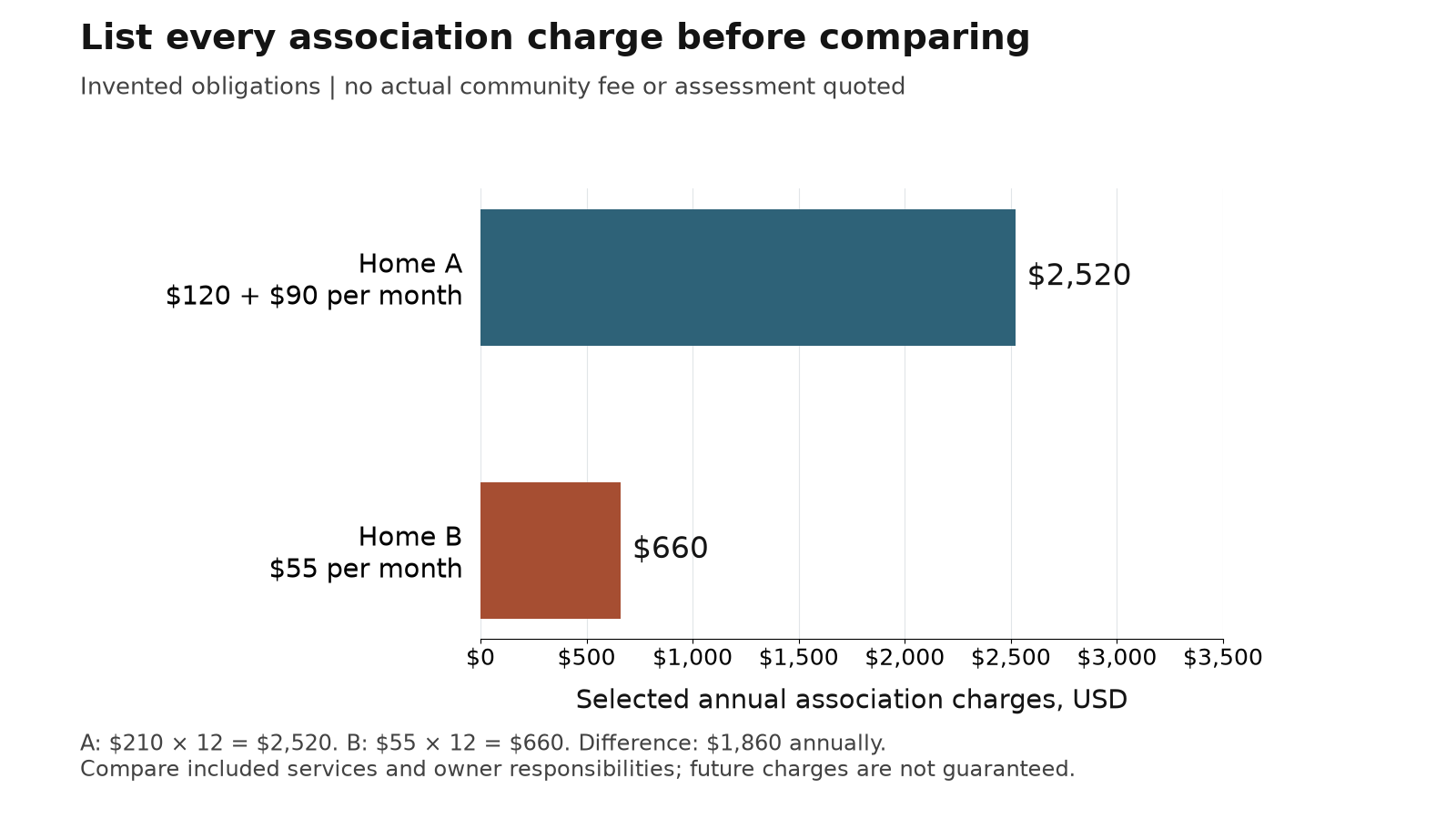
Consider an invented comparison as of October 22, 2026. Home A has assumed monthly charges of $120 to one association and $90 to another, totaling $210 monthly or $2,520 annually. Home B has one assumed $55 monthly charge, totaling $660 annually. The selected difference is $155 monthly or $1,860 annually. These are not quoted Sun City or other Mesquite association fees.
The higher total does not by itself make A worse value. Compare included services and the responsibilities that B leaves to the owner. Conversely, amenities you do not use may add cost without solving a need. Read the financial and maintenance information rather than choosing solely from a dues field.
Keep known special assessments outside the ordinary-dues comparison and confirm their treatment in the transaction. An association’s current fee does not guarantee that future charges will remain unchanged. When material information is unavailable, leave the item unresolved and ask the transaction professionals how to obtain it. This article provides a comparison method; it does not claim to have audited any association’s reserves, insurance, finances or legal compliance.
What Should You Verify About Property Taxes and Insurance?
According to Clark County Assessor’s real-property explanation, taxable value uses prescribed valuation methods and properties fall in different tax districts. Do not estimate the bill as one universal percentage of the asking price. Review the actual parcel information, the period it covers and any change that could affect the amount used in the budget.
According to the county’s tax-abatement guidance, qualifying primary residences can receive a 3% tax-bill cap, with other treatment for other categories and new construction. Recorded ownership changes can require renewed occupancy documentation. This is not a claim that the tax is 3% of the purchase price, and this guide does not determine an individual parcel’s eligibility or final liability.
For insurance, obtain a proposal for the actual property and intended use. Compare coverage, deductibles, exclusions and any conditions the provider requires. Ask how planned vacancy, seasonal use or significant property features affect the proposal when those circumstances apply. A seller’s past premium is not necessarily the new buyer’s quote.
Reconcile differences among the listing, seller records and lender worksheet. Identify whether the numbers use different years, property status or coverage assumptions. If a particular hazard or drainage issue is a concern, obtain the appropriate property-specific information and professional advice. An attractive setting or a favorable overall city description does not establish a home’s insurance availability, flood status or future expense.
How Should Cooling, Utilities and Seasonal Use Enter the Budget?
Ask for available billing history and the circumstances behind it. A lightly occupied house, different thermostat settings or a change in equipment can make the previous owner’s usage a poor match for your plans. Examine the relevant systems during the property review and obtain qualified advice about material condition questions. Do not use a generic “desert home” allowance as proof that the specific house will be inexpensive to operate.
According to Overton Power District’s rates and fees page, customers can review the current rate schedule and billing information. Confirm the service and applicable terms for the address, then use actual usage information where available. This guide does not quote a verified electricity tariff or calculate a particular home’s electric bill. The earlier $300 utilities input is simply a chosen combined allowance.
For seasonal ownership, compare year-round expenses as well as the months you expect to occupy the house. Association charges, insurance, maintenance and selected services may continue while you are away. Ask the relevant providers and association what arrangements apply; do not assume an empty house has no carrying cost or that every service can be stopped without consequence.
Include water use, outdoor maintenance and any pool or irrigation equipment in the investigation when present. Obtain a realistic scope and quotes for work you intend to hire out. The budget should reflect how you plan to use and maintain this house. It should also leave room for uncertainty rather than depending on the lowest historical bill or a promised efficiency saving that has not been verified for the property.
How Can You Check Planned Changes and Nearby Land Uses?
According to Mesquite’s Planning and Zoning page, the city maintains planning functions and links address, parcel and land-use resources. Staff can help explain how relevant policies apply to a proposal. Use the actual address and a clear description of the intended work rather than asking whether a broad neighborhood label generally allows it.
If a future garage, enclosure, addition or other alteration matters to the purchase, investigate it before treating the possibility as part of the home’s value. Determine what documentation and approvals may be needed and whether the relevant estimate includes those steps. Association review and government review may answer different questions; completing one does not automatically establish the other.
The same discipline helps with adjacent land. Ask what is currently shown in applicable records and what remains uncertain about future use. A sales description of an open area or scenic setting is not a guarantee that surrounding conditions will never change. Where the issue could alter the decision, request qualified advice and the actual supporting records.
This article did not inspect an individual parcel map, permit file or proposed development. The city page is a route to the appropriate investigation, not approval for a project. A property remains a better comparison when its verified features are separated from hoped-for changes. If the purchase only works after an uncertain alteration, that uncertainty belongs explicitly in both the decision and the cash plan.
Can a Lower Purchase Price Require More Initial Cash?
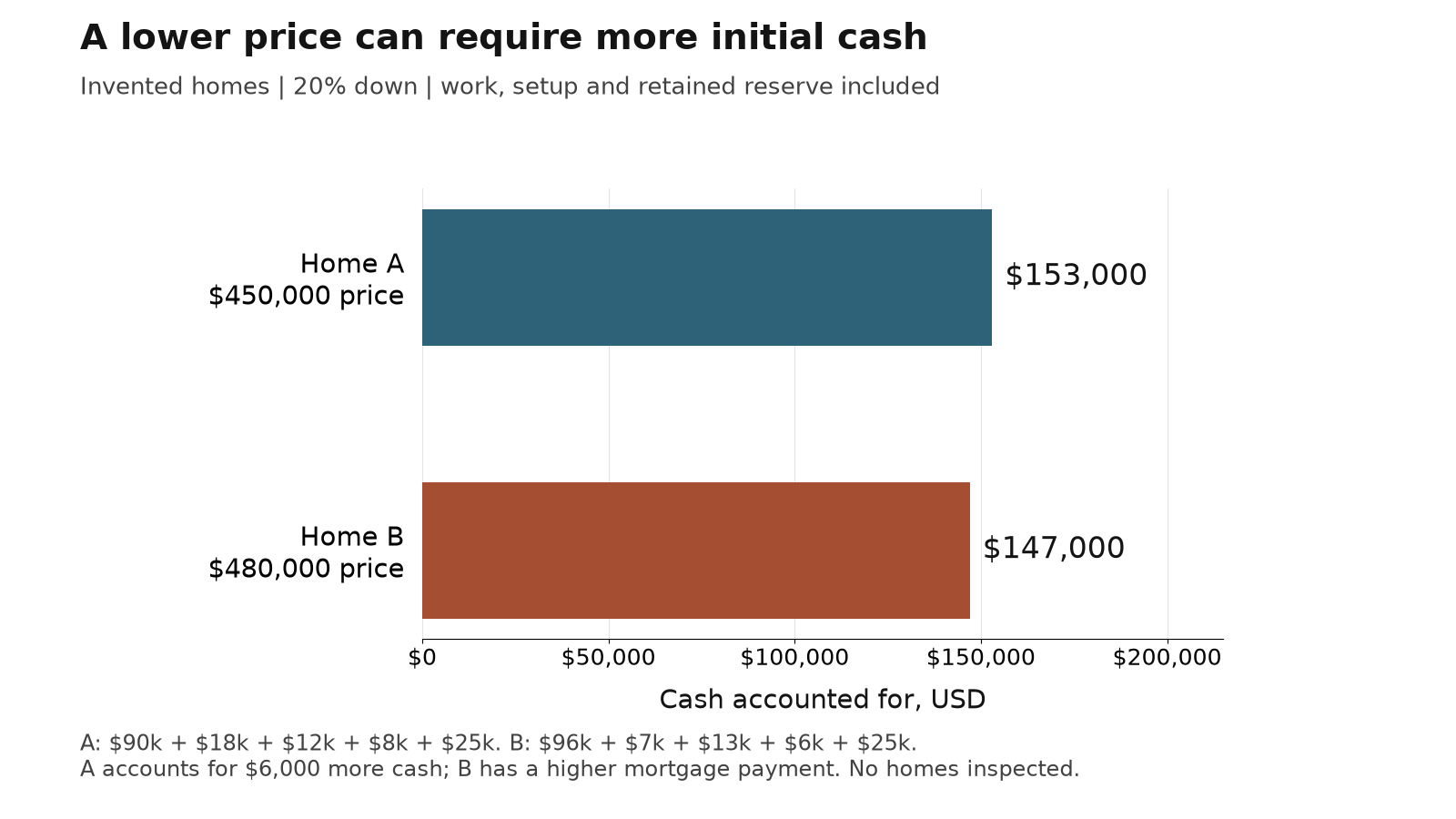
Yes. An invented example as of October 22, 2026 compares a $450,000 Home A with a $480,000 Home B. Both use 20% down, but the assumed necessary work and setup differ. The figures below are selected inputs, not inspected properties or quotes. The reserve remains the buyer’s money; it is included to show the total cash accounted for, not as a closing charge.
| Category | Home A: $450,000 | Home B: $480,000 |
|---|---|---|
| 20% down payment | $90,000 | $96,000 |
| Selected necessary work | $18,000 | $7,000 |
| Closing and prepaid items | $12,000 | $13,000 |
| Moving and setup | $8,000 | $6,000 |
| Retained reserve | $25,000 | $25,000 |
| Total cash accounted for | $153,000 | $147,000 |
Under these assumptions, the lower-price Home A accounts for $6,000 more cash. Home B still has a larger loan. At the same assumed 7.50% fixed rate and 30-year term, its $384,000 loan has $2,684.98 monthly principal and interest, $167.81 more than A. The cash advantage and monthly disadvantage are separate trade-offs.
Replace every line with verified property findings and transaction documents before using the comparison. A reserve amount should reflect household needs and uncertainty, not a universal standard. If proceeds from another home fund the purchase, coordinate the timeline through the seller resources and transaction team. Expected proceeds are not available cash until the relevant transaction provides them. The Nevada escrow guide explains the closing sequence to discuss when coordinating both transactions.
How Do Income and Down Payment Affect the Decision?
Use the selected $3,127.17 payment components from the middle example. If you choose a 30% gross-income screen, the calculation is $3,127.17 × 12 ÷ 0.30, or $125,086.80 annual gross income. This calculation, made as of October 22, 2026, is a planning screen you selected, not a lender’s qualification standard or the income every Mesquite buyer needs.
Test take-home cash separately. With assumed monthly receipts of $7,000, the broader $3,677.17 owner budget and $2,500 other spending leave $822.83. An additional $400 obligation leaves $422.83. Any omitted expense reduces that margin further. Use reliable income and actual obligations rather than assuming a future raise, investment gain or refinance.
I always start buyers with a real pre-approval so we anchor the search to what you actually qualify for. For active-adult buyers using retirement income, I connect you with lenders experienced in asset-based and retirement-income qualifying, which can make a real difference in what you can buy. The lender still needs the actual facts and documentation; no program eligibility is established by this article.
A smaller down payment can preserve cash while increasing the loan and potentially changing other charges. Compare real alternatives with the lender, including mortgage insurance or program fees where applicable, rather than assuming every option has the same trade-off. The useful result is a financing plan, household budget and reserve that work together. Buying with cash also leaves taxes, insurance, association obligations and maintenance to fund. The Nevada home-affordability guide offers a broader framework for comparing financing limits with the household budget.
How Should You Prepare for a Mesquite Offer?
Request current comparable sales relevant to the candidate, its listing history, condition information and the proposed contract terms. A broad median or a portal’s market label cannot tell you a seller’s priorities or whether another offer exists. Do not assume that all homes sell at one discount or within a standard number of days.
In my experience, buyers who are pre-approved and clear on their target community can act decisively when the right home appears, which matters most in the popular Sun City and golf segments. That preparation — pre-approval, target community, and priority list — is what I front-load before we ever tour, so you are ready to move on the right Mesquite home. Preparation supports timely decisions; it does not require ignoring a material unresolved issue.
Discuss investigation deadlines, financing, completion timing and consequences with the professionals handling the transaction. If an association document, inspection result or financing term changes the cost, update the comparison before deciding how to proceed. A price concession can be useful without eliminating the need to understand the underlying problem. Use the Nevada offer guide to prepare the terms and questions for that discussion.
I keep a live read on what is available. For this guide, however, no current listing sample was evaluated and no particular property is recommended as a bargain. Use the published examples as a method, then obtain the current address-specific evidence. Consider the household’s time horizon and ability to carry the home if resale takes longer than expected. A preferred community or a regional price trend does not guarantee appreciation or an easy exit.
What Should Be on the Final Mesquite Comparison Sheet?
The most expensive mistake I see is not matching the community to your stage of life. Translate that concern into specific preferences and requirements: how you will use the house, which activities matter, the applicable occupancy rules, the ongoing responsibilities and the financial limits. Avoid substituting a broad label for an actual fit assessment.
List the candidate’s price, financing, each association charge, taxes, insurance, utilities, necessary work, optional improvements and retained reserve. Mark each as documented, assumed or unresolved. Compare included services with responsibilities left to the owner. Then explain the most important compromise in plain language: more cash today, a higher monthly payment, work to complete or a feature you are willing to forgo.
Check the daily routine from serious candidates, including work, appointments, shopping and other destinations you regularly use. The relevant travel conditions are your own; this guide does not declare a universal commute time or who should live in Mesquite. Test any essential service or access requirement directly rather than relying on a general description of the town.
As the lead agent at Nevada Real Estate Group, I help relocating and local buyers find the right Mesquite home for their stage of life. Call (702) 637-1759 or contact our team to compare current candidates against your chosen requirements. Start with the actual budget and an honest list of unknowns. The goal is a home whose features and obligations make sense together after closing.
Frequently Asked Questions
What is the median home price in Mesquite in 2026?
Use a dated measure and keep its property selection attached. The September asking and sold medians in the table above describe different groups, not one standard house or a guaranteed negotiation discount. For a particular purchase, obtain relevant comparable sales instead of relying on an all-year headline.
What does $450,000 buy in Mesquite?
This guide uses $450,000 as a chosen purchase budget. Actual choices depend on current availability, property type, condition, lot, layout and obligations. It does not promise a particular size, bedroom count or community. Compare specific candidates rather than treating a budget as a standard house specification.
Does Sun City Mesquite have more than one association?
Its public governance page identifies Sun City Mesquite HOA and the Anthem Mesquite Master Association and says residents belong to both. Obtain the current charges, documents and responsibilities applicable to the actual home. This article does not quote verified dues or establish a particular household’s occupancy eligibility.
What is the payment on the $450,000 example?
At 20% down, the assumed loan is $360,000. At 7.50% fixed for 30 years, monthly principal and interest are $2,517.17. Taxes, insurance, association charges and other costs are additional. The broader budget uses invented allowances that need replacement with property-specific documents and quotes.
Is a golf-community home automatically better value?
No. Compare the setting and services you will use with the price, obligations, condition and cash remaining. Verify memberships and costs rather than assuming that a fairway location includes golf access. A view or community name does not guarantee appreciation or resale performance.
Can a less expensive house require more cash?
Yes. Necessary work, closing items and setup can outweigh the smaller down payment. The invented comparison here accounts for $153,000 cash for Home A and $147,000 for the higher-price Home B. Home B also has a higher loan payment, so both parts of the trade-off matter.
Does a 3% tax cap mean the tax is 3% of the purchase price?
No. Clark County’s abatement guidance describes a cap framework for qualifying tax bills, with different treatment and requirements in other situations. It is not a simple percentage of the asking price. Review the parcel’s records, tax district and required occupancy documentation with the appropriate office.
Is an all-cash purchase free of monthly housing costs?
No. Taxes, insurance, association obligations, utilities and maintenance can continue without a mortgage. Necessary repairs and the cash you retain also matter. Compare reliable income, ongoing expenses and reserves, including costs that continue during seasonal absences, before deciding how much cash to put into the property.
Which Sources Inform This Mesquite Budget Guide?
Sources were reviewed as of October 22, 2026. Realtor.com’s Mesquite summary provides the dated asking and sold figures. Conflicting narrative change rates and nearby-market figures were not adopted. No individual sale dataset was recomputed and no current inventory sample supports a promised home specification at the example budgets.
Sun City Mesquite’s community page and governance page provide the general community and two-association descriptions. The public pages are not a complete transaction-document review. Mesquite Planning and Zoning identifies planning functions and resources. Overton Power’s rates page directs customers to billing information; its linked rate table was not visually verified, so no tariff calculation is adopted here.
Clark County’s real-property explanation and abatement guidance support the tax questions. Freddie Mac PMMS supplies dated national rate context, and the CFPB Loan Estimate guide supports financing comparisons. Mortgage and cash worksheets are original calculations using disclosed invented inputs, not lender quotes or client results.
The cover is conceptual and the charts illustrate the selected calculations. No individual parcel, association finances, occupancy eligibility, utility use or permit outcome was verified. Replace assumptions with current documents, retain the source dates and scopes, and resolve the questions material to the purchase before relying on the resulting budget.
Nevada Real Estate Group · Chris Nevada · License S.181401 · (702) 637-1759.