

Your Pahrump budget has to buy a usable property and a manageable set of responsibilities. Two homes with the same asking price can differ in land access, water supply, wastewater disposal, financing and the work needed after closing. Start with the way you want to live, then compare the actual properties that support it. Acreage, a subdivision lot and a home near golf solve different problems.
Pahrump's August 2026 single-family report showed a $334,500 median across 36 closed sales, according to NREG's GLVAR-fed city report. That dated sample does not promise a particular house or lot today. Use $300,000, $375,000 and $475,000 as comparison budgets, then verify each home's condition, land use, water, septic or sewer, financing and total ownership cost before choosing between acreage, subdivisions and Mountain Falls.
- A monthly median describes a closed-sale sample; it is not a current listing or a guaranteed size, acreage or condition.
- Separate rural acreage, connected-service homes and Mountain Falls before comparing prices.
- A well and septic system carry testing, maintenance and replacement responsibilities even without utility-company bills.
- Confirm zoning, access, water arrangements and financing for the actual parcel before paying for imagined future uses.
- Keep down payment, closing costs, immediate work and retained reserves separate from the monthly payment.
How we know this: Across the 9,600+ closings Nevada Real Estate Group has represented statewide — more than $4.85B in closed volume — we work the Southern Nevada market including Pahrump, so we see how this rural valley actually trades. In my experience, the buyers who thrive in Pahrump understand the rural essentials — land, wells, and septic — before they fall for a price, because a $375,000 home on acreage is a very different purchase than a city home. The dated market observation below comes from the linked city report. Payment and repair comparisons are explicitly invented planning examples; they are not client records, lender quotes or descriptions of available homes.
What Does the Latest Pahrump Price Tell You?
The Pahrump single-family market report displayed August 2026, a $334,500 median sold price and 36 closed sales when reviewed on October 22, 2026. This is an affiliated NREG report using Las Vegas REALTORS/GLVAR data through Repliers IDX, with a Pahrump city filter and a single-family property-type selection. It is neither an independent endorsement nor an all-property or full-year median. The report can update after this review.
We've represented buyers in Pahrump, so treat the median as a starting budget, not a house. A median cannot establish how many bedrooms you can buy, the condition of a well, or whether a detached workshop is permitted. Before making an offer, compare recent closed properties with similar construction, lot characteristics, systems and location. Review active competition separately: asking prices are requests, and a closing may involve credits or other terms that the headline price does not explain.
Keep the original guide's useful $300,000, $375,000 and $475,000 shopping levels as illustrative budgets, rather than labeling $375,000 as today's median. A more expensive home can reduce near-term work; a cheaper one can consume the difference in repairs or access improvements. Neither result follows automatically from its price. Start with Pahrump homes for sale and record the actual listing date, property type and included improvements on your comparison sheet.
Which Pahrump Property Type Fits Your Budget and Routine?
Choose the responsibility you want before choosing the largest house in your search results. An acreage buyer may value space for a permitted project enough to accept more maintenance. A frequent traveler may put connected services and a simpler yard first. A golfer may value proximity while still needing to establish exactly what the association and club provide. The categories below are search questions, not promises of current inventory at any price.
| Search option | Potential reason to consider it | Evidence needed before comparing value |
|---|---|---|
| Rural acreage | Space and separation for your intended use | Legal access, boundaries, zoning, water arrangement and wastewater records |
| Town-center or subdivision home | A routine built around nearby services | Actual providers, connections, charges, property condition and any association |
| Mountain Falls | Preference for a planned setting near golf | Address-specific association documents, assessments and separate amenity terms |
| Manufactured home with land | A different construction and financing option | Title, land ownership, installation records and lender acceptance of the specific home |
| Older site-built home | A location or layout worth evaluating | Systems, permits, inspections and written work estimates |
The largest groups I work with are retirees stretching a fixed income or home-sale equity into a paid-off home on land; remote workers who want space and affordability and no longer need a daily commute; land lovers, hobbyists, and homesteaders who want acreage for horses, RVs, or projects; and priced-out Las Vegas buyers who discover their budget goes dramatically further an hour west. Your decision should still start with your own appointments, travel and intended uses. In my experience, buyers who embrace what makes Pahrump different — the space, the independence, the rural rhythm — are the happiest here, and they make more confident decisions because they know exactly what they are buying into.
What Should a $300,000, $375,000 or $475,000 Search Actually Compare?
Treat each price as a filter, then compare usable outcomes. At $300,000, investigate whether a candidate's price reflects construction type, condition, location or an ownership arrangement that changes financing. At $375,000, compare the additional features against the additional debt and cash required. At $475,000, decide which improvements you will actually use instead of assuming a larger budget produces a better fit. These are evaluation methods, not claims about which homes are currently available.
For a controlled illustration, assume a fully amortizing 30-year fixed loan at 7.50%, 20% down, no financed fees and monthly payments. These are chosen inputs, not a current rate quote. Principal and interest are approximately $1,678.11 on a $240,000 loan, $2,097.64 on a $300,000 loan and $2,657.02 on a $380,000 loan. Taxes, insurance, assessments, utilities and repairs are additional. A lender's actual offer can differ.
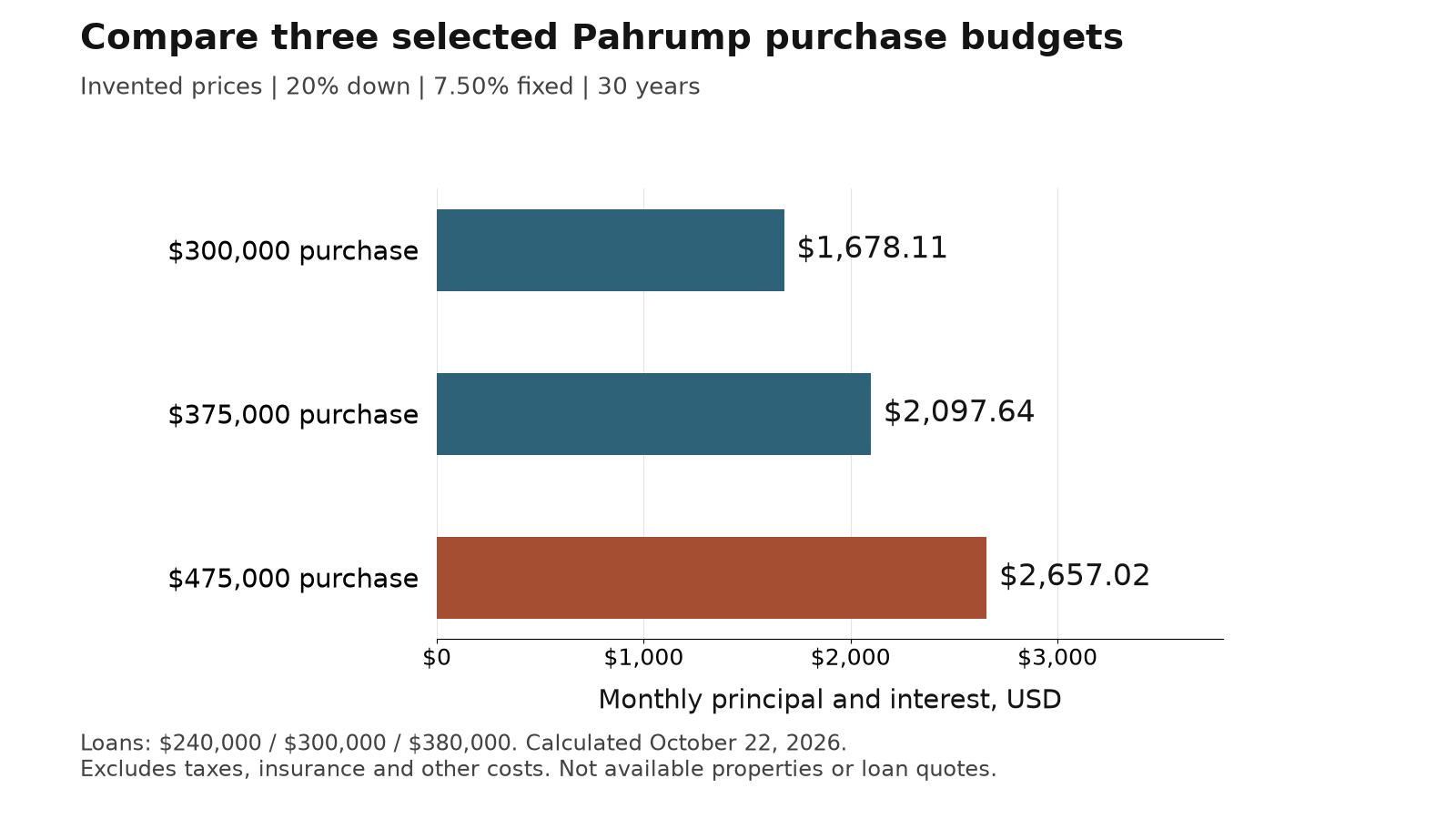
The down payments in that comparison are $60,000, $75,000 and $95,000. Those are not total cash requirements. Before increasing your price filter, decide whether the extra down payment would leave enough for a well repair, a replacement cooling system, moving and your ordinary emergency fund. A house can fit a mortgage formula while leaving an uncomfortable cash position.
What Makes Acreage Useful Rather Than Just Larger?
Acreage has value when it supports the activities you actually want. A parcel's advertised area does not establish its boundaries, access, usable terrain or allowed uses. Walk the relevant portions with appropriate professionals, compare the title documents and recorded maps, and ask about easements or shared routes. Do not assume a visible track across a neighboring lot gives permanent legal access. The Nye County Assessor explains how to retrieve a plat map by parcel number; a map is a starting record, not a substitute for a survey or title review.
Write down the project before shopping: an RV garage, horses, a detached office, storage, a garden or simple separation from neighbors. Then request written guidance from the relevant county office about that use at the specific parcel. The Nye County Planning FAQ distinguishes zoning from the assessor's land-use code and directs owners to zoning verification. A tax classification does not answer the same question as permission to build or operate something.
Budget for the land as well as the house. Fencing, gates, grading, driveway condition, drainage, vegetation management and distances to utility connections can change what you need after closing. Obtain estimates that explain scope and exclusions. A flat allowance per acre is a poor substitute for a contractor examining the work. Keep the Pahrump community hub open beside your property notes so that location and access remain part of the comparison.
How Should You Compare Connected-Service Subdivisions?
A subdivision home can suit a buyer who prefers a smaller maintenance footprint, but a subdivision name does not identify every service or cost. Verify water, sewer or septic, electricity and any fuel arrangements at the actual address. Ask which portions of the system the owner maintains, whether accounts transfer easily and whether connection work is outstanding. Review recent bills where available, then consider how your occupancy and usage differ from the seller's.
I steer buyers who prefer low-maintenance, connected-utility living toward these subdivisions, especially first-time buyers and those newer to rural areas. That preference should be tested against the house itself: a smaller lot with an older roof, unresolved drainage or a complicated irrigation system can require substantial attention. Compare both immediate repairs and recurring work, including anything an association expects the owner to maintain.
Nye County's planning guidance directs utility-location questions to the provider with jurisdiction. A nearby line does not prove an active connection or a quoted connection price. Obtain service confirmation before assuming a listing's word “utilities” means everything needed for occupancy is operating. For broader new-build comparisons, Southern Nevada new construction is a separate search; it does not establish Pahrump availability or erase the need for an address-specific contract and specifications.
What Must You Confirm Before Choosing Mountain Falls?
Compare a Mountain Falls property on its own documents and current costs. A golf setting is not a promise that every home includes unlimited golf, every recreation facility, or the same association arrangement. Request the current resale package or builder documents applicable to the address, the assessment schedule, any separate memberships and the actual maintenance obligations. Ask what changes when ownership transfers and whether any charges are paid annually, quarterly or at closing.
I bring Mountain Falls into the conversation for buyers who want the affordability and space of Pahrump but prefer amenities, a golf setting, and the predictability of an HOA-managed community over rural acreage. The useful next step is a comparison of documented benefits you would use. A pool or club that you rarely visit may have less value to you than a quieter room layout, a suitable garage or a less demanding yard.
Make separate lines for association dues, special assessments, transfer charges and optional activities. Do not combine them into one unexplained “HOA” figure. This guide does not quote current Mountain Falls dues, membership prices or included facilities because those terms need current address-level documents. Compare the resulting total with a non-association property that requires its own exterior maintenance. Both choices involve costs; the timing and allocation differ.
What Should You Verify About a Pahrump Well?
Verify the water arrangement before treating a well as an asset. Request available well records, maintenance history, the equipment details, any shared-use agreement and an appropriate inspection and testing scope. Water quantity, water quality, legal authority and equipment condition are different questions. A brief flow observation does not establish safe drinking water or predict future performance. Have qualified professionals explain the tests and their limits for the specific system.
Before buying a well-and-septic property, I always arrange a well flow and water-quality test and a septic inspection, because a failing well pump or septic field can be a five-figure surprise. The EPA's private-well guidance recommends annual testing for coliform bacteria, nitrates, total dissolved solids and pH, with additional testing as conditions warrant. Ask a certified drinking-water laboratory and the appropriate local authority what applies to the property; a seller's old result is not a complete current assessment.
The Nevada Division of Water Resources map directory provides separate tools for well information, water levels and Pahrump water-right relinquishments. Use those records to frame questions for the agency and your professional advisers. This guide has not inspected a parcel in those maps and does not certify drilling rights, future supply or permission to add another dwelling. Existing equipment and the ability to expand its use should be verified separately.
How Do Septic Systems Change the Ownership Budget?
Start with records, condition and the location of the system's components. Ask for installation and service documents, the tank and drainfield layout, known repairs and the scope of a professional inspection. A receipt for pumping is not automatically a comprehensive assessment of the whole system. Identify what is inspected and what remains unknown before deciding whether an issue needs additional investigation or a written estimate.
The EPA's septic maintenance guide, updated August 17, 2026, describes inspection of an average household system at least every three years and typical pumping every three to five years, with some alternative systems needing more frequent attention. Those are general guidance intervals, not a promise for your property. Household use and the specific equipment matter. Have the service professional set an appropriate plan and keep their records with the property file.
Locate the drainfield before planning an RV pad, workshop, driveway or garden. EPA advises against driving or parking on it. That is why usable acreage cannot be read from the lot-size number alone. Set aside money for ordinary service and unexpected work, and ask how an interruption would affect occupancy. I make sure you know exactly which you are buying and what maintenance it entails before you commit.
Does a Well Mean You Have Free Water and No Utility Costs?
No utility-company water bill does not mean free water. A privately maintained system can require power, testing, treatment, service and equipment replacement. A connected home can also leave the owner responsible for portions of its plumbing or service line. Determine the ownership boundary and obtain actual provider terms or professional estimates before comparing the two. Neither arrangement is automatically the less expensive one.
| Cost or question | Connected services | Private well and septic |
|---|---|---|
| Routine spending | Confirm provider charges, usage and account fees | Confirm power, testing, treatment and scheduled service |
| Repair responsibility | Identify the owner/provider boundary | Identify equipment ownership and any shared agreement |
| Before purchase | Confirm connections, service status and property-side condition | Review records and appropriate independent inspections and tests |
| Cash planning | Allow for non-escrowed bills and owner repairs | Allow for service visits, repairs and replacement reserves |
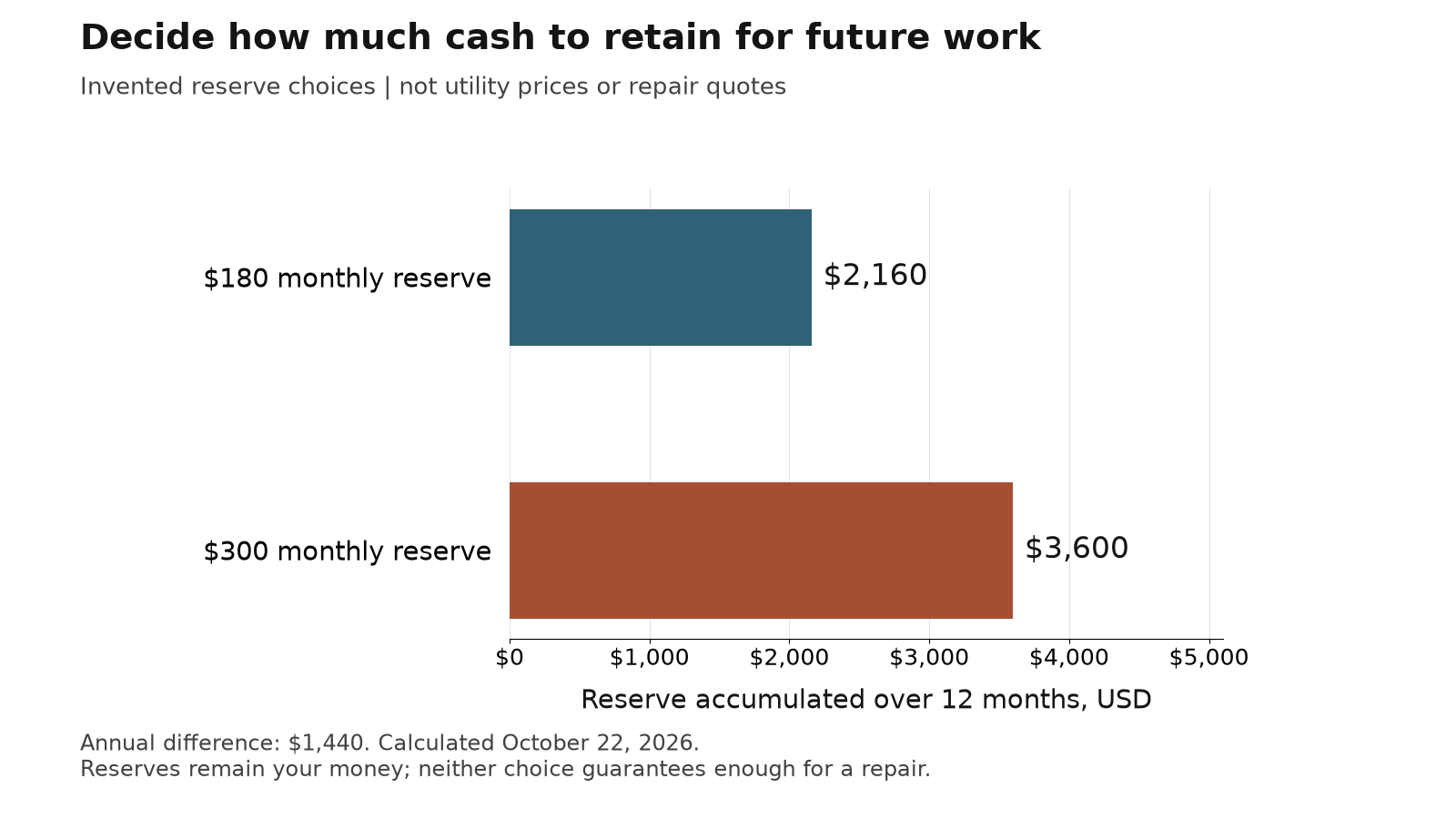
For an invented comparison, a $180 monthly reserve is $2,160 over a year; a $300 reserve is $3,600. The $1,440 difference is money retained for possible work, not evidence that either system costs that amount to operate or that the reserve will cover a failure. Separate reserve contributions from actual utility bills so you do not mistake an accounting choice for a local tariff.
What Could a $375,000 Home Cost Each Month?
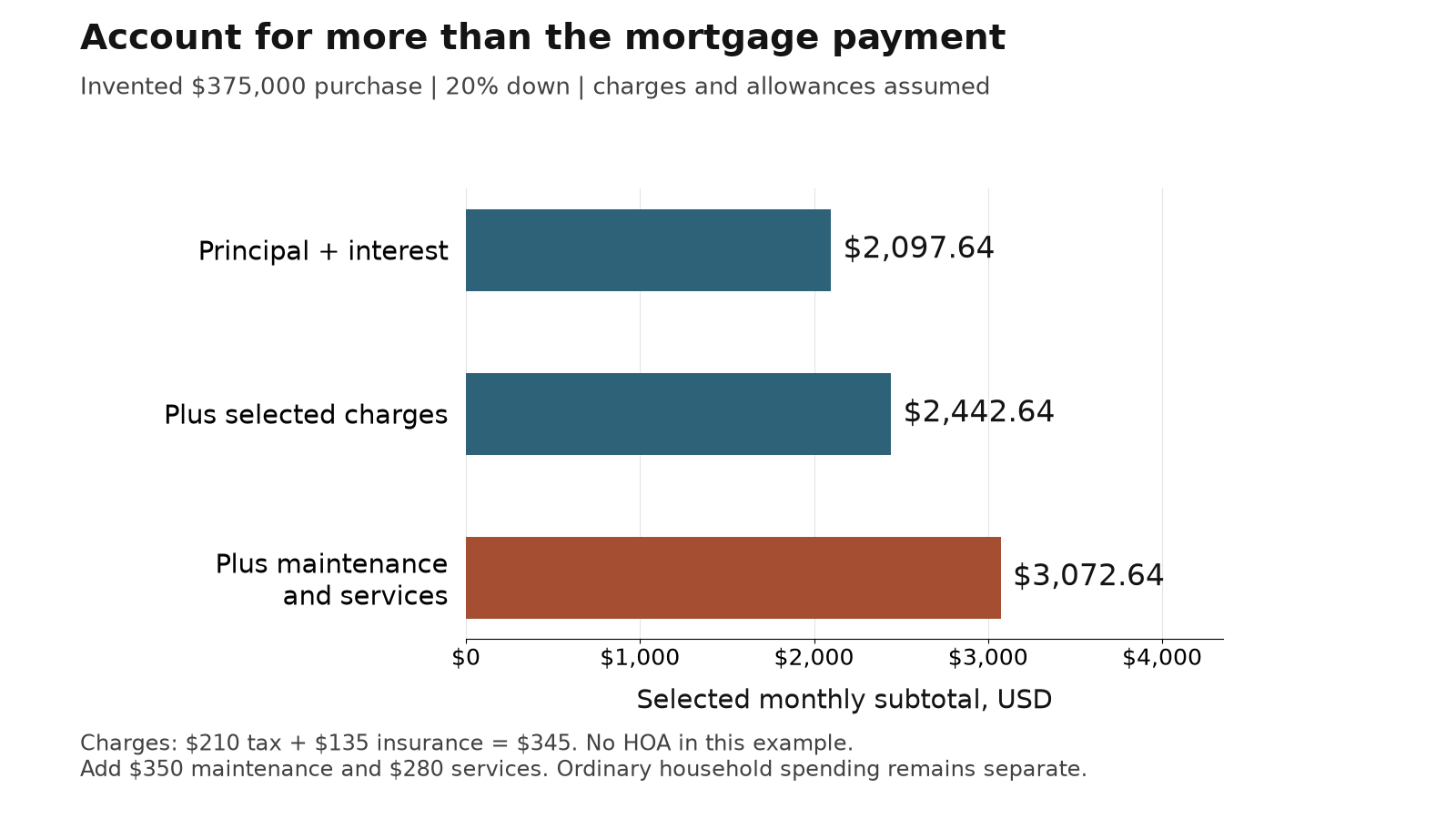
Build a property-specific budget from the loan and confirmed ownership costs. In the earlier illustration, a $375,000 price with $75,000 down produces a $300,000 loan and $2,097.64 monthly principal and interest. Add chosen placeholders of $210 for taxes and $135 for insurance, with no association charge in this example, and the modeled housing amount is $2,442.64. These tax and insurance amounts are invented inputs, not Pahrump averages or estimates for a real address.
Now add a chosen $350 maintenance reserve and $280 for utilities and other property services. The planning total becomes $3,072.64 per month. It still excludes food, vehicles, healthcare, other debts and your nonhousing spending. A reserve is money retained, not a charge paid every month. A major repair could exceed it. Where mortgage insurance, an association, flood coverage or other charges apply, add them explicitly rather than assuming the example covers them.
The Consumer Financial Protection Bureau's Loan Estimate explainer distinguishes principal and interest from other payment and closing items. Use your lender's form and verify tax and insurance assumptions separately. The Nye County Assessor provides local assessment information; ask about the parcel rather than multiplying its purchase price by a generic internet percentage. Budget bills paid outside escrow as carefully as those included in the payment.
How Much Income and Cash Should You Keep Available?
An income screen is a household planning choice, not a lender approval. If you choose to keep the example's $2,442.64 housing amount at 30% of gross income, the arithmetic is about $97,705.60 a year. That does not include the example's maintenance and service allowances, all other spending or your tax situation. A lender assesses income, debts, credit, assets and the property under the applicable program; it may reach a different conclusion about eligibility.
Test take-home cash instead. With invented take-home income of $6,500 and other spending of $2,400, the $3,072.64 property planning total leaves $1,027.36. An additional $500 monthly obligation would leave $527.36. Decide whether that is enough for your savings goals and irregular expenses. A cash buyer removes loan payments but still needs a realistic ownership budget and liquidity for work that cannot wait.
I always start buyers with a real pre-approval so we anchor the search to what you actually qualify for. For rural and manufactured-home purchases, loan type matters, so I connect you with lenders experienced in those. In a separate invented cash plan, $75,000 down plus $12,000 closing costs, $15,000 immediate work, $5,000 moving and a retained $20,000 reserve totals $127,000. The retained reserve is not a closing charge. Replace these choices with the actual transaction and keep amounts already paid from being counted twice.
Which Financing Questions Matter for Rural and Manufactured Homes?
Give lenders the exact property type early. Ask whether the land and home transfer together, how the home is titled, which installation or foundation records are needed, and whether well, wastewater, access or condition issues affect the proposed financing. A pre-approval based on your finances does not prove every property in a price search is acceptable collateral. Obtain the lender's requirements before spending money on a home that may not fit the selected program.
Do not assume all of Pahrump is excluded from USDA financing, or that a rural appearance makes an address eligible. USDA's eligibility site checks an address and household income; other program requirements also apply. Under 7 CFR 3555.103, a guaranteed loan can reach the appraised value plus the up-front guarantee fee, capped by the purchase price plus eligible costs. That does not make closing costs, cash reserves or property repairs disappear, and this guide has not obtained eligibility results for a particular address.
I connect Pahrump buyers with lenders who close rural and manufactured deals routinely, which prevents surprises late in escrow. Compare the actual terms and documentation for your case. Our Nevada FHA guide and VA home-loan guide explain separate programs, while the step-by-step Pahrump buying guide covers the purchase process. This page concentrates on choosing the property and budget; it does not replace underwriting or a complete contract review.
Can the Cheaper House Become the More Expensive Choice?
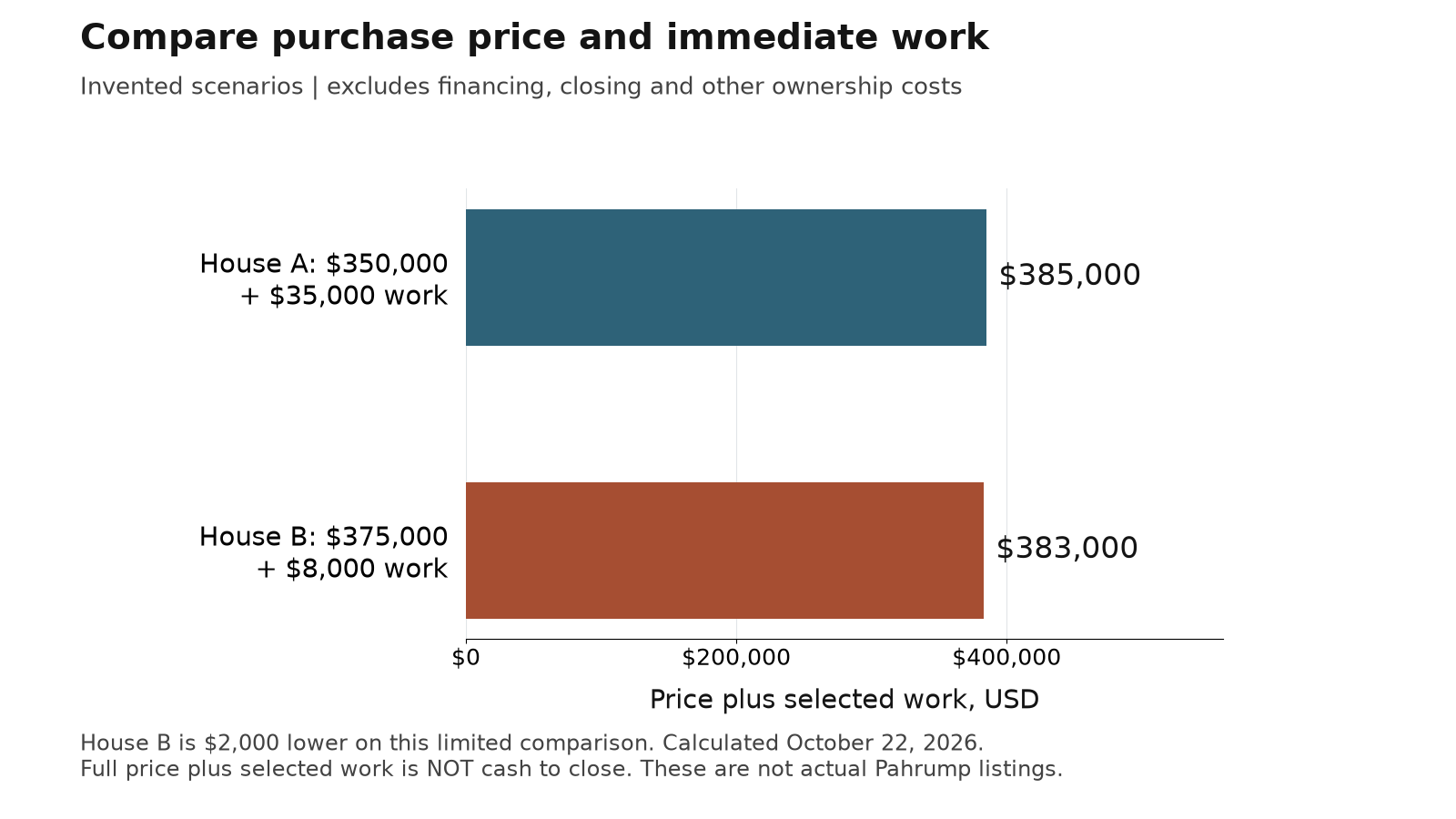
Yes, but establish that with documented scope rather than a blanket assumption about older homes. In an invented comparison, House A costs $350,000 and needs $35,000 of immediate work; House B costs $375,000 and needs $8,000. The price-plus-work totals are $385,000 and $383,000. A $25,000 price difference becomes a $2,000 difference in the opposite direction for these two selected inputs. This is not a claim that the homes are otherwise equivalent.
| Item | House A | House B |
|---|---|---|
| Chosen price | $350,000 | $375,000 |
| Chosen immediate work | $35,000 | $8,000 |
| Price plus work | $385,000 | $383,000 |
| Still outside the comparison | Financing, closing costs, timing and future work | Financing, closing costs, timing and future work |
Ask when work can happen, whether the home can be occupied during it, and how it will be paid for. A repair allowance on paper is not an executed repair or a contractor appointment. Preserve inspection and financing questions within the applicable agreement and deadlines. If your existing home funds the purchase, the seller resources can help organize the sale side without assuming that proceeds will arrive on the day you need them.
How Should Commute, Access and Flood Questions Affect Your Offer?
Test the actual drive between the candidate home and the places you use, at the times you expect to travel. A town-to-town mileage estimate cannot account for your destination, local roads, weather, stops or medical appointments. Compare weekly time and vehicle spending alongside the property payment. If you also consider Las Vegas or Henderson, use the same destination and schedule for each option rather than assuming every valley neighborhood solves the commute.
For remote work, verify service at the exact address and ask about installation timing and backup options. For acreage, examine all-weather access, drainage and the location of improvements you plan to use. Nye County's Planning FAQ directs buyers to its flood information and an address/APN search with the flood layer. This guide has not checked a particular parcel or determined whether flood insurance is required. Ask the appropriate authority and insurer about the home you are actually buying.
In my experience, buyers who are pre-approved and clear on their priority — land, convenience, or amenities — can act decisively when the right home appears. I keep prepared buyers alerted to fitting new listings. Being prepared includes knowing which unresolved documents or inspections would stop the purchase. It does not mean assuming a good well guarantees fast resale or accepting a deadline that prevents necessary review.
What Is the Most Useful Next Step for a Pahrump Buyer?
Build a short list with a consistent comparison sheet: address and parcel number, construction type, included land, intended use, confirmed water and wastewater arrangements, observed condition, unresolved questions, price, loan terms and cash remaining after purchase. Mark each item as documented, quoted or still unknown. A listing description can start an investigation; it should not silently become the answer to every question on the sheet.
The most expensive mistake I see is skipping the rural due diligence — buying a well-and-septic property without a well flow test, water-quality test, and septic inspection. Keep inspection results and written estimates attached to the actual candidate. If a property's main appeal depends on a workshop, additional dwelling, animal use or club access, resolve that specific question before assigning it financial value. The buyer resources can help organize the broader process once your comparison identifies the right kind of home.
As the lead agent at Nevada Real Estate Group, I help buyers navigate Pahrump's rural market — land, wells, septic, and all. Call (702) 637-1759 or contact our team with your budget, target payment and intended property use. The useful outcome is a shortlist grounded in the homes and documents available at that time, with clear next steps for the remaining questions.
Frequently Asked Questions
What is the median home price in Pahrump in 2026?
NREG's GLVAR-fed Pahrump report displayed a $334,500 median across 36 single-family closings for August 2026 when reviewed October 22. That is a dated monthly sample, not a full-year or all-property figure. Check the linked report's period and property-type selection before using it, and obtain recent comparable sales for an individual home.
What does $375,000 buy in Pahrump?
$375,000 is a useful search budget, but it does not guarantee a particular size, acreage, condition or Mountain Falls entitlement. Compare current properties in the same construction and service category, then investigate land use, water, wastewater and repair needs. A lower price may leave room for work, or it may reflect problems that exceed the savings.
Are wells and septic cheaper than utility connections?
Not automatically. A private system may avoid provider bills but still requires power, testing, maintenance and repairs. Connected service has its own charges and may leave some maintenance with the owner. Compare actual bills, ownership responsibilities, inspection findings and reserve needs; this guide's reserve amounts are illustrations, not Pahrump tariffs or service quotes.
Can I use USDA financing in Pahrump?
Check the exact address through USDA's eligibility tool and discuss your household and property with an approved lender. Do not infer eligibility or exclusion from the name Pahrump or a property's rural appearance. Program eligibility includes more than location, and no-down-payment financing for an eligible case does not eliminate every other purchase expense.
Does buying in Mountain Falls include golf?
Do not assume that it does. Obtain the documents and current charges for the particular home's association and any separate club or recreation arrangement. Confirm what transfers to a buyer, what is optional and what use restrictions apply. This guide does not quote current dues or certify included facilities for any Mountain Falls address.
Can I put an RV, workshop or second dwelling on acreage?
Verify the intended use and proposed location with the appropriate county office, title records and any applicable association before buying. Acreage alone does not establish permission. Water, wastewater, access, easements and setbacks may affect your plan. Obtain parcel-specific guidance instead of treating a neighbor's improvement as proof that the same project is allowed.
How much income does the $375,000 example require?
The invented $2,442.64 housing amount equals 30% of approximately $97,705.60 annual gross income. That chosen screen is not underwriting approval, and it excludes the example's $630 maintenance and service allowances plus nonhousing spending. Test your take-home budget and have the lender review your actual income, debts, assets, program and property.
What should I ask before buying a manufactured home with land?
Ask how the home and land are titled, what transfers in the sale, which installation and foundation records exist, and whether the lender accepts the specific property. Review services, access and condition as well. A price listing or personal pre-approval does not resolve these property questions; get the relevant documents early in the comparison.
Which Sources and Assumptions Support This Guide?
Reviewed October 22, 2026: the affiliated NREG Pahrump city report for the stated August single-family sample; Nye County Planning for zoning, utility and flood-information routes; the Nye County Assessor for parcel-map and assessment resources; Nevada Division of Water Resources for the available map tools; EPA private-well guidance and EPA septic guidance for the limited maintenance and testing points cited; USDA's eligibility site for address and income checks; and the CFPB Loan Estimate explainer for payment and closing-cost distinctions.
No listing sample was used to promise a house size or acreage at the three comparison prices. No parcel, well, septic system, association account, insurance policy or loan application was inspected for this guide. The invented payment examples use 7.50% fixed interest, 30 years and 20% down; other expenses are selected placeholders. Replace them with current documents and quotes. Recheck changing facts when the report period, loan offer, inspection results, property documents or household needs change.