

Almost everyone assumes living near the Las Vegas Strip is expensive. It isn't.
The seven ZIP codes that touch the Strip corridor carry a combined median list price of $340,950. The Las Vegas market as a whole sits at $470,598. Living within a few minutes of the most famous four miles of road in America costs about 28 percent less than the valley average.
Buyers who prefer an urban setting can compare our guide to living in downtown Las Vegas with the Strip-adjacent neighborhoods.
That surprises people, and the reason it's true is the reason this guide exists: the expensive parts of Las Vegas — Summerlin, the Henderson hillsides, the guard-gated west — are deliberately far from the Strip. What sits close to it is a mix of aging apartment stock, mid-century neighborhoods, and a handful of glass towers. Those last two have nothing to do with each other, and buyers who don't separate them end up disappointed.
Seven ZIP codes border the Las Vegas Strip corridor, holding 1,252 active listings at a $340,950 median — 28% below the $470,598 valley median. But the range inside that is enormous: CityCenter (89158) medians $850,000 across 51 listings, while Paradise (89169) medians $225,000. Near the Strip splits into two separate markets: high-rise towers and the older neighborhoods around them.
- Strip-adjacent ZIPs median $340,950 — cheaper than the $470,598 Las Vegas median.
- CityCenter (89158) is the outlier at $850,000 with only 51 active listings.
- Scotch 80s (89102) and Huntridge (89104) are the mid-century house options near $400,000.
- Chinatown (89103) carries the most inventory at 333 active listings.
- Resort-corridor noise, traffic and short-term rentals vary block by block — walk it at night.
Which ZIP Codes Actually Border the Strip?
Seven, and they behave like seven different cities.
| ZIP | Area | Active listings | Median list price |
|---|---|---|---|
| 89158 | CityCenter / Veer | 51 | $850,000 |
| 89104 | Huntridge / east of Strip | 103 | $419,000 |
| 89102 | Scotch 80s / west of Strip | 137 | $400,000 |
| 89109 | Strip corridor proper | 299 | $355,000 |
| 89103 | Chinatown / east Spring Valley | 333 | $287,000 |
| 89119 | South of the Strip | 177 | $230,000 |
| 89169 | Paradise / east | 152 | $225,000 |
| All seven combined | Strip corridor | 1,252 | $340,950 |
| Las Vegas, all | Valley-wide | 8,874 | $470,598 |
Read the spread: $850,000 at the top and $225,000 at the bottom, inside an area you could cross in fifteen minutes. That is a 3.8× range across neighborhoods that share a skyline.
No other part of the valley does this. In Summerlin the ZIP-to-ZIP spread is roughly 2.3×; in most master plans it's far tighter. The Strip corridor is unusual because it was never planned as a residential district. It accumulated one, in layers, over seventy years — and every layer is still standing.
Why Is Near the Strip Cheaper Than the Valley Average?
Three reasons, and none of them is that the area is bad.
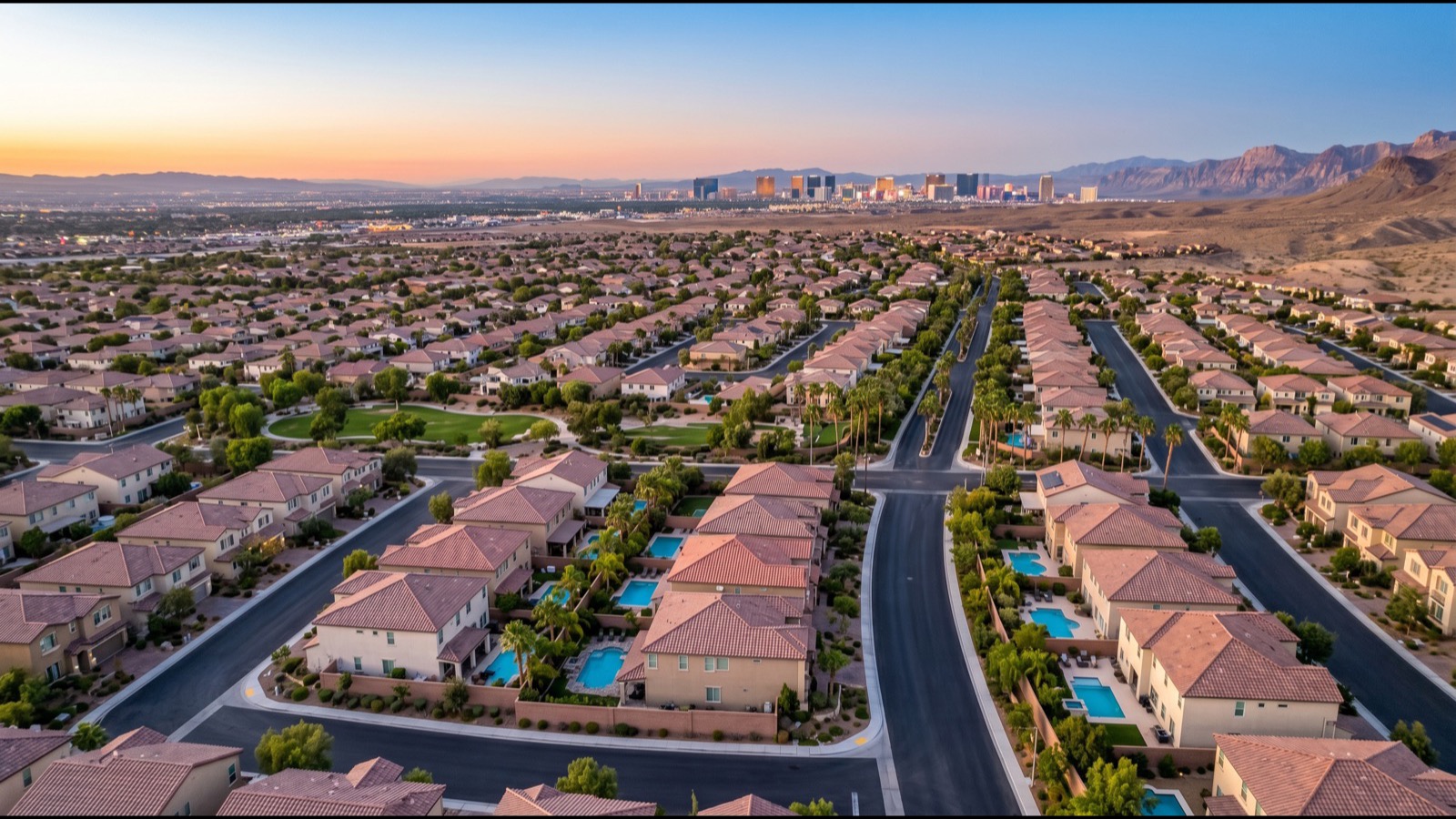
The expensive housing was built elsewhere on purpose. Summerlin, Henderson's hillsides, the guard-gated communities — the valley's luxury stock is concentrated fifteen to thirty minutes away from the resort corridor, by design. Master-planned luxury wanted quiet, views and space, and none of those are available next to a casino.
The Strip-adjacent housing stock is older and denser. Much of what sits within a mile of the resorts is apartments, older condos and mid-century single-family homes on smaller lots. Age and density both pull medians down.
A large share of the inventory is investor-owned. Proximity to the resort corridor makes these ZIPs attractive to short-term and corporate-rental buyers, which shifts the mix toward smaller units. According to the U.S. Census Bureau, the Las Vegas metro has a substantially higher renter share than the national average, and it concentrates near the employment core — which the Strip very much is.
So a low median here does not mean "cheap" in the sense of undesirable. It means the mix is different.
Where Should You Live If You Want a House, Not a Condo?
Two answers, both west and east of the corridor rather than on it.
Scotch 80s (89102) — 137 active listings at a $400,000 median. This is the valley's mid-century enclave: large lots, mature trees, ranch houses from the era when Las Vegas executives and entertainers lived minutes from work. It is genuinely walkable to nothing, but it is minutes by car from the Strip and from downtown. Lot sizes here are unusual for the valley, and it has become an infill and renovation market — buyers purchase the lot and the trees as much as the house.
Huntridge (89104) — 103 active at $419,000, the highest median of the non-tower ZIPs. Huntridge is the historic bungalow district east of the Strip, and it has been on a slow upward path for a decade as restoration buyers moved in. Smaller houses than Scotch 80s, tighter lots, more walkable pockets.
Both are the answer to "I want a yard and I want to be near the action." Neither is a master plan, so expect the trade-offs that come with pre-HOA neighborhoods: variable upkeep house to house, older systems, and no association enforcing anything.
If mid-century architecture specifically is the draw, our guide to Scotch 80s and mid-century Las Vegas covers that market in depth.
What Does the High-Rise Option Actually Cost?
This is the other market, and it barely overlaps with the first.
CityCenter (89158) medians $850,000 across just 51 active listings — the highest median and the thinnest inventory of any Strip-adjacent ZIP. That number reflects what it contains: full-service towers with resort amenities, valet, concierge and, in many cases, Strip views from the unit.
The rest of the tower inventory scatters across 89109, the Strip corridor proper, where 299 active listings sit at a $355,000 median. That figure blends genuine high-rise condos with much older, smaller units, which is why it looks so much lower than CityCenter.
The tower trade is straightforward. You get lock-and-leave living, amenities you would never build into a house, and a walkable relationship with the resort corridor that no single-family neighborhood in this valley offers. You give up land, you take on HOA dues that are substantial by valley standards, and you accept that your resale market is other buyers who specifically want a high-rise — a smaller pool than the market for houses.
For the building-by-building version of this decision, our Strip luxury condo guide compares the towers directly.
What Are the Cheapest Strip-Adjacent Options, and What's the Catch?
Paradise (89169) at a $225,000 median across 152 listings and south of the Strip (89119) at $230,000 across 177 are the least expensive ways to be near the corridor.
The catch is composition. These medians are held down by older condo and apartment-conversion stock, much of it small, much of it investor-held. That is not automatically a problem — it can be a genuinely efficient way to own near the employment core — but it means the median is not describing a house you would raise a family in.
Two things to verify before buying in either:
Rental concentration in the building or block. A complex that is majority investor-owned behaves differently from an owner-occupied one, and it can affect financing. Some lenders limit or decline conventional loans on condo projects above a certain investor-occupancy threshold. According to the U.S. Department of Housing and Urban Development, project-level eligibility requirements exist for FHA condo financing specifically for this reason — so the building matters as much as the unit.
The HOA's financial condition. Read the reserve study, not just the monthly dues. A low monthly figure attached to an underfunded reserve is deferred cost, not savings. According to the Nevada Real Estate Division, Nevada common-interest communities operate under statutory disclosure requirements precisely so buyers can evaluate this before closing.
Which Strip-Adjacent ZIP Has the Most to Choose From?
Chinatown / east Spring Valley (89103) — 333 active listings, the largest inventory of the seven, at a $287,000 median.
Volume matters more than buyers expect. A market with 333 active listings gives you negotiating position, comparable sales for appraisal, and the ability to wait for the right unit. The 51-listing CityCenter market gives you none of those things — when the unit you want appears there, you compete for it.
89103 also has something none of the other ZIPs do: the Spring Mountain Road restaurant corridor, which is the valley's real dining destination and is genuinely walkable from parts of the ZIP.
| Dimension | Towers (89158) | Mid-century (89102 / 89104) | Value ZIPs (89119 / 89169) |
|---|---|---|---|
| Median list | $850,000 | $400,000–$419,000 | $225,000–$230,000 |
| Active listings | 51 | 240 combined | 329 combined |
| Property type | High-rise condo | Single-family | Mostly condo / small |
| Land | None | Large lots | Little to none |
| HOA | High, full service | Usually none | Varies, verify reserves |
| Walkability | Highest | Low | Mixed |
| Resale pool | Narrow, specific | Broad | Investor-weighted |
| Best for | Lock-and-leave | Yard near the action | Entry price near the core |
What Does Living Near the Strip Actually Feel Like?
This is the part a spreadsheet cannot tell you, and it is the reason people move away again.
Noise is directional and unpredictable. The resort corridor generates helicopter traffic, event noise, fireworks on a schedule that includes but is not limited to New Year's, and periodic construction. How much reaches you depends on your exact block, your floor, your orientation and what sits between you and the corridor. Two houses three streets apart can have completely different experiences.
Traffic surges around events. A major fight, a festival, a convention or a race changes the drive time on surrounding streets for days, not hours. According to the Las Vegas Convention and Visitors Authority, the destination hosts millions of visitors annually with pronounced event-driven peaks — and those peaks land on the roads you would use daily.
Short-term rentals are a live issue. Proximity to the resorts makes these neighborhoods attractive to short-term rental operators, and the rules governing them have been actively revised. Whether your street has them, and whether your HOA or the jurisdiction permits them, is worth confirming for the specific address rather than assuming.
In our experience representing buyers in this corridor, the single best predictor of whether someone stays happy is whether they visited the actual block on a Friday and Saturday night before buying. Daytime tours tell you almost nothing about a Strip-adjacent address. The ones who did that test rarely called us to sell two years later; the ones who toured only on a Tuesday afternoon sometimes did.
There is a version of this that cuts the other way, and it is worth saying because the corridor gets unfairly characterized. Plenty of these streets are quiet. Huntridge on a Wednesday evening is a neighborhood of bungalows and mature landscaping where the loudest thing is a dog. Scotch 80s behind its walls is quieter than most suburban collectors, because the lots are large enough to put distance between houses. The corridor's reputation is built on the four miles of resorts, and the residential fabric a half-mile away often has very little to do with it.
What you cannot predict from a map is which side of that line a specific address falls on. Elevation, orientation, the buildings between you and the corridor, and whether your street is a through-route to a venue all matter more than distance in a straight line. A home a mile out on a cut-through street can be louder than one four blocks closer on a cul-de-sac.
The same applies to light. The corridor generates a genuine skyglow, and how much reaches a bedroom window depends on orientation and what is in the way. Buyers who value a dark bedroom should check at night specifically for that, not just for sound. It is a small thing that becomes a large thing at 2 a.m.
None of this argues against the corridor. It argues against buying an address in it sight-unseen after dark, which is a mistake we watch people make every year — usually relocating buyers on a compressed trip who tour Thursday, write Friday, and never see the street at the hour that would have told them the most.
How Much Is the Commute Advantage Actually Worth?
For a large share of this valley's workforce, this is the entire argument, and it rarely gets quantified.
The resort corridor is the single densest employment center in Southern Nevada. According to the Bureau of Labor Statistics, leisure and hospitality is the largest employment sector in the Las Vegas metro by a wide margin, and the overwhelming majority of those jobs are physically located on or immediately around the Strip. Add the Convention Center, the arenas, the stadium and the airport — all within the same few miles — and the concentration is unusual even by big-city standards.
Before choosing a convenient location, investigate airport flight paths and aircraft noise and visit the particular home at relevant times.
| Consideration | Strip corridor | Summerlin / Henderson master plans |
|---|---|---|
| Median list price | $340,950 | $686,000 (Summerlin) |
| Active inventory | 1,252 | 1,240 (Summerlin) |
| Drive to resort jobs | Minutes | Typically 20–40 minutes |
| Housing age | Mostly older stock | Newer, much of it post-2000 |
| Lot sizes | Large in 89102, small elsewhere | Standardized by village |
| HOA | Often none, or condo-only | Nearly universal |
| Amenity package | The city itself | Trails, parks, community centers |
| Night-time quiet | Variable, block by block | Generally consistent |
| Buyer pool at resale | Narrower, more specific | Broad |
Run the arithmetic on your own situation before dismissing it. A forty-minute each-way commute is roughly 330 hours a year — more than eight standard work weeks — plus fuel and vehicle wear. For a household with two people working in the corridor, that doubles. Against a median difference of roughly $345,000 between the corridor and Summerlin, the trade is not obviously in either direction; it depends entirely on what your time is worth to you and whether you would actually use a master plan's amenities.
The honest counterweight: the master plans are where the newer housing is, and newer housing carries lower maintenance risk. Buying a 1958 ranch in Scotch 80s to save a commute means accepting a roof, plumbing and electrical timeline that a 2015 Summerlin home does not have. Neither choice is free.
What Is Changing in the Corridor Right Now?
More than in any other part of the valley, which cuts both ways for a buyer.
The corridor has a continuous pipeline of development — new resorts, entertainment venues, and transportation projects that will change traffic patterns and, in some cases, property values on specific blocks. Two are worth understanding before you buy nearby, because both have been under active construction and both change the character of the streets around them.
The practical implication is not "buy" or "don't buy." It is that a Strip-adjacent purchase is exposed to nearby development in a way a mature master-plan purchase is not. A parcel across the street from your house can become a construction site, a venue, or a parking structure within your ownership period. In Summerlin, the surrounding land use was decided decades ago and is largely built out; in the corridor, it very much is not.
So ask two specific questions about the block, not the neighborhood: what is entitled or under construction within two blocks, and what does the jurisdiction's land-use map allow on the vacant parcels nearby. The Clark County and City of Las Vegas planning records both publish this, and ten minutes there tells you more about your next five years than any neighborhood description will.
For how one of these projects is already reshaping values nearby, our analysis of the Athletics ballpark's real estate impact walks through the mechanics of a corridor development changing a submarket.
How Do Schools and Jurisdiction Work Near the Strip?
Both need verifying at the address level, and the corridor is unusually mixed.
Some of these ZIPs sit inside the City of Las Vegas; others sit in unincorporated Clark County (Paradise and Winchester are county townships despite being adjacent to the Strip). That determines permitting, code enforcement and which body sets short-term rental rules. The Clark County Assessor parcel record is the authority — check it before relying on any assumption.
Schools are served by the Clark County School District, and attendance boundaries in the urban core have been redrawn more than once. Use CCSD's zoning tool for the exact address rather than a community's marketing material, and re-verify the year you enroll. According to GreatSchools, ratings shift year to year, so treat any rating as a snapshot rather than a fixed attribute of the neighborhood.
Who Should Buy Near the Strip, and Who Shouldn't?
A strong fit if you work in the resort corridor, if you genuinely use what the Strip offers, or if you want a lock-and-leave second home in a city you visit often. The commute advantage for hospitality and gaming employees is real and large — it is the difference between a ten-minute drive and a forty-minute one from Summerlin.
A strong fit for mid-century architecture buyers. Scotch 80s and Huntridge contain housing stock that simply does not exist in the master plans, on lots that do not exist there either.
Look elsewhere if you want a new-construction home with a yard, a master-plan amenity package and quiet. That combination is not available near the Strip at any price, and buyers who try to force it end up in a tower they didn't want or a renovation they didn't budget for. The valley's new construction lives in Summerlin, Henderson and the outer edges — our new construction hub covers what's building now.
Think harder if you're buying primarily as a short-term rental play. The rules have moved, they can move again, and a purchase that only works as an STR is a purchase exposed to a regulatory decision you don't control.
Of the 789 homes we closed in 2025, the Strip-corridor purchases that worked best had a specific reason for the location — a job, an architectural preference, a genuine use of the resort corridor. The ones that struggled were bought on the general idea that being near the Strip sounded exciting.

What Should You Check Before Buying in the Corridor?
- Visit the exact block on a Friday and Saturday night, not just during the day.
- Confirm the jurisdiction — City of Las Vegas or unincorporated Clark County — on the Assessor's parcel record.
- For a condo, read the reserve study, not just the monthly dues.
- For a condo, ask the investor-occupancy percentage — it can affect your financing.
- Confirm short-term rental rules for that specific address and HOA.
- Check the CCSD attendance zone for the address if schools matter.
- Ask what is planned nearby — the corridor has continuous development activity.
- Drive your actual commute at your actual departure time.
Number one is the one people skip and the one that decides it.
Frequently Asked Questions
Is it expensive to live near the Las Vegas Strip?
Less than most people expect. The seven ZIPs bordering the corridor carry a combined $340,950 median against a $470,598 Las Vegas median — about 28% below. The valley's expensive housing was deliberately built away from the resort corridor, in Summerlin and the Henderson hillsides.
Which neighborhood near the Strip is the nicest?
It depends entirely on what you want. For a house with a yard and mature trees, Scotch 80s (89102, $400,000 median) or Huntridge (89104, $419,000). For full-service high-rise living, CityCenter (89158, $850,000). For the most inventory and the best dining, Chinatown (89103, 333 active listings at $287,000).
Can you actually walk to the Strip from these neighborhoods?
From the towers, yes — that's their main advantage. From Scotch 80s or Huntridge, realistically no; they're minutes by car but not a pleasant walk, particularly in summer. Walkability near the Strip is a tower feature, not a neighborhood feature.
How bad is the noise?
Highly variable and directional. Helicopter traffic, event noise and periodic fireworks all reach parts of the corridor, and how much depends on your exact block, floor and orientation. Two homes a few streets apart can be completely different. Visit at night before you commit.
Are Strip-adjacent condos hard to finance?
They can be. Condo projects with high investor-occupancy percentages face lender restrictions, and some conventional and FHA programs have project-level eligibility rules. Ask for the investor-occupancy percentage and the HOA's reserve study early, before you're deep into an offer.
Is buying near the Strip a good short-term rental investment?
It can be, but treat the regulation as the main risk rather than an afterthought. Short-term rental rules vary by jurisdiction and HOA and have been revised repeatedly. Never underwrite a purchase on rental income you have not verified in writing for that specific address.
Which Sources Inform This Guide?
Active inventory and median list figures for all seven Strip-adjacent ZIP codes and for the Las Vegas market were pulled live from our MLS data feed on the date of publication and will move. Neighborhood characterizations reflect our own transaction experience in the corridor. Supporting authorities:
- Las Vegas REALTORS — valley market reporting and MLS statistics
- U.S. Census Bureau — Las Vegas metro tenure, density and household data
- Clark County Assessor — parcel records and jurisdiction verification
- Clark County — unincorporated township boundaries and land use
- Clark County School District — attendance-zone verification
- GreatSchools — school ratings context
- Nevada Real Estate Division — common-interest community disclosure requirements
- U.S. Department of Housing and Urban Development — FHA condominium project eligibility
- Las Vegas Convention and Visitors Authority — visitation volume and event-driven demand
- Nevada Department of Taxation — property tax administration
- Bureau of Labor Statistics — Las Vegas metro leisure and hospitality employment
- Freddie Mac Primary Mortgage Market Survey — mortgage rate context
Thinking about the corridor? Call Nevada Real Estate Group at (702) 637-1759 or reach out here — we'll walk the specific blocks with you, at night. Comparing against the master plans? Start with Summerlin or Henderson, browse guard-gated options, or run it live on our search. Selling first? See our sellers resources.