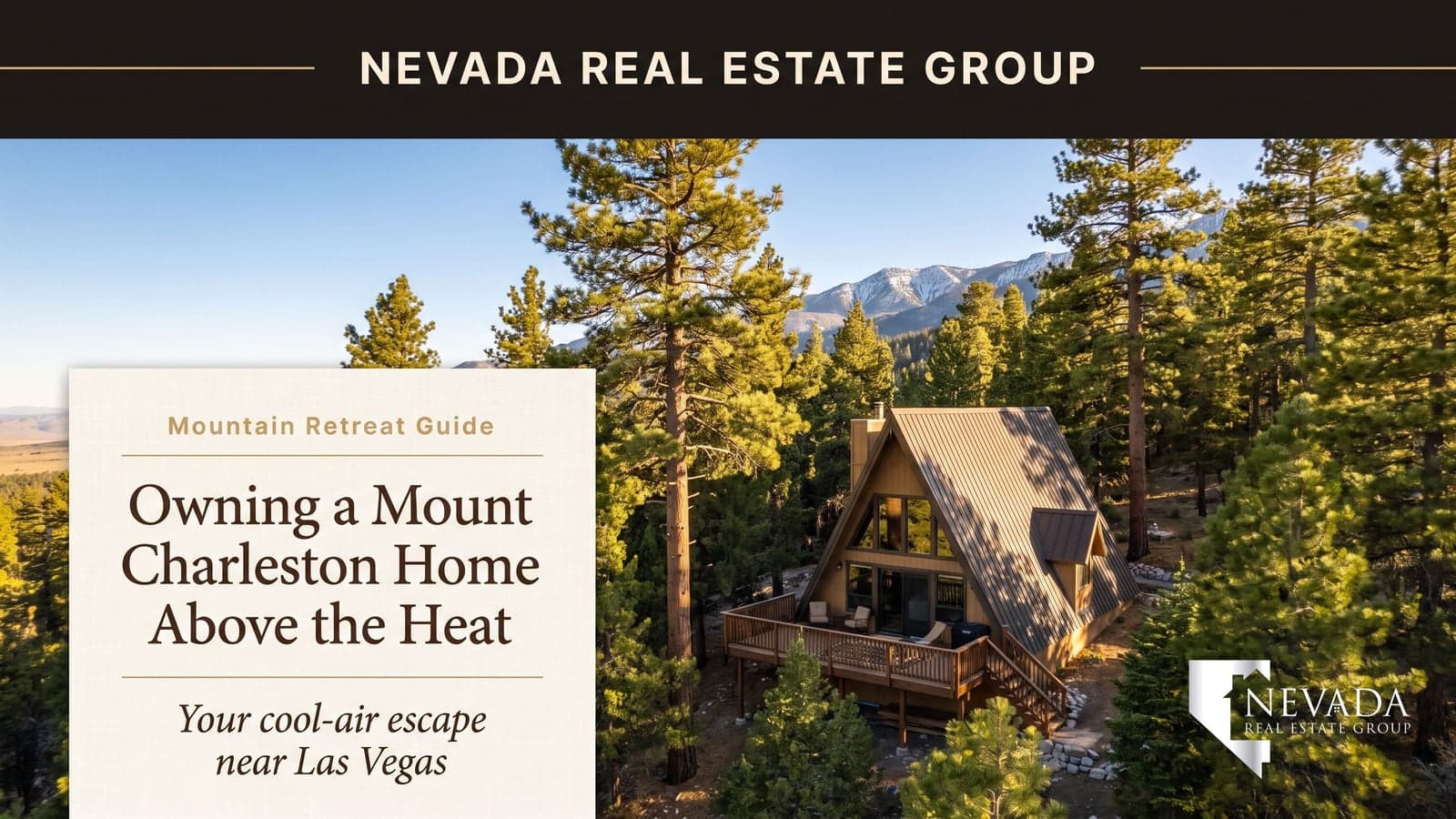

When the Las Vegas valley hits 110°F in July, there's a place 45 minutes away where it's 75°F under the pines — and people actually live there. Mount Charleston rises out of the Spring Mountains northwest of the city, and at roughly 7,500 feet of elevation it runs 20 to 30 degrees cooler than the valley floor. For a specific kind of buyer — someone who wants a summer escape, a four-season cabin, or a full-time home where "cool" isn't a fantasy — it's one of the most distinctive real estate markets in Southern Nevada.
But a mountain home is a different animal from a valley tract house, and the buyers who get burned are the ones who priced it like one. This guide breaks down what it actually costs to own up here in 2026, using our own transaction experience across the roughly 9,600 closings our team has represented in the region, plus the carrying costs — well, septic, propane, snow, and fire insurance — that a Summerlin or Henderson buyer has never had to think about. You'll get real price ranges, the trade-offs of each canyon, how financing a second home works, and the honest downsides before you fall for the view.
Mount Charleston homes run from about $400,000 for a cabin to $1.5 million-plus for a custom estate, in ZIP 89124 roughly 45 minutes northwest of Las Vegas. At about 7,500 feet, it's 20 to 30 degrees cooler than the valley. The catch is carrying cost: most homes run on a private well, septic, and propane, need snow access, and carry higher fire insurance. Budget those before you buy.
- Mount Charleston sits at ~7,500 ft — 20-30°F cooler than the valley, ~45 min from the Strip.
- Homes run about $400K for a cabin to $1.5M+ for a custom estate in ZIP 89124 (~500 homes total).
- Most homes use a private well, septic, and propane — not city utilities. Budget for it.
- Fire insurance and snow access are real costs valley buyers routinely forget.
- A second-home loan usually needs 10%+ down; get pre-approved before you tour.
Where Exactly Is Mount Charleston?
Mount Charleston is the local name for the residential communities within the Spring Mountains National Recreation Area, managed by the Humboldt-Toiyabe National Forest. The area is anchored by Charleston Peak at 11,916 feet — the highest point in Clark County — and the homes cluster in two main canyons plus a couple of outlying pockets, all within ZIP code 89124.
You reach the main residential area via Kyle Canyon Road (State Route 157) off US-95, roughly a 35-to-45-minute drive from the northwest valley depending on where you start. That drive is the whole point: you climb from about 2,000 feet on the valley floor to 7,000-plus feet in the pines, and the temperature drops the entire way up. According to the National Weather Service, summer highs at the town rarely climb above the mid-80s even when the valley bakes past 110°F, and winters bring real snow, with lows commonly between 25°F and 40°F.
This is genuinely rural mountain living inside Clark County — a different world from the master plans of Summerlin or Henderson, and a short enough drive that plenty of owners keep it as a second home while their primary residence stays down in the valley.
How Much Does a Mount Charleston Home Cost in 2026?
The Mount Charleston market is small — only around 500 homes total — so pricing swings more on individual condition, lot, and canyon than on any tidy median. As a working range in 2026, expect roughly:
| Type | Typical range | What you get |
|---|---|---|
| Rustic A-frame / small cabin | $400,000–$650,000 | 1-2 bed, older build, seasonal-leaning |
| Full-time mountain home | $650,000–$950,000 | 3 bed, updated systems, year-round |
| Larger custom home | $950,000–$1.5M | Bigger lot, garage, modern build |
| Trophy custom estate | $1.5M+ | Architect-built, prime view lot |
For context, our Mount Charleston community page tracks the market at roughly $400,000 to $1.5 million-plus, with the community holding around 500 homes established as far back as the 1950s. Compared to the valley, you're often paying a premium per square foot for far less square footage — because you're buying the elevation, the pines, and the temperature drop, not the house alone. The right comparison isn't "what would this cost in Las Vegas"; it's "what is a genuine mountain escape 45 minutes from home worth to me?"
Because inventory is thin — sometimes only a handful of homes are actively listed at once — the buyers who win here are pre-approved, decisive, and working with an agent who watches the market daily. When the right cabin comes up, it can move fast. For the broader valley backdrop, our Las Vegas summer market forecast tracks where prices and inventory are heading.
Why Is Mount Charleston So Much Cooler Than the Valley?
It comes down to elevation. Air cools as it rises, and Mount Charleston's residential areas sit 5,000 to 6,500 feet higher than the Las Vegas Strip. That vertical difference is why, according to climate data for the region, the mean high temperature runs roughly 20°F cooler on average — and on the hottest valley afternoons, the gap widens to 30 degrees or more. A 110°F day at Harry Reid International Airport can be a pleasant 75-to-80°F afternoon at the town.
That single fact drives the entire market. For retirees who love Las Vegas but dread July, for families who want a weekend snow-and-hiking basecamp, and for remote workers who'd rather take Zoom calls under ponderosa pines, the value proposition writes itself. The Lee Canyon ski and snowboard resort sits just up the road, giving the area a genuine four-season identity — you can be skiing in the morning and poolside in the valley by afternoon.
What Are the Different Areas of Mount Charleston?
"Mount Charleston" is really several distinct pockets, and the differences matter for both lifestyle and resale.
| Area | Kyle Canyon (Old Town) | Lee Canyon / Rainbow | Echo & upper elevations |
|---|---|---|---|
| Access | SR-157 | SR-156 | Highest, snowiest |
| Elevation feel | ~7,000-7,700 ft | ~7,500-8,500 ft | 8,000 ft+ |
| Vibe | Established, lodge nearby | Ski-adjacent, forested | Remote, deep-snow |
| Best for | Year-round living | Ski access | Seclusion seekers |
Kyle Canyon is the established heart, home to the historic lodge and the most year-round-friendly access. Lee Canyon trends higher and snowier, closer to the ski resort. The upper-elevation pockets deliver the deepest seclusion and the deepest snow — beautiful, but you'd better be comfortable with winter access. There's also Cold Creek, a separate, even more remote community off US-95 to the north, known for its wild horses; it trades on isolation and is a different buy entirely.
What Are the Real Carrying Costs Valley Buyers Forget?
This is the section that saves you from a bad purchase. A Mount Charleston home is not plugged into the same municipal systems as a valley tract home, and the recurring costs are different in ways first-time mountain buyers routinely underestimate.
- Private well or shared water: many homes draw from a well or a small shared water system, not a city main. Well pumps fail, and replacement can run $5,000 to $15,000+. Always get the well tested and the water-rights situation confirmed before closing.
- Septic system: with no municipal sewer, you're on septic. Budget periodic pumping (a few hundred dollars) and know that a full replacement can run $10,000 to $30,000.
- Propane, not natural gas: heating and often cooking run on propane delivered to an on-site tank. In a cold mountain winter, propane is a real line item — plan for it.
- Snow removal and access: you'll want a plan (and possibly a plow contract or a capable vehicle) for winter. Steep private driveways add cost and effort.
- Fire insurance: the Spring Mountains are a forested, wildfire-exposed environment — the 2013 Carpenter 1 Fire is a local memory. Insurers price that in, and premiums run well above a comparable valley home. Confirm you can even get coverage, and at what price, before you commit.
| Item | Rough cost |
|---|---|
| Well pump replacement (when needed) | $5,000–$15,000+ |
| Septic pumping (periodic) | $300–$600 |
| Septic replacement (worst case) | $10,000–$30,000 |
| Propane heating (winter) | Ongoing seasonal cost |
| Fire/hazard insurance premium | Well above valley rates |
| HOA (where applicable) | $0–$50/mo (low) |
None of these should scare you off — they're normal for mountain property — but they should be priced in before you write an offer. In our experience, the buyers who love Mount Charleston longest are the ones who went in with eyes open on the systems, not just the views.
How Do You Finance a Mount Charleston Home or Second Home?
Most Mount Charleston buyers are purchasing a second home, and the financing rules differ from a primary residence. According to Freddie Mac and standard conventional guidelines, a second-home loan typically requires at least 10% down (often more), with slightly higher rates than an owner-occupied primary. If you're buying it as a true primary residence, you may access more favorable terms.
A few mountain-specific financing wrinkles to know:
- Appraisal comps are thin. With so few sales, appraisers work with limited comparables, which can complicate valuation. An experienced local agent and lender help here.
- Well and septic often require inspection sign-off from the lender.
- Insurance must be in place — and in a wildfire zone, a lender will want proof you can obtain it before funding.
Because of all this, the single best move is to get fully pre-approved with a lender who has done mountain and second-home loans before you tour. It tells sellers you're serious in a thin market and prevents the heartbreak of falling for a cabin you can't actually close on. Start with our Las Vegas buyer guide for the fundamentals, then let's talk specifics.
Can You Rent Out a Mount Charleston Home?
Short-term rental income is a common reason buyers stretch for a mountain property — a cool-weather cabin 45 minutes from a major tourist city has obvious appeal. But rules vary and change, so treat any rental projection as unconfirmed until you've verified it. Clark County regulates short-term rentals, and requirements, licensing, and enforcement have shifted in recent years, per Clark County. Some pockets and any applicable HOA may restrict or prohibit nightly rentals outright.
If rental income is central to your math, make the purchase contingent on confirming you can legally operate the rental you're counting on. Don't buy on a pro forma that assumes nightly bookings the county won't permit. A long-term (30-day-plus) rental is generally a safer, lower-friction path if you want the home to earn its keep between personal stays.
What Are the Downsides of Living on Mount Charleston?
An honest guide names the trade-offs. Mount Charleston is spectacular, but it isn't for everyone:
- Winter access: SR-157 and SR-156 are maintained, but heavy snow can close roads and make steep driveways a chore. If you can't tolerate an occasional snowed-in day, this isn't your market.
- Distance from services: the nearest full grocery, hospital, and big-box shopping are down in the valley. You'll stock up.
- Wildfire risk: it's a forest. Defensible space, fire-hardening, and insurance are part of ownership.
- Schools and commuting: families with kids weigh the daily drive down to valley schools like the zoned Clark County School District campuses. Some owners choose the mountain for weekends and a valley home for the school week.
- Thin resale market: the same scarcity that makes it special means both buying and selling can take patience and the right agent.
For many buyers, these are features, not bugs — the price of admission to a quieter, cooler life. But go in clear-eyed.
How Does Mount Charleston Fit Nevada's Tax Picture?
The financial backdrop is genuinely favorable. Nevada has no state income tax. According to the Nevada Department of Taxation and Nevada Revised Statutes Chapter 361, residential property carries a 3% annual cap on tax increases for owner-occupied primary residences. Effective property-tax rates in Clark County generally run under 1% of market value, and the Clark County Assessor sets the parcel's taxable value.
For a second home, note the 3% cap primarily protects owner-occupied primary residences, so a vacation property may see a different (8%) cap on increases — worth confirming with the Assessor for your specific parcel. Either way, Nevada's overall tax structure is a meaningful reason buyers across the country — and especially from high-tax states — keep landing here, whether they choose the valley or the mountain above it. If you're relocating, our moving-to-Las-Vegas guide covers the full picture.
Who Should Buy on Mount Charleston?
The Ganon buyer profile doesn't apply here — this is a different life. Mount Charleston makes the most sense if you:
- Love Las Vegas but dread the summer and want a genuine cool-air escape without leaving the county.
- Want a four-season lifestyle — hiking, snow, and the Lee Canyon resort — on your doorstep.
- Are comfortable with rural systems (well, septic, propane) and winter access.
- Want a second home close enough to use often, or a full-time home where "escape the heat" is a daily reality.
- Value privacy and quiet over walkable amenities and a big resale pool.
If that's you, few places in Southern Nevada deliver the same combination of cool climate, forest, and proximity. Browse the rest of our Nevada communities to compare, then let's find the right mountain home.
What Amenities and Recreation Come With a Mount Charleston Home?
You're not just buying a house — you're buying a doorstep. According to the U.S. Forest Service, the Spring Mountains National Recreation Area draws visitors year-round, and homeowners get first claim on it. In summer, the trail network is the headline: routes like Mary Jane Falls, Cathedral Rock, and the strenuous South Loop to Charleston Peak (11,916 feet) start minutes from the residential canyons, with cool, pine-shaded hiking that simply doesn't exist on the valley floor.
In winter, the Lee Canyon ski and snowboard resort turns the area into a genuine four-season destination — lift-served skiing, tubing, and a base lodge, all inside Clark County. Day-lift tickets run in the range of $60 to $100+, but for a homeowner it's a 15-minute drive rather than a road trip to Utah or Tahoe. The historic Mount Charleston Lodge and The Retreat on Charleston Peak anchor the dining and hospitality scene, and the Spring Mountains Visitor Gateway off SR-157 serves as the area's interpretive hub.
Wildlife is part of the deal, too: elk, mule deer, and — over toward Cold Creek — a well-known band of wild horses. For buyers who value nature access over walkable retail, this amenity package is unmatched anywhere else in Southern Nevada, and it's a real driver of both lifestyle value and rental demand.
How Does a Mount Charleston Home Compare to Other Cool Escapes?
Buyers chasing relief from the heat have a few options, and it's worth being honest about the trade-offs before you commit six or seven figures.
| Factor | Mount Charleston | Lake Tahoe / Reno | Stay in the valley |
|---|---|---|---|
| Drive from Las Vegas | ~45 min | ~7-8 hours | 0 |
| Summer relief | 20-30°F cooler | Cooler, but far | None — run the A/C |
| Entry price | about $400,000 | $700,000+ (Tahoe) | Valley home you own |
| Use frequency | High (close) | Low (distance) | N/A |
The Lake Tahoe and Incline Village markets are gorgeous, but at 7-plus hours away they're a different kind of second home — one you visit a few times a year, not most weekends. Mount Charleston's whole advantage is proximity: it's close enough to use constantly, which is why the "trade 110° for 75° on a Saturday" pitch actually works.
There's also a pure-economics angle. A large valley home can run $400 to $700+ a month in peak-summer air-conditioning costs — as our guide to surviving your first desert summer in Las Vegas lays out — and according to the U.S. Energy Information Administration, cooling ranks among the top summer expenses in hot climates. A Mount Charleston home barely needs air conditioning at all — its challenge is winter heat, not summer cooling. That doesn't pay for a second home by itself, but it reframes the comparison: you're buying comfort you'd otherwise rent from your electric utility, and you're buying it in a state where, per the Nevada Department of Taxation, there's no income tax eating into what you keep.
Frequently Asked Questions
How much cooler is Mount Charleston than Las Vegas?
Mount Charleston sits at roughly 7,500 feet, about 5,000 to 6,500 feet higher than the valley floor, so it runs about 20°F cooler on average and 30 degrees or more cooler on the hottest afternoons. A 110°F valley day is often a 75-to-80°F day at the town.
How much do Mount Charleston homes cost in 2026?
Homes generally run from about $400,000 for a small or rustic cabin to $1.5 million-plus for a large custom estate, in ZIP 89124. Because the market holds only around 500 homes and inventory is thin, price depends heavily on condition, lot, canyon, and view.
How far is Mount Charleston from Las Vegas?
The main residential area is about 35 to 45 minutes from the northwest valley via Kyle Canyon Road (SR-157) off US-95 — close enough that many owners keep it as a second home while their primary residence stays in the valley.
Do Mount Charleston homes have city water and sewer?
Usually not. Most homes rely on a private well or small shared water system and a septic system, and heat with propane rather than natural gas. These rural systems are normal for the area but carry maintenance and replacement costs a valley buyer should budget for.
Is it hard to get insurance on a Mount Charleston home?
It can be more expensive and more restrictive than in the valley because the Spring Mountains are a wildfire-exposed forest. Confirm you can obtain hazard/fire coverage, and at what premium, before you commit — lenders will require proof of insurance to fund the loan.
Can I use a Mount Charleston home as a short-term rental?
Maybe, but verify first. Clark County regulates short-term rentals and rules have changed, and any applicable HOA may restrict nightly rentals. Make your purchase contingent on confirming you can legally operate the rental you're counting on rather than assuming it.
Does it snow at Mount Charleston?
Yes — it gets real winter snow, with the Lee Canyon ski resort nearby. Winter lows commonly run 25°F to 40°F, and heavy storms can affect road and driveway access, so a snow plan is part of ownership.
What Should Mount Charleston Buyers Take Away?
Mount Charleston is one of the few places where you can own a genuine cool-air mountain home — 20 to 30 degrees below the valley, forested, four-season — and still be 45 minutes from the Strip. Homes run from about $400,000 to $1.5 million-plus, but the sticker is only half the story: the well, septic, propane, snow, and fire insurance are what separate a happy mountain owner from a frustrated one. Price those in, get pre-approved for the second-home or primary loan, and work with an agent who watches this thin market daily.
Thinking about trading 110° for 75°? Call our team at (702) 637-1759, reach us on our contact page, or explore the Mount Charleston community guide to start. We'll tell you honestly which cabin is a keeper and which one is a money pit with a nice view.
Which Sources Inform This Mount Charleston Guide?
- Humboldt-Toiyabe National Forest / Spring Mountains NRA (USDA Forest Service) (land management, recreation area)
- National Weather Service — Las Vegas (regional climate and temperature data)
- Lee Canyon Ski & Snowboard Resort (four-season recreation)
- Clark County (short-term rental regulation, building)
- Clark County Assessor (parcel taxable value, tax caps)
- Nevada Department of Taxation (no income tax, property-tax structure)
- Nevada Revised Statutes Chapter 361 (property taxation, 3% cap)
- Freddie Mac (second-home financing guidelines)
- Clark County School District and GreatSchools (school assignments)
- U.S. Geological Survey (Charleston Peak elevation, terrain)
Price ranges reflect Nevada Real Estate Group's transaction experience across the region plus our Mount Charleston community data; the market is small and pricing varies widely by home. This article is educational and not a solicitation of property already listed. Verify systems, insurance, and rental rules for any specific parcel before purchase.