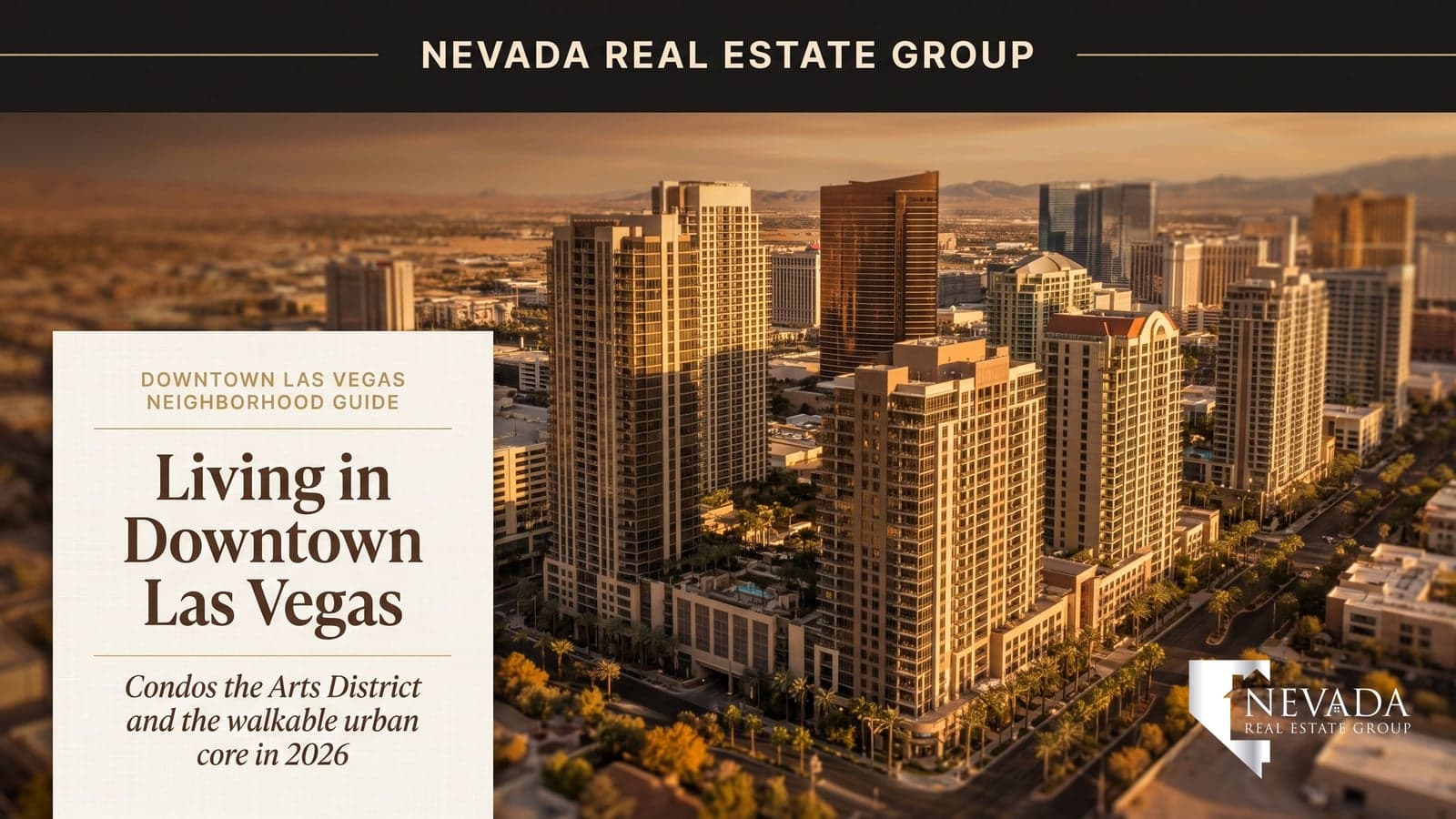

Downtown Las Vegas is the one part of the valley where you can live without a car, walk to a Michelin-caliber dinner, a first-run gallery opening, and a Level 1 trauma center — and still pay less per square foot than Summerlin. It is also the most misunderstood submarket I work in. Buyers picture Fremont Street casinos and stop there, missing the Arts District lofts, Symphony Park high-rises, and 1950s bungalow districts that make the urban core a genuine place to live. This is the honest 2026 guide to what Downtown actually costs, which pockets fit which buyers, and the tradeoffs nobody puts in the brochure.
For background on how the city developed around its older neighborhoods, read our overview of the history of Las Vegas. This edition was refreshed on September 19, 2026 with a fresh MLS pull, the current Symphony Park construction pipeline, Walk Score data, and LVMPD's latest Downtown Area Command numbers.
Living in Downtown Las Vegas in 2026 means trading yard and square footage for walkability, culture, and a lower entry price than the master plans. Across ZIP codes 89101, 89104, and 89106, the median closing was $352,000 in the 12 months ending September 17, 2026 — about $92,000 under the valley median — with condos from about $200,000 and Symphony Park high-rise units from the upper $700,000s. Decide condo versus historic house first; everything else follows.
- Downtown's three core ZIPs closed 630 homes at a $352,000 median in the year ending September 17, 2026.
- Symphony Park has 600-plus apartments open, 540-plus under construction, and the 240-unit Cello Tower condo project pending.
- Walk Score rates the Arts District 86 and Beverly Green 82, against 42 for Las Vegas as a whole.
- LVMPD's Downtown Area Command reported violent crime down 11% and property crime down 15% from 2024 to 2025.
- Buy a condo for lock-and-leave walkability; buy a John S. Park bungalow for a yard and no HOA.
What Counts as "Downtown Las Vegas" in 2026?
Downtown is not a single neighborhood — it is a cluster of them wrapped around the original 1905 townsite. According to the City of Las Vegas, the downtown core sits primarily in ZIP codes 89101, 89104, and 89106, bounded roughly by the Medical District to the west, Charleston Boulevard to the south, and the Fremont corridor to the north and east. Inside that footprint you get radically different housing: glass condo towers, converted industrial lofts, 1930s-1950s bungalows, and brand-new Symphony Park mid-rises, often within the same ten-minute walk.
The pieces, running west to east, are Symphony Park (the 61-acre former railyard around The Smith Center), the Fremont Street casino core and the Fremont East entertainment blocks, the Arts District south of Charleston along Main Street, and then the historic residential districts — John S. Park, Beverly Green, and Huntridge — fanning out south and east of Las Vegas Boulevard. The Medical District, anchored by University Medical Center and the Cleveland Clinic Lou Ruvo Center, closes the western edge. Each has its own housing stock and its own price ladder.
That variety is the whole point. A buyer looking at "Downtown Las Vegas homes" is really choosing among four or five distinct sub-neighborhoods, each with its own personality, and the mistake is to price them as one market. The rest of this guide walks them one by one — but the throughline is that Downtown is the only valley submarket built for people, not cars. If you want to see current inventory across all of it, browse Downtown Las Vegas homes for sale before you fixate on any single tower or block.
How Much Does It Cost to Buy in Downtown Las Vegas as of September 2026?
Downtown is one of the few valley submarkets where you can still buy well below the metro median. Las Vegas MLS data pulled through Repliers on September 19, 2026 shows 630 closings across ZIP codes 89101, 89104, and 89106 in the 12 months ending September 17, 2026, at a median sold price of $352,000 and about $246 per square foot. The valley-wide median across Las Vegas, Henderson, North Las Vegas, and Boulder City in the same pull was $444,000, so the Downtown discount is roughly $92,000 at the median. Median days on market was 25, and 62% of those closings settled below the original list price — buyers have negotiating room, but well-priced homes still move in under a month.
The three ZIPs behave differently. In 89104 (Huntridge and the neighborhoods east of Las Vegas Boulevard) 249 homes closed at a $375,000 median; in 89101 (the Fremont core, Arts District, and the blocks north of Charleston) 186 closed at $347,000; and in 89106 (the Medical District and the Westside) 195 closed at $339,000. Detached single-family homes across the three ZIPs closed at a $355,000 median, while condos and townhomes closed at $210,000 — a figure that mixes older garden-style condos with the tower units, so treat it as a floor, not a tower price.
As of September 19, 2026 there were 395 active listings in the three ZIPs at a median list price of $385,000. Here is how the main housing types price. These are directional bands from that MLS pull; always price a specific address against current comps.
| Housing type | Typical 2026 range | What you get |
|---|---|---|
| Historic bungalow (John S. Park, Huntridge, Beverly Green) | $340,000 – $550,000 | 1930s-1950s character, 1,200–2,000 sqft, real lots, no HOA |
| Entry tower or loft condo (studio / 1-bed) | $215,000 – $400,000 | Juhl studios closed at $215,000–$250,000; Streamline Tower one-beds at $290,000–$300,000 |
| Arts District loft (Newport, SoHo) | $420,000 – $650,000 | Industrial conversions, 1,350–1,800 sqft, First Friday steps away |
| Premium condo (upper-floor 2-bed, Strip views) | $500,000 – $1,175,000 | Streamline Tower 1,847–2,044 sqft units closed at $500,000–$750,000; a 3,171 sqft Newport loft closed at $1,175,000 |
| Symphony Park new-build condo (Cello Tower, pending) | Upper $700,000s and up | Newest construction, culture-district adjacency, penthouses in the millions |
Across the 9,600-plus closed transactions Nevada Real Estate Group has handled, the Downtown buyers who get the best value are the ones who decide first whether they want a lock-and-leave condo or a character bungalow with a yard — because those two paths price and appreciate very differently, and the all-in monthly math (mortgage plus HOA plus taxes plus insurance) is what actually decides affordability downtown.
What Are the Pros and Cons of Living in Downtown Las Vegas?
Every honest downtown guide should put the tradeoffs side by side, because Downtown is a fit-driven submarket — spectacular for the right buyer and frustrating for the wrong one. The pros are structural: the valley's only walkable grid, the densest concentration of independent restaurants, galleries, and performance venues, an entry price roughly $92,000 under the valley median in the 12 months ending September 17, 2026, and a housing stock — from 1930s bungalows to 32-story towers — that no master plan can replicate. The cons are equally structural: older houses with older systems, condo HOA dues that can rival a car payment, default-zoned schools that rate below the top suburban campuses, and nightlife noise on the blocks closest to Fremont and Main Street.
| Factor | Pro | Con | Who it decides for |
|---|---|---|---|
| Price | $352,000 median vs $444,000 valley-wide | Older stock behind the discount | First-time and downsizing buyers |
| Walkability | Walk Scores of 75–86 in the core | Still car-dependent for big-box errands | Car-free professionals |
| Housing | Bungalows, lofts, towers — real choice | HOA dues on condos; systems on bungalows | Anyone comparing all-in monthly cost |
| Schools | Las Vegas Academy magnet downtown | Default zoning rates below Summerlin/Henderson | Families with school-age children |
| Nightlife | First Friday, Fremont East, Smith Center | Weekend noise on the closest blocks | Light sleepers |
| Space | Mature trees, real lots in historic districts | No new 3,000 sqft two-story on a cul-de-sac | Growing families |
Based on the buyers we've represented downtown, three profiles fit cleanly: the car-free young professional who wants to walk to work and nightlife; the downsizing empty-nester trading a Summerlin yard for a lock-and-leave condo and The Smith Center; and the culture-first owner who values First Friday over square footage. It is a harder fit for families needing top-zoned schools and a big yard, or for buyers who want the newest, largest home for the money — those buyers are better served in Enterprise or the northwest. The mistake I see most is a suburban buyer trying to force Downtown to be something it is not. Downtown rewards people who actually want urban life; it punishes people who expected a master plan with a skyline view. Be honest about which you are.
What Is the Arts District Like to Live In?
The Arts District — locals call it 18b, for the original 18 blocks — is the fastest-changing neighborhood in the valley, and the one that most surprises out-of-state buyers. According to the City of Las Vegas, the district anchors the city's monthly First Friday festival, drawing tens of thousands of visitors to galleries, breweries, vintage shops, and restaurants concentrated along Main Street and Casino Center Boulevard. It is also, by the numbers, the most walkable neighborhood in the city: according to Walk Score, the Arts District rates 86, the top score of any Las Vegas neighborhood, against 42 for the city as a whole.
For a resident, that means you can walk to a craft brewery, a Saturday farmers market, and a dozen independent restaurants — an experience that simply does not exist in a master-planned cul-de-sac. Housing here skews toward converted lofts (Newport Lofts and SoHo Lofts are the marquee buildings) and a growing pipeline of new rentals; Nashville-based Southern Land Company began pre-leasing a new Arts District apartment building alongside its Symphony Park projects, which tells you where institutional capital thinks the district is headed. In the 12 months ending September 17, 2026, MLS records show SoHo Lofts units closing between $420,000 and $630,000 and Newport Lofts between $525,000 and $1,175,000, depending on size.
The tradeoff is honest: this is a live-work-play district, so weekend foot traffic and event noise come with the territory. Buyers who want that energy love it; buyers who want silence should look at the historic districts a few blocks south, where the same walkability comes with quieter streets. Our Arts District page tracks the neighborhood, and the high-rise condos hub covers every loft and tower building by building.
What Are the High-Rise Condo Options Downtown?
The condo towers are Downtown's signature housing type, and the anchor building is The Ogden. The Ogden is a 21-story, 275-residence tower one block north of the Fremont Street Experience; it opened in 2008 as Streamline Tower and was renamed in 2011, so MLS records still list both names. In the 12 months ending September 17, 2026, ten Streamline Tower units closed, from $290,000 for a 963-square-foot one-bedroom to $750,000 for a 2,044-square-foot upper-floor residence — a spread that shows how much floor, view, and size matter inside a single building.
Beyond The Ogden, the Arts District's Newport Lofts and SoHo Lofts offer true industrial-conversion living, and Juhl blends lofts with a central courtyard; twelve Juhl units closed in the same window, from $215,000 for a 609-square-foot studio to $600,000 for a 1,510-square-foot loft. Each building carries its own HOA dues — typically $400 to $900-plus a month depending on amenities and unit size — which matters enormously to the all-in cost. A $400,000 condo with $700 monthly dues carries differently than a $450,000 bungalow with none.
The newest option is Symphony Park, covered in the next section, where the rental towers are opening now and the for-sale Cello Tower is still pending. Here is how the main paths compare on the factors that decide fit.
| Factor | Downtown high-rise condo | Downtown historic bungalow | Suburban master plan |
|---|---|---|---|
| Entry price | $215K – $400K | $340K – $550K | $450K – $625K |
| Walkability | Highest in valley | High (Walk Score 76–82) | Low — car required |
| Monthly HOA | $400 – $900+ | $0 (usually) | $50 – $200 |
| Maintenance | Lock-and-leave | Owner-managed, older systems | Newer, owner-managed |
| Best for | Car-free pros, lock-and-leave | Character seekers with a car | Families needing space + schools |
What Is Symphony Park, and What Is Being Built There Now?
Symphony Park is the newest and most deliberately built piece of Downtown — a 61-acre master development on the former Union Pacific rail yards just west of the Fremont corridor. According to the City of Las Vegas, it is anchored by The Smith Center for the Performing Arts, the Discovery Children's Museum, and the Cleveland Clinic Lou Ruvo Center for Brain Health — the Frank Gehry building you have probably seen without knowing what it was — and the city named it its 2025 Place of the Year.
The residential pipeline is the story for 2026. According to the same city page, two apartment communities are already open — Parc Haven with 290 units and Auric at Symphony Park with 324 — and two more are under construction: Bria, a five-story mid-rise, and Capella, a 22-story high-rise that developer Southern Land Company describes as the first luxury high-rise apartment building in Las Vegas. Southern Land lists Capella at 272 residences with about 16,250 square feet of commercial space, and both buildings are expected to open to residents in 2026. A dual-brand AC by Marriott and Element by Westin hotel of roughly 400 rooms opened in 2025, and a 90,000-square-foot Las Vegas Museum of Art and a 100,000-square-foot medical office building are in the pipeline.
The for-sale piece is Cello Tower, the 32-story, 240-residence condominium at the center of Red Ridge Development's six-acre Origin at Symphony Park. Pricing starts in the upper $700,000s, with eight penthouses originally announced from $4.5 million. Be careful with the timeline: the developer held a ceremonial groundbreaking in April 2025, but according to the Las Vegas Review-Journal on March 27, 2026, he had not yet closed on the city-controlled 5.9-acre site, the city had extended the land-sale deadline to August 19, 2026, and the project reported more than $165 million in residences under contract and 90% of its retail pre-leased, including a grocery store. Verify the current construction status before you put a deposit on any pre-sale unit downtown.
| Project | Type | Units | Status |
|---|---|---|---|
| Parc Haven | Rental mid-rise | 290 | Open |
| Auric at Symphony Park | Rental mid-rise | 324 | Open |
| Bria (Southern Land) | Rental, 5 stories | 275 | Under construction, opening 2026 |
| Capella (Southern Land) | Rental, 22 stories | 272 | Under construction, opening 2026 |
| Cello Tower (Red Ridge) | For-sale condo, 32 stories | 240 | Pre-selling; land closing and vertical start pending as of March 2026 |
For residents, the point is that Symphony Park is becoming a real neighborhood rather than a cultural campus, and the last parcels are the ones that will set its resale ceiling. Anyone weighing Downtown against the resort corridor should also read our guide to getting around Las Vegas, because transit access is a real part of the Symphony Park value proposition.
What Is Fremont East Like as a Place to Live?
Fremont East is the six-block entertainment district immediately east of the Fremont Street Experience canopy, running from Las Vegas Boulevard to 8th Street between Ogden and Carson. According to Travel Nevada, the city created the district in 2007 as part of its downtown revitalization, with retro neon — the 30-foot martini glass, the showgirl, the stiletto — lining the median, and it has since filled with cocktail bars, live-music rooms, and independent restaurants that draw a local crowd rather than a tourist one. It is where the Downtown Project's decade of private investment was concentrated, including the relocation of the Zappos headquarters to the former City Hall, and it is the reason the blocks east of the casino core feel like a real city rather than a casino district.
Housing right on Fremont East is limited — this is a commercial corridor — so "living in Fremont East" usually means The Ogden one block north, or the older apartment and bungalow blocks that begin around 6th to 10th Streets and run south toward Charleston. That is where a buyer gets the district's energy at a walking distance rather than under the window. The tradeoff is noise and foot traffic on Friday and Saturday nights, and the honest advice is the same one I give for the Arts District: tour on a weekend night before you buy, not just on a quiet weekday morning.
For the right buyer, Fremont East is the single best argument for The Ogden, because the tower puts a 24/7 concierge, secured parking, and a rooftop pool between you and the street while leaving fifty bars and restaurants within a five-minute walk. For a buyer who wants the same walkability with quieter nights, the John S. Park blocks south of Charleston are about a fifteen-minute walk away and a very different experience after 10 p.m.
Are the Historic Neighborhoods a Good Place to Buy?
If the towers are Downtown's flash, the historic districts are its soul. The John S. Park Historic District, Huntridge, and Beverly Green hold the valley's densest concentration of pre-1960 homes — Spanish Revival, mid-century modern, and ranch bungalows on real, tree-lined lots. John S. Park, bounded by Charleston Boulevard, Las Vegas Boulevard, Franklin Avenue, and South Ninth Street, was the first Las Vegas residential neighborhood listed on the National Register of Historic Places, added on May 16, 2003 after the city placed it on its own register that March; the district contains 161 resources, 126 of them contributing, and the American Planning Association named it one of the ten best neighborhoods in the United States in 2010. Beverly Green joined the City of Las Vegas Historic Property Register in 2016.
These neighborhoods sell character that no new build can replicate: mature landscaping, walkable streets, and architecture with a story. According to Walk Score, John S. Park rates 78, Beverly Green 82, and Huntridge Park 76 — all car-optional by the scoring service's standard and far above the city's 42. The honest tradeoff is age. A 1948 bungalow means original or updated systems, smaller closets, and the maintenance realities of an 80-year-old house — so a thorough inspection and a sewer scope are non-negotiable, and exterior changes in a city-designated historic district can require review under the City of Las Vegas historic design guidelines.
Pricing in the 12 months ending September 17, 2026 ran from the mid-$300,000s to the mid-$500,000s depending on renovation level, which lands these homes below the valley median while putting owners inside the walkable core. For first-time buyers, this is one of the few gateways to Downtown ownership under $400,000 — our first-time buyer resources map the financing side, and the FHA 203(k) renovation loan exists precisely for a sound bungalow that needs a panel, a roof, or a kitchen. At the other end of the scale, a handful of larger custom homes in 89104 trade well above that range; our look inside the Mel Exber estate at 1400 Maria Elena Drive, a 1970 home first owned by the Las Vegas Club's longtime owner, shows what that tier looks like.
For context on an adjacent area, review Historic Westside redevelopment and distinguish announced projects from completed changes.
How Walkable Is Downtown Las Vegas Really?
Very — and it is the number one reason buyers choose the core. According to Walk Score, Las Vegas as a whole rates 42 (car-dependent), with a Transit Score of 36 and a Bike Score of 46, and the ten most walkable neighborhoods in the city are all downtown or immediately adjacent: the Arts District at 86, Beverly Green 82, Hillside Heights 80, John S. Park 78, Francisco Park 77, Huntridge Park 76, Downtown proper 75, Meadows 72, West Huntridge 71, and the Gateway District 70. Nothing in Summerlin or Henderson comes close on that scale. According to the Regional Transportation Commission of Southern Nevada, Downtown is also the hub of the valley's transit network, including the Deuce and the Strip-to-Downtown corridor routes and the Bonneville Transit Center.
That walkability translates to real money. According to AAA's Your Driving Costs study released September 15, 2026, owning and operating a new vehicle now costs $12,863 a year, or about $1,072 a month. A household that goes from two cars to one downtown recovers most of that — enough to cover a typical condo HOA payment and then some — which materially changes the affordability math against a suburban home that requires two vehicles.
The caveat is that "walkable" downtown still means a car for a Costco run, a trip to Red Rock, or a Summerlin dinner. What it eliminates is the daily driving: groceries, coffee, dinner, the gym, and for many residents the commute. For a car-free young professional or a downsizing couple, Downtown is not just a lifestyle choice; it is often the cheaper total-cost-of-living option once you net out transportation. That is a calculation almost no suburban buyer gets to make.
What Are the Schools Like in Downtown Las Vegas?
This is Downtown's honest weak spot — with one major asterisk. According to the Clark County School District, the default-zoned neighborhood schools serving the urban core generally rate below the top suburban campuses in Summerlin or Henderson, which is the single biggest reason families with young children often look elsewhere in the valley. School-level performance varies so much inside a district of CCSD's size that district averages tell you nothing about a specific campus; check the Nevada Report Card for the exact elementary, middle, and high school an address is zoned to before you write an offer.
The asterisk is magnet schools. Las Vegas Academy of the Arts, located downtown, is one of Nevada's most competitive and highest-performing magnet high schools, drawing students from across the valley for its performing- and visual-arts programs. According to GreatSchools, CCSD's magnet and select-school lottery gives downtown families access to top campuses that the default zoning does not. Magnet admission runs on an annual application and lottery well before the school year, so a family buying downtown in spring for a fall move may already have missed that year's window — check CCSD's magnet page for the current deadlines.
The practical playbook: if you have school-age children, treat the magnet lottery as central to your decision, not an afterthought; verify current-year zoning for any specific address, because CCSD boundaries shift; and weigh the private and charter options that the central location puts within a short drive. For empty-nesters and child-free professionals — the majority of downtown buyers we represent — none of this matters, which is exactly why the same neighborhood can be a poor fit for one household and a perfect one for another.
How Safe Is Downtown Las Vegas According to LVMPD Data?
Safety is the question every out-of-state buyer asks about Downtown, and the answer should come from the police department's own numbers rather than from a portal's color-coded map. The Las Vegas Metropolitan Police Department's Downtown Area Command (DTAC) covers about 10 square miles with roughly 165 officers, and according to the Las Vegas Weekly on March 5, 2026, DTAC's captain reported that violent crime fell 11% and property crime fell 15% across the command from 2024 to 2025, with both categories down 3% in the Arts District specifically. The same report cites LVMPD's February 22, 2026 weekly crime report showing calls for service up 5.6% year to date — which the command attributes to business owners now reporting incidents they previously did not — and citations up 36%.
The counterweight is that Downtown remains the busiest command for the most serious crime. According to News 3 Las Vegas, citing LVMPD's weekly statistics, DTAC recorded 14 homicides in 2025 through November 2, the most of any area command, while LVMPD's jurisdiction-wide count of 71 was down from 99 at the same point in 2024. Domestic violence, not street crime, was the leading circumstance. LVMPD publishes weekly figures for every area command on its statistics page, and I would rather a buyer read that than a rumor.
What the numbers mean block by block: the residential districts — John S. Park, Huntridge, Beverly Green, Symphony Park, and the towers with 24/7 security — are settled, owner-occupied neighborhoods where daily life feels like any older city neighborhood. The transitional corridors are the blocks north of Fremont toward Bonanza and stretches of Main Street north of the Arts District, and the deputy city marshals' six-member Problem Oriented Policing team formed in 2023 works the Arts District specifically. Tour prospective blocks at different times of day, and lean on an agent who knows the specific streets.
How Do You Buy Downtown: Condo vs Historic House, HOA, and Insurance?
The buying process downtown splits in two the moment you choose a property type, and the paperwork is different enough that I walk clients through it before they tour. For a condo or loft, the seller must deliver the association's resale package under Nevada Revised Statutes Chapter 116 — the declaration, bylaws, current budget, the most recent reserve study, and minutes — and you have a statutory window to review it and cancel. Read the reserve study the way you would read a home inspection: a thinly funded reserve in a 2008 tower means a special assessment for a roof, elevator, or facade is a matter of when, not if, and it can dwarf any discount on the unit. Ask whether the building has pending litigation and what share of units are owner-occupied, because both affect whether a lender will treat the building as warrantable; a non-warrantable building narrows you to portfolio lenders or cash. Insurance is an HO-6 policy covering the interior and your liability, with the association's master policy covering the structure — confirm which walls-in items the master policy excludes.
For a historic bungalow, there is no HOA, so the diligence moves to the house itself. Order a sewer scope, a roof inspection, and an electrical evaluation on any pre-1960 home; galvanized plumbing, undersized panels, and root-intruded laterals are routine, and a renovation loan such as FHA 203(k) can fold the fixes into the mortgage. Insurance on an older home depends on the age of the roof, wiring, and plumbing, so get a quote during your due-diligence period rather than the week before closing. In a city-designated historic district, exterior changes can require review under the City of Las Vegas historic preservation design guidelines, which protects your block's character but constrains a stucco-and-black-windows flip.
Either way, get fully underwritten before you tour, because a well-priced downtown listing moved in a median 25 days in the year ending September 17, 2026, and the spread between the third floor and the fifteenth in the same tower can be $150,000 for the same floor plan. Across our 789 closings in 2025, the downtown buyers who won were the ones who had their financing, their HOA questions, and their inspector lined up before the right listing appeared.
How Does Downtown Compare to the Rest of the Valley, and Is It a Good Investment?
Downtown trades space for access, and price for character. In the same Las Vegas MLS pull through Repliers on September 19, 2026, the Summerlin ZIP codes (89134, 89135, 89138, 89144, 89145) closed 2,804 homes at a $606,000 median and $316 per square foot in the 12 months ending September 17, 2026; Henderson closed 5,659 at $489,500 and $264 per square foot; and North Las Vegas closed 3,116 at $415,000. Downtown's three ZIPs closed at $352,000 and $246 per square foot. Against Summerlin and Henderson, Downtown wins decisively on walkability and entry price, and loses on schools, yard size, and newness. Against the Strip corridor high-rises, Downtown is generally more affordable per square foot and more genuinely residential — you get neighbors, not nightly-rental turnover.
| Factor | Downtown (89101/89104/89106) | Summerlin ZIPs | Henderson | North Las Vegas |
|---|---|---|---|---|
| Closings, 12 months | 630 | 2,804 | 5,659 | 3,116 |
| Median sold price | $352,000 | $606,000 | $489,500 | $415,000 |
| Median price per sqft | $246 | $316 | $264 | $234 |
| Median days on market | 25 | 34 | 33 | 23 |
| Walkability | Highest in valley | Low | Low to moderate | Low |
| Schools (default) | Weaker plus strong magnets | Top-rated | Top-rated | Mixed |
For the right property, Downtown is a good investment — with eyes open. According to the U.S. Census Bureau, Nevada remains one of the fastest-growing states, and the Census Bureau's Vintage 2025 estimates put Clark County at 2,407,226 residents as of July 1, 2025, up from 2,266,446 in the 2020 base. Urban-core living is a durable national demand trend, and Downtown is the only walkable urban core in that metro; the supply of 1905 townsite blocks and 2003-vintage historic districts cannot be expanded, while Symphony Park's 540-plus units under construction add exactly the kind of neighbors — renters who later buy — that support condo resale.
The risk is selectivity. Downtown is gentrifying unevenly, so a poorly chosen block or an overpriced condo in a building with a depleted reserve can underperform the broader valley. According to Las Vegas REALTORS, the valley as a whole has cooled from the 2021-2022 frenzy into a balanced market with rebuilding inventory, and the MLS pull confirms it downtown: 62% of closings settled below the original list price, and the difference between a well-priced tower unit that sells in three weeks and an overpriced one that lingers for months is wider here than anywhere else I work. My take: Downtown is a conviction buy for people who genuinely want urban life, not a passive index play. Buy the walkability and the culture because you will use them, and the appreciation tends to follow. Compare it honestly against the broader Las Vegas, Summerlin, and Henderson markets — and the Strip-adjacent Paradise township — before deciding.
Ready to Buy in Downtown Las Vegas With Nevada Real Estate Group?
Start by deciding your housing type — condo or bungalow — because everything else flows from it. Get fully underwritten so you can move on the right listing, and if you are eyeing a tower, request the HOA budget and reserve study early; a healthy reserve fund is the difference between stable dues and a special-assessment surprise. Tour on both a weekday and a weekend night to feel the real rhythm of the block, and pull the LVMPD area-command numbers and the CCSD zoning for the exact address rather than relying on a portal's shading.
Then lean on local knowledge. Downtown rewards granular, block-by-block expertise more than any master plan, where one street can be fully transformed and the next still transitional, and where two condo units in the same tower can carry wildly different value on view, floor, and reserve health alone. That is exactly the kind of nuance a portal estimate cannot capture and a local agent lives in every day. Nevada Real Estate Group has represented 9,600-plus closings across Nevada, closed 789 homes in 2025, and carries 9,146-plus verified five-star reviews — and the downtown agents on our team know which Ogden stack faces the Strip, which John S. Park blocks have already been renovated street by street, and which associations just finished a reserve study.
Browse current Downtown Las Vegas homes for sale, and when you find a building or bungalow worth pursuing, call Nevada Real Estate Group at (702) 637-1759 for the all-in monthly math — mortgage, HOA, taxes, and insurance — and the honest read on that specific address. We will tell you when a listing is priced right, when it is not, and when the better answer is the building next door.
Frequently Asked Questions
Is Downtown Las Vegas a good place to live?
For the right buyer, it is the best place in the valley to live. Downtown offers the metro's highest walkability — Walk Scores of 75 to 86 across its core neighborhoods against 42 citywide — its densest culture and dining, and a $352,000 median sale price in the 12 months ending September 17, 2026, roughly $92,000 under the valley median. It fits car-free professionals, downsizing empty-nesters, and culture-first owners best. It is a weaker fit for families needing top-zoned schools and a big yard. The deciding question is whether you genuinely want urban life — if you do, nothing else in Las Vegas compares.
How much does it cost to live in Downtown Las Vegas?
In the 12 months ending September 17, 2026, entry tower and loft condos closed from about $215,000 for a Juhl studio to $300,000 for a Streamline Tower one-bedroom; Arts District lofts ran $420,000 to $650,000; historic bungalows the mid-$300,000s to mid-$500,000s; and premium view units up to $1,175,000. Condos add HOA dues of roughly $400 to $900-plus a month, so always compare all-in monthly payments. Offsetting that, AAA puts the annual cost of a new vehicle at $12,863 as of September 2026, so a household that drops a car can make Downtown the cheaper total-cost option.
Is Downtown Las Vegas safe?
Safety varies block by block more than in a uniform master plan, which is exactly why local guidance matters downtown. According to LVMPD's Downtown Area Command, violent crime fell 11% and property crime fell 15% from 2024 to 2025, and both fell 3% in the Arts District; the command still recorded the most homicides of any LVMPD area in 2025 (14 through November 2), most of them domestic. The residential districts — John S. Park, Huntridge, Beverly Green, Symphony Park, and the towers with 24/7 security — are settled, owner-occupied neighborhoods. Tour prospective blocks at different times of day and read LVMPD's weekly statistics for the exact area.
What are the best neighborhoods in Downtown Las Vegas?
The Arts District (18b) suits buyers who want lofts and nightlife within walking distance and rates 86 on Walk Score; Symphony Park suits those who want the newest construction next to The Smith Center, with Bria and Capella opening in 2026 and Cello Tower pre-selling; and the John S. Park, Beverly Green, and Huntridge historic districts suit character seekers who want a bungalow on a real lot. Fremont East is the entertainment corridor, with The Ogden one block north as its residential anchor. Each prices and lives differently, so match the neighborhood to your lifestyle first.
Are the schools good in Downtown Las Vegas?
Default-zoned CCSD schools downtown generally rate below top suburban campuses, which is the main reason families with young children often look elsewhere. The major exception is magnet schools: Las Vegas Academy of the Arts, located downtown, is one of Nevada's top-performing magnet high schools. Magnet admission runs on an annual application and lottery well before the school year, so if you have school-age children, make the CCSD magnet timeline central to your plan and verify current zoning for any specific address before buying.
Is Downtown Las Vegas walkable?
Yes — it is the only genuinely walkable submarket in the metro. According to Walk Score, the Arts District rates 86, Beverly Green 82, John S. Park 78, and Downtown proper 75, against 42 for Las Vegas as a whole, and every one of the city's ten most walkable neighborhoods is downtown or adjacent. Downtown is also the hub of the RTC transit network. That walkability is the core reason buyers choose the district and can save a car-free household most of the $12,863 a year AAA says a new vehicle costs.
Should I buy a condo or a house in Downtown Las Vegas?
Choose the condo if you want lock-and-leave living, building amenities, and maximum walkability, and you are comfortable with monthly HOA dues and the NRS 116 resale-package review. Choose a historic bungalow if you want a yard, more square footage, and no HOA, and you accept the maintenance realities of a 1940s or 1950s home. Run the all-in monthly math on both — a $400,000 condo with $700 dues can cost more than a $450,000 bungalow with none — before deciding.
Which Sources Inform This Downtown Las Vegas Guide?
This guide draws on Las Vegas MLS data pulled through Repliers on September 19, 2026 (closings in the 12 months ending September 17, 2026, and active listings as of that date), city and county records, Walk Score, LVMPD statistics, and federal population figures. Every figure is directional as of September 19, 2026; confirm current numbers and zoning before any transaction.
- Las Vegas REALTORS — local market statistics
- City of Las Vegas — Symphony Park development page
- City of Las Vegas — arts and culture / First Friday
- Las Vegas Review-Journal — Cello Tower status, March 27, 2026
- Southern Land Company — Bria and Capella at Symphony Park
- Walk Score — Las Vegas neighborhoods
- Las Vegas Weekly — Downtown Area Command crime figures, March 5, 2026
- News 3 Las Vegas — 2025 homicides by area command
- Las Vegas Metropolitan Police Department — statistics
- Travel Nevada — Fremont East District
- National Register of Historic Places — John S. Park Historic District
- Nevada Revised Statutes Chapter 116 — common-interest communities
- Clark County Assessor — property data and tax rates
- Clark County School District
- GreatSchools — Las Vegas school ratings
- Regional Transportation Commission of Southern Nevada
- AAA — Your Driving Costs, September 15, 2026
- U.S. Census Bureau — Nevada QuickFacts
- U.S. Census Bureau — Vintage 2025 city and county population estimates