
Almost every "most expensive neighborhoods" list you will find for this city is built from asking prices, from a magazine's impression of prestige, or from whichever enclave had one spectacular sale that year. Asking prices tell you what sellers hope for. I wanted to know what buyers actually paid.
So I pulled every closed single-family sale in the City of Las Vegas over the twelve months from September 1, 2025 through August 31, 2026, grouped them by recorded subdivision, rolled those granular parcel names up into the communities people actually use, and ranked by median sale price. Only communities with enough closings to produce a meaningful median made the list. The result is below, and the headline finding surprised me even after twenty years here.
The Ridges is the most expensive neighborhood in Las Vegas, with a $3,462,500 median sale price and $797 per square foot across 36 closings in the twelve months to August 31, 2026. The Summit Club followed at $2,375,000, then Country Club Hills at $2,160,000, Red Rock Country Club at $2,010,000 and Reverence at $1,600,000. All five sit inside Summerlin, and 1,260 of the city's 13,752 single-family sales cleared $1 million.
- The Ridges led on both median price, $3,462,500, and price per square foot at $797.
- All five most expensive Las Vegas neighborhoods sit inside the Summerlin master plan.
- The Summit Club produced the city's largest sale of the period at $25 million.
- Outside Summerlin, Southern Highlands enclaves took sales at $15.5 million and $12 million.
- 1,260 of 13,752 city single-family sales, about 9 percent, closed at $1 million or more.
Which Las Vegas Neighborhoods Are Actually the Most Expensive?
Here is the ranking, measured rather than asserted. Every figure comes from closed sales recorded between September 1, 2025 and August 31, 2026 inside the City of Las Vegas.
| Rank | Neighborhood | Median sale | Price per sq ft | Sales | Range | Median size |
|---|---|---|---|---|---|---|
| 1 | The Ridges | $3,462,500 | $797 | 36 | $1.75M to $16.0M | 4,618 sq ft |
| 2 | The Summit Club | $2,375,000 | $598 | 45 | $1.50M to $25.0M | 3,960 sq ft |
| 3 | Country Club Hills | $2,160,000 | $451 | 11 | $1.30M to $3.40M | 4,649 sq ft |
| 4 | Red Rock Country Club | $2,010,000 | $553 | 65 | $1.10M to $5.95M | 3,489 sq ft |
| 5 | Reverence | $1,600,000 | $513 | 37 | $710K to $3.20M | 2,852 sq ft |
The finding that matters most is not any single line of that table. It is that all five are inside one master plan. Summerlin does not merely lead the Las Vegas luxury market; it is the Las Vegas luxury market, at least at the level where medians are measured. No neighborhood outside Summerlin posted enough million-dollar-plus closings to break into the top five on a median basis.
That concentration is unusual. Most large metros spread their top tier across several districts with different characters — an old-money quarter, a waterfront, a hillside, a downtown penthouse market. Las Vegas built essentially all of its high end in one master plan on the western edge of the valley, against Red Rock Canyon. According to the Howard Hughes Corporation, Summerlin covers 22,500 acres and has been building since 1990, with roughly 6,000 acres still remaining for future phases.
A note on method, because it changes how you should read the table. A median tells you what a typical home in that community fetched, which is the right measure for comparing neighborhoods. It is not the same as where the biggest sales happen — The Summit Club's median is a million dollars below The Ridges, yet it produced the single largest transaction in the city. Both facts are in the table, and the next sections take them in turn.
Why Does The Ridges Top the Ranking?
Because it combines the highest price per square foot in the city with homes large enough that the multiplication gets serious. At $797 a square foot across a 4,618 square foot median home, The Ridges is the only Las Vegas community where those two numbers are simultaneously at the top of the market.
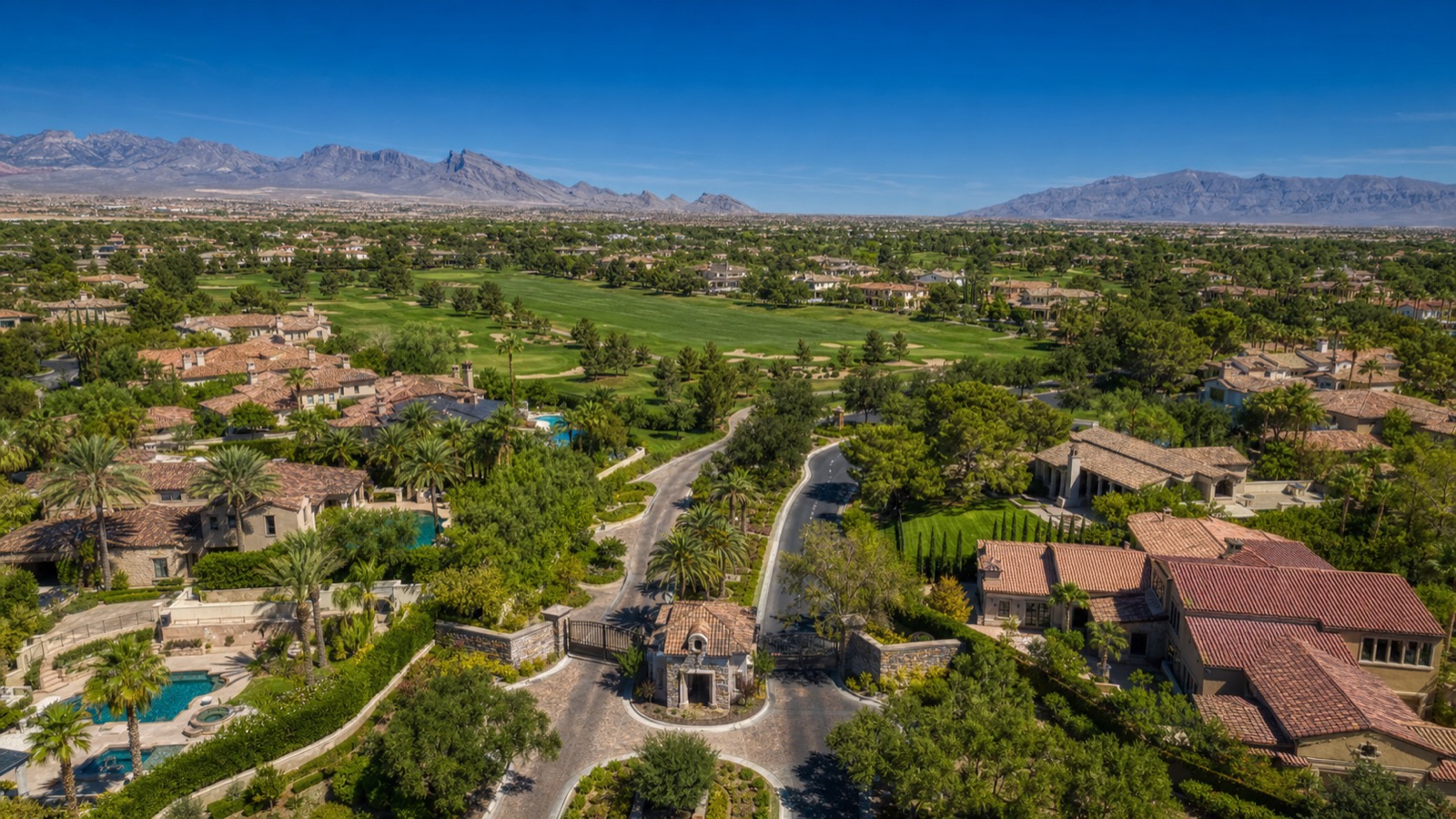
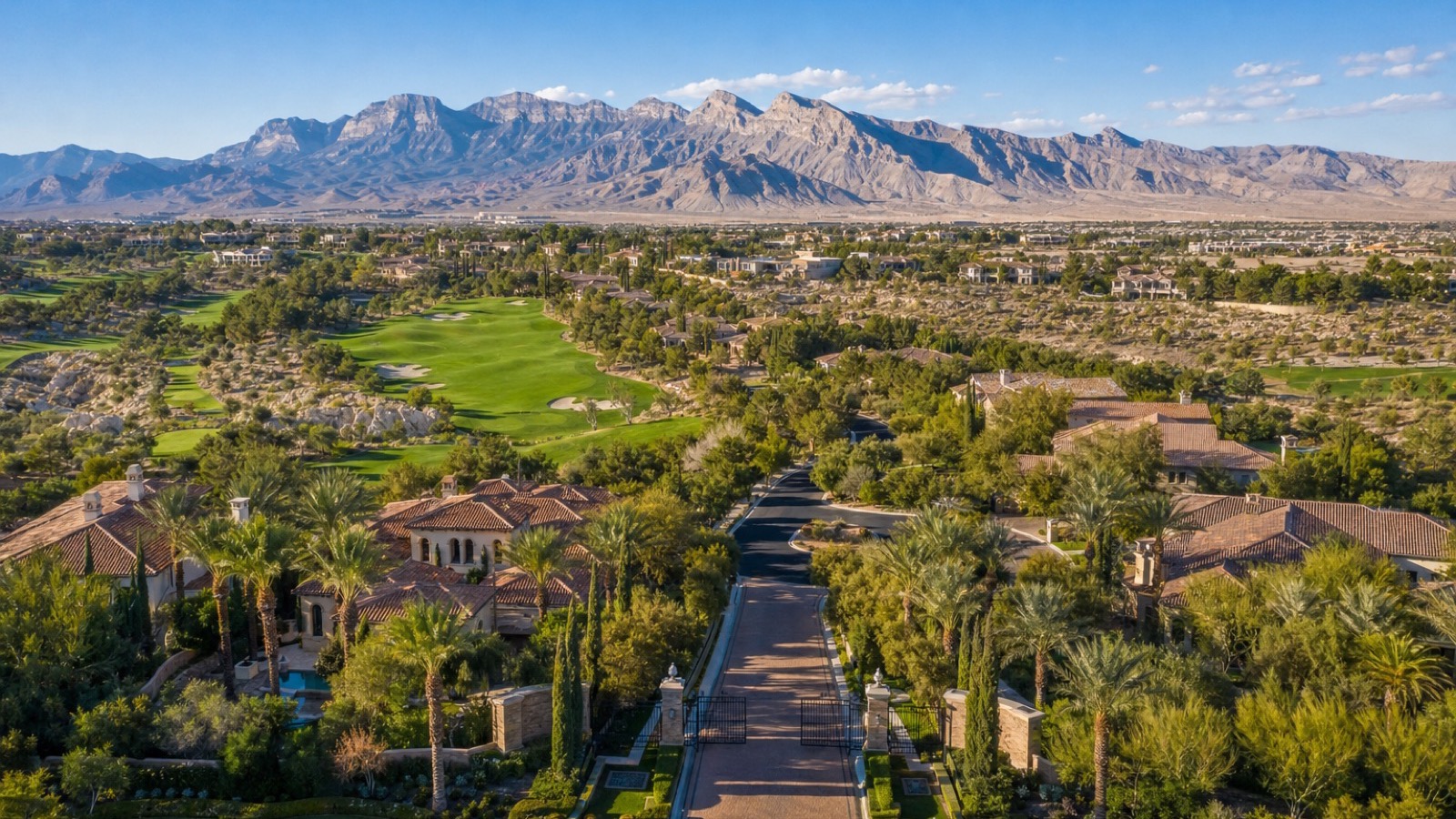
The community sits in Summerlin's Village 18, a collection of guard-gated custom and semi-custom parcels wrapped around the former Bear's Best golf course, with the Spring Mountains directly behind and the Strip laid out below. Its 36 closings over the period ran from $1,750,000 to $16,000,000, and it took a median 67 days to sell — the longest of any community in the top five. What makes the price per square foot hold up is that the housing stock is genuinely custom at the top end — architect-designed contemporary homes on view lots, not production floor plans with upgraded finishes.
The sub-parcels inside it carry their own reputations and their own pricing, which is why the recorded subdivision names in the data read as things like Village 18 Ridges Parcel J K Windsong and Village 18 Ridges Parcel M N O. A buyer shopping The Ridges is really shopping five or six distinct parcels that share a gate and a name, and the spread between them is wide. Our Ridges community page and the Fairway Hills enclave page break that down further.
One community does outrank it on a longer view, and it deserves naming rather than hiding. Tournament Hills, the gated enclave beside TPC Las Vegas, posted a $3,850,000 median across nine sales over a 24-month window — higher than The Ridges. It had too few closings inside the twelve-month window to rank here, which is why it sits in the text rather than the table, but a buyer shopping at this level should know it exists. Our Tournament Hills page covers it.
What Makes The Summit Club the City's Ceiling?
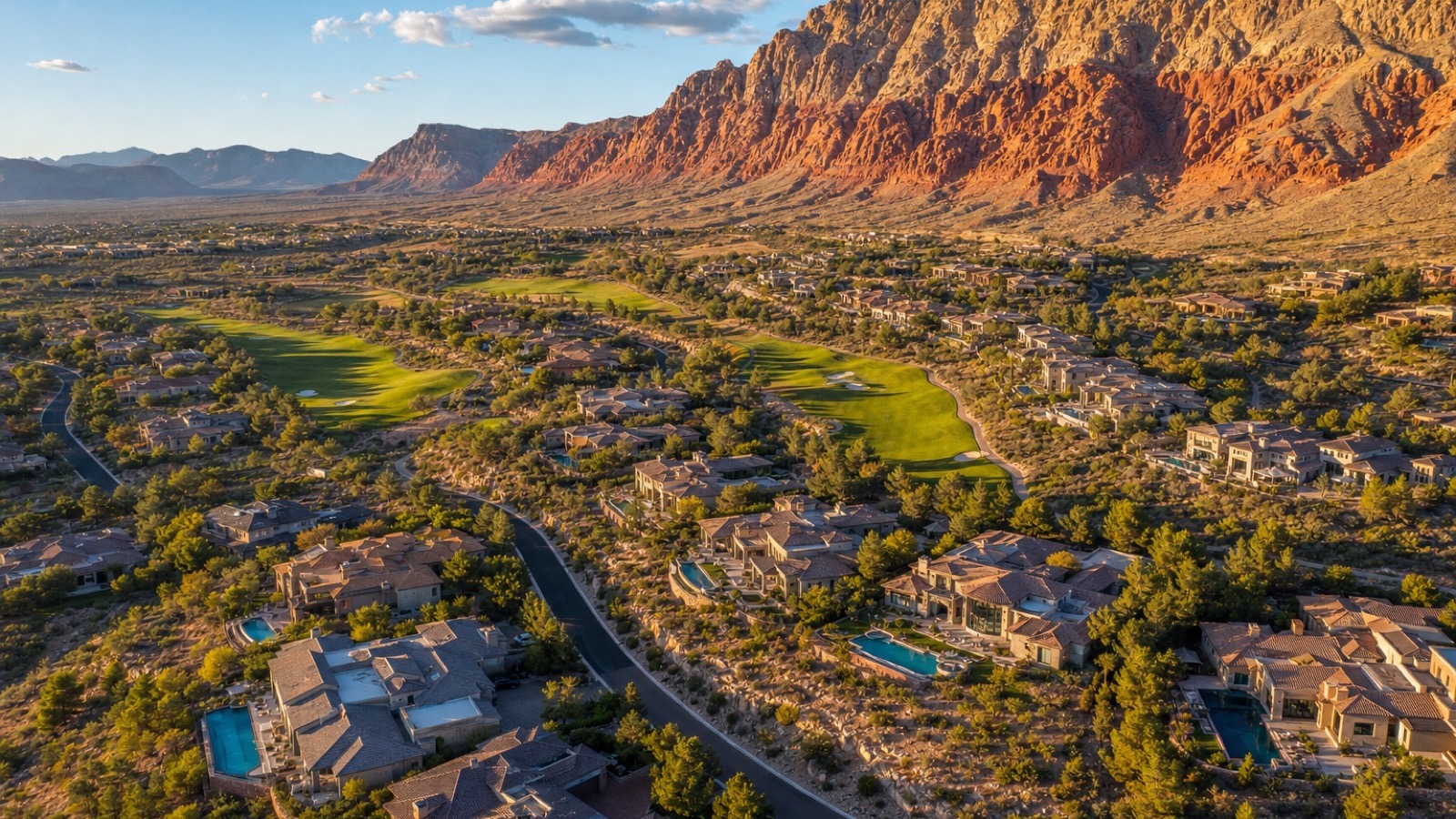
The Summit Club is where the biggest cheques get written, even though its median sits second. Over the twelve months it recorded 45 closings from $1,495,000 to $25,000,000 — and that $25 million sale was the largest single residential transaction in the City of Las Vegas during the period. Widen the window to 24 months and the same community holds the top four sales in the city, including one at $29,250,000.
The gap between its median and its maximum is the whole story of this community. A $2,375,000 median alongside a $25 million ceiling describes a place where the entry product and the trophy product are separated by an order of magnitude. That is a function of how the community is built. According to the Howard Hughes Corporation's announcement of the venture, The Summit was developed jointly with Discovery Land Company across roughly 555 acres around a private Tom Fazio-designed course. Membership in the club is a separate proposition from owning the dirt, and custom homesites at the top of the hill carry prices that have nothing to do with the more modest homes lower down.
At 45 closings it is the second-deepest sample in the top five, which makes its $598 per square foot figure reliable even though it sits below The Ridges' $797. The reason for that gap is instructive: The Summit's median home is smaller at 3,960 square feet, and its transaction mix over the period included far more of the club's mid-tier product than its headline estates. It also sold faster, a median 35 days against 67 in The Ridges.
For buyers, the practical difference between the top two is access rather than price. The Ridges is a guard-gated neighborhood you can buy into on the open market. The Summit Club is a private club community where the social membership and the real estate are entwined, and where a meaningful share of transactions never reach public marketing at all. Our Summit Club page covers the structure. If you want the full picture of how the valley's gated communities compare on access and amenity, the guard-gated communities hub is the place to start.
How Do Country Club Hills and Red Rock Country Club Compare?
These are the two golf-anchored communities in the top five, and they behave very differently despite similar medians.
Country Club Hills, in the 89134 corridor of older Summerlin around the TPC course, posted a $2,160,000 median on eleven sales ranging from $1,300,000 to $3,400,000, and it moved fastest of anything on this list at a median five days. Its defining number is size: a 4,649 square foot median, the largest of any community in the top five, at a comparatively modest $451 per square foot. That combination — big houses, lower per-foot pricing — is the signature of an established neighborhood where the homes were built generously in an earlier era and the land has appreciated more than the finishes have.
Red Rock Country Club is the opposite profile. A $2,010,000 median on a 3,489 square foot home works out to $553 a square foot, well above what Country Club Hills commands, and it did that across 65 closings — by far the deepest sample of any community in the top five. Its range ran from $1,100,000 to $5,950,000.
That 65-sale sample is worth pausing on, because it makes Red Rock Country Club the most statistically solid entry in this entire ranking. If you want a defensible answer to "what does a luxury Las Vegas home actually cost," this community gives it with the least uncertainty: about $2 million, around $550 a foot, with real liquidity. It is also the toughest negotiation on the list — the median sale closed at 94.7 percent of asking, the lowest ratio in the top five.
The two communities also illustrate a choice buyers face constantly at this level. Country Club Hills buys square footage and mature landscaping in a neighborhood that was prestigious twenty years ago and remains so. Red Rock Country Club buys newer construction, guard gates and a higher per-foot basis. According to Red Rock Country Club, the community is built around two Arnold Palmer-designed championship courses, the private Mountain course and the Arroyo course, which is the only such pairing in Las Vegas. Neither is obviously the better purchase; they suit different people, and the medians landing within $150,000 of each other tells you the market prices them as genuine substitutes.
Why Is Reverence the Newest Entry on the List?
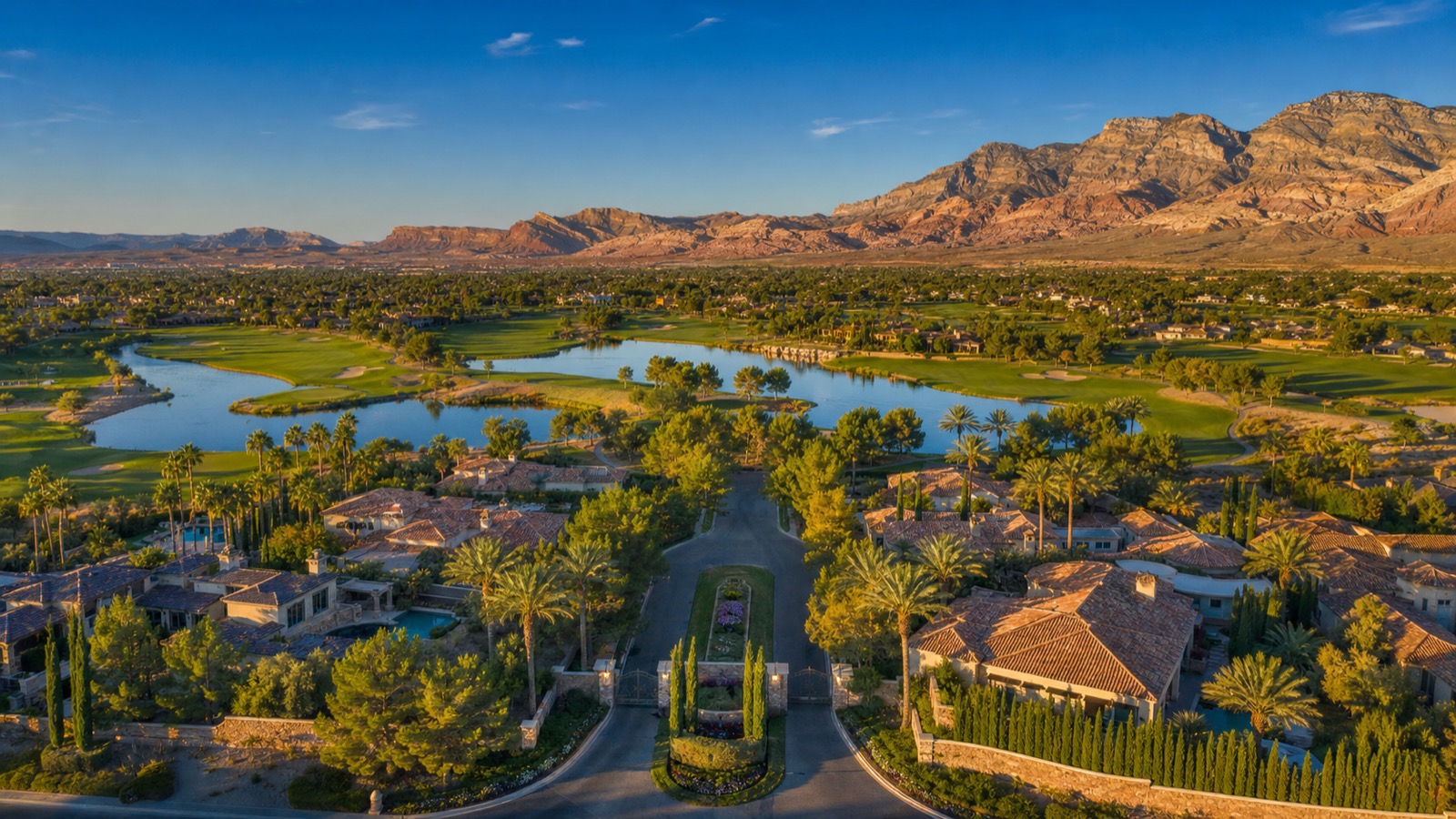
Because it is the newest community on the list, full stop. Reverence occupies Summerlin's Village 26 at the far northwest edge of the master plan, developed by Pulte, and it was still delivering homes through the measurement period. Its 37 closings ran from $710,000 to $3,200,000 at a $1,600,000 median and $513 a square foot.
Look at that range and you can see the community's structure directly. A spread from $710,000 to $3.2 million inside one village means Reverence contains several distinct product tiers, from smaller detached homes up to large custom-adjacent estates on the elevated parcels. It is also the strongest seller's market on this list: the median sale closed at 98 percent of asking and 13 of its 37 sales reached or beat list, both the best figures in the top five.
Reverence earns its place on this list on a mechanism the four older communities do not share: new-construction pricing. When a builder is actively releasing phases, the closings you see include brand-new homes selling at current list prices with current options, and those set a floor that resale-only communities do not have. That tends to hold a village's median up while it is selling, and the honest caveat is that nobody yet knows how Reverence resales will price once the builder finishes and the community trades purely on the secondary market.
Its 2,852 square foot median is also the smallest in the top five by a wide margin — roughly 1,800 square feet less than Country Club Hills. Reverence buyers are paying luxury prices for notably less house, and what they are buying instead is elevation, views across the valley, and the newest construction in the master plan. Whether that trade holds its value is the single most interesting open question in Summerlin right now, and I would want a buyer to go in with eyes open about it. The new construction hub tracks what builders are currently releasing across the valley.
Where Is the Expensive Real Estate Outside Summerlin?
This is the part the top-five table cannot show you, and it is where a lot of the valley's most interesting high-end property actually sits.
Summerlin dominates on medians because its luxury communities are homogeneous — nearly every home in The Ridges is expensive, so the median is high. Elsewhere in Las Vegas, the pattern is different: large master plans contain a small gated enclave of genuinely expensive homes surrounded by a much larger body of ordinary ones. The enclave never shows up in a median ranking, because the median is dragged down by everything around it.
Southern Highlands is the clearest case. Across a 24-month window it recorded 611 sales at a $610,000 median — nowhere near this list. Yet within it, the gated Estates parcels produced the two largest non-Summerlin sales in the city at $15,500,000 and $12,000,000, plus further sales at $8.55M, $8.30M, $7.25M and $7.00M. A community whose median is $610,000 containing a $15.5 million sale tells you everything about how that master plan is structured.
| Sale price | Community | ZIP |
|---|---|---|
| $15,500,000 | The Estates, Southern Highlands | 89141 |
| $14,320,000 | Peccole West, near Queensridge | 89145 |
| $12,000,000 | Estates at Southern Highlands | 89141 |
| $8,550,000 | Southern Highlands, Parcel 315 | 89141 |
| $8,300,000 | Southern Highlands | 89141 |
| $7,250,000 | Estates at Southern Highlands | 89141 |
| $6,600,000 | Estates at Southern Highlands | 89141 |
| $6,550,000 | Peccole West, Parcel 20 | 89145 |
Several other names deserve mention. Tournament Hills posted a $3,850,000 median across nine sales over 24 months, the highest median of any community in the valley on that window. Eagle Hills ran $2,800,000 across seven, and Willow Creek $2,499,950 across thirteen. Canyon Gate Country Club posted a $1,695,000 median across thirteen sales with a $4,350,000 ceiling. Spanish Trail in the 89113 corridor — the valley's original guard-gated country club community, developed in the 1980s — ran a $705,000 median across 144 sales but topped out at $5,500,000 in its Estates section.
The pattern across all of them is the same: small, old, gated and thin. None recorded enough twelve-month closings to rank in the main table, which is precisely why a ranking built on medians alone would leave a buyer at this level under-informed. The Queensridge area is the sharpest example — its ordinary housing stock runs a $466,500 median, while the adjacent Peccole West parcels produced sales at $14.32 million and $6.55 million.
How Much of the Las Vegas Market Is Actually Luxury?
Less than people assume, which is worth knowing before you calibrate expectations.
Across the twelve months measured, the City of Las Vegas recorded 13,752 single-family closings at a $485,000 median, of which 1,260 sold at $1 million or more — about 9 percent of the market. Nine in ten homes sold in this city changed hands below a million dollars, and only 323 cleared $2 million. The ultra-luxury tier is thinner still: across two full years the city produced roughly a dozen sales above $7 million.
That scarcity cuts two ways for a buyer. On the supply side, it means genuine competition for the best product. When Country Club Hills records eleven sales in a year, a buyer with specific requirements — a particular parcel, a view corridor, a single-story plan — may wait months for something suitable, and will be bidding against people who have also been waiting.
On the pricing side, it means the luxury market moves on different signals from the market underneath it. Mortgage rates matter far less when a large share of transactions are cash or heavily down-paid. What matters more is the flow of equity arriving from California and the Pacific Northwest. According to the Tax Foundation, Nevada levies no individual income tax while California's top marginal rate reaches 13.30 percent, which is the specific reason a great many of these buyers are looking here rather than in Orange County.
The practical implication: comparing the luxury tier to valley-wide statistics will mislead you in both directions. According to Las Vegas REALTORS, the metro-wide statistics quoted in the news each month cover the whole market — meaning metro median price, metro days on market and metro inventory are all describing the 91 percent of the market that is not this. If you are shopping above $2 million, the relevant comparison set is the 323 homes in that band, not the thirteen thousand below it. Our luxury communities hub organises the valley by that band rather than by geography.
What Does Price Per Square Foot Reveal That Median Price Hides?
It separates expensive neighborhoods from neighborhoods with big houses, and the two are genuinely different things.
Rank the top five by price per square foot rather than median and the order shifts. The Ridges stays first at $797 and The Summit Club holds second at $598. But Red Rock Country Club takes third at $553, Reverence fourth at $513 — and Country Club Hills drops to last at $451, despite having the third-highest median on the list.
| Dimension | The Ridges | The Summit Club | Country Club Hills | Red Rock CC | Reverence |
|---|---|---|---|---|---|
| Median sale price | $3,462,500 | $2,375,000 | $2,160,000 | $2,010,000 | $1,600,000 |
| Price per square foot | $797 | $598 | $451 | $553 | $513 |
| Median home size | 4,618 sq ft | 3,960 sq ft | 4,649 sq ft | 3,489 sq ft | 2,852 sq ft |
| Sales in the period | 36 | 45 | 11 | 65 | 37 |
| Highest sale | $16.0M | $25.0M | $3.40M | $5.95M | $3.20M |
| Median days on market | 67 | 35 | 5 | 34 | 36 |
| Median sale to list | 95.6% | 95.6% | 97.7% | 94.7% | 98.0% |
| Character | Guard-gated custom | Private club | Established golf | Guard-gated golf | New construction |
Country Club Hills is the instructive case. Its $2,160,000 median makes it look like one of the most expensive places in the city, and in absolute dollars it is. But at $451 a foot it is the cheapest housing in the top five by a wide margin — you are buying a very large home at a moderate per-foot price, not a small expensive one. It also sold in a median five days, the fastest on the list, which says the market recognises that value even if buyers browsing by price do not.
The inverse is Reverence at $513 a foot on a 2,852 square foot median. The homes are over 600 square feet smaller than Red Rock Country Club's, which is why its median lands $410,000 lower despite a comparable rate. You are paying a premium rate for less house, and buying elevation and views instead.
Which measure you should weight depends on what you are buying for. If the house is your home and you want room, median price and square footage matter most. If you are thinking about resale or about holding a scarce asset, price per square foot and sample depth are the better guides, because they tell you how the market values the land and the address rather than the building.
Which of the Five Fits Which Buyer?
After enough transactions at this level the sorting becomes fairly predictable, and it turns on four things: how much house you want, whether you want to build or buy finished, whether a club matters to you, and how much you care about being able to sell quickly.
If you want the most recognised address in Nevada and the architecture to match, it is The Ridges, and the price of entry is real — the lowest closing over the period was $1,750,000 and the median ran $3,462,500. What you get for the highest per-foot rate in the city is genuinely custom contemporary building on view lots, inside the gate that carries the most weight when you eventually sell. Expect to wait: a median 67 days on market is the slowest in the top five.
If the club is the point — the golf, the private social membership, the level of service Discovery Land builds its communities around — it is The Summit Club, and you should be prepared for a purchase that involves more than a house. Its $1,495,000 entry is lower than The Ridges, but the membership sits alongside it and a meaningful share of the best inventory moves privately.
If you want the most square footage for the money, Country Club Hills is the clear answer and it is not close. A 4,649 square foot median at $451 a foot is the best space-per-dollar on this list, in an established neighborhood where the trees are mature and the lots are generous.
If you want liquidity — the ability to buy now and sell in five years without discovering there is no market — Red Rock Country Club is the safest entry on this list. Sixty-five closings in twelve months is real depth, and depth is what protects you on the way out. It is also where a buyer has the most negotiating room, with the median sale closing at 94.7 percent of asking.
And if you want brand-new construction with valley views and are comfortable being early, Reverence offers the lowest entry of the five at $710,000 — but it is the tightest market on the list, closing at 98 percent of asking with 13 of 37 sales at or above list, so do not expect much movement on price.
What Should You Know Before Buying at This Level?
Five things that come up in nearly every transaction I handle above a million dollars, and that are different from the rest of the market.
Inventory is thin and much of it is quiet. In communities recording seven to twenty sales a year, a meaningful share of the best property is sold privately or with limited marketing. If you are shopping The Ridges or The Summit Club strictly off public listings, you are seeing part of the market. The working relationship matters more here than at any other price point.
The club and the house are separate purchases. At The Summit Club, Red Rock Country Club, Canyon Gate and Spanish Trail, golf or club membership carries its own initiation, its own dues and, in some cases, its own approval process. Price the membership before you fall in love with the house, and confirm whether it transfers with the sale or must be applied for.
Verify the parcel, not just the address. According to the Clark County Assessor, parcel records, lot dimensions and ownership history are public and searchable, and in communities where sub-parcels price very differently the parcel record is what tells you which one you are actually buying.
Read the HOA documents as carefully as the inspection. Guard-gated communities carry meaningful monthly assessments, architectural review committees that govern what you may change, and in the custom parcels, design guidelines that can constrain a renovation substantially. According to NRS 116.4109, the seller must deliver the resale package — declaration, bylaws, rules, current budget and reserve-study summary — and you may cancel within five calendar days of receiving it. Use that window rather than waiving it.
Appraisal behaves differently up here. With few comparable sales, appraisers reach further in time and distance, and at the top of a community's range there may be no true comparable at all. On new-construction purchases and on any home substantially above its neighborhood's median, plan for the appraisal to be a live issue rather than a formality.
Know which measure you are negotiating on. Sellers at this level quote price per square foot when it flatters them and absolute price when that does. The table above gives you both for the top five, which is usually enough to see which frame you are being handed.
If you want the current picture for a specific community — what is actually available, what closed in the last ninety days, and what is quietly for sale — call Nevada Real Estate Group at (702) 637-1759 and we will pull it for the neighborhoods on your shortlist.
Frequently Asked Questions
What is the most expensive neighborhood in Las Vegas?
The Ridges, measured by what homes actually sold for. Across the twelve months from September 1, 2025 to August 31, 2026, its 36 closings produced a $3,462,500 median at $797 per square foot on a median home of 4,618 square feet, with sales ranging from $1,750,000 to $16,000,000. It leads on both median price and price per square foot, making it the most expensive Las Vegas neighborhood on either measure. It sits in Summerlin's Village 18, guard-gated, against the Spring Mountains.
Are all the most expensive Las Vegas neighborhoods in Summerlin?
On a median basis, yes. All five of the top-ranked communities — The Ridges, The Summit Club, Country Club Hills, Red Rock Country Club and Reverence — sit inside the Summerlin master plan. No neighborhood outside Summerlin recorded enough million-dollar closings over the period to break in. That said, individual expensive homes are spread more widely: the largest non-Summerlin sales in the city over two years reached $15,500,000 and $12,000,000 in gated Southern Highlands enclaves, and $14,320,000 in Peccole West near Queensridge. Tournament Hills also out-medianed The Ridges on a 24-month view at $3,850,000, on too few sales to rank.
What was the most expensive home sold in Las Vegas this year?
A $25,000,000 sale in The Summit Club, recorded in Summerlin Village 17, was the largest across the twelve months measured. Widen to 24 months and The Summit Club holds the top four sales in the city, topping out at $29,250,000. The Ridges reached $16,000,000. Outside Summerlin, the ceiling was $15,500,000 in the gated Estates at Southern Highlands, followed by $14,320,000 in Peccole West.
How much do you need to spend to buy in the top Las Vegas neighborhoods?
Entry points vary more than the medians suggest. The lowest closing recorded in each of the top five over the period was $1,750,000 in The Ridges, $1,495,000 in The Summit Club, $1,300,000 in Country Club Hills, $1,100,000 in Red Rock Country Club and $710,000 in Reverence. So Reverence and Red Rock Country Club offer genuine entry points near or just above a million, while The Ridges effectively starts around $1.75 million. Budget separately for club membership where it applies.
Is Southern Highlands a luxury neighborhood?
Partly, and the distinction matters. Southern Highlands as a whole recorded 611 sales at a $610,000 median across 24 months, which is a mainstream price. But it contains gated sub-enclaves — the Estates and specific numbered parcels — that produced the two largest non-Summerlin sales in the city at $15,500,000 and $12,000,000, plus four more above $6.5 million. It is a large master plan with a genuine luxury tier inside it rather than a uniformly expensive community, so the parcel you buy in matters more than the master plan name.
What percentage of Las Vegas homes sell for over $1 million?
About 9 percent. Of the 13,752 single-family homes that closed in the City of Las Vegas between September 1, 2025 and August 31, 2026, 1,260 sold at $1 million or more and 323 above $2 million, against a citywide median of $485,000. Nine of every ten homes traded below a million. The tier above $5 million is far thinner still, producing roughly a dozen sales across a two-year window, which is why buyers at that level frequently wait months for suitable inventory.
Which is better value, Country Club Hills or The Ridges?
They are different purchases rather than better and worse. Country Club Hills delivers the largest median home on the list at 4,649 square feet for $451 per square foot — the lowest rate in the top five — in an established Summerlin golf neighborhood, and it sold in a median five days. The Ridges costs $797 per square foot, roughly 77 percent more, for a similarly sized median home, and what you buy with that premium is newer custom architecture, view lots and the valley's most recognised luxury address. For space per dollar, Country Club Hills wins clearly.
Do the most expensive Las Vegas neighborhoods hold their value?
The measured evidence here covers pricing at a point in time rather than appreciation, so I will not claim a trend I have not tested. What the data does show is that the deepest, most liquid luxury market is Red Rock Country Club, with 65 closings in twelve months, which matters for resale because liquidity is what lets you exit at a predictable price. The thinnest is Country Club Hills at eleven sales, and the slowest to sell is The Ridges at a median 67 days. The open question is Reverence, where new-construction pricing currently supports the median and nobody yet knows how resales will price once the builder finishes.
Which Sources Inform This Las Vegas Neighborhood Ranking?
Every price, count and ratio above was measured directly from the GLVAR-fed listing data for the City of Las Vegas. The main ranking covers all closed single-family sales between September 1, 2025 and August 31, 2026 — 13,752 transactions at a $485,000 median, of which 1,260 closed at $1,000,000 or more and 323 above $2,000,000. Sales were pulled month by month and deduplicated, because a single twelve-month query is truncated by a server-side result cap that understates every count. Homes were grouped by their recorded subdivision and rolled up into communities, with each rollup verified against the underlying subdivision strings and constrained by ZIP so that similarly named subdivisions elsewhere in the valley could not contaminate a community's figures. Only communities with at least four twelve-month closings were ranked. Tournament Hills, Eagle Hills and Willow Creek are named in the text but excluded from the table because they fell below that floor, despite Tournament Hills posting the highest 24-month median in the valley at $3,850,000 across nine sales. The non-Summerlin section uses a wider 24-month window, September 2024 to August 2026 — 38,793 closings — because those enclaves are too thin to measure over twelve.
Median price per square foot is calculated per transaction and then taken as the median of those values, rather than dividing one median by another, which avoids the distortion that arises when a community's largest homes are also its most expensive. Live inventory changes daily; the Las Vegas, Summerlin and luxury communities pages carry current listings.
Community background is drawn from the developers and associations themselves: the Howard Hughes Corporation for the Summerlin master plan and its villages, Discovery Land Company for The Summit Club, and the respective club and homeowner associations for Red Rock Country Club, Canyon Gate and Spanish Trail. Statutory points on resale packages and the buyer's cancellation right come from NRS 116.4109. Market context from Las Vegas REALTORS.
For deeper reading, see our companion ranking of the most expensive Summerlin villages, which takes the village-level detail this citywide guide can only summarise, and our look at the wealthiest Las Vegas neighborhoods, which approaches the same communities through household income and ZIP-code wealth rather than transaction prices.